


Plums vs Prunes: Which Fruit Form Fits a Frozen Ingredient Specification?
Sep 27, 2026
Leave a message

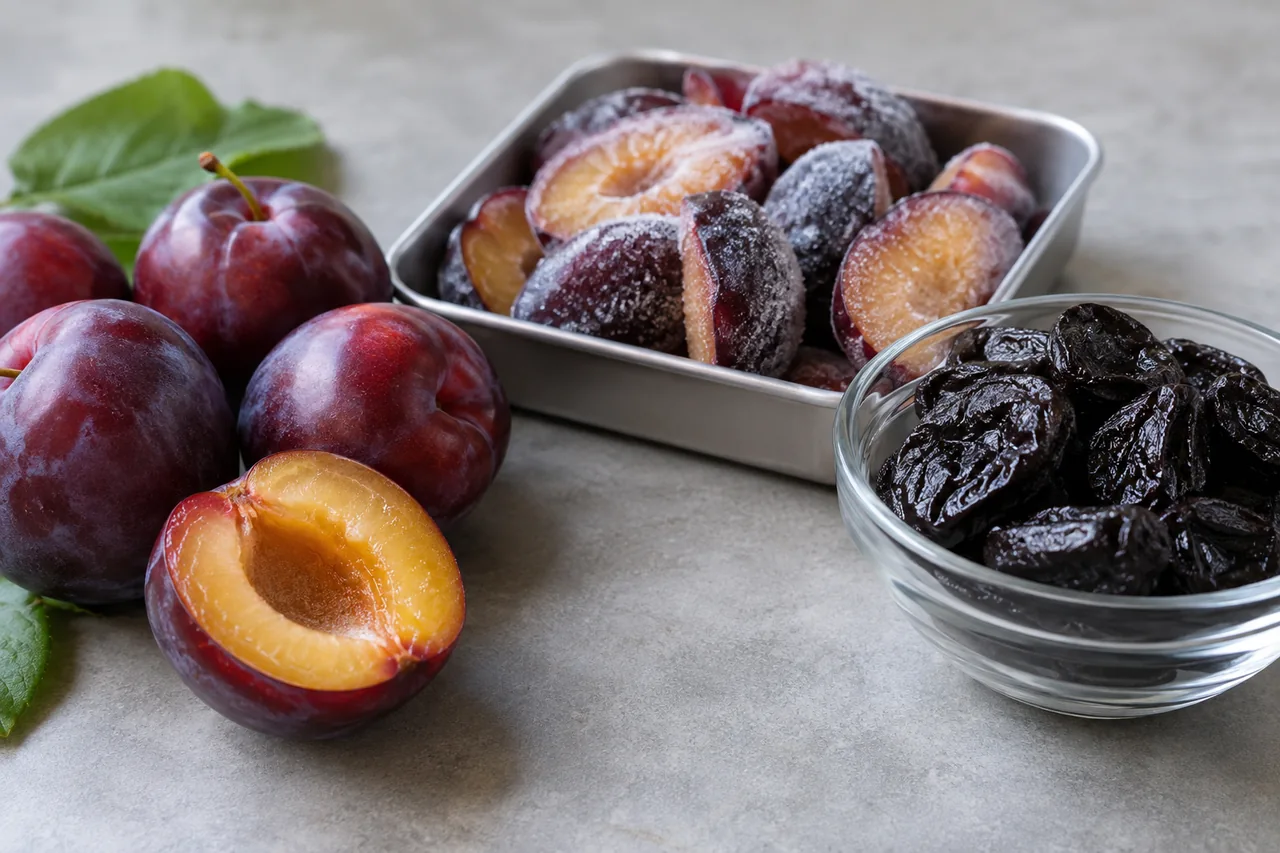
Name the fruit form before discussing a prune
The common short answer is that prunes are dried plums, but it leaves a purchasing trap. In horticultural writing, "prune plum" also describes a fresh plum variety suitable for drying. UC Agriculture and Natural Resources distinguishes those uses of the word. A purchase order containing only "prune" may be interpreted as dried fruit by one seller and as a particular fresh cultivar by another. Neither party can resolve the mismatch with a picture of a purple fruit alone.
Start the request for quotation with the state of the fruit: fresh, IQF frozen or dried. Add the botanical or cultivar requirement if it genuinely affects the recipe. For a frozen line, specify whole, halves, slices or dice; whether the fruit is pitted; the target size range; and the intended pack. For dried fruit, name whole or cut form, pit status, moisture or water activity acceptance if relevant, and any rehydration step. If the cultivar is unknown and the application only needs a color, acidity and cooked texture range, describe those functional targets rather than importing a cultivar name from a consumer recipe.

Fresh plums and a cut plum from the GreenLand plum product gallery.
The handling path follows from the form. IQF fruit needs a frozen distribution and storage plan, controlled thaw or direct frozen use, and an agreed tolerance for clumps and broken pieces. Dried prunes need a separate moisture, texture and shelf-life control plan. Fresh plums need rapid intake decisions, ripeness control and a short production schedule. A single quotation column headed "price per kilogram" conceals these differences. It compares a kilogram of water-rich fruit with a kilogram of dried solids as if their roles were identical.
Ask the development team to write one sentence defining the ingredient's job. Is it an identifiable half on a tart, a purple fruit note in a smoothie, a binder in a fruit bar, or a dark concentrate in sauce? This function is more stable than a casual ingredient name. It also tells the supplier what sample to send. A buyer seeking visible halves should not approve a puree simply because both started as plums.
At GreenLand-food, we would confirm the frozen form against the intended application before fixing a cut specification. Our IQF plum product page shows the type of frozen ingredient to discuss. It does not turn a dried-prune recipe into a frozen-plum recipe automatically. The formulation team still has to test the outcome and the procurement team still has to approve the actual supplied grade.
Separate a prune-type cultivar from the drying process
Some plum cultivars have the composition and structure that make them useful for drying. That explains the name "prune plum," but cultivation and processing are separate facts. A fresh prune-type plum retains its fresh-fruit water and texture. Drying removes water and concentrates the remaining fruit components. Freezing preserves a different piece structure and needs low-temperature handling. Asking whether "plum and prune are the same" misses this sequence.
Oregon State University Extension treats freezing and drying as distinct preservation routes, and Utah State University Extension describes prune-type plums among the broader plum family. These sources support the terminology; they do not certify the functional performance of a particular commercial lot. A buyer needs the supplier's sample and product specification for that.
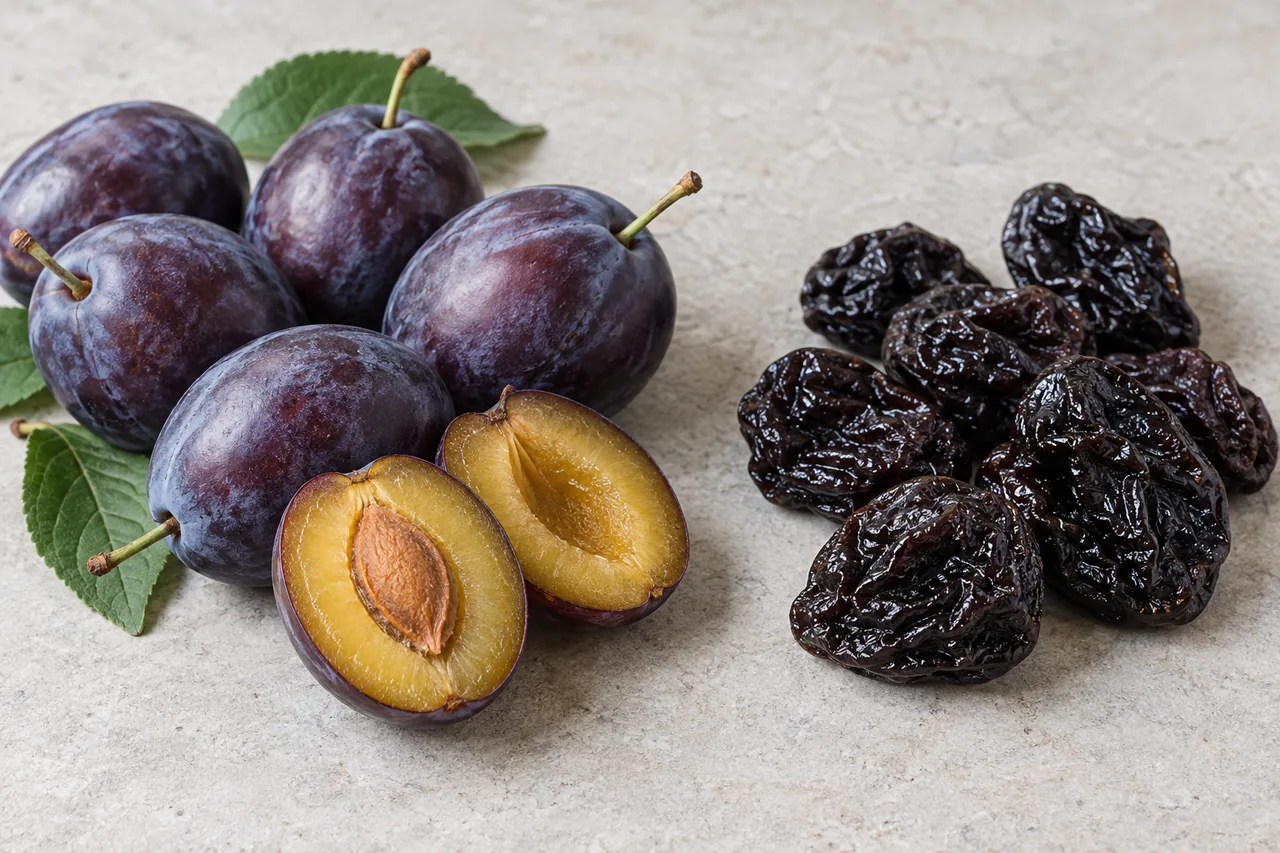
Fresh oval prune-type plums beside dried prunes.
Color is an unreliable shortcut. A dark purple frozen plum is not necessarily a prune cultivar, and a dried prune's dark appearance is affected by both the starting fruit and the drying process. If cultivar is critical to an established product, request cultivar identification and traceability documents. If the desired property is sweetness, acidity, skin color or firmness after heat, set an application test with acceptance boundaries. That approach gives both parties a measurable target even when seasonal fruit origin changes.
The same distinction matters for claims on finished food. Calling an ingredient a "prune" when the formulation uses only frozen fresh plum can misstate what consumers will receive. Labeling requirements depend on the market and finished product, so the brand's regulatory team should confirm the accepted ingredient name. Procurement can help by obtaining a precise supplier description: species or cultivar where known, processed form, pit treatment, and any added ingredients. Avoid using a vendor's marketing term as the only source of product identity.
Consider a developer replacing dried prunes with IQF halves in a breakfast bake. The fruit mass cannot be copied unchanged. The frozen halves bring more water and different particle size; they can leak juice and change bake time, while prunes may absorb water from the batter. Conversely, replacing frozen halves with dried prunes may make a visible fruit piece disappear into a darker, denser bite. Those outcomes need a pilot trial, not a rule of thumb based on the word "plum."
Specify IQF plum form, pit status and fruit quality
Specify the state of the fruit at the moment it enters the buyer's equipment. A line may feed halves while frozen, temper them briefly, or thaw them fully before mixing. These routes expose different defects and require different dosing controls. In a bakery trial, test whether the frozen piece displaces batter, whether released liquid pools under the fruit, and whether pieces remain visible after baking. In a dairy or beverage trial, monitor seeds or skin fragments, blending time, color change and the acidity effect on the base. The same IQF grade can be suitable for one route and poor for another.
If the buyer wants a fruit claim or a specific fruit percentage on a finished label, align the mass calculation with the market's labeling rules and the formulation record. Do not silently count thaw drip as lost fruit in one trial and as retained fruit in another. Keep a worksheet showing incoming frozen mass, separated liquid and finished mass. The method may be simple, but consistency is essential for comparing suppliers or seasonal lots.
An IQF plum specification starts with the pieces a line will actually handle. Whole fruit, pitted halves and diced fruit have different mechanical and visual behavior. Halves show the cut face and pit cavity; dice may distribute more evenly but can create smaller fragments. A processor using an automated depositor needs to know the largest likely piece and whether fruit blocks remain free flowing at feed temperature. A bakery topping buyer may value a clean half more than the same fruit as loose fragments.

Actual GreenLand IQF plum halves with frosty cut surfaces.
Put pit status in the contract rather than relying on a photograph. "Pitted" also needs an agreed inspection method and defect limit, because an occasional pit or fragment is a food safety and consumer complaint concern. Identify who checks it at receiving, after thaw if relevant, and before the fruit enters a finished product. Ask for a representative sample from the proposed production specification, not a specially chosen display tray. Check the sample in the normal state in which the line will use it.
The USDA frozen plum standards offer terminology for identity and quality attributes. A commercial buyer should still write the dimensions, defect limits and sampling rule the supplier and plant can execute. A US grade reference does not by itself define a GreenLand-food supply agreement. Confirm fruit maturity, characteristic color, freedom from foreign material, damaged pieces and acceptable frost or ice. Name the pack weight and whether inspection will be on a frozen, partially thawed or fully thawed sample; these states show different defects.
Look at what happens after a controlled thaw. A frozen plum half may look firm while frozen but release juice once thawed. Measure drained weight or fruit retention when that outcome matters. In a smoothie, juice release may be useful; in a pastry topping, excess free liquid may flood the pastry. A specification that only describes the unopened frozen bag cannot predict both applications. Record time, temperature and drainage method so two sample runs are comparable.
GreenLand-food's frozen plum range gives a starting point for available forms. Buyers should verify current cut, size, packaging, origin and documentation for their shipment rather than treating a site illustration as a batch certificate. The practical approval set is a written specification, a representative sample and a processing trial with retained notes. Those items make later changes in piece distribution or color easier to identify.
Specify dried prune moisture, pit status and rehydration need
Check whether the dried offer contains preservatives, added oil or other ingredients, and whether they fit the finished product's declaration and processing needs. An anti-stick treatment can be useful for a dicing line but may affect a clean-label formulation. The purchase specification should list permitted additives and require the supplier's current ingredient statement. If the dried material will be used in a product sold to several markets, the regulatory team should review each destination's requirements before the buyer approves the substitute.
The supplier's shelf-life statement should also be tied to an unopened pack and specified conditions. Once an industrial pack is opened, moisture migration, handling and contamination controls change. A small trial in a resealable kitchen container may not expose the problems seen in a production hopper. Ask the plant to test how pieces flow, whether they clump, and how rapidly they take up moisture during the planned shift. These observations belong in the form decision alongside flavor and cost.
A dried prune is a concentrated, lower-moisture ingredient, but dried products still vary. Whole pitted fruit, diced pieces, paste and rehydrated material are different purchase forms. USDA AMS dried prune grades define a separate dried-fruit grading framework. A frozen-plum grade should not be copied across to this product. The dried buyer should address size, defects, pit material, moisture condition, texture, additives if any, and the way the product will be used.
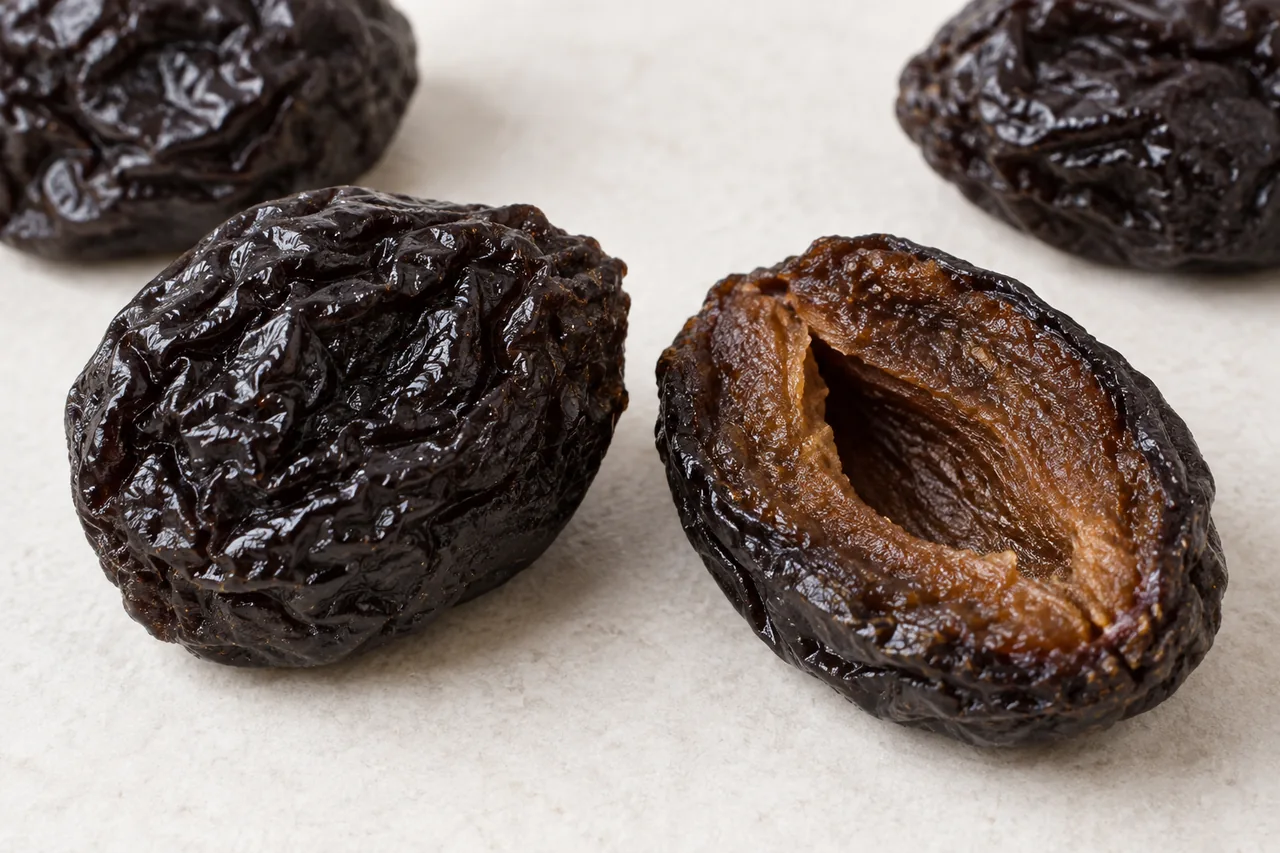
Whole and opened dried prunes showing skin, flesh and pit cavity.
For a fruit bar, a pliable prune may be valuable because it can bind the mix. For a biscuit with visible fruit bits, pieces that hold a defined shape after mixing and baking may be more important. For sauce, fruit that disperses after rehydration might be ideal. The purchase specification should name the functional outcome and the test used to judge it. "Soft" is too ambiguous without a temperature, time and sample method; a cold warehouse sample and a warm kitchen sample can feel different.
If rehydration is planned, treat added water as part of the recipe. Specify the liquid ratio, temperature, dwell time and drainage method for the trial, then weigh the usable fruit before mixing. A prune that takes up water slowly may behave differently from one that softens rapidly. The resulting water can change both cost per usable kilogram and the finished product's texture. Do not assume every dried prune has a single fixed conversion ratio to fresh or frozen fruit. Starting moisture, cut size and process all influence it.
Check pit risk independently of the "pitted" label. A pit fragment in a dried piece is especially difficult to spot once the ingredient is chopped into a dark filling. Agree the inspection and control steps appropriate to the finished food and equipment. The same logic applies to frozen pitted fruit, but the defect might be found at a different stage. An application trial should include the normal supplier pack, not only a cup of perfect pieces sent for tasting.
Storage and transport conditions should reflect the actual dried product and its pack. Ask for supplier documentation covering the specified moisture or water activity, packaging and shelf-life basis. These are supplier and lot attributes, not universal properties of "prunes." GreenLand-food's frozen plum product information addresses a different route; use a separate dried-fruit specification if a dried supplier is also in the comparison.
Test fruit behavior in the intended bakery or sauce application
The fastest way to resolve a form choice is a paired small-scale trial with the same base recipe and defined substitution method. Decide first what success looks like. A tart might require recognizable pieces, stable color, controlled juice migration and a clean slice. A sauce might require a target thickness, acidity and fruit flavor after heating. A smoothie might prioritize blending behavior and finished solids rather than piece appearance. Write those criteria before looking at the samples.
Make the substitution fair. If a formulation uses 100 kilograms of frozen plum, a 100-kilogram charge of dried prunes would bring a very different amount of fruit solids and water. Build a trial formulation for each form and document added water and sugar. Compare final batch mass and cooked loss, not merely ingredient weights at the mixer. If frozen fruit is thawed, log whether the released juice was kept in the recipe. If dried fruit is rehydrated, log how much of the rehydration liquid entered the product.
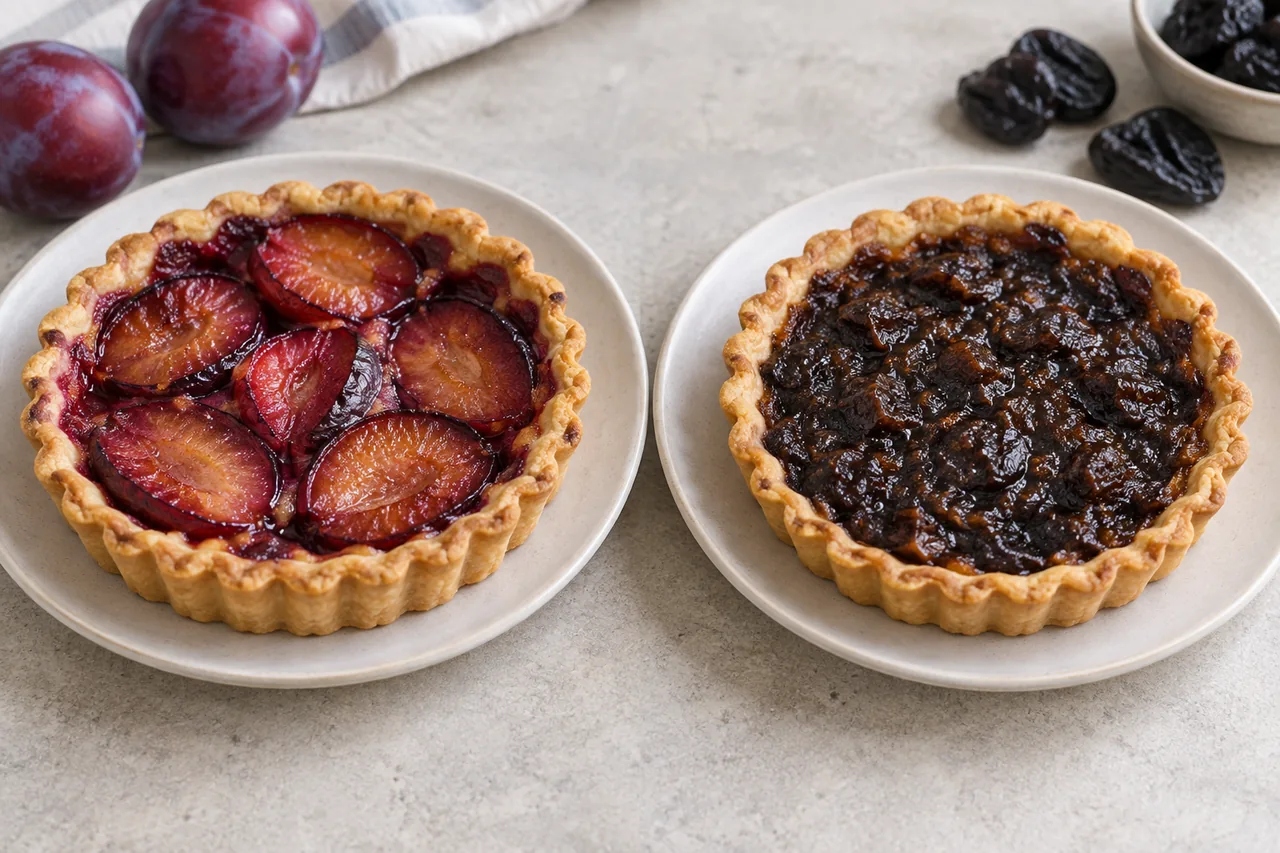
Two small tarts compare visible plum halves with a denser dried-prune filling.
Run the candidates through the real process: deposition, baking or cooking, cooling, packaging and the intended shelf-life observation. Evaluate the product at the point the customer consumes it, not only immediately after the oven or kettle. A prune filling may thicken on cooling. A frozen half may bleed pigment into a pale base or soften after a freeze-thaw cycle. A premium tart may favor visible IQF halves even if a darker prune filling performs well in flavor. The objective is fitness for the named product, not a universal winner.
Keep a simple record: sample lot, supplier, fruit form, size, pit status, incoming moisture or frozen condition, recipe adjustments, cooking time, drained or usable mass, final texture and a photograph at the same lighting. This lets procurement see why a lower quoted price per kilogram did or did not lower the finished cost. It also helps the supplier reproduce a successful lot. If two forms are intentionally blended, define each as a separate ingredient with its own acceptance criteria.
Our guide to using frozen plums offers application ideas, but a production change still needs a line trial. GreenLand-food can discuss frozen cut form and pack once the buyer has described the service environment and desired appearance. An image of a finished dessert is useful for the target appearance; it cannot replace weighed yield and repeatable sensory notes.
Compare quotations on usable ingredient and finished yield
Document the commercial terms as carefully as the fruit quality. Compare net fruit weight, carton dimensions, minimum order, lead time, delivery basis and the cost of holding inventory. A frozen offer with a higher ingredient price may reduce pre-processing labor, while a dried offer may avoid freezer space but require additional preparation. The cost sheet should show these as separate rows so the decision can be revisited when energy prices, labor capacity or the recipe changes. A single blended price hides which assumption drove the result.
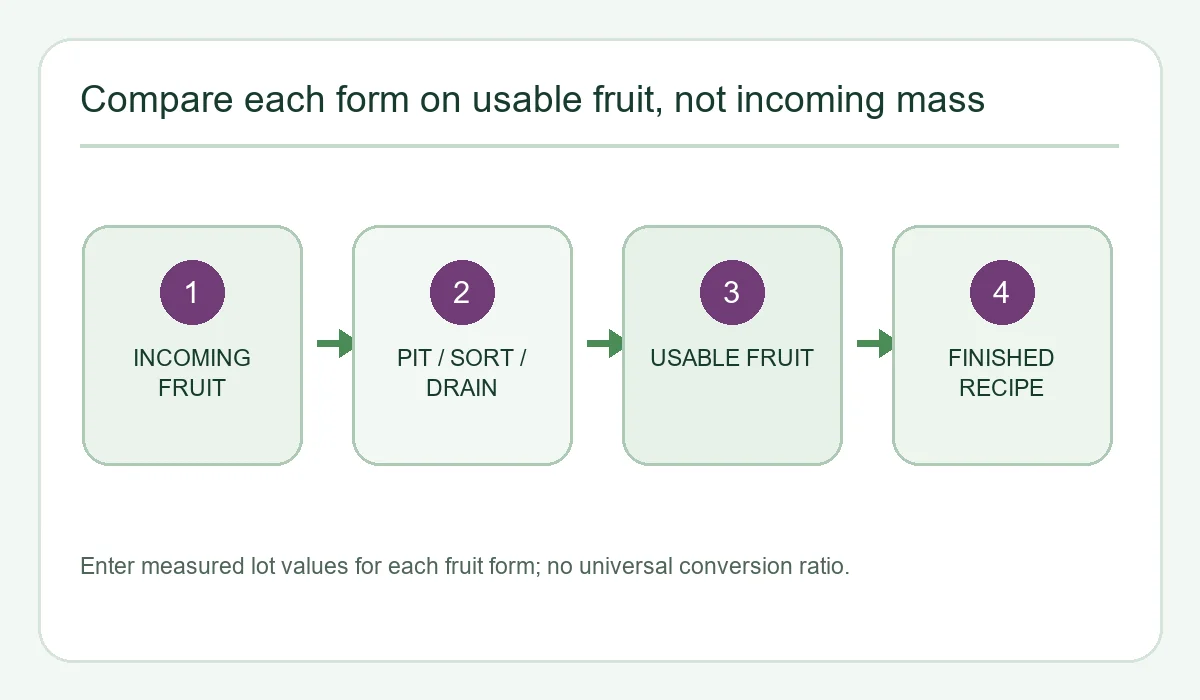
Diagram of incoming fruit, pitting and sorting, usable fruit, and finished recipe yield.
Finally, write a sample approval rule. Retain a reference pack or sample photograph, the trial recipe, results and the approved specification revision. If a later quotation proposes a different plum variety, cut, moisture range or pit-control method, decide whether the original trial still applies. The buyer can then ask for a targeted recheck rather than repeating every development step or accepting an untested substitution. That traceable decision is the practical value of naming the fruit form precisely at the start.
Price per incoming kilogram is only the first number. For IQF plums, calculate the usable mass after removing any unacceptable pieces and accounting for the drained liquid if the recipe discards it. For dried prunes, include rehydration water, pit or defect removal and processing loss. For fresh plums, include sorting, pitting and trimming before freezing or cooking. The denominator should be the ingredient mass that actually reaches the approved recipe under a defined procedure.
For example, build a worksheet with incoming kilograms, rejected kilograms, recovered fruit kilograms, added process water, final product kilograms and the sensory result for each candidate. Leave the conversion cells blank until a plant trial supplies numbers. A fabricated "one kilogram dried equals three kilograms fresh" assumption can reverse the decision because moisture and yield vary. Report both cost per usable fruit kilogram and cost per finished unit meeting the quality target. A cheap ingredient that raises rework or lowers saleable yield is not necessarily the cheaper formulation.
Keep logistics on the same sheet. IQF fruit requires freezer capacity, cold-chain records and a plan for opened packs. Dried fruit requires its own moisture-safe storage and may need labor or equipment for rehydration or chopping. A fresh prune-type plum is seasonal and may require immediate pitting. A frozen form can offer scheduling flexibility, but it still needs confirmed inventory, pack and delivery conditions. These differences matter especially when a line changes from trial size to repeated industrial batches.

Actual GreenLand frozen plum pieces in a bulk container.
Approve the exact form and specification, then set a change-control rule. If a future lot changes cultivar, size distribution, pit treatment or pack format, decide whether the original trial remains representative. The plant can retain a sample and reference photographs from the approved lot. A procurement manager can then compare a new offer against a defined result instead of debating whether the fruit "looks like a prune."
GreenLand-food can quote frozen plums by the form and pack the buyer needs to test. The useful first inquiry includes the application, cut size, pit requirement, annual volume, destination and target delivery schedule. We can then confirm the current frozen specification and arrange a sample decision around the buyer's recipe. Dried prunes require a separate dried-fruit source and specification; the name alone does not make the two materials substitutes.
Source Frozen Plums with GreenLand-food
GreenLand-food is a professional frozen plums supplier and manufacturer in China, providing factory-direct wholesale supply for importers, food manufacturers, foodservice distributors and private-label programs.
Send the product form, specification, packing, quantity, application, destination and requested documents so we can confirm the current offer and sample route.