


Frozen Fruit Puree for IDDSI Level 4: Test the Finished Meal
Oct 09, 2026
Leave a message

For a care-food purchaser, three decisions need clear ownership: selecting a suitable fruit input, confirming the prepared food's texture, and determining whether that texture is appropriate for an individual. At GreenLand, we would discuss the ingredient and the buyer's development requirements; the care team's clinical recommendation remains separate. This guide uses the current official IDDSI documents checked in October 2026: Detailed Definitions version 2.2 and Testing Methods version 2.0. It explains how to frame a procurement and application trial, without certifying a product or prescribing a diet for any patient.
An ingredient name is not a finished-food classification
A puree is an ingredient description with a wide practical range. One product may be a coarse crushed fruit preparation, another a finer blended material, and another a formulation containing other ingredients. The name does not fully describe particles, fibres, release of liquid or behaviour on utensils. Before selecting a frozen input for texture-modified food development, obtain the actual ingredient description and discuss what preparation the buyer intends to apply. A promising input still needs to be evaluated as part of the resulting food.
The frozen pack is a different object from the served food. Its apparent firmness can be caused by its frozen state. A thawed sample may differ again from material blended, sieved or incorporated into a recipe. The finished dish may contain ingredients or additions absent from the supplier's pack. Classifying the pack from its product name skips all of those changes. Define where the texture assessment will occur and identify the sample that represents the food actually intended for service.
Viscosity is also only part of the description. An instrument reports behaviour under specified test conditions; it does not observe every relevant food characteristic. A viscous puree can still contain particles or separate liquid, and a material that holds a mound can still be too sticky in the applicable assessment. Keep the instrument, method and sample state with the result. Do not convert a Brookfield or Bostwick number into an IDDSI classification through an invented threshold or a supplier-wide rule.

Ingredient, prepared food and served food are distinct assessment objects.
The official IDDSI framework page states that testing describes a particular food or drink at the time of testing and under intended serving conditions, especially temperature. It also assigns individual food or drink recommendations to the clinician's comprehensive assessment. Those two boundaries guide this enquiry: the buyer needs evidence about the prepared food, while the relevant clinical team determines its use for the person. Neither question is answered by the frozen ingredient's commercial name.
Keep approval attached to the correct object
| Record | Object being assessed | Responsible decision |
|---|---|---|
| Ingredient description | Supplied fruit input and agreed documents | Procurement selects a candidate for the intended preparation. |
| Instrument reading | Sample under stated instrument conditions | Development evaluates its defined process-control role. |
| Texture assessment | Finished food at the intended service state | Competent team applies current IDDSI food observations. |
| Clinical recommendation | Individual and clinical assessment | Clinical team determines the appropriate food or drink level. |
| Food-safety evidence | Product preparation and service controls | Responsible team validates and manages applicable hazards. |
Consider a buyer evaluating strawberry puree for a care-food dessert. The supplier's description may help identify fruit type and input form. The dessert's formulation and preparation determine the sample that the food-service team must assess. If the trial includes other ingredients, the result concerns that combination, not an unmodified puree straight from a pack. If the formula changes later, the earlier assessment should not silently be transferred to the new formula as though no relevant material changed.
Ingredient selection still matters. The buyer can ask about composition, fruit preparation, particle or fibre information available for the product, packaging and intended handling. These details help determine whether an input is a reasonable candidate for the buyer's process. They do not make the supplier's specification a finished-meal classification. A procurement document should identify which information comes from the supplier and which observation will be established by the buyer's own representative preparation and assessment.
The live commercial product images in this guide intentionally remain input evidence. One strawberry-puree image shows visible fruit structure, illustrating why the noun "puree" does not settle the final-food question. Another shows sliced fruit as a preparation input. Neither photograph is a Level 4 test result. The new smooth-puree scene is likewise an editorial illustration, not a certified sample. Keeping those captions explicit prevents a visual impression of smoothness from becoming a clinical or product-compliance claim.
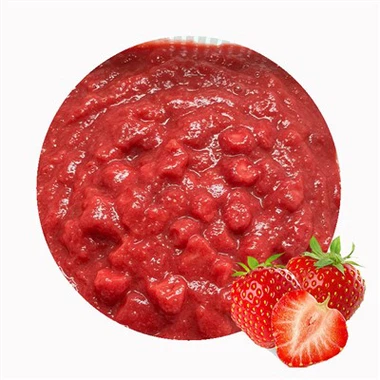
Frozen Strawberry Puree - actual supplied input appearance, including visible fruit pieces where present; not an IDDSI Level 4 determination.
At GreenLand, we would begin by asking what the buyer means to make, what texture level its responsible team has specified, and how the finished food will be assessed. That allows a useful ingredient discussion without promising that every preparation of a supplied fruit will meet a level. A supplier can support the selection of a candidate material and provide agreed product information. The classification belongs to the food actually prepared and tested under the appropriate conditions.
Use the applicable IDDSI food observations
Use the current official documents rather than a recalled description from an older guide. The IDDSI resource page currently identifies Detailed Definitions version 2.2 and Testing Methods version 2.0. The versions differ because the documents have separate histories. Record which documents the application team used in its assessment. A resource page and its linked methods are a better reference for current criteria than an ingredient seller's informal summary or a screenshot detached from its edition.
For Level 4, the current detailed definitions describe smooth food without lumps, stickiness or separated liquid. The fork observations consider a mound above the prongs rather than continuous flow; a small short tail is permitted. Spoon tilt considers shape retention and easy release as one spoonful, with little residue rather than a firm, sticky mass. The document also describes fork-pressure surface observations. These are complementary observations of the food, not a single instrumental viscosity cutoff; the syringe flow test is not applicable to Level 4.
The official Testing Methods document explains the distinct purposes of fork and spoon assessments. Spoon tilt addresses cohesiveness and adhesiveness, while fork drip examines the behaviour through the prongs. Use the complete official instructions and detailed level description when performing the assessment. This article's short explanation is intended to identify the appropriate reference and the reason multiple food characteristics matter; it is not a substitute protocol or a certificate based on a photograph.

Red fruit puree on a service tray with a blank sample bowl; illustrative serving-state scene.
Keep the observations together in the record. A sample that appears satisfactory in one respect can remain unsuitable in another. The assessor should not select the single favourable observation and omit the unfavourable one. If the food does not satisfy the applicable assessment, record the result and refer it to the responsible development or care-food team. Do not rename the food by selecting a different level without that team's authorized decision about the intended product and service requirements.
The question "Does it fall off a spoon?" is incomplete when asked on its own. The actual observation concerns the nature of the release and residue under the official method, alongside the other applicable characteristics. A very loose material and a cohesive material could both leave a spoon in different ways. A stubborn mass might retain shape but present a different problem. Use the defined observations rather than reducing them to a casual description that can be interpreted differently by different operators.
The same care applies to "thick enough." A buyer may use that phrase to mean shape retention, lack of separated serum, or an instrument reading. Ask which observation prompted the concern. That makes the development response more specific: the team can investigate the feature it actually observed while continuing to assess the full finished food. A general request for "more thickness" can otherwise lead to a formulation change that improves one characteristic while leaving another unresolved.
Training and consistent records matter when multiple people prepare or assess the product. The 2019 school-nutrition implementation study investigated use of dysphagia guidance in food preparation settings. It is older implementation evidence, not the current normative definition. Its practical relevance is that a named diet category still requires preparation and observation in the food-service setting. A purchase order label alone does not provide that implementation evidence.
Instrumental checks may support process consistency if the buyer has established a valid role for them in its own product. Keep that role separate from the official classification assessment. A correlated internal process measure, if properly developed, can help flag a changed batch; it is not automatically an IDDSI conversion method. We would not offer a universal Bostwick distance, spindle reading or puree-solids value as a shortcut to Level 4. The buyer's responsible team should retain the applicable finished-food observations and their conditions.
Fruit structure still matters after blending
Blending changes fruit, but the verb does not fully describe the result. Pieces, skin fragments, seeds and fibres can remain depending on the starting material and preparation. A sample can also appear uniform in one spoonful while a different part contains a particle or a pocket of separated liquid. The procurement question should therefore include the structure of the input and the buyer's preparation, followed by observation of representative finished food. A "blended" label is not enough to establish the relevant texture.
A seedless description narrows one feature and leaves others open. It does not establish that the food lacks skin fragments, fibres or lumps, or that it behaves appropriately on utensils. Ask what the description actually means for the supplied product and what evidence is available. If the buyer's finished-food process includes further preparation, record that step and assess its output. Do not assume that removal of one kind of particle establishes every characteristic needed for the intended food.
The Cambridge University Hospitals guide discusses smooth consistency without bits such as fibres or skin and without separated fluid. Its usefulness for this ingredient discussion is the reminder that fruit structure remains relevant beyond bulk thickness. It is a hospital implementation guide; the current official IDDSI documents remain the source for the applicable definitions and methods. We do not use the guide to prescribe an individual's diet or to certify a supplier's puree.

Particles, fibres and serum may remain relevant after blending; this schematic assigns no food level.
Different fruit inputs may create different preparation questions. A sliced input requires a buyer-defined preparation before it becomes a puree-based food. A commercial puree may already have a particular degree of particle reduction, but the buyer still needs its actual description and application evidence. The point is to select a material that fits the intended process, rather than assume that one commercial format always passes and another always fails. The finished-food result depends on what is actually prepared and served.
Separate liquid deserves direct observation. A thick-looking central portion can coexist with a thinner liquid layer at the edge or surface. If the product is stirred, record that preparation and assess it in the state relevant to service. Do not photograph the attractive central mound while ignoring the liquid elsewhere in the portion. The sample representing the served food should include the features that the person receiving it would encounter, not just the most favourable area selected for a demonstration.
The particle-and-serum illustration is a conceptual sampling aid. It contrasts a visually uniform sample with one containing a discrete inclusion and one showing a separate liquid region. It provides no acceptable particle-size limit for Level 4 and no certification of the pictured food. Its purpose is to show why bulk appearance and one convenient spoonful can miss relevant heterogeneity. The actual assessment should follow the official method and the buyer's competent preparation and sampling procedures.
Sampling after preparation matters for a larger batch. Ask how the development sample was obtained from the actual product. Was the whole batch prepared consistently, or was a small demonstration portion processed more intensively? Were additions distributed as intended? A favourable result from a specially selected sample can be valid for that sample while failing to represent routine service. A representative trial should connect the observed food to the preparation that the kitchen or manufacturer will actually repeat.

Frozen Strawberries Sliced - actual supplied input appearance, including visible fruit pieces where present; not an IDDSI Level 4 determination.
If a structural issue is observed, keep it as a development finding rather than a reason to improvise a bedside correction. The responsible food-service and clinical teams should determine the appropriate next action within their procedures. For an ingredient enquiry, describe the observed particles, fibres or separation, the material used and the recorded preparation. Those details can guide discussion of a different input or an amended development trial without turning a general supplier article into patient-specific preparation advice.
Assess the food in its intended serving state
A useful handover record lets the next kitchen team identify the prepared food without guessing. Give the recipe a controlled identity and keep the ingredient version, preparation record and assessment conditions with it. If a demonstration uses a small batch, state that scope. The next stage can then determine whether routine preparation reproduces the assessed output. A photograph labelled only with the fruit name leaves the receiving team unable to tell which formula or condition the image represents.
Supplier samples should also remain identifiable through development. If two candidate inputs are being compared, retain their lot references and avoid transferring them into unlabelled containers. Record any substitutions before preparation. This is ordinary traceability, but it becomes important when a successful finished-food assessment is later used to support a supply decision. The purchaser needs to know which candidate was actually used. A trial involving one material cannot be assigned to a similarly named alternative simply because both products are sold as frozen fruit puree.
The state at service is part of the test object. A food assessed immediately after blending may differ from the same formulation after its actual holding period or at a different temperature. A frozen pack, a freshly thawed bowl and a plated finished dessert are therefore separate samples. The useful procurement trial follows the intended preparation far enough to evaluate the food in the conditions that matter to service, rather than stopping at the point where the puree happens to look most promising.

Evaluate the actual formulation through preparation and holding to its intended serving state.
Record the full formulation used in the trial. Fruit proportion, added ingredients and water additions should correspond to what is intended for the finished food. A sample evaluated without the proposed additions cannot automatically classify the later recipe containing them. The same applies to a demonstration prepared with a different fruit input or a different proportion. Name the assessed formulation so that a future colleague can tell whether the result still represents the food being made.
Preparation needs an identifiable endpoint. Document the route sufficiently to repeat it, including the relevant blending or other preparation steps chosen by the competent development team. Equipment names alone may not describe the result. A small laboratory blender and a larger production system can produce different material even when both operations are called blending. The representative comparison should establish the prepared output under the intended process, rather than assume that a familiar operation name guarantees the same texture.
The South Tees Level 4 guidance gives a current food-service explanation of the texture characteristics and observations. Together with the official methods, it reinforces assessing the actual prepared food rather than accepting an ingredient label as the result. It is supporting institutional guidance, not evidence that a particular GreenLand ingredient meets a level. The responsible team should use the official references and its own service procedures for the food it will provide.
Define which serving conditions the trial represents. If the food is intended for chilled service, assessing a warmer preparation leaves an unanswered question. If holding is part of the route, the team should consider the relevant point in that route rather than quietly transferring an immediate-post-preparation result to all later states. This guide supplies no universal holding duration or temperature. Those conditions must come from the intended product, service procedure and food-safety controls, then be recorded with the texture assessment.
A development comparison can be designed around a specific change. For example, the buyer may compare two candidate fruit inputs in the same formulation and preparation. Keep the other relevant conditions matched so that the outcome is interpretable. If the formulation, input and serving state all change together, the team can compare the finished foods but cannot isolate which change caused the observed difference. Decide whether the purpose is candidate selection or investigation of a specific variable before arranging the samples.
Capture unfavourable observations as well as favourable ones. A record should show which sample and state were assessed and whether the applicable observations were met at that point. A photo is useful supporting documentation, but it does not replace the assessor's recorded observations under the method. If the food changes between development and routine preparation, the earlier record should be reviewed against that change rather than used as a permanent property of the ingredient's trade name.
This is the boundary we would use in a GreenLand sourcing discussion: a candidate ingredient can be selected for a representative preparation trial, and the trial can establish evidence about that prepared food under its recorded conditions. It cannot establish that any recipe containing the ingredient will have the same classification. Keeping the material, formula and serving state attached to the result allows the buyer to make practical decisions about supply changes without attributing every finished-food outcome to the supplier's puree alone.
Keep procurement, clinical approval and food safety separate
Consider a reconstructed enquiry from a care-food purchaser who wants frozen fruit puree for a texture-modified meal. This is an illustrative purchasing situation, not a verified GreenLand transaction or a patient case. The buyer asks whether a puree name or a viscosity result is enough for Level 4. Our response would be that the finished food needs the applicable assessment in its intended serving state, and the individual's recommended level must come from the relevant clinical team.
The ingredient discussion can then become specific. We would ask for the intended formulation and use, the texture requirement already set by the responsible team, and the preparation and service conditions planned for the trial. Ask about particles, fibres and separated liquid in the prepared food, alongside the utensil observations. If there are existing trial results, send the complete record and identify the sample. A screenshot of a viscosity number without material and method details does not resolve those questions.
Procurement approval concerns the supplied ingredient and agreed requirements: composition, form, packing, documentation and suitability as a candidate for the buyer's process. Finished-food texture verification concerns the prepared sample under the applicable method. Clinical recommendation concerns the person and the assessment made by the care team. Food safety concerns hazards and controls under the relevant product and service procedures. These responsibilities interact, but approval in one area does not establish approval in all the others.

Procurement, food preparation, clinical suitability and food safety carry distinct responsibilities.
The St George's hospital guidance presents Level 4 alongside other diet levels and their observations. It is another implementation reference for understanding the terminology, not permission to select a level for an individual from this article. If the clinical requirement is unclear, the purchaser should obtain it from the responsible team before treating the ingredient enquiry as a finished-meal specification. The supplier should not infer that requirement from the general phrase "care food."
A texture result is not microbiological clearance. The utensils and observed flow or structure do not determine whether the food has been stored, prepared or held safely. Equally, appropriate food-safety controls do not establish the required texture classification. The development and service record should retain both responsibilities with the people who manage them. This article does not propose a thawing schedule, cooking validation or shelf-life claim for the ingredient, and it does not certify an individual serving as safe to swallow.
For the next GreenLand discussion, send the intended use, the two ingredients or trial conditions being compared, and the basis of each result. Include the fruit form, full recipe, preparation route, relevant serving conditions and the responsible team's assessment record. We can use those details to discuss a suitable frozen-fruit input and agreed supply documents. The practical outcome is a candidate ingredient and a clearly defined finished-food trial, with clinical recommendation and food-safety approval retained by the appropriate teams. A blanket "IDDSI-approved puree" promise would go beyond that evidence.
Related reading for your next trial
Water on Top of Thawed Fruit Puree: How to Measure Separation Before Rejecting a Lot
Describe separated serum in representative material before attributing a problem to the lot.
Bostwick vs Brookfield for Fruit Puree: Why the Results Do Not Convert Directly
Keep two instrumental methods separate from finished-food texture classification.
Air in Thawed Fruit Puree: Separate Foam, Dissolved Oxygen and Filling Variation
Distinguish foam and entrained air from other puree observations during preparation.
Source Frozen Strawberry Puree with GreenLand-food
GreenLand-food is a professional frozen strawberry puree supplier and manufacturer in China. We provide factory-direct wholesale supply for importers, food manufacturers, foodservice distributors and private-label programs.
Send the intended application, product form, specification, packing, quantity, destination, private-label needs and requested documents. Include the two reports or trial conditions you are comparing and the sample basis for each result.