


How to Make Ginger Juice from Ginger Root: Extraction, Yield and Beverage-Safety Boundaries
Sep 27, 2026
Leave a message

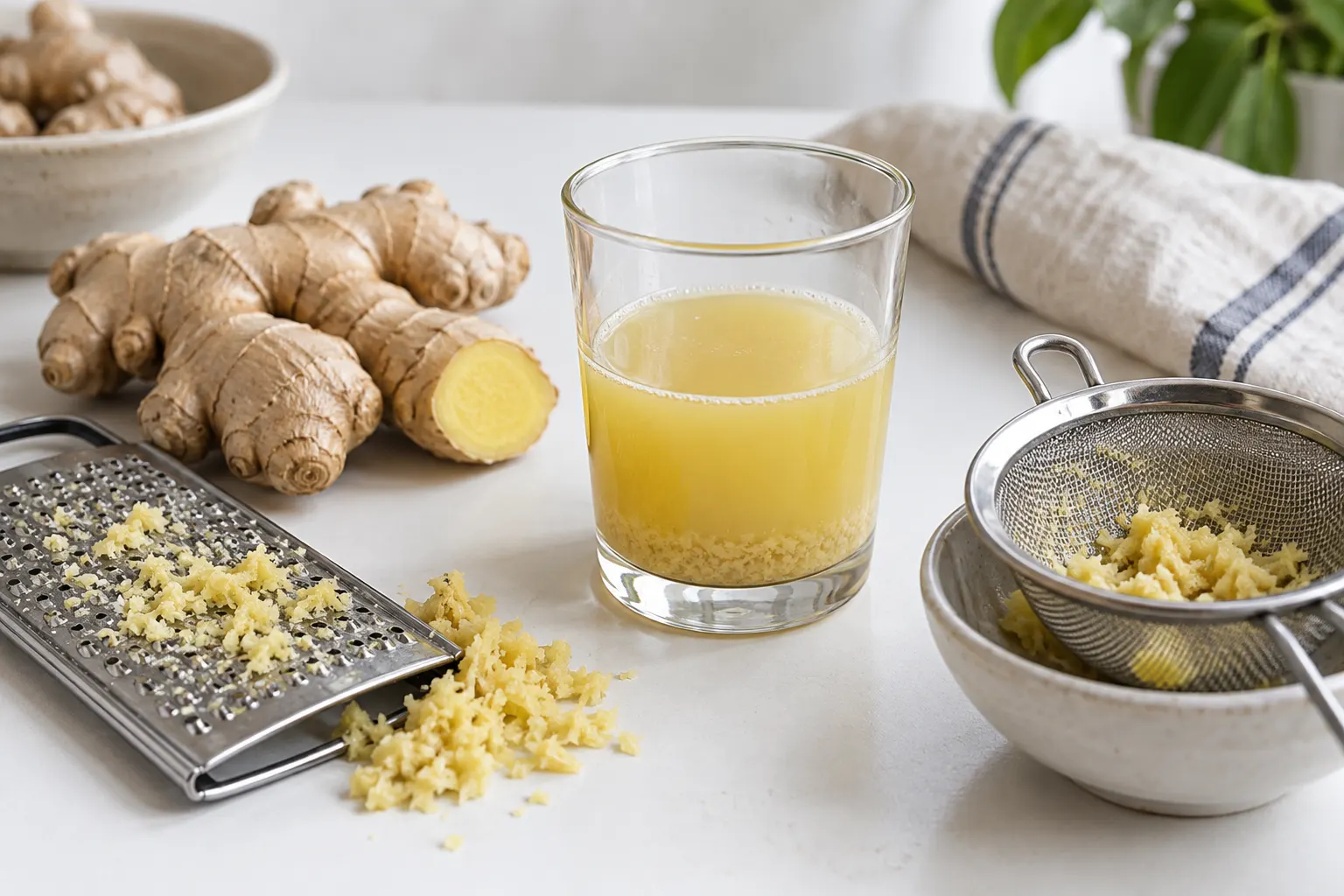
For a test kitchen, a juicer is an efficient way to obtain a relatively concentrated extract. Grating and pressing is practical for small trials. A blender can process a larger quantity with common equipment, but added water must be accounted for so the resulting volume is not mistaken for root extraction yield. Start with one ginger lot, use a consistent cleaning method, and taste the extract in its intended drink rather than judging it only by the force of a neat ginger shot. GreenLand-food's frozen ginger product page lists root and prepared forms that may be relevant as inputs; it does not list a finished ginger juice SKU or authorize raw cold beverage use.
Select the ginger input and its intended use
Fresh whole ginger root gives a developer direct control over washing, trimming and extraction. Frozen whole or peeled ginger can simplify inventory and portioning when its form, prior processing and thaw behavior suit the equipment. Grated or minced frozen ginger may help a flavor test but can carry a different particle load and may not fit a juicer feed system. Ask for the exact offered form before calculating labor or extract yield. Product photographs indicate what a form looks like; the current signed specification and sample determine its acceptance.
Start with a representative sample of the root. Record gross mass, trim loss, usable mass, visible skin, fibrousness, age or maturity information where available, and any off-odor or damaged areas. A root with heavy trimming loss can appear cheap by invoice weight yet costly per usable kilogram. If frozen, inspect the pack for integrity, lot code, condition and unusual ice. Thaw a sample according to the planned procedure and record free liquid separately. If that liquid is included in the extract, its effect on flavor and measured yield should be explicit.
The intended use changes the ingredient question. Ginger extracted for a hot sauce that will receive a validated heat step has different processing questions from ginger extract added after treatment to a chilled beverage. A quick culinary drink made and consumed promptly is another setting. These examples cannot be treated as interchangeable from a food-safety perspective. Request the supplier's declaration of whether the particular ginger form is ready to eat, requires cooking, or carries another stated intended use. Freezing alone does not prove that a raw juice is safe for a cold beverage.

A verified product photo shows one possible root input for extraction trials.
Skin removal is a recipe and quality decision, not a universal rule. Some juicing equipment can handle well-cleaned skin; another application may require peeling for appearance or mouthfeel. The cleaning step must be suitable for a soil-grown rhizome with crevices. Wash and inspect the root using the operation's approved produce procedure, then trim defects. A coarse kitchen brush may remove visible soil, but commercial processors need documented controls appropriate to the intended ingredient and hazard analysis. Do not make a food-safety claim from how clean a root appears in a photograph.
The GreenLand fresh versus frozen ginger guide discusses functional differences between forms. For juice development, a side-by-side extraction trial answers a narrower question: does the frozen lot deliver the required aroma, sharpness, solids behavior and usable yield in the selected machine? Compare the same measured input mass under a defined thaw procedure. Keep the result as a trial measurement, not a permanent yield promise for all ginger crops.
When requesting samples, specify root size or cut, peeled or unpeeled state, pack size, lot quantity, destination and required documents. If the project involves a private-label finished drink, ingredient supply and beverage co-manufacturing are distinct decisions. We can discuss a frozen ginger input only against confirmed specifications and availability; the buyer's beverage developer controls extraction, formulation and any later processing.
Compare juicing, grating and blending
A mechanical juicer separates liquid from fibrous pulp in one operation. Cut cleaned ginger to fit the manufacturer's feed opening and observe whether the machine handles the rhizome without clogging or excessive heating. Collect the juice and spent pulp separately. The liquid may still contain fine particles that settle. Screen size, machine design and feed rate influence the result, so a quoted extraction percentage from an unrelated kitchen cannot substitute for a trial on the actual equipment and ginger lot.
Grating followed by pressing is useful when only a small volume is needed. Weigh the root before grating, gather the grated mass in a clean fine mesh cloth or press, then collect the expressed liquid. The method gives a developer direct contact with the fibrous texture and can reveal whether fine particles remain after pressing. It is labor intensive for production and may have variable pressure between operators. For a fair comparison, record how much ginger remains in the cloth and whether a second pressing materially changes yield or flavor.
Blending breaks the root into fine pieces. A blender may need water or another beverage ingredient to circulate the mass. Measure that addition before blending. Strain through the chosen mesh and note both the liquid collected and the wet pulp retained. The collected volume is a diluted ginger extract, so call it by that name in trial results. A blender sample can taste weaker than a neat juicer sample because of the added water even if much of the ginger's soluble flavor was released. Compare flavor at a common ginger input per liter of finished drink.
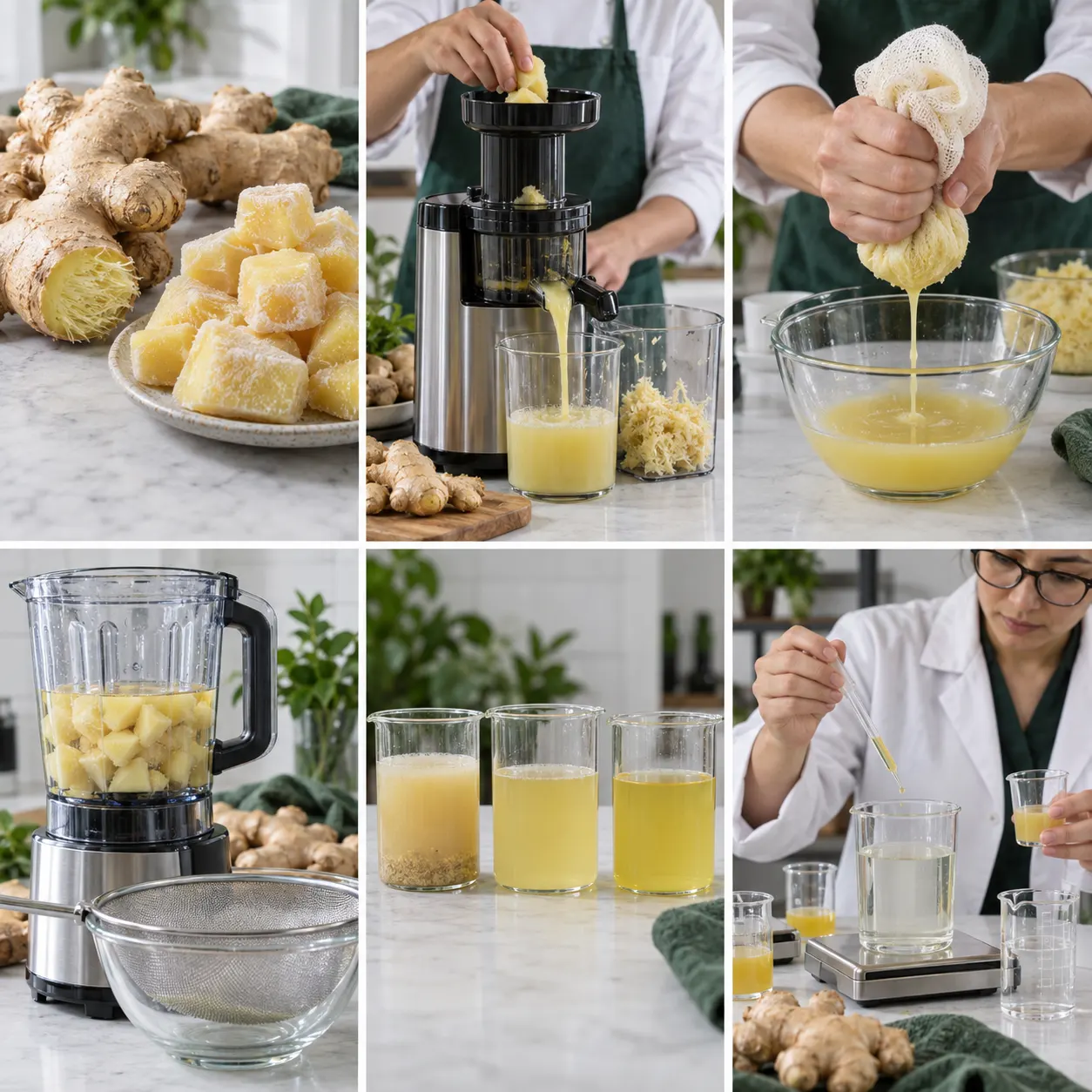
Juicing, pressing and blending produce different liquid and pulp fractions.
The Eating by Elaine ginger juice guide and The Dizzy Cook's method show how home cooks use a juicer or blender. Their practical steps are useful starting points for equipment choice, but the articles do not give a commercial ingredient specification or process validation. A manual grating example illustrates the small-batch pressing route. We use those routes as alternatives to test, not as evidence that one will always have the highest yield or safest handling.
Run the methods on the same lot in a small controlled comparison. Use equal prepared ginger mass, document any water added, collect extract in weighed containers and allow a defined settling period. Note machine cleaning time, screen fouling and pulp handling. A method with slightly lower liquid recovery may be attractive if its juice filters easily and its flavor is repeatable. Another may be unsuitable if it leaves excessive fines that clog a downstream filter. The best route depends on the complete beverage process.
Do not treat the pulp as a loss without considering its destination. It may be a waste stream, a separate ingredient if appropriate and safely handled, or material whose disposal costs matter. If a product concept uses ginger pulp deliberately, it becomes a different texture and formulation question. Keep extract yield and total ingredient utilization as separate measures, because combining them in one percentage can hide a weak extraction step.
Measure extract yield and drink strength
Use mass as the primary trial language. Weigh clean ginger input, neat extracted juice, spent wet pulp and any water or carrier liquid added. If the blender receives 200 grams of water and produces 260 grams of strained liquid from 100 grams of ginger, the result is not a 260% ginger juice yield. The report should show 260 grams of diluted extract and 200 grams of added water, along with the ginger mass. This simple separation prevents an attractive but meaningless yield comparison between methods.
If a juicer produces a neat extract, calculate its mass yield as recovered liquid divided by prepared root mass, using the same units. Record the condition of the root and the machine settings. The calculation is a measured result for that lot and procedure. Do not copy a universal percentage from a recipe or search snippet into a purchase specification. Ginger moisture, skin, fiber, trimming and equipment all influence recovery. Repeat the test with another lot before setting a commercial target.
For a beverage, strength should be expressed as ginger input or ginger extract mass per unit of finished drink, together with sensory evaluation. A 10 ml dose of a fine-strained concentrated extract cannot be assumed equivalent to 10 ml of a watered blender liquid. Prepare a small dilution series in the intended base, then taste after a defined mixing and hold period. Acidity, sugar, fruit aroma and carbonation can all change how ginger heat is perceived. An extract that tastes aggressive neat may be balanced in a citrus beverage, while a mellow extract can disappear in a sweet formulation.
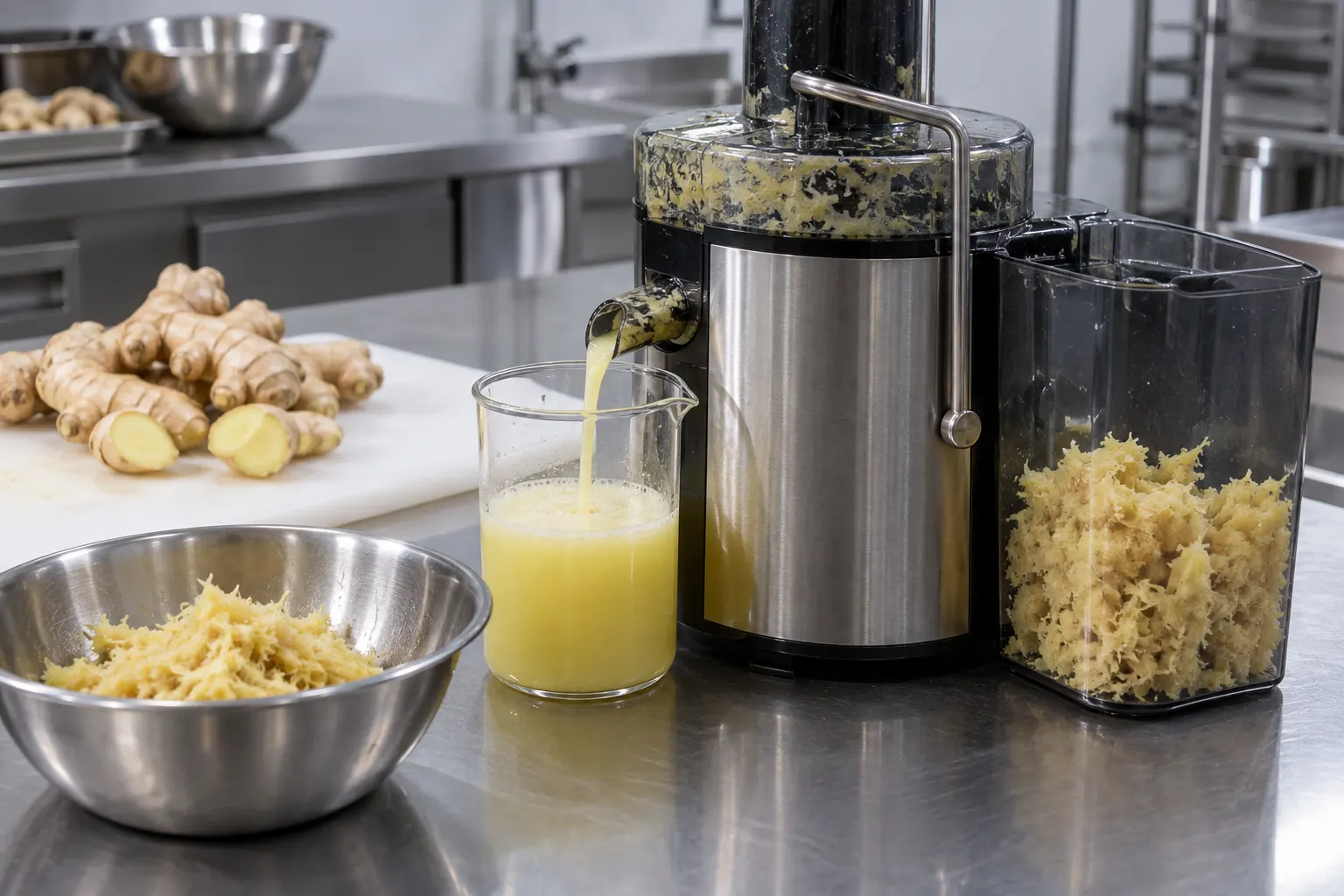
Weigh recovered liquid and spent pulp to establish a lot-specific yield.
Measure useful analytical properties according to the product: soluble solids, pH and acidity of the final beverage, turbidity or sediment, and perhaps a defined marker for a standardized industrial process. Do not present a Brix reading as a complete measurement of ginger potency. Brix reflects soluble material in the liquid and is influenced by any sugar or carrier ingredient. Sensory performance and a repeatable mass-balance method are necessary alongside it. Keep the instrument calibration and sample temperature in the trial record if these measures are used for acceptance.
Put a sample through the intended holding time. Ginger's pungent impression and aroma may change as the liquid sits or mixes with the beverage base. Look for a settled layer, a cloudy ring, separation after agitation and any color shift. Record when the sample was made and when it was judged. Comparing a fresh juicer extract against an overnight blender extract is a poor method comparison. Refrigeration during a bench trial is a handling control under the test plan, not proof of a retail shelf life.
Finally, calculate material cost on the same basis. Use purchased ginger mass, trim loss, actual extract recovery, filtration loss, labor, sanitation time and packaging for the ingredient stream. Include the cost of a purchased juice ingredient as a delivered, specified input rather than comparing invoice price per liter with raw-root price per kilogram. A lower raw-root price can be offset by low recovery or substantial labor. These records support a sourcing decision without inventing a standard yield.
Set filtration and sediment targets
Ginger juice can contain fine fibers and other suspended material. A coarse strain removes larger particles while leaving a cloudy drink. A finer filter can produce a smoother liquid but may slow throughput and remove some flavor-bearing material with the solids. Decide whether the finished beverage should be clear, naturally cloudy, or intentionally pulpy. Each target demands a different filtration test. There is no reason to polish an extract to clarity if the final drink is a smoothie that welcomes fine ginger texture.
Examine the liquid immediately after extraction and after the planned hold. Use clear containers of the same shape and fill level, then photograph or measure the settled layer. Gently invert one sample and leave another undisturbed to see how easily sediment redistributes. For a retail bottle, consider what a customer sees through the package and whether "shake before use" is an acceptable, truthful instruction. For a foodservice syrup that is stirred before serving, some settling may be acceptable if it does not create inconsistent doses.
Particle size also affects mouthfeel and downstream equipment. A coarse fiber can be unpleasant in a small shot and may clog a filler or filter. Very fine sediment may pass a screen yet collect at the bottom of a bottle. Record filter type or mesh size, pressure or flow behavior, and the mass lost to the filter. If a filtered sample tastes notably weaker, the team may adjust the ingredient dose or filtration method. Each adjustment should be measured so that a strong first cup and weak last cup are not built into the process.
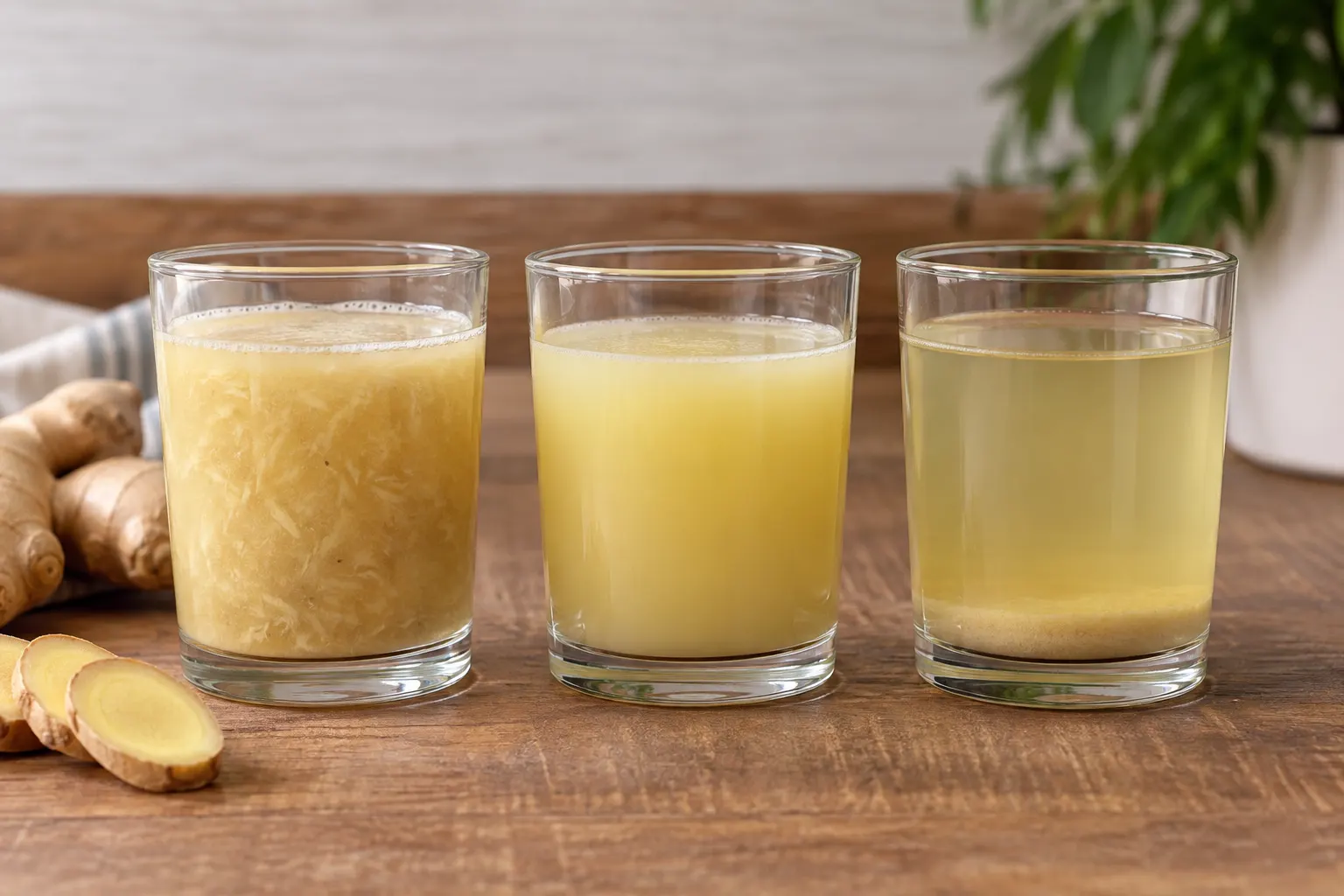
Filter choice changes mouthfeel, appearance and recoverable extract.
Color is a related quality observation, but it should be kept separate from safety. Freshly extracted ginger liquid can change appearance as it stands, depending on the root and surrounding ingredients. A pale yellow sample may become duller without proving that it is unsafe; a clear golden sample is not evidence that it is safe. The relevant decision is whether the color fits the product standard over its validated life. Evaluate changes under the actual formulation, treatment and packaging rather than borrowing advice that a squeeze of citrus will preserve every ginger drink.
If the extract will be heated, blended into an acidic drink, carbonated or mixed with dairy, run the sediment test after those steps. Heat can alter the dispersion of solids; another ingredient can promote flocculation; carbonation can lift particles into foam. A clean extract in a small glass may perform differently in the final matrix. Keep the chosen filter method connected to the application it serves. For a plant trial, collect samples at the beginning, middle and end of a run to detect buildup or changing clarity.
Set practical acceptance criteria after the development trial: maximum visible sediment at a defined hold time, acceptable redispersion, flavor strength at use dose, absence of objectionable coarse fiber and repeatability between lots. These are proposed buyer controls, not performance claims for a particular GreenLand ginger lot. A supplier can confirm the root or prepared ginger input; extraction behavior requires verification in the buyer's own equipment and drink.
Validate beverage safety and intended shelf life
Extraction creates a new ingredient stream. Washing, cutting, pressing, filtering, filling and later mixing introduce opportunities for contamination and growth. Freezing the incoming root does not kill every pathogen and should never be treated as a substitute for a validated beverage process. A cold drink made with raw ginger extract needs a hazard analysis suited to its complete formula and use. A hot drink, a refrigerated juice ingredient and an ambient-stable retail bottle require different control plans.
The U.S. FDA Juice HACCP questions and answers explains how the U.S. juice regulation applies to various juice and puree operations, including vegetable juice in its scope. Applicability depends on the exact processor, product and market. A commercial buyer should ask a qualified food-safety specialist to determine the relevant rule and validated controls for the planned beverage. This article cannot supply a processing schedule or prove that an ingredient is ready to drink.
Clarify who owns each step. The frozen ginger supplier should declare the supplied form, lot traceability, specification and intended-use status. The extractor should control incoming material, sanitation, cross-contamination and the extraction operation. The beverage maker should validate the final formula, treatment, packaging, cold chain and shelf life. These may be different companies. A handoff document that says only "ginger juice" leaves gaps: it should identify concentration, filtration, microbiological specifications where appropriate, storage state, treatment history and the party responsible for final process validation.
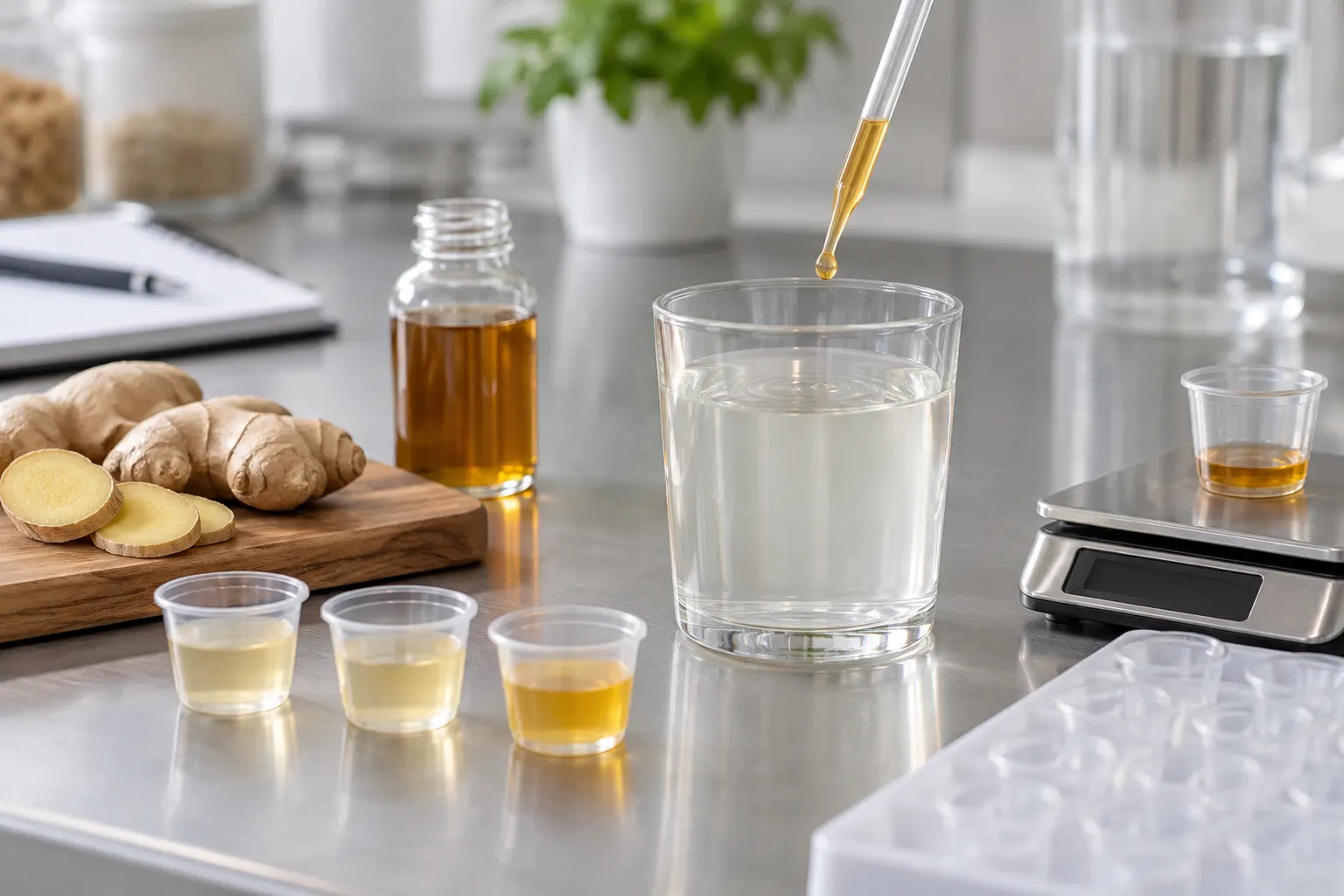
A formulation sample still needs its own validated safety process.
Do not infer ready-to-eat status from descriptors such as IQF, cleaned, peeled or blanched. Those words describe handling, not a complete lethality claim. If a frozen ginger lot is intended for cooking, a cold beverage concept needs a suitable validated process before sale. If the buyer plans to use a purchased ginger juice ingredient, request its specification, process description and validation evidence rather than assuming a bottled appearance implies safety. The same discipline applies to a small test kitchen once a sample moves beyond immediate internal tasting.
Shelf-life work should follow the actual finished beverage and package. pH, acidulant, sugar, treatment, oxygen exposure, closure and distribution temperature can all affect the outcome. A few days of acceptable flavor in a refrigerator is a sensory observation, not a validated retail shelf life. When a product will be shipped or sold, the responsible team needs appropriate microbiological and quality studies and a documented date-code basis. Destination-market labeling and import rules also need review.
Keep claims restrained. Ginger may contribute a distinctive flavor and pungency, but this production guide does not establish detoxification, medical or disease-prevention benefits. Focus on a reproducible ingredient and a safe, honestly described beverage. A reliable process protects both the consumer and the product's intended sensory character.
Compare root extraction with a purchased juice ingredient
A root-based route gives the beverage maker control over cut, extraction and dose, but it also places cleaning, equipment, yield, labor, waste and process validation on the operation. A purchased ginger juice ingredient can reduce some of that work when it comes with an appropriate specification and validated treatment, yet it may restrict flavor, concentration or filtration choices. Compare both routes in the actual beverage and on a delivered cost basis. The choice should follow the product standard and responsible control plan, not a general belief that fresh extraction is always superior.
For the root route, ask GreenLand-food about frozen ginger forms that the current offer and specification can support. Confirm whole versus peeled pieces, grated or cube forms, pack size, expected quantity, crop and lead-time plan, cold-chain requirement and relevant documents. Our verified site describes these input forms, but it does not establish a ginger juice SKU. We would sample the selected root form and let the beverage developer test its extraction and flavor rather than promise a juice yield from the product listing.
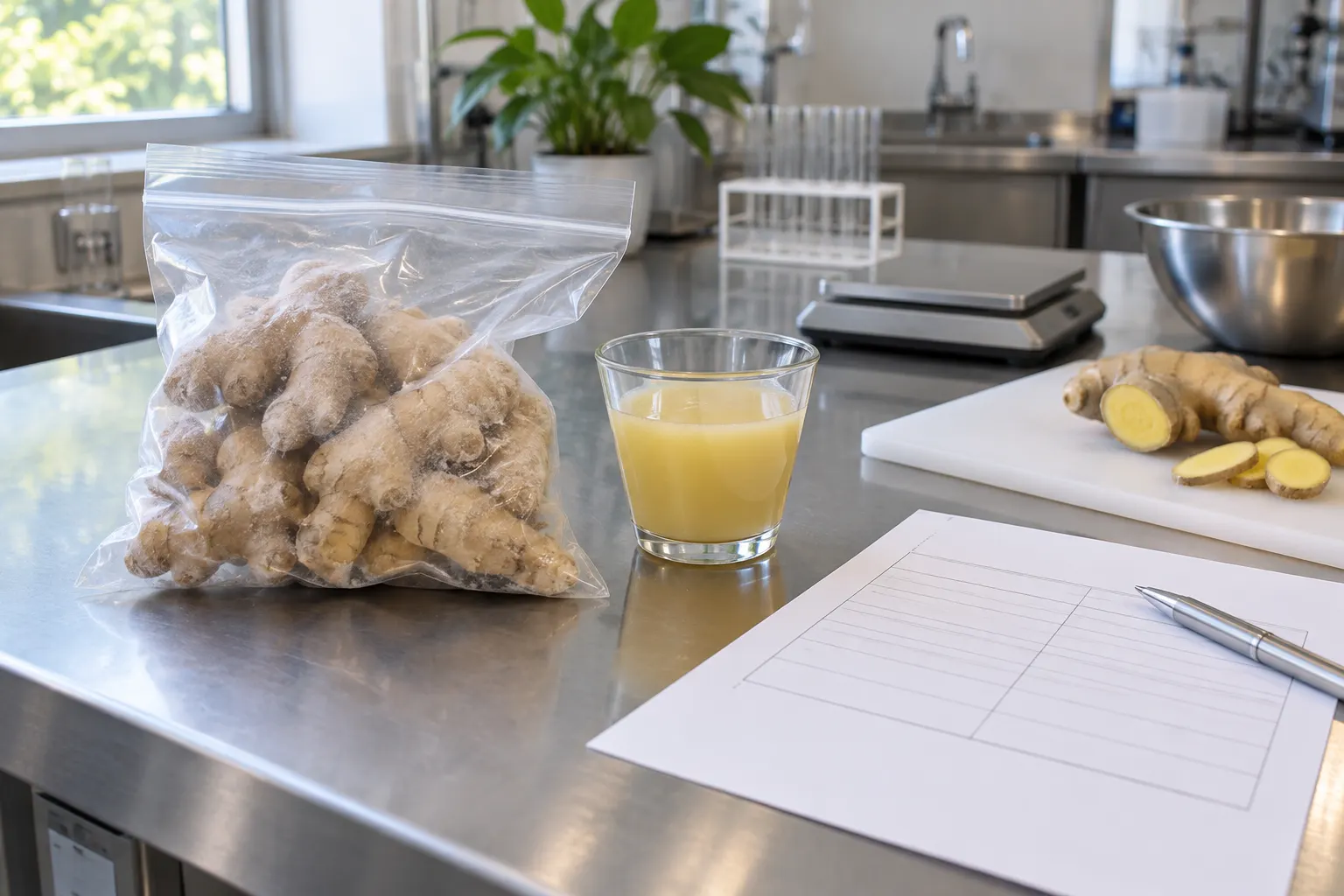
Compare a specified frozen root input with a separately sourced liquid ingredient.
For a purchased liquid, request concentration basis, ingredient statement, treatment method, filtration grade, sensory standard, pack type, storage conditions, shelf-life support, traceability and documents. Compare the delivered liquid with the root-derived trial at equal ginger contribution in the finished drink. If the purchased juice is diluted or includes other ingredients, its price per liter is not directly comparable with neat fresh extract. If it is highly concentrated, a small dose may provide the target flavor but a different aroma profile. Measure the result in the beverage.
The decision sheet should include yield and labor uncertainty. Record how many kilograms of root are needed per production run at the measured recovery, the number of operators and cleaning time, expected filtration loss, and the equipment capacity at realistic feeding rates. For the purchased route, include minimum order quantity, lead time, remaining shelf life on receipt and any change-control terms. Where a buyer needs several beverage variants, a root input may offer flexibility; where the drink is fixed and volumes are stable, a specified liquid ingredient may simplify repeatability. The plant's own data decides.

This product photograph documents a distinct prepared ginger form.
Packaging and destination still matter when sourcing root. A frozen ginger shipment needs agreed temperature controls and packaging that can be portioned within the extraction schedule. Request batch traceability and market-specific documents early. A foodservice buyer producing a small daily batch may prefer a different pack than an industrial beverage line. We help the buyer confirm the frozen input and shipment; the finished juice processor validates extraction, sanitation, treatment and beverage release.
Use a final pilot to compare cost, flavor, sediment and process control together. Taste the actual drink at production dose after its planned hold, review any visible settling, and reconcile the measured mass balance with the commercial price. Then decide whether the frozen root has a clear role in the process or whether a purchased juice ingredient better fits the operation. That decision can be documented without claiming an unverified GreenLand juice product or a universal extraction result.
Source Frozen Ginger with GreenLand-food
GreenLand-food is a professional frozen ginger supplier and manufacturer in China, providing factory-direct wholesale supply for importers, processors and foodservice buyers.
Send the product form, specification, packing, quantity, application, destination, private-label needs and requested documents.