


How to Cook Frozen Yuca
Sep 24, 2026
Leave a message

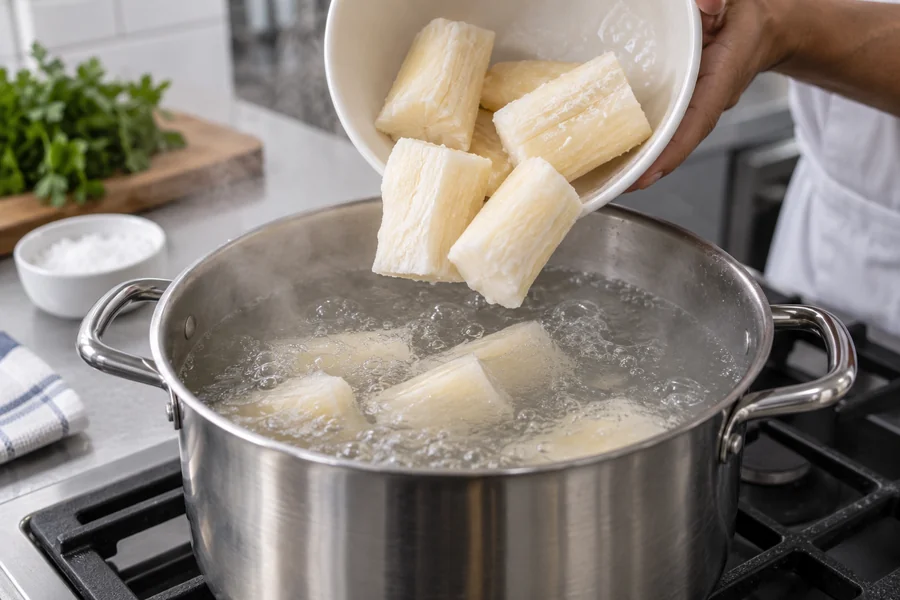
Yuca is edible cassava root, a starchy ingredient that requires proper raw-material selection, peeling, preparation and cooking. A bag marked "frozen" could contain raw peeled chunks, blanched pieces, partially cooked sticks or a fully prepared product. Those are different starting points. The method below addresses a verified raw, peeled frozen sweet-cassava product intended to be cooked by the user. If the package says otherwise, follow its instructions. Buyers should confirm the product's processing history and food-safety controls rather than assuming that freezing has made raw cassava ready to eat.
Identify the frozen yuca product before heating
Start with the words on the package or supplier specification. "Yuca," "cassava" and "manioc" commonly identify the edible root in food trade. The spelling "yucca" sometimes appears on menus, but it can refer to a different ornamental plant, so a commercial ingredient record should use cassava or yuca clearly. The product may be peeled whole sections, thick chunks, wedges, sticks or cubes. Size affects the time needed for heat to reach the middle and for the starch to soften.
The format comparison image shows three common cut styles on one tray. A large chunk is suited to boiling and later cutting. Sticks can be prepared for a fry or roasted side after an appropriate first cook. Small cubes fit soups or mixed dishes but may break down faster. The picture describes shape, not prior heat treatment. White frozen pieces that look alike can still have different cooking obligations, so a label or written process description is essential.
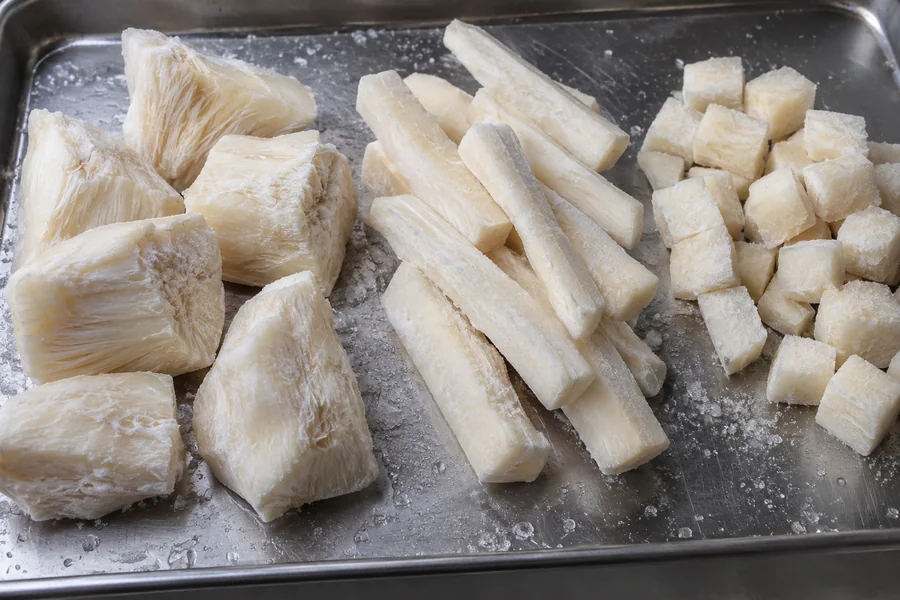
Three actual cassava formats: large peeled frozen chunks, uniform sticks, small cubes, clearly separated on a clean cold tray.
For a retail bag, check that the seal is intact, the product is still frozen and the instructions are legible. Excessive loose ice, large fused blocks, damaged packaging or severe discoloration can indicate a storage or handling problem. At home, take out only what will be cooked and return the rest promptly to frozen storage if the pack allows resealing. Avoid extended thawing on a counter. If the package says to cook directly from frozen, that instruction removes the need for a separate thawing stage.
Commercial buyers need one additional answer: is the product raw, blanched, par-cooked or fully cooked? GreenLand's IQF frozen cassava page states that blanching or pre-processing can be applied according to specification and that the product should be fully cooked unless the agreed specification says it is fully cooked. The word "IQF" describes individual quick freezing and portioning behavior, not the degree of cooking. A receiving team should be able to find the preparation status on the approved product sheet.
If a bag contains roots with skin, it is a different preparation problem from peeled frozen yuca. Cassava's outer and inner peel layers must be removed according to the product instructions before cooking. Do not apply a peeled-product recipe to unpeeled roots without verifying the appropriate preparation. For an unknown root or an unlabeled bulk pack, pause and establish its identity and processing history rather than improvising a shorter method.
Boil frozen yuca until the center is tender
For raw peeled frozen pieces intended for boiling, bring a pot of water to a full boil and add the frozen yuca carefully. Use enough water to cover the pieces and enough pot space for circulation. Salt may be added for flavor when the product directions allow it. Let the water return to a steady boil, then cook at a sustained simmer or boil according to the package. Test the thickest piece through its center, not only its surface. The accompanying image shows a knife entering the middle of a chunk.
- Confirm that the pack is peeled, raw frozen sweet cassava intended for boiling, and read its instructions.
- Bring ample water to a boil and add a manageable load directly from frozen if directed.
- Keep the pieces submerged and cook for the product's instructed time, checking the largest center for full tenderness.
- Drain the cassava, discard the cooking liquid, and remove any remaining fibrous core.
- Serve fully cooked yuca or finish the drained pieces as fries, mash or a thoroughly cooked stew component.
The starting state explains why frozen yuca cannot be timed like a fresh potato. A frozen chunk needs time to thaw within the hot water, then time for the dense starchy flesh to soften.
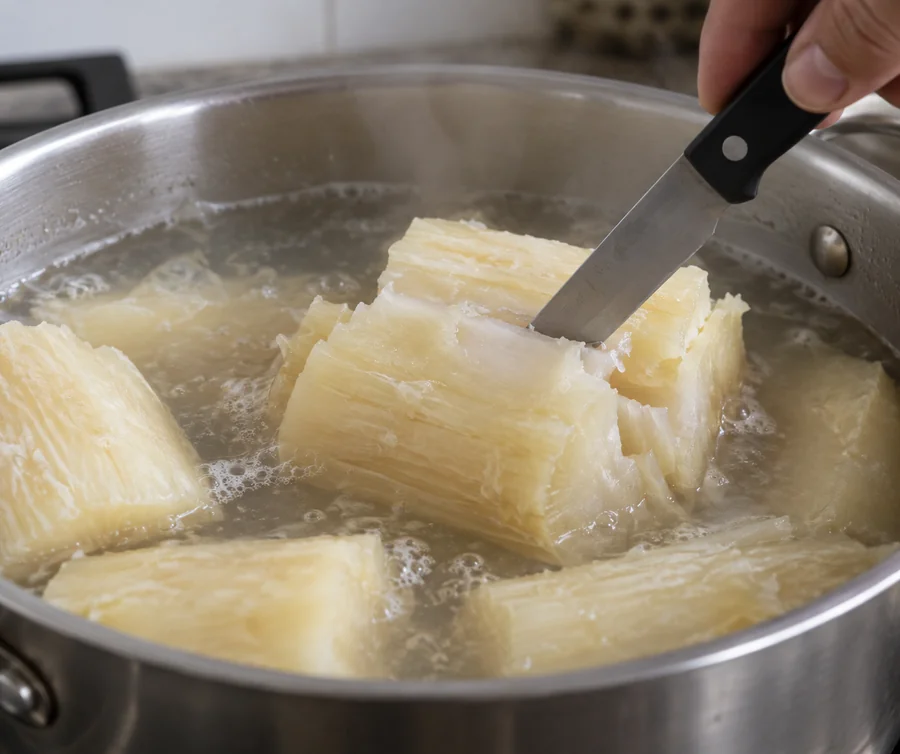
Largest frozen cassava chunk in simmering water tested at center with a paring knife, steam modest, no misleading timer.
Larger pieces take longer than small cubes. A tightly crowded pot loses heat when a large load is added and may recover slowly. A par-cooked pack can behave differently again. A commercial raw frozen yuca product sheet gives 15–30 minutes or until tender and says not to thaw first; that is the manufacturer's instruction for its named product, not a promise for all frozen cassava.
Current recipes illustrate the spread. Chef's Resource gives about 20–30 minutes, while Laylita's recipe allows 40–50 minutes for frozen pieces and Cook2eatwell describes 45–60 minutes in its dish. These differences should prompt a cook to inspect the exact product and piece size. They should not be averaged into a false "standard" time. Begin checking when the manufacturer's expected range approaches, then continue until the largest representative piece is cooked through.
Properly cooked yuca becomes tender, moist and starchy. A knife or fork should enter and leave the thickest piece without striking a hard center. Depending on variety and cut, the surface may split or open slightly. A firm opaque core of uncooked flesh requires more time. For pieces intended to become fries, stop when the center is cooked but the chunk still holds its shape; an extremely soft piece will break during cutting and frying. For mash, greater softness can be useful, provided the product has been fully and safely prepared.
Drain the cooked cassava and follow the product guidance for the cooking liquid. Do not assume water used to cook cassava is an appropriate broth to reuse; cassava's natural cyanogenic compounds and preparation history make that an unsafe casual recommendation. Keep hot cooked pieces protected until they are served or moved into the next cooking stage. An industrial operation should have its own validated procedure for time, temperature, load and cooling.
Remove the fibrous core and finish the dish
Many cassava roots have a firm, stringlike central core that remains unpleasant even when the surrounding flesh is soft. After boiling and cooling just enough to handle safely, split larger pieces lengthwise and lift the core out. The image shows the narrow fibrous material being removed from cooked yuca. A small cube may already have had its core removed during factory cutting, so inspect the actual supplied form rather than assuming every piece needs the same trimming step.
Core removal influences yield. A raw frozen carton weight includes any fibrous centers still present. For a restaurant, the usable cooked amount per portion matters more than the weight of unopened bags. Buyers can request a target for core removal or defect tolerance, but they should confirm it in the specification and sample. The requirement may affect available cut sizes, price and processing yield.
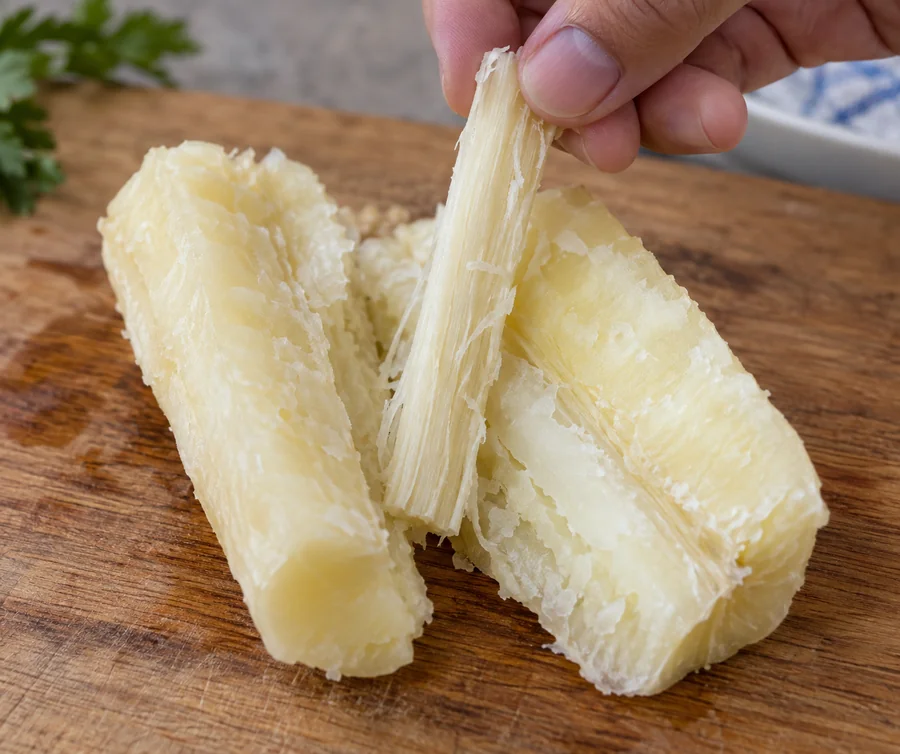
Fully cooked cassava split lengthwise with fibrous central core being lifted away, pale starchy interior in focus.
For a simple boiled side, season the drained yuca while warm, then serve with an appropriate sauce or topping. It can carry garlic, citrus-based sauces, herbs or savory stews without losing its own mild starchy character. Cooked yuca is substantial and slightly different from potato; it may split into thick flakes and has a more fibrous grain. A finished portion should be uniformly tender, with no hard raw centers or woody strips.
For fries, allow the cooked pieces to dry and cool enough to cut cleanly, remove the core and make reasonably even sticks or wedges. Then fry or roast according to a tested recipe or product instruction until the exterior browns and becomes crisp. The first cooking stage establishes a cooked center; the second creates the surface. Our guide to what yuca fries are explores the product distinction between raw frozen root and prepared fry formats. A bag of pre-fried frozen yuca may have a completely different finishing instruction from raw frozen cassava.
For mash, cook until the flesh is very soft and remove the core before crushing. Add liquid or fat gradually because cassava starch thickens the mixture and can become heavy. For soups and stews, add pieces in time for complete cooking but consider how much starch they will release; small cubes may break down and thicken the liquid. The final method should be tested in the actual recipe, especially if it will be chilled, frozen and reheated again.
Adapt the method for fries, mash and stews
The finishing image shows golden fried yuca beside a soft mash. Both start with cassava, but their preferred cut and first-cook endpoint differ. Fries benefit from pieces that are fully cooked inside and still strong enough to hold a crisp outer surface. Mash benefits from very soft flesh. A stew can use chunks that remain visible after simmering or cubes deliberately chosen to partly disperse. The cook should identify the desired final texture before choosing the pack.
For foodservice fries, consistent stick thickness reduces the number of pale centers and over-browned edges in one fryer basket. Too many wet pieces can cool the oil and produce a greasy surface. Draining and surface drying after the first cook improve browning. If the product is already par-cooked or pre-fried, use its specific final instruction instead; a second boil may damage its texture. Record the actual fryer load, oil condition and hold time when approving a commercial ingredient.
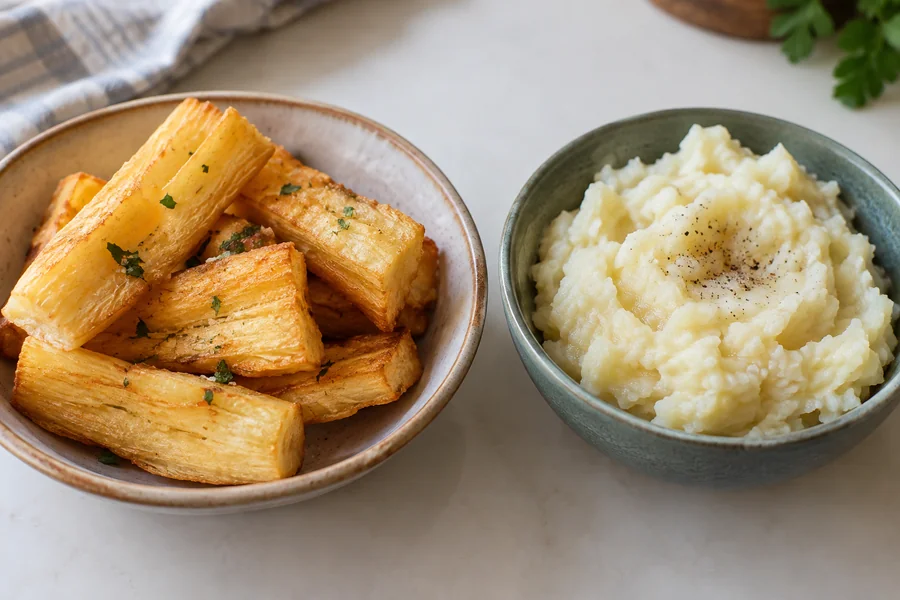
Cooked drained cassava pieces divided between golden fried sticks and soft mash, both visibly derived from cooked yuca.
For a hot holding line, the test does not end when a fresh portion leaves the fryer. Cassava fries can soften in a closed takeaway pack as steam accumulates. Mash may thicken as it stands and require a controlled reheat method. Stew pieces can become fragile after a long hold. A buyer should evaluate the serving point the customer sees, including a typical wait or reheating cycle. That test often changes the preferred cut more than a discussion about raw weight.
Frozen cassava is convenient because peeling and cutting may already be completed, not because all safety questions have disappeared. The GreenLand frozen cassava range offers peeled, chunks, cubes, sticks and other agreed forms for different applications. The buyer should still specify the raw-material type, prior processing, core treatment, intended final cook and pack. A pictured cube and a pictured stick can be distinct products with different yields.
In a home kitchen, follow the bag first, then use the tenderness check to account for normal piece variation. In a central kitchen or factory, develop a measured method for the actual SKU: load size, water or equipment ratio, process time, center doneness, drainage and subsequent handling. A recipe found online can suggest a trial, but it cannot validate another supplier's raw material or a large industrial batch.
Handle cassava safely
Cassava contains naturally occurring cyanogenic glycosides. Properly managed edible cassava is an important food, but raw-material type and processing matter. Food Standards Australia New Zealand states that cassava must be peeled and fully cooked before eating and cautions that cooking methods alone are not a reliable universal detoxification method for all roots. The Canadian Food Inspection Agency distinguishes sweet and bitter cassava and explains that bitter types need more extensive preparation as well as cooking.
This is why a simple statement such as "boil any cassava for twenty minutes" is unsafe. The instructions in this article apply to commercially prepared, peeled frozen sweet cassava with a defined cooking requirement. They cannot identify an unknown root's cyanogenic potential or replace a supplier's control program. A buyer should request the variety or raw-material class, the pre-treatment description, the intended-use statement and relevant test or compliance documentation for the destination market. An importer should verify that the product and its labeling meet local requirements.

Photographed white cassava cubes in a distinct product inset.
Freezing is a preservation step; it is not evidence that cassava has been detoxified or cooked. Blanching may be part of a quality or preparation process, but its parameters need to be known before calling a product ready to eat. Likewise, golden frying on the surface is not proof that a thick center was fully cooked. Follow a verified product instruction, test the center and avoid serving any piece that remains hard or raw.
For food manufacturing, safety decisions belong in a documented hazard assessment and validated process, supported by raw-material controls and records for the actual lot. A photograph of white cassava cubes, or a generic claim of "premium quality," cannot demonstrate these controls. We discuss processing level and requested documentation at the quotation stage so the product offered matches the customer's final cooking process.
Storage and handling remain relevant after purchase. Hold the frozen pack at its required temperature, protect it from thawing and refreezing, and use clean equipment. Cooked cassava that is held for later service needs appropriate hot holding or rapid cooling and refrigerated storage under the operation's food-safety program. The root's long frozen shelf life does not transfer to a cooked dish left at room temperature.
Choose frozen yuca for foodservice and manufacturing
The real product photos in this section show cassava sticks, cubes and a cooked-looking cut presentation from GreenLand product material. They help a buyer compare geometry and visible surface condition. They do not establish whether the particular pack is raw, par-cooked or fully cooked. An image also cannot show the tested residual cyanogenic content or the internal temperature reached in a customer's kitchen. Those points require product records and a trial with the actual supply lot.
For a restaurant side dish, a larger chunk may give the kitchen flexibility to boil and split portions. A pre-cut stick reduces preparation work for fries but makes thickness uniformity and broken rate more important. A soup or ready-meal line may prefer cubes that meter consistently into trays, with an agreed size range and low fragment share. The cheapest quoted kilogram may have more core waste, breakage or trimming loss. Compare usable cooked portions and labor, not only carton price.

Photographed peeled cassava sticks displayed in a product inset.
An RFQ can state the preferred cut dimensions, core-removal requirement, blanching or pre-cooking status, cooking obligation, natural white to cream color, defect tolerance, pack size, quantity, destination and application. Include private-label needs if the product will go into a retail bag. Ask for the product specification, lot-linked certificate of analysis or other agreed tests, traceability, packing list and destination-market documents. The final proposal should refer to the same SKU and processing status as the sample used in the kitchen trial.
At GreenLand-food, we supply IQF frozen cassava and review peeled chunks, sticks, cubes or customized cuts against the buyer's process. We can discuss bulk, foodservice and private-label packing according to order requirements. Our team should confirm the raw-material selection and preparation steps, not infer them from the phrase "frozen yuca." Tell us whether the final product is a boiled side, a fried portion, mash, soup or ready meal, and how it will be cooked and held.
Approval should include at least one full process trial: prepare the product from frozen as planned, check the thickest center, remove any remaining core, record usable yield and judge texture at the actual serving point. Repeat with the intended batch size if a tiny test pot hides heat-recovery problems. Write the accepted cut and cooked result into the specification. That makes the next carton a repeatable ingredient rather than a guess based on a broad product name.

Photographed cooked cassava cubes in liquid in a product inset.
A side-by-side trial can make the cut decision concrete. Weigh equal raw frozen amounts of chunks, sticks and cubes, cook each by its approved method, then weigh the usable drained portions after core or defect removal. Record the time to a tender center and the share of pieces that break during handling. A restaurant may find that a more expensive pre-cut stick reduces labor and waste enough to be worthwhile. A factory may prefer cubes because they portion evenly into trays. These outcomes cannot be read from the frozen bag's front image; they appear only under the real process.
The product's color can be checked before and after cooking. Natural white to cream flesh is expected for many edible cassava products, but dark spots, severe discoloration or a large broken fraction may violate an approved standard. Compare under consistent light and with a defined sample size. A few surface cracks caused by freezing should be judged differently from a hard black interior or a rotten odor. Do not taste a suspect undercooked piece as a test. If a lot raises questions about identity, preparation status or quality, isolate it and ask the supplier for the relevant records.
For a private-label pack, the cooking direction needs to match the exact SKU. A thick raw frozen chunk and a par-cooked stick cannot share one set of instructions merely because both are called yuca. The consumer needs to know whether to boil from frozen, whether any fibrous center remains, and what tender completion looks like. Market-specific warnings or labeling requirements should be checked with the importer. Food Standards Australia New Zealand, for example, describes a requirement that cassava be accompanied by a statement to peel and fully cook it before eating. That is a regulatory example for its market, not a universal label template.
Frozen inventory helps foodservice operators plan supply, but only if the cold chain holds and the process remains consistent. Record storage requirements, date coding and the response to damaged or thawed cartons. A kitchen should avoid repeatedly pulling a bag into warm preparation areas and returning the remainder to the freezer. Portioning needs to be planned around the pack size. If demand changes, a smaller foodservice bag may protect quality better than a large carton that is opened and handled over many shifts. These details complete the cooking answer for a business that serves the dish every day.
Source Frozen Cassava with GreenLand-food
GreenLand-food is a professional frozen cassava supplier and manufacturer in China, providing factory-direct wholesale supply for importers, food manufacturers, foodservice distributors and private-label programs.
Send your product form, specification, packing, quantity, application, destination, private-label needs and requested documents so we can discuss a relevant sample and quotation.