


Scallion Pancakes with Frozen Spring Onion: Moisture, Cut Size and Layers
Sep 28, 2026
Leave a message


GreenLand-food supplies frozen spring onion as an ingredient, not finished scallion pancakes. The IQF frozen green onion product page shows product forms that can begin a purchasing discussion; the exact cut, green-to-white proportion, processing state, packing and cooking instructions must be confirmed for the ordered lot. This article turns the familiar layered pancake into a practical trial: make the same dough, measure the onion by mass, observe water during shaping, and judge both a freshly cooked pancake and a separately frozen assembled pancake. The two routes answer different questions.
Start with a rolled and layered scallion pancake
The target here is cong you bing, the Chinese scallion pancake made from a dough sheet. A poured batter pancake, Korean pajeon, a sourdough-discard pancake and a shortcut made from ready-made wrappers can all be appealing, but they handle onion and water differently. The rolled dough format is especially sensitive to a wet filling because a thin sheet is rolled around oil and onion before it is coiled and flattened. A little liquid trapped at that interface can leave a gummy streak, make the sheet stick to itself, or force the cook to add flour in a place where oil should separate the layers. Define the format before asking whether frozen onion works.
For a first kitchen benchmark, select a tested recipe and follow its ingredient weights and sequence as written. The Kitchn's extra-flaky method uses a flour-oil paste, while China Sichuan Food's scallion pancake method describes a related layered route with its own oil handling. Either can establish a fresh-onion reference. Do not combine the water quantity from one, the paste quantity from another and the cooking time from a third and call the mixture a validated formula. Once the reference is reproducible, change the onion state as the trial variable. A developer can then say what the onion changed rather than what an improvised recipe changed.

Sheet, roll, coil and cooked round show the target layered-dough structure rather than a pourable batter.
In general terms, make the dough, allow its specified rest, portion it equally and roll a sheet of consistent diameter and thickness. Apply the selected oil or flour-oil system, spread the measured scallion pieces without piling them into a ridge, roll the sheet into a rope, coil the rope, rest if the chosen method calls for it, and flatten it without crushing the layers. Cook with the method's stated pan and oil conditions until the center is fully cooked. This is an orientation, not a universal formula: flour strength, hot-water use, hydration, rest, paste and pan heat all change the result. Keep those choices written down for every comparison batch.
The rolling sequence matters more than a photograph of an attractive finished round. A pancake may brown before the center is cooked; a thick coil may hold many visible scallions but lift poorly; a thin one may blister while a punctured area leaks oil. Record the dough portion mass, sheet diameter, approximate final thickness, onion mass, rolling resistance, number of tears and center doneness. Cut a cooked pancake and look for distinct tender layers, not merely a brown face. Taste a fully cooked test portion for onion aroma and bite. Raw flour dough should not be tasted as a seasoning shortcut.
For a consumer, the useful instruction is to learn the rolled, oiled and coiled shape with a fresh-onion reference first. For a prepared-food team, the same benchmark is a control. It creates a repeatable base against which an IQF onion change can be judged. If the first control pancake is dense or greasy, fixing the onion specification will not repair an unsuitable dough or pan procedure. Separate the material question from the method question before making a purchasing decision.
Specify onion pieces that the dough can hold
"Frozen spring onion" names an ingredient family, not a single particle. A fine green leaf piece lies flatter in a thin dough sheet than a thick, firm section from the pale base. A long cut may bridge across a fold or stick out of the roll; a very fine cut may distribute easily but lose its visible scallion identity. The right piece is the one the chosen sheet thickness can cover without puncture and the customer can still see and taste after cooking. This is why a supplier inquiry should request an actual cut specification and a representative lot sample instead of assuming that any chopped green onion in a catalog is interchangeable.
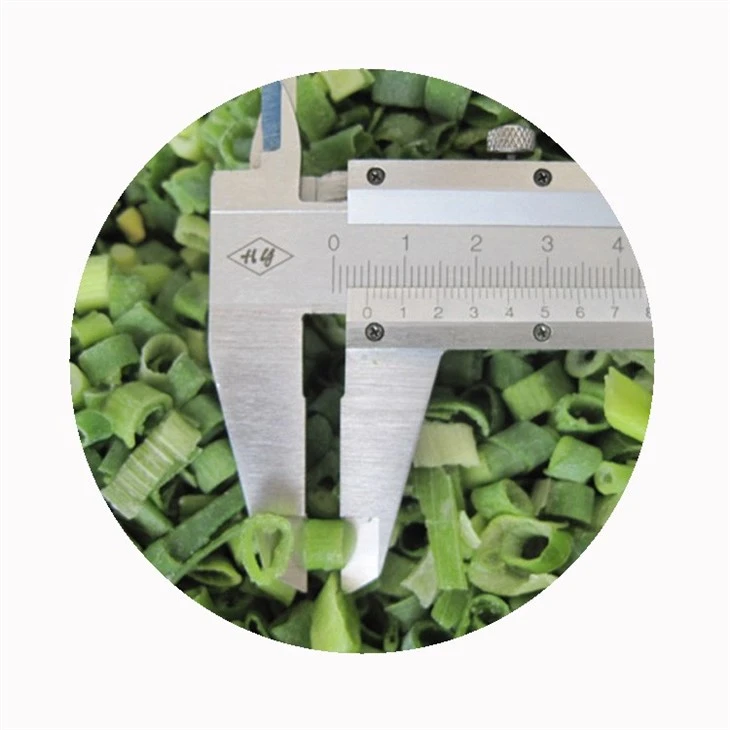
The two inspected GreenLand product photographs in this article show different cut presentations on the corresponding IQF green onion detail page. They establish that pieces and cut scale are relevant sourcing questions; a photograph does not prove the measured distribution in a shipment. In a purchasing specification, ask for the nominal cut and its permitted range, the green-to-white balance, the amount of firm stem, and the condition in which the sample will arrive. Confirm whether the stated dimension is taken before or after freezing and whether broken fragments are included. Do not read a precise tolerance off a product-page ruler image.

A GreenLand product-page view shows chopped green spring-onion pieces with a scale reference; the lot cut still needs specification confirmation.
Weigh onion for every test. A loose cup of fresh leaves, a cup of compacted thawed pieces and a cup of frosty IQF onion do not necessarily contain the same edible onion mass. If a recipe gives only a volume, weigh the fresh reference portion when it is prepared and record that number. Then set the frozen trial by a declared mass basis, while separately recording any liquid removed during permitted tempering. That lets the developer distinguish an onion-dose effect from a measuring-cup effect. It also prevents the trial from quietly reducing onion flavor simply because the frozen pieces occupied more or less volume.
Screen the candidate pieces before the dough is mixed. Spread a weighed sample on a clean tray and note whether the pieces are free-flowing, clumped, heavily frosted, dominated by white bases, or broken into fines. Do not leave the sample warming on a bench simply to make it easier to weigh. Use the product's handling instructions and the facility's controlled process. If clumps are present, record whether they separate under the permitted method. A clump that lands in one dough segment can create a pocket of water and onion while another segment has almost none, making the pan result hard to interpret.

Fine green pieces and coarser white sections can behave differently inside a thin sheet; confirm the actual lot cut.
A small factorial trial is more useful than a single successful demonstration. Hold the dough and oil system constant and compare two documented onion cut specifications at the same edible onion mass. Within each cut, compare only the handling states the selected product and food-safety plan allow. For each batch record lot code, input mass, visible surface ice, dough temperature, torn sheets, uneven bulges, cooked yield and sensory notes on a fully cooked sample. The resulting table can have blank result cells until the trial runs; the article does not claim that one cut has already won. A supplier can help identify which offered format matches the requested cut, while the finished-food maker approves its own process.
GreenLand's spring onion application guide mentions pancake uses and general moisture handling. The more specific decision here is whether a particular IQF piece fits a particular laminated sheet and process. That is an ingredient-to-dough interface question, not a broad claim that frozen onion is suitable for every pancake recipe.
Account for frozen-onion water before rolling
Freezing does not erase water in onion tissue. As an IQF piece warms, surface ice and released liquid can reach the dough. The practical question is not whether thawing is always good or always bad. It is which controlled handling route gives an evenly distributed onion dose without wet patches, and whether that route is permitted for the ingredient and the finished-food process. A trial may compare direct dosing from a defined frozen state with a refrigerated, tempered and drained state, but only if the supplier's instructions and the manufacturer's food-safety plan allow both. Record the actual temperature and hold path instead of writing "thaw as needed."
For a direct-frozen trial, weigh the onion promptly and distribute small pieces across the prepared sheet as the chosen method permits. Watch for frost that melts while the sheet is being rolled. Record whether the dough sticks to the board, whether oil and water collect in visible droplets, whether pieces slide into one edge, and whether the seam still closes. The warmer and longer the shaping operation, the less comparable one portion may be to the next. A production trial should define the time from dosing to sealing, dough temperature and permitted rework rather than judge only the first round made by an expert operator.

A strainer illustrates measured meltwater collection in a permitted tempered trial, not a commercial dewatering instruction.
For a permitted tempered route, collect the liquid in a measured container instead of squeezing an unknown amount from the onion. Weigh the onion before and after draining, record the tempering conditions, and state whether the test dose is based on original frozen mass or drained mass. A strainer is a visual teaching aid; it is not a validated commercial dewatering system. Excessively aggressive squeezing may change texture and aroma, while leaving uncontrolled liquid may soften the dough. The route selected for scale-up needs a clear yield basis and a process that can be repeated with the actual line equipment.
Do not solve every wet-pocket failure by dusting more flour into the dough or onto the onion. More flour can make rolling easier in the moment while producing a thick, tough layer that hides the original problem. Similarly, adding more oil can mask sticking but increase oil pickup and reduce layer definition. First identify whether the moisture came from frosty product, a clumped dose, a high-white-stem cut, condensation on cold dough, an overfilled sheet, or a handling delay. Change one factor at a time. A trial that changes onion mass, flour, oil and rolling thickness together cannot tell procurement which onion specification to order.
Define the observations before cooking. A simple worksheet can have fields for frozen input mass, drained liquid mass if applicable, dough temperature at rolling, sheet diameter, number and location of tears, visible wet spots, seam integrity and the time taken to shape each unit. After cooking, add total cooked mass, center appearance, crispness after a fixed rest, onion aroma, and any gummy line around a cluster of onion. Count defects over multiple rounds, including late rounds, because a single attractive first pancake is a weak basis for a commercial decision.
Water control is also a safety boundary. A dry-looking piece is not proof of ready-to-eat status, and a photo of washed onion is not a release certificate for an uncooked filling. Follow the lot's cooking and handling instructions and validate the complete finished pancake. The buyer should request relevant product documentation and confirm the intended cook step, allergen controls and destination-market labeling separately from texture trials. An ingredient supplier can provide a documented input; the finished-food operator owns the cooked product and its shelf-life evidence.
Protect the oil layers during shaping and cooking
The characteristic flake is formed when a thin sheet with a separating oil layer is rolled and coiled. Scallion pieces sit inside that system. If a hard white segment cuts the sheet, oil may escape and the coil may fuse; if a wet onion clump interrupts the oil film, part of the pancake may remain dense. A fine green cut can fit more smoothly, but too much onion can still block a clean seam. The aim is an even distribution that preserves a continuous dough surface and gives a distinct onion bite in the cooked pancake. A close-up of a successful coil illustrates the target geometry; it does not quantify an allowable onion cut for all factories.
Choose one oil-layer approach for the first comparison. An oil-only method and a flour-oil paste method are both used in published recipes, but their spread behavior and effective thickness differ. Changing from one to the other while evaluating onion will hide the ingredient effect. Record the oil or paste mass per dough unit, the spread area and whether the filling is placed before or after the layer separator according to the selected method. A flour-oil paste may carry scallion pieces differently from plain oil. That is a reason to test the actual planned product rather than to borrow a ratio from another recipe.

The oil layer and coil need an unbroken sheet with an even measured onion distribution.
Let the dough rest as the reference formula directs and divide it by weight. Roll each portion to a controlled sheet, spread the chosen separator, add the measured onion, then roll and coil with the same sequence and operator instruction. Use a standard flattening target; an "about palm-sized" round is too vague for a process comparison. If the coil springs back, note it. If a piece protrudes and tears the sheet, record its approximate size and whether it was a white stem or green leaf. A test should preserve failed samples as evidence rather than quietly patch every tear and count the unit as flawless.
Cooking can create another false positive. A hot pan may make the outside brown and blister while a thick center remains undercooked; a cool pan may dry the pancake before the layers lift. Use the selected recipe's pan type, oil amount, turning pattern and cooking endpoint consistently, then verify the center of the actual portion. If a customer plans a griddle, conveyor or frozen-to-pan service, test that equipment instead of relying solely on a household skillet. Note oil pickup and cooked yield as well as color. A product that looks flaky but absorbs substantially more oil may be unsuitable for a costed prepared-food line.
Evaluate the fully cooked pancake at more than one serving interval. Immediately from the pan, many rounds are crisp. After a short defined hold, moisture from onion and the inner dough may soften the surface. Cut through the center to look for distinct layers, gummy patches, uneven onion clusters and dry hard zones. A blind side-by-side tasting of the reference and frozen-onion candidates can score aroma, onion distribution, crispness and chew. The score sheet should name the exact hold time and serving temperature. "Tastes good" without a common test window is hard to repeat between suppliers or production days.
The decision is not simply a preference for fresh or frozen. It is a workable combination of dough, layer separator, onion cut, onion state and cooking route. Once the team has a stable benchmark, it can ask GreenLand-food for an ingredient specification that matches the selected cut and green-white balance. That keeps the sourcing conversation concrete: which lot and format can be supplied, what handling instructions accompany it, and what variation is acceptable before the prepared-food line must adjust?
Test freezing the assembled pancake as a second process
Freezing the shaped pancake is a separate experiment from using frozen spring onion inside it. A fresh-onion pancake can be formed and frozen; a frozen-onion pancake can be cooked immediately; a frozen-onion pancake can also be formed, frozen and cooked later. Those are three different process histories. Success in one does not validate the others. The Woks of Life shortcut pancake and other household recipes can suggest convenient freezer handling, but their results cannot establish the shelf life or cooking endpoint of a commercial GreenLand-ingredient product.
If an assembled-pancake freeze route is intended, first decide whether the unit is raw or par-cooked, its portion mass and final thickness, and the exact pack format. Lay shaped rounds with separators so they do not fuse, and record the time and temperature path under the facility's validated process. Compare units made with the fresh-onion control and the chosen frozen-onion condition. A pressed stack that has torn during separation is a packaging failure even if the dough formula was good. A round that freezes individually but later develops wet onion patches is an ingredient and process interaction that deserves its own investigation.
A second GreenLand product-page view shows a finer mixed green and pale cut supplied as an ingredient, not a finished pancake.
Cook frozen test units using the planned service method, not a convenient one-time skillet setting. Specify whether the unit is cooked directly from frozen or after a controlled temper; follow the finished-food operation's validated instructions. Record time to a fully cooked center, exterior color, layer lift, oil pickup, total yield and crispness at a fixed serving interval. If the center is not cooked when the outside looks done, adjust the process and rerun rather than declaring the ingredient unsuitable from one pan. Conversely, a crisp exterior alone is not enough evidence for release.
A trial matrix can be compact and honest. Keep one dough and one oil-layer system, then create cells for two defined onion cuts and two permitted onion-handling states. Within each cell, measure input mass, drained liquid when relevant, dough temperature, sheet tears, layer separation, cooked yield and aroma. Only after selecting an acceptable ingredient condition should the team run a second matrix for assembled-unit freezing, separator type, thickness and cook-from-frozen behavior. Leave the result fields blank before the trials. Neither this article nor the photographs report GreenLand customer test data.

Separated raw rounds and a cooked wedge illustrate two process stages; freezing and service results require testing.
Cost and service questions matter alongside appearance. Measure how many sellable pancakes remain after shaping, freezing, separation and cooking. Record whether rework increases, whether the unit needs more pan oil, and how crispness changes across the intended service hold. If a foodservice distributor wants consistent pieces from a frozen carton, variation in onion dose and torn edges may be more important than the single best pancake from a pilot kitchen. If a retail brand wants a visible scallion pattern, cut distribution and green color after the planned process belong in the acceptance criteria.
Write a release rule before viewing the finished samples. For example, the team can set its own permitted number of sheet tears per trial lot, acceptable variation in unit mass, minimum layer separation score and maximum holding time for the desired crisp bite. These limits must come from the buyer's product brief and measured trials; no universal number follows from a recipe page. When a condition fails, preserve the lot code and process record. A repeat with a different onion cut is meaningful only if the dough, oil, shaping thickness and cooking endpoint stay comparable. This discipline makes the eventual specification useful to both procurement and production.
The ingredient inquiry can now be specific. Send GreenLand-food the desired IQF spring-onion cut, green-to-white balance, intended pancake process, input mass per unit, handling route, packing, expected quantity and destination. Ask for the product's actual specification, lot documentation, cooking instructions and a sample suitable for the controlled trial. GreenLand-food can discuss frozen spring-onion supply and relevant formats; the buyer must validate the finished pancake's safety, allergen declaration, label, storage life and service instructions. That division turns an attractive recipe idea into an auditable ingredient decision.
Source frozen spring onion with GreenLand-food
GreenLand-food is a professional frozen spring onion supplier and manufacturer in China, providing factory-direct wholesale supply for importers, food manufacturers, foodservice distributors and private-label programs.
Send the product form, specification, packing, quantity, application, destination, private-label needs and requested documents so we can confirm the appropriate frozen ingredient.