


Frozen Stuffed Peppers: Should You Freeze the Shell, Filling or Finished Meal?
Sep 27, 2026
Leave a message

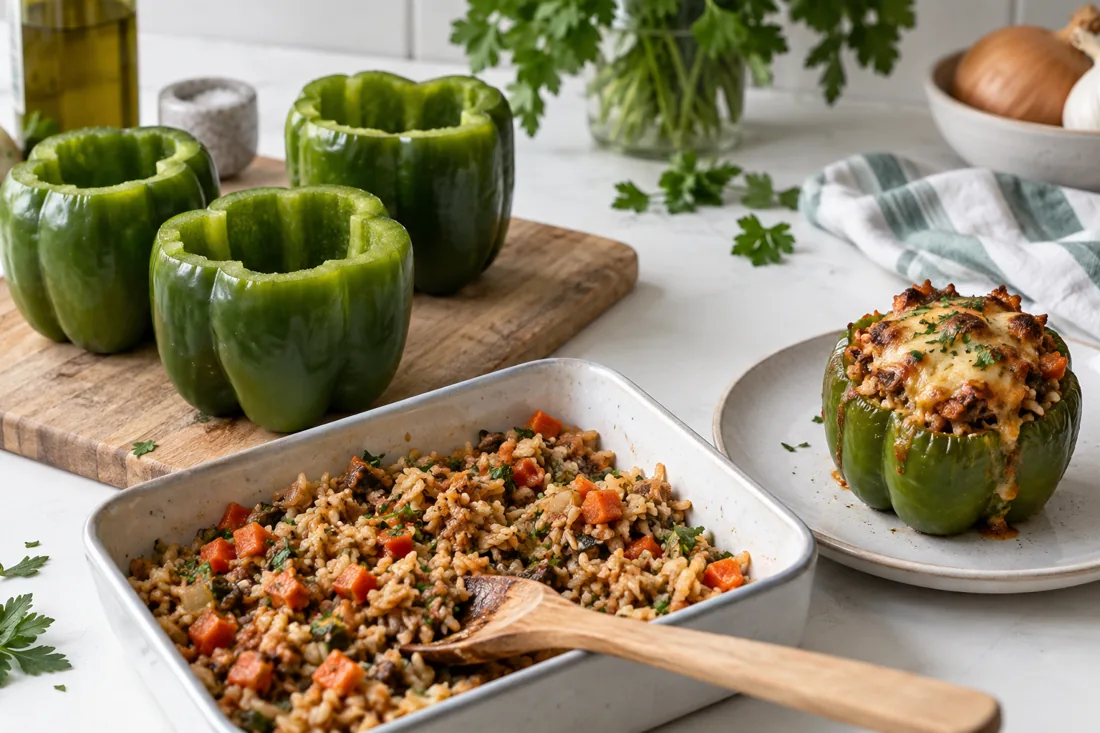
Specify the ingredient before choosing a freeze stage
The phrase "frozen stuffed peppers" can describe three purchases that should never share a specification. An IQF pepper ingredient may arrive as a strip, dice, half or suitable whole cup, depending on confirmed availability. A cooked filling is a separate prepared component. A finished stuffed pepper is an assembled entrée with a defined recipe and validated cooking instructions. Each level adds ingredients, hazards, labels, pack requirements and release checks. At GreenLand-food, our published frozen pepper supply covers pepper ingredients. It does not establish a ready-to-heat stuffed-pepper SKU.
Start the inquiry by drawing the boundary around what arrives at your plant. If you want a pepper cup for filling on your own line, give the supplier the cultivar or color preference, cup height, top opening, wall thickness, stem treatment, seed removal, acceptable tears and intended cooking method. If the visible final dish uses a full upright pepper, a photo and dimensional range tell more than a loose request for "whole peppers." The photographs on the current IQF bell pepper product page show frozen pepper pieces and cuts. They prove relevant pepper supply, while a cup form must be confirmed against an actual order and sample.
The state at delivery also matters. A frozen raw or blanched cup may require further cooking; a cut pepper may have been processed under another route. Ask for the current lot specification and any supplied cooking-status statement. Do not infer that freezing makes an ingredient ready to eat. For a product with a meat, rice or dairy filling, the manufacturer of the assembled meal owns the recipe and its food-safety validation. A pepper supplier can confirm the ingredient's origin, cut, pack and frozen-chain records, while the entrée maker must connect those records to the finished product.

Frozen red bell pepper strips shown on the GreenLand IQF pepper product page.
An early specification should describe the acceptance test, not only the frozen appearance. A cup that looks upright when frozen can collapse after filling and reheating. Decide whether the diner expects a soft, spoonable pepper or a clean, stand-up shell. If the pepper is intended for a tray meal, specify whether it must survive conveying, sauce dosing, sealing and distribution. These downstream requirements determine whether an empty cup, a fresh cup or a fully cooked assembled pepper is worth testing.
The GreenLand frozen pepper category lists ingredient options, and the IQF bell pepper product page shows actual frozen cuts. Our bell pepper freezing guide explains ordinary pepper preparation. This article takes the next step: it tests what happens when pepper structure has to carry a filling through a second heat cycle.
Compare three production routes
Run the first route with an empty pepper cup held frozen until assembly. It gives a kitchen or meal line control over filling and sauce, but the cup has already experienced ice formation before stuffing. During thawing and final heating, a cup can shed liquid and lose rigidity. A cup that is soft may still be suitable for a plated dish; it may fail a tightly packed upright tray. Keep the cup dimensions and fill weight constant during the trial so a structural result does not merely reflect a larger load.
In the second route, cook and cool the filling under the actual safety plan, freeze it separately, then combine it with the chosen pepper shell at service or before final baking. This may protect the appearance of a fresh shell, and it lets the filling and shell follow their own preparation schedules. It also adds a handling and assembly step. Check whether thawed filling spreads easily, whether rice remains moist, and whether sauce is retained. If the service kitchen cannot accommodate assembly labor, a beautiful sample may be commercially irrelevant.
The third route is a fully assembled stuffed pepper frozen as a meal. It simplifies portioning and can reduce work at service, but the packed unit has several layers that heat at different speeds. A wet filling may soften the shell during frozen storage and reheating. Cheese can brown before the center warms; tomato sauce can collect beneath the pepper. None of these outcomes is automatic. The exact formula, portion weight, container and heating profile decide whether the route works.
Prepare the same base recipe at the same fill weight for each route, and record all differences that cannot be held constant. Use a target pack and realistic freezing rate, storage interval and reheating equipment. Photograph the dish before freezing, after unpacking, after reheating and after the specified hold. Weigh free liquid in the tray and score shell shape on a written scale. This turns a vague preference for "better texture" into evidence the product team can compare.
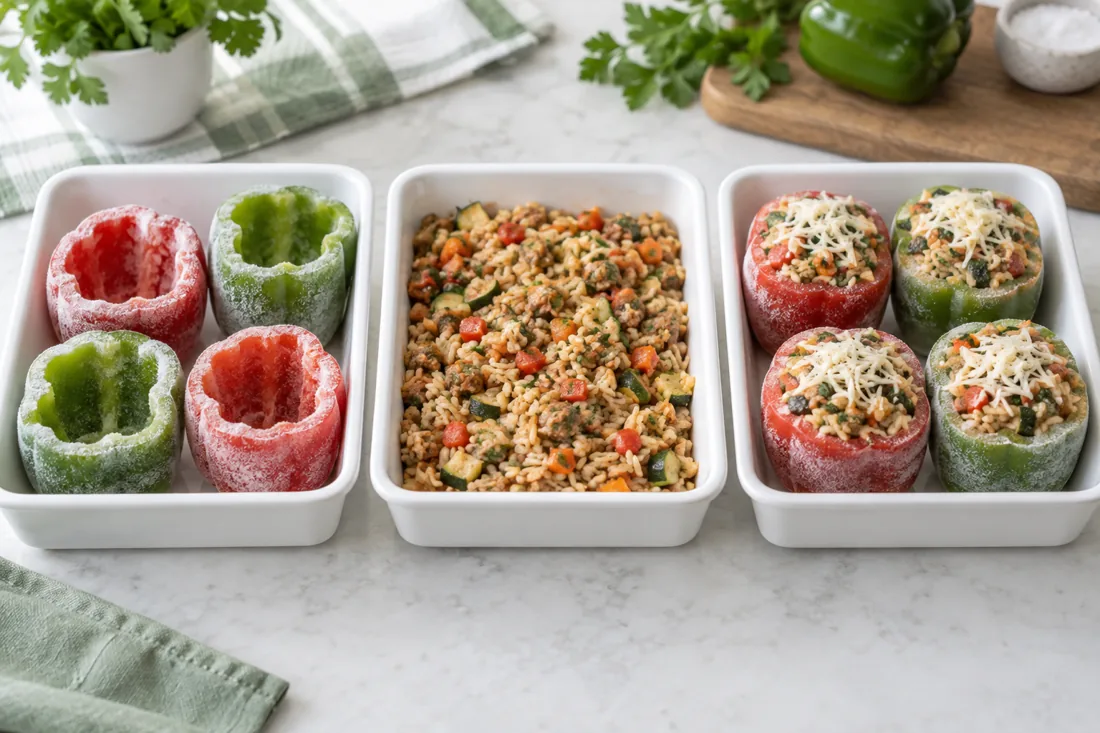
Illustrative trays of empty frozen pepper cups, cooked filling and assembled peppers.
A side-by-side comparison also prevents a false cost decision. Separate filling can improve finished appearance but consume more kitchen labor. Assembled meals can save labor but require stronger packaging or higher reject allowance if shells break. Empty cups can reduce fresh pepper preparation, yet only if the supplier can provide the required form and the post-reheat yield is acceptable. Quote each route in the unit that matters: cost per saleable served portion, including ingredient, processing, packaging and rejected units.
| Route | What is frozen | Main quality risk to measure | Service verification |
|---|---|---|---|
| Empty pepper cup | Pepper shell before filling | Slump, tears and free liquid after final heat | Cup shape and finished portion appearance |
| Separate cooked filling | Filling apart from selected shell | Dry or clumped filling and added assembly labor | Filling moisture, assembly time and center heat |
| Assembled pepper meal | Shell and filling as one portion | Uneven center heating and shell softening | Validated center check and hot eating quality |
Measure shell softness and free liquid
The pepper shell is both food and structure. Freezing damages some vegetable cells, so a thawed pepper commonly has less crispness than a fresh pepper. Baking or microwave reheating then adds another softening step. The shell's response varies with wall thickness, maturity, cut geometry, blanching or precooking history, filling moisture and heating method. It is therefore more useful to measure the cooked result than to label one freeze method "best" before a trial.
Score the shell while hot at the planned serving time. Can a portion be lifted from the tray without tearing? Does the cup stand on the plate? Does a fork cut cleanly through the skin, or does the skin peel away from softened flesh? Is the tenderness acceptable for the dish? The right endpoint is not universal. Some catered meals want a soft pepper that blends with the filling; a retail pack photographed as a whole upright pepper may need a stronger shape standard.
Collect liquid from the tray after the normal hold, while keeping sauce and pepper drip distinct where practical. A few grams of free liquid may be harmless in a sauced entrée but conspicuous in a dry rice-filled cup. The tray design can hide or amplify the puddle. Weigh and photograph the released liquid rather than calling the whole batch "watery." If one route seems wetter, inspect the filling before blaming the pepper. Tomatoes, onions and vegetables may release more liquid than the shell itself.
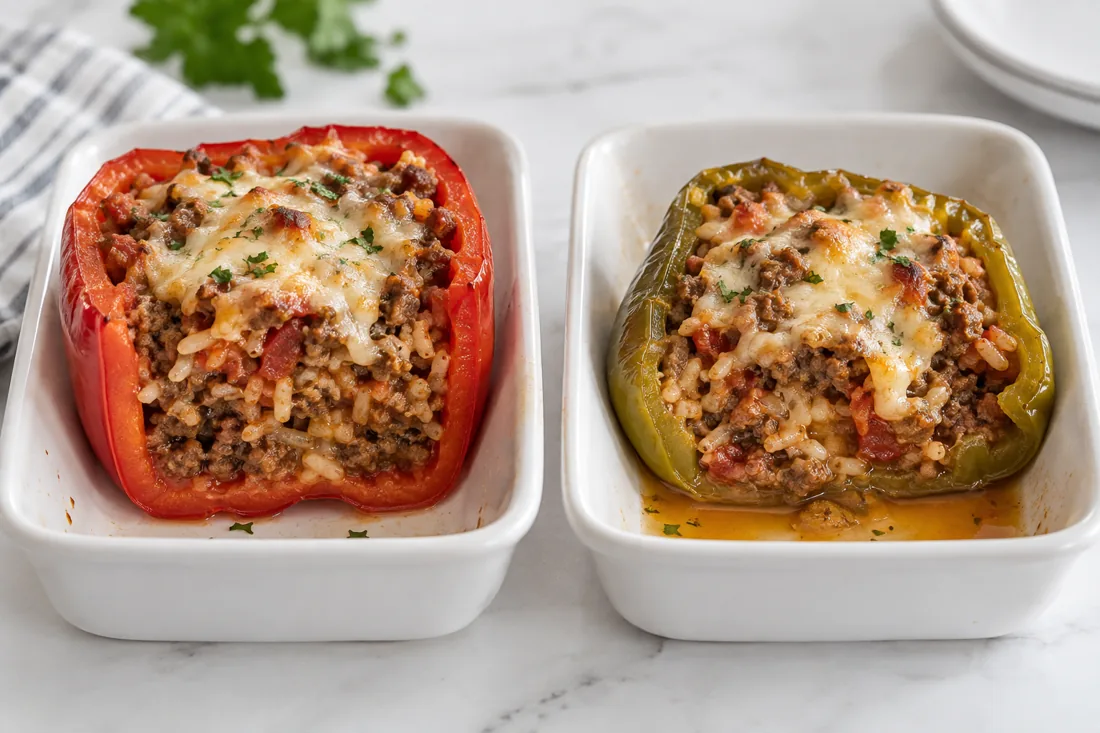
Illustrative reheated stuffed peppers with different shell firmness and liquid release.
Shell thickness is a starting variable, not a guarantee. A thick wall can provide more structure, yet a larger pepper may need longer center heating, exposing the shell to more heat. Test size bands and fill weights together. Keep the topping and sauce treatment fixed. If cheese is added only after a first heating stage, record that as part of the method rather than attributing the difference to the pepper supplier.
Use a simple score sheet with defined terms: intact cup, minor slump, major collapse, skin separation, excess free liquid and acceptable eating texture. Let trained tasters examine the same samples at the same temperature. The aim is a repeatable judgment a receiving or development team can use later, not a single attractive photograph. The score also supports an honest specification conversation with us about cut dimensions, color, frozen separation and defects within the supplied pepper ingredient.
Control the filling and reheated center
The filling makes stuffed peppers a prepared-food project. Cooked rice, legumes, meat, poultry, cheese and sauce each have different cooling, storage and heating concerns. Build the process around the highest-risk component in the actual formula and the destination market's rules. A supplier description for frozen peppers cannot validate a meat-containing entrée. Ingredient records and a finished-meal safety plan meet at the assembly step, where handling time and temperature become important.
Before freezing, document whether the filling is cooked, partly cooked or raw. A cooked filling should be cooled and frozen through a controlled process; a raw filling needs a validated final cook. Keep clear records of when sauce is added and when a pepper cup is filled. An assembled raw unit can be difficult to heat evenly because the exterior pepper cooks while the dense center warms more slowly. The actual center must be checked with a suitable probe in representative portions, including the largest unit and a cold position in the equipment.
For US retail foodservice, the FDA Food Code gives conditions for reheating cooked, cooled time/temperature control foods for hot holding. USDA FSIS advises reheating leftovers to 165°F with a food thermometer. These are useful safety references, but the exact rule for a commercial product depends on its ingredients, process, packaging, jurisdiction and label instructions. Use the applicable validated standard in the safety plan; do not copy a home recipe's oven time as a commercial critical limit. A thermometer location, standing time and post-heating hold should be specified.
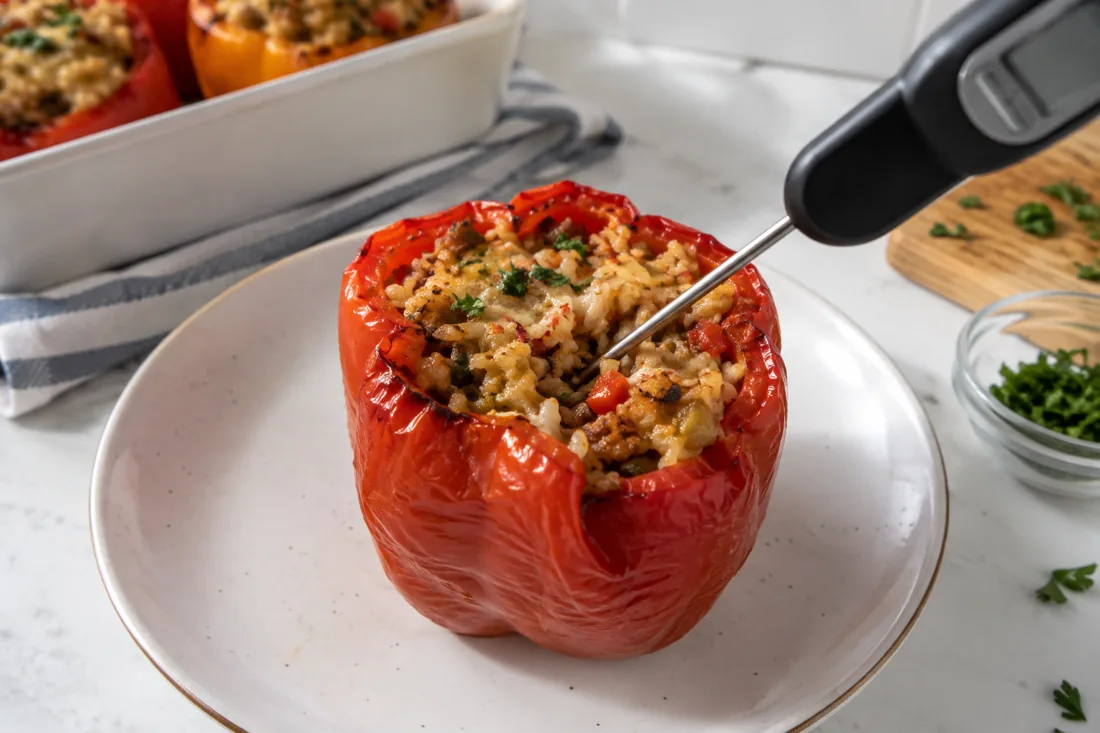
Illustrative thermometer probe in the center of a reheated stuffed pepper.
Check several points in the filling if a microwave is part of service. The outer pepper and sauce can be hot while the center remains cool. Rotation, covering and standing time may improve even heating, but performance depends on pack shape and equipment. Repeat the check after any change in portion weight, recipe viscosity, container or instructions. A frozen tray and a thawed tray may need separate validated directions.
Safety and eating quality should be recorded together. A longer bake may clear the center heating requirement but dry the filling or collapse the shell. Adjust the upstream preparation, portion depth, sauce placement or equipment profile and retest. The approved route is the one that produces a safe center and an acceptable finished plate under realistic service conditions. If either condition fails, keep the route in development.
Pack for the actual service method
Packaging determines how a stuffed pepper freezes, travels and reheats. A single-portion container can support an upright cup and give the user direct access to one meal. A larger catering tray may improve packing efficiency yet allow portions to shift or crush each other. Test the real container, lid and seal rather than a laboratory plate. Measure how often peppers tip, how much sauce migrates and whether an operator can remove a portion cleanly.
Choose sauce timing with the dish in mind. Sauce packed beneath a pepper may protect against drying but can soften the base. Sauce supplied separately can preserve presentation and permit a precise serving amount, at the cost of another pack component. Cheese applied before freezing may melt and brown differently from cheese added late in reheating. These choices influence the consumer experience and the label as much as they influence the factory line.
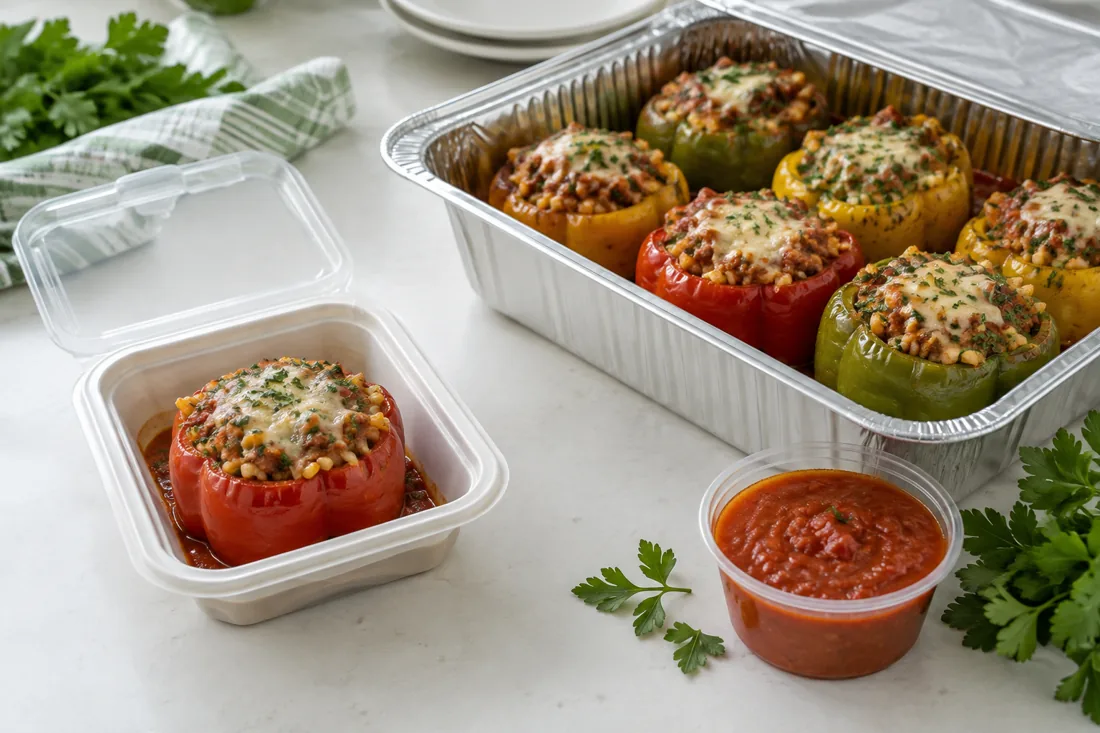
Illustrative single and catering portions with sauce packed separately.
Air exposure and compression matter for frozen quality. A loose or poorly sealed pack can encourage surface drying and freezer burn, especially around exposed pepper rims and rice. Excess headspace may let a portion move during distribution. Over-tight packaging can deform a soft cup. Verify seal integrity, drop or vibration tolerance where relevant, and the frozen-chain conditions promised to the buyer. Use the actual distribution duration in the trial; a fresh pilot sample says little about a portion after transport and storage.
The service method should appear on the development brief before the pack is chosen. Oven finish, microwave reheat, combi-oven, buffet hold and plated regeneration give different heat distribution and surface results. A tray that works in an oven may be unsuitable for the microwave. A lidded microwave pack may trap moisture that softens the pepper, while an open oven tray may dry rice. Test the route that the customer will actually use.
When requesting frozen pepper ingredients, give us the required packing format, net weight, order quantity, destination and cold-chain handoff. For a cup application, also ask us to confirm whether the requested whole or cup cut is currently available. The frozen pepper supply page can start that discussion; the meal pack itself is specified and validated by the prepared-food producer.
Approve a repeatable pilot and pepper specification
Set one written pilot before collecting attractive samples. Define the pepper source and size band, cup or cut geometry, filling recipe, fill weight, cooking state, freezing method, storage period, pack, heating equipment and serving hold. Give each trial batch an identity and retain the ingredient lot records. This allows a failed shell or cold center to be traced to the actual configuration rather than dismissed as random variation.

Frozen green bell pepper strips shown on the GreenLand IQF pepper product page.
Compare three route samples after the same service process: empty frozen cup plus filling, separately frozen cooked filling with the selected cup, and assembled frozen entrée. Measure center temperature under the applicable validated plan, hot shell integrity, free liquid, serving yield, sensory acceptance and assembly labor. Photograph the whole portion and the cut center. If the final product is sold as a meal, run the sensory check after the promised storage interval and again after realistic distribution, not just on production day.
The pepper ingredient specification should include the form we actually agree to supply, color, size or dimensions, cut tolerance, stem and seed treatment, defects, broken percentage, frozen separation, pack and required documents. If a cup is requested, obtain a current physical sample and written confirmation; a catalog image of strips is not a cup approval. For applications using strips or dice in a deconstructed pepper meal, the existing IQF forms may be a better and simpler fit. That is a product-design choice, not a downgrade.
Approve a route only when both teams know their responsibilities. We can prepare and document frozen pepper ingredients against the confirmed order specification and coordinate factory-direct wholesale supply. The meal producer controls the filling, assembly, packaging, cooking instructions, finished-product microbiology and shelf-life validation. If the first trial fails, change one variable at a time: pepper wall or size, filling moisture, sauce position, freeze stage, pack or heat profile. Then repeat the same measurements. This provides a defensible improvement path without claiming that one universal stuffed-pepper recipe always freezes well.
The final purchasing decision is the one that gives a safe, saleable portion in the intended service setting. Ask for a frozen pepper sample that matches the proposed form, then test it in your actual recipe and equipment. Record the result as a finished-meal requirement so future ingredient lots can be checked against the same expectation.
One useful pilot variation is to separate the visible product promise from the ingredient route. If a retail pack promises a whole, upright pepper, the panel can define minimum standing height, acceptable leaning and the amount of filling visible after reheating. If the product is sold as a sauced tray meal, appearance can be judged in the tray after transport and heating. These descriptions turn an aesthetic preference into an acceptance limit. They also keep the supplier discussion focused: pepper wall and cut tolerance are ingredient variables; tray movement and sauce migration belong to the finished-meal design.
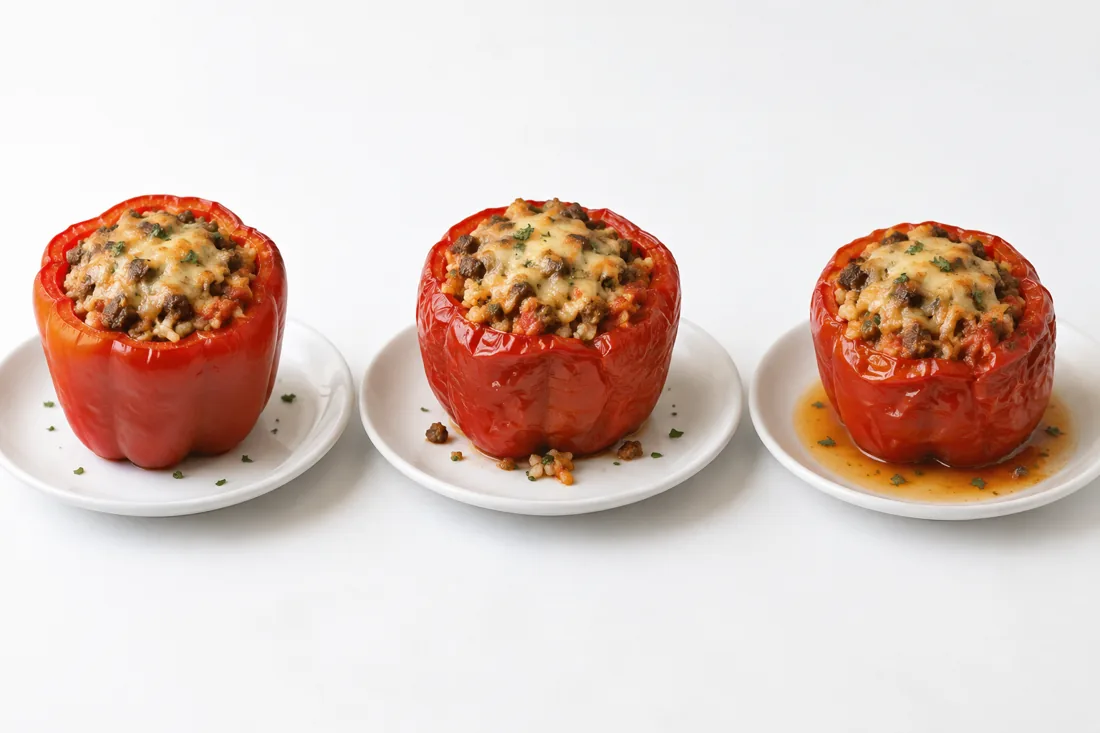
Illustrative side-by-side reheating trial for three stuffed pepper portions.
Record failures as carefully as successes. A collapsed shell, dry rice or cool center should be tied to a lot, position in the oven or microwave, pack type and time after heating. If failures cluster at one tray corner, heat distribution may be the cause. If they follow a particular pepper size across packs, ingredient geometry may matter. A development log with photos and measurements is more useful than repeatedly changing recipes without knowing which condition moved. The next pilot should test the most plausible variable while holding the rest fixed.
Scale-up needs another check. A small bench batch may freeze quickly on an open tray, while a full production load enters a different freezer arrangement and sits in a sealed retail package. Filling temperature at assembly, time before freezing and pack density can change the thermal path. Before setting a finished product specification, repeat the chosen route at representative line speed and load. Confirm that the approved reheating instructions work at the upper portion-weight tolerance, because the heaviest accepted unit is often the hardest to warm through while preserving shell quality.
Finally, plan how the result will be checked at receiving and over time. The meal producer can inspect frozen portions for upright position, damaged rims, leaked sauce and pack integrity, then reheat a defined sample at release and after storage. If a pepper ingredient lot changes size distribution or wall thickness, a reference cook can reveal its effect before a full meal run. These controls need a sampling plan and agreed tolerances; they should not be presented as universal numerical limits. Their value is continuity between the successful pilot and the commercial product.
Agree on a change-control trigger before launch. A new filling supplier, different rice hydration, larger pepper, deeper tray or revised reheating direction can invalidate the comparison that selected the route. Put the approved recipe version, pack drawing, largest accepted portion weight and heating method on the pilot sheet. When one of those changes, repeat the relevant center-heating and eating-quality checks rather than treating the old result as transferable. This matters especially for contract manufacturing, where an ingredient buyer and meal producer may hold different parts of the specification. One shared reference sample and a short written release protocol make the handoff much easier to audit.
For the commercial RFQ, separate pepper requirements from finished-meal requirements in two columns. We can respond to the frozen ingredient form, size, color, defects, pack, quantity and destination. The prepared-food partner should answer questions on filling safety, assembly, meal packaging, cooking instructions and shelf life. This division gives purchasing a useful quote without implying that a pepper ingredient quotation approves the entire entrée. It also makes a rejected pilot actionable: the team can identify whether the next sample should change the pepper, the filling, the pack or the heat profile.
Source Frozen Pepper with GreenLand-food
GreenLand-food is a professional frozen pepper supplier and manufacturer in China, providing factory-direct wholesale supply for importers, food manufacturers, distributors and private-label programs.
Send the product form, specification, packing, quantity, application, destination, private-label needs and requested documents. We will confirm the current offer and representative sample route.