


Mango Puree for Drinks: Frozen Input, Brix and Pourability
Sep 27, 2026
Leave a message

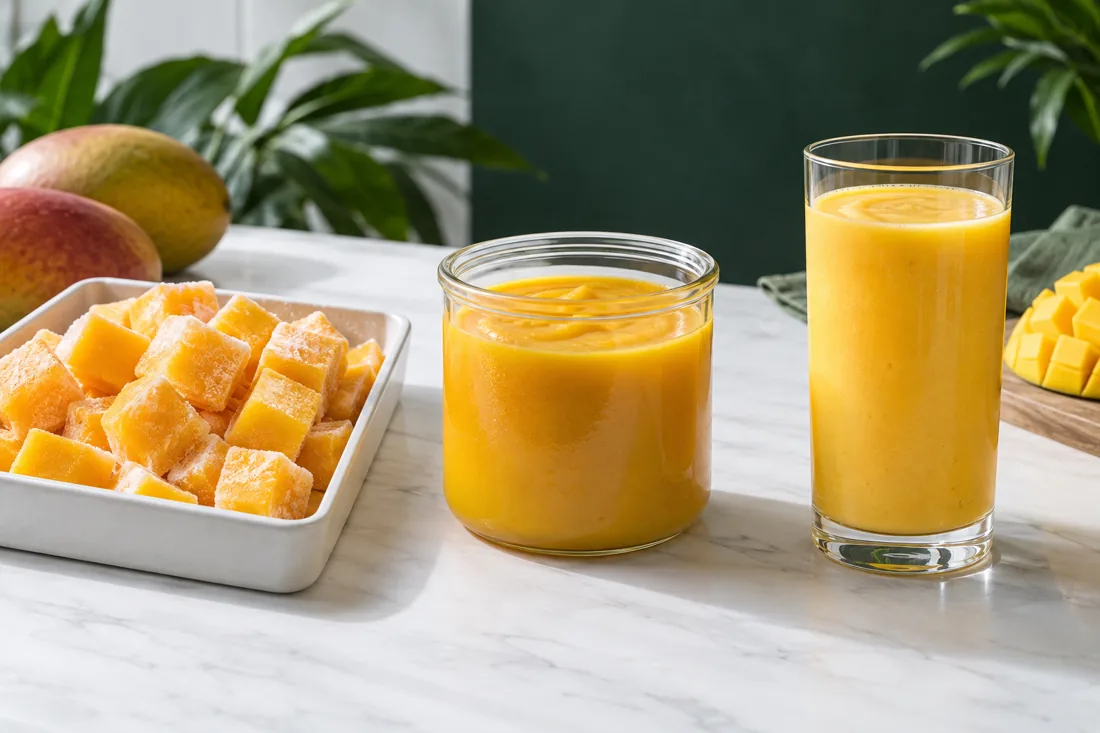
Choose IQF pieces or prepared puree for the drink
Start by naming the physical input that will enter the beverage plant. IQF mango chunks or dice are recognizable fruit pieces with flexible uses beyond drinks. They require thawing or direct controlled processing, pulping and possibly finishing before they become a beverage base. Prepared puree has already passed through a supplier's pulping and finishing route. It can save line time, but its fiber level, particle size and thermal history are partly fixed before the beverage maker receives it. "Puree" is therefore a process description that needs a sample and a specification, not a promise of identical texture across suppliers.
The GreenLand frozen mango category lists puree among available forms, while the mango frozen chunks page shows a confirmed IQF cut. Ask us to confirm which form can be supplied for the current order, its variety and origin, whether any sugar or other ingredient has been added, and its pack. An IQF piece can be a good starting point when the plant wants to control sieve size and pulp retention. A prepared puree may be preferable when the desired texture and process are already matched to the supplier's sample.
Keep as-received comparisons separate from fruit-equivalent comparisons. One kilogram of frozen pieces includes fruit water and fiber; one kilogram of a prepared puree may have been screened, diluted, concentrated or otherwise processed. Even two single-strength purees can differ in usable solids and screen residue. Request composition and processing declarations, then calculate the contribution to the actual formula. The quote should state units, frozen or aseptic condition, pack size, transport temperature and any minimum order quantity before the development team assumes one route is cheaper.

IQF mango cubes shown on the GreenLand frozen mango product page.
The existing GreenLand mango packaging guide explains fruit-form and packing differences. This decision continues at the beverage line: how much input survives the screen, what remains suspended, and whether the drink pours as intended. A form that works in a smoothie may be too fibrous for a narrow nozzle or a clear-looking fruit drink. Conversely, aggressive screening may remove the body and mango character that consumers expected. Name the drink's target before choosing the input.
| Input route | Processing before blending | What the pilot must weigh | Decision affected |
|---|---|---|---|
| IQF mango pieces | Thaw or process, pulp, then finish | Screen residue, transfer loss and usable puree | Line labor and fruit yield |
| Prepared mango puree | Confirm composition, mix and possibly re-screen | Pack residue and any additional screen loss | Ingredient cost and throughput |
Measure fiber and screen loss
Mango flesh can contain fibers that affect both the processing line and the mouthfeel. Variety, maturity and pulping method change the quantity and form of the fiber. FAO's tropical fruit processing chapter describes the commercial importance of fibrous mango cultivars and the role of pulping and finishing. It does not give a universal screen for every GreenLand lot. The screen size belongs to the beverage design, because the acceptable particle profile depends on the package, pump, nozzle and expected drinking sensation.
Set up a simple mass balance for each candidate input. Weigh the thawed IQF fruit or prepared puree at entry, then weigh puree after pulping, material retained by a specified screen, transfer loss in vessels and hoses, and final usable base. Keep the screen specification, temperature and mixing time identical. A fine sieve may remove more visible fibers and skin specks, but it can also discard a meaningful share of saleable fruit. A coarse sieve can increase usable output yet leave strings or graininess in the cup. Record both, rather than choosing on apparent smoothness alone.
Inspect the retained residue. Fibrous strands, peel fragments and hard foreign matter are not equivalent findings. Fiber can be a normal cultivar feature whose level needs a defined tolerance; peel or foreign material may trigger a different QA response. Photograph the residue and weigh it as a percentage of input. If a line needs several passes or frequent screen cleaning, include that labor and downtime in the route comparison. These costs can outweigh a small difference in ingredient price.
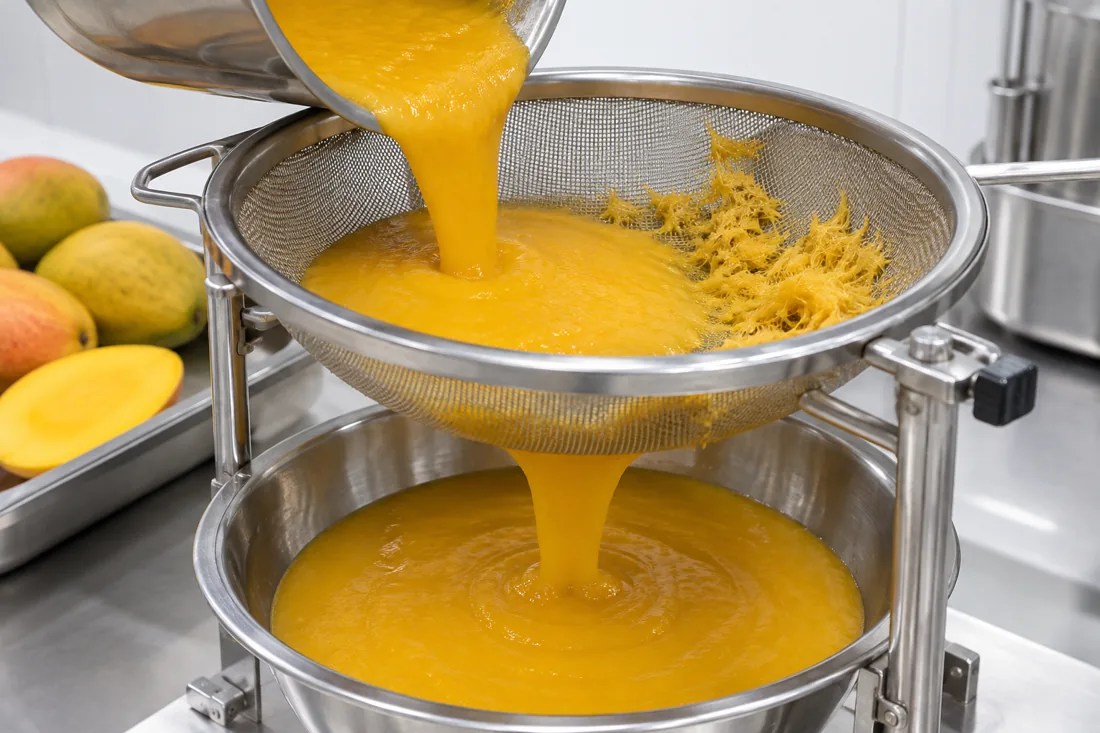
Illustrative mango puree passing through a sieve with fiber retained on the screen.
Sample the output at normal serving dilution. A puree can feel smooth at full strength but expose fibers when mixed with water. A milk base may hide visible particles while still feeling gritty or stringy. Use a trained sensory description and, where available, particle-size or sieve-retention measurements. Avoid asserting a numerical fiber limit without a target drink and actual acceptance trial. We can confirm fiber condition in the ingredient order, while the beverage producer should approve how that fiber behaves after its own processing.
If the prepared puree appears much smoother, ask what finishing or enzyme treatment produced the difference and whether that treatment is acceptable for the intended label and market. If IQF pieces give a preferred flavor but a difficult residue, adjust pulping and screening before concluding that the fruit form is wrong. A controlled trial separates ingredient behavior from equipment settings.
Judge sediment and mouthfeel at serving strength
Suspended mango particles give a drink body, but they can settle during storage. The visible sediment line may become a consumer complaint even when the beverage initially tastes good. A thick puree can slow settling, yet higher viscosity can also make filling and pouring harder. A clear or lightly cloudy mango drink has a different acceptance target from a smoothie or nectar. Define whether the consumer should shake the package, whether visible pulp is desired, and how long the product must remain attractive after filling and during service.
Measure sediment in the actual formulation, not in a beaker of pure mango. Make a matched control batch with the same fruit-equivalent amount, water, sugar, acid and other ingredients. Fill clear test containers of the intended shape and examine them at a fixed time and temperature. Photograph the top, middle and bottom. Record a sediment height or mass using a repeatable method, then gently resuspend and assess whether the drink returns to its original mouthfeel. A compact hard layer and a loose, easily resuspended layer are different practical outcomes.
For dairy or whey beverages, run a separate compatibility test. Protein interactions and the drink's pH can change appearance, viscosity and settling. A published whey-mango study discusses sedimentation as a challenge in mixed beverages; it is evidence that the issue deserves testing, not proof that any particular GreenLand ingredient will fail. Check stability, curdling or separation under the actual heat treatment and storage conditions. Do not transfer a result from a water-based drink into milk without a new trial.

Illustrative mango drinks showing settled pulp beside a uniform sample.
Evaluate mouthfeel with the sediment result. One candidate may have fewer visible fibers but feel thin after dilution. Another may have pleasant body at opening yet become grainy after several days. Test the drink cold and, if relevant, at room-temperature service. Note coating, stringiness, pulp particles, ease of swallowing and aftertaste. A pumpable puree is not automatically a drinkable finished formula; the two viscosity endpoints occur at different concentrations and temperatures.
Stabilizers and homogenization can be tools in beverage development, subject to formulation, labeling and process validation. They should not be used as an assumed repair for an ingredient that has not been characterized. First identify whether sediment comes from large mango particles, protein interaction or another component. Then compare a targeted process change with the original route and document its effect on flavor and cost.
Balance sweetness, acidity and color after dilution
Measure Brix and pH for incoming samples, but interpret them in context. Brix approximates soluble solids; it does not tell the whole story of sweetness, fiber, viscosity or fruit concentration. Two mango ingredients at the same Brix can taste different because variety, acidity, aroma and processing history differ. A high Brix sample can become weak after the final dilution if its aroma is low. A lower Brix sample may taste fuller because it retains a desirable ripe mango note.
Prepare the comparison at the target serving dilution. Keep fruit-equivalent addition and added sugar recorded, then check soluble solids, pH, titratable acidity where relevant, color and sensory balance. The FAO mango nectar discussion describes blending puree with water, sugar and acid according to raw material and desired use. It does not supply one number that should be copied into every beverage. The target depends on whether the product is a smoothie, nectar, fermented drink, milk beverage or a diluted foodservice base, as well as destination-market composition and labeling rules.
Color must be judged in a transparent or opaque final package under normal light. A rich golden puree can become pale at serving dilution. Heat treatment can change the color further. Compare samples before and after the planned process, and during the intended storage trial. If a puree has already received heat treatment, request that information; if IQF pieces are processed on your line, account for the heat step you apply. Keep photographs with a consistent white background and lighting so a supplier sample can be compared fairly with later production.
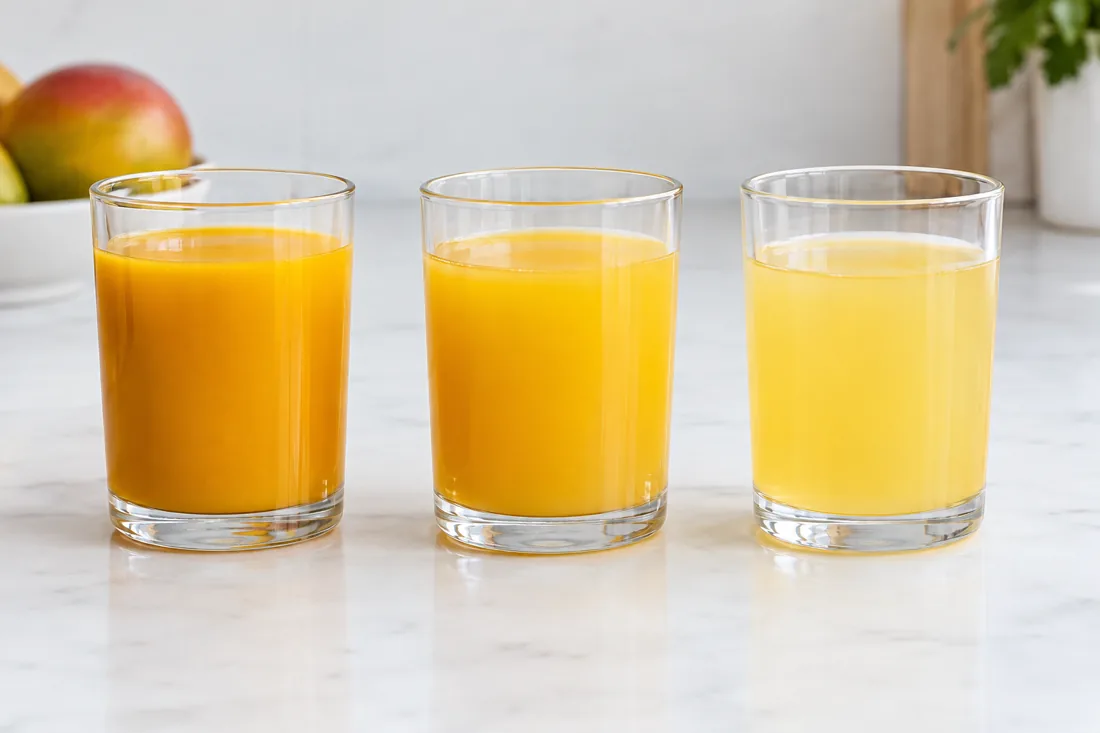
Illustrative mango drinks showing color at three serving dilutions.
Do not chase sweetness alone by adding more fruit. Increasing mango dosage also changes particle load, viscosity, sediment and cost. Likewise, adding acid can sharpen flavor but may influence a dairy matrix or the thermal process. Move one formulation variable at a time, then taste the final drink at its actual temperature. Record a reference formula and a sensory acceptance range that can be repeated when the crop lot changes.
Our product specification discussion can include variety, maturity, Brix, color and fiber condition for the mango input. The beverage maker should translate those ingredient ranges into finished-product limits. If a later lot falls within the purchase specification but the drink differs materially, the first question is whether the ingredient spec captured the variable that the formulation needs.
Test water and milk bases separately
Water-based mango drinks expose fruit aroma, acidity, color and pulp sediment directly. A sample that looks bright and pours well in water can be assessed for screen residue and cloud stability without the added complexity of protein. It remains necessary to verify its processing and microbiological controls; fruit and water do not become safe through blending alone. The intended package, heat treatment and destination rules should be part of the development plan.
Milk and whey systems need a separate pilot because their protein, fat and acidity change the behavior of mango puree. A fruit preparation may be added before or after a dairy heat step, and that sequence can change viscosity, particle size and sensory quality. Examine separation, curdling, sediment, color and flavor after the real process and during storage. A water drink's pH target cannot be copied uncritically into a dairy formula. The beverage producer's technical and food-safety team should validate the formulation.
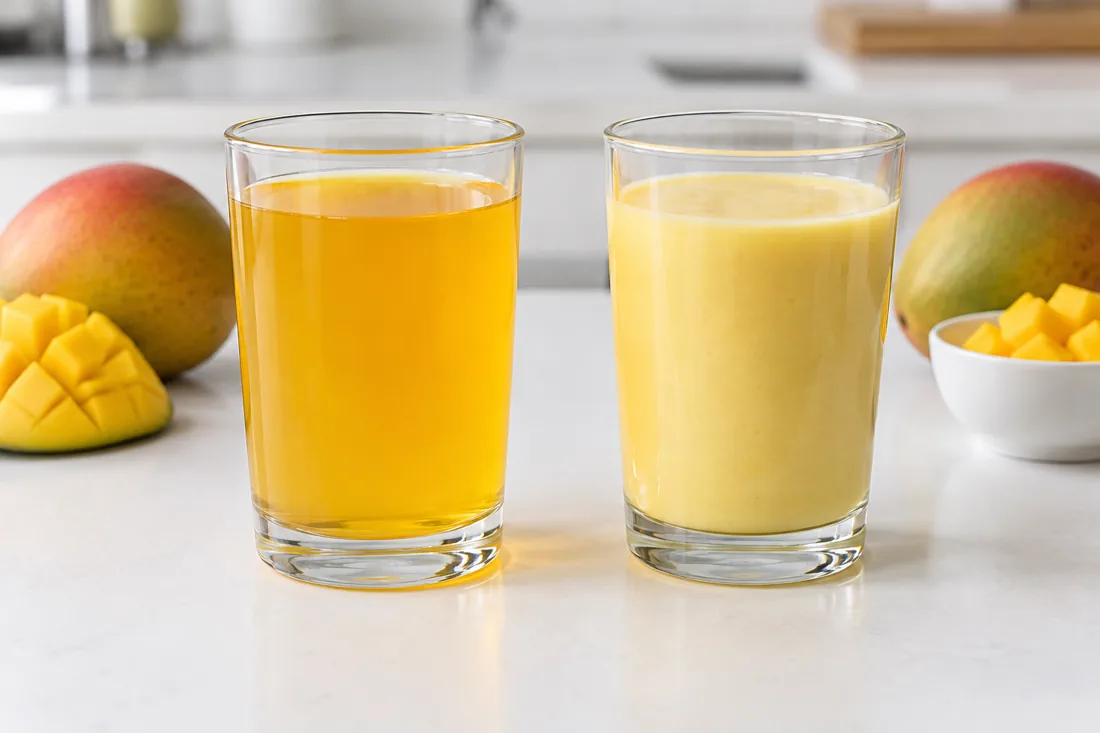
Illustrative mango drinks in water and milk bases.
For foodservice smoothies made shortly before serving, a certain amount of pulp may be welcome, and long-term shelf sediment may matter less. Yet screen residues and blender throughput still affect cost and consistency. A bottled drink intended for weeks of distribution has different stability and packaging requirements. Name the service life and handling conditions in the brief so the same puree is not approved under an easier use and quietly moved to a harder one.
Keep a matched fruit dose across water and dairy trials, then allow separate adjustments for acid, sweetener and stabilizer where the product concept requires them. Record the actual addition rate and the final sensory score. If a mango lot has a stronger aroma but more fiber, it may suit a smoothie while a smoother puree suits a bottling line. This is a legitimate split in purchasing specifications, even when the mango source is the same.
Do not treat a supplier's application list as proof of finished-drink performance. A product page can correctly say that mango is suitable for beverage development while a specific milk formulation still needs its own process study. We can provide ingredient samples and documents for evaluation; the buyer's product team confirms the finished formula.
Calculate usable output and cost per finished liter
The cheapest mango ingredient per kilogram may cost more per finished liter if it loses substantial mass on the screen or requires extra processing. Calculate from delivered input to saleable beverage. For IQF pieces, include thaw handling, pulping, screen residue, transfer loss, labor, energy and any additional heat treatment. For prepared puree, include its pack yield, transfer loss, need for re-screening and storage conditions. Include rejected beverage during the trial if a route fails sediment or sensory acceptance.
Use one written mass balance. For example, record 100 kilograms of each as-received input, the kilograms of usable puree base after the specified screen, and the liters of finished drink at the agreed fruit contribution. This is a proposed calculation framework, not a GreenLand production result. Do not assume that every liter weighs exactly one kilogram; use the measured density or plant formulation records if precision matters. Compare delivered prices only after the output basis is clear.
A route with higher fruit retention can still lose on operations. Slow finishing, blocked screens or labor-intensive cleaning may limit line capacity. A prepared puree may shorten processing but cost more to purchase or carry a pack format that produces more waste at small batch size. A bulk drum and a foodservice pouch serve different production scales. Compare the same order quantity and destination, including frozen storage or aseptic handling, before extrapolating a laboratory trial to a commercial quote.

Illustrative mango pieces, screen residue, usable puree and a finished drink.
The final comparison should carry more than one number. Put screen residue, usable yield, finished Brix and pH, viscosity or pour behavior, sediment after the agreed hold, sensory preference and cost per liter beside each other. A technically acceptable route may still be too expensive for the target price point. A low-cost route may fail a premium drink's mouthfeel. Approval is a product decision supported by measured tradeoffs.
When a customer requests a GreenLand quote, we can align the fruit form, packing, quantity, destination and relevant documents. We should not invent a finished beverage yield from a frozen-fruit specification. Ask for a sample quantity adequate for both bench and pilot-line testing so the loss and throughput estimates are based on the equipment that will actually run.
Confirm the mango lot and supplier specification
An approved prototype is only useful if future lots can reproduce it. Specify the mango form, variety or type where material, origin, maturity, cut size for IQF pieces, or finishing level for puree. Confirm Brix, pH or acidity as applicable, color, characteristic aroma, fiber condition, foreign-material limits, packaging and storage. The actual lot sample should be assessed in the reference drink formula, not just tasted neat. State how a deviation will be handled before production begins.
For IQF mango pieces, ask about separation, broken-piece tolerance, ice or clumping, pack integrity and frozen-chain records. These influence handling and thaw yield. For puree, confirm whether it is single strength or concentrated, sweetened or unsweetened, frozen or aseptic, and what ingredients and processing declarations accompany it. The GreenLand category lists puree, but its current availability, exact composition and pack must be confirmed with a current quote and lot specification. Never infer them from an image of frozen chunks.
Request a certificate of analysis and the documents your market and process require, then verify which facility and order they cover. A generic list of possible certifications is not evidence that every document applies to every lot. Ask for sample labels and shelf-life or storage guidance for the ingredient format. The beverage maker still validates its own heat treatment, microbiology, packaging and finished shelf life.
Retain a comparison sample and the pilot worksheet. Record the ingredient lot, screen mesh, processing temperature, fruit dose, finished Brix/pH, sediment method and sensory panel notes. If an incoming lot changes the drink, these records show whether the source fruit, process settings or formula moved. We help purchasing teams confirm the ingredient parameters and factory-direct wholesale shipment details; the formulator closes the finished-drink decision with its own evidence.
The right mango puree for a drink is the one that delivers the intended color, flavor, body and stability at a repeatable usable cost. Start with a matched sample trial, and let its measurements determine whether IQF pieces or prepared puree fit the line. Send the drink format and target package with the RFQ so the ingredient sample addresses the real production question.

Small frozen mango dice shown on the GreenLand frozen mango product page.
When several suppliers are compared, use the same sample-handling instructions. A puree that is fully thawed and mixed will appear different from an IQF-piece batch blended while partly frozen. Standardize temperature, mixing energy, screen mesh, water quality and time between preparation and evaluation. Keep retained samples for a second sensory session rather than selecting a route from one tasting. This is especially useful when mango aroma is subtle after dilution: the panel can compare coded drinks at the same serving temperature, while operations staff separately record screen cleaning and pump behavior.
Translate the pilot into a practical incoming check. A small representative sample can be measured for Brix, appearance, aroma and agreed fiber or sieve residue before the plant commits a full beverage run. Use a lot reference and an agreed escalation route when the sample is outside the approved range. A passing ingredient check does not replace finished-drink testing, but it can catch a material shift early. The buyer should also revisit the mass balance when the pack size or line equipment changes; the cost per liter approved on one pilot line may not transfer unchanged to another.
Define how the plant will respond to a marginal lot. If Brix is within contract tolerance but aroma is weaker in the reference drink, a formula adjustment may be possible; a change in coarse fiber could instead require new screening time or reject the lot for a clear beverage. Record who can authorize an adjustment, what must be retested and which label or nutrition values could be affected. This prevents an informal production correction from turning a qualified mango input into an unvalidated finished drink. It also helps sourcing compare suppliers on consistency and response time, alongside price and sample quality.
Source Frozen Mango with GreenLand-food
GreenLand-food is a professional frozen mango supplier and manufacturer in China, providing factory-direct wholesale supply for importers, food manufacturers, distributors and private-label programs.
Send the product form, specification, packing, quantity, application, destination, private-label needs and requested documents. We will confirm the current offer and representative sample route.