


Passion Fruit Filling from Frozen Pulp: Acid, Seed and Set Decisions
Sep 27, 2026
Leave a message

For a bakery or food manufacturer, the starting material has its own specification. A frozen seed-in pulp portion and a smooth seedless puree behave differently at the sieve, depositor, and finished bite. A quotation for frozen passion fruit should identify the offered form and lot; a buyer should validate the filling recipe and finished-product shelf life separately. At GreenLand-food, we can discuss frozen passion fruit formats and supply requirements. We do not treat a raw fruit ingredient as a ready-to-use pastry filling or promise bake or freeze-thaw performance without a tested formulation.
Start with the filling application, then choose the pulp
The destination is the most useful starting point. A chilled tart assembled after the shell is baked needs a filling that deposits cleanly and holds an attractive surface at serving temperature. A hand pie places the filling inside dough before baking, so leakage, boiling, and moisture movement into the crust matter. A molded dessert insert may look perfect while frozen but must remain neat after thawing in a display case. These are different technical requests even when all three products are called passion fruit filling.
Write down the sequence in which the product will see the ingredient. For a cold-filled tart, that might mean prepare the fruit base, cook or hydrate a chosen thickener, cool it, deposit into a baked shell, chill, display, and serve. A bake-in pastry adds oven exposure while the filling is enclosed, followed by cooling and perhaps retail holding. An entremets insert may be deposited, frozen, demolded, placed inside a mousse, transported frozen, and thawed before cutting. The formulation and tests have to cover that real sequence. A spoonful in a bowl is an early taste check, not a finished-product approval.
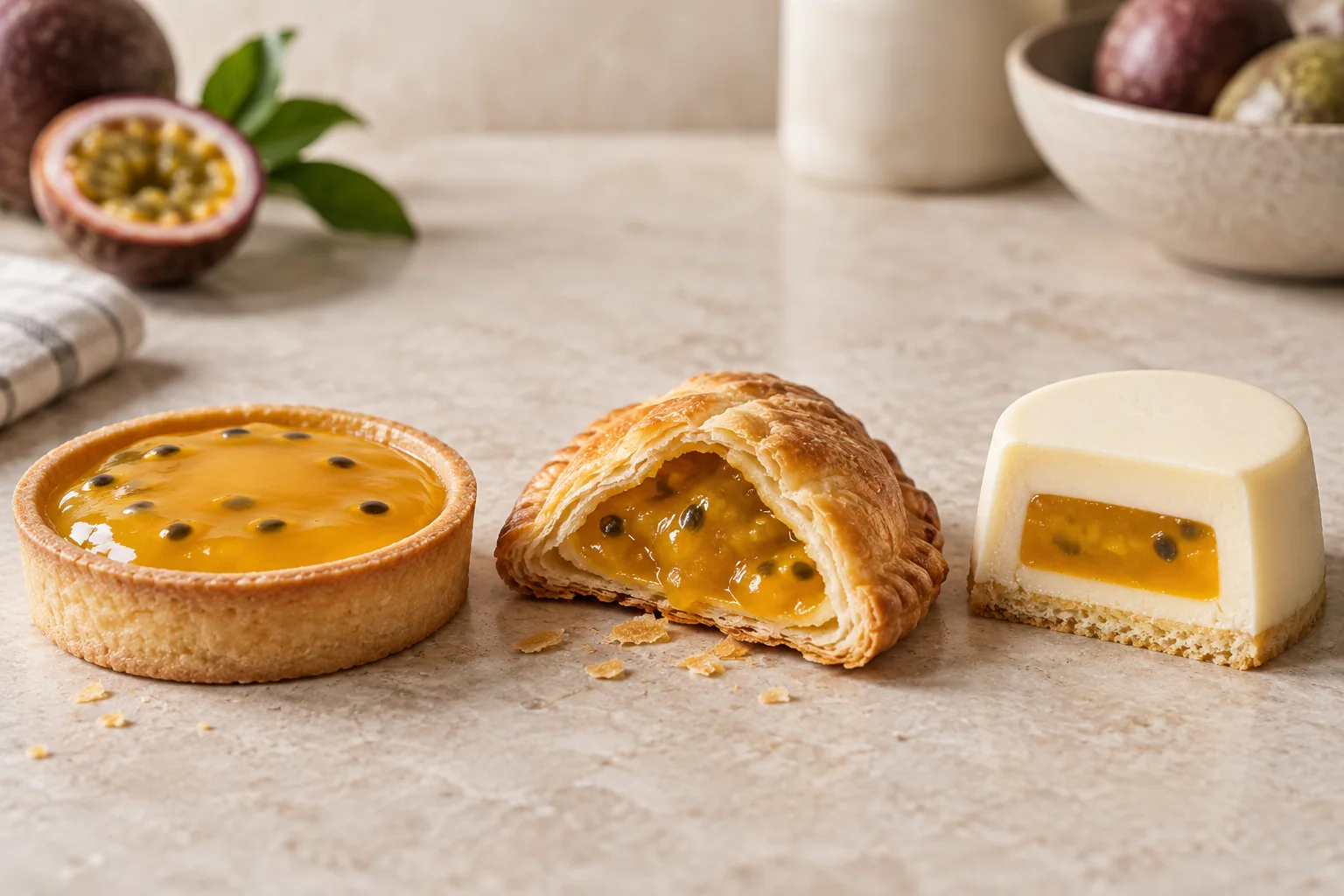
Cold tart, baked pastry and chilled insert illustrate different passion fruit filling applications.
The search results show why application matters. King Arthur Baking's passion fruit bars use a seedless puree in an egg-based curd layer that is cooked, strained, then baked on a crust. Ponthier's passion fruit cream uses a different system with pectin, starch, fats, and seeds managed separately. Both are credible pastry examples, yet one cannot infer that their methods will give the same deposit viscosity or freeze-thaw result. An industrial buyer should treat them as examples of design choices, then run the desired process with its own ingredients and equipment.
The product brief should be practical. Specify whether the finished filling should be smooth or visibly seeded, spoonable or sliceable, hot-filled or cold-deposited, and whether the pastry will be baked after filling. Note the expected frozen and chilled holding steps and the desired eating temperature. These details tell the development team which pulp form to sample and which defects to watch for. If two customer products have different routes, make two briefs. A single "passion fruit filling" specification can hide a large difference between a refrigerated topping and a bakery inclusion.
Commercial ready-to-use fillings can be a useful benchmark, but they are a separate category. Puratos describes its Vivafil range as pectin-based, ready to use, and designed for bake and freeze-thaw stability. A Bakels passionfruit Pastryfill specification lists a formulated blend containing water, sugar, passion fruit components, modified starch, and gums, with a bake and freeze-thaw stability claim for that product. Those claims belong to the named finished fillings. GreenLand frozen passion fruit pulp is a fruit input for the buyer's own formulation; its value is flavor and controlled raw-material supply, while the filling's final performance must be established in the buyer's recipe.
Know what the frozen passion fruit pulp actually contains
Before adjusting sugar or pectin, identify what is inside the frozen pack. "Passion fruit pulp" can refer to seeded edible interior, a sieved puree, a sweetened preparation, or a blended fruit base depending on the producer and market. They do not have interchangeable solids, acidity, texture, or label declarations. The purchase specification should name the exact product, ingredient statement, seed status, pack size, net weight, origin, and lot identity. Ask for a current sample and specification instead of relying on a photograph or a generic category name.
The first bench step is to thaw a representative sample under controlled food-safe conditions and observe it before adding other ingredients. Measure its actual temperature, appearance, aroma, seed distribution, free liquid, and visible fiber. A frozen block or portion can look uniform while ice is present; after thawing it may show a distinct juice layer or settled solids. Mix it as the production instruction requires, then take a consistent sample for measurements. The observed separation is not automatically a defect, but it matters when a depositor must deliver the same fruit concentration to every pastry.
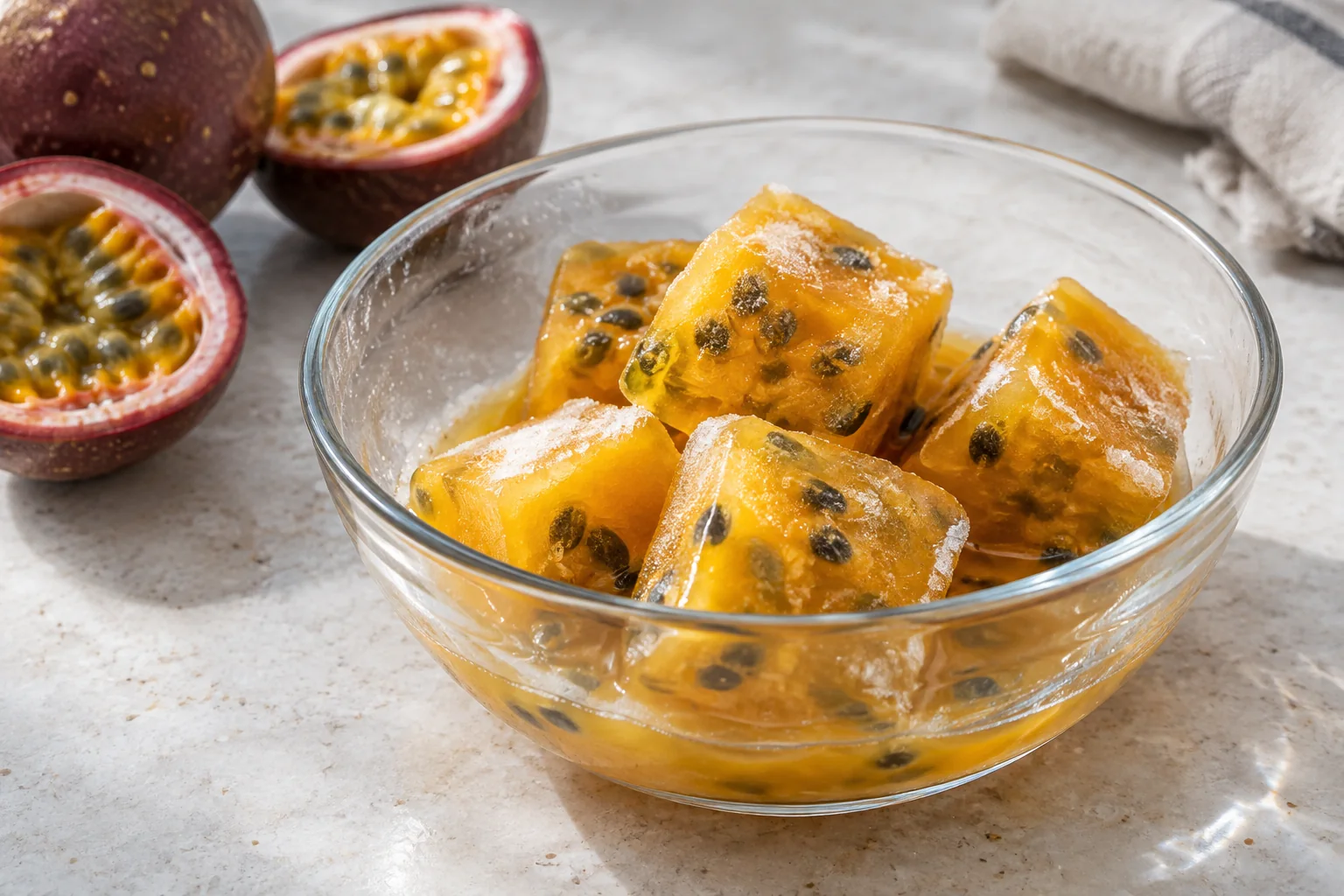
Frozen passion fruit pulp cubes thaw with visible liquid and intact seeds.
Measure pH and soluble solids with calibrated tools and a documented sampling method. Record titratable acidity if that is part of the formulation control plan. These measurements answer different questions: pH describes the acidity environment relevant to flavor, microbial controls, and some gelling systems; soluble solids reflect dissolved material and help track variation, but a refractometer reading is not a complete ingredient analysis. The finished filling may contain added sugars, starches, fats, eggs, or other components, so its final values cannot be copied from the pulp certificate. Set acceptance bands from trial data and the selected formulation, then compare future lots against them.
Do not equate orange color with the same fruit strength. Variety, ripeness, growing conditions, processing, and seed content can change the sensory profile. A stronger aroma may make one batch seem more acidic even when its measured pH is similar. Taste a controlled dilution or standardized reference preparation alongside the technical measurements. Check for cooked notes, excessive bitterness from seed damage, and any off-odors after thawing. That evaluation should include the intended pastry matrix, because cream, white chocolate, butter, and baked dough each change the perception of passion fruit tartness.

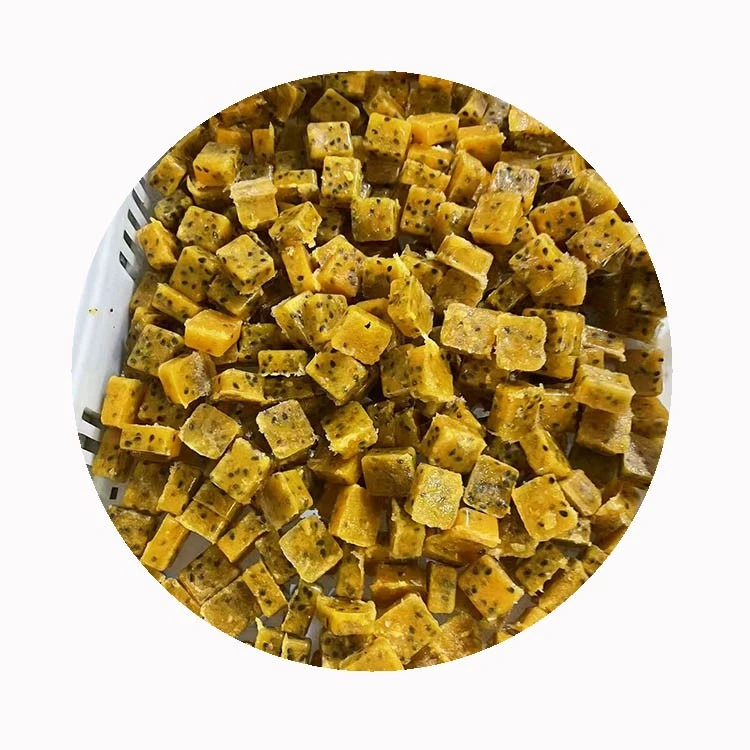
Seeded frozen passion fruit pulp sheet shown in GreenLand product photography.
Frozen handling is part of the ingredient specification. Ask how the product is packed, its storage requirement, the documented lot and production dates, and what evidence is available for traceability and quality release. Portion size affects thaw time and how much of the pack must be opened for a test. A large block may suit a continuous line; smaller portions can reduce waste for a pilot bakery. Once thawed, use and hold the ingredient under a validated food safety plan. Refreezing leftover open pulp simply to avoid waste may change quality and create a traceability problem. Agree on a workable sample quantity before commercial evaluation.
Our frozen passion fruit puree page shows the ingredient form and the supplier context. The frozen cubes and seeded pulp photographs in this article are real product imagery. They do not establish the composition of every lot, and they do not show a finished bakery filling. A buyer can use the page to start a specification discussion, then request the current offered product documents and sample to check the fruit against the intended recipe.
Keep or remove seeds deliberately
Passion fruit seeds can provide a recognizable appearance and a light crunch. They can also interrupt a smooth curd, clog a narrow depositor, create uneven portion weights, or read as a defect in a delicate cream. The choice is not just aesthetic. Decide it before selecting the screen size, mixing method, and finished-product texture. If a retail customer expects visible seeds, record an acceptable seed distribution and ensure the portioning process keeps them suspended. If the filling must be silky, confirm how completely the offered pulp can be strained and whether a seedless puree is available.
The two commonly cited pastry examples make opposite choices. Epicurious's passion fruit curd uses the seeds as visible and textural features, while the King Arthur bar recipe specifically calls for a seedless 100% puree and strains the cooked curd. Neither choice is inherently more authentic for a commercial product. A seeded tart glaze can communicate passion fruit immediately; a smooth layer inside a laminated pastry may be easier to pipe and bite. The brand promise and equipment determine which result is useful.
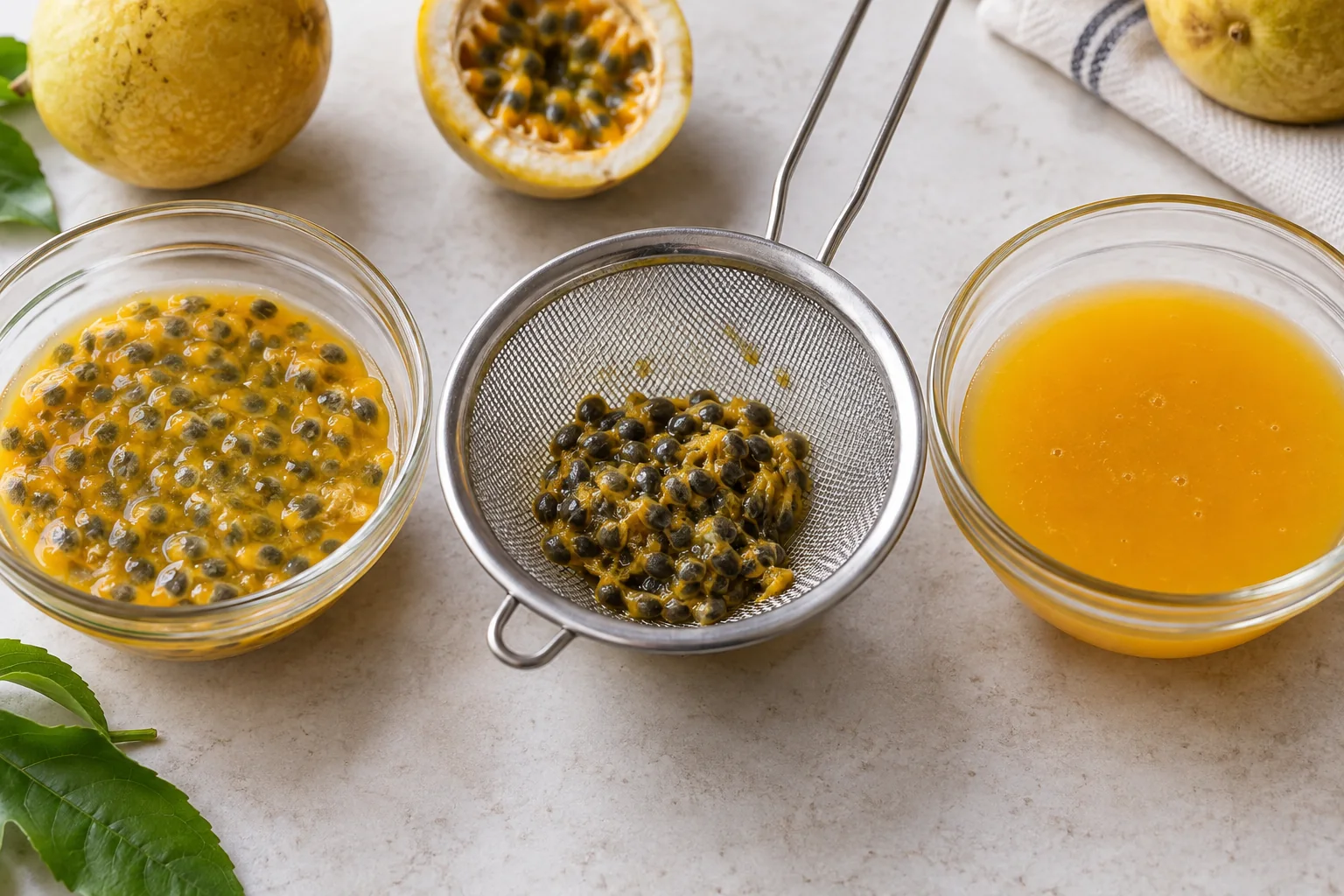
Seed-in pulp, retained seeds and smooth strained puree show the texture choice.
If the source pulp includes seeds but a smooth base is needed, remove them with a sieve appropriate to the pulp and operation. Weigh the input and the retained seed fraction so the team understands yield. Excessive force through a fine screen can push seed fragments or undesirable bitterness into the puree. A high-speed blender may break seeds and produce dark specks rather than a clean smooth base. Test the process with the actual equipment and document the result. If the seed fraction is removed, the effective fruit yield, cost per kilogram of filling, and ingredient declaration may change.
Some developers keep a controlled portion of seeds for decoration. That can work if the seeds are added after a smooth base is hydrated or cooked, then mixed gently enough to distribute them. Ponthier's professional recipe explicitly strains and later returns seeds in its own process, illustrating one reason to separate seed handling from thickener hydration. The exact step is formulation-specific. Seeds added to a set gel may collect in streaks; seeds present during vigorous blending may break. Make the handling decision while the filling is still a bench-scale sample rather than on the first production day.
Look at the final product from the customer's point of view. A black seed inside a translucent golden tart can be intentional. The same seed trapped along a pastry seal can prevent a clean closure. In a frozen insert, a dense seed layer may appear after thawing if the base was deposited before it had sufficient body. Cut several finished units from the start and end of a batch to compare distribution. A single beauty sample is a weak basis for specifying a seeded filling. The acceptance method should say whether seed count, visual distribution, or simply presence is the criterion.
Balance tartness, solids and the setting system
Passion fruit is valued for a sharp aromatic profile, but sweetness and structure must be set in the context of the finished pastry. A very sweet carrier can flatten its fruit character; a low-solids base can remain thin or release water into cake. Add sugar for the eating target and the chosen setting system, then measure the resulting filling rather than assuming a fixed ratio from a consumer recipe. If the pastry contains sweet cream or meringue, the filling may need to remain deliberately bright. If it sits in a plain dough, the balance may be different.
The set comes from the whole formula. Egg-based curd uses controlled heating to thicken proteins and usually includes butter or another fat for body and mouthfeel. Starch-based fillings rely on appropriate hydration and heating; the type of starch and the acid/heat exposure affect viscosity after cooling. Pectin systems depend on pectin type, soluble solids, pH, sometimes calcium, and process order. Gelatin can create a soft cold set for certain desserts but has its own heat and freeze-thaw limits. These are mechanisms, not a menu of direct substitutions. A gram of one thickener cannot be exchanged for a gram of another without a new trial.
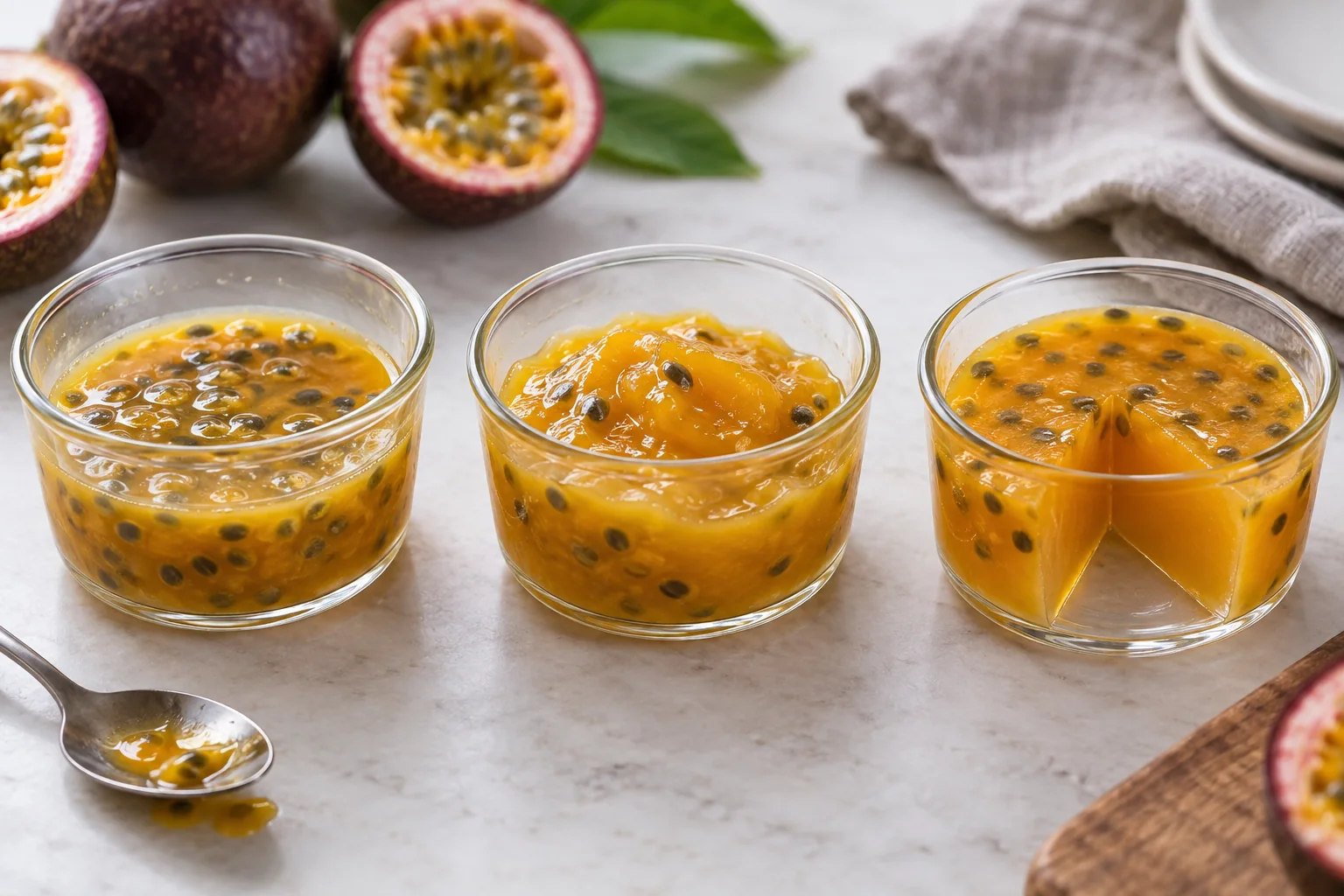
Loose, spoonable and sliceable passion fruit samples show distinct filling set.
The interaction is visible in the research. A published study on passion fruit pulp with sucrose and pectin found that the particular concentrations and freezing conditions changed flow behavior before and after thawing. That result supports checking the actual matrix; it does not provide a universal filling formula. The researchers measured a specific pulp, additive range, and freezing method. A buyer using another puree, sugar system, acid level, or bakery process needs its own measurements. Even within one plant, a formulation change made for clean label or reduced sugar can alter set and water release.
Developers should observe both immediate texture and aged texture. A hot saucepan can make a base seem fluid even though it sets firmly after cooling; a cold spoonful may look thick because the fat phase is firm, then flow at room temperature. Place samples at the product's actual deposit, storage, and serving temperatures. Record the time to reach a usable viscosity, the ability to pump or pipe, the finished bite, and any liquid separation. If the filling will be cut, inspect the edge. If it will be injected into dough, check that the nozzle delivers consistent weight without seed or gel plugs.
Acid and heat should be adjusted with care. Heating a strongly acidic fruit base for longer than needed may dull the fresh aroma, change color, and affect some thickener systems. Adding extra lemon or acidulant to chase tartness can change the pH environment and destabilize a set that looked correct earlier. A change in puree solids changes both flavor and the amount of unbound water. Make one change at a time in the trial matrix where possible, keeping a control batch. Record measured pH and soluble solids in the final mixture; also record sensory and physical results. The best formula is the one that meets the agreed application and food safety requirements, not the one with an attractive isolated reading.
Test cold-fill, bake-in and freeze-thaw performance separately
For a cold-filled tart or cream puff, start with deposit quality and chilled holding. Does the filling pipe without stringing? Does it hold an even surface, stay inside the shell, and retain the intended bite after the planned display time? Check whether moisture migrates into pastry and softens it. A cold trial can reveal the need for a barrier layer or a different filling solids balance. It cannot demonstrate bake-in stability, because the filling has not faced oven expansion, steam, and pastry movement.
A bake-in trial needs the actual dough, fill weight, seal geometry, oven profile, and cooling process. Watch for boil-out, surface splitting, under-set centers, and a wet layer at the dough interface. Cut units after cooling and again after the intended storage interval. A tray with no visible leakage can still have soggy pastry or a filling that thins after cooling. Test the edges and center of the tray if oven conditions vary. If the product will be frozen after baking and reheated, add those steps to the same test instead of assuming the first bake is sufficient.

Baked pastry and chilled insert show application-specific filling trials.
Freeze-thaw testing is a separate cycle. Fill and freeze the intended insert or finished product under the proposed production conditions, hold it for the planned interval, then thaw it under realistic distribution and display conditions. Inspect for weeping, collapse, dull surface, ice crystal damage, seed settling, and a changed cut edge. Weigh or photograph the free liquid when useful. The cycle should include packaging and handling, because a stable-looking uncovered bench sample may behave differently inside a wrapped dessert after condensation and temperature fluctuation. Repeat with more than one sample and at least one production-representative batch.
Commercial filling claims illustrate the amount of formulation work behind a stable product. Bakels documents its named pastry filling as bake and freeze-thaw stable, and Puratos makes similar claims for its formulated range. Those claims provide performance targets for a bakery considering a make-versus-buy decision. They do not transfer to frozen passion fruit pulp by virtue of sharing the fruit name. If a buyer wants to formulate from frozen fruit, it may gain control of fruit profile and label choices, but it also owns the work of validating the setting system, process, packaging, and shelf life.
Set pass criteria before the test. "Looks good" after one hour is hard to reproduce. A practical record can define acceptable leak rate, portion weight, amount of separated liquid, height loss, pastry crispness, cut quality, color, and flavor at the relevant checkpoints. The thresholds are product-specific and should be tied to the customer's specifications and quality system. Include safety and shelf-life testing under the relevant regulatory framework; a low pH reading alone is not a finished safety determination. If the formula contains eggs, dairy, or other allergens, those ingredients also affect process controls and labeling. The fruit input does not remove those obligations.
Run a small trial before approving a production lot
A bench trial is most useful when it answers a purchase decision. Start with one reference pulp sample and a clearly defined application. Record the thaw method, seed handling, target fill weight, and first formulation. Keep a control batch, then change one major variable at a time: for example seed inclusion, sweetness, or setting system. Where combinations matter, run a small planned matrix rather than a succession of undocumented adjustments. The goal is not to find a universal passion fruit filling; it is to identify a robust range for the product the buyer actually sells.
Measure the pulp before production and the finished filling after it reaches the relevant temperature. Log pH, soluble solids, temperature, appearance, and any agreed viscosity or texture method. Photograph the filling at deposit, after processing, and at the end of intended holding. For baked products, keep representative units for cut inspection. For frozen products, retain a sample after the complete freeze-thaw cycle. Compare results to the initial acceptance criteria, not to a memory of how the first trial looked. A careful record lets the team determine whether a variation came from pulp, formula, equipment, or handling.
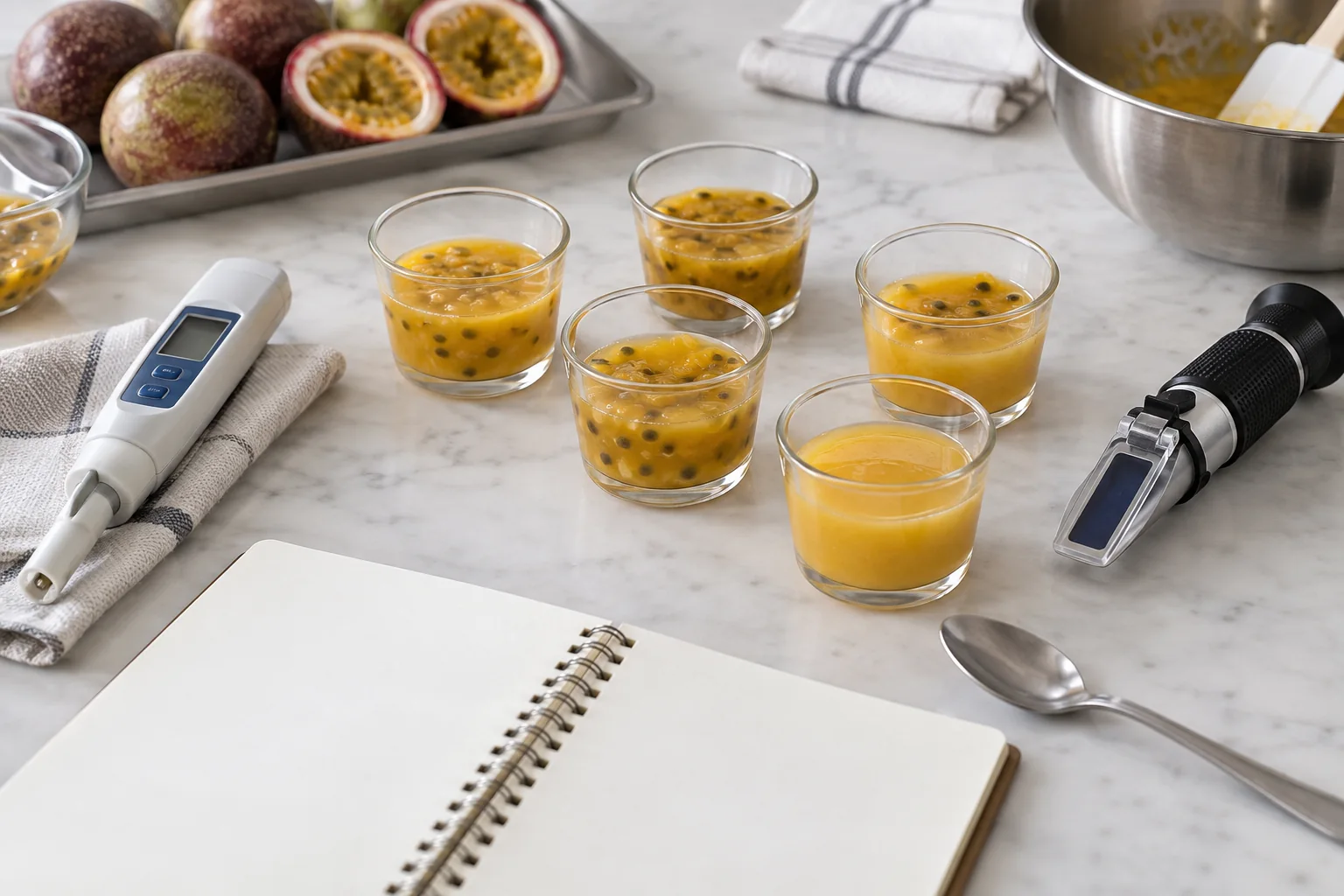
Bench samples with pH meter and refractometer represent formulation testing.
Scale-up creates additional questions. A thickener that disperses in a small saucepan may clump in a larger kettle; a seed-in pulp that looks evenly mixed in a bowl may settle in a hopper during a long run. Heating and cooling rates change with batch size. A transfer pump can shear a gel, and a depositor can expose a filling to different temperatures over a shift. Run a pilot through the planned equipment before fixing the commercial specification. Take start, middle, and end samples. If the line needs a hold time, test it at that duration. These checks convert a promising bench sample into a process that can be repeated.
The ingredient purchase agreement should distinguish what the supplier controls from what the bakery controls. For the frozen pulp, confirm identity, seed status, ingredient statement, origin, pack, storage condition, quantity, lot traceability, available quality documents, and a reference sample or agreed measurable ranges. For the finished filling, the buyer controls added ingredients, processing, deposit, packaging, safety validation, and shelf-life claims. If a new pulp lot falls within its agreed specification but the filling fails, investigation should compare both ingredient variation and the actual production records. That division avoids blaming the fruit or the formula without evidence.
GreenLand can discuss frozen passion fruit and puree format for a proposed project. Send us the desired seed status, application, annual volume, pack size, destination, and any specific quality documents needed. We can then confirm the current offered material and sample route. The buyer's pastry team can use that sample to select a set system and approve the filling through its own cold, bake, or freeze-thaw tests. That is the reliable path from frozen pulp to a repeatable passion fruit filling.
Source Frozen Passion Fruit with GreenLand-food
GreenLand-food is a professional frozen passion fruit supplier and manufacturer in China, providing factory-direct wholesale supply for importers, food manufacturers, foodservice distributors and private-label programs.
Send the product form, specification, packing, quantity, application, destination, private-label needs and requested documents. We will confirm the current lot and sample plan.