


Why Do Peaches Have Split Pits? Detecting Internal Defects Before Frozen Processing
Sep 27, 2026
Leave a message

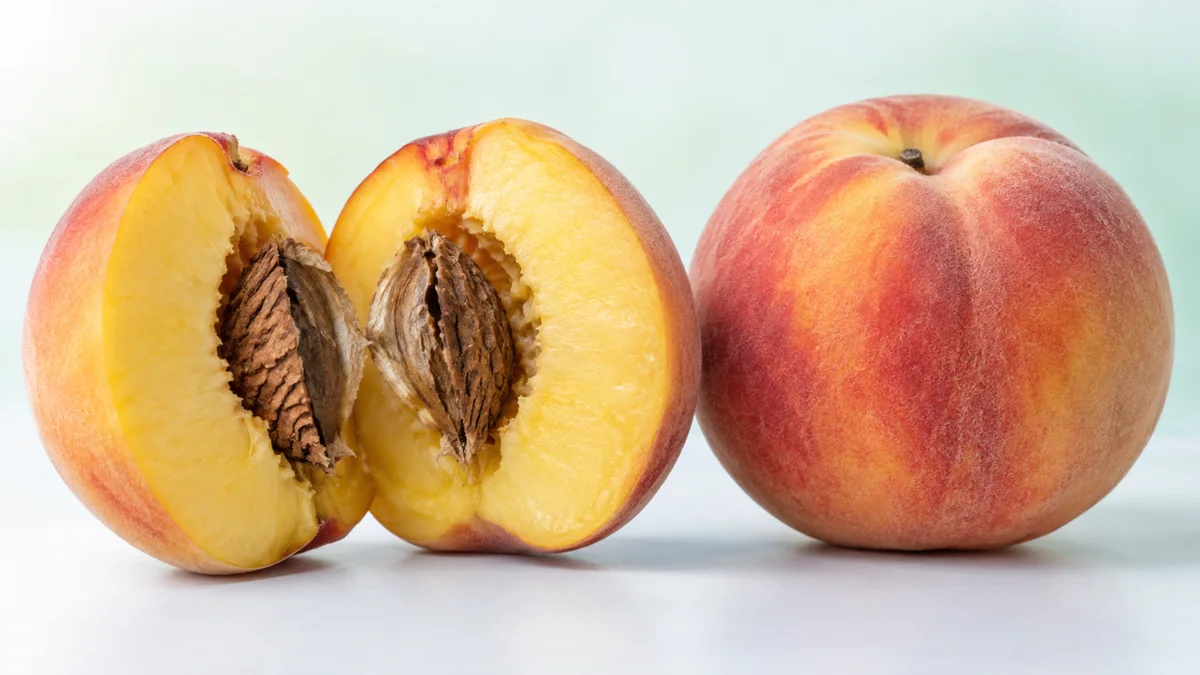
Recognize a split stone before calling it a pitting defect
The peach pit is the woody endocarp that surrounds the seed. In a split-pit fruit, this shell fractures, commonly along a suture. A processor can see two pieces of stone still facing one another inside the flesh, a widened cavity, or smaller shards that have separated. A normal freestone peach may also show a clean cavity after cutting, but its stone remains whole; the flesh simply detaches readily. Clingstone fruit holds more tightly to the stone. Attachment and fracture are independent observations, so the receiving code should not collapse them into "pit problem."
Start with the outside but do not stop there. Extension sources describe a possible stem-end opening and, in some affected fruit, an unusual shape or early color. They also describe fruit that looks normal until cut. A stem-end clue can direct a closer look, yet it is not a reliable substitute for the agreed destructive sample. Conversely, a surface crack or bruise need not mean the stone fractured. The inspector should note both the external condition and what the longitudinal cut actually reveals.
A cut made through the stone's suture gives a useful view of fracture, cavity and adjacent flesh. Keep both halves in the photograph and include the lot identifier in a separate visible record, rather than relying on an isolated close crop. If a stone can be lifted out intact, note that. If the shell has broken into pieces, document the number and approximate size of loose fragments and whether they remain embedded in fruit tissue. A broken stone from a fruit already on the pitting line needs a separate event record because the timing of breakage may be different.
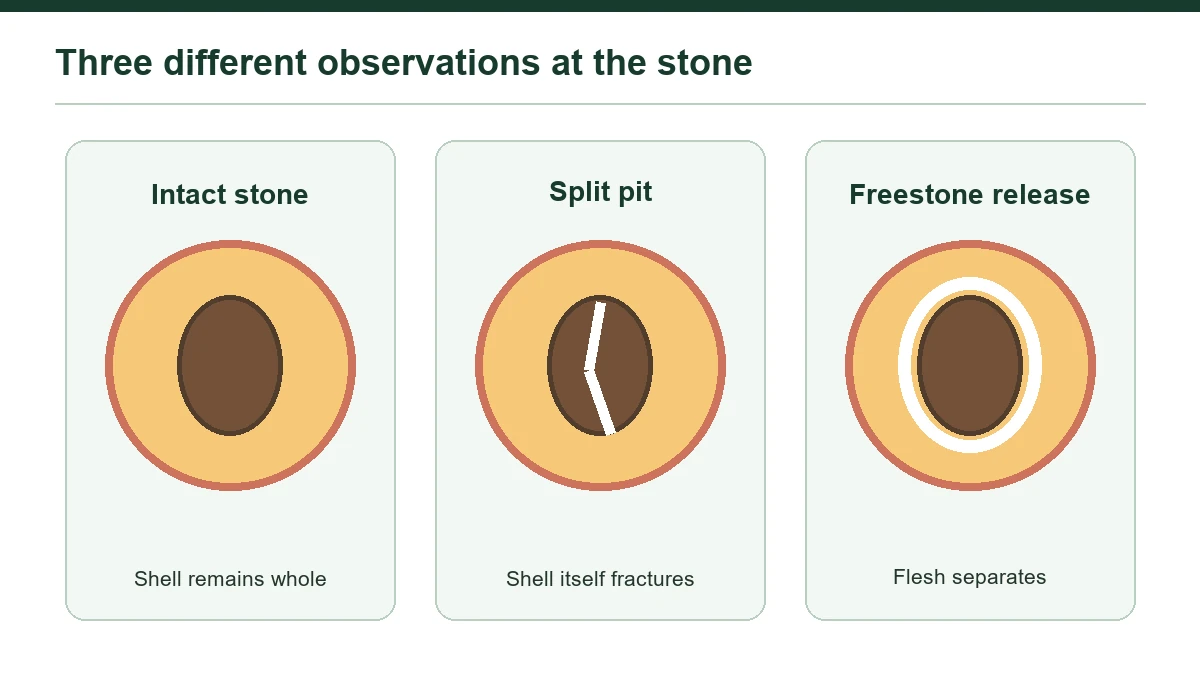
Normal stone integrity, fracture and freestone release are different observations.
Color around the cavity is also evidence, but it cannot do all the work of diagnosis. Natural pigment or callus tissue can occur near a peach stone. Brown, softened or visibly moldy tissue requires a different assessment from sound tissue with an intact surface. Record odor, leakage and tissue firmness if the inspection plan calls for them. Do not describe every discolored surface as decay or every sound-looking split stone as safe. The responsible QA process evaluates the full observation.
This terminology matters to the buyer receiving sliced or diced frozen peach. A cut can expose a normal stone scar; it can also expose a loose fragment that might travel with finished pieces. The product specification should name the defect being controlled: stone fracture in raw fruit, residual pit or hard fragments in the final cut, decay, or damaged fruit. Each has a different sampling point and corrective action. A single vague percentage for "bad pits" hides those distinctions.
Why the stone fractures before harvest
The stone hardens as lignin accumulates in the developing endocarp. The flesh and seed continue to grow during this period. When mechanical pressure rises faster than a vulnerable part of the shell gains strength, the shell can fracture. University of Florida extension describes the disorder as multifactorial, with fruit growth, water relations, nutrition, temperature and cultivar susceptibility all relevant. This is an orchard-origin process. Industrial freezing does not create an internal crack that formed on the tree.
A grower may see more split pits in particular cultivars or seasons, but a processor should resist turning that pattern into a one-cause verdict for a delivery. A fast-growing peach can result from several interacting conditions. Rainfall after stress, thinning intensity, temperature changes during pit hardening and cultivar development time may each affect risk. A photograph of one stone cannot identify which field practice caused it. Supplier feedback is more useful when it compares dated orchard and packing records with repeatable receiving observations across lots.
A stone can fracture without a visible path from the outside. Another fruit may develop an opening near the stem and a cavity that permits later deterioration. These two states should be described separately. The cavity is a route by which tissue condition may worsen; the fracture itself is not a microbiological test. A processor needs to inspect the flesh adjoining the pit and apply the actual food-safety criteria when decay is suspected.
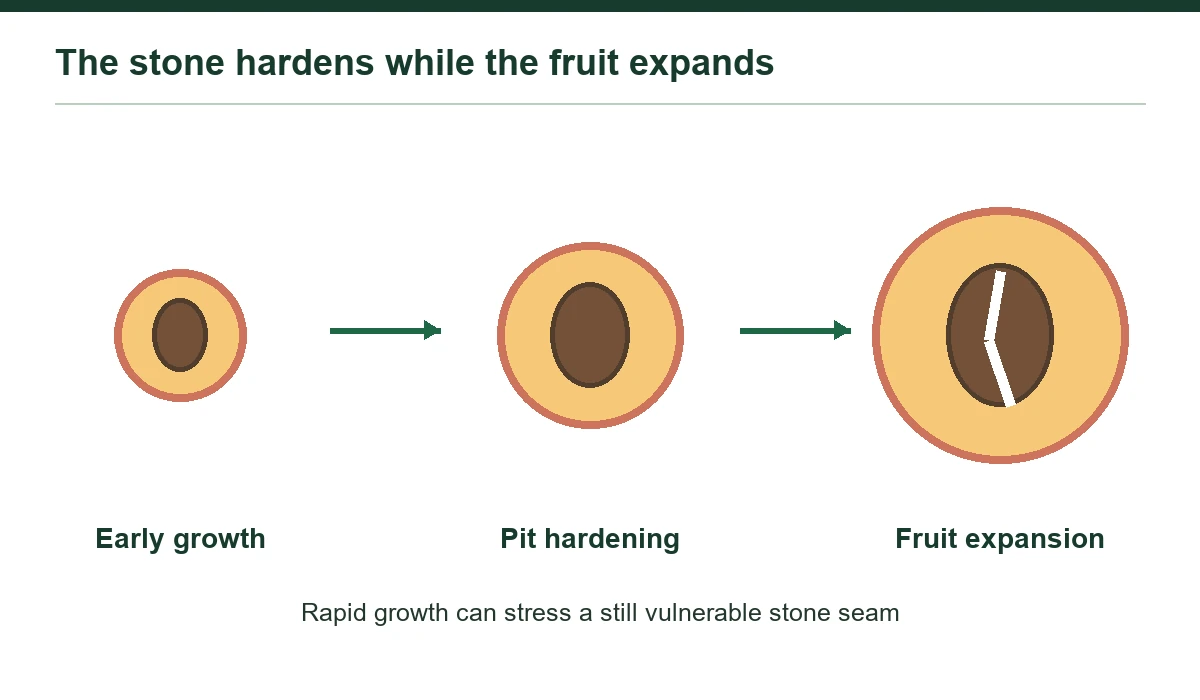
Stone hardening and flesh expansion overlap during fruit development.
University of Kentucky's scouting guidance notes that shattered pits can be hidden until cutting and may lie toward the blossom end. That detail argues for a cut direction and a second look when the first cut fails to reveal the full cavity. It does not mean every peach must be cut twice or that a particular sample size will work for every lot. Sampling intensity should reflect product risk, supplier history, contract requirements and the consequences of fragments in the intended cut.
Do not import a fertilizer or thinning prescription from an extension article into a procurement clause. The cited orchard advice was written for a specific growing context. A buyer can request cultivar, harvest window, crop condition and the supplier's own monitoring record, then ask whether a cluster of split-pit findings coincided with a change in fruit size or maturity. The commercial control is an agreed receiving limit and verified processing response, not a claim that one orchard practice eliminates all split stones.
Cut-open inspection and evidence for an incoming lot
A representative plan begins by defining the lot. Fruit from one cultivar, orchard block, harvest date or delivery may be combined or separated according to the supplier's traceability system. Before sampling, identify which unit will be held or released if the sample fails. An inspection that produces a defect count without a matching traceable unit cannot support a defensible disposition. Record container, pallet, supplier code and time of arrival with the cut-open sample.

Conceptual receiving inspection: record both cut halves and any loose woody material.
Choose fruit across the lot's containers and visible condition range rather than cutting only the largest or most blemished pieces. A targeted sample of suspect fruit can be useful as an investigation, but it should not be presented as an unbiased estimate of lot prevalence. The written plan should separate routine random or systematic selection from directed follow-up. It should state who cuts, how fruit is cut, what is observed, how uncertain cases are escalated and what result triggers more sampling. The numeric threshold comes from the buyer's agreed specification and risk assessment.
Photograph representative intact exteriors, both cut halves, the stone and any detached hard material. A useful record distinguishes at least four findings: intact stone with normal release, split stone with sound flesh and no loose fragment, split or shattered stone with recoverable hard fragment, and cavity with suspect tissue. Mixed cases can carry more than one code. Count the fruit examined as well as the fruit in each code; a list of defect photos alone cannot establish a fraction.
In the first production trial for a supplier, use an observation sheet with blank fields for lot ID, number examined, external clue, stone state, cavity condition, loose fragment, tissue condition and disposition. Enter actual measurements and photograph IDs during the trial. Avoid filling the form with a sample defect rate to make the guidance appear concrete. A processor may also retain examples of acceptable and unacceptable fruit, approved jointly with the buyer, so different shifts classify the same condition consistently.
If the first sample suggests a clustered problem, hold the affected traceable unit while QA checks how it was assembled. A split-pit finding in a few containers from one orchard block may not describe every pallet. Conversely, mixing without records can make a localized defect impossible to isolate. Rework, extra sorting or rejection must follow the customer's contract and the line's demonstrated capability. Additional cutting alone does not prove the finished product free of small hard fragments.
A second inspection can clarify an uncertain first result, but its scope should be written down before the team sees the new count. If the sampling plan changes after a defect appears, keep both the original and expanded results rather than merging them into one unlabeled rate. A buyer may require a hold while the expanded sample is reviewed. The final decision should cite the contract clause and the person authorizing release, not only a photograph of a sound peach.
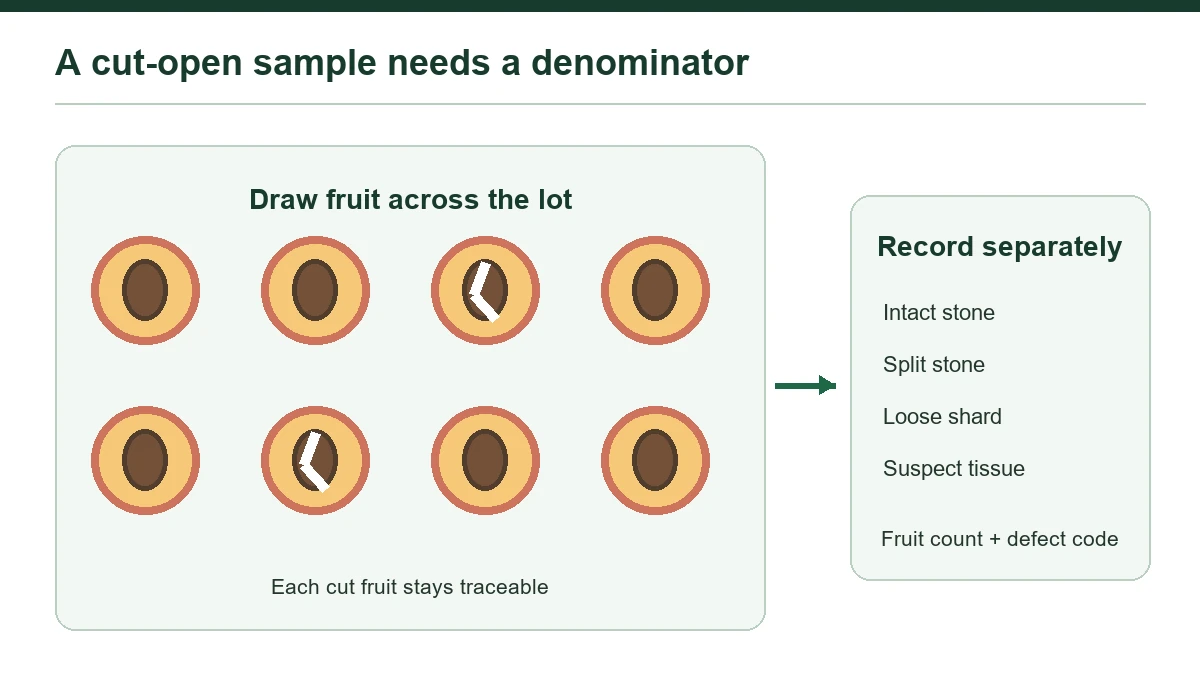
A cut-open sample needs a fruit count as well as a defect classification.
The sampling record should also distinguish the denominator. A percentage of affected fruit, a count of loose fragments per sample and a count of finished packs containing a fragment answer different questions. Reporting one as another can make a seemingly small problem look larger or smaller than it is. Record each measure in its own unit, with the number and mass examined, and use the method agreed with the customer.
The practical value of the receiving record appears later. If a finished IQF lot has residual stone pieces, the team can compare the raw-fruit cut-open evidence with pitting-machine incidents, post-cut inspection findings and detector challenges. Without those checkpoints, the origin of a fragment is guesswork, and feedback to the grower or machine operator is too broad to repair the process.
Keep decay and pit-fragment hazards separate
A cracked stone can leave a cavity. An open stem-end route or injured internal tissue may allow spoilage organisms to establish, and extension photographs show examples with mold or soft tissue. Still, the risk is conditional: an observed split pit is not the same thing as confirmed decay. Record whether the cut tissue is sound, discolored, soft, gummy, leaking or visibly moldy. The receiving team should use its own defined categories and send suspect fruit through the food-safety hold procedure rather than improvising a yes-or-no safety label at the cutting table.
The hard-fragment problem is physical. A stone shard may detach during cutting or pitting, lodge in a peach half, or travel into slices and dice. Puree processing changes how fragments are handled, but it does not make a shard acceptable by default. Screens, sorting and metal detection each have different limits; a woody fragment is not a metal target. The line must validate its real method against representative fragment types and sizes that the buyer and QA team consider relevant. Do not claim that a machine detects every shard because the equipment brochure names a technology.
The two paths can occur together, but they should remain separately visible in the decision record. A fruit with a split stone and sound flesh may need tighter fragment control. A fruit with visible mold near the cavity requires a food-safety disposition even if the stone stays whole. A fruit with a fragment and suspect tissue calls for both responses. Classification controls the action: segregate the raw lot, stop a line for investigation, reject material under contract, or document validated rework. Each step should identify who can authorize release.
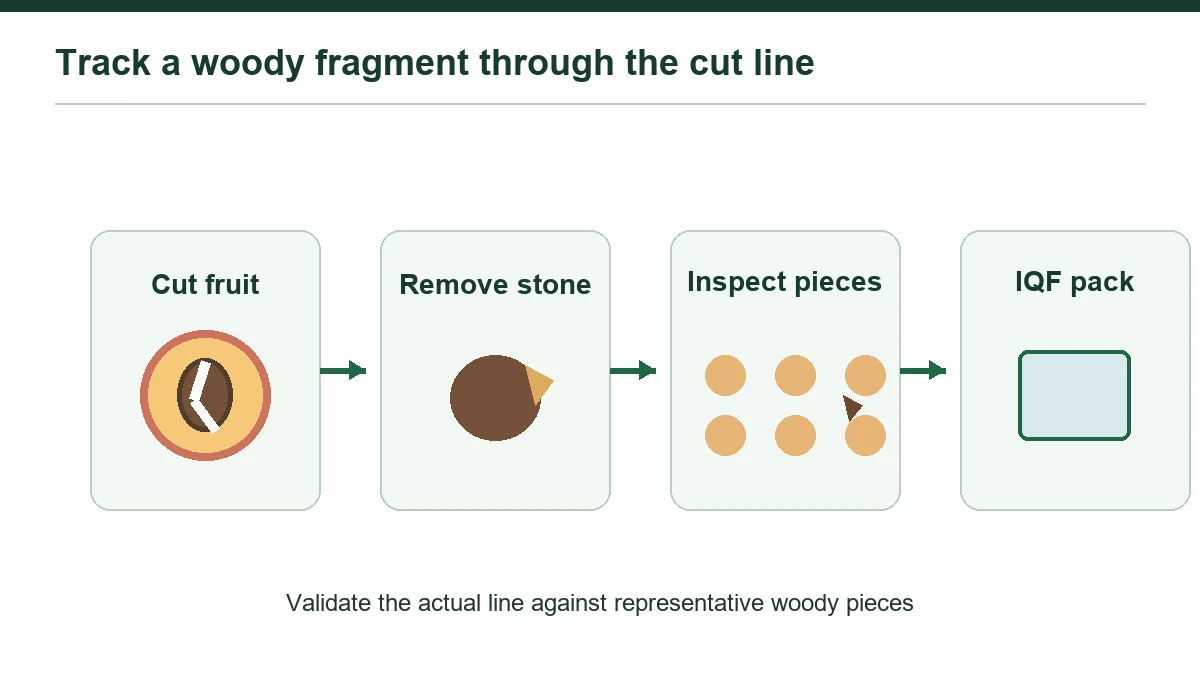
A woody fragment must be controlled across cutting, pitting, inspection and packing.
Freezing can preserve a raw-material defect's evidence while making some signs less obvious to a later customer. Frost may hide surface color; cut pieces can lose the original pit cavity as a recognizable whole. For that reason, the evidence should be collected before fruit is dispersed through cutters and freezer flow. Once a suspect peach becomes a frozen dice, the buyer can examine a hard particle but may not reconstruct the entire incoming fruit. Good traceability links that finished piece back to the relevant production and receiving record.
Food-safety requirements vary with destination, product use and customer specification. The article cannot set a universal allowable number of pit fragments or a universal microbial standard for a visible cavity. Ask for the applicable contract defect definition, foreign-material program, inspection validation, and any destination-market requirements before naming a finished-product limit. The buyer's question is whether the supplier can show how each hazard is controlled in the actual route used for the offered frozen peach.
Follow fragments through preparation and freezing
The first opportunity for a loose fragment is often the fruit's own cavity. During washing and grading, the exterior may still look acceptable; during halving and pitting, the shell can separate. A raw-fruit sorter may remove obvious damaged fruit while missing an internal split. A cutting step can turn one retained shard into a smaller piece that is harder to see among dice. The process map should therefore mark each point where fruit is opened, stone is removed, cut size changes, and product is inspected.

Real frozen peach halves in a lined bulk container; use to discuss pitted finished form
For frozen peach halves, the stone cavity remains visible on every piece and can be checked directly. For slices, the curved stone-contact surface may pass across several pieces. For small dice, the number of pieces per original fruit grows, and a fragment can appear in a different container from the rest of that fruit. These are format-dependent inspection challenges, not a ranking that automatically makes one form safe. The acceptance method should be validated for the cut actually purchased.
At GreenLand-food, our frozen peach supply page lists cut sizes, IQF separation and checks for peel or pit fragments, damaged fruit and foreign material. Those are useful specification headings. An RFQ should still request the current product form, cut dimension, residual-pit criterion, inspection method, and evidence that the method works on the specific line and packing configuration. The frozen peach cooking and processing guide extends the discussion of finished-cut use; the present issue is the internal stone before and during preparation.
A metal detector protects against specified metal contaminants when correctly set and challenged; it does not by itself settle a woody pit-fragment question. Optical sorting may identify contrast or shape differences under certain conditions, but wet surfaces, mixed flesh color and fragment orientation can affect detection. Manual inspection is subject to view, line speed and fatigue. A supplier should present actual challenge pieces, test locations and records before stating a capability. The relevant result is the end-to-end control of the offered product, not an unqualified device name.

Second real frozen peach halves view showing cut and cavity variation
After pitting, freezing and packing, verify that product remains free-flowing as specified and that packaging prevents damage and contamination in frozen storage and transport. IQF does not remove a shard, and a cold chain does not undo an earlier cavity condition. Finished-lot checks should be linked to the original raw-fruit lot and to any rework, so a later complaint can be traced to both orchard material and processing events. Document the response if a retained sample or customer report contains a hard particle.
Make the lot decision and close supplier feedback
The decision should start with the written contract definition. A buyer might agree on separate categories for natural split pit, loose pit fragment, decay and residual stone in finished product. Each category needs a sampling unit, examination method, acceptance threshold or hold trigger, and escalation owner. A blank decision matrix can then record the actual observation rather than implying that a split stone always means reject or always permits rework. The form is useful only if the team can tie every decision to a lot and evidence ID.
When sound fruit has split stones but no detected loose pieces, the processor can consider additional inspection or segregated processing if the agreed procedure allows it. If woody fragments are present, the team must ask whether the actual pitting and sorting route can reliably remove them before releasing any output. If decay is visible, food-safety assessment has priority. A proposed rework requires evidence that it addresses the identified problem; moving fruit to a puree route is not automatically a safe or contract-compliant outlet.
Supplier feedback should be specific enough to act on. Send the cultivar, block or receiving unit, harvest date, fruit size and maturity where recorded, cut-open count and photo examples, plus the location of any finished fragments. If the pattern changes across deliveries, compare it with source records while avoiding a single-cause accusation. The grower may adjust field monitoring, and the processor may inspect pitting performance. Both sides can test whether the next lots improve against the same definitions.

Real yellow peach halves with a caliper showing dimension check
For a purchasing team, the release file should contain the agreed specification, sample plan, photographs, defect counts, hold or disposition approval, line validation relevant to pit material, finished-lot inspection results and traceability. Request documents required for the destination and the chosen frozen peach form. Discuss packing and order volume only after the defect and application requirements are clear; a low unit price has little value if a fine dice repeatedly fails the customer's hard-fragment tolerance.
The aim is a defensible answer for the actual shipment. A split pit begins in the developing peach, but its commercial consequence depends on what the cut-open sample reveals and what the validated process can remove. Sound tissue, suspect decay and loose stone cannot share one code. Once those observations are separated, buyer and supplier can agree whether to release, segregate, rework or reject the traceable lot and what evidence would change that decision next season.
Source Frozen Peach with GreenLand-food
GreenLand-food is a professional frozen peach supplier and manufacturer in China, providing factory-direct wholesale supply for importers, food manufacturers, distributors and private-label programs.
Send the product form, specification, packing, quantity, application, destination, private-label needs and requested documents. We will confirm the current offer and representative sample route.