


How Many Frozen Food Cartons Fit on a Pallet? Case Dimensions, Weight and Reefer Airflow
Sep 27, 2026
Leave a message


This is why a supplier's carton net weight or a generic "pallet capacity" result is insufficient for a frozen-food quotation. Export cartons change with inner-bag arrangement, board grade, moisture exposure and destination marks. The pallet may be accepted at one distribution center and refused at another because of height, overhang or wrapping. A refrigerated container adds a load line, a T-bar floor and an airflow path that a dry-container diagram cannot settle. We use the calculation as a planning record, then confirm the physical load with the packing site, receiving warehouse and carrier before stating cases per pallet or cases per reefer.
Start with the measured carton, pallet and reefer inputs
Ask for the outer length, width and height of the closed master carton in millimeters. A specification that says "10 kg frozen mushrooms" gives product net weight, not the footprint that touches the pallet. A lined carton has flaps, seams and an actual assembled outer wall; the packed case can measure differently from an empty box drawing. Request gross case weight, including inner bag and carton, because the pallet and vehicle carry that mass. If the pack changes from 1 × 10 kg to 10 × 1 kg retail bags, measure the new master carton even when the same product net weight is ordered.
The approved pallet has its own footprint, tare, height and safe working load. EPAL's Euro pallet specification lists 1200 × 800 × 144 mm, about 25 kg tare and a 1500 kg safe working load for an intact EPAL 1 pallet. Those numbers make a transparent example possible; they do not approve an uninspected or damaged pallet. A receiver may specify another pallet size, maximum load or treatment mark. Confirm its standard before optimizing cartons against it. A carton pattern designed around 1200 × 800 mm can lose a whole row when moved to a different footprint.
The vertical limit comes from more than a container's internal height. Obtain the receiving warehouse's maximum unit-load height, its handling equipment limit, the carrier's booked reefer model and the applicable interior load line. The pallet adds to total height. The door opening can be lower than the interior roof. If the load will be handled in a rack or through an automated conveyor, those limits may govern before the container does. Write each limit beside its source rather than replacing them with an assumed universal "standard pallet height."

A lined frozen mushroom case at a weighing station shows why gross carton mass belongs in the load plan.
The GreenLand frozen mushroom packaging guide already explains inner bags, carton marks, wrap and transport damage. Its packing discussion is the starting context. For a pallet count, we additionally need the measured dimensions of the approved case, a tested stack condition and a layout that the destination accepts. A photo of one lined frozen mushroom carton on a scale can help the purchasing team ask for gross case weight; it cannot by itself certify the final production carton or prove that a whole stack will survive a voyage.
Before calculation, pin down whether the quotation is per loose carton, per pallet or per loaded container. Those are different denominators. A buyer may approve a 10 kg net carton but later require a specific pallet pattern for a distribution center. That change affects carton count, total order quantity, handling cost, packing list and sometimes the number of reefer units. It is cheaper to reconcile those inputs before artwork, cartons and freight are booked than after a finished load has been wrapped.
Fit whole cartons into one layer
The first calculation is two-dimensional. Place the measured outer case footprint inside the usable pallet deck with zero overhang unless the receiver explicitly allows otherwise. Test the carton with its long side along the pallet's long side, then rotate it 90 degrees and test again. Count only complete cases. The more useful arrangement may be the one that appears less intuitive when a carton is viewed in isolation.
For a 1200 × 800 mm pallet and a 400 × 300 mm case footprint, the first orthogonal grid gives floor(1200 ÷ 400) × floor(800 ÷ 300) = 3 × 2 = six cases per layer. Rotating the case gives floor(1200 ÷ 300) × floor(800 ÷ 400) = 4 × 2 = eight cases per layer. In this declared example, eight is the better of the two simple grids. The calculation assumes the carton is placed on a face the pack specification permits; turning a carton onto a side to gain more positions may be unacceptable for product, seal or printed orientation.
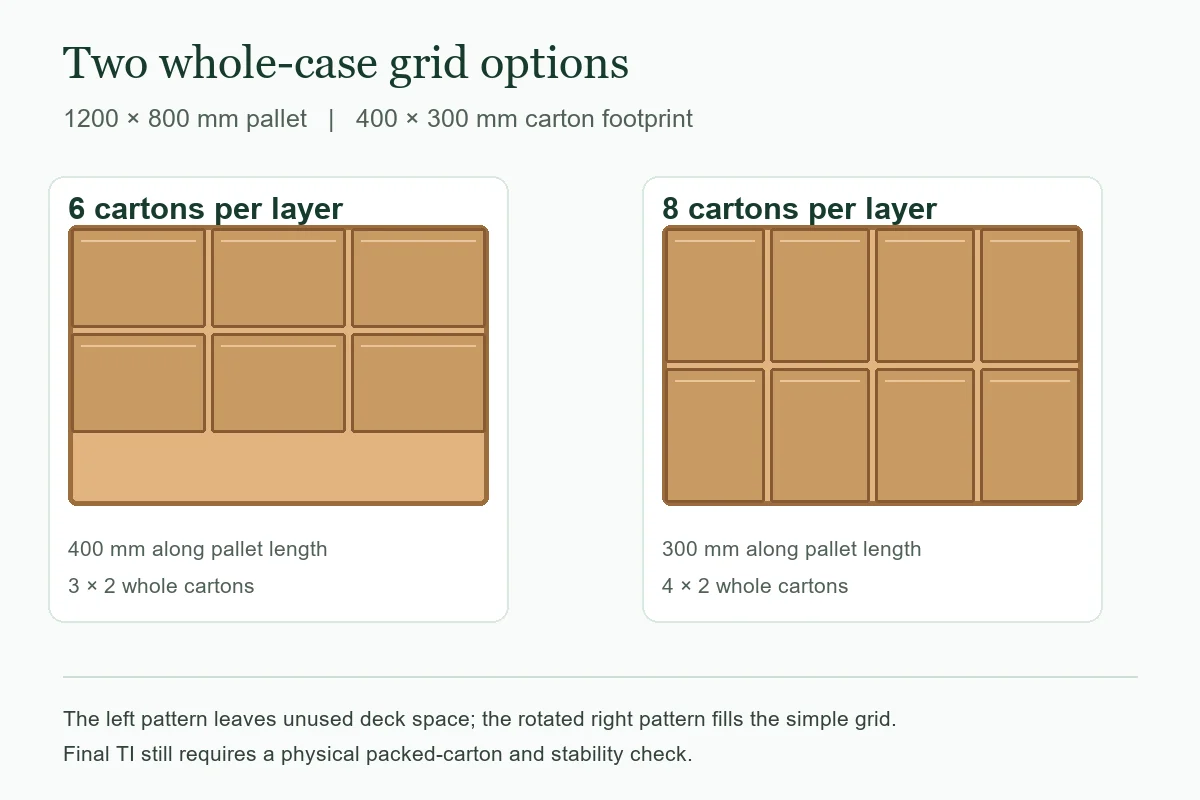
Illustration: the same carton footprint can produce a different whole-case layer after rotation.
Those two grids are reproducible starting patterns, not a mathematical proof that eight is the absolute maximum. A mixed-orientation or pinwheel layout can sometimes fit more whole cases in the same footprint. It also changes corner support, layer stability and the ability to repeat the pattern across production lots. Ask the packing site to draw the proposed layer and build one trial pallet. Check that every carton sits on the deck, edges do not protrude after wrapping, labels remain accessible and the layer can be handled without shifting. A supplier can present a higher geometric result only after those physical checks support it.
Avoid dividing pallet surface area by carton surface area and rounding the result. That operation hides unusable strips. For the 400 × 300 mm case, the case footprint is 120,000 mm² and the pallet area is 960,000 mm², so the area ratio happens to be eight. It reaches the same number here because the rotated grid tiles exactly. Change the case by a few millimeters, add a bulged seam or select a different pallet, and the ratio can suggest fractions of cartons that no real layer can hold. The floor-function grid and a sketch of the actual layout remain necessary.
Allow a small measured tolerance where carton dimensions vary, especially when filled cartons bulge. A nominal 400 mm side that becomes 405 mm under pack pressure no longer gives three cases along 1200 mm. Stretch wrap and corner boards may add to the unit-load footprint even when the bare cartons fit. The final TI is the one measured on the packed, secured pallet. Record the orientation and position pattern beside the number so another shift or factory can reproduce it.
Let height, gross weight and carton strength cap the layers
Once TI is known, height supplies one possible HI. Subtract actual pallet height from the smallest approved total load height, divide by the measured carton height, and round down. In a hypothetical example with a 144 mm EPAL pallet, a 250 mm case and a 1800 mm total load-height cap, floor((1800 − 144) ÷ 250) gives six layers. This is a geometric ceiling. A warehouse that accepts only 1600 mm overall would yield five layers instead. The real booking and destination policy determine which height to use.
Mass supplies another ceiling. If the chosen layer has eight gross cartons of 12 kg each, a full layer carries 96 kg of cases. For the EPAL example, 1500 kg of rated cargo load is not the constraint at six layers; the case cargo would be 576 kg. Add the approximately 25 kg pallet tare, wrap, corner protection and any strapping when reporting the gross unit-load mass. Do not subtract pallet tare from a manufacturer's safe working load without checking how that rating is defined; keep cargo load and total loaded-pallet mass as separate fields. The warehouse floor, forklift, rack, container payload and road limits may set lower practical caps.
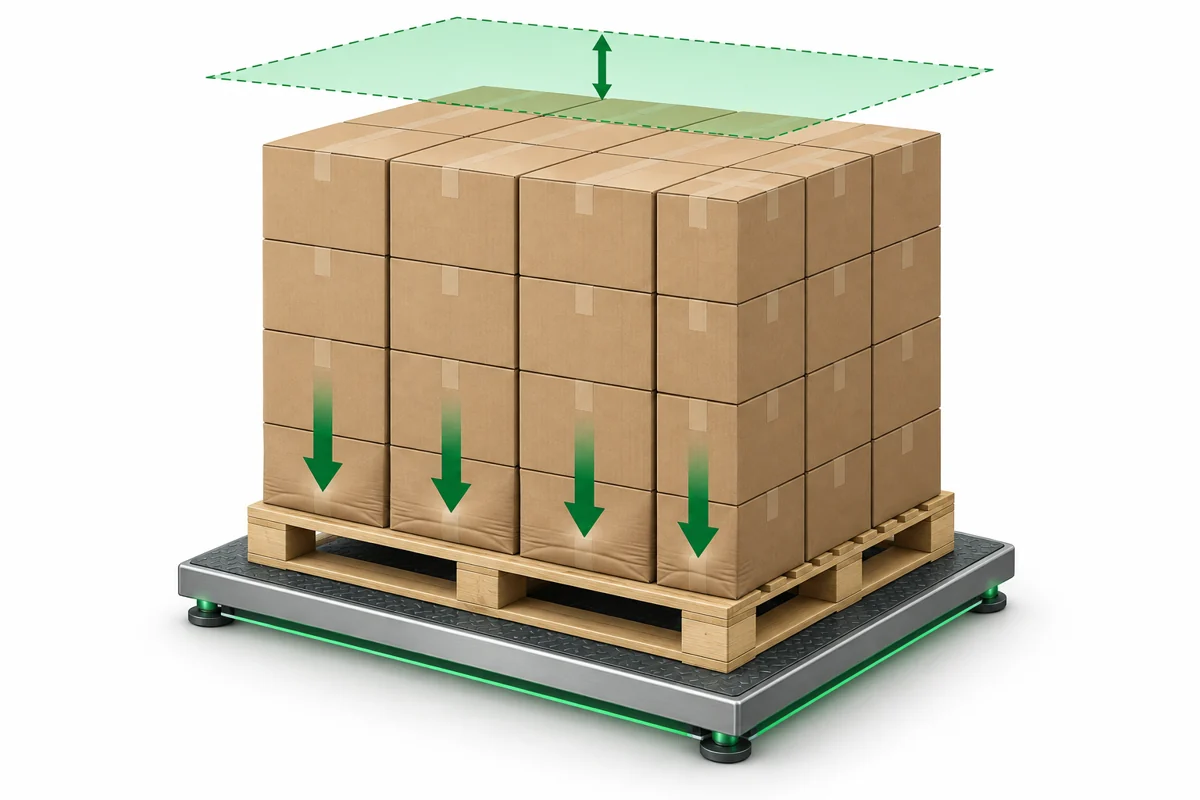
Illustration: height, weight and the strength of bottom cartons are separate limits on layer count.
Carton compression is often the controlling constraint that a web calculator cannot know. Ask the packaging supplier or packing site for the approved stack height under the relevant board, closure, frozen storage and shipment conditions. A dry-room burst-strength description is not a substitute for a filled-carton stacking test. Bottom cases carry the weight of all cases above; moisture, condensation, vibration and imperfect alignment can reduce usable strength. An interlocked pattern may resist lateral movement but can put upper corners over the panels of lower cartons. The approved pattern must balance column support, stability and handling.
Consider the 400 × 300 × 250 mm, 12 kg case again. Eight cases per layer and six geometric layers would give 48 cartons. If a hypothetical signed packing trial approves only four layers for that exact filled carton and securing method, the order plan becomes eight × four = 32 cartons, or 384 kg of gross cases plus pallet and securing materials. This is an illustration of a limiting factor, not a GreenLand carton test result. Without a trial or an accepted engineering basis, the buyer should treat the higher number as unapproved.
The final HI is the smallest approved result from height, cargo mass, carton strength and handling rules. Keep a short calculation sheet showing each cap separately. A single "maximum cases" field hides why the number changed when a new retail bag, thicker liner or different board was introduced. If carton quality varies between crop lots or packaging suppliers, repeat the physical check rather than carrying a historical HI forward automatically. The plan should also state whether double stacking loaded pallets is allowed; a pallet's own load rating does not authorize another full pallet above it in a reefer.
Check the booked reefer load line and airflow path
After deriving a plausible pallet, move from the pallet to the booked refrigerated container. Obtain the equipment specification and actual loading plan from the carrier or freight forwarder. A reefer's insulated walls, refrigeration machinery, door opening and T-bar floor reduce usable space relative to a dry box of the same nominal length. Published Maersk reefer equipment data show why type-specific interior and door measurements belong in the file. The booked unit and route can differ from a generic document, so the final plan needs current confirmation.
Hapag-Lloyd's reefer cargo-handling guidance says cargo should be evenly stowed, below the load line and within the T-bar flooring surface, with the air circulation path kept effective. It warns that large gaps and blocked flow can affect cooling. Its instructions are carrier guidance for its equipment and method. We use them to frame the inspection question, then follow the booked carrier's current instructions. The container must carry food already at its required transport condition; it is not a shortcut for freezing a warm pallet after loading.
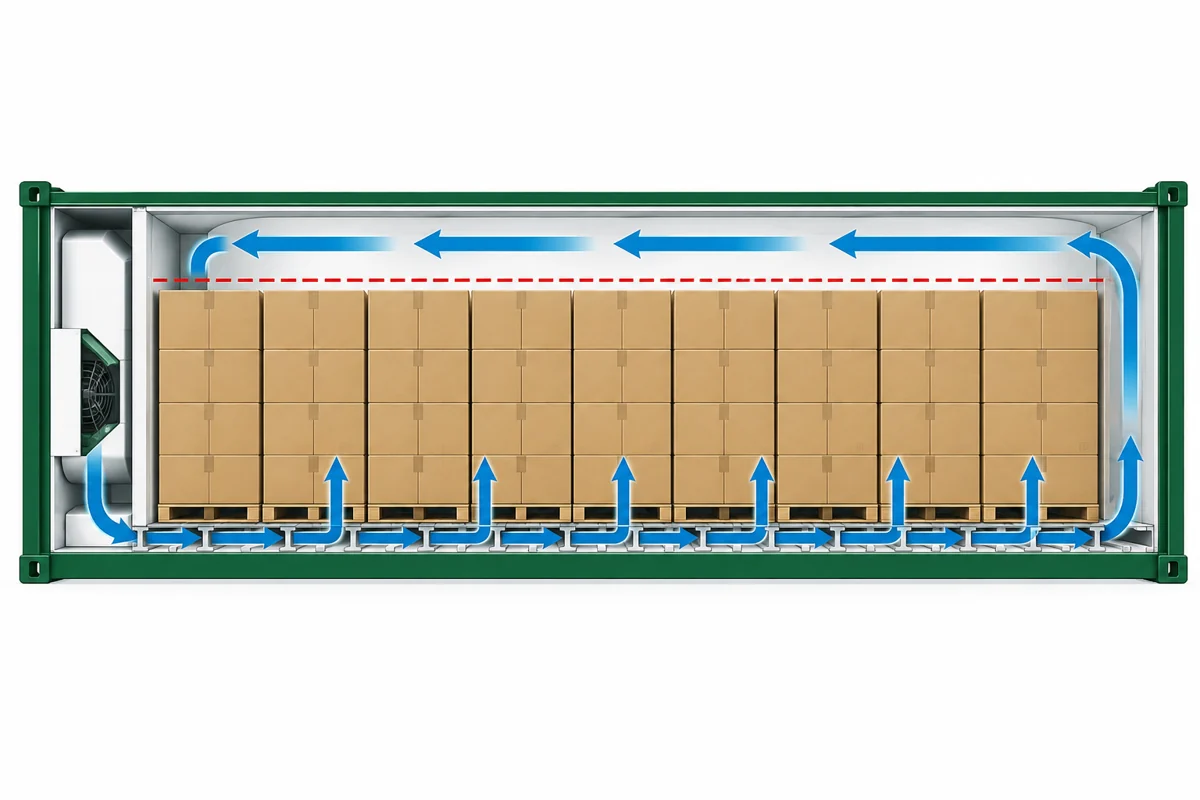
Illustration: a reefer loading plan must preserve the T-bar floor delivery path and upper return space.
Palletized cartons can leave channels or spaces that need deliberate treatment. Stretch film can stabilize a load but may act as a vapor barrier in the wrong placement. No one should infer from a photo that the arrows in an explanatory diagram represent the airflow rate in a specific reefer. The loader needs a plan that respects the floor air-delivery system, keeps the load below the marked line, secures cargo and avoids unsupported open floor areas. The exact carton ventilation, pallet design and dunnage decision depend on the carrier's instruction and whether the cargo is frozen or chilled. A frozen-food load can have different fresh-air settings from respiring fresh produce.
The count of pallets per reefer is a separate floor-layout calculation. Use the actual unit's usable floor dimensions, pallet orientation, door geometry and allowable payload. Include the securing method and whether pallets may be turned. A line that says "20 pallets per 40-foot reefer" without the unit type, pallet size and loading diagram is too weak for an order commitment. Even if the pallet footprints fit on a drawing, the load may fail at the door, top line, gross payload or air path. Have the freight forwarder accept the drawing before multiplying cases per pallet by a guessed reefer pallet count.
Record the set point, preloading product temperature check, seal, container number and loading photos under the agreed shipment documents. Those do not replace the carton calculation, but they let the buyer connect an approved paper plan to the actual loaded units. If the container or pallet type changes late, reopen the calculation rather than editing only the packing-list total.
Work two carton sizes through the calculation
The table below uses hypothetical, measured-looking case sizes on an intact EPAL 1 pallet. It demonstrates how the same eight-case layer can produce different approved totals. The 1800 mm overall height is a declared example limit, not a universal reefer or warehouse rule. Both cases are assumed to stand on their 400 × 300 mm footprint; a physical trial must verify that orientation and any carton-strength assumption.
| Declared input or result | Case A: lighter, taller carton | Case B: heavier, shorter carton |
|---|---|---|
| Outer case dimensions | 400 × 300 × 250 mm | 400 × 300 × 200 mm |
| Gross mass per filled case | 12 kg | 25 kg |
| Better simple grid on 1200 × 800 mm pallet | 8 cases per layer | 8 cases per layer |
| Geometric layers below 1800 mm overall, including 144 mm pallet | 6 layers | 8 layers |
| EPAL 1500 kg cargo-load cap | Not active at 6 layers | 7 full layers by mass |
| Hypothetical carton-strength approval | 4 layers | 5 layers |
| Planning result after all stated caps | 8 × 4 = 32 cases | 8 × 5 = 40 cases |
| Case cargo mass; pallet and securing added separately | 384 kg | 1000 kg |
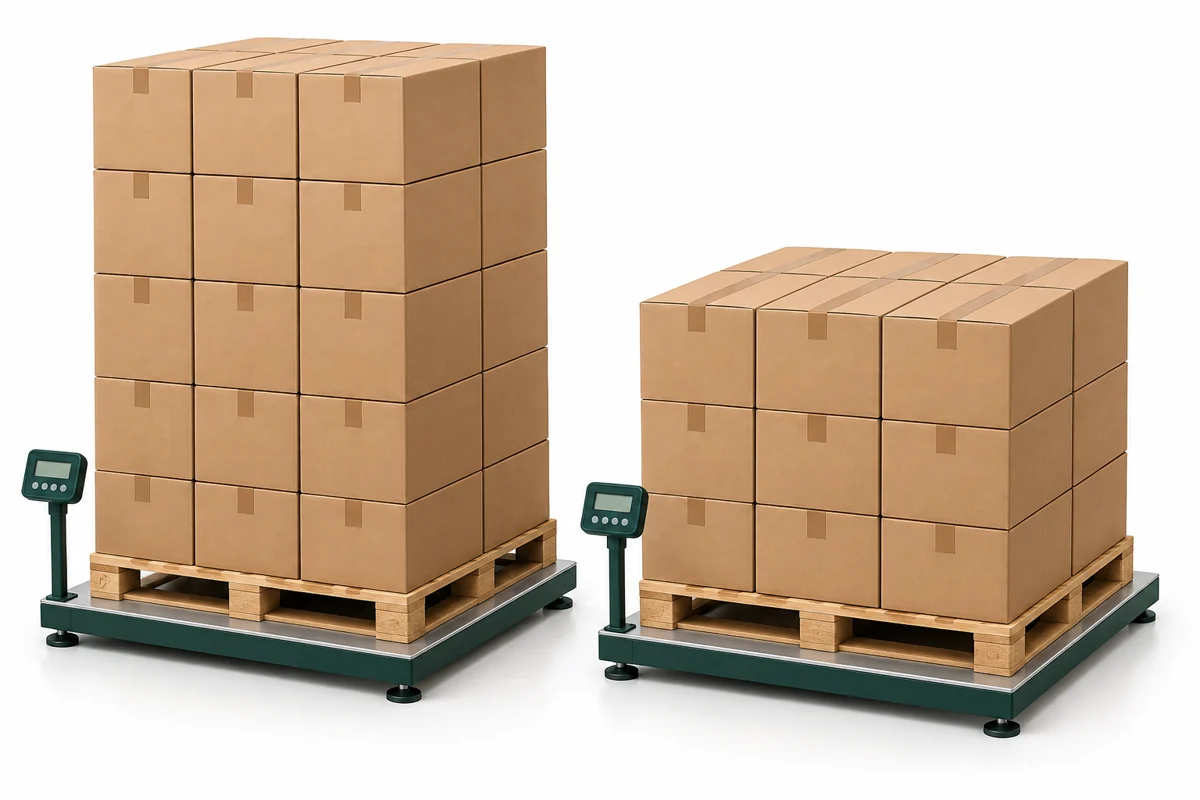
Illustration: two case formats can share a layer footprint while reaching different height and mass limits.
For Case A, the pallet could stand six layers within the declared 1800 mm height, yet the assumed four-layer compression approval governs. For Case B, the shorter carton could stand eight geometric layers, while eight layers at 8 × 25 kg per layer would carry 1600 kg of case cargo and exceed the EPAL 1500 kg rating. The mass cap therefore reduces the provisional limit to seven full layers; the assumed five-layer case approval reduces it again to 40 cartons. These are arithmetic examples with openly stated inputs. They do not certify a particular GreenLand SKU, packing site, pallet or route.
The table also reveals a common quotation error: net product kilograms and gross shipping kilograms are different. Case A might contain 10 kg of net frozen food while its filled carton weighs 12 kg; Case B might contain a larger net pack but 25 kg gross. A quote for 32 or 40 cartons needs the actual net content per case to calculate saleable kilograms and the actual gross weights to check logistics. Never infer those net weights from this example. Ask the supplier to put net case content, case gross mass and carton dimensions on the same approved specification revision.
Suppose an order needs 1000 approved cases. At 32 cases per pallet, Case A would require 31 full pallets and one partial pallet if partials are accepted; at 40 cases per pallet, Case B would require 25 full pallets. Those pallet counts alone do not say which order fits one reefer. The booked unit's floor plan, payload, route rules and disposition of the partial pallet remain open. A partial pallet can need separate securing and receiving treatment. The commercial comparison belongs on total landed cost per usable kilogram, including packing, freight, handling damage and warehouse labor, rather than simply "more cartons per pallet."
If the trial produces another result, update the table and rerun the arithmetic. The final paperwork should show both the measured inputs and the limiting factor, so the buyer can tell whether a better board grade, a new carton footprint or a different pallet could legitimately change the result. A spreadsheet output without assumptions can look precise while giving the wrong shipment quantity.
Compare palletized and loose cartons for the actual order
Palletizing offers quicker forklift moves, a repeatable receipt unit and a defined TI-HI pattern. It also consumes pallet volume and can reduce the count of cases inside a container. Loose cartons may use floor space more densely but take longer to load and unload and can expose cases to more individual handling. The right plan depends on the destination warehouse's acceptance, labor arrangement, case strength, equipment, cargo value and the carrier's frozen-food stowage instructions. Neither format should be selected from a generic capacity number alone.
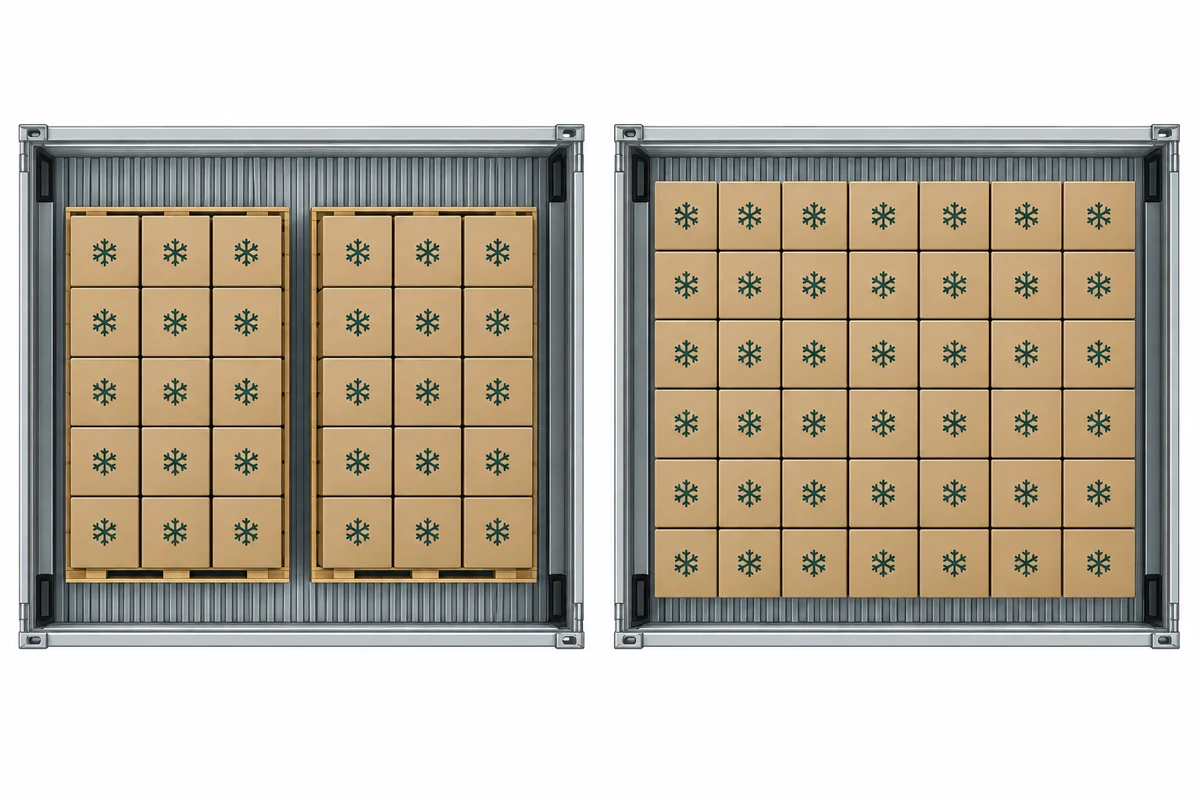
Illustration: pallets occupy floor space; compare handling and accepted loading plans with the case count.
Ask the forwarder for both layouts only when both are operationally acceptable. The comparison should show cases per pallet, number of pallets, any loose cases, total cases, net saleable kilograms, gross cargo mass, loading and discharge method, and the space reserved by the approved air path. A loose-carton figure that ignores bracing, gap control or door access is not a meaningful alternative. A palletized figure that ignores wrap thickness, actual pallet dimensions or empty deck space is equally weak. Confirm who bears the extra labor and the consequences of a damaged carton at destination.
The frozen-food product can change the risk. A sturdy 10 kg bulk vegetable carton and a retail assortment carton with fragile printed inner bags may have different stacking approvals, even when outer dimensions match. A high-value whole-fruit grade may make damage prevention more valuable than a few extra cases per reefer. A mushroom shipment may need a lined case and careful compression control. We review the format with the specific product, not with a pallet calculator that treats all cartons as identical solids.
Where a buyer uses automated receiving, a stable pallet footprint and clear label orientation may be mandatory. Where the buyer plans immediate cross-dock or manual unloading, a loose arrangement may be considered if the carrier and warehouse accept it. The packing plan should state who supplies pallets, whether they must meet destination treatment requirements, and whether returnable pallets are allowed. Put any constraint that changes the shipping quantity into the purchase order and packing specification before production begins.
Put the approved plan into the quote and receiving check
The quotation should identify the product and case pack, then state measured outer L × W × H, net and gross case weights, pallet specification, cases per layer, approved layers, cases per pallet and gross loaded-pallet weight. Add total pallet count, partial-pallet rule and the quoted case total per reefer only after the booked equipment and loading pattern are confirmed. If the buyer needs a private-label retail format, link its approved inner-bag artwork and master-carton marks to this same revision. A change in bag count or carton board can invalidate the prior TI-HI approval.

Export cartons on a pallet provide a useful view for checking alignment and visible carton condition at receipt.
The packing site should build and photograph the accepted pattern before shipping. Useful images show a top view of the layer, a side view of the finished wrapped pallet, visible carton marks, any corner boards or strapping, and the loaded reefer arrangement. These are practical records, not substitutes for a signed specification or case-strength basis. GreenLand can coordinate product and packing requirements with the selected production site for a frozen-food order; the exact site, process and applicable documents should be confirmed for that order. Our factory audit and inspection support explains how buyers can review the applicable production and verification scope.
At receipt, count pallets and cases against the packing list, then compare case orientation and layer count with the approved drawing. Look for overhang, shifted or leaning stacks, crushed bottom cartons, broken wrap, wet board, open seals and marks that do not match the purchase order. Record the container and seal numbers, receiving temperature evidence according to the contract, and photos before dismantling a disputed load. A pallet that arrives with the correct number of cases can still be unacceptable if the product or carton condition violates the agreed tolerance.
If the quote arrives with only "40-foot reefer: X cartons," ask for the calculation sheet. The useful answer is a traceable chain from actual carton dimensions through layer pattern, limiting height/mass/strength, pallet count and carrier-approved reefer loading. That chain lets the buyer change a case pack or destination without guessing which number remains valid. For product-specific supply, send GreenLand-food the ordered form, case pack, destination warehouse rules and requested loading evidence; we can review a suitable specification and packing plan before confirming quantity and lead time.
Plan Frozen Food Supply with GreenLand-food
GreenLand-food is a professional frozen food supplier and manufacturer in China, coordinating factory-direct wholesale supply for importers, processors, foodservice distributors and private-label programs.
Send the product form, specification, case dimensions, packing, quantity, application, destination, private-label needs and requested documents so we can review a suitable load plan with the selected production and logistics partners.