We supply 100% passion fruit ingredients for beverage, dairy, bakery, dessert, foodservice and private-label programs. Buyers can select pulp with seeds, seedless pulp or puree, screened NFC juice, or frozen portion blocks, with the required Brix, acidity, microbiological program and export packing written into the sales specification.
12–16°Bx single strength
With seeds or seedless
Bulk and private label
Stored at −18°C or below
Frozen Passion Fruit Pulp, Puree, NFC Juice and Portion Blocks
We supply 100% passion fruit ingredients for beverage, dairy, bakery, dessert, foodservice and private-label programs. Buyers can select pulp with seeds, seedless pulp or puree, screened NFC juice, or frozen portion blocks, with the required Brix, acidity, microbiological program and export packing written into the sales specification.
12–16°Bx single strengthWith seeds or seedlessBulk and private labelStored at −18°C or below
The phrase "frozen passion fruit" can refer to several technically different ingredients. A seeded pulp is not interchangeable with a refined puree, an NFC juice is not a 50°Bx concentrate, and a moulded frozen portion is not necessarily an IQF free-flowing fruit piece. We therefore quote against the intended product identity rather than relying on a broad product name. This prevents differences in yield, seed load, viscosity, thawing behaviour, flavour intensity and labelling from appearing after the first shipment.
1. Product form
With seeds, seedless pulp/puree, screened NFC juice, portion block or concentrate.
2. Process program
Raw frozen or pasteurized frozen, because the microbiological limits and flavour profile differ.
3. Commercial format
Retail pouch, foodservice pouch, 10 kg block, 20 kg bag-in-box or contracted industrial pack.
4. Destination standard
Market-specific residue limits, document set, label language and inspection requirements.
Available Frozen Passion Fruit Forms
Form
Identity
Starting specification
Best fit
Pulp with seeds
100% single-strength passion fruit edible pulp with naturally occurring seeds
12–16°Bx; pH 2.5–3.3; raw frozen or pasteurized frozen
Visible-seed drinks, sauces, desserts and foodservice
Seedless pulp / puree
Pulp separated from coarse seeds and peel through refining or screening
12–16°Bx; screen and residual seed tolerance agreed by contract
Dairy, bakery filling, sorbet, smooth beverages and blending
NFC juice
Not-from-concentrate single-strength juice, normally more finely screened
12–16°Bx; no added water or sugar unless separately declared
Juice, beverage base, cocktails and flavour systems
Frozen portions / blocks
Seeded or seedless product frozen in controlled portions or larger blocks
50 g and 100 g portions; 1 kg, 2.5 kg and 10 kg blocks
Measured dosing, foodservice, smoothie and small-batch production
Concentrate
Water-reduced passion fruit concentrate; a separate SKU from single-strength pulp
Approximately 50°Bx, with its own acidity, density and reconstitution specification
High-volume beverage production and lower freight per soluble-solid unit
Important identity rule: we do not describe liquid pulp or puree as individually quick frozen merely because it is frozen. "IQF" is used only when the supplied physical form and freezing method support that description. Formulated fruit cubes containing other juices, pectin or starch are also a separate recipe product and are not presented as 100% passion fruit.
Frozen portion cubes shown after freezing; size and weight are ordered by specification.
Core Physicochemical Specification
The following values are our practical quotation baseline for single-strength passion fruit pulp, puree and NFC juice. They define a commercial range, not the Actual Result of a shipment. The final sales contract identifies the product form, method, tolerance and destination standard; the corresponding production batch is then measured and reported on its COA.
Parameter
Standard single-strength program
Control note
Ingredient
100% passion fruit
No added water, sugar, colour or preservative unless separately contracted and declared
Soluble solids
12.0–16.0°Bx
Measured by refractometer at the stated reference temperature
Selected high-solids program
14.0–18.0°Bx
Subject to crop, origin and contracted lot selection
pH
2.50–3.30
Reported on a fully thawed, homogenized laboratory sample
Titratable acidity
3.0–4.5% as citric acid
Method and endpoint written into the final specification
Colour
Characteristic yellow to orange-yellow
Natural variation by cultivar and harvest; no abnormal browning
Flavour and aroma
Characteristic aromatic, tart-sweet passion fruit
No fermented, musty, burnt or other off odour/flavour
Product Video
Passion fruit product overview. We confirm the product form, processing method and packing for each order.
Passion fruit is naturally heterogeneous. Seeds settle differently from suspended pulp, and apparent viscosity changes with temperature, shear, screen size and the time between thawing and measurement. A universal viscosity number without a defined test method is therefore not useful. For a repeat program, we agree the sample preparation, measurement temperature, spindle or flow method, and acceptance range before production.
With-seed program
Natural seed distribution is retained. The contract can control seed-to-pulp balance by a defined gravimetric method, while avoiding a misleading fixed percentage that does not suit every cultivar.
Seedless program
Coarse seeds are removed through an agreed refining screen. The specification states screen size and the permitted residual seed or seed-fragment count in the inspection sample.
Thawing behaviour
Natural separation is assessed after controlled thawing and mixing. The product should rehomogenize without abnormal gel lumps, fermentation gas, foreign particles or irreversible phase defects.
Raw Material and Sensory Control
We source Passiflora edulis fruit from contracted programs and separate the commercial description by purple and yellow/golden fruit types. Fruit is selected for maturity, clean flavour, usable pulp yield, soluble solids and defect condition. Green skin alone is not promoted as a standard variety because it can also indicate immature fruit.
Incoming lots are checked for rotten or fermented fruit, mould, insect damage, soil and extraneous matter. After opening and pulping, we inspect colour, aroma, seed condition, peel carryover and abnormal particles. The specification requires foreign material to be absent and excludes shell pieces, leaves, stalks, stones, glass, metal, hard plastic and other non-fruit matter. Cosmetic and intrinsic dark-speck tolerance is defined by an agreed sample weight and count where the buyer's application is visually sensitive.
Because passion fruit's natural acidity and aroma shift by cultivar and harvest, we use Brix together with pH, titratable acidity and sensory review. Brix alone does not represent sweetness, flavour strength or maturity. A beverage buyer may prioritize acidity and aroma, while a bakery filling buyer may prioritize colour, seed load and consistency.
Close product view used to assess colour, seed distribution and visible texture.
How We Prepare Passion Fruit Pulp for Frozen Supply
We prepare Frozen Passion Fruit to the agreed product form, pretreatment, grade and packing specification. The diagram shows a typical production process; we confirm preparation and step order for your order.
Typical process flow. Final processing and step order follow the confirmed specification. Site photos show the captioned subjects and may illustrate a representative form; process illustrations show typical operations. Storage and loading photos are generic frozen-food references.
Production and handling stages
Raw Material InspectionWe check identity, condition and the agreed raw-material criteria.
Initial SortingWe remove visible defects and unsuitable material.
WashingWe follow the confirmed cleaning and water-control route.
Pulp ExtractionWe prepare the agreed product form and remove the specified inedible parts.
Pulping & RefiningWe prepare the declared pulp, puree or particle profile.
Filling or Portion PreparationWe prepare the confirmed bulk pack or individual portions.
Quick FreezingWe freeze the confirmed filled pack or portion form.
Frozen Pack & Product InspectionWe review frozen condition, pack integrity and the declared product form.
Final Packing & Metal ControlWe confirm net weight, coding, carton condition and agreed metal controls.
Batch Review & ReleaseWe match lot identity and records to the agreed release checks.
Frozen StorageWe maintain the agreed frozen-storage conditions and lot identity.
Reefer LoadingWe review cartons, lot records and refrigerated shipment arrangements.
Processing Programs: Raw Frozen and Pasteurized Frozen
We keep these programs distinct. Raw frozen pulp preserves a fresher, less heat-affected profile but carries a different microbial risk profile. Pasteurized frozen product receives a validated heat process before freezing and can be supplied to a tighter starting microbiological specification. Freezing does not sterilize fruit; customers must select the process appropriate to the final food, target market and downstream kill step.
Raw frozen
Receiving → sorting → washing → opening/pulp extraction → optional deseeding or screening → filling → rapid freezing → frozen storage. It is appropriate when a fresher sensory profile is required and the buyer has a validated downstream heat treatment or an accepted raw-frozen microbiological specification.
Pasteurized frozen
Receiving → sorting → washing → extraction/refining → validated pasteurization → controlled filling → freezing → frozen storage. Time and temperature belong to the validated process file and are not replaced by a generic marketing temperature.
Bulk frozen seeded pulp block; inner liner, net weight and carton format are agreed by order.
Microbiological Specification Options
These are starting limits for quotation and specification discussion. The tighter column is not automatically applied to raw frozen product. The final microbiological plan depends on whether the product is raw or pasteurized, the sampling plan, analytical method, destination regulation and intended use.
Test
Raw frozen starting limit
Pasteurized frozen starting limit
Aerobic plate count
≤100,000 CFU/g
<10,000 CFU/g
Enterobacteriaceae
≤1,000 CFU/g
By contracted market program
Total coliforms
<100 CFU/g
<10 CFU/g
E. coli
<10 CFU/g
<10 CFU/g
Yeasts
≤1,000 CFU/g
<100 CFU/g
Moulds
≤1,000 CFU/g
<100 CFU/g
Coagulase-positive Staphylococcus aureus
<100 CFU/g
<100 CFU/g
Salmonella
Absent in 25 g
Absent in 25 g
Listeria monocytogenes
Absent in 25 g where contracted
Absent in 25 g where contracted
Application reference only: beverage, dessert, puree and frozen-block formats.
Chemical Safety and Destination Compliance
For EU-oriented supply, a practical starting specification is lead ≤0.10 mg/kg and cadmium ≤0.050 mg/kg for the edible fruit portion. These are maximum specification limits, not a claim that every batch has the same result. The batch COA reports the Actual Result when the parameter is included in the agreed release plan.
Pesticide control is active-substance and destination specific. For the European Union, a general default MRL of 0.01 mg/kg applies where no specific MRL is established; individual legal MRLs can be higher or lower according to the substance and commodity rule. We therefore manage the residue screen against the current destination list instead of promising "zero residue."
Additional testing can include arsenic, mercury, patulin, allergen cross-contact review and market-specific contaminant panels when required by the product risk assessment or buyer contract. The quotation should identify whether testing is per batch, by monitoring frequency or by an accredited external laboratory.
Batch COA and Release Documents
We can provide a COA tied to the production lot and shipment. The specification column states the contracted acceptance limit; the Actual Result column states what was measured for that production batch. It is not filled with a copied limit or a generic "pass" where a numerical laboratory result is available.
COA section
Typical fields
How it supports release
Identification
Product, form, lot number, production date, best-before date, packing
Connects the result to the labelled shipment
Sensory
Colour, aroma, flavour, texture, foreign matter
Confirms conformance of the inspected sample
Physicochemical
Brix, pH, titratable acidity; optional seed/pulp and consistency controls
Supports formula yield and flavour consistency
Microbiology
Counts and pathogen results under the contracted program
Supports raw or pasteurized frozen lot release
Safety monitoring
Residues, heavy metals and other scheduled parameters
Matches destination and buyer testing frequency
Document scope matters. This visual shows general company and facility documentation; it is not a passion fruit batch COA and does not mean every certificate applies to every factory, SKU or destination. Available documents are supplied according to the production site and order scope. The order file may also include the signed specification, packing list, commercial invoice, bill of lading, health or phytosanitary document where applicable, certificate of origin and temperature records.
Packaging, MOQ, Lead Time and Container Planning
Commercial item
Supply option
Industrial packing
1 × 10 kg liner/carton, 4 × 2.5 kg, 10 × 1 kg, 1 × 20 kg bag-in-box or contracted pail/drum format
Retail / foodservice
250 g, 500 g, 1 kg and 2.5 kg pouches; moulded 50 g or 100 g portions where feasible
Standard MOQ
12 metric tons for standard bulk packing; custom printed/private-label programs normally start from 15 metric tons
Mixed loading
3–5 metric tons per compatible SKU within an agreed reefer program, subject to packing and production compatibility
Loading reference
20-foot reefer approximately 10–12 metric tons; 40-foot high-cube reefer approximately 20–24 metric tons, depending on carton size, pallet use and carrier limits
Production lead time
Normally 15–25 days after specification, artwork, deposit and production slot are settled
Loading port / terms
Xiamen, China; FOB, CFR or CIF quotation
Storage / shelf life
24 months from production when continuously stored at −18°C or below in unopened original packing
Container figures are planning references rather than guaranteed payloads. The confirmed load plan considers the exact net/gross weight, carton dimensions, pallet pattern, reefer payload, port restriction and destination axle limits. For private label, we also check pouch structure, seal integrity, date coding, carton marks, barcode, label language and artwork approval before mass packing.
Cold-Chain Handling
Finished product is held in frozen storage and loaded under a controlled cold-chain plan. We check carton condition, lot separation, labels, quantity and reefer readiness before dispatch. The set point is normally −18°C or colder according to the shipment specification.
A brief temperature rise during door opening is not assessed in isolation; the shipment record, product core condition and contracted transport rule are considered together. Thawed product should not be refrozen for commercial use unless a validated disposition procedure permits it. After opening, the customer should keep the product refrigerated and use it within its validated internal handling time.
General frozen-food cold-storage capability; not a dedicated passion fruit production line.
Application Selection Guide
Beverages and juice blends
Choose seedless pulp or NFC juice for smooth filling. Specify Brix, acidity, screen, pasteurization status and pulp suspension. Seeded pulp is appropriate when visible seeds are part of the finished product design.
Dairy and plant-based products
Use seedless puree when dosing into yogurt, ice cream or cultured bases. Confirm acidity interaction, seed fragments, viscosity, colour and microbiological program against the downstream process.
Bakery and confectionery
Select puree for fillings, glazes and inclusions. The buyer should define heat treatment, water activity strategy, desired fruit identity and whether formulation ingredients will be added after receipt.
Dessert and foodservice
Seeded pulp and 50 g or 100 g portions simplify visual presentation and dosing for sauces, sorbet, mousse and plated dessert. Portion tolerance and thaw yield are specified.
Industrial flavour systems
NFC juice supports natural single-strength formulation; approximately 50°Bx concentrate is selected when soluble-solid efficiency and freight density matter. These products use different calculation bases.
Retail and private label
Define declared product name, ingredient statement, net weight, nutrition basis, storage instruction, origin, barcode, coding area, artwork language and destination claims before packaging procurement.
Applications & Quality Requirements
We match Frozen Passion Fruit to your processing or packing line. Product form to confirm: Frozen passion-fruit pulp/fruit; seed presentation by order. Tell us the intended use and target texture so we can review the relevant size, grade, preparation and packing requirements before quotation.
Application illustrations. Product form, preparation and suitability follow the confirmed specification. Open the overview to inspect the image.
Beverage Base Processing
For: Juice processors and beverage ingredient manufacturers
Form: puree
We review puree for your beverage base processing programme. Confirm seed presentation, acidity and pulp or concentrate consistency. Buyer must extract/filter as appropriate and validate beverage heat treatment or equivalent safety process.
Dairy fruit preparations
For: Fruit preparation and dairy purchasing teams
Form: puree
We review puree for your dairy fruit preparations programme. Confirm seed level, acidity and prepared puree viscosity. Prepare and validate the fruit component before dairy addition; check acidity, enzyme activity and microbiological suitability.
Sorbet and fruit ice bases
For: Frozen dessert manufacturers
Form: puree
We review puree for your sorbet and fruit ice bases programme. Confirm refined pulp consistency, sugar-acid balance and seed or fiber control. Remove inedible parts, pulp/refine and validate dessert base preparation and final freezing behavior.
Bakery fillings
For: Bakery ingredient purchasing teams
Form: puree
We review puree for your bakery fillings programme. Confirm puree solids, seed level and filling viscosity. Cook or formulate the filling and validate bake performance; freezing is not a kill step.
Match the Application with the Purchasing Specification
Application
Selected form
Quality points to confirm
Beverage Base Processing
puree
seed presentation, acidity and pulp or concentrate consistency
Dairy fruit preparations
puree
seed level, acidity and prepared puree viscosity
Sorbet and fruit ice bases
puree
refined pulp consistency, sugar-acid balance and seed or fiber control
Send us the product, required form, final application, key quality requirements, packing, quantity and destination market. We will review the supply programme and confirm the order specification with your team.
A useful pre-shipment approval starts with a representative sample and a written trial target. We can arrange a product sample from the available form and process program, but a sample from one lot is not treated as a permanent guarantee of every natural characteristic. Passion fruit is an agricultural ingredient, so colour tone, aroma intensity, pulp suspension and acid balance can move within the agreed range. The signed specification creates the repeatable commercial boundary, while the approved sample provides a sensory reference within that boundary.
For an industrial trial, we recommend recording the sample lot, thawing procedure, formulation dosage, mixing order, process temperature, holding time and finished-product observation. A beverage trial should record sedimentation, seed movement, filling performance and flavour after the intended shelf-life treatment. A dairy trial should review acid interaction, protein stability, colour and flavour after culture or heat treatment. A bakery or dessert trial should review bake stability, water release, texture and the visibility of seeds or dark particles. These observations help us convert a broad inquiry into measurable supply fields.
Golden sample
Retain an approved reference under controlled frozen storage, identified by product form, lot and approval date. It supports sensory comparison but never replaces laboratory release testing.
Pre-production check
Review signed specification, artwork, pack material, code format, carton marks, pallet pattern and required documents before the production slot begins.
Release decision
Compare the production lot with the agreed sensory, physicochemical, microbiological, safety and packing criteria. Nonconforming results require disposition before shipment.
Repeat-order control links the raw material reception code, processing record, filling time, packaging batch, finished-product lot, cold-store location and shipment marks. This traceability allows the order file to be followed backward from the carton label to production and raw-material records, and forward to the containers or customers that received the lot. Retained samples and record periods follow the contracted quality plan and site procedure.
Commercial Specification Checklist
Before price comparison, buyers should align every quotation to the same basis. A low price for raw seeded pulp in a 20 kg block cannot be compared directly with pasteurized seedless puree in printed 1 kg pouches. Freight, yield, testing, packing material and processing all change the delivered cost. We use the following fields to make offers comparable and reduce later revisions.
Buyer field
Details to state
Commercial effect
Identity
Seeded pulp, seedless puree, NFC juice, portion block or concentrate
Defines yield, processing and declaration
Process
Raw frozen or pasteurized frozen
Changes micro target and sensory profile
Technical limits
Brix, pH, acidity, seed/screen, consistency and micro plan
Controls formula performance and release cost
Packing
Net weight, liner/pouch, carton, label, pallet and private-label artwork
Changes material, labour and container payload
Order basis
First order, annual forecast, destination, incoterm and delivery window
Determines production and freight planning
Frequently Asked Questions
1. Is frozen passion fruit pulp the same as puree?
Not always. Pulp may retain seeds and more coarse fruit structure. Puree is generally refined to a smoother consistency. We write the seed status, screen and texture into the specification.
2. What Brix range do you supply?
Our standard single-strength range is 12–16°Bx. A selected 14–18°Bx program is available subject to crop and contracted lot. Approximately 50°Bx concentrate is a separate SKU.
3. Can you supply both seeded and seedless pulp?
Yes. Seeded pulp retains the characteristic seeds; seedless pulp or puree is refined. The seedless order should state screen size and residual seed-fragment tolerance.
4. Is the product raw or pasteurized?
Both programs can be quoted. They have different process records, microbiological targets and sensory effects. The chosen program appears on the signed specification.
5. Do you add water, sugar or preservatives?
Our baseline product is 100% passion fruit without added water, sugar, colour or preservative. Any formulated product is separately named, specified and labelled.
6. What are the standard bulk packs?
Common options are 10 × 1 kg, 4 × 2.5 kg, 1 × 10 kg and 1 × 20 kg bag-in-box. Final liner, carton, pallet and label details follow the order.
7. What is the MOQ?
The standard bulk MOQ is 12 metric tons. Custom printed or private-label supply normally starts from 15 metric tons. Compatible mixed loading can start from 3–5 metric tons per SKU.
8. What is the shelf life?
The standard frozen program is 24 months from production at −18°C or below in unopened original packaging. The final label follows the contracted product and destination.
9. Can you provide a batch COA?
Yes. The COA can show lot identity, Brix, pH, acidity, sensory review and contracted microbiology. The Actual Result represents that production batch.
10. Can pesticide residues and heavy metals be tested?
Yes. The panel and frequency are set for the destination and contract. EU-oriented starting limits include Pb ≤0.10 mg/kg and Cd ≤0.050 mg/kg.
11. Is natural separation after thawing acceptable?
Some separation is natural. The sample should rehomogenize under the agreed method and show no abnormal gel, gas, fermentation or irreversible texture defect.
12. Can you supply private-label passion fruit pulp?
Yes. We coordinate pouch size, carton, ingredient statement, storage text, coding, barcode and artwork. Destination claims remain subject to the applicable label rules.
13. How much fits in a reefer container?
A 20-foot reefer normally plans around 10–12 metric tons and a 40-foot high-cube reefer around 20–24 metric tons, depending on carton, pallets and carrier limits.
14. What information should I send for an accurate quotation?
Send form, seed status, raw or pasteurized process, Brix/acidity target, microbiological limits, pack, quantity, destination, label language, incoterm and required delivery window.
Send Your Frozen Passion Fruit Requirement
For a comparable quotation, include the product form, seed status, process program, Brix and acidity range, micro limits, packing, annual volume, first-order quantity, destination port and required documents. We will match the commercial offer to those fields.
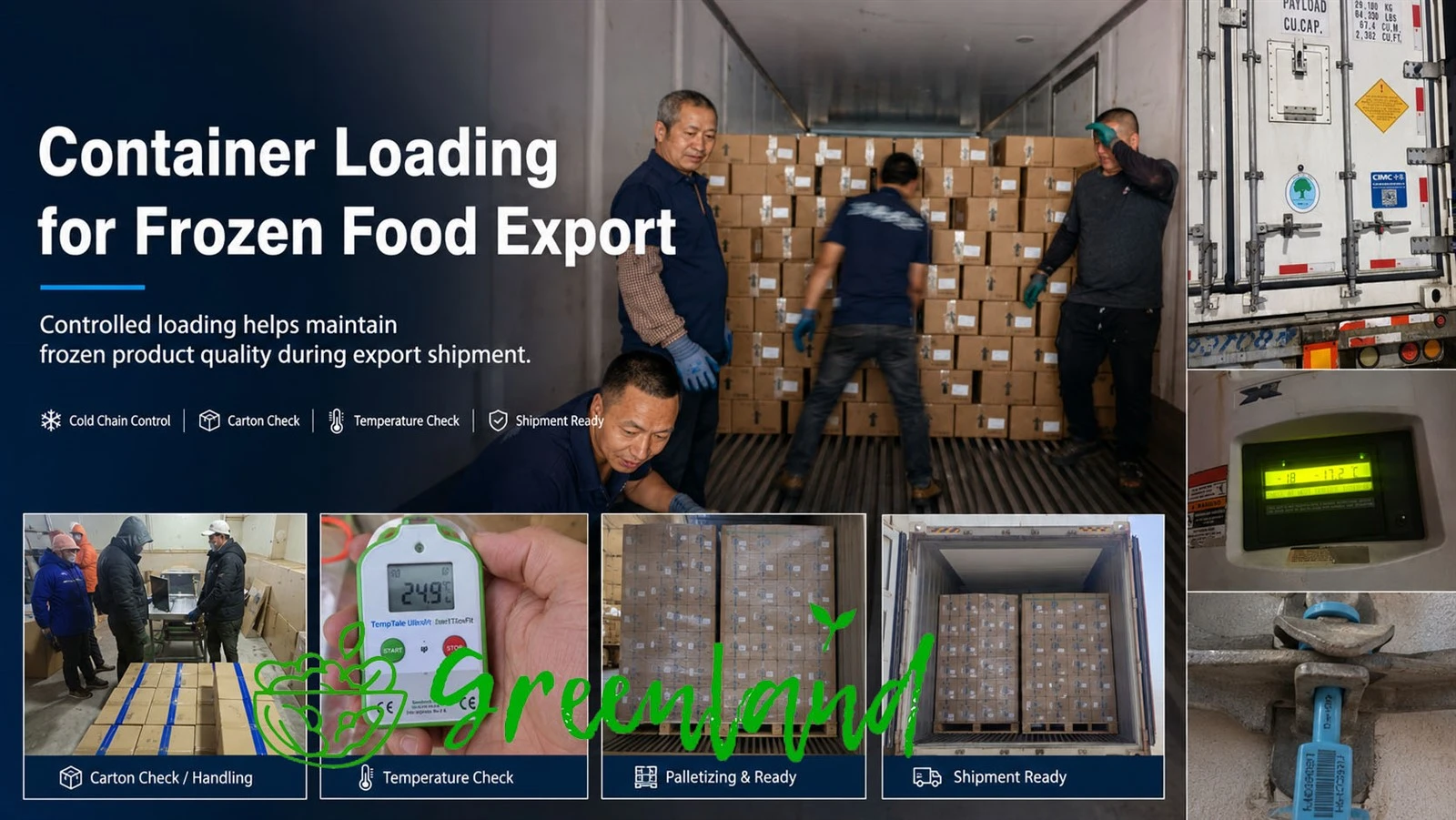
General frozen-food export loading evidence; shipment-specific records accompany the corresponding order.
Hot Tags: frozen passion fruit, China frozen passion fruit manufacturers, suppliers, factory
Technical specification · reference schedule
Frozen Passion Fruits
We review the selected form, grade, process and packing against the technical schedule below. Published and TDS values are specification references for order review. External benchmarks apply only within their stated scope. Acceptance is governed by the signed SKU specification; the identified lot COA reports actual measured results.
Form: Frozen passion-fruit pulp/fruit; seed presentation by orderProduct category: Frozen Passion Fruit
01 / Physical & Sensory
Parameter
Specification / reference
Verification & order basis
Dimensions - Pulp with seeds
100% single-strength passion fruit edible pulp with naturally occurring seedsPublished reference
Confirm method, representative sample and acceptance basis in the signed specification.
Colour
Characteristic yellow to orange-yellowPublished reference
Compare with the approved sensory reference using the stated frozen/thawed/prepared condition.
Compare with the approved sensory reference using the stated frozen/thawed/prepared condition.
Refining & particle presentation
Declare seeded, seedless/refined, pulp, juice or concentrate style; specify screen aperture and permitted residual particles for that style.
Document the screen used and inspect residual seeds/particles on the agreed sieve or sample.
Declared product form
Frozen passion-fruit pulp/fruit; seed presentation by order
Match approved sample, pack label and order form. Published page identity; approve selected grade before order.
02 / Physicochemical & Residue Controls
Parameter
Specification / reference
Verification & order basis
Soluble solids
12.0–16.0°BxPublished reference
Measure representative prepared sample with a temperature-compensated refractometer.
pH
2.50–3.30Published reference
Use calibrated pH meter or titration on the stated sample preparation.
Titratable acidity
3.0–4.5% as citric acidPublished reference
Use calibrated pH meter or titration on the stated sample preparation.
Flow / viscosity reporting
Define a viscosity or consistency target only with its temperature, solids level and measurement conditions.
Report instrument/spindle/speed, or Bostwick distance and elapsed time; use a fully thawed homogeneous sample.
Pesticide residue schedule
Named active ingredients and commodity-specific limits are selected for the destination market. EU source
Link farm spray history, laboratory LOQ and batch result to the destination MRL. EU database is one market reference; apply the actual destination rule.
Lead, cadmium and other contaminants
Apply the limit for the exact commodity and processed form in the destination market. EU source
State analyte, preparation basis, method, LOQ and lot result. Do not transfer a fresh-commodity limit to a processed form without the required assessment.
03 / Microbiological Criteria
Parameter
Specification / reference
Verification & order basis
Aerobic plate count
≤100,000 CFU/gPublished reference
Report the named organism, analytical method, sample mass, sampling plan and lot result; use CFU/g for enumeration and a stated mass for detection.
Enterobacteriaceae
≤1,000 CFU/gPublished reference
Report the named organism, analytical method, sample mass, sampling plan and lot result; use CFU/g for enumeration and a stated mass for detection.
Total coliforms
<100 CFU/gPublished reference
Report the named organism, analytical method, sample mass, sampling plan and lot result; use CFU/g for enumeration and a stated mass for detection.
E. coli
<10 CFU/gPublished reference
Report the named organism, analytical method, sample mass, sampling plan and lot result; use CFU/g for enumeration and a stated mass for detection.
Yeasts
≤1,000 CFU/gPublished reference
Report the named organism, analytical method, sample mass, sampling plan and lot result; use CFU/g for enumeration and a stated mass for detection.
Moulds
≤1,000 CFU/gPublished reference
Report the named organism, analytical method, sample mass, sampling plan and lot result; use CFU/g for enumeration and a stated mass for detection.
Coagulase-positive Staphylococcus aureus
<100 CFU/gPublished reference
Report the named organism, analytical method, sample mass, sampling plan and lot result; use CFU/g for enumeration and a stated mass for detection.
Salmonella
Absent in 25 gPublished reference
Report the named organism, analytical method, sample mass, sampling plan and lot result; use CFU/g for enumeration and a stated mass for detection.
Listeria monocytogenes
Absent in 25 g where contractedPublished reference
Report the named organism, analytical method, sample mass, sampling plan and lot result; use CFU/g for enumeration and a stated mass for detection.
Acceptance schedule
Select the test panel and limits by intended use (ready-to-eat or further processing), product form and destination. EU source
State organism, analytical method, sample mass and n/c plan; report actual lot results. A universal APC, coliform, Salmonella or Listeria limit is not assigned to every frozen product.
04 / Freezing & Cold Chain
Parameter
Specification / reference
Verification & order basis
Frozen storage and transport
≤−18 °CTDS reference
Product core check and logger record. Selected form and grade must match this TDS reference. Applies to: Frozen Passion Fruit frozen formats.
Storage / shelf life
24 months from production when continuously stored at −18°C or below in unopened original packingPublished reference
Verify unopened-pack validation, declared storage condition and production/best-before coding.
Controlled thawing for industrial use
Approve thawing time/temperature, closed-pack handling and post-thaw use period for the receiving process. Codex
Check the receiving SOP and product temperature; maintain lot identity during thawing.
Product thermal centre
−18°C or colder after freezing and thermal stabilization; maintain the agreed frozen distribution condition.External referenceCodex
Probe the thickest representative pack and retain storage/transport temperature records. Codex quick-frozen reference; selected product form and route must be frozen.
Frozen condition at dispatch
Hard frozen, correctly sealed and coded, without thaw/refreeze evidence or excessive loose ice. Codex
Check pack integrity, free-flow or block condition as declared, carton condition and loading temperature.
05 / Pack Size & Shelf Life
Parameter
Specification / reference
Verification & order basis
Industrial packing
1 × 10 kg liner/carton, 4 × 2.5 kg, 10 × 1 kg, 1 × 20 kg bag-in-box or contracted pail/drum formatPublished reference
Check approved pack drawing, calibrated scale and production records.
Declared net contents
Verify each selected pack format against the artwork and applicable quantity-control rule. Codex
Calibrated checkweigher or scale; defined sample and tare.
Shelf-life basis
The labelled period applies only to its validated pack and continuous stated storage condition. Codex
Review stability study or approved shelf-life file and production-date code.
06 / Process Controls
Parameter
Specification / reference
Verification & order basis
Raw-material preparation checks
Separate juice, puree, seeded pulp and concentrate; state extraction/refining and pasteurization route.
Verify the selected product flow and the relevant trimming, sorting and pretreatment record.
Heat-treatment programme
Separate non-pasteurized further-processing material from a validated pasteurized programme; define hold, cooling, filling and release conditions by SKU. Codex
Verify the approved lethality study and product/line record for a heat-treated order.
CCP designation
Use the site-approved HACCP plan to identify true CCPs and their validated critical limits. Codex
Check hazard analysis, monitoring, deviation and corrective-action records. A quality-control step is not automatically a CCP.
07 / Ingredients, Additives & Allergens
Parameter
Specification / reference
Verification & order basis
Ingredient
100% passion fruitPublished reference
Verify approved formula, supplier declarations and line-specific allergen assessment.
Added glaze / coating declaration
Declare any intentionally added water glaze, syrup, oil or coating and the measurement basis; loose ice is assessed separately.
Verify formula/addition records; agree a deglazing or coating test and net-content basis where applicable.
Additive use
Declare any colour-protection agent, acidulant or other additive by ingredient and maximum permitted use for the target market. NHC standard
Check approved formula, actual addition record and market-specific additive category. GB 2760-2024 applies to China; export rules are checked separately.
Allergen and cross-contact assessment
Declare inherent allergens and assess shared-line cross-contact from the actual facility schedule. FDA
Review line matrix, cleaning validation and buyer label approval. Do not claim a shared-line allergen or allergen-free status without facility evidence.
Record each defect class separately by count or mass; state sample size, denominator and combined-limit rules.
Hazardous foreign matter
No foreign matter detected in the defined inspection sample; reject and investigate any finding.External referenceCodex
Define visual-inspection sample size and detector challenge in the signed quality schedule. "None detected" is a sampling statement, not an absolute guarantee of zero particles.
09 / Packaging Materials & Label
Parameter
Specification / reference
Verification & order basis
Food-contact pack
Specify inner-contact material and obtain the applicable food-contact compliance declaration. NHC standard
Review film structure, supplier DoC, migration evidence and actual intended conditions. GB 4806 series is China-specific; EU export also checks Regulations 1935/2004 and 10/2011.
Carton and seal integrity
Define carton stacking strength, bag seal and puncture resistance for the confirmed net weight and pallet plan. EU source
Inspect pack drawing, compression/seal test and shipment configuration.
Label verification
Match product name, ingredient/allergen statement, net weight, lot/date, shelf life and storage instruction to the destination artwork. Codex
Approve artwork against the signed specification and destination rules.
10 / Detection & Traceability
Parameter
Specification / reference
Verification & order basis
Foreign-body detector
Validate Fe, non-Fe and stainless-steel challenge pieces for the actual product, aperture, pack and line; record the proven sensitivity. Codex
Challenge at defined start, changeover, interval and end points; retain rejection records. Do not copy generic detector sizes into a plant capability claim.
Lot traceability
Link input source lot, processing run, packaging code, test records, frozen storage and shipment to one finished lot. Codex
Trace one sample lot forward and backward in a recorded mock recall. Recall speed is stated only when the site has a validated target and record.
Order approval: Confirm the selected form and grade, ingredient formula, intended use, destination market, packing, sampling plan and test panel. The signed specification controls acceptance; the identified lot COA reports actual results.