


When Are Raspberries in Season? Harvest Windows and IQF Buying Plans
Sep 27, 2026
Leave a message

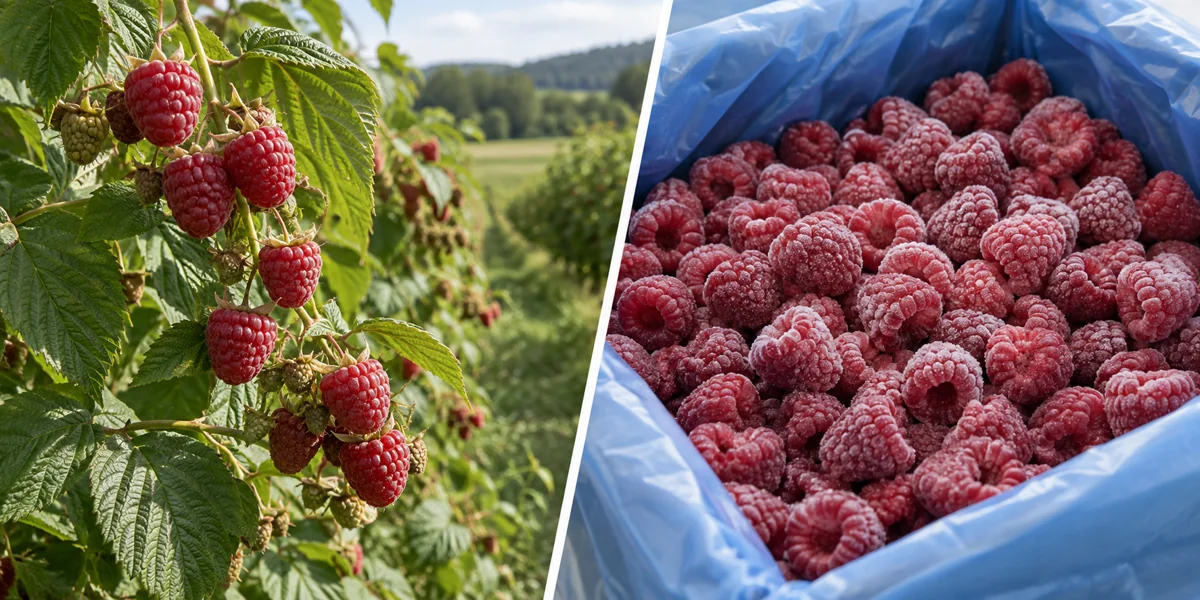
Why raspberry season has more than one window
Most familiar red raspberry shoots grow for two seasons. A first-year shoot is a primocane. It may grow vegetatively and overwinter, then become a floricane that fruits on lateral branches in its second season. Some cultivars bear on the tips of the current year's primocanes in late summer or autumn. Pruning and production system can allow a fall crop, a following summer crop, or one selected crop. The Royal Horticultural Society, University of Minnesota and UC IPM describe these patterns in their respective growing regions.
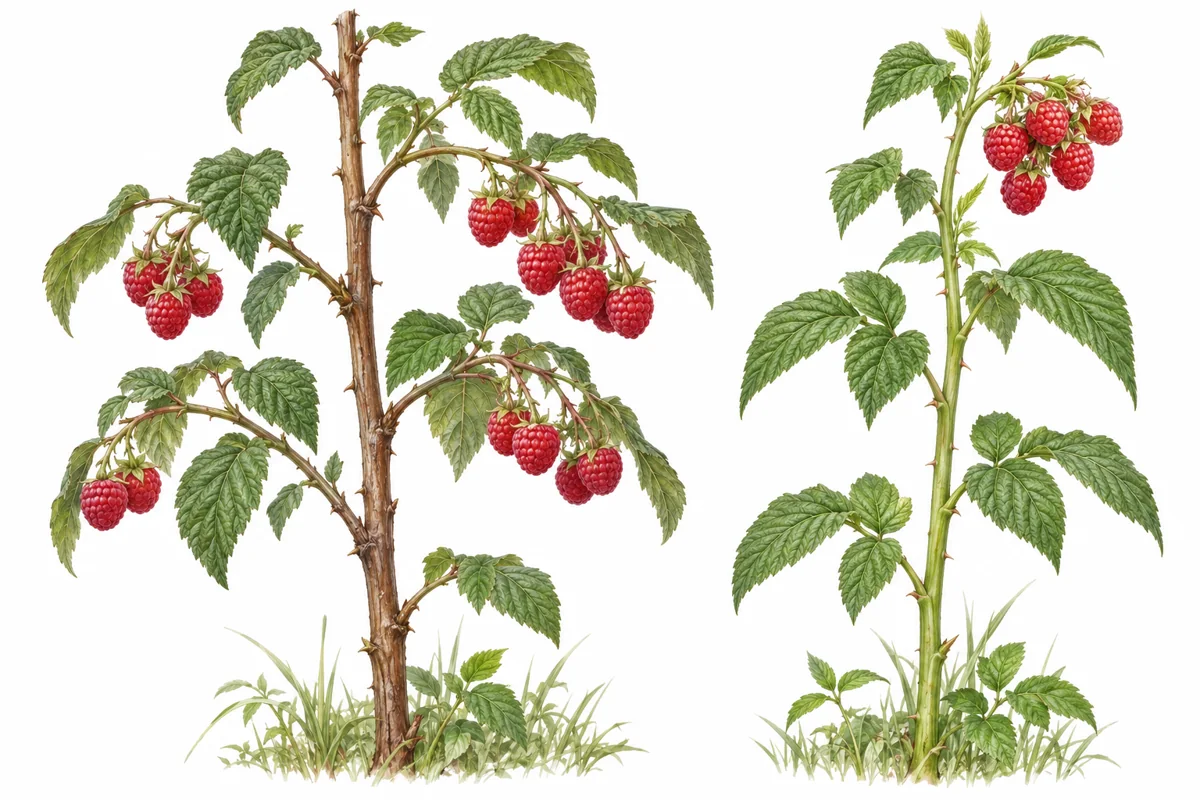
Illustrated floricane and primocane show why one crop calendar does not cover every raspberry system.
That biology explains why a single "raspberry month" is misleading. A summer-bearing crop may be concentrated in a relatively short run. A primocane-bearing program can begin later and continue until conditions end harvest. Planting a mix of cultivars, using protected cultivation and choosing different regions can extend availability, but each changes fruit handling and commercial economics. An importer should request the actual source plan rather than infer it from a general gardening calendar.
The fruit can also ripen unevenly across a planting. Pickers return repeatedly to gather berries that are mature enough to detach without crushing. Weather during the harvest window affects picking pace, color, softness and how much fruit remains suitable for a whole frozen grade. This is why a crop forecast should carry a range and an update date. A quoted shipment based on expected harvest volume is different from a lot already frozen, inspected and held in stock.
Regional examples are still valuable when labeled. RHS describes summer-fruiting and autumn-fruiting windows in the United Kingdom. Minnesota extension notes a late-summer to frost primocane crop in its region. Maine extension describes cultivar differences and warns that some later fall types may not mature reliably in a short northern season. California's UC IPM describes systems that may harvest primocane fruit, floricane fruit or both. These examples show the variables to ask about; they do not establish the origin of a specific GreenLand lot.
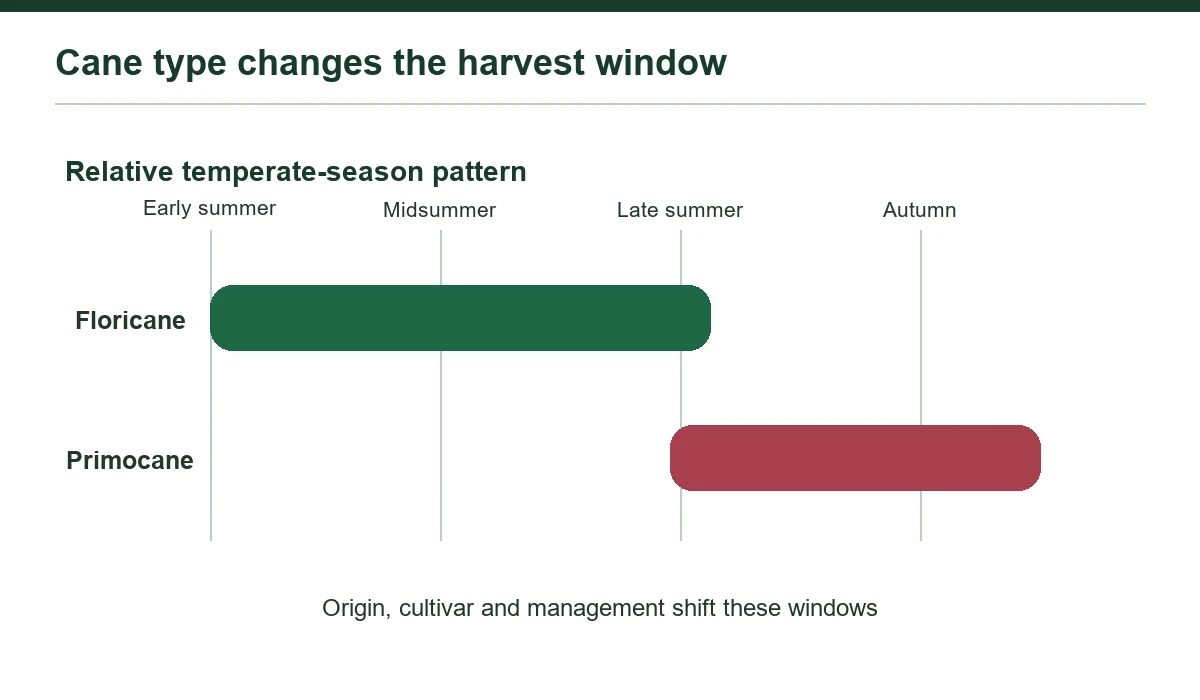
Relative harvest windows vary with cane type, origin, cultivar and management.
A useful crop-intake question has four parts: which origin and cultivar, which cane crop, what expected harvest span, and how much of the picked fruit is intended for the form you buy. Whole IQF, puree and seedless products can use different raw-fruit grades and preparation steps. The allocation between fresh retail and processing changes with contracts and fruit condition. No general season chart can replace a supplier's current production allocation.
What regional calendars can and cannot tell an importer
A calendar can tell a purchasing team when to begin supplier conversations and sample planning. It can suggest when new crop fruit may enter the freezer and when replacement lots will need approval. It cannot confirm a production slot, yield, finished grade or container loading date. Nor can an overseas calendar be copied into a China-sourced offer without verifying the actual growing area and crop system.
Temperature, rainfall, daylight, cultivar and cultivation method shift harvest within a region. A late spring can delay one planting; a hot period can compress picking and alter firmness. Higher latitude may move the window and shorten the later crop. Protected production may change timing, but it also changes handling and cost. The buyer should treat dates in public extension sources as contextual examples and ask the supplier for the current harvest forecast and its confidence level.
The buyer should ask who owns a crop forecast and what event causes it to be revised. A weather event may reduce marketable fruit without changing the broad harvest season. A processing slot can also move if raw fruit from another contracted program arrives first. Put a date and source on every forecast, then replace it with actual harvested and frozen quantities as those records become available. A call-off plan built on stale projections can fail even when the harvest itself occurs on time.
The forecast belongs on a timeline with visible decision gates. Before harvest, agree on specification and sample route. At first intake, check actual berry condition and trial the form intended for freezing. After IQF, inspect whole rate, broken fruit, color, clumping, seed/stem residue and packaging against the contract. Then approve a named production lot for call-off. If the lot differs materially from the prior season's sample, freeze date and country of origin alone cannot stand in for renewed approval.
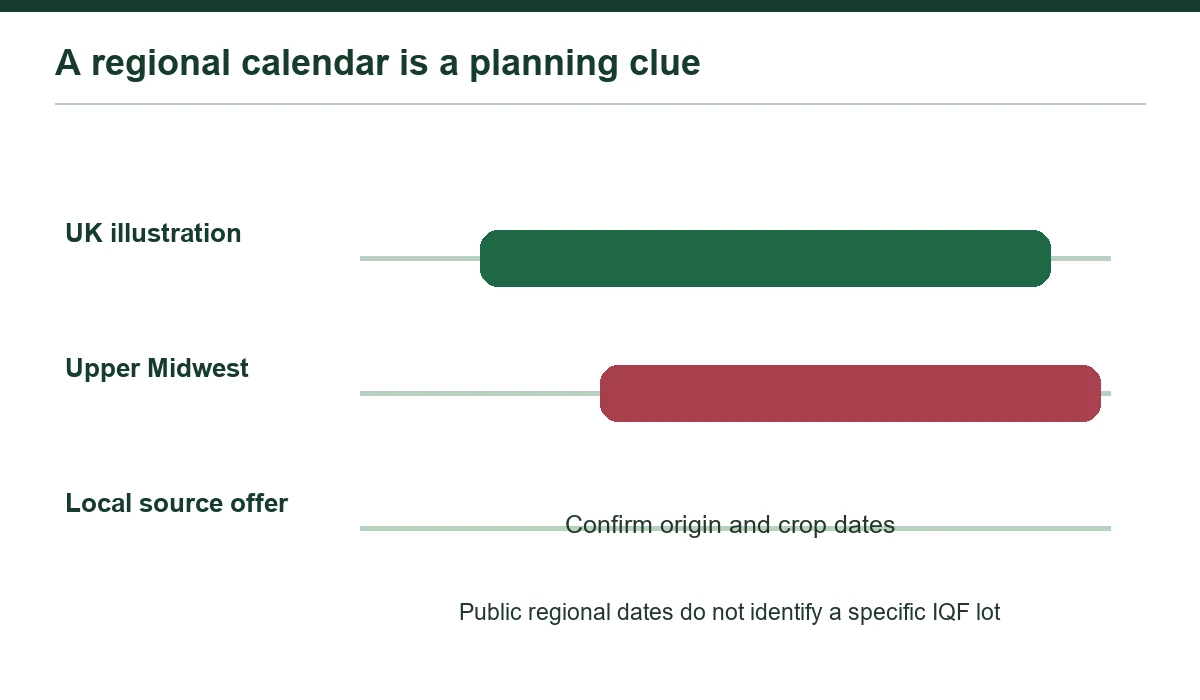
Public regional examples can guide questions but cannot date a specific offered lot.
Watch for a second sort of calendar confusion: retail availability. Fresh raspberries can appear in stores outside a local outdoor harvest window because of imports, tunnel production or storage and distribution arrangements. The store date says little about the source, grade or timing of an IQF ingredient lot. A processor may also freeze a large crop and sell it across many months. The frozen order can therefore be available when no local fresh fruit is being picked, provided traceability and cold-chain records support it.
For a commercial program, use origin, harvest date, freezing date, storage location and expected shipment date as separate fields. Ask how the processor identifies a crop change within its stock, and whether bags from different production dates are mixed. A sample from one lot should not silently approve every later pallet if the application is sensitive to berry size or drip. The line between "same specification" and "same eating result" is established by tested tolerances, not a calendar label.
From harvest day to approved IQF stock
Raspberries are fragile. The hollow fruit and drupelet structure that make them distinctive also make bruising, leakage and breakage a serious quality concern. For whole IQF supply, mature fruit must reach sorting and freezing in a condition that can retain recognizable berry form. A puree route can tolerate a different appearance grade, but food-safety, maturity and defect controls still apply. The buyer should ask how the offered form is selected and packed from the actual crop, without assuming that every fruit picked is interchangeable.

Real raspberry sorting scene; supports harvest-to-IQF preparation discussion
The relevant production chain is harvest, intake, sorting, preparation, freezing, inspection, packing, frozen storage and release. Each step has a date and a traceable lot. A fresh harvest estimate becomes finished inventory only after the processor knows the usable yield and releases the grade. Rain damage or a high share of broken berries can reduce the whole-IQF output even when field tonnage meets the forecast. The buyer's call-off plan should therefore be based on approved frozen quantity, with a separate note for expected but unreleased production.
Our frozen raspberry product page describes whole, puree and seedless forms and the quality fields we confirm, including Brix, color, berry integrity, broken fruit, drip, packing and destination needs. That page is a starting point for an RFQ. The confirmed offer must specify which forms and lots are currently available; a category description is not proof that every form or origin is in stock today. A request for an unusual cut or pack may also need a separate production commitment.
Freezing preserves an ingredient for a later buying window, but it does not erase differences among crop lots. A batch frozen promptly from firm berries can have a different whole rate from a batch of softer later-picked berries, even if both meet the broad label "frozen raspberry." Sampling should test the customer's exact handling: how berries pour from the bag, how many remain intact after the chosen thaw, and how color and flavor perform in the formulation. A spooned cheesecake topping has different priorities from a decorative whole berry on a dessert.
A supplier's finished stock figure should identify pack, grade and lot. If a warehouse holds 10 tonnes of raspberry products, that number may include whole fruit, broken fruit and puree with different pack sizes and customers' reservations. The buyer needs the unallocated quantity of the approved form, not a sum of unlike inventory. Ask when the stock report was generated and how reservations are updated after other call-offs.
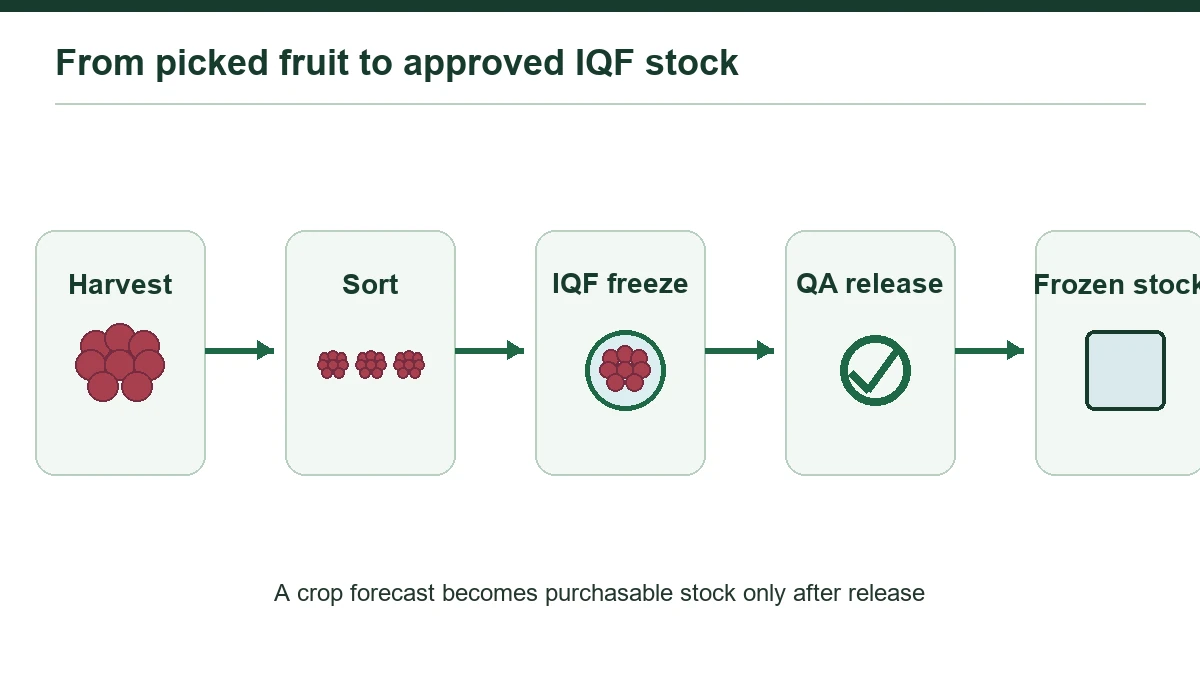
The buyer can call off only stock that has passed the agreed release checks.
The processor should also tell the buyer whether a sample comes from the beginning, middle or end of a production run when variation is material. A first-hour sample may not describe fruit frozen after a weather change or shift change. The sampling agreement can use composite or stratified specimens, with a clear retained-sample procedure. That helps the buyer investigate a later discrepancy without assuming every case in a large seasonal run was identical.
Cold-chain records matter between release and use. Request the storage condition, loading condition, container plan and any agreed temperature-monitoring evidence. Inspect packaging for damage, ice accumulation and clumping at receipt. Those signs may justify investigation, but a photo of frost alone does not prove a specific history or safety state. Compare it with documented temperatures and product condition. A later call-off should refer to the released lot and the buyer's approved sample, not only to a price list line.
How early and late crop lots can differ
An early and a late lot may share a SKU while differing in size distribution, sweetness and acid balance, color, firmness or broken-berry fraction. Variety and maturity can matter as much as harvest date, so date should be treated as an explanatory variable rather than a quality grade. The purchasing team needs the attributes that affect its use. For a visible fruit topping, whole rate and uniform color may dominate. For a blended beverage, usable puree yield, seed perception and flavor at dilution may be more important.
Brix is useful, but it measures soluble solids and does not by itself describe acidity or aroma. Two lots with the same Brix may taste different in yogurt or a sweetened sauce. A standardized application trial can compare their sweetness and tartness under the same recipe. Record the thaw method, input mass, screen specification and serving temperature. Otherwise, a lot difference can be confused with a change in preparation. The fresh versus frozen raspberry guide covers broader quality and landed-cost questions; here the decision is whether a seasonal replacement lot behaves like the approved one.
Broken fruit is also not one universal defect. A specification may allow a measured broken fraction for puree input while requiring a much higher whole rate for a visible inclusion. The buyer should state how the fraction is measured: sample mass, thaw state if relevant, definition of "whole," and treatment of clumps. An unsupported claim of "premium whole" is less useful than a testable condition at receiving. Samples from different crop windows should be evaluated by the same method.

Real whole frozen raspberry product view for integrity comparison
Color can shift with variety, maturity, storage and processing, while surface frost can alter how it appears before thawing. Evaluate color under consistent light and in the finished product where possible. Berry seed and drupelet texture also affect perceived smoothness after blending or screening. If a product developer is choosing a seedless route, confirm the actual available form and screen loss rather than assuming whole IQF fruit and prepared puree have the same net yield.
The trial result should be attached to a named lot and a decision. If the later crop is acceptable only in a cooked topping, the buyer can approve it for that use without automatically approving it for a whole-fruit retail bag. If it misses one tolerance, ask whether another available lot fits or whether a controlled formula adjustment is allowed. Keep the commercially sensitive facts, such as grade, price and volume, separate from speculation about why the crop changed.
Build a call-off and replacement-lot plan
Start from the quantity the application is expected to consume between two realistic delivery dates. Add the pack format, order multiple, transit time and any buffer that the business has approved. Then place the known approved frozen lots on the same timeline. Mark three statuses clearly: forecast crop, produced but pending QA, and released stock reserved for this buyer. A call-off should draw only from the last category unless the contract explicitly permits a conditional order with an agreed release date.
A rolling plan has update points. Before the crop, send the forecast and confirm likely form and pack. During harvest, ask for production updates and sample timing. On finished-lot release, approve the exact lot against the application trial and reserve the volume. Ahead of each shipment, reconcile remaining stock, minimum order quantity, destination documents and loading date. If a replacement lot is needed, run an abbreviated or full requalification according to the observed change and risk of the application.
A second source or alternate form can be useful, but it needs its own specification. A puree pack may keep a sauce line running when whole berries are scarce, yet it will change yield, seed handling and label claims. A buyer cannot simply substitute an unverified foreign-origin crop, a different cultivar or an unconfirmed GreenLand form because a seasonal chart shows fruit somewhere in the world. Confirm supply and destination compliance before changing the purchase order.
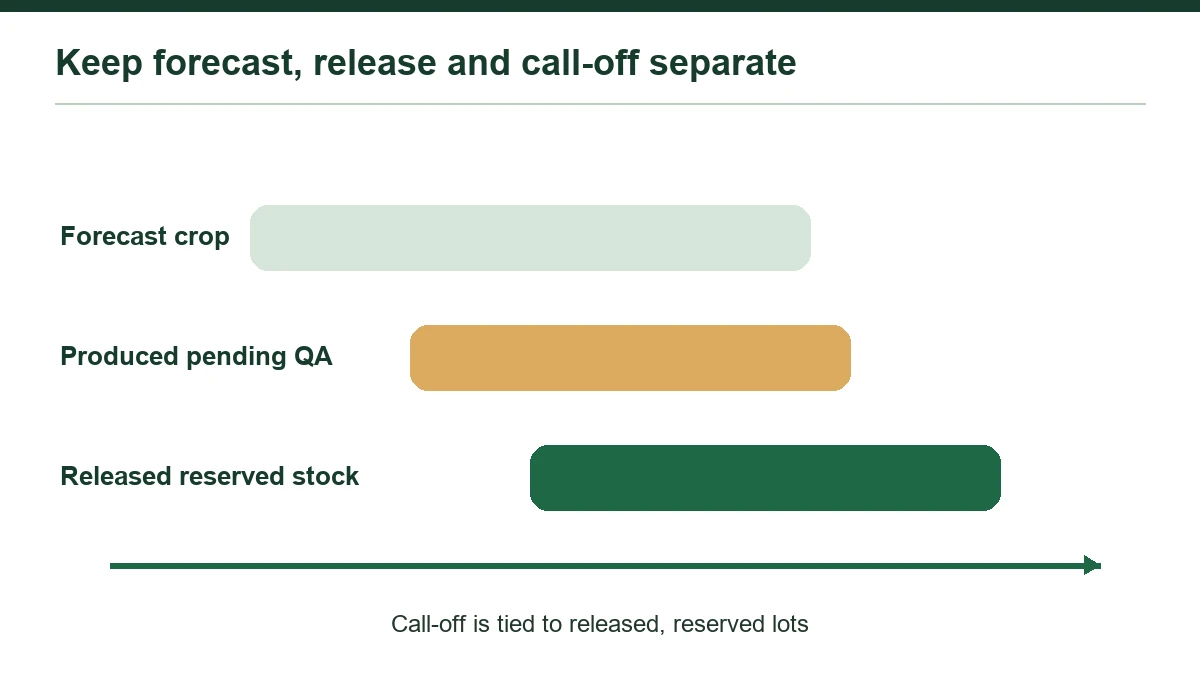
Forecast fruit, produced inventory and released reserved stock require separate status.
The call-off plan should include a practical response to a late or short harvest. Who approves a replacement sample? How much notice does the bakery or beverage plant require? Is a mixed production date acceptable? Can the pack size change? What documentation must travel with the container? Answers written before shortage give the supplier room to reserve suitable stock and prevent hurried acceptance of a lot that has not been tested in the final product.
Do not infer unlimited shelf life from the fact that fruit is frozen. The named product's label, specification, storage record and handling route define the usable window. Repeated temperature abuse or damaged packaging can reduce quality. A contract may also set a maximum age at shipment. The buyer should have that condition in the purchase order if it matters, and inspect against it when the lot arrives.
Specify the frozen raspberry that fits the application
The specification should identify how the fruit will be used after thawing. A bakery may bake berries into a filling, while a dairy plant may fold them into a cold product where bleed and breakage are conspicuous. The trial route should mimic that handling closely enough to reveal meaningful differences. Record whether the sample was cooked, blended, folded or simply thawed, and how long it waited before judgment. A seasonal lot comparison without a consistent use test can reward the prettier frozen surface while missing the actual eating-quality difference.
An effective RFQ names the form first: whole IQF, a broken-fruit grade, screened puree or another form the supplier has confirmed. It then states the application and the acceptance characteristics that affect it. For a frozen yogurt inclusion, ask about berry size, whole fraction, color transfer, drip and clumping under the manufacturer's mixing route. For a bakery filling, ask about fruit flavor, seed texture, usable yield and heat behavior. For a beverage, specify screen, dilution, Brix and acid interpretation in the actual formula.
Add practical purchase fields: target pack and net weight, quantity per call-off, annual forecast if available, destination, private-label needs, required certificates and export documents, and the date by which a sample must be approved. Ask for crop and production lot identity, freezing date and a representative current-lot sample. Those fields make the seasonal plan auditable. The buyer can then compare an early and later lot under the same test and decide whether one specification covers both.
Our raspberry topping article illustrates a finished-use question; a topping may tolerate broken fruit that a decorative whole-berry program cannot. This is why season planning ends with an application trial. Whole rate, sweetness, acidity and visible color are not abstract grades. They are acceptance criteria only after the buyer has decided what the berry must do on the plate or production line.

Real frozen raspberries in bulk liner for pack and application context
Ask the supplier to show what is confirmed, what remains forecast and what requires a trial. We can discuss a factory-direct frozen raspberry offer in the requested form and packing, but the specific origin, crop dates, available volume and replacement lot must be confirmed for the current order. A supplier can support that record with a dated crop update, current-lot specification, release report, retained sample, stock reservation and shipment documents. The buyer should agree who sends each item and when, because a document arriving after production starts may be too late to prevent a substitution. This is particularly relevant for a private-label bag whose fruit appearance is visible to the final consumer. The approved sample and released lot must describe the fruit actually packed under that label.
The most useful answer to "when are raspberries in season?" is therefore a linked record: origin and cane system, expected harvest window, actual IQF production date, approved lot, reserved stock and next shipment date. That record supports reliable supply long after the field harvest ends.
Source Frozen Raspberry with GreenLand-food
GreenLand-food is a professional frozen raspberry supplier and manufacturer in China, providing factory-direct wholesale supply for importers, food manufacturers, distributors and private-label programs.
Send the product form, specification, packing, quantity, application, destination, private-label needs and requested documents. We will confirm the current offer and representative sample route.