


Strawberry Puree for Matcha Drinks: Color, Acidity and Layering
Sep 27, 2026
Leave a message

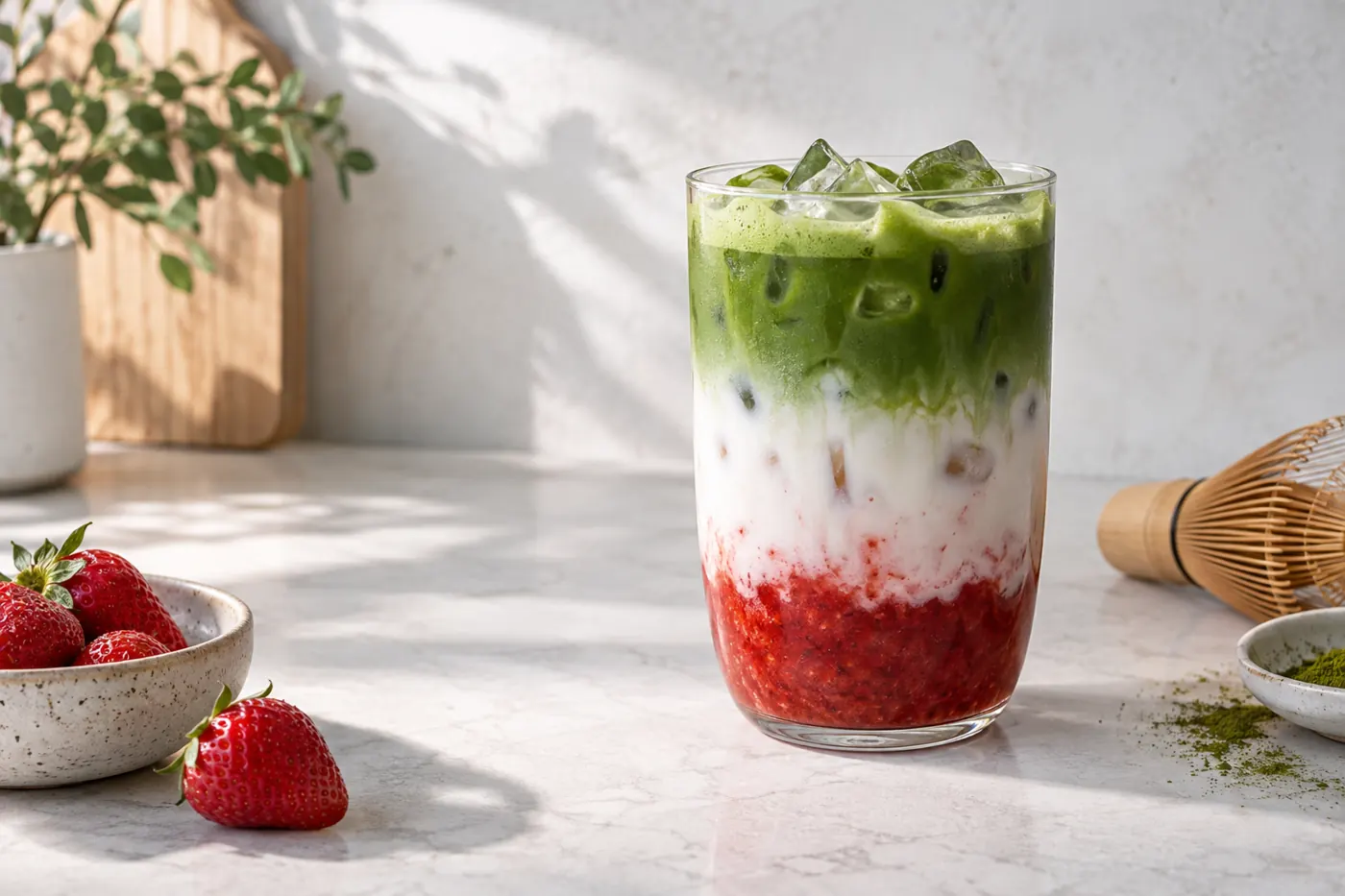
Define the layer the drink must deliver
Start with the finished glass. In a typical layered build, strawberry sits at the bottom, milk occupies the middle, and whisked matcha adds a green top. The visible boundary is part of the product promise, yet the drink also has to taste balanced once the customer stirs it. A layer that survives a photograph but deposits a dense plug of fruit at the bottom is not automatically a good menu item. Decide whether the customer should experience discrete layers at handoff, a gradual blend while drinking, or a fully mixed beverage after a deliberate stir.
That choice determines what to measure. For a handoff appearance, specify the minimum period between assembly and pickup that matters in the real store. For delivery, inspect the cup after the movement and waiting the delivery route creates. Record the boundary, color contrast, fruit settlement, and free liquid rather than giving the drink a single vague score. A small test series using the intended cup, ice, milk, and matcha concentration will tell you more than a large number of attractive one-off samples.
Strawberry brings sweetness, acidity, aroma, and suspended solids into a relatively delicate tea profile. Greater fruit loading can strengthen color yet cover the matcha. Added sugar can soften acid but may also change how heavy the base feels. Fine particles may create an even drink; coarse pieces can signal fruit while interfering with a straw or dosing pump. These tradeoffs are reasons to specify a target drink first, then adjust the puree, instead of choosing the reddest puree on its own.
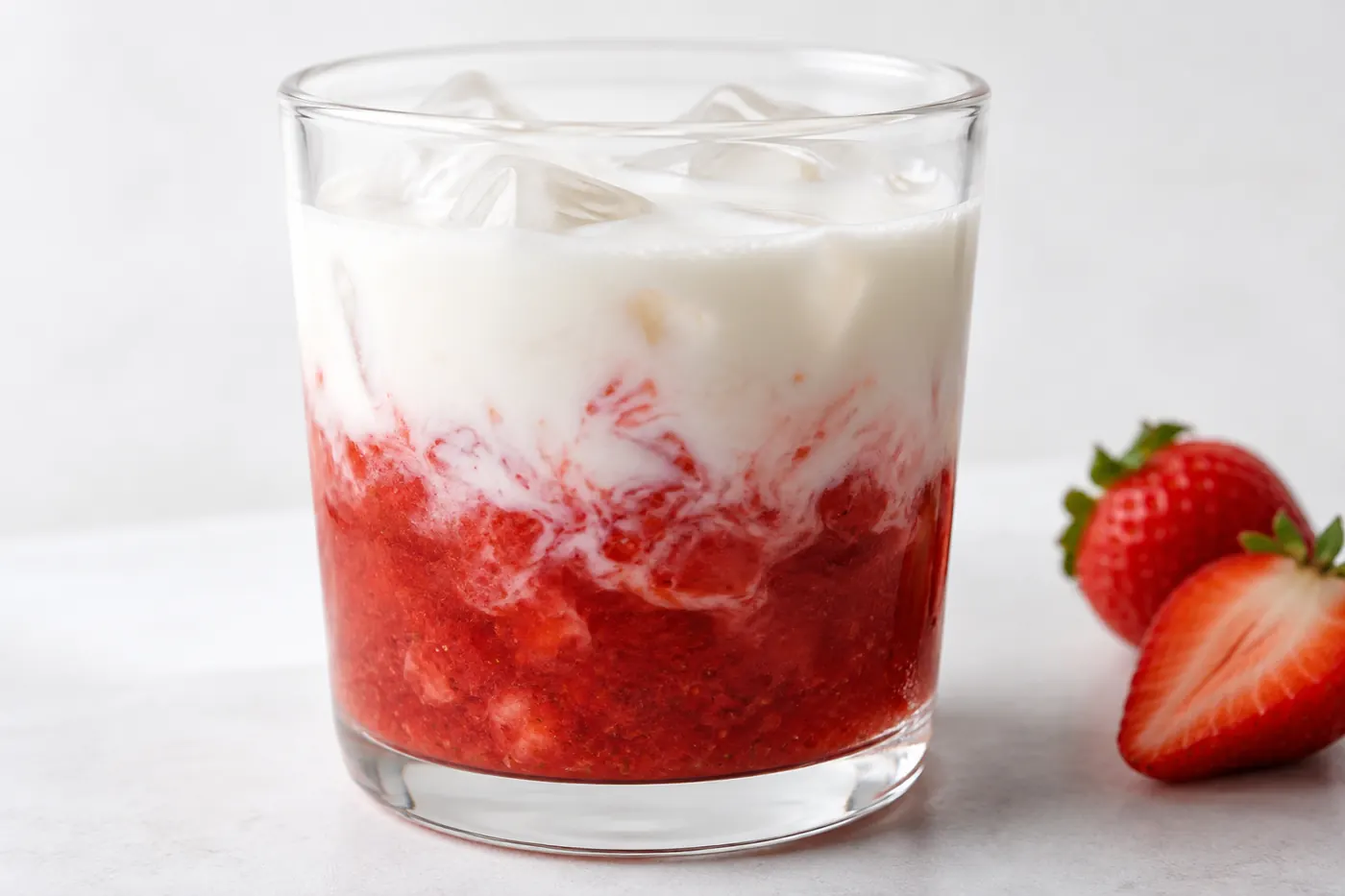
Strawberry layer beneath milk and matcha with visible fruit texture.
Temperature also changes the judgment. Cold milk can mute perceived sweetness, while melting ice dilutes both strawberry and matcha during a hold. A layer made with warm puree may initially look sharp and then spread as the cup cools; a cold, thick puree may pour slowly but blend more pleasantly after stirring. Prepare all test components at realistic service temperatures, and note those temperatures in the trial. Otherwise, a successful bench sample may be impossible for a barista to reproduce at rush hour.
The reference should include the cup profile and fill line. A tall narrow glass can exaggerate separation; a short wide cup exposes a broad interface between fruit and milk. Clear cups show every swirl and sediment line, while opaque cups shift the evaluation to flavor and mouthfeel. Decide which presentation the customer actually buys before setting an acceptance threshold. The same puree may be appropriate for a mixed strawberry matcha and unsuitable for a dramatic three-color presentation.
Recipe pages often recommend adding fruit, ice, milk, and then matcha slowly. That is a sensible starting sequence, also used in Just One Cookbook's strawberry matcha latte. Commercial development needs the extra step of defining a result and checking repeatability. We suggest photographing the same trial glass at assembly and at the specified handoff time, then tasting a stirred sample. A beautiful separation and a good blended flavor should both be visible in the record.
Choose a frozen strawberry input and account for thaw juice
Frozen whole berries, halves, and dices give the puree maker different handling choices. Smaller pieces generally feed a blender or kettle more conveniently, while larger fruit may give the buyer a clearer view of piece integrity during incoming inspection. The cut is not itself a guarantee of puree yield or flavor. Ask for the relevant cut, size range, grade, packing, origin, and lot information, then test the actual material in the intended process. GreenLand's frozen strawberry range provides a starting point for discussing available forms.
Thawing creates a practical fork in the recipe. Some juice separates from the fruit as ice crystals melt. If a developer blends the fruit and all of that juice, the yield and flavor balance differ from a trial that drains the liquid away. Neither choice is inherently correct. What causes trouble is changing the choice between trials, stores, or production shifts. Weigh the frozen input, collect and weigh any separated liquid, and record whether it returns to the puree. That simple mass record helps explain why two nominally identical batches flow differently.
The treatment of a frozen berry also needs a separate food safety decision. Freezing preserves a fruit for frozen distribution; it is not a validated kill step for all hazards. The FDA notes that freezing generally does not inactivate viruses on berries. If the drink uses a raw or unheated fruit puree, the buyer must confirm the fruit's intended use, supplier controls, local requirements, and the beverage operation's own preventive plan. A pasteurized puree and a simply blended frozen berry should never be treated as the same ingredient solely because both pour red.

Frozen strawberry dices shown on a GreenLand product page.
Commercial packs also influence waste and preparation time. A large bag can be efficient for a central kitchen that thaws and processes a controlled amount at once; smaller packs can reduce partial-bag handling at store level. Specify how a lot will be identified after an outer case is opened, how material will be protected during transfer, and how prepared puree will be dated under the buyer's own controls. If the program involves several facilities, a clear pack and lot code is often more valuable than a small theoretical saving in blend time.
Fruit color and flavor can vary with cultivar, harvest, and processing history. A supplier sample should represent a defined lot or agreed specification, not a promise that every future crop will have the exact shade shown in a marketing photograph. Compare incoming strawberry samples against a signed sensory and analytical reference, if the drink's appearance is critical. A color judgment made in a bowl of puree is not enough; evaluate it beneath milk and matcha in the actual cup, under the lighting customers will see.
For a procurement brief, ask for a proposed cut and pack size, quantity, destination, desired documentation, and whether you intend to blend on site or at a central processor. We can use those inputs to discuss frozen strawberry supply, then the beverage team can verify yield, thaw handling, and the finished drink. The product photo here shows a real frozen cut; it does not make any claim about a completed matcha formulation.
Control puree particle size, color and acidity
Puree texture governs both the first pour and the last sip. Large fruit particles can bridge a narrow nozzle or collect at the bottom of a cup. Very fine puree can run cleanly through a dispenser but make the drink feel more like a sweetened liquid than fruit. Decide which equipment the product will pass through: a handheld squeeze bottle, a dosing pump, a gravity filler, or a spoon. Then evaluate particle size at the outlet and in the finished cup. A visual comparison of two blends is useful only when the same input fruit and formula are used for both.
Seeds deserve a specific decision. A lightly blended base may retain a recognizable strawberry appearance but leave an occasional seed in the straw. Straining removes that texture and changes yield, labor, and perceived fruit character. The appropriate choice follows the brand's texture target. Document the screen or strainer used in a trial, how much material it removes, and whether the process can be repeated at commercial throughput. Avoid describing a sample as "smooth" without saying what that means for the drinking equipment.
Acidity is a similar sensory and operating variable. Strawberry's tartness can brighten matcha and milk, yet an overly sharp base can make the blend taste thin or clash with a sweetened milk system. Measure the attributes relevant to your recipe, such as pH and soluble solids, but set acceptance from the finished drink. A single number cannot predict perceived balance in a beverage with tea bitterness, dairy or plant milk, added sweetener, and melting ice. Keep the formula fixed while comparing fruit lots or grades.
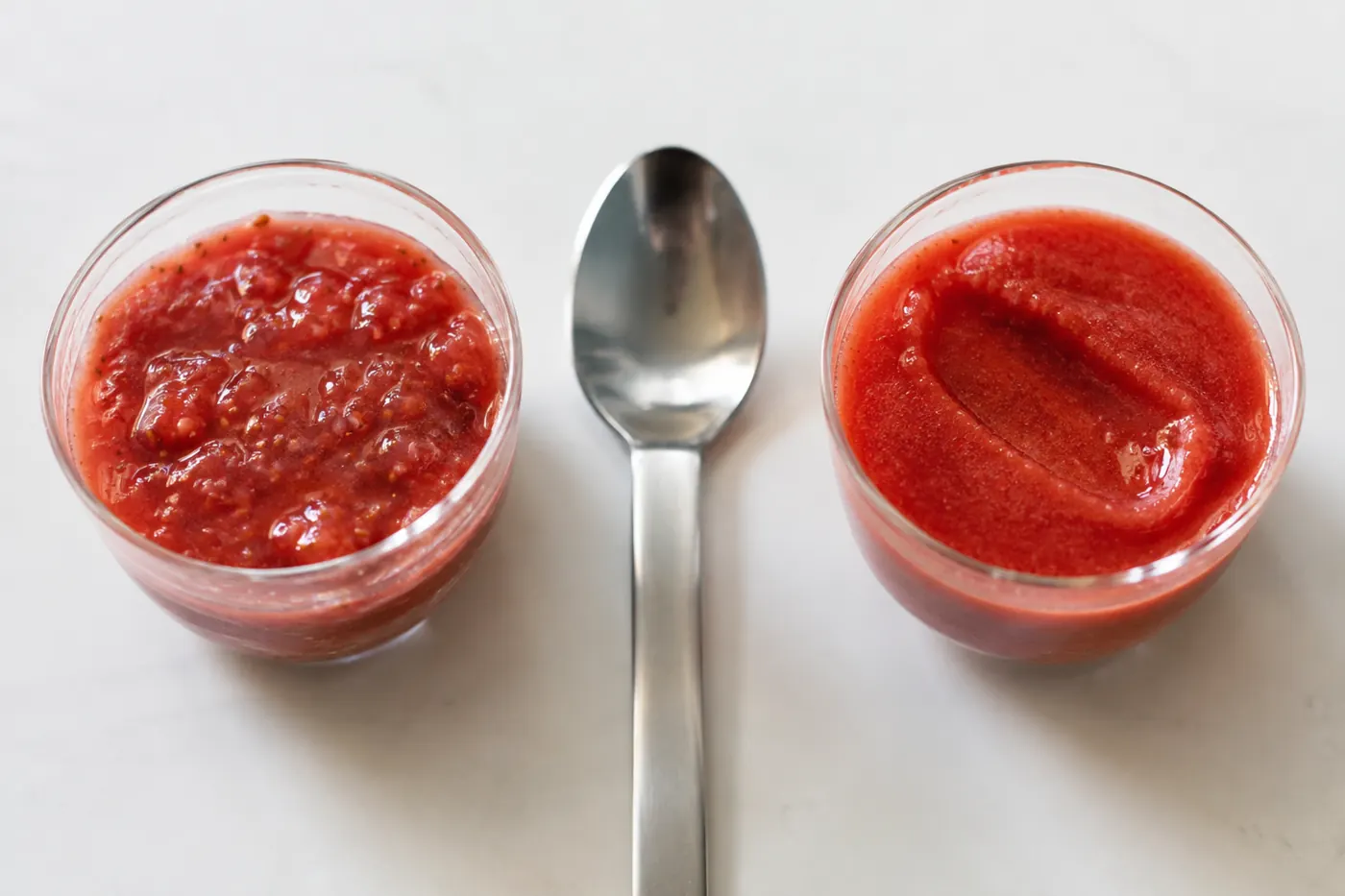
Coarse and finer strawberry puree samples for a drink trial.
Color needs two checks: appearance in the fruit base and appearance after contact with the other layers. A puree can look bright red in a small jar and dull or pale at the bottom of a milky cup. Look for browning, excessive pink dilution, and particulate settling after the actual hold. If color is being adjusted with another ingredient, declare that in the formula and test its interaction with taste. Do not ask a frozen fruit supplier to guarantee a photograph's shade without defining the fruit specification and the beverage process.
Flow is easier to discuss when it is tied to a simple, repeatable method. Use the actual serving bottle or pump and record the portion delivered by weight, the time needed to dispense it, and any interruptions caused by pieces or seeds. Repeat after the puree has spent the intended period under controlled chilled holding, since a fresh blend and a service-ready bottle may behave differently. The result becomes a practical instruction for operations rather than an adjective such as "pourable."
If the team is considering a manufactured strawberry puree instead of blending fruit, compare the ingredient declaration and processing status as carefully as the texture. GreenLand has a frozen strawberry puree product page, but a product listing is a starting point for asking about the exact offered specification. Confirm whether the sampled product has the composition and treatment your beverage requires. Do not carry performance assumptions from a frozen fruit cut to a processed puree with different ingredients or controls.
Test layering with milk, ice and matcha
Build a controlled assembly trial before optimizing the fruit alone. Select one cup, one ice specification, measured portions, defined milk temperature, and a matcha preparation method. Use the same mixing time and water amount for each matcha portion. When these variables move together, a puree change can appear to improve separation even though the real cause is a colder milk pour or larger ice. A standard build gives the team a fair comparison among fruit inputs and puree formulations.
The usual order is fruit base first, then ice and milk, then matcha. Let milk flow against the cup wall or over ice rather than dropping it straight through the puree. Add matcha gently over ice or a spoon if the presentation requires a green top. This sequence is a handling method, not a promise that the layers will remain perfectly fixed. Density, viscosity, cup shape, pour height, and ice movement all affect the boundary. The diagram makes the pour path explicit so a store can reproduce the test.
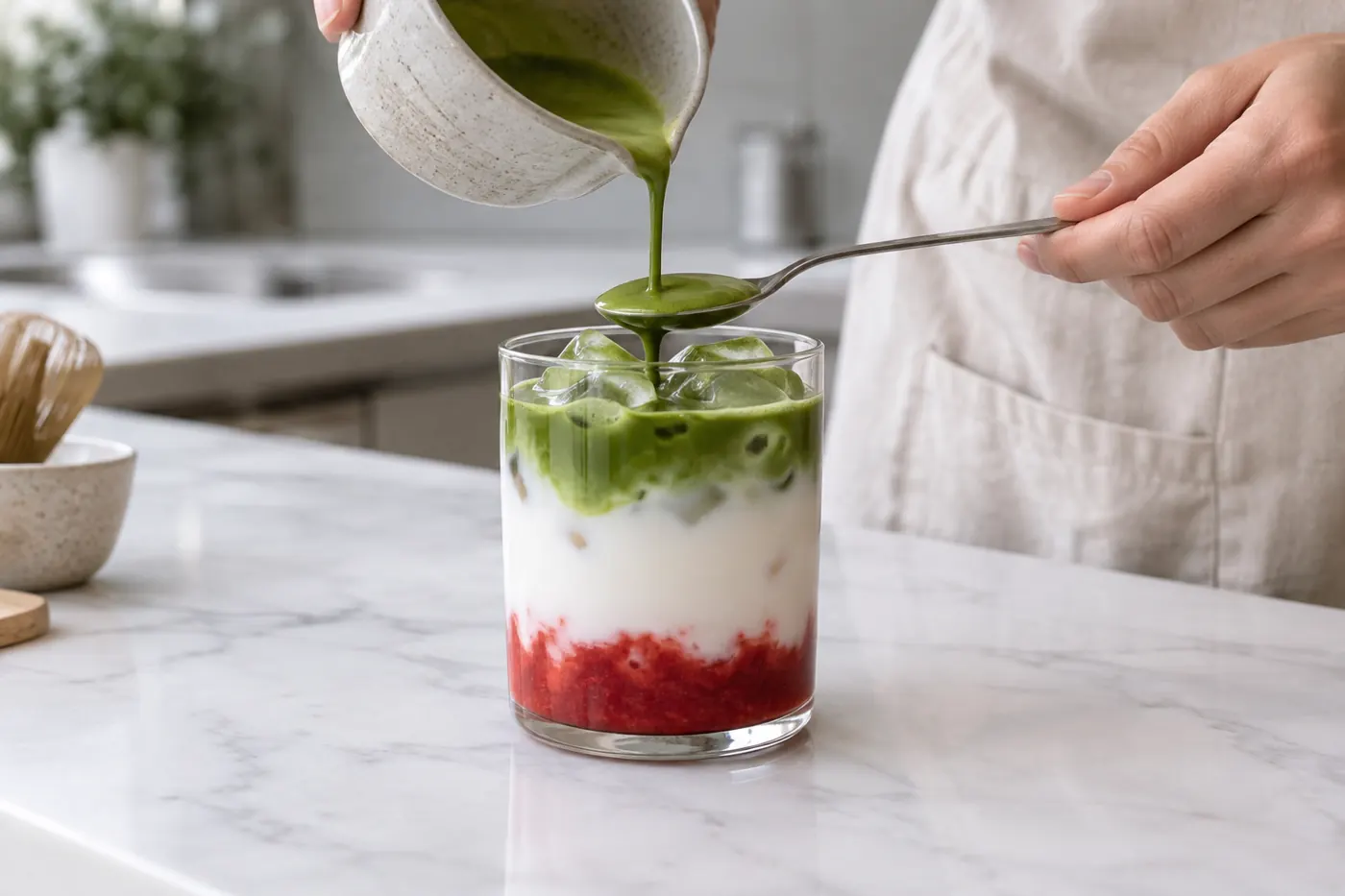
Matcha poured gently over ice and milk above a strawberry base.
Assess both a careful build and a realistic busy-service build. If only the slowest employee can preserve the layers, the drink may need a thicker fruit base, a different cup, a wider acceptable appearance, or a simplified service instruction. Invite several staff members to follow the same brief without coaching, then compare their cups after the same hold. This is a useful way to separate an ingredient defect from an instruction that is too delicate for the counter.
Ice is not a passive decoration. Its amount changes the space available for milk, the path of the pour, dilution, and how quickly the cup reaches its final temperature. A different cube size can alter the visible boundary. If the menu uses crushed ice in one location and solid cubes in another, test both. Record the cup fill level by weight or a clear service mark, not a description such as "a handful." For a scaled program, this little discipline prevents many avoidable complaints about weak color or inconsistent sweetness.
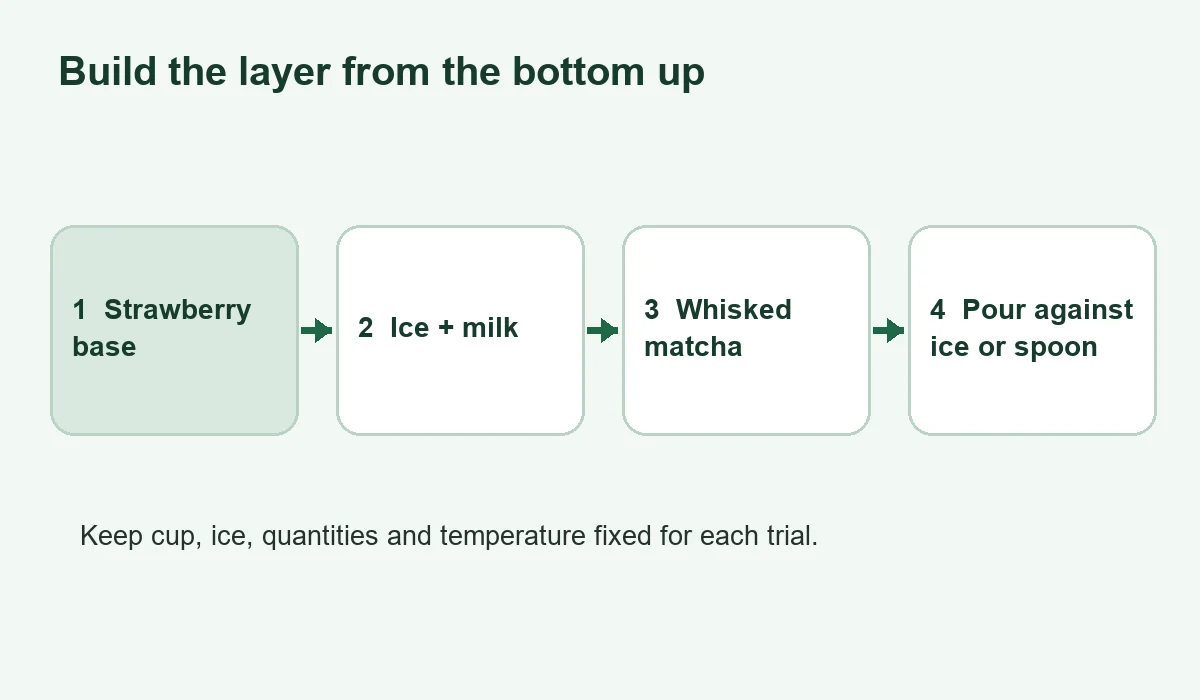
The order and direction of pouring a layered strawberry matcha drink.
Matcha itself can create misleading effects. A concentrated whisked matcha portion may sit distinctly on top of cold milk at first; one that includes much more water can mix faster and dilute the strawberry taste. Record the powder, water amount, water temperature, whisking method, and waiting interval before pouring. The objective is not to compare tea brands in this article. It is to keep the tea portion steady while deciding whether a strawberry puree works for the chosen menu drink.
After photographing the layers, stir and taste the whole cup. The base should not require an impractical amount of stirring to distribute fruit, and the resulting sweetness and tartness should still allow the tea to be recognized. A sensory panel can use a short description of the intended flavor rather than an elaborate numerical score. Note whether the last sips are stronger or more pulpy than the first. An attractive layer with a poor drinking sequence is a formulation problem, not a success.
Judge the drink after the real service hold
The decisive inspection occurs at the time a customer receives or drinks the beverage. Set a hold that reflects the actual order queue, pickup shelf, or delivery route. Do not use a universal minute value copied from another café, because cup size, room temperature, ice, and service speed differ. The blank observation strip gives three checkpoints: assembly, handoff, and the target hold. Fill it with your own timing and observations during a trial rather than treating a diagram as evidence of performance.
At each checkpoint, photograph the cup from the same angle and light. Record whether the strawberry boundary remains visible, whether the red travels upward, whether matcha sinks into milk, and whether sediment forms at the bottom. A single photograph can make the drink look better or worse depending on backlighting, so pair images with a written observation. Repeated trials help determine whether a change is stable enough to specify rather than a lucky pour.
Also inspect the cup after ordinary handling: a lid placed on it, a short walk, a vehicle transfer if delivery is planned, and a straw inserted. These actions disturb the layers in different ways. A menu team may reasonably accept some blending after the customer moves the cup. What matters is that the acceptance rule matches the sales channel. A product advertised through a dramatic three-color photo needs a more careful handoff standard than a drink described primarily by taste.
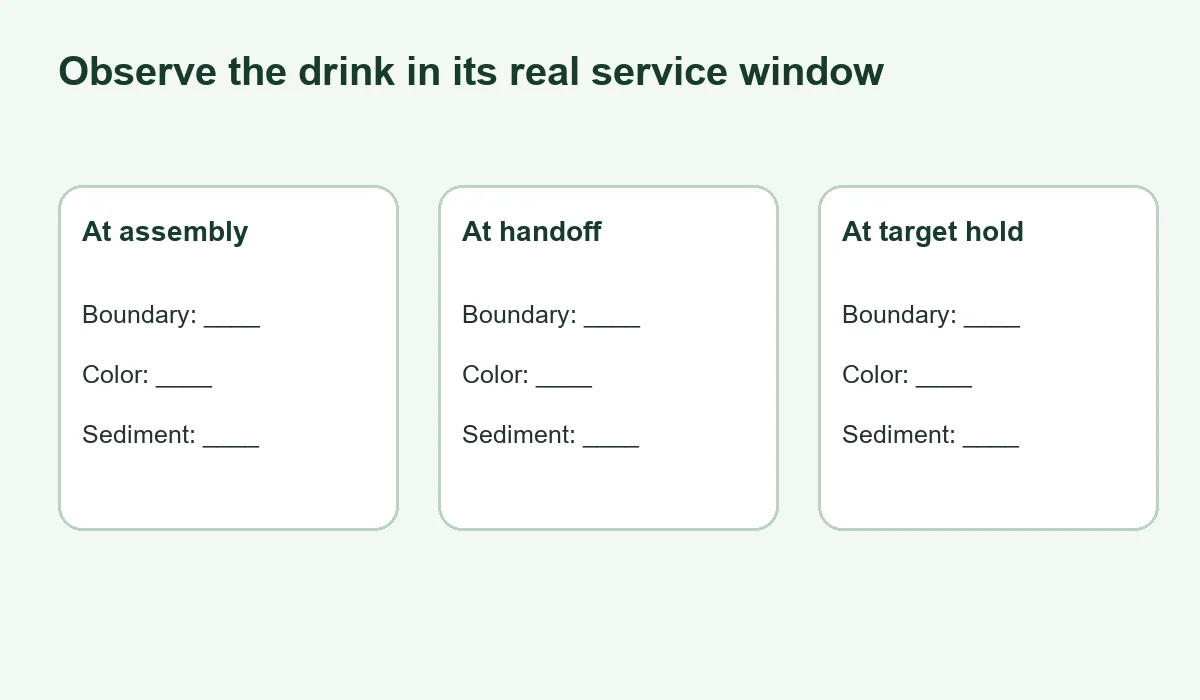
Blank checkpoints for checking a layered drink during service.
Hold trials have a food handling side as well as a visual side. Prepared fruit base, milk, and the completed beverage must follow the operator's applicable time and temperature controls. A pleasing appearance cannot justify extending a chilled ingredient's approved use period. Record preparation and disposal rules separately from the visual service window. The former is a safety and quality control; the latter answers what the customer will see. Keeping those records separate helps a buyer understand what the ingredient trial has proved.
When a trial fails, change one variable at a time. If strawberry spreads immediately as milk is added, look first at puree flow and pour force. If it holds at assembly but washes out later, inspect ice melt and the required wait. If color survives yet fruit collects as a dense layer after stirring, review particle size and fruit loading. This diagnosis keeps the team from solving every problem with more sugar or more thickener, changes that can distort the intended drink.
Take the winning formula to the actual outlet or a realistic pilot line. Observe staff dosing and cleaning, not only the beverage's appearance. A base that separates in a squeeze bottle or clogs a pump will be hard to run consistently even if a chef can prepare an excellent sample. Ask the team to log yield per pack and any fruit discarded after the approved use period. Those observations connect ingredient economics to the customer experience.
Specify the ingredient and service process for repeat orders
Once the drink is approved, turn the successful trial into two connected specifications. The ingredient document should name the frozen strawberry form, acceptable cut or size, packing, required lot information, requested documents, and any agreed sensory or analytical references. The operations document should name thaw practice, puree formula, particle treatment, serving portion, cup, ice, milk, matcha, order of assembly, and service hold. Neither document can substitute for the other. Consistent fruit cannot rescue a drifting store procedure, and a precise recipe cannot erase a major change in raw material.
Agree how a new lot will be checked. A receiving team can verify outer case condition, temperature and identity under its standard procedure, then retain a representative sample for the beverage test where appropriate. A short bench check can compare flow and color against the approved reference; a full cup test can be reserved for a change that affects performance. State who can release a lot, what evidence they need, and who decides on a borderline result. A decision pathway is more useful than an instruction to "check quality."
For multi-market buying, describe destination and documentation early. Import requirements, label language, packing preference, and private-label needs can change the feasible product and lead time. Ask a supplier about the available harvest or production window, shipment options, and the cold-chain handoff that applies to the proposed order. Confirm all details against the actual quotation and product documents. A general website photograph is illustrative; it is not a binding specification for a later lot.

Frozen strawberry size reference on a GreenLand product page.
Build a reference set that includes both the frozen material and a completed drink. The fruit reference helps purchasing judge a supply change; the drink reference helps beverage development judge whether that change matters to customers. Keep the approved formula version with the reference images and record any controlled adjustment. If a reformulation increases fruit loading or changes the milk base, revisit the supplier acceptance limits rather than assuming old trial data still applies.
We can discuss frozen strawberry cuts and packing with your purchasing team when you share the intended matcha application, monthly quantity, destination, and documentation needs. The team preparing the drink should then run the controlled trial with its own milk, tea, equipment, and service route. The goal is a menu item staff can produce repeatedly and customers can enjoy after the first photograph.
The real frozen strawberry image here supports a conversation about fruit form and intake checks. It does not certify a particular puree viscosity or finished layer. Request a representative sample and written specification for the exact offered material, then connect those facts to the cup test. That is the shortest path from a promising strawberry matcha idea to a stable order and a service instruction everyone can follow.
Source frozen strawberry with GreenLand-food
GreenLand-food is a professional frozen strawberry supplier and manufacturer in China, providing factory-direct wholesale supply for importers, food manufacturers, foodservice distributors, and private-label programs.
Send your product form, specification, packing, quantity, application, destination, private-label needs, and requested documents. We will review the requirements for the proposed order.