


Importing Frozen Produce into Russia: A Buyer Guide for China-Origin IQF Broccoli
Oct 16, 2026
Leave a message

Importing China-grown, blanched IQF broccoli florets into Russia starts with an EAEU food-conformity decision by an eligible local applicant, a correctly classified frozen-vegetable customs line and a Russian-labelled bulk pack. The current EAEU quarantine-product schedule lists fresh Brassica under heading 0704 but does not list frozen heading 0710 in either risk schedule. That means a correctly classified, fully frozen 0710 shipment is outside that enumerated plant-quarantine list; it does not remove food-safety, customs or any temporary product-origin measures. The buyer should confirm the final code and current restrictions immediately before contracting.
A proposed cold-chain handoff for the specified frozen broccoli.
Reviewed 16 October 2026. This guide follows a single ingredient, conventional broccoli floret grown and processed in China, washed, blanched, individually quick frozen, packed in industrial bulk and intended to be cooked before eating. A mixed vegetable preparation, seasoned pack or ready-to-eat food requires a fresh conformity and label assessment. GreenLand-food can prepare supplier and lot evidence, while the EAEU-resident applicant and Russian customs declarant own their legal filings.
Define the Russian importer and frozen broccoli SKU
Start the file with a product definition that remains identical across the supplier specification, EAEU declaration, invoice, transport document, Russian carton, laboratory evidence and customs entry. "Frozen broccoli florets" should identify Brassica oleracea var. italica, China origin, single-ingredient composition, blanched process, frozen form, industrial bulk and cook-before-eating use. A photograph of florets can support the description, but it does not show whether the item is a mix, has seasoning or was actually blanched. The producer's formulation and process records supply that evidence.
The Russian commercial party should name three roles early. The importer buys and holds the goods, the EAEU applicant assumes responsibility for food conformity and the customs declarant or appointed representative submits the import declaration. They can be the same company, but the paperwork must show who has each authority. Article 22 of TR TS 021/2011 permits an applicant registered in an EAEU member state as a legal entity or individual entrepreneur, as manufacturer, seller or a party carrying out a foreign manufacturer's functions under contract. A China-only exporter is not such a resident applicant merely because it prepared laboratory certificates.
For customs, heading 0710 covers vegetables frozen, whether uncooked or cooked by steaming or boiling in water. The Russian broker should confirm the current ten-digit EAEU commodity code within its "other vegetables" subdivision based on the actual floret, blanching and pack. The complete code drives tariff treatment, customs data and any measures. A supplier's pro forma "0710" is only the heading. Do not insert a duty rate copied from an old tariff table; the broker should price duty, import VAT and fees from the current EAEU tariff, customs value, origin and transaction.

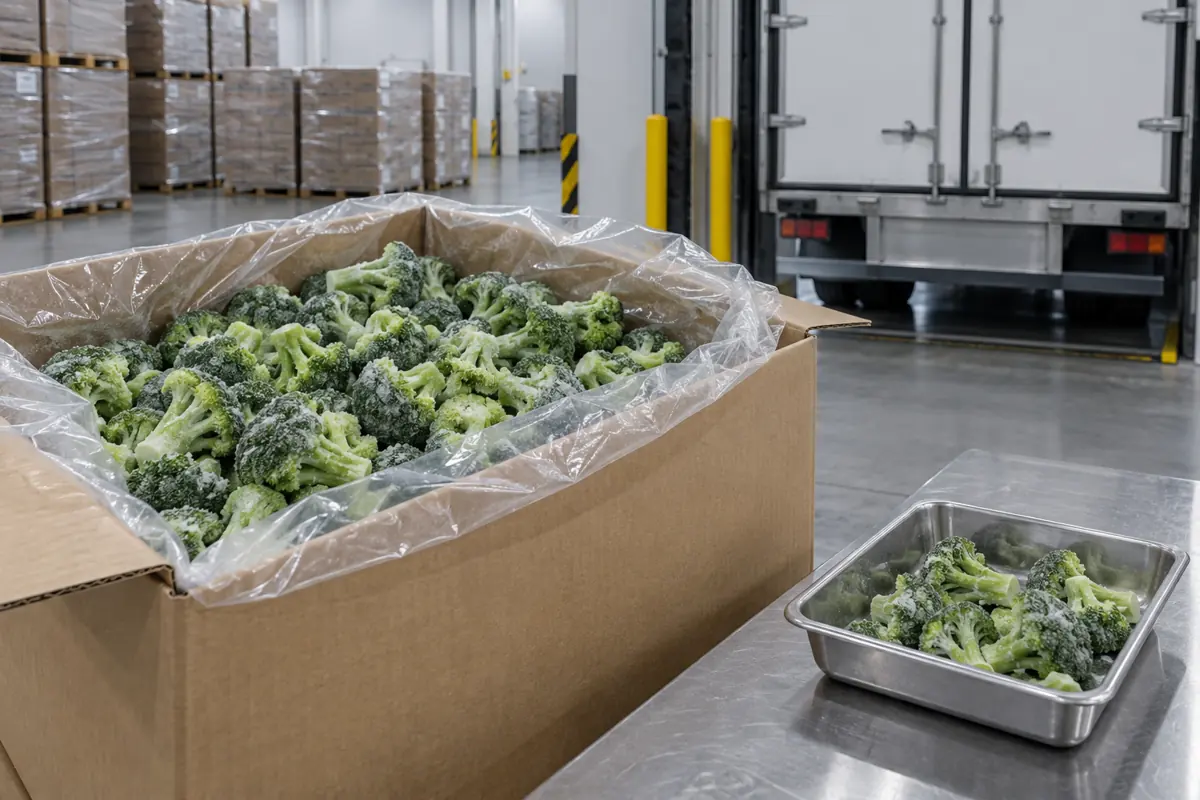
Actual GreenLand frozen broccoli product form for grade discussion.
The sale channel also matters. A processor buying ingredient cartons for cooked meals needs a different pack concept from a retailer selling consumer bags. TR TS 022/2011 contains a specific transport-pack marking rule and a further rule when unpacked food in transport packaging is intended for later consumer repacking. The Russian applicant should decide which rule the actual carton triggers. We would ask for intended downstream use, first warehouse, storage target, pack weight, desired grade and forecast before proposing final artwork and shelf life. This prevents a line built for one use being declared as another.
An order agreement should assign ownership of conformity tests and declaration evidence. The applicant may need manufacturer technical documents, process information, sample test reports and a contract accepting foreign-manufacturer responsibilities. We can supply records from the selected producing establishment after checking their scope and validity. We should not claim a certificate, Russian registration or a fixed lead time that has not been verified for the source and order. A buyer can approve the specification and first-lot sample while its applicant prepares the legal file.
Classify 0710 and check the Decision 318 plant-health list
The EAEU Commission's Decision 318 schedule is an enumerated list of goods subject to quarantine phytosanitary control at the Union border and within the customs territory. The official consolidated list available during this review includes fresh or chilled edible Brassica vegetables under 0704 among high-risk goods. It has no heading 0710 entry in its high-risk or low-risk schedules. Thus the described, fully frozen blanched broccoli, if customs confirms 0710, is outside the listed quarantine-product scope. Calling it a "low-risk quarantined vegetable" would assign a regime the list does not state.
The distinction is not semantic. A fresh broccoli head in 0704 and an individually frozen, heat-treated floret in 0710 have different tariff descriptions and different plant-health classification. The shipment still must arrive in clean packaging under food-safety and transport rules, and an emergency or temporary country/product restriction can exist independently of the static Decision 318 list. The importer should have its broker check current Rosselkhoznadzor measures and customs restrictions for China-origin frozen broccoli immediately before loading. This review found no reliable official SKU-specific prohibition in the sources examined, but absence from search results is not a legal clearance.
The EEC list has been amended repeatedly, including amendments noted through November 2025 in the official PDF used here. Before each booking, the broker should check whether a newer effective decision changes the list and retain the version or link consulted. If classification changes because the product is merely chilled or the pack contains fresh vegetables, the conclusion changes with it. A phytosanitary certificate issued by an exporter for a different category should not be accepted as proof that the specific 0710 shipment is controlled or that it is exempt from every other border check.

Decision 318 lists the fresh 0704 line; frozen 0710 broccoli is outside that listed scope, subject to current amendments and restrictions.
We would provide the importer with a concise technical statement of the actual production form: washed florets, blanched, frozen, single ingredient, sealed food-grade liner, with botanical identity and gross/net packs. The broker can attach the description to its tariff and plant-health file. If an authority questions the code or requests examination, the importer should follow the written official decision, identify the lots presented and keep the outcome. The supplier should not instruct the carrier or warehouse to bypass an inspection based on a web article.
The plant-health conclusion is only one part of entry. TR TS 021/2011 food safety, TR TS 022/2011 marking, applicable packaging requirements, EAC marking after conformity, customs declaration, origin and commercial acceptance remain. A buyer who obtains a phytosanitary "no measure" answer still has substantial work before offering the broccoli for sale. Build those parallel workstreams into the order plan rather than treating an absent 0710 line as a shortcut to market.
Obtain the EAEU food conformity declaration
TR TS 021/2011 describes several conformity forms. Ordinary industrial frozen broccoli is food placed on the EAEU market and falls under conformity declaration under Articles 21 and 23, subject to its exact product identity. State registration in Articles 24 and 27 addresses specialized or novel food; single-ingredient conventional blanched broccoli has no inherent claim to either category. A baby-food formulation, special dietary positioning or novel ingredient would need a new assessment. The Russian applicant should document this branch decision in the technical file.
The resident applicant selects the applicable declaration scheme and assembles technical documents, production-control evidence and sample test results. Article 23 describes schemes including 1d, with preparation and analysis of technical documentation, production control, sample testing, adoption and registration of the declaration, and EAC marking. Other permitted schemes can involve third-party evidence and differ between serial production and batches. The applicant should select a scheme that matches its transaction and evidence; this guide does not choose one for every buyer. A consultant may help, but it does not replace the applicant's legal responsibility.
The Russian applicant registers through the Federal Accreditation Service declaration service using its authorised organisation account and qualified electronic signature. Prepare the applicant/manufacturer identity, applicable regulation and scheme, exact product and production or batch scope, technical documentation and test evidence. Check the resulting registered number, status, manufacturer and covered product before relying on it. An adviser can prepare documents, while the eligible applicant adopts the declaration and remains responsible. Retain the actual registry result for the declared broccoli.

An EAEU resident applicant registers the ordinary food declaration and checks any special product category separately.
The China supplier's contribution is practical. We would define the floret and process, supply the actual facility and lot documents available for the order, support representative sample selection, provide traceability and analytical evidence, and correct inconsistencies in the technical description before the applicant files. We cannot sign the declaration as a China-only exporter. The applicant must ensure the declaration covers the actual manufacturer, broccoli formulation, processing form, pack and relevant lots or production scope. A declaration for a generic mixed vegetable pack should not be stretched to a new single-ingredient broccoli SKU without checking scope.
There is a defined registration charge. Order 714, Annex 2, published by the National Accreditation Institute (FAU NIA), lists 1,500 rubles for declaration registration, subject to the order's scope and exceptions. This charge is separate from laboratory, translation, consultant, brokerage and import taxes. NIA's official payment guidance directs the organisation to pay.niakk.ru: sign in via its Gosuslugi/ESIA organisation or authorised employee account, complete the organisation details and offer acceptance, generate the invoice and pay through the bank or treasury. Funds must be available before registration. Payment does not establish product conformity; retain both payment and registration outcomes.
Apply EAEU safety and Russian labelling rules
TR TS 021/2011 contains actual broccoli-relevant microbiological and chemical requirements. Its Annex 1 pathogenic table includes blanched, boiled and quick-frozen vegetables in the group where pathogenic microorganisms, including Salmonella, are not permitted in 25 g. The same annex assigns Listeria monocytogenes absence in 25 g to blanched quick-frozen vegetables and products made from them. The test report should identify separate sample units, the method and the exact lot. "Not detected" without the analytical mass or method cannot be mapped to a 25 g requirement.
Annex 3 section 6 lists toxic-element limits for vegetables and their products: lead 0.5 mg/kg, arsenic 0.2 mg/kg, cadmium 0.03 mg/kg and mercury 0.02 mg/kg. The document's footnotes and current amendments should be checked for the actual finished-product category and sampling method before final release. The lower cadmium number can be missed if a laboratory uses a generic frozen-food panel. We would ask the Russian applicant to approve a matrix naming analyte, limit, sample material, method, reporting limit and decision rule, then test the saleable IQF floret lot. Laboratory accreditation and scope need checking for the chosen methods.
Other hygiene rows in Annex 2 are more narrowly worded. Some apply to whole blanched frozen vegetables, and others to salads or mixtures of blanched frozen vegetables. This SKU is florets: pieces of one vegetable, neither a whole head nor a mixed salad. The applicant should obtain a category determination for indicator counts instead of borrowing a nearby row because its number appears convenient. Buyer specifications may set stricter aerobic count, coliform, yeast or mould targets, clearly labelled contractual. The legally relevant pathogen and toxic-element examples above are a starting evidence matrix, not permission to omit other applicable hazards or current amendments.

TR TS 021 vegetable-product metal examples and applicable 25 g pathogen checks require category, method and lot confirmation.
Pesticide limits require the active substance and legal residue definition applicable to broccoli under current EAEU rules. The exporter should share grower-use information and finished-lot test results; the applicant should map them to the current EAEU maximum-residue framework and any buyer restriction. A parent-compound-only report may be inadequate where the regulated residue includes metabolites. Do not carry over a Thai or EU broccoli MRL to Russia without a Russian/EAEU source. We would hold the lot if the selected method lacks sensitivity against the applicable threshold, rather than interpret "below detection" as a pass without seeing the detection limit.
TR TS 022/2011 requires Russian-language food marking. For transport packaging, the EEC text specifies name of food, quantity, production date, shelf life, storage conditions, batch identification and manufacturer name/location. If food without consumer packaging in the transport pack is intended for later consumer repacking, additional packaged-food particulars may apply under its cross-reference. The Russian applicant should review that branch and approve artwork. The declared shelf life needs supporting evidence from the actual product and pack, not a copied 24-month competitor claim. EAC marking follows the applicable conformity route; it should not appear as proof of an unregistered declaration.
Prepare a customs and shipping evidence file
The broker needs a commercial file that describes one shipment consistently: contract or purchase order, invoice, packing list, transport document, full tariff code, origin evidence, customs value support, conformity declaration details and any measure triggered by the code. The importer should confirm whether its chosen declaration scheme and registry record cover the exact manufacturer and product. The customs declaration is normally electronic through the Russian Federal Customs Service's participant services or a licensed representative's channel. The broker should confirm the current local system and data fields; the supplier should provide clean source documents, not attempt to act as the Russian declarant.
The invoice should state seller, buyer, Incoterm, currency, unit price, quantity, country of origin and exact broccoli description. The packing list should tie carton net and gross weights to pallet count, container, seal and lot codes. The bill of lading or other transport document carries routing and consignee details. Origin proof is relevant to origin determination and any actual preference claim, but an ordinary origin statement does not prove EAEU food conformity. Insurance and freight costs should be documented consistently with the Incoterm for customs valuation.
We would prepare a product sheet with botanical identity, one-ingredient declaration, blanching and freezing description, intended use, floret grade, bulk-pack details, storage instruction and traceability code. For the final lot, available process and test evidence should reference the same lot as the cartons. If a facility holds a certificate, its scope and validity should be checked before inclusion; the article does not assert one. The importer may require a manufacturer responsibility agreement for the EAEU declaration. The Russian-language translation should be reviewed by the applicant because a mistranslated processing verb can change the conformity description.

Manufacturer evidence, registered declaration, FCS goods line and Russian receipt meet at the finished lot.
Cold-chain documentation belongs in this file. The purchase contract can specify a frozen product target such as at or below −18 °C, how product temperature is measured, reefer set point, logger placement and what excursion triggers a hold. We would record product condition at loading, container and seal, and any loading delay. The carrier controls transport settings and transshipment; the importer reads arrival data. A reefer display at arrival shows current air conditions, not the history of each carton. The buyer should inspect both the logger record and selected product temperatures.
The Russian side should also estimate border and warehouse costs against plausible delays. Conformity verification, customs assessment, inspection or a documentary discrepancy can extend dwell time. Ask the broker for the current duty and VAT calculation, terminal handling, reefer plug-in, demurrage and storage assumptions. Government sources examined here do not publish a reliable all-in fee or release time for this exact China-origin bulk broccoli shipment. A pricing model with explicit assumptions helps the buyer compare delivery terms without pretending every container clears on the same day.
Coordinate customs, carrier and conformity decisions
An ordered plan keeps legal and physical events distinct. First the resident applicant confirms TR TS 021/2011 scope and prepares its registered declaration. In parallel, the broker fixes the 0710 national code, checks Decision 318 and any current temporary measures, and obtains duty and document instructions. The supplier and buyer finalise Russian artwork, pack, grade, tests and shipping papers. At departure the container and seal are recorded. At arrival the declarant files customs data and presents conformity information as required, while the carrier handles freight and delivery-order formalities.
The customs authority can release the declaration for the relevant procedure, but that result does not create a declaration of conformity. The EAC mark and Russian label must rest on the appropriate registered conformity record and label rule. Likewise, a carrier's delivery order enables physical handover but says nothing about Salmonella, packaging integrity or contract grade. The importer should keep all three statuses visible to its warehouse and sales team. If one is pending, the lot should remain under the appropriate legal or commercial hold.
If customs asks for more information about the code, the broker should provide the technical description, process and photographs without changing the invoice opportunistically. If the conformity registry shows a suspended or mismatched declaration, the applicant resolves it through the official system. If an authority imposes an inspection or temporary measure, obey the written instruction and keep the sample and seal record. A private laboratory result cannot overturn a formal border decision. Escalation roles should be written into the supply agreement so the supplier knows what evidence to send and the importer knows who communicates with government.

EAEU conformity, FCS customs, carrier and buyer acceptance remain distinct releases.
The same principle applies to the quarantine list. Because 0710 is not enumerated in Decision 318's high- or low-risk product schedules as reviewed, a standard phytosanitary certificate is not presented here as a universal precondition. The broker still checks the current schedule and origin-specific restrictions immediately before each shipment and follows any individual official instruction. This limited conclusion is more useful than either a blanket "all plants need phyto" or an unqualified "no plant controls ever".
Receive, verify and release the lot for sale
The receiving warehouse should start with container identity, seal, temperature history, carton count, visible damage and storage location. Selected cartons from across the load should be opened under controlled frozen conditions. Check liner seal, ice build-up, free flow, floret size, stem length, breakage, colour, foreign material and a standard cooked sample. A nominal size on the invoice cannot resolve a dispute unless the parties agreed the measuring dimension, sample mass and tolerance. Keep photographs and measured results linked to the lot code.
Compare the finished-lot reports with the EAEU matrix. Salmonella and Listeria monocytogenes absence in 25 g and the Annex 3 toxic-element limits are concrete examples for this blanched frozen vegetable. The applicant should confirm the currently applicable edition and analytical category, including any further pesticide and hygiene requirements. A result for a different field or production date does not release this container. If the lab reports a value close to a limit, use the predetermined measurement-uncertainty and retest rule rather than a new rule invented under commercial pressure.
The importer can set tighter acceptance criteria for its application: a chosen floret range, allowable fragments, cooker yield, colour, target microbiological indicators, pack strength, carton weight and temperature excursion. Label these as contract conditions, separate from mandatory EAEU limits. Specify whether a failure causes reinspection, a hold, a price adjustment where lawful, or rejection. A contaminated lot cannot be solved by a price concession. A shipment with acceptable legal tests may still be commercially rejected for excessive stem or broken pieces.

Actual GreenLand broccoli floret detail for receiving inspection.
Release for sale requires the appropriate customs status, a valid declaration and marking for the actual product, completion of any applicable authority measure, and the buyer's own acceptance. The quality manager should sign that final disposition and record affected lot and cartons. A declaration registry record is an authorization basis for the described food but not a guarantee that each later lot meets its specifications. Ongoing production control and receiving verification close that gap.
For repeat shipments, keep the classification and decision evidence current. Review any 2026 or later Decision 318 amendment, origin-specific restriction, TR TS revision, laboratory-method change and label amendment before reusing a prior file. We would use the first shipment's defect rates and cooked results to propose a revised grade only through an approved specification revision. The Russian resident applicant retains conformity responsibility; GreenLand-food supplies the actual, traceable China-side product and records needed to make that responsibility workable.
Continue with the China-origin IQF broccoli supply plan for the same China-origin, single-ingredient, blanched IQF broccoli order.
Related reading
Compare the EU food and border route with this country-specific order.
See how a different import market separates customs and food release.
Compare floret, lot and cold-chain decisions for an adjacent market.
Plan your frozen vegetables supply
GreenLand-food is a China-based frozen vegetables supplier and manufacturer discussing factory-direct wholesale supply. Send us the product form, floret specification, packing, quantity, cooking application, Russia destination, any private-label needs and requested documents so we can prepare a proposal for the actual order.