


Importing Frozen Produce into Thailand: A Buyer Guide for China-Origin IQF Broccoli
Oct 16, 2026
Leave a message

For a first commercial shipment of China-grown, blanched IQF broccoli florets into Thailand, the Thai importer should settle the FDA food classification and licensed-premises route before booking the refrigerated container. The supplier can prepare the product and its evidence, but the Thai entity submits the import applications and shipment declarations. The sequence then moves through any applicable plant-health decision, FDA import records, customs clearance and the buyer's own lot release. This guide uses a single-ingredient industrial bulk product intended to be cooked before eating. A seasoned, sauced, ready-to-eat or retail-packed broccoli product can trigger a different Thai food category and different label duties.
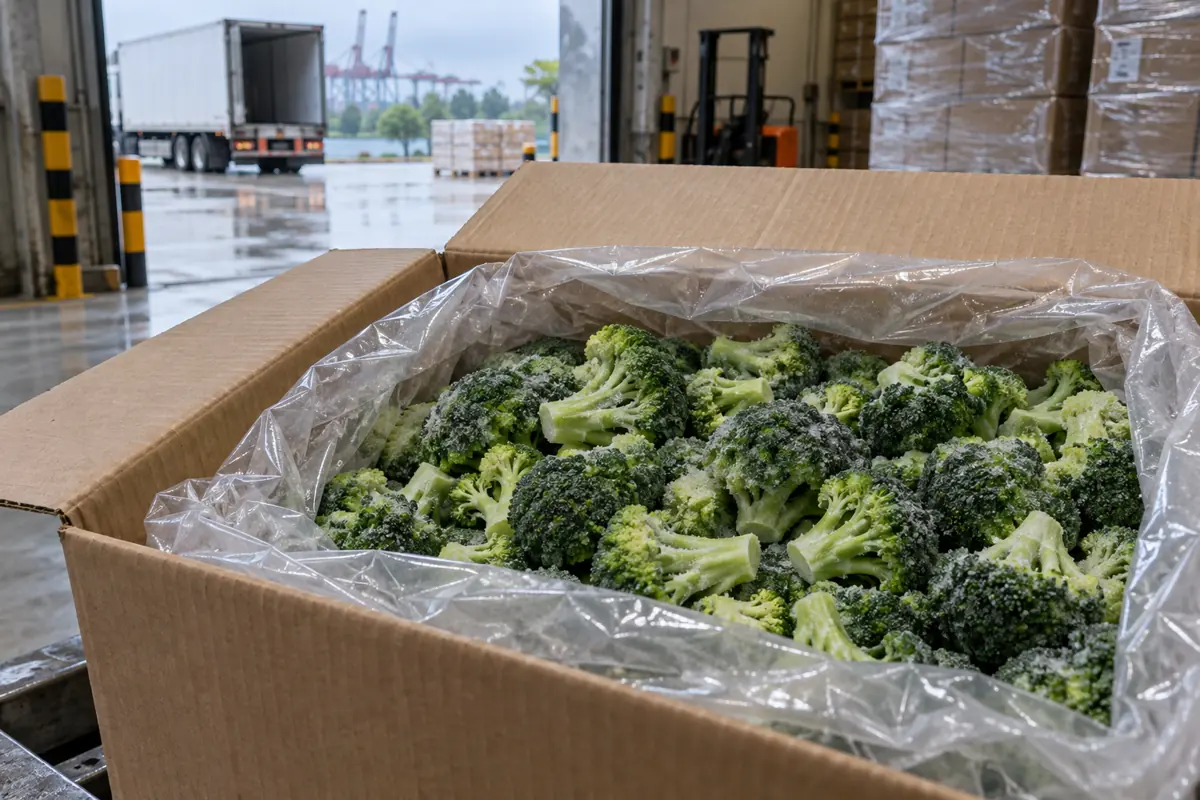
A proposed cold-chain handoff for the specified frozen broccoli.
Reviewed 16 October 2026. The numerical examples below come from the identified Thai notifications and must be checked against the actual product, processing and analytical method at order confirmation. We would put the classification response, purchase specification and receiving plan into the same file so the buyer can see where a government permission ends and its own acceptance decision begins.
Define the imported broccoli and responsible Thai business
The import description is deliberately narrow: Brassica oleracea var. italica florets grown and processed in China, washed, blanched, individually quick frozen, with no seasoning or other ingredient, packed in an industrial food-grade liner and carton. It remains a frozen vegetable for cooking. The invoice, product specification, outer carton, analytical report and customs declaration should describe the same form. A declaration that merely says "mixed vegetables" or "processed food" creates an avoidable classification question because neither describes this lot.
The Thai buyer first decides who imports for sale. Thailand's Food and Drug Administration states that a food importer must be a person or legal entity with commercial registration and a place of business in Thailand. That entity needs an import licence, suitable import and storage premises, and the account used for electronic submission. A Chinese manufacturer cannot substitute its export documents for the Thai importer's local permission. A distributor can import and sell to a processor; a processor importing an ingredient for its own registered finished product may use a different virtual-number route. The intended commercial use belongs in the application narrative.
In the purchase file, we would ask the Thai entity for its licensed name and address, the name on the bill of lading, the cold-store address, the intended sales channel, and the person who can answer FDA and customs queries. Matching those identities is operationally useful: an LPI record, invoice and customs entry that refer to different legal parties can stall a shipment even if the broccoli is sound. The consignee should also establish whether a broker will make the customs declaration on its behalf and which party may instruct the carrier to release the container.

Actual GreenLand frozen broccoli product form for grade discussion.
The HS starting point is heading 0710 for vegetables, uncooked or cooked by steaming or boiling in water, frozen. Broccoli sits in the "other vegetables" branch rather than the fresh Brassica heading 0704. The importer and Thai customs broker must confirm the complete Thai tariff line against the current tariff and the actual blanching and packing description. A code is needed for duty, VAT, data exchange and possible plant-health screening; this article does not claim a duty rate from a generic 0710 listing. Preference under an applicable China–Thailand arrangement requires its own origin proof and current tariff check. An ordinary certificate of origin does not itself grant a preference.
GreenLand-food's proposed supply file would start with botanical identity, origin, single-ingredient composition, blanching status, target floret range, pack size and a lot coding proposal. We would confirm which fields the buyer wants on the commercial invoice and packing list before artwork is printed. The buyer then has one agreed SKU description for its FDA classification question, its customs classification exercise and the receiving inspection. This prevents the quality specification from becoming detached from the legal description of the goods.
Obtain the Thai FDA importer licence and decide the product pathway
Begin through the current Thai FDA SKYNET portal, choosing the entrepreneur service, ผู้ประกอบการ. Its public sign-in choices now include ThaID, Digital ID and Paotang; use the identity and company authority accepted for the Thai applicant. FDA's English import procedure describes the earlier Open ID and Food System access sequence. For an establishment in Bangkok it directs account-supporting documents to the FDA One Stop Service Center, Building 6, fourth floor; elsewhere it directs the applicant to its Provincial Public Health Office. Submit the premises-licence application with the required business, location, storage and manufacturing-standard evidence, pay the application fee, answer requests, and after approval pay the licence fee and retain Form Orr.7. We provide the actual producer, product and process information for the selected order. For category or application questions, FDA lists its Pre-marketing Group at +66 2 590 7033 / +66 2 590 7320.
The product-number decision is separate from the importer licence. The FDA's category description places plants and plant products used for cooking and not ready to eat in general food when no more specific category applies. Its import page says general food of that kind can be imported without an FDA food serial number, but the business operator must enter its details in the Virtual Number System. For this exact single-ingredient cook-before-eating broccoli, that is a reasoned starting route, not an unconditional ruling. A change to a prepared meal, sauce, ready-to-cook composite, nutrition claim or retail presentation can move the product into a category requiring product licence or different labelling.
For general food sold after import, the FDA describes this order: the importer holds its food import licence; opens access to the Virtual Number System; enters the general-food details through Open ID; checks the U1-prefixed product certificate number through the Import and Export Inspection Information System; and opens a License per Invoice, or LPI, account through the National Single Window. A product that does require a food serial number instead passes through a product licence in e-Submission before U1 and LPI. The distinction should be recorded before a purchase order becomes a firm production booking.
For the agreed general-food branch, the buyer can access the FDA portal for its authorised virtual-number work; FDA lists food_lpi@fda.moph.go.th for that service. It must also complete the inspection-system access and U1 check before using shipment-level LPI through the Thai National Single Window. Keep the actual virtual/product identifier and LPI linked to the invoice and lot. Our source data should reach your applicant early enough to correct any identity, pack-count or process mismatch before loading.

Thai FDA licence and category lead to a product-number or virtual-number branch; the selected route determines LPI fields.
There is a further route for raw material imported by a licensed Thai food producer for its own food production. The FDA describes a virtual-number entry in place of raw-material registration, linked to a finished product that already has the relevant food serial number. It is inappropriate to call every industrial bulk import "raw material" and skip the importer-for-sale sequence. A cold-store distributor reselling unopened cartons and a processor using broccoli in an approved finished food have different facts. The Thai partner should state which arrangement it will use, and provide its FDA result or adviser opinion to the broker.
Before shipment, we would request a written confirmation of the Thai category, the name of the licensed applicant, the relevant virtual number or product number, and the expected shipment-level LPI record. We can then align the pro forma invoice, specification and pack data with that result. We would not print a Thai FDA number or imply product approval before the importer obtains it. The FDA page explains process order but does not publish a universal completion time or one charge for this SKU; the importer must obtain the live fee and review timing within its own portal or from FDA. A schedule that depends on an unpublished "standard five-day approval" would be fiction.
Check plant-health scope and customs classification
Food import permission, plant-health controls and customs entry answer different questions. Thai FDA addresses food for sale. The Department of Agriculture, through its plant quarantine administration, decides whether a particular plant product and presentation is controlled at the border. Thai Customs assigns and assesses the imported tariff line and releases the goods from customs control. The carrier separately controls delivery order and container handover. None of these decisions by itself demonstrates that a buyer has accepted the lot for use in food production.
The Department of Agriculture publishes plant-quarantine import and National Single Window material, but the public material reviewed for this article does not provide a clear SKU-specific ruling for washed, blanched, fully frozen broccoli florets under the proposed 0710 line. The Thai importer or its broker should submit the exact treatment, frozen state, botanical name, tariff line, origin and intended use to the DOA before shipment, and retain the response. If the authority applies a permit, inspection, phytosanitary certificate or other measure, its written decision determines the documents and port presentation. We should not issue a generic "fresh vegetables" checklist as a substitute for that decision.
The DOA NSW public entry provides operator registration and separate manuals for plant-quarantine permits and plant-checkpoint import notifications. Account registration uses the person's or business's identifiers and email, followed by official review and emailed activation. This account is separate from FDA SKYNET and is not itself a decision that a permit is required. Give the relevant plant-quarantine office the exact botanical name, China origin, blanching treatment, fully frozen form, proposed tariff line and intended use for its scope decision. If a DOA filing is required, use the appropriate permit/arrival function and retain its result with the lot; do not register a fresh broccoli consignment merely to force an unsuitable category.
This distinction matters commercially. A fresh head of broccoli has plant material and transport conditions unlike a blanched IQF floret in a sealed liner. Conversely, freezing or blanching does not empower a supplier to declare itself exempt from Thai controls. The importer can make a documented scope inquiry without waiting for a container to arrive. That inquiry is a small planning task compared with a missed clearance requirement and demurrage in a refrigerated terminal.

The DOA product-scope decision is separate from the Thai customs tariff entry.
The customs broker should test the full national HS line, the tax treatment and the claim to any preferential origin rate. It should calculate duties and import VAT from the current tariff and transaction facts, rather than from a promotional "free trade" statement. If preference is pursued, the Chinese exporter and Thai importer need to agree on the exact rule of origin and accepted proof before export. The origin document must describe the goods consistently with the invoice and customs declaration. A valid food import record does not decide the origin preference, and a preference certificate does not decide the FDA food category.
Where DOA inspection is applicable, the importer should give its broker and carrier the arrival notice, port location, cold-store plan and documents early enough to coordinate refrigerated examination. An inspection request may lead to sampling, documentary release or another official outcome; the buyer should retain the actual result. If the DOA confirms this presentation outside the relevant controlled scope, retain that answer as a reasoned classification record. The same approach works for future contract changes: a new cut, raw rather than blanched form or different degree of processing deserves a fresh check.
Apply Thailand food-safety limits to the exact lot
Safety testing begins with the product category and the relevant legal analyte definition. Thailand's Ministry of Public Health Notification 460, effective from July 2025, governs pesticide residues. Its order of comparison is a Thai MRL, then a Codex MRL, then an ASEAN MRL, followed by a 0.01 mg/kg default where no listed MRL applies, subject to the notification's terms. The buyer should identify the broccoli commodity group and the legal residue definition for each pesticide in a proposed panel. A laboratory result for one parent molecule is not automatically comparable with a limit defined as the sum of parent and metabolites or isomers.
One concrete example is deltamethrin. The current Thai annex lists 0.1 mg/kg for the flowerhead brassica group and defines the residue as the sum of deltamethrin and its alpha-R- and trans-isomers, expressed as deltamethrin. The broccoli specification should therefore name both the group and that sum definition, and ask the laboratory whether its method measures the necessary components at a reporting limit useful against 0.1 mg/kg. The buyer should check the current annex again for any other selected pesticides and for processing factors before setting acceptance criteria on finished IQF florets. The 0.01 mg/kg fallback is not a blanket "zero pesticide" rule for every analyte.
Thailand's contaminant Notification 414 contains a 0.05 mg/kg cadmium maximum for Brassica vegetables other than leafy Brassica, with broccoli assessed on the immature flower head. It lists lead at 0.1 mg/kg for the same relevant Brassica description. Because this shipment is blanched and frozen, the Thai importer's technical adviser should confirm how the notification's commodity portion and any processing treatment apply to the tested finished sample. For purchasing, we would specify analytical results on the actual saleable florets and keep the laboratory method, detection limit and sample identity with the report. A raw-farm certificate alone cannot demonstrate the exported finished lot's result.

Thai MoPH 460/414 examples for the relevant Brassica commodity; confirm the residue definition, edible portion and processing treatment.
The microbiological decision needs the same care. A cook-before-eating single-ingredient broccoli floret should not automatically inherit numerical criteria written for a prepared frozen meal or a salad. The buyer should ask its Thai food specialist to select the applicable legal category under the current microbiological notification and then agree a contractual panel suited to its process. A proposed contract may ask for Salmonella absent in 25 g and Listeria monocytogenes absent in 25 g, with five separately drawn 25 g analytical units if the parties choose that plan. Those numbers would be contract acceptance terms here, not a claim that Thai law explicitly assigns the ready-to-cook meal row to this SKU.
Testing does not replace prevention. We would plan to control field identification, intake cleanliness, washing, trimming, blanching, cooling, freezing, post-blanch hygiene, optical sorting where suitable, final foreign-matter detection, sealed packing and lot traceability. Optical sorting rejects visual colour or shape defects; a density or X-ray step addresses different foreign-body risks and must be validated for the actual pack and product. A metal detector also has its own sensitivity demonstration. We would not claim a particular detector, validated blanching time or held certificate until the actual production site and order are confirmed. The lot release file should show what controls were used, how they were verified and what nonconforming material was held.
Build a shipment and LPI evidence file
A shipment file should be assembled around one commercial lot identity, not around a pile of certificates. The Thai importer needs the food import licence and the applicable FDA product or virtual-number pathway. It then needs the U1 check and shipment-level LPI through the National Single Window as the FDA procedure directs. The customs broker needs the invoice, packing list, bill of lading or air waybill, declaration data and any required permits or origin proof. The carrier needs freight and delivery-order instructions. Each party should know which version of the carton count, net weight and lot code is final.
We would issue a commercial invoice showing the seller and Thai consignee, product description, origin, currency, price, Incoterm, quantity and packaging. The packing list would tie carton counts, net and gross weights, container and seal identifiers to the lot codes. A product specification should carry botanical and processing description, cut range, ingredient statement, cook-before-eating instruction, storage condition and contractual tolerances. Analytical certificates should identify the sampled lot and methods. A packing photograph can help the buyer confirm layout, but it cannot substitute for an inspection record or a sealed-container tally.
The food-production-standard document requested by Thai FDA should come from the actual producing establishment and be checked for accepted standard, scope and validity. We can provide available facility and process records for the selected order after verification; this article does not assert a particular held certificate. If FDA or DOA requests a statement specific to the manufacturer, the statement should identify the establishment and product precisely. Generic marketing claims such as "export quality" have no value in an official application.

FDA product pathway, LPI, invoice and reefer records reconcile through the finished lot.
The buyer should also settle label and carton details while there is time to revise them. Thai-language food label obligations depend on the final food category, form of sale and packaging level. Industrial bulk cartons should still have clear identity, net content, origin, manufacturer or importer details as applicable, production/expiry or best-before information, lot and storage instructions in the format the Thai importer approves. A consumer pack is a different artwork exercise. We would submit a proof of the proposed carton mark and liner specification to the importer; it would confirm the legally required wording and use instructions before printing.
For temperature evidence, specify the contractual shipping and storage target, a logger placement plan, who reads the device, and the disposition rule if the record has an excursion. A commonly used commercial frozen-food target is at or below −18 °C, but the contract should state its own monitoring point and excursion assessment. The reefer set point is only equipment instruction. It does not prove product-core temperature throughout transport. Pre-cooling, loading time, container seal and receiving measurements complete the record. The proposed control is to hold questionable cartons pending a documented buyer decision rather than silently reset a thermostat reading.
Clear the shipment without confusing release decisions
The practical order is to obtain the importer permission, settle category and any DOA scope, enter FDA product details, prepare the LPI route, confirm tariff and origin, ship the contracted lot, present the declarations, and then inspect and receive it. The FDA's public page gives the sequence of virtual-number or serial-number application, U1 check and LPI account. Customs electronically receives the import declaration and supporting data; the National Single Window connects agency permissions where applicable. The broker should verify that the shipment's LPI and any DOA measure correspond to the same invoice before filing.
At arrival, the shipping line may issue a delivery order after freight formalities, the terminal may release the physical container, an authority may complete an inspection, and Customs may release the import declaration. These are separate events. A container can be physically available while an FDA or customs issue remains open. It can also be cleared by customs while the buyer is still waiting for laboratory or sensory acceptance. Build enough refrigerated storage and hold space into the plan for that last possibility.
The importer should keep the actual government result, not just a screenshot saying "submitted". Where a permit is conditional, confirm its conditions are met. Where samples are taken, record seal numbers, sampling location, lot and result linkage. If the authority orders detention, re-export, treatment or destruction, follow that written instruction; a supplier's private certificate cannot override it. When customs assesses duty or VAT, keep the assessment and payment evidence in the import file. The broker should explain any difference between declared and final quantities or tariff line.

FDA, customs, carrier and buyer release decisions run in parallel.
An import timeline is therefore an order of dependencies rather than a universal number of days. FDA account or licence preparation can run in parallel with the supplier's test-panel design; the product classification must be settled before final LPI data; the shipping documents depend on the actual packed cartons and vessel; and final sale release waits for the receiving decision. Published agency pages examined here do not provide a single reliable fee or turnaround time for this exact bulk broccoli route. Ask the Thai applicant to retrieve the live portal fees and its current service status before committing to a vessel date.
Receive, verify and release the frozen lot
The receiving team should inspect the seal, container cleanliness, carton condition and temperature record before unloading into a suitable freezer. It should reconcile carton count, net weight, production date and lot codes against the packing list. Selected cartons should be opened under controlled cold conditions to check liner integrity, free-flowing florets, ice build-up, colour, shape and foreign material. A sample thaw and cook test should follow the contract's defined preparation method so the buyer judges the product as it will be used.
Set the acceptance plan before the vessel sails. The buyer can specify a floret size range, percentage outside the range, stem length, broken or loose pieces, colour variation, defects, foreign matter, carton weight tolerance and sensory outcome. The contract should state the sample unit, number of cartons drawn across the container, measurement method and who decides a disputed result. A nominal "20–40 mm" grade is meaningless unless the parties say what dimension is measured and how many undersized or oversized pieces are allowed. We would propose the range after seeing the application and source crop, and provide a first-lot approval sample for comparison.
For laboratory decisions, keep mandatory Thai limits separate from the buyer's tighter contract. The purchase agreement can require the Thai MRL lookup and residue definition for the actual pesticide panel, cadmium and lead checks, and a microbiological panel agreed by the local specialist. The laboratory report should carry the same lot as the cartons and declare method, reporting limit and date. A passed source-field or preproduction sample does not release a later finished lot. If a result is near a legal limit, the buyer should apply its specified decision rule and measurement uncertainty rather than invent a new threshold on arrival.

Actual GreenLand broccoli floret detail for receiving inspection.
Commercial release is a signed buyer decision after the governmental and physical steps. Customs release enables lawful withdrawal from customs control. FDA or DOA completion addresses their own controls. The buyer's quality manager then compares actual documents and samples with the purchase order and either accepts, conditionally holds, reworks where legally and technically possible, or rejects the lot. The disposition record should identify the affected lot and cartons. This is the point at which the importing business can responsibly feed the broccoli into a factory or offer it for sale.
For a repeat program, retain what the first shipment taught. If Thai FDA confirmed the general-food virtual-number path, keep that decision with the precise SKU description. If the DOA gave a plant-health scope response, link it to the same processed form. Record any customs classification ruling, recurring analytical findings, temperature excursions and customer complaints. A change in blanching, ingredients, packaging or sales channel deserves a fresh review. GreenLand-food can then revise the proposed grade and control plan using actual buyer evidence while the Thai importer keeps ownership of local applications and market release.
Continue with the China-origin IQF broccoli supply plan for the same China-origin, single-ingredient, blanched IQF broccoli order.
Related reading
Compare the EU food and border route with this country-specific order.
See how a different import market separates customs and food release.
Compare floret, lot and cold-chain decisions for an adjacent market.
Plan your frozen vegetables supply
GreenLand-food is a China-based frozen vegetables supplier and manufacturer discussing factory-direct wholesale supply. Send us the product form, floret specification, packing, quantity, cooking application, Thailand destination, any private-label needs and requested documents so we can prepare a proposal for the actual order.