


Importing Frozen Produce into the UK: GB, NI and Border Release
Oct 16, 2026
Leave a message

Importing frozen vegetables into the UK starts with the destination and the exact product. For a China-grown and China-processed, single-ingredient, blanched IQF broccoli floret in industrial bulk packing, Great Britain and Northern Ireland cannot be treated as one regulatory address.
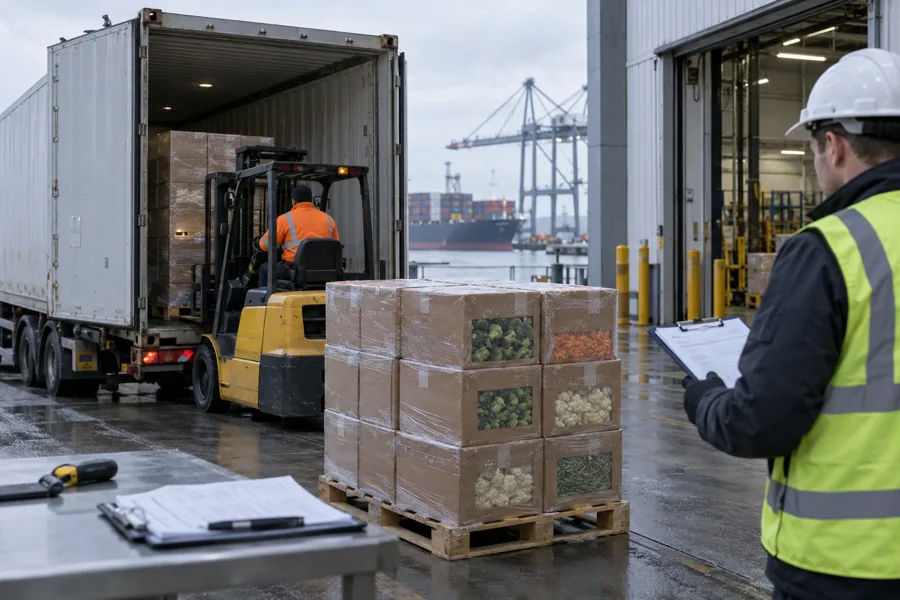
Illustrative frozen produce container handoff at a UK port.
Reviewed 16 October 2026.
We use that SKU to plan an import in the order a buyer actually makes decisions. We prepare the product specification, traceability and shipment records. The UK importer establishes its business and customs identity, checks any conditional food or plant-health border control, lodges the customs declaration, and arranges frozen receipt. The broccoli is supplied for cooking, so its label and buyer process must say so. A clearance message from one authority is not permission to ignore a hold from another authority or from the carrier. The FSA's June 2026 fruit-and-vegetable guidance says imported frozen vegetables must meet domestic food standards and that an ordinary fruit-and-vegetable health certificate is not normally required. The importer still needs a product-and-origin check for any special control.
Our working sequence is deliberately short enough for a purchase order. The detail below tells each party what evidence to obtain before shipping and what event permits release.
Read our UK broccoli supply plan beside this article when planning the same consignment.
- Identify whether the destination is Great Britain or Northern Ireland.
- Confirm importer EORI, food-business registration, tariff code and agent.
- Check the exact food and plant-health risk branches.
- Approve the lot specification, legal tests and frozen shipment plan.
- Reconcile authority, customs, carrier and buyer releases.
Define the frozen consignment and UK destination
The first line of an import file should describe the goods, not just say "frozen vegetables." We would identify the botanical ingredient as conventional broccoli, Brassica oleracea var. italica, grown and processed in China, washed, blanched, individually quick frozen, with no sauce, seasoning or animal ingredient. The form is florets in food-contact industrial liners and outer bulk cartons, not a retail ready-to-eat salad. The intended use is further cooking by a food manufacturer, caterer or distributor's customer. Those facts drive tariff classification, food-law review, plant-health status, label wording and hazard controls. If the item includes cauliflower, a cheese sauce, an organic claim or a different origin, it deserves a separate decision rather than an assumed extension of this plan.
We ask the buyer to name the legal importer of record, the first UK destination, the customs territory and the ultimate customer. "UK warehouse" is too vague. A shipment landed in England, Scotland or Wales enters Great Britain (GB); a direct China-to-Northern-Ireland shipment follows the Northern Ireland route, with EU food and plant-health rules relevant under the Windsor Framework. A later GB-to-NI movement can introduce a different route again. HMRC's import steps explicitly separate GB and NI and flag a possible XI EORI for NI. We therefore do not place a GB-only residue statement on a consignment destined for Belfast without an NI review. The importer should retain the address and route decision with the order file.

GreenLand frozen broccoli florets showing head and stem form.
The importer and its customs agent also agree the commodity code and origin before a price is final. HMRC's vegetable classification guide describes heading 0710 for vegetables frozen throughout at no more than −12°C, including vegetables cooked by steaming or boiling before freezing. It is a tariff classification rule, not our contractual storage target. For a broccoli floret, the broker must confirm the current detailed UK Trade Tariff code, any measure attached to that code, the customs value, applicable origin evidence, duty and import VAT treatment. We will not put an unverified duty percentage on the quotation. The seller's invoice, packing list, bill of lading or airway bill, manufacturer and lot information must be internally consistent so the declarant does not have to reconstruct origin at the border.
Our proposed order control is a one-page product-and-route sheet approved by the importer before production. It records ingredient, blanching, cook-before-eating designation, pack form, origin, destination, selected tariff code and who will make the declaration. We provide the supplier-side facts and a sample label. The importer or broker signs off destination-specific classifications. If the route changes from GB to NI or the recipe changes, this approval expires for the new movement. That is a practical release gate; a generic sales specification cannot answer it.
The purchase contract should distinguish the contractual buyer from the declarant and the food business that first places the product on the market. They may be the same company, or a distributor and its agent may divide the work. We ask for one named person who can approve label changes, laboratory scope and border documents. If those decisions are left to a carrier, the carrier may possess the container but cannot responsibly decide whether a microbiological result or artwork meets the buyer's food specification. A responsibility sheet signed before production avoids a port-side argument about who had authority to answer an official query.
Prepare the UK importer and customs identity
For a commercial import into GB, the importing business obtains a GB EORI through the HMRC EORI application service. A UK applicant prepares its UTR, business start date and SIC code, VAT information if registered, and National Insurance number for an individual or sole trader. The service explains the different requirements for a business based outside the UK. HMRC issues a GB EORI immediately unless checks are needed, which can take up to five working days. The importer agrees broker authority and responsibility for value, origin and classification separately. For an XI EORI, the applicant first needs a GB EORI and follows the XI registration form and eligibility conditions; HMRC states an XI result within five days. We supply the product facts and align the shipment documents with the importer's confirmed identity.
The food-business side is distinct. The FSA food-business registration guidance includes companies that distribute or broker food even from an office. In England, Wales and Northern Ireland, registration is required at least 28 days before trading; the relevant local authority receives the registration. A buyer that already runs a registered food business should check that the correct premises and activity are covered. A Scottish operator should follow the Scotland-specific route identified in the same guidance. Registration is not a certificate saying that one broccoli lot passed inspection. We request the registered food-business name and receiving-site details to make traceability and any authority contact workable. The buyer retains its own registration evidence and responsible person.
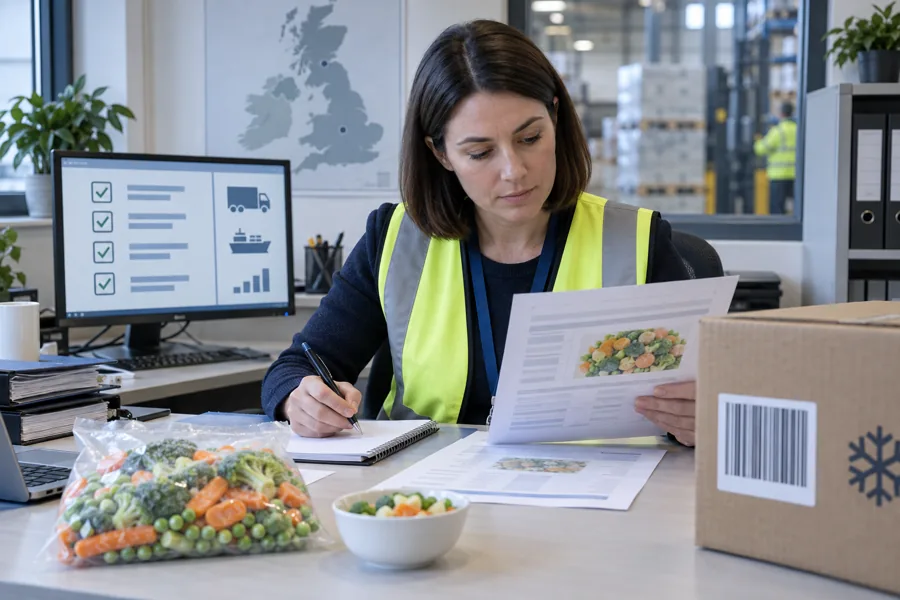
Illustrative UK importer reviewing product and route details.
The customs declaration normally goes through the Customs Declaration Service (CDS). The importer or appointed agent enters the commodity code, origin, value, procedure and supporting documents, then deals with any duty or import VAT and HMRC messages. The freight operator or customs agent controls movement data. A road movement through a Goods Vehicle Movement Service (GVMS) port needs the relevant pre-lodged customs declaration in the movement reference; GVMS is a route-specific road-port system, not a step for every sea-container arrival. HMRC's GVMS guide specifies the pre-lodgement and RRS01 information for such imports. We ask the buyer to identify whether its port uses GVMS before instructing the haulage firm.
Fees and timing belong on the same sheet as responsibilities. Food-business registration is free under the FSA application route; a broker's fee, port handling, storage, detention, duty, import VAT and any official inspection charges are separate commercial or statutory items. Published HMRC and FSA guides do not promise a single end-to-end release time for this frozen broccoli. We therefore ask the importer to budget space and power for a refrigerated hold and to name who will pay each charge if a query or examination extends dwell time. Our supplier-side gate is a matched invoice, packing list, origin and lot record; the importer controls EORI, registration and customs lodging.
Check food and plant-health border branches
Two government questions must be answered separately. First, does the exact China-origin food fall within a current high-risk food and feed of non-animal origin measure, safeguard measure or other import restriction? Second, is this blanched, frozen, packed product regulated for plant health? The FSA's July 2026 GB restrictions list names China measures but does not show ordinary frozen broccoli in its China entry. That is useful dated evidence, not a permanent exemption. The buyer or agent rechecks the live schedule by origin, ingredient, processing form and tariff code at dispatch. A restriction on a different vegetable, fresh form or origin cannot be transferred to broccoli by analogy.
If a high-risk food measure actually captures the goods, the importer or its agent uses IPAFFS to pre-notify and follows the measure's document, designated Border Control Post, inspection and sampling instructions. The FSA pre-notification page states that high-risk imports must be notified before arrival. The timing, certificate or analytical report and costs depend on the applicable measure; we would collect those details before booking the vessel. If the exact SKU is not controlled by that food measure, a routine IPAFFS high-risk-food notification should not be claimed as universal. Food law still applies, and port health or local authorities may investigate a food-safety concern.
For a non-EU consignment actually subject to this HRFNAO branch, the GB notification instructions require IPAFFS notification at least one working day before expected arrival at the point of entry. The importer includes the applicable CHED-D information, supporting documents and authorised point of entry and keeps the submission reference. This conditional step is not imposed on ordinary broccoli merely because it is a vegetable.
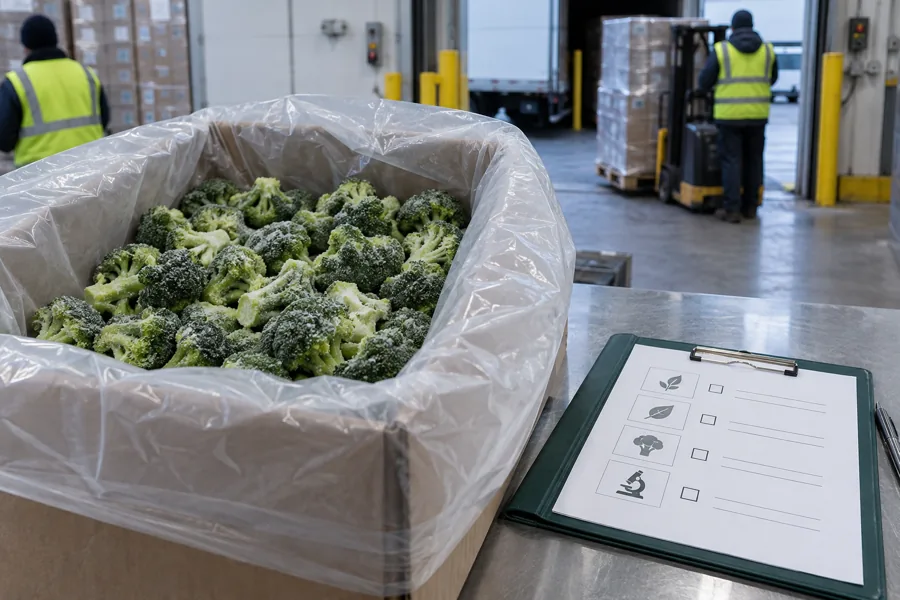
Illustrative packaged frozen broccoli plant-health review.
Plant health uses a different test. The APHA/Defra non-EU plant guidance sets high, medium A, medium B and low risk categories for plants and plant products. Processed and packaged frozen vegetables often fall outside the regulated plant route, but that must be checked against the current risk list for the exact presentation. We provide the evidence of washing, blanching, freezing and packing; the importer or plant-health agent records the risk decision. Only if the product is in a controlled category does it follow that category's phytosanitary certificate, IPAFFS plant notification, designated point, possible checks and fees. The same page says a paper original phytosanitary certificate for controlled goods must be posted to the authority within three days after arrival. It would be misleading to demand a phytosanitary certificate for every industrial carton of frozen broccoli, or to assume processing alone resolves every possible plant case.
Northern Ireland is not simply a copy of the GB result. A direct NI importer should confirm EU/NI high-risk food lists and DAERA plant-health rules, the correct border facility and notification route before shipping. If the exact food is high-risk food of non-animal origin, the FSA says the importer uses a CHED-D in TRACES NT to notify district-council staff at the authorised Northern Ireland point of entry at least 24 hours before arrival; an official laboratory may take 3–7 days if sampling is required. That conditional route is described in the FSA high-risk food guidance (official FSA high-risk-food guidance). A GB-to-NI retail scheme is another distinct movement and is not assumed here. We ask the buyer to send its destination-specific agency or broker determination with the purchase order. If a conditional branch applies, our shipment file adds the exact certificate, sampling or pre-notification data it requires. We release supplier documents for dispatch only after that branch is documented; the authority alone releases any official hold.
Build the British food-law and lot evidence file
The FSA says frozen vegetable imports must meet the same hygiene and food-safety standards as food made in GB. We translate that into an actual lot file: botanical identity, ingredient statement, intended cooking instruction, process flow, supplier and farm traceability, lot coding, packaging specification, temperature handling, contaminant and residue plan, and records of the tests agreed with the buyer. The product is single-ingredient and conventional; we do not claim organic status, a special certificate or a verified kill step. Blanching is a heat preparation step, but its time and temperature must be validated for its stated purpose before anyone relies on it for pathogen control. The customer's cooking process needs its own validation. A loose statement that "IQF is safe" is not a release criterion.
Pesticide compliance begins with the destination. For GB, the HSE GB MRL Statutory Register applies to food treated in or imported into England, Scotland and Wales. The broker or UK food business identifies broccoli in the commodity list, checks the active substance's enforcement residue definition and numeric level, then asks the laboratory to report the correct analytes and detection limit. For NI, EU MRLs apply and can diverge from GB; a GB pass cannot be copied onto an NI certificate. A raw-agricultural-commodity MRL also needs careful interpretation for a blanched frozen product: processing factors may change concentration, and a buyer's tighter number is a contract condition, not a statutory amendment. We offer the crop-treatment history and an agreed sample plan, then compare the actual lot's laboratory result with the current destination rule and contract. The importer confirms the final legal classification.

Illustrative frozen broccoli laboratory sample review.
Microbiology needs the same separation. GB applies its assimilated microbiological-criteria framework, while NI follows applicable EU law. The EU's Regulation 2024/2895 changed a ready-to-eat Listeria criterion from July 2026; the FSA RTE shelf-life guidance explains the GB and NI distinction. Our broccoli is labelled for cooking, so it must not be advertised as ready to eat or assigned the RTE criterion without checking the legal food category and intended use. The buyer may request Salmonella, Listeria, E. coli or other analyses as risk-based contractual release terms, but the sampling units, methods, action limits, handling of a positive result and who may authorize disposition must be written before testing. A "negative" on a small sample is not a guarantee of a sterile container.
Food-contact liners, carton strength and label artwork are part of compliance. A B2B bulk label should identify the food, lot, net weight, responsible parties and storage and cooking instructions suitable for the actual UK sale route; the importer checks UK food-information requirements and any customer artwork. We can provide artwork content and packaging declarations available for the chosen materials, then approve a physical first-article pack. We do not promise a particular plastic specification or certificate until agreed and documented. The lot file is complete when the importer can match every carton and lab result back to a production batch, source crop and shipment document. That is the buyer's evidence before it instructs release into its own network.
Lodge customs and manage refrigerated arrival
Before loading, we send a draft commercial invoice, packing list, container and seal plan, and lot list to the buyer's customs agent. The agent checks that the declared description matches the physical frozen broccoli, that invoice currency and value basis are clear, and that origin and tariff code are consistent. The importer confirms any licence or border-document measure returned by the live tariff and the food/plant checks. We then issue final shipment documents only for the approved load. A last-minute substitution of carton count or port can break a pre-notification, transport reservation or declaration, so the change must be checked before the container closes.
For goods marketed as quick-frozen in England, Schedule 2 of the Quick-frozen Foodstuffs (England) Regulations 2007 requires −18°C or colder after thermal stabilisation and continued maintenance at no warmer than −18°C, subject to its defined exceptions. Brief transport periods may reach −15°C; that is an exception rather than the normal shipment target. The importer checks the corresponding territorial provisions for its actual UK destination. We will align product-temperature checks, transport monitoring, pack instructions and the receiving decision with those legal conditions and any tighter agreed specification. The separate −12°C tariff-classification threshold does not replace them.

Illustrative UK customs broker matching freight documents.
The carrier or forwarder files transport and arrival data and makes the container available at the nominated port. The customs agent tracks CDS acceptance and any control or exam messages. If the road leg uses GVMS, the haulier manages the goods movement reference at that port. If an applicable food or plant branch requires an authority inspection, the importer books and pays for the approved facility and keeps the load under suitable frozen control. The port or carrier may still require settlement of freight, terminal and storage charges before releasing the container. Those operational releases are independent of HMRC's clearance. We ask for the arrival notice, release messages and delivery order to be saved together so no one mistakes a paid freight invoice for food release.
There is no published universal turnaround for a China-origin broccoli container through all of these steps. It depends on documents, route, official selection, lab work, port capacity and the buyer's own acceptance. The purchase order should specify a refrigerated hold location and a named UK decision maker able to approve examination access or delay delivery. If a broken seal, warm product, missing lot map or inconsistent invoice is found, the importer should keep the goods on hold, preserve logger and seal evidence and agree an investigation before distribution. Supplier dispatch does not close the claim window.
Arrival sampling needs the same discipline as pre-dispatch testing. The receiver and supplier should agree whether cartons are taken from the front, centre and rear of the container, how many pallet positions are represented, what temperature is maintained during opening, and which laboratory gets custody of sealed samples. A single carton near the door may be the warmest or most damaged and can be important evidence, but it is not automatically a representative analytical sample of the entire lot. The receiving report should identify which finding is a shipment-condition observation and which is a formal contract test. This helps both sides investigate without obscuring a real food-safety hold.
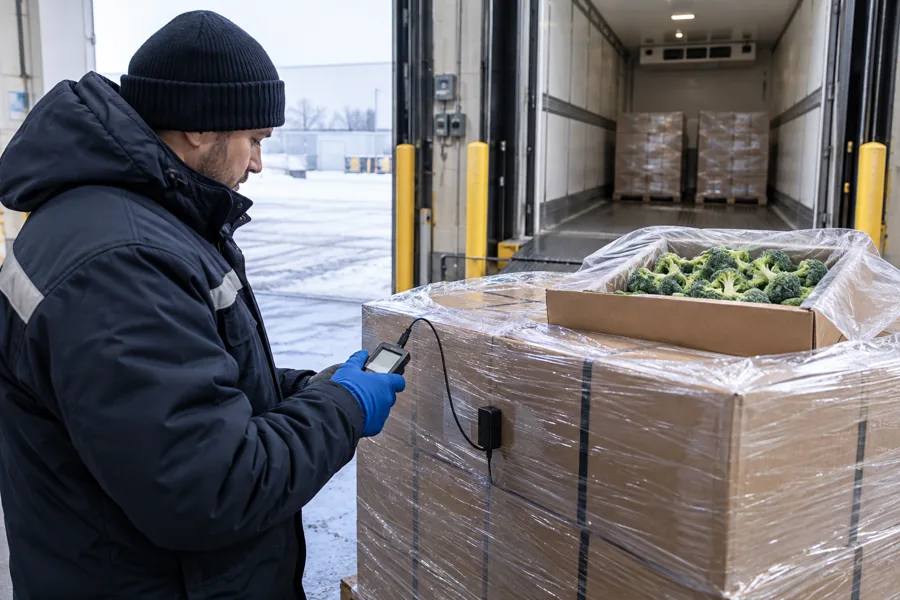
Illustrative refrigerated broccoli pallet arrival and logger check.
Close government, carrier and buyer release separately
We use a release matrix because a stack of documents is only useful when each has a decision attached. Product identity: we supply a signed SKU description, ingredient and process statement, lot map and carton artwork; the importer approves the GB or NI route before production, and a changed recipe returns to review. Food and plant border status: the importer or agent saves the live restriction and risk-category checks; if a control applies, its notification, certificates, fees and authority release are conditions before inland movement. Food-law file: we provide agreed crop, hygiene, sampling, packaging and temperature evidence for the actual lot; the buyer reviews it before accepting the shipment into its manufacturing system.
Customs: the importing declarant lodges the CDS entry against the real invoice, origin and commodity code, pays or accounts for duty and VAT as applicable, and waits for HMRC release. Carrier: the forwarder presents the relevant shipping documents, charges and delivery order and confirms that the container can be collected. Physical receipt: the nominated cold store checks seal, count, packaging, temperature history and sample defects against the signed contract, then records any conditional hold. We ask the importer to send one consolidated release confirmation that identifies these separate decisions. A buyer who has customs release but has a port-health hold or a blocked delivery order must not call the goods available for sale.

GreenLand frozen broccoli florets being measured.
If a result fails, the correct action depends on the failed gate. A residue exceedance or microbiological finding can require product quarantine, investigation, authority contact and potentially rejection or recall; a commercial size defect can be handled under the agreed claim and disposition clause, provided food safety is intact. A plant-health noncompliance may require official treatment, re-export or destruction, which a supplier cannot override. We keep the source and production records for trace-back and do not blend a failed lot into a passing one to erase evidence. The importer remains responsible for UK market placement and agency decisions.
For a first UK order, send us the destination territory, delivery point, intended cooked application, floret size, industrial pack weight, expected volume and any retailer or manufacturing specification. We can prepare a draft product and evidence plan. The buyer and its agent then close the GB or NI regulatory branch and tell us which documents and tests must exist before the production slot and loading date are fixed. That sequence turns a generic offer of frozen broccoli into a consignment the importer can actually clear and receive.
Continue with the China-origin IQF broccoli supply plan for the same China-origin, single-ingredient, blanched IQF broccoli order.
Related reading
Read Common Import Risks When Sourcing Frozen Vegetables - Use the broader shipment and claim checklist before fixing a UK route.
Read Foreign Matter Control in Frozen Vegetables - Review detection strengths and limits behind a foreign-matter specification.
Read Blanching in Frozen Vegetables: When It's Necessary - Connect blanching status to the UK product description and cooked use.
Discuss Frozen Vegetables Supply
GreenLand-food is a professional frozen food supplier and manufacturer in China. We discuss factory-direct wholesale supply around your product form, specification, industrial packing, quantity, application, destination and requested documents.