


Importing Frozen Produce into Brazil: A Buyer Guide for China-Origin IQF Broccoli
Oct 16, 2026
Leave a message

For China-grown and China-processed, single-ingredient blanched IQF broccoli florets shipped in industrial bulk, the Brazilian importer must settle three decisions before promising delivery: the actual NCM and administrative treatment of the operation, the customs declaration route available on its filing date, and the food regularization required for the intended sale. A plant-health category alone cannot answer the food question. A carrier's delivery receipt cannot answer either.
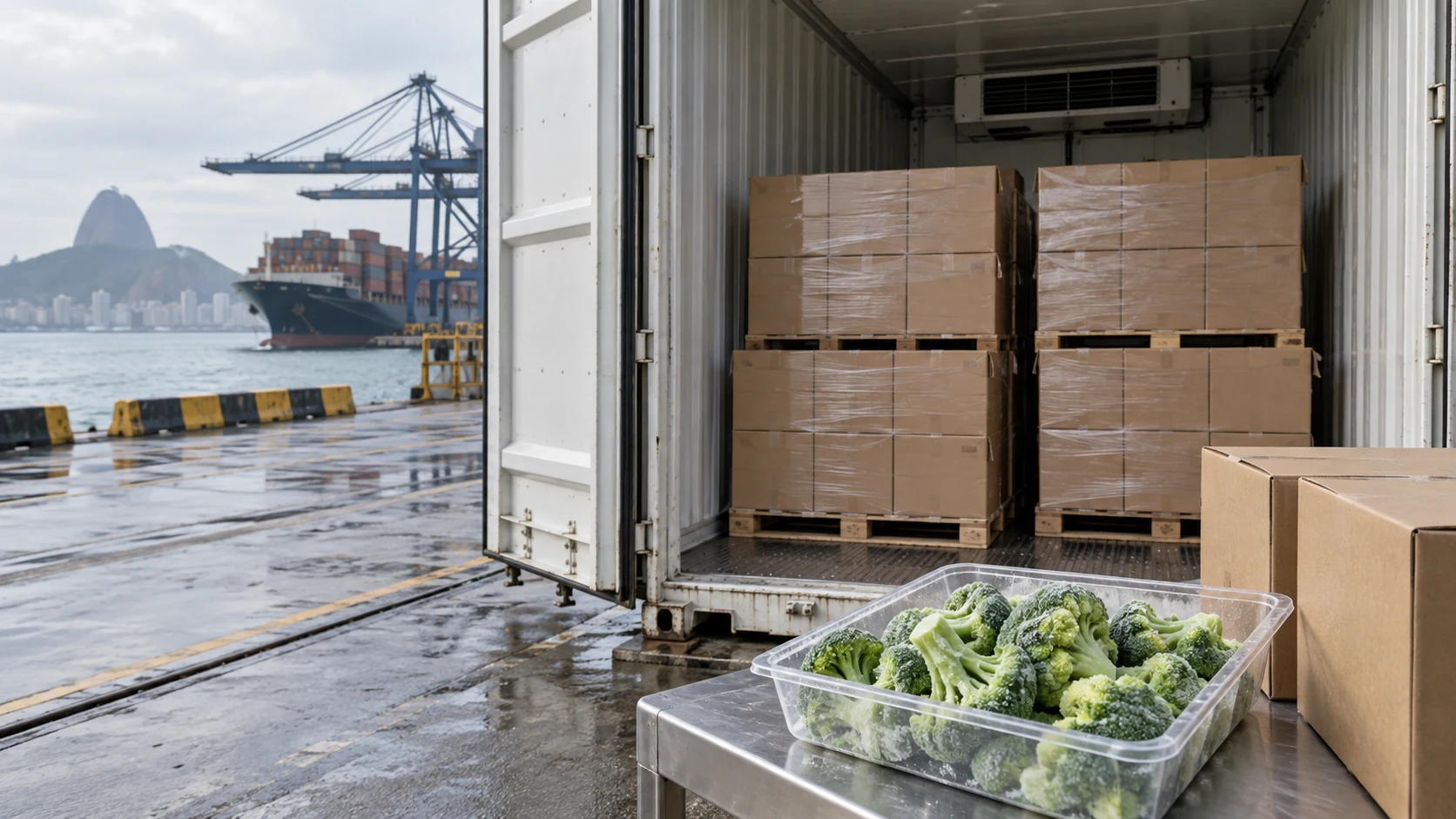
A proposed frozen broccoli handoff for a Brazilian buyer.
This guide follows a cook-before-eating broccoli SKU, rather than every frozen vegetable. GreenLand-food proposes the source, processing and lot dossier from China. The Brazilian importer and its broker enter the transaction in Siscomex, obtain any operation-specific consent and make the customs declaration. The local food business checks ANVISA's regularization route before first sale. A seasoned mix, organic claim, retail ready-to-eat pack or different thermal process needs its own classification.
Reviewed 16 October 2026.
Identify the Brazilian importer and exact product use
The buyer should nominate the Brazilian legal importer before requesting an all-in landed quotation. The importer is the party that needs access to the relevant foreign-trade systems, identifies the establishment that will receive the goods, files or instructs the customs declaration and bears the local food obligations. A freight forwarder can arrange movement, but its possession of the container does not make it the food importer. A customs broker can transmit an entry for its client; that delegation does not move the underlying applicant obligation to the Chinese supplier. We would put these names and responsibilities in the order file at the quotation stage.
Describe the article precisely: broccoli florets, Brassica oleracea var. italica, cultivated and processed in China; washed, cut, briefly blanched, cooled and individually quick frozen; no other ingredient, sauce, seasoning or additive; bulk lined cartons; and a cooking instruction. A blanching step controls an enzyme and process condition, but no buyer should assume it sterilizes a bag of vegetables. The Brazilian use must remain effective heating before consumption. If the buyer intends a no-cook salad, the microbiological analysis and label decision must be re-opened before accepting the order.
The importer's end-use statement matters twice. It describes the commercial application and can decide whether ANVISA's product regularization is a communication or an exemption for an ingredient used exclusively to manufacture industrialized foods. A processor buying florets solely as an ingredient in its cooked finished food is a different channel from a distributor reselling bulk cartons to restaurants. We would ask the buyer to state its first customer, use and packaging route in writing. A blanket word such as "industrial" on an invoice is insufficient evidence that every downstream use fits the exemption.

Actual GreenLand broccoli form used to discuss the contracted grade.
The Brazilian importer should check its own enrollment and habilitation to operate in Siscomex before committing a vessel slot. The Receita Federal habilitation manual explains the entity's access route and the applicable authorization status. The importer can then authorize its broker and user profiles for the chosen system. GreenLand-food cannot create that account for a buyer, and a supplier quotation should not quietly assume one exists. If the new buyer is still setting up, the commercial timeline needs a separate registration allowance before a manufacturing or sailing date becomes firm.
Start with Receita Federal's company Siscomex habilitation service, updated 6 October 2026. The Brazilian legal representative needs a regular CPF and active intervenient registration. Through the linked Portal Único, select Habilitar Empresa → Cadastro de Intervenientes → Habilitação → Requerer Habilitação and complete the requested data and applicable modality. If automatic habilitation is not granted, use the linked Meus Processos route for the habilitation request; attach the signed system-generated application, identification where required, any power of attorney and the requested supporting information. Check the outcome in Cadastro de Intervenientes or the digital decision and mailbox, then register the broker as a representative. The official service states an estimated up to 10 calendar days and no service charge; automatic processing can be immediate. This is company access preparation before the first shipment, with its own decision record. We supply the planned product and commercial information, while the Brazilian entity completes its local habilitation.
Company food licensing is another prerequisite. ANVISA's food-company guidance directs the business to its competent local Vigilância Sanitária for the operating licence; ANVISA does not issue an ordinary food-sector AFE. Check any separate rules for a third-party trading or bonded-storage arrangement. As a concrete local example, São Paulo city's June 2026 service starts licensing through VRE/REDESIM. The responsible person declares the CNAE activities actually exercised at the establishment. Medium-risk activities receive the integrated CLI, equivalent to the sanitary licence; high-risk activities follow the local health unit's document/inspection route. Retain the issued CLI or licence and its activity/address coverage before using it in the import file. Other municipalities use their own competent service. This establishment licence is distinct from the Annex XI product communication, which São Paulo's guidance directs to the regional UVIS when applicable.
We propose a one-page SKU identity sheet attached to the purchase order: botanical name, ingredient, cut form, blanching description, frozen state, intended cooking, carton net weight, lot coding, source establishment, intended destination and the nominated importer. Both parties should sign off the key commercial grade and legal description. The receiving warehouse, broker and regulatory adviser should see the same sheet, avoiding a situation where "processed broccoli" on one paper and "fresh broccoli" on another sends the shipment into conflicting controls.
Classify NCM and simulate administrative treatment
The starting classification is heading 0710, frozen vegetables whether or not cooked by steaming or boiling in water. Plain broccoli florets fall in the other-vegetables branch, with 0710.80.00 as the working Mercosur NCM for this case. The Receita Federal NCM source is the official reference; the Brazilian importer and broker must settle the current item from the actual product and process. A mix, a prepared meal or added sauce could move the article away from this working code. Do not substitute a supplier's eight digits for the importer's classification decision.
After classification, run the actual administrative treatment in Siscomex's import treatment service. Use the current simulator linked from the official simulators page, with the importer's declared operation characteristics, country, mode, product and regime. Record the dated output and any licensing or consenting-agency model. The portal says its downloadable tables are informative; the live operation-specific result controls planning. This distinction is material in 2026, when both portal migration and treatment tables can change between an early quotation and actual filing.
For this NCM, a current official LPCO spreadsheet includes an ANVISA model for personal import and conditional DECEX rows. Those rows do not establish that a business-to-business food container requires personal-import LPCO, and an absent literal MAPA row does not prove there can be no agency condition. They show why the importer must filter by the real transaction rather than copy a screen or a spreadsheet row from another shipment. If the live simulator returns a required LPCO or legacy LI, the named applicant follows that model and obtains the result at the stage required by the system. If it returns no advance consent, do not manufacture a license merely because the goods are food.
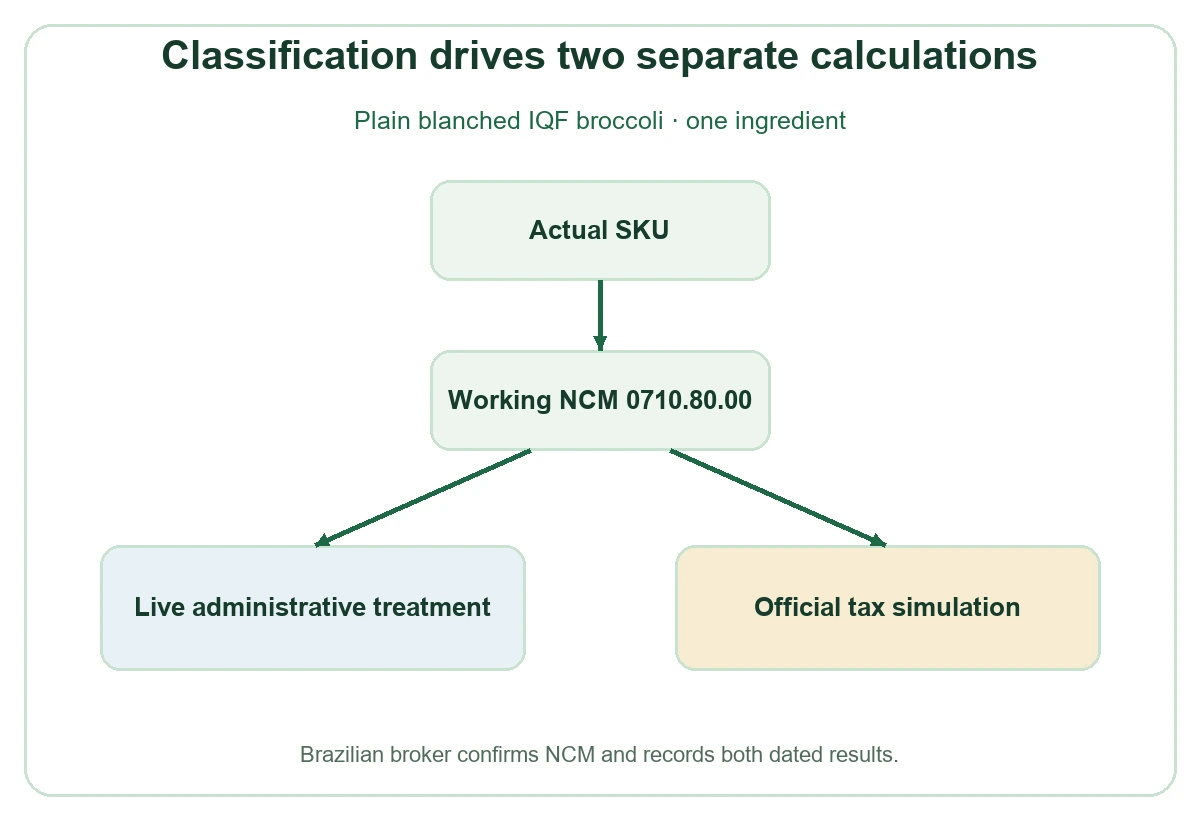
The diagram connects the decisions described in this section.
The same classification starts a tax and landed-cost calculation, but the payable amount is not a fixed "Brazil broccoli tariff" independent of date, valuation and regime. Run the official import-tax simulator with the final transaction and have the broker review the result. Commercial invoice value, freight, insurance, exchange basis and tax treatment should reconcile with the filed declaration. China as an origin should not be given an assumed trade preference; any reduction requires a current legal basis and compliant proof, verified by the importer. We would supply factual cultivation and processing evidence rather than promise a rate.
Keep the simulator output in the order dossier. If the buyer changes importer, declared use, shipping mode or NCM, rerun it before shipment. A customer may regard those details as administrative, but the physical product can wait in a reefer while an incorrect filing is amended. The small upfront cost of checking the transaction is usually less than port storage and electricity during avoidable uncertainty.
Separate MAPA phytosanitary category from food controls
Brazil applies Mercosur phytosanitary risk categories through MAPA's IN 23/2004. The instrument lists frozen plant products and cooked or precooked plant foods among category 0 examples. For this frozen, briefly blanched broccoli, category 0 is the expected plant-pest route; it ordinarily involves no phytosanitary intervention at import. The importer should retain the full process description and confirm the treatment against the current MAPA rule and the actual product, rather than asking the exporter for a phytosanitary certificate on autopilot.
That conclusion is narrow. Category 0 addresses plant pests. It is not a sanitary clearance, an ANVISA product registration, a customs release or proof that the broccoli meets composition, residue, contaminant and microbiological rules. Nor does a category 0 statement override an operation-specific administrative treatment returned by Siscomex. The Vigiagro manual provides procedural context, while the live treatment lookup decides which control applies to the filed operation.
We would build the supplier process sheet with enough detail for a regulator to distinguish freezing from a merely chilled crop, and water blanching from a formulated prepared food. It should specify the line stages, approximate product form and packaging, without claiming a validated pathogen kill unless the particular plant has produced evidence for that claim. The technical file should also make the one-ingredient status visible. A buyer who adds a sauce in Brazil will create a different final food; the imported input is still the single-ingredient frozen floret described in this guide.
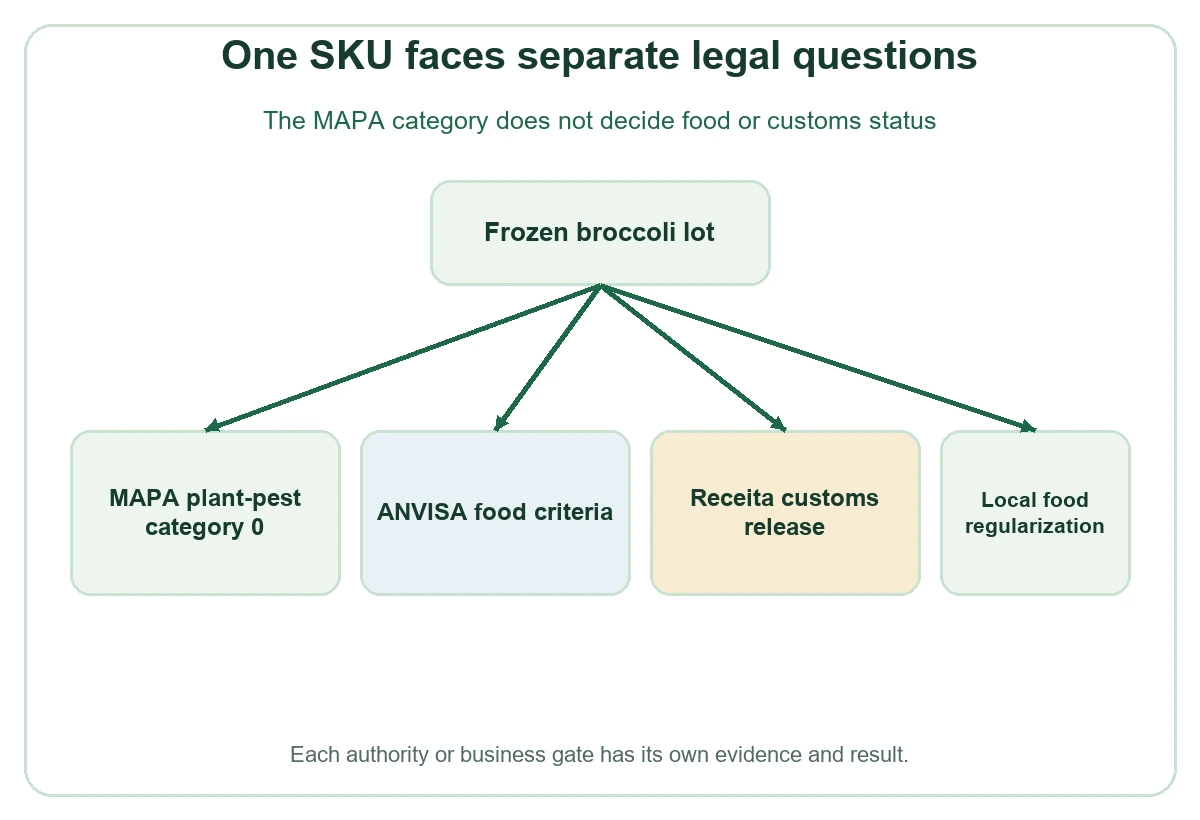
The diagram connects the decisions described in this section.
If the importer finds a conflicting MAPA or portal result, hold the shipment date and obtain a written determination through the appropriate authority or broker channel before loading. An unofficial agent's shorthand such as "all vegetables need phyto" is not a safe basis for a certificate requirement; neither is "frozen means no controls" a safe basis for ignoring food law. The useful output is a dated decision for the actual NCM, origin, process, use and filing route, saved beside the purchase order.
The supplier can help by providing source-field and manufacturing traceability, carton photographs and a process flow. The importer owns the interpretation and the customs declaration. This division is practical: we know the crop and factory facts; the Brazilian applicant knows its own legal use, registered entity and transaction attributes. The two records must describe the same shipment before any agency can assess it coherently.
Choose the current DUIMP or DI filing route
Brazil is in a staged migration from the legacy Declaração de Importação (DI) and Licença de Importação (LI) process to the Portal Único Declaração Única de Importação (DUIMP), product catalogue and Licenças, Permissões, Certificados e Outros Documentos (LPCO). The Siscomex import-treatment page and current manuals show both environments. The October 2026 DUIMP rollout schedule and DI disconnection schedule are still staged, so an article cannot prescribe one route for every Brazilian buyer.
The importer should first test the specific operation's eligibility with the official simulator and its broker, then document which route is open on the intended filing date. For an eligible DUIMP operation, the importer maintains a product-catalogue item describing this broccoli, associates any required LPCO model returned by treatment, and files the DUIMP with the transaction, transport, valuation and document references. For an operation still in the DI path, it follows the DI and any required LI procedure. "LPCO" should not be used as a generic name for every food document, nor should an LI be requested just because an old checklist says so.
The planned arrival route can affect filing. Ask the broker to map the intended port, carrier document, cargo manifest, customs regime and anticipated submission stage. Some controls must be obtained before a declaration or shipment, while others are checked at arrival. The exact official simulator and manual output provides that timing. We would not load a reefer against an unresolved condition that calls for pre-shipment evidence. The purchase contract can make broker confirmation a release-to-ship condition.
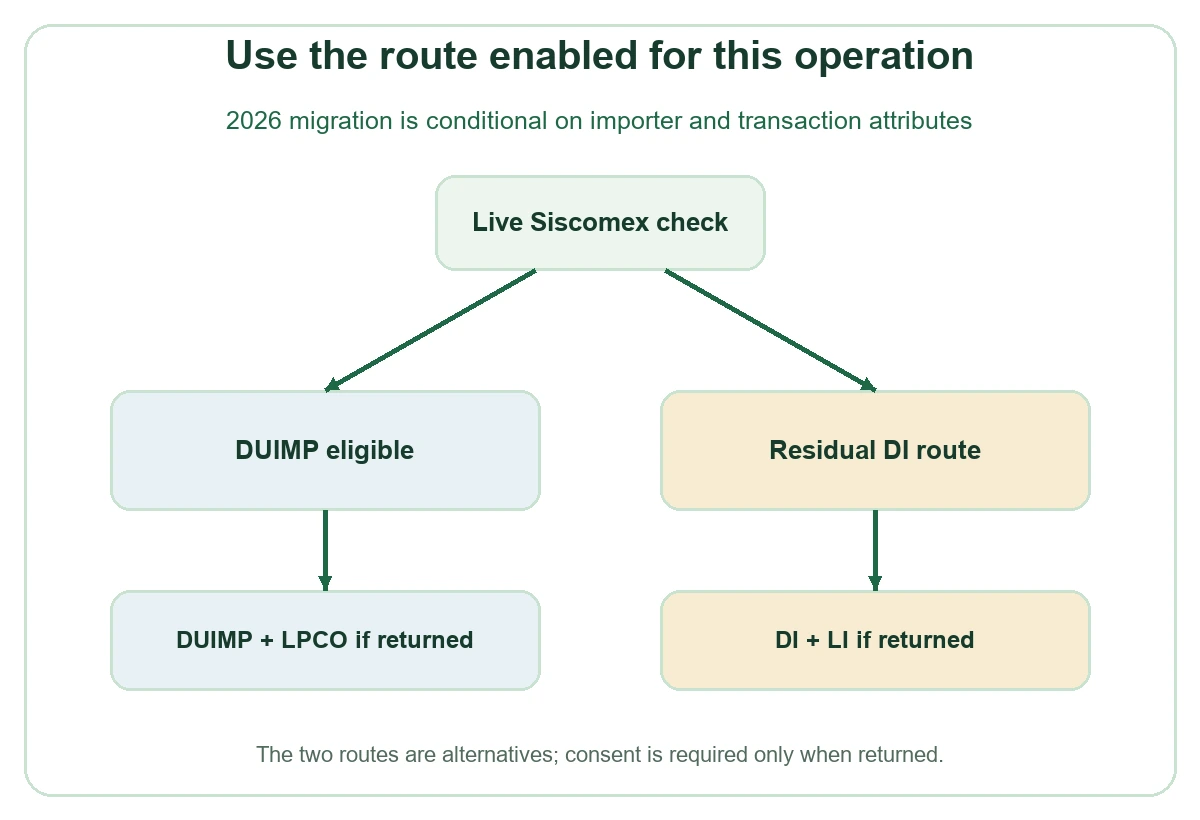
The diagram connects the decisions described in this section.
For the product catalogue, give the importer stable values: ingredient, botanical name, manufacturing country, brand or unbranded presentation, bulk carton type, net weight, cooking instruction and our source establishment. Use one controlled specification version. A revised floret-size range may be a commercial adjustment, while a change from single ingredient to seasoned product may alter legal classification; the importer should assess the revision before reusing an existing catalogue item. Product data in the portal, invoice and actual cartons should reconcile.
The immediate outputs to save are the route decision, administrative-treatment result, product-catalogue reference if used, consent reference if required, customs declaration number and final customs release. A forwarder status of "arrived" or "delivered" is evidence of movement, not of these decisions. Make a small shared milestone register so importer, broker, cold store and supplier can discuss the same status without using the ambiguous phrase "cleared."
Prepare the origin, laboratory and bulk-label dossier
Before production, agree an evidence list that can actually be tied to the lot. We propose the signed purchase specification, source and plant lot map, ingredient declaration, process flow, carton artwork, packing list template, test plan, temperature plan and document naming convention. The buyer should add the Brazilian NCM, current treatment result, port, importer data and intended use. A supplier should not present a general website certificate as proof that the future lot passed a particular test. Test reports and formal certificates belong to their issuing body and exact batch.
The commercial file should reconcile seller and buyer identities, invoice item, net and gross weights, carton and pallet counts, origin, manufacturing lot, container and seal numbers, bill of lading, packing list and the importer-facing product description. If two manufacturing lots share a container, list both and their case ranges. A laboratory composite across lots may be unusable if an authority or customer needs a result for one identifiable lot. Put sampling, method and acceptance criteria in the contract rather than presenting a certificate of analysis as a magic document whose scope is never checked.
Brazil's ANVISA IN 161/2022 gives a specific microbiological category for prepared, blanched, frozen vegetables requiring effective heating before consumption. Under Annex I item 2(c), Salmonella must be absent in 25 g, n=5 and c=0; E. coli is measured per gram, n=5, c=3, m=50 and M=500. The instrument describes effective heating as 75°C at the cold point or a validated equivalent. We would design a five-unit lot plan with an accredited laboratory and send the intended cooking statement to the Brazilian buyer for review. We cannot turn a brief blanch into a validated final cooking step by assertion.

China production, Brazilian filing, carrier and receiving records must identify the same product and lot. Record owners contribute different evidence.
For chemical hazards, ANVISA IN 160/2022 lists non-leafy Brassica vegetables, including broccoli, with total arsenic 0.30 mg/kg, cadmium 0.05 mg/kg and lead 0.30 mg/kg, noted after washing. The importer and laboratory should confirm whether and how those commodity entries apply to the washed, blanched frozen final lot; there is no automatic raw-to-finished conversion. Pesticide review needs the live ANVISA monograph for each active substance, broccoli or crop-group applicability, residue definition and test method. A generic "EU compliant" report is not a Brazilian legal determination.
One current Brazilian crop example is ANVISA's A29 acetamiprid monograph, whose current official PDF lists broccoli at 0.1 mg/kg; the compliance residue definition is acetamiprid. Its Brazilian foliar-use row also gives a one-day safety interval. That local authorized-use entry is not an instruction for a Chinese grower: the source must comply with applicable Chinese use rules and the export residue requirement. We would compare the actual spray record and harvest date with the buyer's Brazilian panel, request a method with an adequate quantification limit, and identify the finished frozen sample and any processing comparison. This one substance is an example, not a complete residue panel or evidence that a future lot has passed.
Bulk cartons need legible Portuguese information or a compliant importer-controlled label solution for the actual market channel. At minimum we would provide validated product name, ingredient, net mass, lot, manufacturer and country facts, storage and cooking instructions, dates and traceability fields for the importer's label review. The final Portuguese claims and any mandatory nutrition or allergen presentation depend on Brazilian labeling rules and use; the importer should approve artwork before printing. Our broccoli florets product page shows the family, but the order artwork controls the actual cases.
Manage arrival, agency checks and customs release
The freight plan should preserve product state, evidence and access at the port. The carrier supplies the transport document and reefer temperature record; the terminal controls handling; the importer and broker monitor the Siscomex event and any agency hold. GreenLand-food can send loading photos, case counts, lot map and pre-shipment records. A clean temperature logger is evidence that the carrier held its contracted conditions, but not proof that customs has released the goods or that ANVISA food regularization is complete.
At origin, we propose a release check linking physical cases to the invoice, packing list and test results. Use the same lot code on each carton and pallet record. Record net weight separately from corrugated and pallet gross weight. Inspect loaded-container cleanliness, seal, set point and the time that doors are open. Agree who handles a logger deviation and who may authorize a route change. The carrier should keep the frozen product under the contracted cold-chain condition, while the buyer's receiving site is prepared to unload into appropriate frozen storage.
On arrival, the importer/broker follows the declaration route selected above. If the live administrative treatment or a competent authority orders inspection or document review, hold the lot and supply the requested file through the official channel. A phytosanitary category 0 analysis should be available to explain the frozen process, but it is not a substitute for complying with a real operation-specific hold. Customs release comes from Receita Federal's declaration process. It is separate from the carrier's delivery order and from the food business's authority to place the broccoli on the Brazilian market.

The diagram connects the decisions described in this section.
The receiving warehouse should check seal, carton condition, lot count, frozen condition and any indicated logger excursion before releasing its internal hold. Sample only under a method agreed with the importer and laboratory, protecting the cold chain and chain of custody. If cartons are wet, crushed or thawed, segregate them and record case numbers and photographs; do not blend them into accepted stock to meet a delivery window. A claim against a carrier, a supplier quality investigation and an agency decision can proceed on different tracks.
For a first shipment, share a status register containing declaration number, any consent result, customs release date, receiving temperature and count, laboratory disposition and local food-regularization status. The purchaser can then distinguish "in the country," "customs released," "at the freezer" and "available for sale." This record has commercial value: it shows which party can act when demurrage, a document correction or a disputed test delays a sale.
Complete food regularization before the first sale
Brazil's ANVISA food-regularization guidance explains the RDC 843/2024 and IN 281/2024 framework. Vegetable products generally appear in Annex III, where the Brazilian manufacturer or importer communicates the start of manufacture or importation to its state or municipal sanitary authority using the Annex XI form. Ingredients used exclusively to manufacture industrialized foods may fall under Annex IV exemption. The importer should document its actual product category, use and establishment before relying on either route. "Exempt from product communication" is not the same as exempt from food safety law or importer obligations.
If Annex III applies, the Brazilian importer prepares the current communication form, company and product identifiers, composition, label and other information specified by the competent local sanitary authority, then submits it where the business is established. It should save the receipt and any response or local conditions. If the exclusive industrial ingredient exemption applies, the importer records the qualifying use and supporting documents so a later distribution change triggers re-evaluation. The Chinese supplier can provide a factual technical sheet, but cannot file the Brazilian local communication in its own name.
This is a separate gate from Receita Federal customs release. A container may be released from the port, moved to a cold store and still be on commercial hold until the business has completed the appropriate ANVISA/local sanitary pathway and its own lot acceptance. Conversely, a product communication does not pay import taxes or release a container from customs. The first customer order should be timed only after both sides of the record are in place. Record the date and authority of the local filing rather than using a vague "approved" stamp on all internal stock.

Actual GreenLand floret-size inspection photograph.
The importer should also verify the final label and permitted use for the channel it actually sells into. Bulk ingredient labels and consumer retail packs can carry different information obligations. If cartons are repacked, blended or supplied for a no-cook application in Brazil, ask the responsible Brazilian food business to reassess category, microbiology and artwork before sale. Our proposed supplier records can support that reassessment, but they cannot validate a downstream process we do not control.
For a first order, we would close the file with a joint review of three outcomes: the product matched the contracted floret grade and frozen condition, the declaration and any agency decisions matched the shipment, and the importer documented its lawful first-sale route. That review gives the next purchase order a concrete specification and a more predictable timetable. It also identifies whether a delay came from field material, paperwork, an official control or a customer application, rather than treating all four as an undifferentiated "import problem."
Continue with the China-origin IQF broccoli supply plan for the same China-origin, single-ingredient, blanched IQF broccoli order.
Related reading
Compare food and customs controls if your physical route transits the EU.
Compare the same floret specification under a different market's entry rules.
Plan your frozen broccoli supply
GreenLand-food is a China-based frozen broccoli supplier and manufacturer discussing factory-direct wholesale supply. Send us your floret size, grade, packing, quantity, cooking application, Brazilian destination and requested documents so we can prepare a reviewable proposal for the actual source and order.