


Czech Frozen Produce Import Guide for China-Origin IQF Broccoli
Oct 16, 2026
Leave a message

A first shipment of China-grown, blanched IQF broccoli florets to the Czech Republic starts with a precise product description and a named EU food business. The importer, customs declarant, carrier and receiving processor each make a different decision. A targeted border CHED-D applies only when the current product-origin rule actually lists the shipment.

A proposed frozen broccoli handoff for a Czech buyer.
Reviewed 16 October 2026. A Czech importer has a useful distinction that many generic EU checklists miss: SZPI says ordinary safe food from a third country needs no special import permit unless a directly applicable measure imposes one, and its destination-notification list does not include this frozen broccoli. This worked example is conventional broccoli florets, washed, blanched and individually quick frozen in China, in industrial bulk packing, with cooking required before eating. It is not a seasoned, organic, ready-to-eat or infant-food product. A changed formulation, claim, origin, route or entry date requires a new check. We can help assemble the supplier-side evidence, while the EU importer and its appointed representatives make the official applications and release decisions.
The EU frozen produce import guide covers the law common to all member states. This guide concentrates on the Czech registrations, portals, border handoffs and first-lot decisions that a generic EU checklist cannot settle.
Define the China-origin IQF broccoli and delivery route
Write one product identity and use it everywhere. The commercial description should say broccoli florets, Brassica oleracea var. italica, China grown and processed, one ingredient, blanched, IQF, for cooking, with the actual net mass per liner and carton. The invoice, packing list, production record, carton mark and import declaration should agree on that identity. "Frozen vegetables" is a useful category for a website, but too broad for a tariff or a residue decision. It could describe mixtures, seasoned preparations, vegetables steamed before freezing or raw frozen ingredients with different commercial uses. If a broker receives only a broad category, it has to reconstruct facts while a refrigerated container is already moving.
The customs starting point is heading 0710 for vegetables, uncooked or cooked by steaming or boiling in water, frozen. A conventional blanched broccoli floret normally belongs in the frozen other-vegetables branch, rather than heading 0704 for fresh or chilled Brassica. The importer and broker must confirm the full current CN/TARIC code, the treatment and any national declaration detail. That check controls duty, restrictions and the document codes in the customs entry. It also determines whether a targeted measure names the product. One cannot infer the final tariff treatment from the word broccoli alone, and this guide does not promise a duty rate based on a generic eight-digit code.
The Czech Food Inspection Authority (SZPI) third-country page, updated 6 October 2026, separates ordinary food from named EU controlled products. We would give the Czech broker the exact frozen form, one-ingredient declaration and process record to avoid a false fresh-vegetable route. A Czech customer can receive the lot after free circulation elsewhere in the EU or make the customs entry locally; those are different document chains. The buyer should decide which entity first places the food on the Czech market and which warehouse holds the cartons while quality review is pending.
Before a purchase order becomes a production instruction, define the buyer's use. A soup factory may want small crowns that disperse; a ready-meal line may prefer larger intact florets; a foodservice packer may have a visual grade and a particular carton weight. All three can import the same legal commodity but reject one another's commercial grade. We would record target crown width, stem allowance, broken-piece share, colour, foreign material, pack mass, lot size and cook test in the agreed specification. These are buyer-contract criteria unless a specific legal rule says otherwise. We should agree the test method and acceptance sample size rather than advertise a "premium grade" without a measurement.

Actual GreenLand broccoli form used to discuss the contracted grade.
The importer-of-record decision is equally specific. Name the EU entity in charge of placing the food on the market, the customs declarant and its representation authority, the warehouse receiving the cartons, and the customer who may approve or reject them. A freight forwarder can make a filing for an importer; a customs MRN still does not replace that importer's food-safety duties. Keep the EORI holder, commercial buyer, consignee and cold-store operator visible as separate roles when they differ. Their identifiers must match the fields in the relevant systems and the shipping documents.
Register the Czech food business and customs identity
EU Regulation 852/2004 Article 6 makes the food business notify the appropriate authority of each establishment under its control so it can be registered. The legal obligation applies to activities such as importing, handling, storing and distributing this plant-origin food. It does not turn a Chinese broccoli supplier into a Czech registered importer; the local entity must complete its own establishment procedure. Nor should an animal-product establishment approval form be applied automatically to a single-ingredient frozen plant food. We ask the buyer for the registration identity and activity scope, not a decorative certificate from an unrelated scheme.
The Czech buyer needs the food-business establishment and activity notified to the competent authority under Article 6 of Regulation 852/2004. For this plant-origin food, SZPI is the central import-food information source; the buyer should confirm its own local registration route and activity scope with SZPI or the responsible local office. A Czech importer of this SKU should not apply an animal-origin approval procedure or a fresh-produce establishment model by analogy. We would record the exact receiver and cold-room address on the supplier handoff sheet, because the actual first Czech handler-not merely the invoice payer-must control receiving and traceability.
Use SZPI's current business forms page, which links the notification of commencement, change or termination of food-business activity and its submission instructions. It recommends the Ministry of Agriculture electronic submission service. Prepare the legal operator's identity, establishment address, responsible contact and actual import/storage/distribution activities, complete the relevant activity notification and retain the submission evidence and resulting establishment details. We provide the broccoli and process description for that record. This business notification is separate from the destination-arrival form for selected foods; the fact that frozen broccoli is absent from that arrival list does not remove the business-registration duty.
The local business should then set internal authority for three tasks. The quality manager owns the food specification, supplier approval and receiving hold. The customs lead or broker owns the tariff line, EORI, declaration and fiscal data. The logistics lead owns the entry point, arrival notice if one is applicable, reefer booking and cold-store slot. A single person can cover several jobs, but the shipment file should name who gives the answer to each authority. We would ask for a named technical contact before final artwork and documents are locked, because a last-minute change to importer name or delivery location ripples through invoice, label, declaration and release instructions.
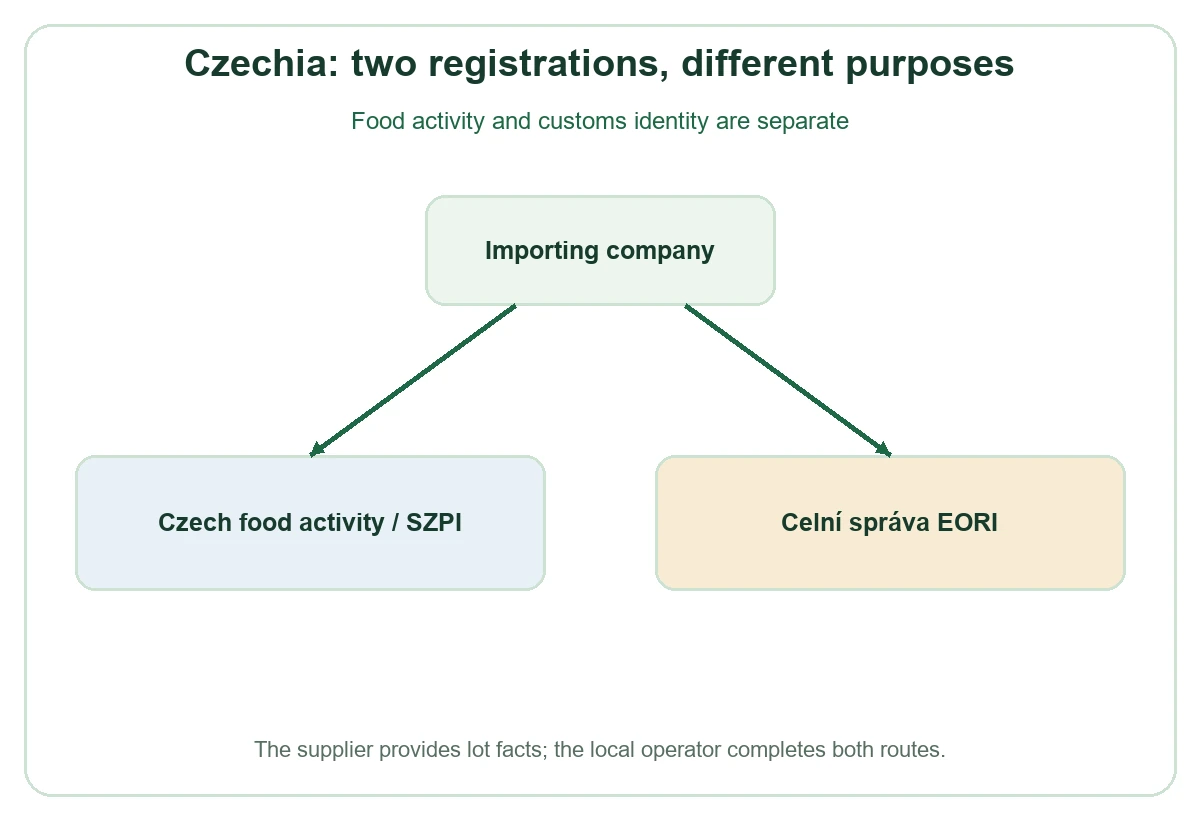
Food-business activity and customs identification are separate registrations.
Every EU customs trader generally needs one EORI identifier, issued by the member state of establishment or first relevant operation, usable across the Union. A company already holding a valid EU EORI should verify it, not ask for five national EORI numbers merely because it buys in several countries. Local VAT arrangements and company registration are related but different records. If an overseas seller proposes to act as importer, the buyer should have the customs representative and tax adviser test who may be declarant and what fiscal arrangement is needed; an Incoterm alone does not create an eligible EU food operator.
Czech Customs describes customs declarations for goods from third countries and EORI identification. The Czech importer should verify its EORI, representation authority and electronic filing arrangement before sailing. A broker acting as representative needs the full product description and valuation file; an EORI number alone is no food approval. If the goods arrive first in Germany or the Netherlands, the importer should specify whether they move under customs transit to the Czech Republic or have already been released for free circulation. That determines which customs evidence the Czech receiver keeps.
Check conditional food and plant-health controls
Separate three questions that are often conflated. First, is this commodity subject to the EU's temporarily increased official controls or an emergency measure? Second, does its physical state fall under a plant-health certificate or CHED-PP rule? Third, does the Czech Republic impose a national arrival or sanitary step for non-harmonised food even when the first two answers are no? The broker should record the answer and the version of the measure used. A search result about fresh broccoli or a different country of origin cannot resolve a China-origin, blanched, frozen 0710 floret.
The current consolidated Implementing Regulation (EU) 2019/1793 lists specific food or feed, origins, CN lines and hazards in its annexes. The consolidated version shown on EUR-Lex is dated 30 June 2026 as of this review. We did not find ordinary China-origin frozen broccoli florets in the relevant listing on that review date. The resulting working route is ordinary non-animal food rather than an automatic CHED-D and TRACES pre-notification. This is a product-and-date conclusion, not a standing exemption for all Chinese frozen vegetables. Confirm the annex again before shipment, including any later amendment, TARIC measure, route-specific direction or emergency restriction. If a future entry captures the exact product and origin, the importer must use the designated border route, notice, documents and official decision then in force.
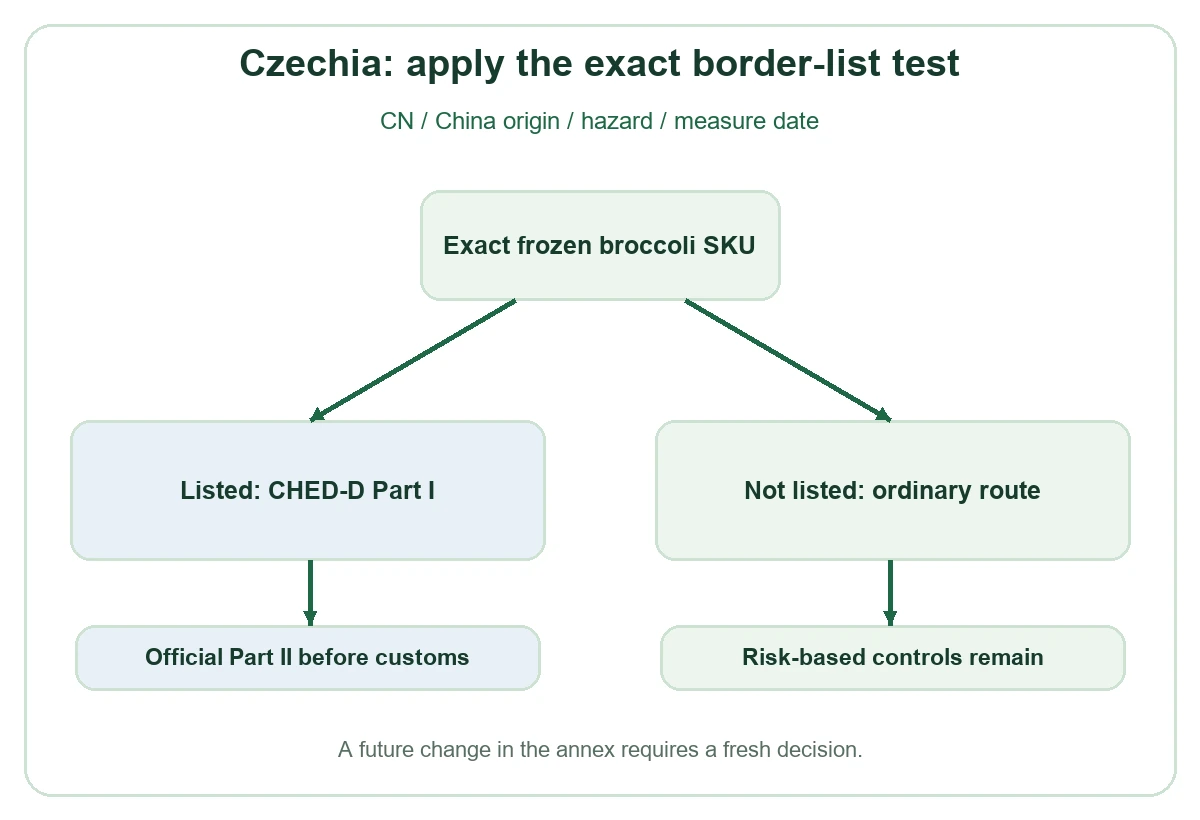
The current product, origin and hazard listing determines whether CHED-D is required.
The EU plant-health regime commonly discussed for fresh vegetables must also be matched to the product state. This is a processed, blanched and fully frozen floret under the proposed 0710 heading, not a fresh head under 0704. We would not request a fresh-produce phytosanitary certificate or a CHED-PP simply because the botanical species is broccoli. The importer should confirm the actual presentation against the current plant-health annexes and the authority at the first EU entry point. Wood packaging, if used, has its own treatment/marking issue; it does not change the food classification. An authority may still sample an ordinary import under risk-based controls, so "not listed for systematic CHED-D" never means "outside food law."
SZPI's current third-country guidance says safe ordinary food not covered by special directly applicable EU measures requires no general special import permit or certificate. It identifies risk-food routes such as Regulation 2019/1793, with designated border control posts and official results only for listed products. The first entry must be screened by the actual CN/origin/hazard combination. Separately, the Czech destination-notification service currently applies to apples, potatoes, poppy seed and food supplements. Frozen broccoli is not on that list; the buyer should not waste time filing that form as a supposed universal plant-food notice. This does not relieve it of ordinary traceability and safety obligations.
The practical evidence is a dated classification note: commodity description, photos or specification of frozen form, proposed CN/TARIC code, country of origin, intended use, search of the current targeted annexes, and the national authority or broker confirmation. Share that note with the supplier before loading. If a control is triggered, do not send a reefer to a terminal that cannot provide the required inspection facility. Book a cold-compatible inspection slot, decide who pays storage and sampling costs, and place any official certificate reference in the customs declaration only after it actually exists. If no targeted control is triggered, retain the note so a routine customs question can be answered quickly.
Prepare the national import and customs filings
An import declaration is a data set, not a scanned folder of certificates. The declarant needs importer and representative identifiers, the full commodity code, origin, customs procedure, value and currency, quantities, transport details, invoice reference and any required document or prohibition code. The freight forwarder separately handles manifest and arrival operations; a terminal release or delivery order is a physical logistics decision. When a food-control document is required, its result or reference must be aligned with the customs entry. Filing a declaration does not itself mean customs has released the goods for free circulation.

Goods already released in another EU state and goods under transit follow different customs paths.
The declarant uses the Czech customs electronic procedure described by Celní správa, with EORI, full CN/TARIC code, declared procedure, origin, value, invoice, packing and transport records. It should not insert a CHED-D reference for an ordinary unlisted lot, because there is no such official result. If the live EU risk list or an emergency measure captures a future shipment, the operator arranges CHED-D through TRACES and first-entry BCP control before customs free circulation. The broker should return the declaration/MRN and release status; a truck note is not the customs decision.
Before sailing, we would give the buyer a draft commercial invoice and packing list for broker review. Each should show GreenLand's supplier identity as contracted, buyer and consignee, exact product, origin, packing configuration, net and gross mass, lot codes, container/seal references when known, value and currency. The bill of lading, freight terms and origin evidence then need reconciliation against those drafts. The EU buyer's customs broker should advise whether a preferential tariff claim is available under the actual rules of origin and documentary proof. A generic certificate of origin or China-origin statement is not an automatic preference. For the first shipment, ask the broker to return a data-field checklist rather than a vague "documents okay."
SZPI and customs can ask for evidence at different moments. The first EU entry point handles any applicable targeted food border check, while the Czech customs office handles the declaration if the goods remain non-Union under transit. If they were cleared at another EU port, carry the free-circulation proof into the Czech receiving file rather than lodging a second import entry. The Czech receiver should plan a frozen holding location that can keep case ranges distinct if an authority or buyer sample concerns only one manufacturing lot. Do not allocate cartons to production based solely on an estimated arrival time.
On arrival, the declarant monitors the customs message or MRN, responds to requests for documents, pays or accounts for duty and VAT as applicable, and records the free-circulation result. If a food authority has ordered a hold or sampling, customs and carrier movements must respect it. The cold-store should be told whether cartons may be unloaded, held under customs control, placed under an official food hold, or used for production. Those are different statuses. A spreadsheet with one green "cleared" cell hides the difference and makes a later trace exercise harder.

A matched commercial, transport and lot dossier feeds the Czech customs entry.
Set food-safety criteria and Czech label information
Food safety has a legal layer and an order layer. EU General Food Law, Regulation 178/2002, places responsibility for safe food, traceability, withdrawal and recall on food businesses. Regulation 852/2004 sets hygiene obligations. Regulation 396/2005 controls pesticide residues through substance-and-commodity maximum residue levels, including the exact residue definition and processed-food treatment. Regulation 2023/915 controls named contaminants, and Regulation 2073/2005 sets microbiological criteria only for its specified food categories and stages. We would not copy an unrelated ready-to-eat food criterion or a fresh-produce default into a cook-before-eating blanched IQF broccoli release sheet.
As a concrete EU contaminant example, Regulation 2023/915 has a 0.10 mg/kg lead maximum for the ordinary Brassica-vegetable row 3.1.5.1 and a 0.040 mg/kg cadmium maximum for the ordinary Brassica row 3.2.5.1, on wet weight, after washing and separating the edible part. Broccoli belongs to that Brassica group, but this is a blanched and frozen processed food. Article 3 requires the relevant processing factor to be justified where no specific processed-food maximum is listed; it would be careless to label 0.10 and 0.040 mg/kg as automatically validated final-IQF thresholds without assessing that factor. The buyer's laboratory plan should state analyte, edible portion, wet-weight basis, sample size, method, limit of quantification and processing-factor rationale. A reported result with no method or lot identity is not a release decision.
For residues, use the current EU pesticides database and Annexes to Regulation 396/2005 for each active substance and the broccoli commodity definition. The well-known 0.01 mg/kg default is used only where the regulation supplies no specific MRL and no other applicable provision; it is not a universal limit for all pesticides. The laboratory needs a method that captures the legal residue definition, which may include metabolites, and a suitable reporting limit. For microbiology, agree a buyer risk plan for this cooked-use food, including Salmonella and Listeria where the customer's hazard analysis calls for them, but distinguish the contract from a statutory row. The buyer must decide whether its actual downstream process changes the intended-use classification.
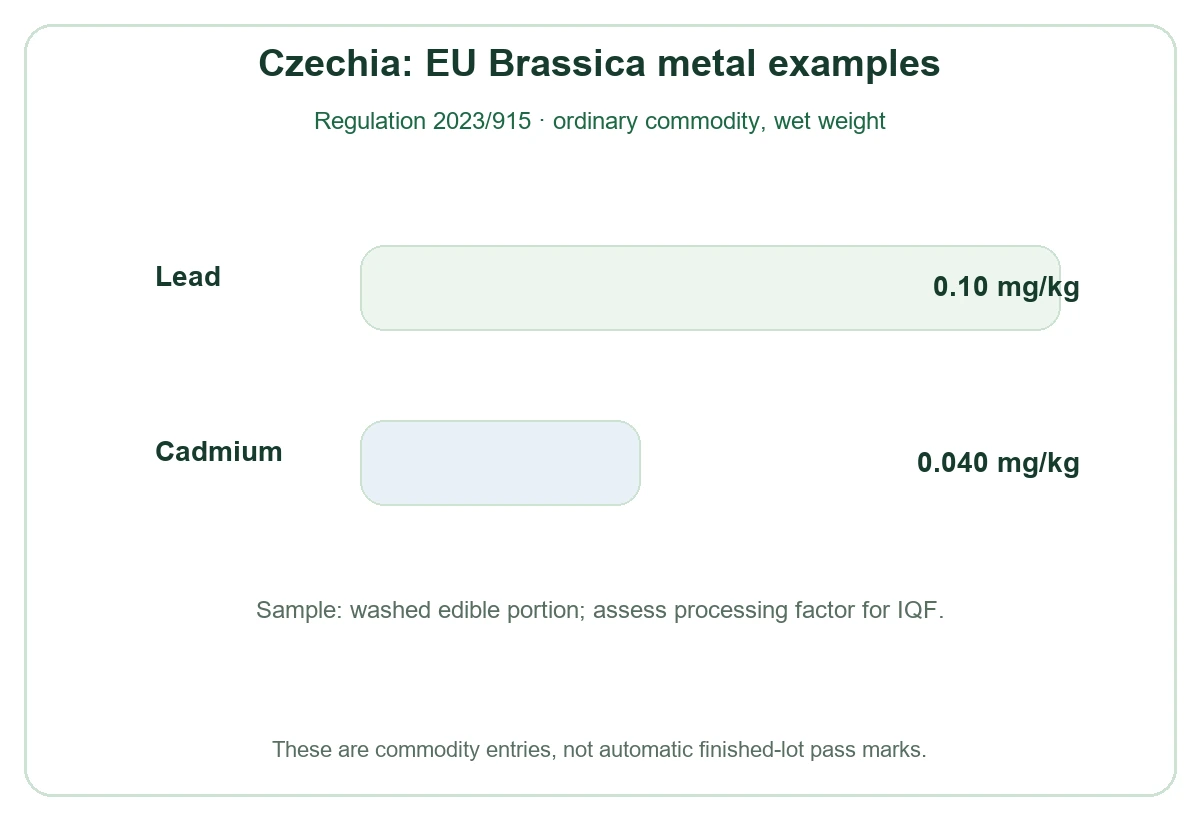
EU Brassica lead and cadmium rows require the stated edible portion and processing assessment.
The Czech importer should distinguish an EU legal criterion from a customer contract limit in its acceptance table. Lead and cadmium Brassica commodity rows can guide an analyte plan, but the laboratory must assess the blanched frozen matrix and any applicable processing factor. Pesticide checks need the EU substance-and-commodity record; microbiology needs a category matching cook-before-eating use. The importer should approve Czech-language market information for its actual channel, not assume that English export cartons alone meet every downstream sale. The local destination-notification exclusion for this broccoli has no bearing on these safety and label obligations.
The pack text should identify the food, lot, net quantity, operator details, origin where required or where omission misleads, storage instructions and the necessary use or cooking instruction. Regulation 1169/2011 distinguishes prepacked consumer information from information transmitted for food supplied to mass caterers or for further processing. Industrial cartons can use commercial documents for some particulars under the regulation's conditions; they cannot disappear from the trace system. The importer decides the Czech language solution for its actual sales channel. An English-only exporter carton may be acceptable in a limited professional transaction only if the competent rules and recipient understanding permit it; it should not be assumed adequate for later consumer-facing sales. We would provide editable artwork fields and have the local operator approve the final text before print.
Prepare GreenLand production, lot and shipping records
For your order, we prepare a product and lot file for supplier approval, local filings and receiving checks. We begin with the agreed floret specification, source identity, harvest and intake-lot links. Production records should follow washing, blanching, cooling, IQF, grading, foreign-material control, packing and frozen storage. We match the process description to the actual line and product: the blanch setting needs a defined purpose and validation, with monitoring records for the production run. The agreed process-flow and verification information, together with the link from source lots to packed batches, lets your technical team review how the ordered ingredient was controlled.
After IQF, two different sorting concepts should be stated correctly. Colour or optical sorting detects visible colour and shape deviations under its configured conditions. Density-based X-ray inspection can find some dense foreign bodies depending on calibration, product geometry and pack presentation. Neither can be promised to remove every physical hazard, and one should not describe an optical colour sorter as if it measures internal density. A sensible acceptance file records the controls actually used, verification result and nonconformance handling. The supplier's role is to show evidence for the lot, while the buyer determines whether it meets the agreed specification and legal criteria.
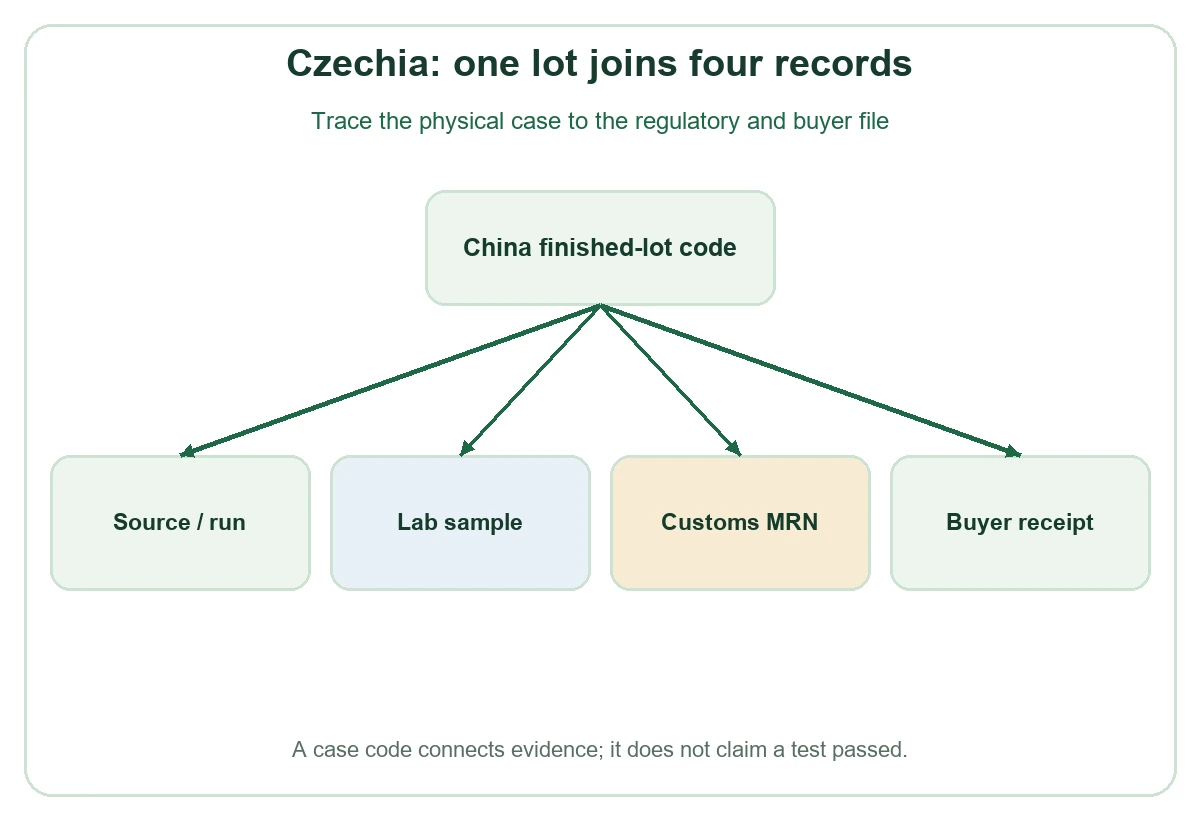
The finished lot links source records, laboratory samples, the customs entry and buyer receipt.
The finished-lot file should tie a batch code to a defined sampling plan. For each requested laboratory panel, ask which jurisdictional rule or buyer criterion the result is meant to satisfy; state unit, analyte or organism, sample unit, method, laboratory identity and date. A "pass" logo on a COA without the analytical basis is weak evidence. We would also reconcile the quantity represented by the sample with the carton count shipped. If several production batches share one container, each batch needs its own trace link and agreed composite or separate sampling logic. The importer should retain source, purchase and sale records in a form that supports one-step-back/one-step-forward traceability.
Our proposed Czech file would place the SZPI listing check beside the manufacturing lot, not in place of the lot. We would provide source-to-case traceability, agreed floret grade, process flow, sample record and available COA. Where a customer asks for a "phytosanitary certificate" because the ingredient is a vegetable, we would ask the broker to check the actual processed-frozen 0710 state against the current plant-health annex rather than request a fresh crop certificate without basis. The cold-chain plan should identify the first EU terminal, any transit leg and the Czech receiver, with separate temperature evidence for each custody segment.
Before loading, freeze the final data set: invoice, packing list, product specification, label proof, lot and carton list, available COA, container and seal, loading record and temperature logger arrangement if agreed. The shipping document should not call it "fresh broccoli," "organic broccoli" or "ready to eat" unless those facts and claims are genuinely true and documented. We can propose a cold-chain logger, but the parties must agree who installs it, who reads it and what excursion leads to hold or investigation. A reefer setpoint alone does not prove product core temperature throughout voyage or acceptance on arrival.
Separate authority, customs, carrier and buyer release
At destination, the first check is administrative: did the correct authority receive any required notice, and is the official result recorded? The second is customs: has the declaration been accepted and the goods released for the chosen procedure, with duty and tax handled? The third is carrier and terminal: is the delivery order available, has the container been discharged and can a refrigerated truck collect it? The fourth is commercial: does the buyer accept the food lot for its intended operation? These events may occur hours or days apart. No party should treat a gate passed by another party as proof that its own gate is satisfied.

Actual GreenLand floret-size inspection photograph.
At the Czech destination, the receiver should retain the customs free-circulation evidence, any real official food-control decision, incoming carton and temperature checks, and the buyer's lot acceptance. For this ordinary broccoli it should also save the current reason no SZPI destination notice was filed: the notification list covers other named goods. If a future lot includes a listed commodity or different origin, rerun the checks. A good floret-size result cannot cure an uncleared customs entry, while a customs release does not compel the factory to use a thawed or contaminated ingredient.
The receiving team should record seal integrity, carton count, outer condition, lot codes, temperature evidence and any visible thaw/refreeze signs. It can sample floret size, broken share, stem proportion, colour and cooked performance against the agreed method. If results conflict with the COA or the expected condition, segregate the affected lot, keep it frozen, preserve the temperature and photo record, and notify the supplier and importer before use. A customs release does not require a food factory to use a nonconforming ingredient; conversely, a good product inspection cannot legalise an uncleared customs entry.
The first-lot review should be operationally useful. Record actual filing numbers, broker corrections, inspection appointments, cost items, transit and waiting times, temperature readings and any buyer deviations. Put those observations beside the planned process for the next order. We can then revise the pack or document template where it caused a real delay. We should not promise a uniform port dwell time or claim a registration fee without an authority's current tariff and a defined service. What we can promise to prepare is a matched SKU and lot evidence package so the local importer can make its own applications and a defensible receiving decision.
Related reading
Review the EU law shared by every member-state route.
Compare the same floret specification under another EU buyer's application.
Plan your frozen broccoli supply
GreenLand-food is a China-based frozen broccoli supplier and manufacturer discussing factory-direct wholesale supply. Send us your floret size, grade, packing, quantity, cooking application, Czech destination and requested documents so we can prepare a reviewable proposal for the actual source and order.