


Organic Frozen Produce Imports: Certification Scope and Shipment Documents
Oct 16, 2026
Leave a message

An organic frozen-produce order needs two kinds of proof: current certification covering the actual growing, processing and handling chain, and the destination's document for this shipment. The buyer should settle that route before asking us to print an organic claim or load a reefer.
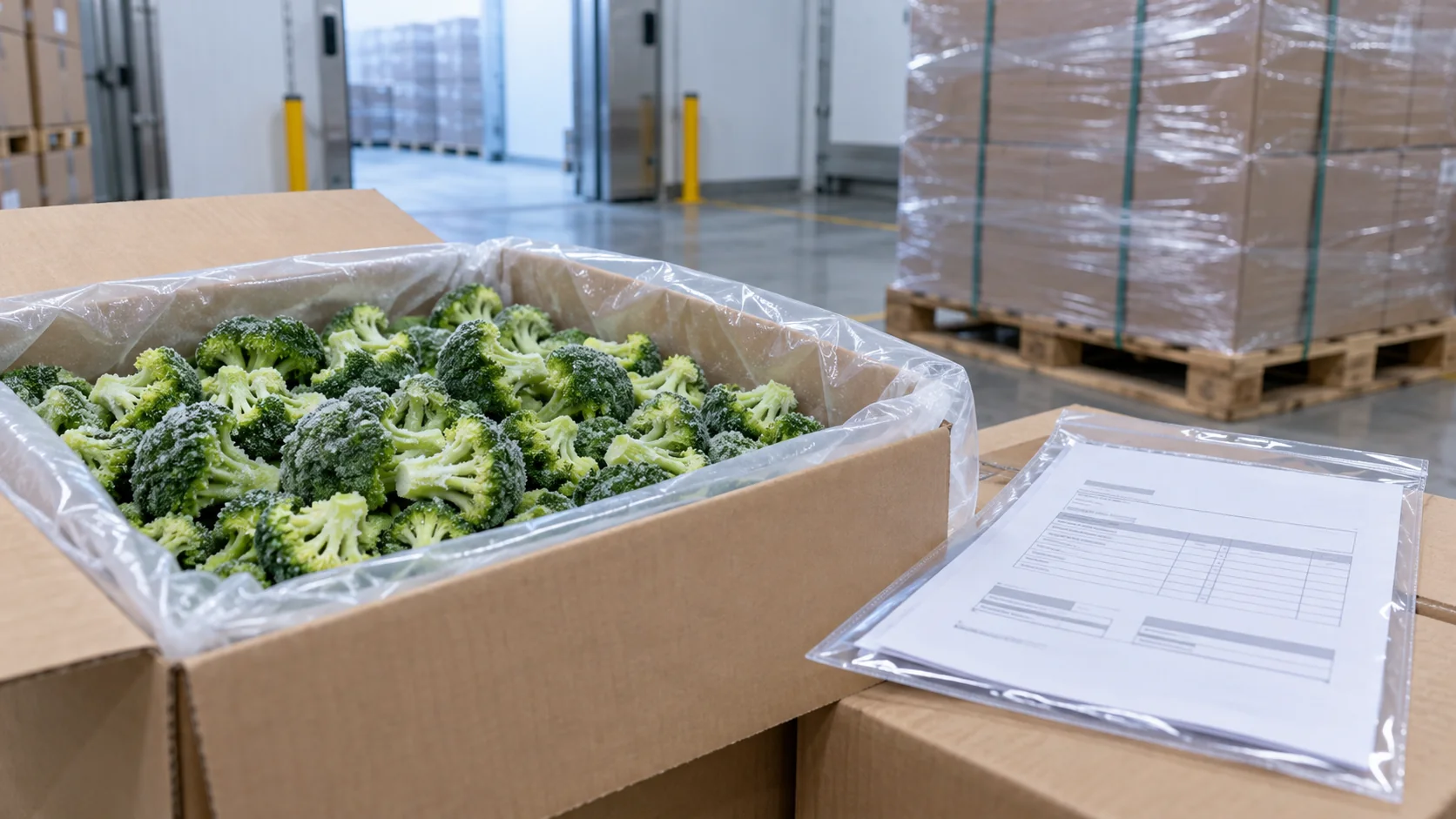
Industrial IQF broccoli in a proposed bulk export setting.
An ordinary commercial invoice or a certificate held by a different factory cannot repair a missing organic import document at arrival. The precise answer changes by market: the EU uses an electronic certificate of inspection in TRACES, the United States requires an NOP Import Certificate associated with each organic shipment, and Japan controls Organic JAS grading and the use of its seal. These systems are not interchangeable.
For a worked order, consider China-grown, China-processed, single-ingredient blanched IQF broccoli florets, packed in industrial cartons and intended to be cooked before eating. We can propose the product form, lot plan, packing, sample and document handover. We would represent this order as organic only after the named certified operations, product scope, certifier status and route-specific consignment document have been checked for that order. A good-looking broccoli sample remains a separate commercial decision. Organic status does not set floret width, stem share, frost, microbiological criteria or cold-chain acceptance for the buyer.
Decide whether the order may be sold as organic
The first decision is the market where the claim will be used, not the location where someone happens to hold a certificate PDF. A German ingredient importer, a U.S. foodservice distributor and a Japanese private-label buyer may each buy the same physical IQF broccoli but need different certification recognition, transaction data and package statements. Ask whether the buyer intends to sell the broccoli as organic, use it in an organic processed food, or buy conventional product while evaluating an organic program. Those three orders should not share one artwork approval. The importer or downstream certified operator should give the certifier the actual product, destination, growing and processing locations, and every business that owns or handles the lot.
The European Commission's organic trade guidance says that imported product marketed as organic must meet EU organic legislation and that all organic imports require an appropriate electronic certificate of inspection, or e-COI, in TRACES. For origins outside the listed arrangements, a Commission-recognised control body or authority inspects and certifies the operators. China is not listed among the equivalent countries on that page. The importer therefore needs the applicable recognised control body for the Chinese operation, then the e-COI for the consignment. A generic Chinese domestic organic certificate does not by itself establish the EU route.

Actual GreenLand IQF broccoli product photograph.
The USDA's electronic import-certificate guidance says each shipment of organic agricultural products imported into the United States must be associated with an NOP Import Certificate issued by an accredited certifying agent in the Organic Integrity Database. That is a shipment record, not simply an annual operator certificate. The importer must also establish its own certification or exemption status under the applicable NOP rules and use certificate data in its import filing. We would identify the certified exporter or final handler that will request the certificate, then confirm which eligible certifier will issue it in INTEGRITY before the booking is treated as an organic shipment.
Japan requires a separate decision. MAFF's Organic JAS page states that organic wording for covered foods depends on the Organic JAS logo and certification of the operator authorised to apply it. MAFF's equivalency guidance identifies country arrangements and a certified-importer path for qualifying goods. For this China-origin broccoli, the Japanese buyer should have an accredited JAS certifying body determine the overseas-operator certification and grading route; an equivalency arrangement between Japan and another country cannot be presumed to cover China-grown material. We would keep the carton description conventional until that route is documented.
Map certified farms, processors, handlers and lots
An organic certificate proves only the scope written on it. Before confirming supply, map the field or producer group, broccoli intake, washing and blanching, IQF freezing, sorting, packing, cold storage and export handover. Not every physical step necessarily has a separately named certificate, but the certifier must explain how each operator and activity fits its approved system. The legal entity on a certificate should be matched with the actual site address, product category, process and validity. A certificate for dried vegetables, a second address, or another season's crop should prompt a question rather than an assumption.
The physical controls also matter. Certified and conventional broccoli may share receiving, blanching, freezing or packing equipment under an approved system, but the operator needs segregation, changeover, cleaning and identification evidence appropriate to its certification. For the proposed order, we would obtain the current certified-operation scope and the processor's segregation and changeover records before stating which site and line are covered. The buyer should ask how labels and empty packaging are controlled, since an organic printed bag applied to conventional florets creates a false claim even when the food itself is safe. A mock recall should identify cartons and recipients without guessing from a production date alone.
The broccoli example is only one route. For each additional SKU we create an operator and lot map before quoting the organic claim. We identify the certified raw-material supplier, actual processor, cold store, trader and any repacker; then check which activities require certification under the destination rules. A common trading brand cannot extend one plant certificate to every product or factory.
On a small screen, swipe the table horizontally to read every column.
| Product / change to review | What we collect before accepting the claim | Batch check and claim hold |
|---|---|---|
| Cut spinach | Certified leaf source, cutting/blanching site, any water treatment or processing aid, segregated handling and packaging. | Link incoming organic weight and rejected trim to the packed lot; investigate an unexplained yield or status mismatch. |
| In-pod edamame | Correct crop/product listing, farm identity, production inputs, blanching and packing activities. | Keep crop identity, organic status and soybean label review together; a non-organic replacement needs a separate approved order. |
| Water-chestnut dice | Eleocharis dulcis source, peeling/dicing processor, losses and all anti-browning substances if proposed. | Check permissible input and claim treatment with the certifier before use; reconcile peel/trim loss and finished organic quantity. |
| Cultivated blueberries | Actual cultivated fruit source, sorting/freezing location, storage, repacking and intended use. | Keep organic segregation separate from the RTE safety decision. Organic certification does not validate a no-further-heat process. |
| Mango chunks | Farm/fruit scope, peeling/pitting/cutting plant, aids or coatings, packaging and intermediate storage. | Reconcile fruit input, peel/stone/trim and chunk output. A formulation or subcontractor change triggers certifier review before production. |
| Cultivated shiitake slices | Species/source, cultivation operator and inputs, slicing/freezing site and the destination body's applicable mushroom-production scope. | Check the source and processing scope with the certifier; a certificate for field-grown vegetables does not establish coverage for this mushroom chain. |

The source batch and each certified handling step must lead to the same finished broccoli lot.
Apply through the body authorized for the destination
A Chinese organic certificate alone does not establish EU, USDA NOP or Organic JAS eligibility. For a proposed certified supply, we map the farm, processor, packer, exporter/trader, storage and destination importer, then send the relevant certifier the actual activities and product route. Certification is an operator assessment before claim-bearing production and sale; the shipment document is a later, separate task.
On a phone, swipe horizontally to compare the columns.
| Destination | Where the operator starts | Material and result needed |
|---|---|---|
| EU organic claim | Commission organic trade and control-body route. The China-side operation chooses a body recognized for China and its product category; the EU importer enters its own national control system. | Provide legal entity/sites, crop or ingredient sources, process, inputs/aids, subcontracting, segregation and traceability. Obtain the relevant operator certification and confirm its activity/product coverage before arranging e-COI. |
| U.S. USDA Organic | USDA-accredited certifiers and USDA application sequence. The Chinese farm/handler and covered exporting/trading/importing operations determine their certification obligations. | The selected certifier supplies its application and fees. Submit the organic system plan and records, complete document review and site inspection, close findings and obtain its decision. Annual review/inspection maintains certification. |
| Japan Organic JAS | MAFF Organic JAS: certification-body lists and technical criteria. Choose a registered body able to certify the overseas operation and relevant scope. | Describe source, processing/packing, facilities, inputs, segregation and grading/label responsibilities. Obtain certification for the actual operator/activity and establish who is authorized to grade and apply the mark. |
Ask the selected body for an itemized application/audit/travel/annual-fee quote and the work needed before inspection. The official routes do not establish one worldwide fee or completion time. Certification preparation, inspection findings and a new site or product can change the schedule. We can plan documents and packing around an accepted route; a quotation or submitted application does not authorize organic artwork.
Prepare the EU TRACES e-COI route
For an EU destination, name the EU importer, the operator responsible for the consignment, the first consignee and the recognised third-country control body before producing organic artwork. The importer should verify each party's TRACES access and have the competent authority or control body clarify its role in creating, endorsing and checking the electronic certificate of inspection. The Commission trade page is direct: without the e-COI, an organic product will not be released from its EU port of arrival. An ordinary customs declaration and a general food-control decision still have their own functions; the e-COI is the organic claim gate.
The draft e-COI needs to describe the real consignment. We would provide the scientific or clear commercial product name, frozen form, net mass, cartons, exporter, processing site, container and seal when known, and the production lot that appears on the carton. The importer and control body should reconcile the CN line, origin and product description with invoice and transport documents. If cartons are split between two importers or a container combines certified and conventional products, the certifier should decide the documentation structure before departure. Copying a prior e-COI and changing only the date risks a mismatch in quantity or operator identity.
China's organic access route should be checked in the Commission's live control-body listing for the relevant product category. The control body responsible for issuing the e-COI is determined by recognition and scope, not by the exporter's marketing relationship with a logo. If the buyer also requires a food-safety certificate or a CHED-D under a separate product-origin control, those should be identified distinctly. A TRACES organic certificate does not prove that the food has met every pesticide limit, nor does a border food decision grant the right to print an organic logo. The importer should reserve both release statuses in its warehouse system.
For our additional product lots, the authorized operator and control body review the organic commodity description, origin/export route, operator scope and consignment data. The importer and first consignee coordinate the applicable TRACES roles and control steps; GreenLand supplies consistent product, weight, package, operator and transport information early enough for the certificate workflow. Use the Commission's organic trade route and organic controls information to identify the current recognized control arrangements for the actual origin and product.

For an EU organic sale, recognized control-body scope and the TRACES e-COI must match the consignment.
What the EU importer does, in order
- Before the first organic order: the importer completes its organic operator certification/control arrangement and identifies the first consignee and responsible authority. For Germany, the Berlin authority's import page gives a concrete example: EORI, an authorized control-body contract and certification covering import activity. The authority must correspond to the actual release location; a Berlin contact is not the authority for every German port.
- Establish system access: each user creates a personal EU Login and requests the appropriate operator role in production TRACES NT. Select the organic activity and the responsible control body/authority and obtain validation, following the official organic-operator access guide. User access and operator/activity validation must both be resolved; an account alone is insufficient.
- Before departure from the third country: the recognized issuing body verifies the actual consignment and issues its e-COI at the required stage. We assemble the supplier/operator route, approved product description, lot, quantity, packages, invoice and available transport information for that body. Agree the point of control and customs release before the broker files; the issuing body controls certificate creation and correction.
- Before arrival: the importer/responsible operator completes arrival notification and provides the required documents to the competent authority in the applicable local time window. Berlin specifically asks for notice as early as possible and no later than two full working days before arrival, plus direct telephone/email contact when the COI and documents are ready. Use that instruction only for its jurisdiction. Confirm the actual port/state authority's cut-off when planning the shipment.
- At control and release: the competent authority performs the applicable checks and records the decision in COI box 30. The broker coordinates customs free-circulation release and any separate food/plant controls. The official COI endorsement guide distinguishes organic, in-conversion, non-organic, partial and refused release outcomes.
- At receipt: the first consignee checks the actual lot and completes box 31 where applicable. A consignment released in batches uses the corresponding extract COI workflow, as the first-consignee guide explains. Preserve that result, customs release, carrier delivery and receiving acceptance against the stock quantity.
If a document is wrong, notify the issuing body and importer before the next certificate/control stage. After an authority has signed a wrong box-30 conclusion, correction must go through that authority's authorized route; the exporter cannot fix it by editing a downloaded PDF. We supply the revised lot, weight or transport facts and retain the approved replacement/revision with the order.
Prepare the U.S. NOP Import Certificate route
For a U.S. organic program, the certified exporter or final handler requests an NOP Import Certificate from its eligible certifier, which issues the record in USDA's Organic Integrity Database. USDA's guidance makes the per-shipment association explicit: every imported organic shipment must be associated with a certificate, but one certificate may cover a single shipment, multiple shipments or a time frame under the certifier's oversight system, with one certificate per commodity, product or HTS code. The importer and broker should match each movement to the certificate that actually covers it. The U.S. importer uses the certificate information in its Customs and Border Protection filing; USDA's trade page describes importer certification obligations and limited exemptions. The buyer should have its own certifier or adviser decide its status rather than assume an importer of record automatically qualifies to market organic food.
The import certificate does not replace FDA food entry requirements. The U.S. importer and broker must still handle FDA Prior Notice, relevant facility registration data, FSVP responsibilities and CBP entry information for the food. A laboratory report may support the importer's verification, while the NOP certificate supports organic integrity; they answer different questions. We would provide one lot-level evidence set so the certifier, broker and purchasing team see the same mass, case count and manufacturer. A certificate issued for 'mixed vegetables' should not be silently used for single-ingredient broccoli if its stated product scope differs.

The exporter requests, the certifier issues in INTEGRITY, and the importer links the covered shipment to its entry.
From certification to the broker's ACE entry
- Before supplier approval: identify the certified China-side producer/final handler and exporter, and the covered U.S. organic importer. Review status and certified activities through USDA's Organic Integrity system and the certifier. The import certificate itself contains commercial information and is not a public database lookup.
- Before export: the certified exporter requests the NOP Import Certificate from its certifier with the product/HTS, quantity, parties and transport details. USDA's current SOE FAQ requires issuance before departure and says certificates cannot be backdated. We establish this cut-off with the exporter and send the certifier the reconciled lot and shipping data in time for its review.
- Hand the filing data to the importer and broker: provide the applicable electronic certificate's 21-character number: 19 digits and two dashes. It is a different identifier from the operation's 10-digit NOP ID. For the electronic certificate, the broker uses OR2 in ACE and enters that certificate number; USDA says a DIS upload of the certificate is not required. Retain the issued record and the entry's identifier match.
- Check the covered movement: match commodity/product/HTS, validity, exporter, recipient and quantity to this shipment. An approved certificate can cover permitted multiple movements or a time frame, but each movement needs a valid association. Different commodities or HTS codes in a mixed shipment need separate NOP Import Certificates; agree the full 10-digit HTS code with the certifier and broker. The broker handles the organic data alongside separate FDA/CBP filings; a food-facility registration number is not an NOP certificate number.
- At release and receiving: the importer checks the organic entry data, FDA/CBP dispositions and any other applicable controls, then reconciles cases and lot codes with the certified quantity received. A missing or invalid pre-export certificate creates an importer/certifier escalation before organic stock release; ask the competent parties for the lawful disposition rather than promise a retrospective certificate.
Our document handover includes the approved organic product description, actual exporter/final-handler identity, batch and case quantities, invoice/packing-list version and certificate identifier. If a booking or quantity changes, we send one change notice to the importer and certifier so the physical lot and electronic record remain traceable. The USDA electronic certificate guidance is the entry point for the certifier's shipment-certificate task.
Check Japanese Organic JAS and equivalency
Japan's organic claim depends on the Organic JAS system rather than automatic recognition of a foreign logo. MAFF states that the Organic JAS mark is applied by certified operators and that covered products cannot be sold with organic wording without the mark. Its organic equivalency page identifies a path where a JAS-certified importer affixes the mark for qualifying products from recognised countries, supported by the required foreign certificate. A separate path involves overseas JAS-certified operators who produce and mark goods under JAS. The precise path for China-grown and processed frozen broccoli should be confirmed with the Japanese importer's registered certifying body before printed bags or cartons are approved.

A Japanese organic claim follows an approved JAS operator and grading route for the actual China-origin lot.
For Japan, an EU or U.S. certificate is not a universal permission to place the Organic JAS mark on a China-processed SKU. The importer and proposed certifier must establish the applicable certification or equivalency route and the operator authorized to grade and label. Consult MAFF Organic JAS and its registered certification-body information before assigning the mark. We provide the actual cultivation, processing, ingredients, subcontracting and packing details for that decision, then hold organic printing until the authorized route is confirmed.
A direct route for China-grown and China-processed produce
China is absent from MAFF's April 2026 equivalency-country list. For a lot grown, processed and exported from China, plan the overseas Organic JAS certification route for the relevant operation and product. Holding USDA NOP or EU certification alone does not put that lot on Japan's equivalency route. A genuinely different multi-country production/export chain needs assessment against the particular arrangement's conditions.
- Select the certifier and category: use MAFF's Organic JAS page and its domestic/overseas certification-body lists. Send the botanical product, cultivation/ingredient source, exact cutting/blanching/freezing process, recipe, sites and proposed Japanese claim. Have the body classify the plant or processed-food scope and identify each operation that needs coverage.
- Prepare and obtain operator certification: the relevant overseas operator submits the body's application, facilities and production/handling procedures, input approvals, segregation, record controls and responsible personnel; inspection and the body's decision follow. An application to the certifier is distinct from MAFF's process for registering certification bodies.
- Establish grading and mark control: the certified operator uses its approved grading rules, personnel and records for the actual lot. MAFF's processed-food production-process-manager criteria, clauses 7–8 describe grading rules, records, disposition and responsible grading staff. Confirm the appropriate criteria for the classified product; do not apply this processed-food route to every raw fruit automatically.
- Approve artwork and repacking: identify who grades and applies the Organic JAS mark, its authorized product/site and the lot record. If the importer will repack bulk produce, assess the repacker's certification and label controls before printing retail bags. GreenLand prepares the exact crop/process/site/packing and lot data for the accepted operator route.
- Complete ordinary import and receiving: the Japanese importer handles food import notification and any plant-quarantine steps, the broker obtains the customs import permit, and the carrier/terminal releases physical cargo. Use the Japan import guide for those separate steps. Retain grading/claim records and the actual receiving-lot reconciliation before stock is offered as organic.
Certifiers set application, inspection and maintenance fees for the actual overseas site and product scope; obtain their schedule and plan production around their decision. MAFF's public English importer list includes only businesses that consented to publication, so an absent name there is not by itself proof that a business lacks certification. Use the current certifier/official operator records for the relevant scope.
Join certification to packing, invoice and cold-chain records
The buyer's most useful control is a single identity running through four layers: certified source, finished product lot, shipment and receiving stock. The export invoice should use the approved organic product description and quantity only when the certificate covers them. The packing list should show cartons, pallet configuration, net and gross mass, production lot and container or seal as applicable. The e-COI, NOP certificate or JAS grading record should point to the same material. A distributor's sales order and a cold-store receipt should preserve that link after the container is stripped. Otherwise the right certificate can accompany the wrong physical cartons.
We would propose a lot reconciliation before loading and photograph representative cartons, pallet marks and the sealed container as evidence of the actual packed identity. Temperature recorder placement, set point and data handover can be agreed with the importer and forwarder. Organic certification does not validate a specific transit temperature excursion, so the buyer should define what receiving QA will do with a broken seal, wet cartons, visible frost or a recorder gap. The certifier may also need to know about any repacking or relabelling after arrival, especially when an organic mark remains on new units.

The certified lot, carton code, invoice quantity and receiving stock must reconcile after shipment.
When a lab report is supplied, link the sample to the saleable finished lot and name its method, analytes and decision rule. Organic status does not mean 'pesticide-free' or 'pathogen-free.' A buyer's pesticide or microbiological specification is a distinct legal or contractual gate and may vary by market. We would propose evidence from raw intake through finished pack and shipment, then discuss which tests are appropriate for the actual destination and cooking use. If a report fails or a lot is quarantined, the organic document should not be treated as a quality override.
A mass-balance example for peeled and cut produce
Illustrative reconciliation, not a GreenLand production result: if an approved organic mango run receives 10,000 kg and records 3,500 kg of peel, stones and trim, 200 kg of other documented loss and 6,300 kg of packed chunks, the recorded outputs total 10,000 kg. If the finished chunks use 10 kg net cartons, 630 cartons account for 6,300 kg. These assumed numbers demonstrate the calculation; they are not a required yield, tolerance or guaranteed pack option.
For the actual run, processor QA records weighed inputs and outputs, work in progress, rework and any additions, explains legitimate differences and links each movement to its organic status and batch. GreenLand reconciles the sale quantity with the packing and shipping records supplied for the order. A water-chestnut run needs its own peel/trim pattern; a shiitake run needs species/source and the applicable cultivation scope. The certifier evaluates whether the actual records substantiate the claim; a mathematically balanced total cannot validate an uncertified source.
Release the organic claim only after both border and buyer checks
Reviewed 16 October 2026. Before a lot is described or sold as organic, the importer needs a current recognised certification chain, the destination's shipment or grading evidence, lawful food and customs release, and buyer stock acceptance. These statuses may arrive at different times. EU TRACES e-COI validation, a U.S. NOP Import Certificate and Japanese Organic JAS grading are different records with different responsible parties. A carrier delivery order only allows physical movement; it grants no organic status. A customs release also does not decide the customer's contracted grade.
The receiving team should compare the actual cases and lot code with the approved certificate and packing list, inspect packaging and temperature evidence, and record the quantity admitted to organic stock. If any part is uncertain, hold that stock under a visible status and ask the responsible importer and certifier for the disposition. A partial lot can require an explicit quantity reconciliation rather than a broad 'certificate okay' note. If repacking, blending or relabelling will occur, the certified operator should confirm that the next activity and artwork stay within scope before the new pack is offered as organic.

Actual GreenLand IQF broccoli product photograph.
Tell us the product, destination and intended use. We can develop the proposed source and processing route, identify the certified parties and their approval tasks, and organize the lot, label and shipment information for your importer. The agreed order plan will state what must be completed before organic printing, export, entry and stock acceptance, with a named owner for each step.
Related reading
Compare destination food and border decisions.
Review routine import and cold-chain risks.
Compare the product and certification distinction.
Plan your frozen food supply
GreenLand-food is a China-based frozen food supplier and manufacturer providing factory-direct wholesale frozen food. Tell us your product, destination and intended use; we will work through the relevant certification, packing and document route with your team.