


Frozen Water Chestnut Dice Import Specification: EU, US and Japan
Oct 16, 2026
Leave a message


Reviewed: 16 October 2026. Product identity, process and intended use determine the applicable requirements.
For this order plan, we assign a GreenLand order owner and quality reviewer to the selected source and processor. Before confirming supply, we agree the product, destination, use and evidence schedule with you. Production and shipment remain on hold until the applicable legal, technical and signed commercial conditions are met.
| Market | First classification question | Entry owner and result |
|---|---|---|
| EU | Annex I commodity and current residue definition | Importer checks current control list; CHED-D if applicable, then customs release |
| United States | 40 CFR crop group or individual tolerance | FSVP importer and broker handle Prior Notice, FDA entry and CBP release |
| Japan | MHLW food code and positive-list substance row | Importer files food notification; certificate and customs permission follow |
Identify the edible corm and the peeled frozen dice
The water chestnut in this guide is the peeled, diced edible corm of Eleocharis dulcis, grown and processed in China, single ingredient, frozen, and intended to be cooked before eating. It is not a tree nut despite the English name. A Taiwan buyer raised a "less than 1.5% black skin" point after receipt; that is a buyer request whose meaning and legal status remain unverified. It should not appear in an export offer as a statutory threshold or as a promise about a released lot until the parties sign an inspection method.

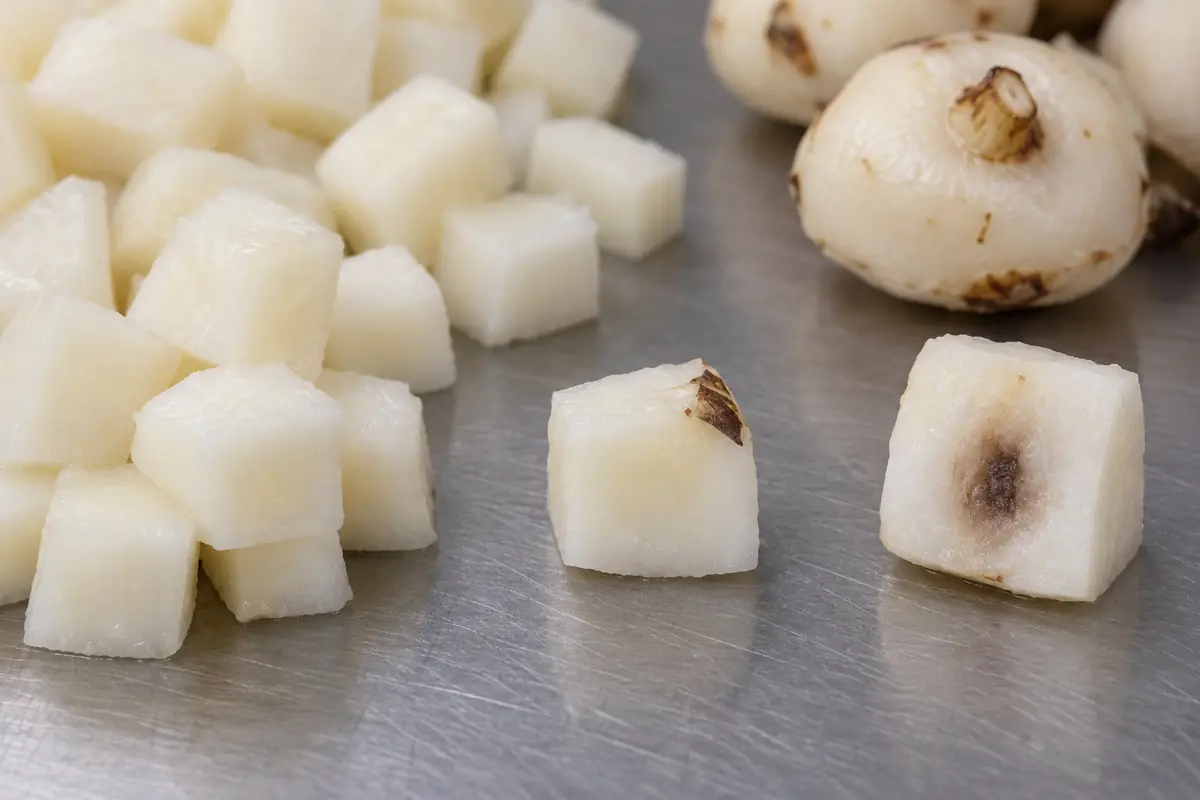
Frozen water chestnut mixed product forms including diced pieces, GreenLand photo 1. GreenLand product-page photograph; the signed order fixes the supplied form.
The buyer should first identify the legal food, physical form, treatment and intended use in one sentence. A regulator's category can change when a pod is removed, a leaf is chopped or a corm is peeled; a familiar trade name does not settle that category. Ask the importer to confirm tariff classification separately from food-safety classification. Keep a signed sample, front-and-back photographs, a cut or pod view where relevant, and a pack mock-up in the order file. The agreed description belongs on the inquiry, proforma invoice, purchase order, laboratory request and shipping documents. If those records describe different foods, an apparently compliant test result may not answer the entry question.
A working specification is a set of decision rules, not a collection of attractive adjectives. Record target and rejection bands, how a sample is selected, whether assessment occurs frozen or thawed, how water is drained, and whether a percentage counts pieces or weighs them. State the person who accepts a reference sample and the point at which an amendment becomes binding. For a new product-market pair, reserve a pilot lot or pre-shipment sample review before artwork and shipment are locked. Any proposed number in our commercial plan remains a negotiating value until it is signed by both sides and checked against the destination law.
Turn appearance language into a signed defect method
The saleable article is peeled dice. Sign the target edge-length band, tolerances, off-shape fraction, free ice and clumps, odor, foreign matter and the appearance reference. Keep three observations separate: adherent dark peel on an outer cut surface, a superficial dark spot without peel, and internal black heart exposed on cutting. Photographs with scale, front and reverse views, and a cut-through view resolve disputes much better than the phrase "black skin" alone.
Do not substitute one photograph for a measurable acceptance method. A master sample is valuable for appearance, but it cannot establish pesticide residue, nitrate, allergen status or a microbial result. Define a primary unit of inspection, how many cartons represent a lot, and which defects are critical regardless of average level. Foreign material, mold, unusual odor and an untraceable batch call for a hold even when a routine visual percentage looks acceptable. The buyer should inspect the same physical state the supplier uses for release; frost, thawing and draining change the apparent mass and the visibility of small defects.

Frozen water chestnut mixed product forms including diced pieces, GreenLand photo 2. GreenLand product-page photograph; the signed order fixes the supplied form.
The sample plan should account for production time and carton position. A single polished top layer can miss a startup adjustment or an end-of-shift packing issue. Photograph disagreements against a neutral background with a scale and lot label, preserving the retained sample. The specification should also name the cure path: rework when technically valid, extra sorting, independent retest for a disputed analytical result, or rejection. Rework itself needs a new identity and traceability decision. Neither party should silently redefine a failure after the goods are loaded.
Before quoting, confirm the intended dice edge length and whether the buyer will use the pieces in stir-fry, dumpling filling or industrial mixed vegetables. A nominal 10 mm cut can contain long slivers and tiny chips unless a distribution and method are stated. Photograph representative peeled surfaces and the exposed center after cutting. A faint natural cream tone, a brown surface spot, residual peel and an internal black core are different judgments. If the buyer's "black skin" request concerns only adherent peel, counting internal heart against that same 1.5% numerator would distort the contract; if it concerns all dark material, the term needs to be renamed and separate category thresholds negotiated. The product photo on the public page includes mixed forms; the contract must identify the diced form specifically. Retain a signed physical standard in frozen and thawed states so two inspectors can reach comparable decisions.
EU: use Chinese water chestnut code, not tree chestnut
Current EU public pesticide-database rows for arrowroots product ID 93 show acetamiprid (R) 0.01*, azoxystrobin 1.0, and bifenthrin (sum of isomers) (F) 0.05 mg/kg. The asterisk marks the analytical limit of determination. Match each pesticide's enforcement residue definition to a representative sample of peeled, diced frozen product. If the manufacturing record shows a heat or other processing step, assess concentration or dilution under Article 20 using evidence for that exact process; do not assume a blanch step or residue reduction.
Regulation (EU) 2018/62 Annex I places Chinese water chestnut, Eleocharis dulcis, at expanded code 0212040-002 under arrowroots code 0212040. It is separate from chestnuts/tree nuts code 0120040. For each pesticide, check the current parent arrowroot entry and residue definition; use the 0.01 mg/kg Article 18 default only when no specific MRL applies. The importer and laboratory must also confirm the edible sample and any supported processing relationship.
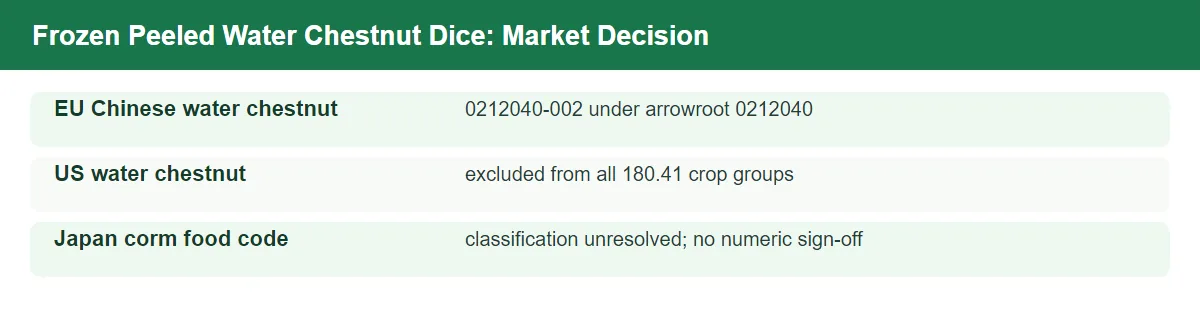
Frozen Peeled Water Chestnut Dice regulatory and supply illustration for eu: use chinese water chestnut code, not tree chestnut. Illustration of the specified decision or control. View full-size diagram
This taxonomy is commercially important. A tree-chestnut pesticide table is wrong for an aquatic corm; a generic tuber line is also wrong in the U.S. The EU arrowroot parent line gives a concrete direction for a substance-by-substance lookup, including the edible part and residue definition. A buyer should ask the EU importer or competent laboratory to sign the current code and the applicable limits in the order file. Metals and microbiology likewise require correct food category and intended use, rather than a borrowed spinach or nut threshold.
EU pesticide MRLs are set under Regulation (EC) No 396/2005. The legal sequence is to identify the Annex I commodity, identify each analyte and its enforcement residue definition, read the current specific Annex II or III entry, and use the Article 18 default only where no specific entry applies. Article 20 addresses processed food by considering concentration or dilution in processing; it does not give permission to assume that blanching made an incoming residue disappear. Freezing and blanching must be described accurately to the laboratory, and a processing factor needs scientific support for the actual process. A raw-crop result can guide supplier selection but it does not replace an applicable finished-product judgment.
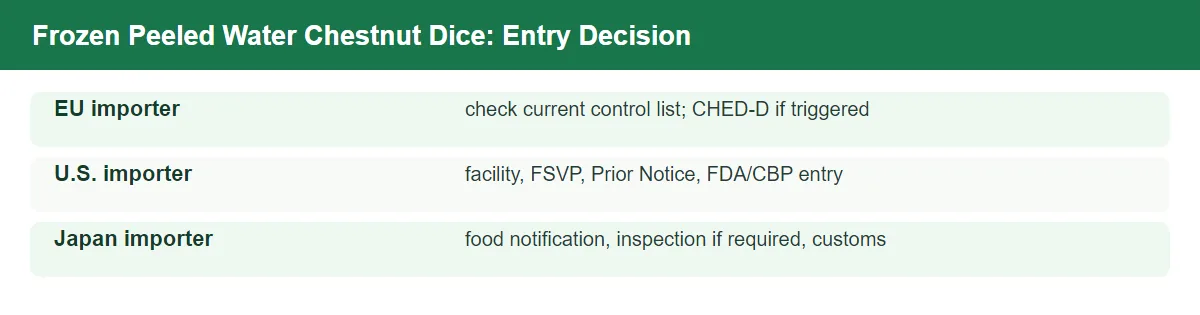
For ordinary food of non-animal origin, the EU importer normally takes responsibility for food-law compliance, customs declaration and traceability. The importer should check whether a commodity-origin combination is in the current increased-control or emergency-measure lists before loading. If listed, the importer or responsible operator uses the applicable TRACES NT/CHED-D route and presents documentary, identity or physical checks at the designated border point; if unlisted, there is no automatic promise of border inspection or a universal pre-export food permit. The exporter supplies product description, invoice, packing list, origin and batch records, analysis and any specifically requested certificate. Customs release follows the required official-control outcome, not the supplier's internal release alone.
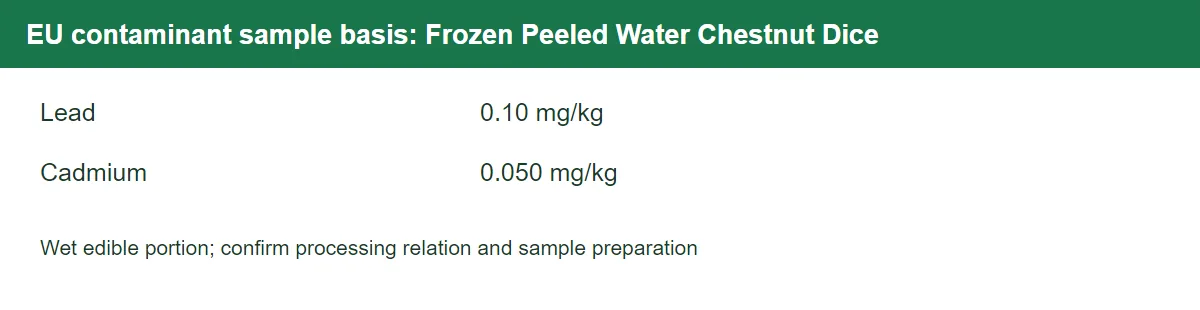
Reference values are tied to the current EU category and edible sample basis; confirm finished-product interpretation. View full-size diagram
EU root-and-tuber reference rows for the Eleocharis dulcis corm: lead 0.10 mg/kg and tropical-root/tuber cadmium 0.050 mg/kg on the wet edible portion. For peeled, diced frozen product, verify the processing relation and exact sample portion before declaring compliance. Current EU public pesticide database acetamiprid (R), azoxystrobin and bifenthrin (sum of isomers) figures, respectively, are 0.01* / 1.0 / 0.05 mg/kg. An asterisk is a limit-of-determination flag. The special acetamiprid sum definition in Regulation (EU) 2025/1212 concerns specified animal products; for these plant rows the laboratory should still confirm the current enforcement residue definition.
Where CHED-D is triggered, the EU responsible operator uses TRACES NT / EU Login for the consignment document and border-control outcome; customs clearance follows the competent authority decision.
For importer registration, border-control status, CHED-D timing and customs sequence, consult the verified EU frozen-produce import requirements guide alongside this product-specific specification.
United States: do not borrow a root-group pesticide tolerance
40 CFR 180.41(b) expressly excludes water chestnut from all crop groups. A root/tuber-group tolerance cannot be assigned to this corm. Before approving a field spray program or a lot result for U.S. entry, the U.S. importer's qualified reviewer must identify each pesticide, its compliance residue definition and any applicable individual tolerance or exemption in current Part 180. Our quality reviewer keeps the U.S. market decision on hold until that conclusion is recorded; an unsuccessful text search is not a legal finding of universal zero tolerance.
Frozen Peeled Water Chestnut Dice regulatory and supply illustration for united states: do not borrow a root-group pesticide tolerance. Illustration of the specified decision or control. View full-size diagram
The United States has three separate clocks. Before entry, the foreign facility that manufactures, processes, packs or holds food for U.S. consumption checks FDA food-facility registration and U.S. agent obligations; exemptions require a reasoned determination. The U.S. FSVP importer identifies itself with the required unique facility identifier and maintains the foreign-supplier verification program for the hazards and supplier. Prior Notice is submitted for each food entry in the FDA/CBP system before arrival within the applicable mode-specific window. Registration, FSVP and Prior Notice are different obligations; one confirmation does not stand in for the others.
At arrival, the customs broker or importer submits the entry and FDA data, including product code, manufacturer, shipper, country, quantity and prior-notice confirmation. FDA may review records, examine or sample, or permit the entry to proceed. CBP makes its separate customs release decision; the importer checks both statuses before arranging collection. A shipment can be detained and require evidence or refused. The supplier should provide a precise invoice and lot/packing mapping, manufacturing and storage identity, ingredient/allergen statement, process summary, traceability records and any analytical certificates promised in the contract. Release planning should leave time for a requested examination rather than treating a planned vessel date as a regulatory clearance date. The importer or broker should verify the tariff code and any agricultural agency scope for the exact product.
For the application entrance, filer, required information and official outcome, use the U.S. frozen-produce import sequence; its example crop is separate, so apply the product-specific category and limits stated here.
Japan: obtain the named food classification before numeric sign-off
Japan residue sign-off is still open: the importer should submit the botanical identity (Eleocharis dulcis edible corm), peeled diced frozen presentation, edible test portion and intended use to the MHLW quarantine station, then obtain the named Japanese food classification and substance-specific residue rows before GreenLand approves a spray program or shipment test panel. A generic "other vegetables" row is not a product limit.
Japan's importer submits a Notification of Importation of Foods for each consignment to the MHLW quarantine station, commonly through the food-import notification system, with manufacturer and product information and supporting process or test documents when required. MHLW allows advance notification from seven days before the expected arrival. The station reviews the notification, may require examination or laboratory inspection, and issues a notification certificate when the lot is found compliant; customs clearance follows with the certificate. The exporter prepares the process flow, ingredients, additive status, test reports, origin and traceability details, but the importer owns the filing and any dialogue with the quarantine station.
For pesticide controls, the Japanese positive list has a uniform 0.01 ppm criterion when there is no individual standard, subject to the regulation's exclusions and substance definitions.
Do not apply a government database row to a similarly named food without confirming the food code, measured part and analyte definition.
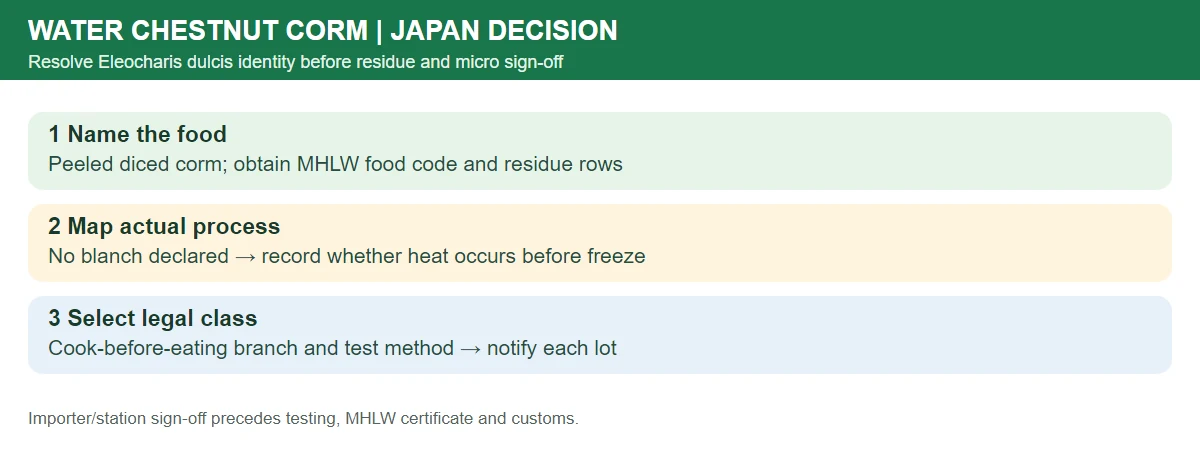
Eleocharis dulcis corm identity and Japan class decision before import. Illustration of the specified decision or control. View full-size diagram
MAFF plant-quarantine treatment of sufficiently processed frozen plants is another distinct question; confirm the exact presentation and any exemption with the importer rather than making the food notification disappear.
| MHLW frozen-food branch | Aerobic plate count | Indicator | Product decision |
|---|---|---|---|
| Heat required to eat; actually heated immediately before freezing | ≤100,000/g | Coliform negative | Only if the documented process meets this exact branch. |
| Heat required to eat; all other pre-freeze processes | ≤3,000,000/g | E. coli negative | For these dice, classification must be confirmed from the actual heat/cooling/freezing sequence and intended-use label before either branch is selected. |
For peeled water-chestnut dice, no blanch or final pre-freeze heat has been declared. Do not select either branch from the product name alone. The importer should give the MHLW station the botanical identity, process-flow and intended cook-before-eating label, request the applicable frozen-food class, and then commission the corresponding test before lot release. The corm's Japanese residue-food mapping is a separate unresolved sign-off gate.
The Standard 370 frozen-food method starts with 25 g of frozen product and 225 mL sterile phosphate-buffered diluent, followed by 10 mL of that preparation mixed with 90 mL diluent to make the prescribed stock solution. For the E. coli branch, inoculate three EC fermentation tubes with 1 mL of that stock each, incubate at 44.5 ± 0.2 °C for 24 ± 2 hours, and perform the specified confirmation when gas develops. The laboratory must follow the full official method and state the confirmed category on its report. The −15 °C statutory storage ceiling belongs to this frozen-food standard; the proposed −18 °C order condition is a separate commercial requirement.
For the application entrance, filer, required information and official outcome, use the Japan frozen-produce import sequence; its example crop is separate, so apply the product-specific category and limits stated here.
Japan's Consumer Affairs Agency sets food residue standards. Use its current standards with the searchable government database; MHLW quarantine stations handle the separate import notification and enforcement review.
Control peel, surface spotting and internal black heart separately
At intake, the proposed control file identifies grower, paddy or field, water and soil history, harvest date, treatment program, raw corm source and visible rot. A documented wash and peel step precedes trim and dicing. Inspection must catch residual peel and surface spots; a cross-section check is needed for internal black heart. Any actual heat treatment and the freezing process should be recorded and assessed for the agreed cook-before-eating article.
Build a traceability chain that can be followed in both directions: field or supplier lot to intake lot, processing batch, freezer run, laboratory sample, carton code and container seal. At each transfer, a responsible person records quantity in, quantity out, time, temperature and any hold or rework. A mass-balance gap or mixed unidentified source is a release stop. Input-water, cleaning and sanitation records should be relevant to the actual line and risk assessment. The agreed process description should disclose any additive; the planned articles here are single ingredient, so an unexpected processing aid or added ingredient changes the regulatory review and perhaps the label.
Frozen Peeled Water Chestnut Dice conceptual process illustration for control peel, surface spotting and internal black heart separately. Illustration of the specified decision or control.
How we organize your order from raw material to delivery
On a phone, swipe the table sideways to read every column.
| Stage and responsible role | Action and measurement | Evidence and decision |
|---|---|---|
| 1. Source approval - procurement | Procurement records field/paddy, harvest and corm lot. Receiving cuts a representative sample for internal black heart and records rot separately from peel loss. | Source and input-use register; source/market approval before processing. |
| 2. Preparation - processor; our quality review | Processor peels, trims and dices against the cut-size distribution. Inspect adherent peel, surface spots and internal black heart as three categories, with scaled photographs. | Intake/in-process checks, raw quantities, rejects and signed reference. |
| 3. Process - processor technical team | Processor supplies the actual wash/heat/cool/freeze flow. Quality verifies aids, water and hygienic contact controls; the order does not assume blanching. | Actual flow, validated operating basis where needed, monitoring and corrective action. |
| 4. Sampling - our quality reviewer and laboratory | Quality closes the U.S. pesticide-specific tolerance/exemption review and Japanese food/class mapping before approving those markets. EU testing uses the arrowroot parent entry and confirmed contaminant category. | Sampling record, full original report and written hold/release review. |
| 5. Packing and loading - packer/logistics | Quality applies the signed peel method to time/position samples and preserves raw weights. Packing identifies peeled diced corms and cooking use; logistics records carton map, seal and temperature. | Approved artwork, pack checks, lot reconciliation, load map and logger start. |
| 6. Filing and arrival - order owner/importer | Order owner sends the released lot file for filing. Importer obtains required releases; buyer repeats the same thaw/drain/defect method and preserves disputed samples before any rework. | Filing handover, official outcomes, arrival inspection and complaint record. |
Validation and verification are different. The processor validates a time-temperature or detection step for the actual hazard and equipment, then verifies each run stayed within the approved range. Calibration, deviations, maintenance and corrective actions belong with the batch record. A cook-before-eating instruction shifts the consumer preparation expectation, but it cannot excuse gross contamination, an uncontrolled process or a false ready-to-eat claim. The importer may ask for a HACCP-style hazard analysis, supplier audit evidence and certificates; supply only records that exist, with scope and expiry checked. The release file records the actual control, its evidence and the reviewer's decision.
Raw corms should remain segregated by supplier and harvest area because water, soil, storage and disease history may affect peeling yield and internal defects. A receiving cut-through sample helps estimate black heart before the plant invests in dicing. Record peel losses separately from rejected rotten corms, then reconcile diced yield. A surprising yield improvement can signal residual peel, while a steep loss can reveal raw-material deterioration; neither is a legal limit by itself. Define knife and trim inspection, how hard or woody pieces are removed, and how wash water and post-peel contact surfaces are controlled. A visual surface camera, if present, cannot reliably see the inside of every dice; the plan should include a destructive cross-section sample. Tie each sample to a processing interval. A heat treatment, if used, needs an actual validated profile; the final consumer instruction remains cook before eating until a different use has been assessed.
Sample the buyer's black-skin proposal and release the lot
Proposed contract method for the buyer's <1.5% peel point: draw sealed cartons across the lot, including pallet positions and production time; thaw only enough to view the surface, drain by a signed protocol and photograph the representative portion. Separate pieces into "visible adherent peel" and all other categories. Calculate 100 × mass of dice carrying visible adherent dark peel ÷ mass of the entire drained inspected dice sample. Record sample mass, affected mass, scale calibration and individual carton results. Whether one fleck makes a whole dice affected, acceptable confidence level and whether the lot passes on combined mass or per-carton results require buyer signature. Surface spots and internal black heart get separate recorded fractions and rejection rules, not silently combined with peel.
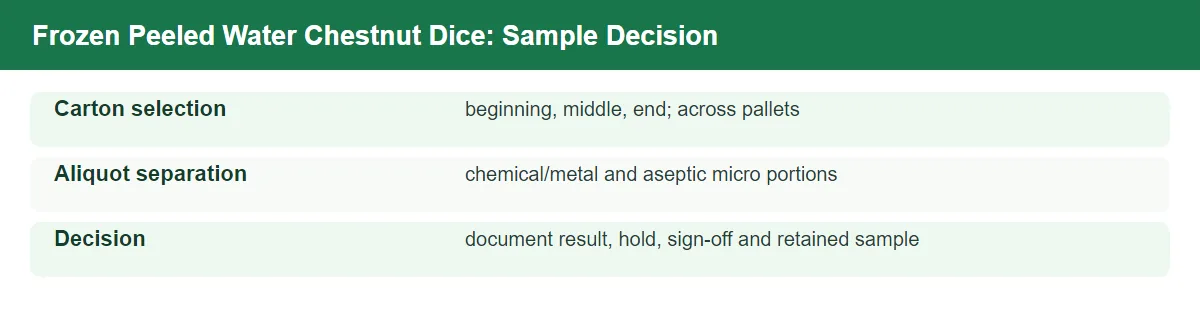
Frozen Peeled Water Chestnut Dice regulatory and supply illustration for sample the buyer's black-skin proposal and release the lot. Illustration of the specified decision or control. View full-size diagram
Choose the release panel from the destination classification, field pesticide history, prior findings and buyer contract. A generic "multi-residue pass" statement is not enough: name the analytes, reporting limits, laboratory method, residue definitions, sample basis and date. For metals, document the edible portion and contaminant category. For microbiology, distinguish a statutory criterion that actually applies from a buyer specification or internal hygiene trend. Salmonella, E. coli and Listeria decisions depend on product category, intended use and local law; no single international count or absence rule should be attached to every frozen vegetable. Where a ready-to-eat criterion is inapplicable, a hazard-based verification plan still matters.
A certificate of analysis is one piece of evidence. It should map to the lot on cartons and invoice, with retained samples and lab accreditation or method suitability reviewed. If a result lies near a limit, check measurement uncertainty and the jurisdiction's enforcement convention with the importer; do not relabel a fail as pass through rounding. Define who can authorize shipment: production verifies traceability and process record, quality reviews visual and analytical results, commercial confirms the signed contract, and the importer confirms country-specific entry readiness. A release date is recorded only after those conditions are met.
Pack and ship with country-entry documents and clear ownership
Artwork should name frozen peeled diced water chestnut and the botanical or descriptive identity when needed to avoid confusion with tree nuts. The importer confirms destination allergen wording; do not assert a blanket "nut-free" claim without cross-contact evidence. Include single ingredient, origin, lot, net weight, frozen storage and cook-before-eating directions. Reconcile carton count, batch and seal against the shipping papers, and reserve a hold/release status until legal pesticide mapping, product tests and appearance acceptance are signed.
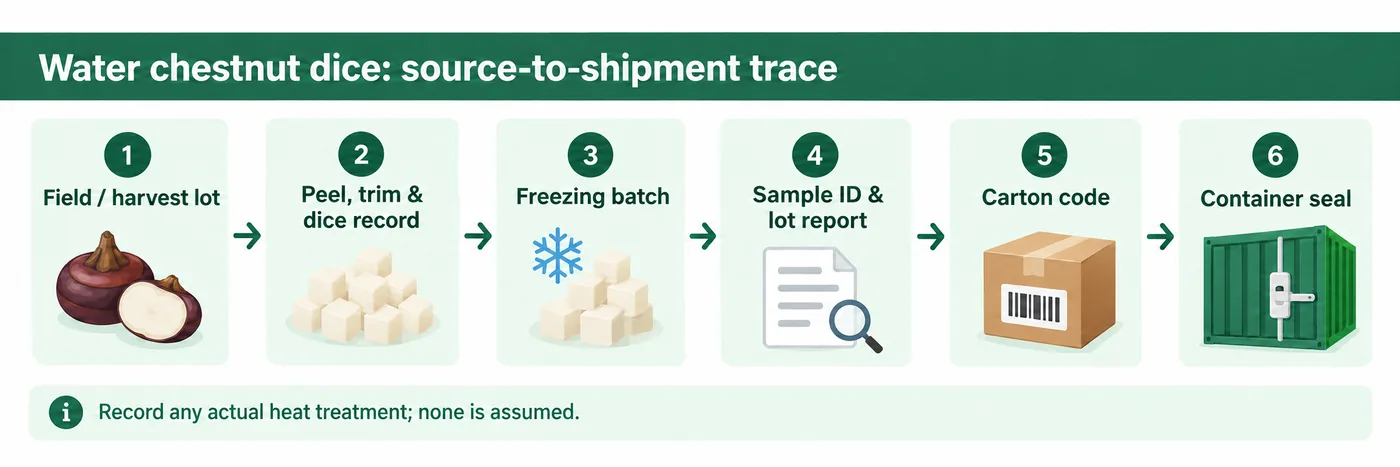
Follow the actual corm lot through peeling, dicing, freezing, sampling, carton coding and container sealing. Any heat treatment is recorded from the actual process. Illustrative trace map. View full-size diagram
Where your importer files, and what permits the next step
On a phone, swipe the table sideways to read every column.
| Responsible party and official entrance | Information and filing deadline | GreenLand handover and release evidence |
|---|---|---|
| EU - before booking and before arrival EU importer obtains EORI from its national customs authority; its food-business registration is a separate local task. Commission EORI guidance. | Importer checks the current commodity/origin control measures against this China-origin peeled frozen Eleocharis dulcis dice. Only a triggered measure calls for CHED-D in TRACES NT and the designated border route. Normally notify at least one working day before arrival; the narrow logistical derogation requires authority acceptance. Timing rule. | We send the actual site, process, lot, origin, invoice, packing, transport and test data, plus a measure-required official certificate/report if applicable. Importer retains the competent authority's CHED decision where required and separate customs release. An unlisted consignment does not acquire a universal CHED-D requirement. |
| U.S. - before entry and arrival U.S. importer names the FSVP importer and its name, email and FDA-recognized UFI (DUNS). Importer/broker files the customs/FDA entry through ACE; CBP's account application is the account route, while the broker's ABI transmission handles the declaration. The broker is not automatically the FSVP importer. | We provide actual manufacturer/site details, product description, ingredients, lot, quantity, shipper and supplier-verification records. The responsible operator confirms applicable FDA facility registration. Prior Notice is filed via ACE/ABI or FDA PNSI at FDA Industry Systems. FDA must receive and confirm it at least 8 h before water arrival, 4 h before air/rail, 2 h before road. FDA timing guidance. | Importer/broker retains entry and Prior Notice confirmations, answers FDA/CBP examination requests and checks APHIS ACIR for the exact commodity, processed form, China origin and port. FDA admissibility and CBP release are separate decisions; a Prior Notice receipt or supplier COA clears neither hold. |
| Japan - each consignment Japanese importer submits the Article 27 food import notification to the responsible MHLW quarantine station. Its form/procedure hub explains paper/electronic filing; the electronic food-notification route uses FAINS with the required prior user/terminal registration. The NACCS customs route handles the separate customs declaration. | Before the first lot, we send botanical identity, actual manufacturing flow, ingredients/aids, intended use and proposed label for the importer's classification consultation. Each lot adds manufacturer, quantity/pack, transport and requested analytical records. Advance food notification is available from 7 days before expected arrival; this is an opening date, not a promised turnaround. | Station reviews documents and may require inspection/testing. A satisfactory food-notification certificate supports the separate Customs import permit. Hold the goods under official instructions until required decisions are complete; only then arrange terminal/carrier release and warehouse receiving acceptance. |
Agree carton and inner-bag material, seal integrity, net-weight method, pallet pattern and label proof before the production slot. Food-contact declarations and recycled-content claims require destination-appropriate evidence. The pallet mark and carton code should let an importer trace a complaint back to the source and processing batch without opening every box. Keep a load map, verified pre-cool and container setting, loading temperature, seal number and a data logger plan. The agreed transport temperature is a commercial and quality condition; records of the actual journey matter more than a generic promise of cold-chain control.
The shipment packet should contain the signed specification and approved label, sales contract or purchase order, commercial invoice, packing list, transport document, origin statement or certificate when needed, lot-coded test reports, manufacturer/process documents and any market-specific notification or inspection evidence. Separate papers the exporter creates from applications the importer or broker must submit. Ask the importer for the outcome documents: EU CHED-D where triggered plus customs release, U.S. FDA entry decision and CBP release, or Japan food-notification certificate followed by customs permission. Archive those outcomes with deviations and any buyer complaint so the next order updates the specification rather than repeating an ambiguity.
The proposed less-than-1.5% affected-mass criterion is deliberately presented as a commercial offer for discussion. It does not tell us the buyer's lot size, sample size, confidence level or whether a single carton can fail independently. Before signing, run a joint trial with several lots and both inspection teams to assess repeatability. Photograph borderline flecks with a scale and include a neutral adjudication rule. Keep the original raw weights and images, not just a rounded percentage. On the regulatory side, ask the U.S. importer to obtain a substance-by-substance tolerance conclusion before field chemical selection or shipment; 40 CFR's explicit crop-group exclusion makes this a real gating issue. Ask the Japanese importer or MHLW quarantine station to confirm the food code for the named Eleocharis dulcis corm. The EU importer should check the arrowroot parent commodity and current chemical-specific rows. None of these open classification questions is cured by a visually perfect white dice.
If an authority requests more information or detains the cargo, the importer/broker sends us the written notice and response deadline. Our order owner identifies all affected lots and supplies the original source, process, sampling and shipping records; our quality reviewer investigates the discrepancy with the processor. The goods stay in the instructed hold status. Retesting, relabelling, re-export or destruction follows the authority's permitted route and a written disposition, with costs allocated under the order terms. Carrier/terminal release and warehouse acceptance remain separate from food and customs decisions.
For a U.S. order in the current cycle, a facility required to register must complete the 1 October–31 December 2026 FDA biennial renewal. We request the applicable site's confirmation before accepting the shipping schedule; a routine update is not the biennial renewal.
For U.S.-bound cargo subject to the ocean Importer Security Filing (ISF) rule, the ISF importer or agent files eight data elements no later than 24 hours before vessel loading. The remaining container-stuffing location and consolidator information is supplied as early as possible, no later than 24 hours before arrival. Our logistics owner provides the supplier/loading facts for that filing. This separate security clock must be on the booking calendar alongside FDA Prior Notice.
For an EU order marketed as quick-frozen food, Directive 89/108/EEC, Articles 1 and 5 requires −18 °C or colder at all points after thermal stabilization and maintenance of that temperature. Its limited allowance for brief upward transport fluctuations of no more than 3 °C does not authorize routine −15 °C storage. Regulation 37/2005, Article 2 requires suitable instruments to record the air temperature in transport and storage at frequent, regular intervals. Dated records are retained for at least one year, or longer as product nature and shelf life require. We put the applicable legal temperature, any tighter buyer condition, instrument evidence, logger custody and excursion-review owner on the load plan; the Japanese class criterion and a commercial target remain separate decisions.
Primary sources checked for this guide
Regulatory examples are dated to 16 October 2026 and require a pre-order recheck. The country importer should verify live classification, amendments and any shipment-specific measures.
- European Commission - pesticide MRL legislation
- EU Annex I - commodity classification
- EU amendment - acetamiprid entries and residue definition
- EU amendment - pesticide entries
- EU 2023/915 - contaminant maximum levels
- U.S. eCFR - pesticide crop groups, 40 CFR 180.41
- U.S. eCFR - acetamiprid tolerances, 40 CFR 180.578
- U.S. eCFR - bifenthrin tolerances, 40 CFR 180.442
- FDA - FSVP importer responsibilities
- FDA - Prior Notice filing entrance
- Japan - food-specific pesticide residue database
- MHLW - food import notification procedure
- MHLW - positive-list uniform limit
- MHLW - Standard 370 frozen-food categories and methods
- MAFF - plant-quarantine information
Source Frozen Peeled Water Chestnut Dice with GreenLand-food
GreenLand-food is a professional Frozen Peeled Water Chestnut Dice supplier and manufacturer in China, proposing factory-direct wholesale supply for importers and food manufacturers against a signed specification and evidence plan.