


Importing Frozen Produce into Switzerland: A Buyer Guide for China-Origin IQF Broccoli
Oct 16, 2026
Leave a message

Importing China-origin frozen vegetables into Switzerland starts with the Swiss importer and the exact product description. For conventional, single-ingredient, blanched IQF broccoli florets, the working customs family is frozen vegetables under heading 0710.
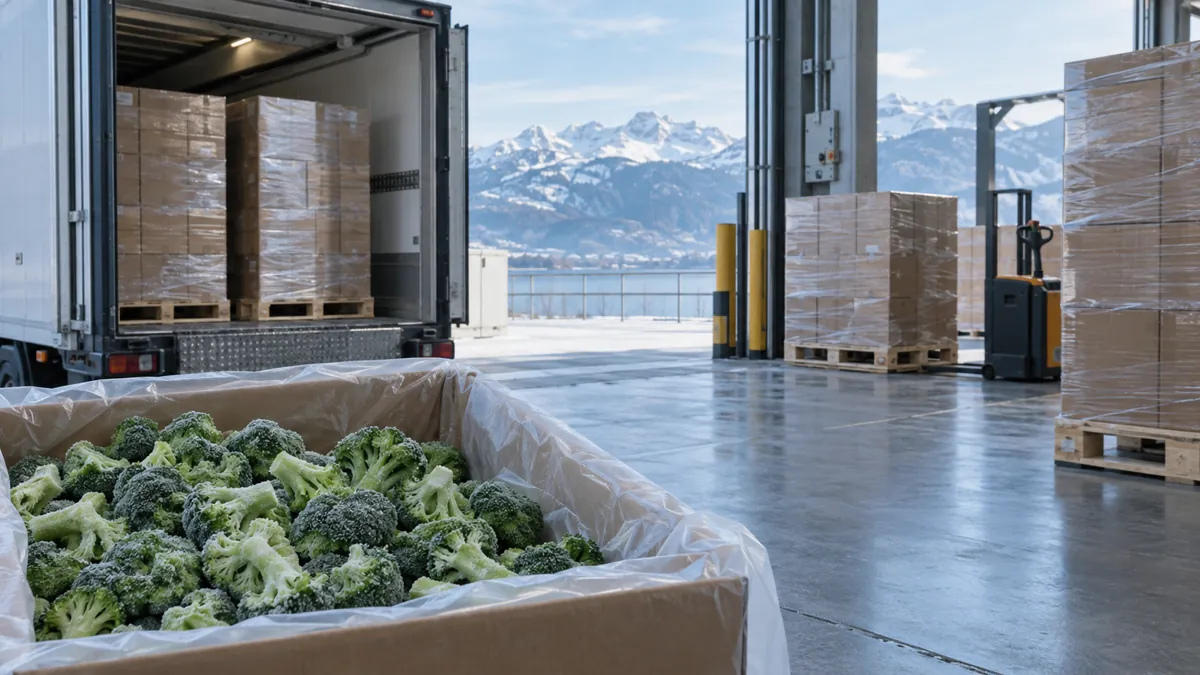
A proposed frozen broccoli handoff for a Swiss buyer.
The importer needs a Federal Office for Agriculture general import permit, must decide whether it has a frozen-vegetable tariff-quota share, and must check current food-control measures before the broker lodges the import declaration. As of 16 October 2026, ordinary importers continue to use e-dec Import; Passar Import is available only to pilot participants. The product is processed and frozen, so the ordinary plant-health route does not require a phytosanitary certificate. The Swiss buyer still needs a compliant food product, accurate origin and labels, a controlled frozen chain, and evidence that a particular lot may be released for sale.
The distinction matters because each step answers a different question. A general import permit establishes the right to import this agricultural category. A quota share determines access to a lower tariff rate. Customs accepts and assesses a declaration. Food authorities may impose product and origin-specific controls. A warehouse should release cartons into distribution only after the applicable decisions and its own receiving checks are complete. We use broccoli throughout this guide so an importer can translate the procedure into an actual order; other frozen vegetables can have different tariff branches, schedules or measures.
Reviewed 16 October 2026.
Define the exact frozen-food SKU and Swiss import entity
Before requesting a quote, describe the commodity in terms an inspector, tariff specialist and supplier can all recognize. Our example is Brassica oleracea var. italica, broccoli florets, grown and processed in China, washed, blanched, cooled and individually quick frozen, without sauce, seasoning, salt or other ingredients. It remains frozen and is intended for cooking before eating. A mixed vegetable pack, a prepared broccoli meal, an organic claim or a ready-to-eat presentation would require a fresh classification and regulatory assessment. The product name alone is not enough because treatment and ingredient composition can change the legal route.
The Swiss-based importer of record should be named before any shipment is booked. The FOAG general import permit guidance says a GIP may be issued to persons or entities resident or established in Swiss customs territory. It is a unique identification number and does not itself grant the lower in-quota duty rate. The permit is applied for through eKontingente; FOAG says it is free and has indefinite validity. An exporter in China can prepare product and shipment evidence, but the Swiss importer's permit, tariff entitlement, food-business obligations and customs representation remain that importer's own responsibility.
The importer also checks its food-business notification with the competent canton, separately from the FOAG agricultural permit. For a Zurich establishment, the Cantonal Laboratory notification service expressly covers businesses importing, storing, transporting or selling food. Its online form records the type of notification, establishment and responsible person; postal or email forms are alternatives. The authority sends a notification confirmation. Changes to establishment data are reported within fourteen days under the published Zurich instructions. An importer in another canton uses that canton's competent food-control office. We supply the source, product, process and traceability information needed for its own-control file.
The buyer should also decide who will make the import declaration, who will pay duties and import VAT, which cold store receives the cargo, and who controls a hold or release decision. These roles belong in the purchase order or operating instructions. If a customs broker acts for the importer, the broker needs the correct permit number, tariff line, country of origin, quantity and supporting documents. A freight forwarder moving the reefer is not automatically the food business that may sell the product. The division of roles becomes especially important when goods cross the EU in transit: the Swiss import decision still belongs to Switzerland even when the physical route passes through an EU port.

Actual GreenLand broccoli form used to discuss the contracted grade.
We would first give the importer a proposed product description, ingredient statement, process summary and example case label. The importer can take those to its broker and regulatory adviser while we check whether the chosen floret grade and bulk pack match the intended foodservice or processing line. This early exchange avoids producing a pallet of cartons whose invoice calls the product one thing, whose outer label says another and whose customs entry uses a third description. The same lot identity should appear in the specification, invoice, packing list, test records and carton code. GreenLand's frozen broccoli florets product page gives the baseline product form; each order still needs its signed specification.
Classify under Swiss Tares and secure the FOAG general import permit
The FOAG frozen-vegetable import page explicitly places broccoli among frozen vegetables under tariff heading 0710 and says those imports require a general import permit. It directs importers to the Swiss electronic tariff, Tares, for the actual tariff number, permit indication and applicable charges. The buyer or broker should confirm the full Swiss tariff line against the final product description and treatment. A supplier's six-digit HS heading or another country's ten-digit code is useful for discussion, but it is not a Swiss tariff ruling.
The sequence is practical. First, send the final ingredient and process statement to the Swiss broker. Second, confirm the Swiss line in Tares and check its remarks. Third, arrange the FOAG GIP through eKontingente in the name of the qualified Swiss importer. Fourth, record that number in the broker's customs master data before the cargo reaches the border. If the classification is genuinely uncertain, ask the Federal Office for Customs and Border Security for a tariff clarification using the actual product specification and, when necessary, a sample. A quote prepared before that clarification should show the tariff assumption, so a later duty change is visible rather than hidden in the delivered price.
The GIP should not be confused with a shipment-specific food certificate. FOAG's permit is an agricultural import identifier. It does not certify that this lot meets pesticide limits, microbial criteria, label rules or cold-chain conditions. Those checks require a separate product and lot dossier. Likewise, the plant-health exemption for processed frozen products does not remove the FOAG permit requirement. They are administered for different reasons and should appear as distinct rows in the importer's pre-shipment checklist.
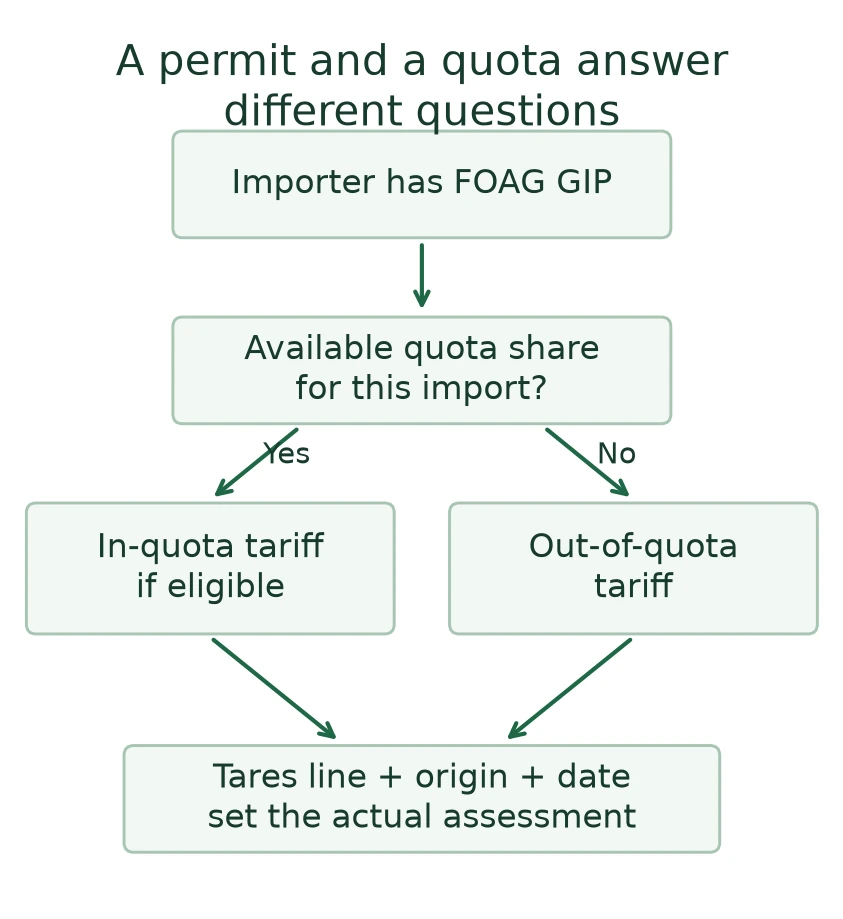
The diagram connects the decisions described in this section.
For the buyer, the tangible result of this step is a validated tariff branch, an active GIP number and a broker instruction that matches the invoice and packing list. If any one of those remains unresolved, do not treat the quoted landed cost as final. The tariff line influences duty, import conditions and possible origin preference, while an incorrect commodity description can delay assessment or trigger a later correction. We can provide the manufacturing detail that supports classification; the importer or its appointed adviser confirms the Swiss legal entry.
Price the frozen-vegetable quota and origin options
FOAG says the annual Swiss frozen-vegetable tariff quota is 4,950 tonnes. It allocates 35% by imports in the preceding three years, 65% by domestic performance in that period, and reserves 10 tonnes for new entrants. A newly qualified importer that obtained a GIP in the preceding six months can receive a minimum 300 kg allocation valid to year-end. The detailed entitlement must be checked in eKontingente for the importer's own account. These figures describe the published allocation framework, not a promise that a particular purchase order has available share on its arrival date.
A GIP holder without quota share may still import, but FOAG says the goods are assessed at the out-of-quota tariff rate. That distinction can dominate a landed-cost calculation for a low-margin frozen vegetable. Ask the importer to provide the actual quota allocation, volume already used, validity period and any transfer arrangement before pricing a container at an in-quota rate. If the shipment will arrive after the relevant year closes, the allocation and rate may change. A forecast that is accurate for one batch can be wrong for a later sailing.
There is a second, separate question: whether China-origin goods qualify for a preferential rate under an applicable Swiss trade agreement. Preferential origin is a rule about how the product was made and documented; it is not created merely by shipping from China or by printing "Made in China" on a carton. Swiss SME import guidance explains that a valid proof of origin and the agreement's origin rules are needed before a preference may be claimed, while other charges and VAT can remain due. The broker must compare the live Tares entry, quota status and preference route for the actual Swiss tariff line.
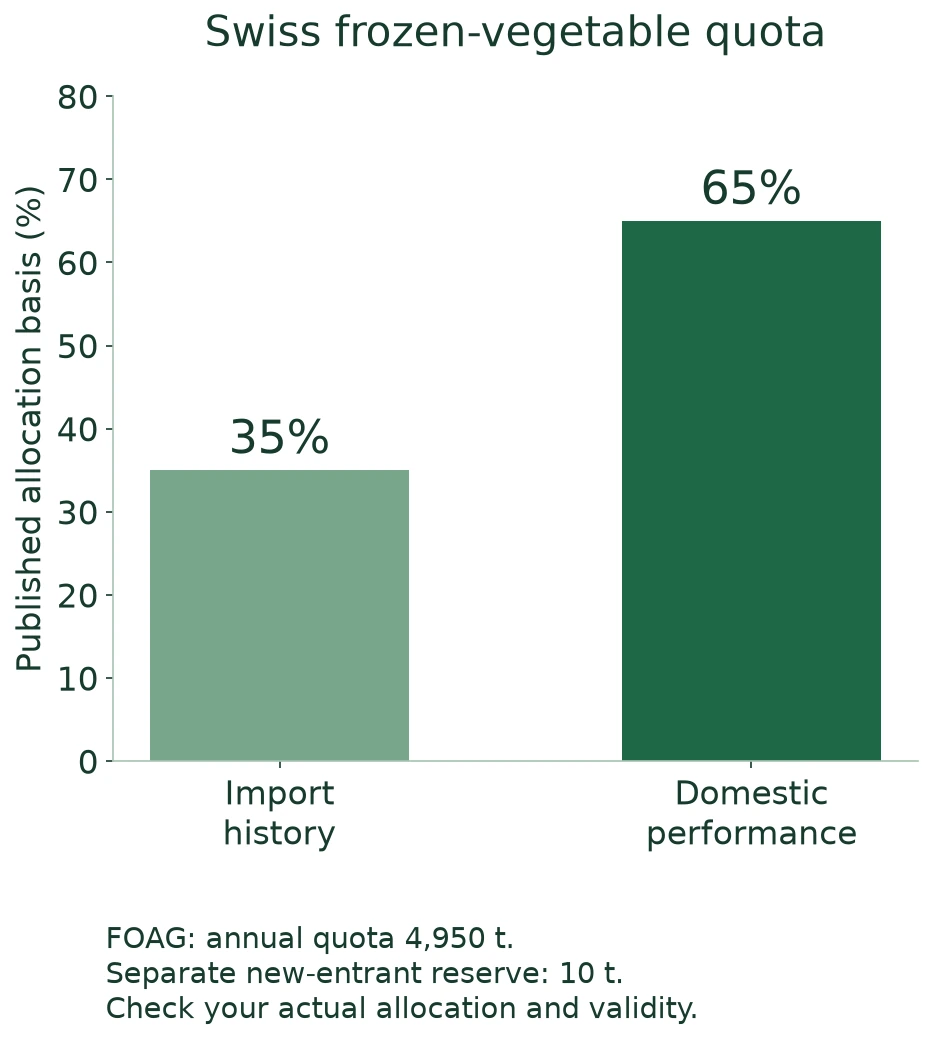
The diagram connects the decisions described in this section.
We would therefore quote a product and freight price separately from a declared estimate of Swiss duties, taxes and broker charges unless the Incoterm explicitly makes us responsible for them. The buyer can calculate at least two defensible scenarios: available quota share at the relevant rate and no available share at the out-of-quota rate. A third scenario can test a verified preferential-origin claim if the product-specific rule, documentation and tariff remarks support it. Do not stack benefits by assumption. The signed order should state who supplies an origin document, who verifies it, and what happens if the document fails before entry.
Check FSVO food measures and Swiss product requirements
Switzerland is outside the EU, although certain food-control and plant-health provisions are aligned or cross-referenced. The Federal Food Safety and Veterinary Office directs commercial importers to its import database and warns that protective measures in force on the day of import take precedence. It also explains enhanced controls for specified plant-origin foods from specified countries. For products on the relevant high-risk lists, prior notification, certificates, sampling or border checks may apply. The importer should search the exact commodity and origin in the FSVO database before dispatch and again close to arrival, recording the result with the date and tariff description. A generic claim that all frozen vegetables follow the same inspection route is unsafe.
The ordinary plant-health distinction is clearer for this defined SKU. FOAG plant-import guidance states that already processed plant products, including frozen goods, do not need a phytosanitary certificate and are not inspected by the plant-health service on that basis. This conclusion is about the actual blanched frozen broccoli florets. It does not excuse a fresh broccoli shipment, live plants, seeds or raw plant material from their own rules. If the product formula changes or an origin-specific protective measure appears, the importer must revisit the result.
The food itself must comply with Swiss limits and presentation rules. Pesticide residues are assessed against the Swiss maximum-residue ordinance for the specific active substance and commodity, using the legal residue definition and current annex, not a universal "zero pesticide" line. Contaminants and microbiological criteria must be assessed in their own legal scopes. Blanching supports enzyme control and food processing, but we do not describe it as a validated pathogen kill step or as a ready-to-eat assurance. For a cook-before-eating product, the specification should state the intended use and the label should carry a clear cooking instruction. A lab result needs its sampling plan, method and detection or quantification limit before anyone can interpret compliance.
A current Swiss example is available in the official VPRH Annex 2 workbook, version 1.9, effective 1 August 2026. For broccoli code 0241010 it lists bifenthrin, sum of isomers, at 0.4 mg/kg; acetamiprid at 0.06 mg/kg; and pyraclostrobin at 0.5 mg/kg. These are substance-specific examples, not a complete broccoli panel or measured GreenLand results. The laboratory request must cover the Swiss enforcement definition and suitable reporting limits. The importer also applies the ordinance's processing provisions to the actual blanched frozen material. We use the source-field treatment history to complete the analyte list, then attach the dated legal comparison, sample identity and actual laboratory results to the named finished lot.
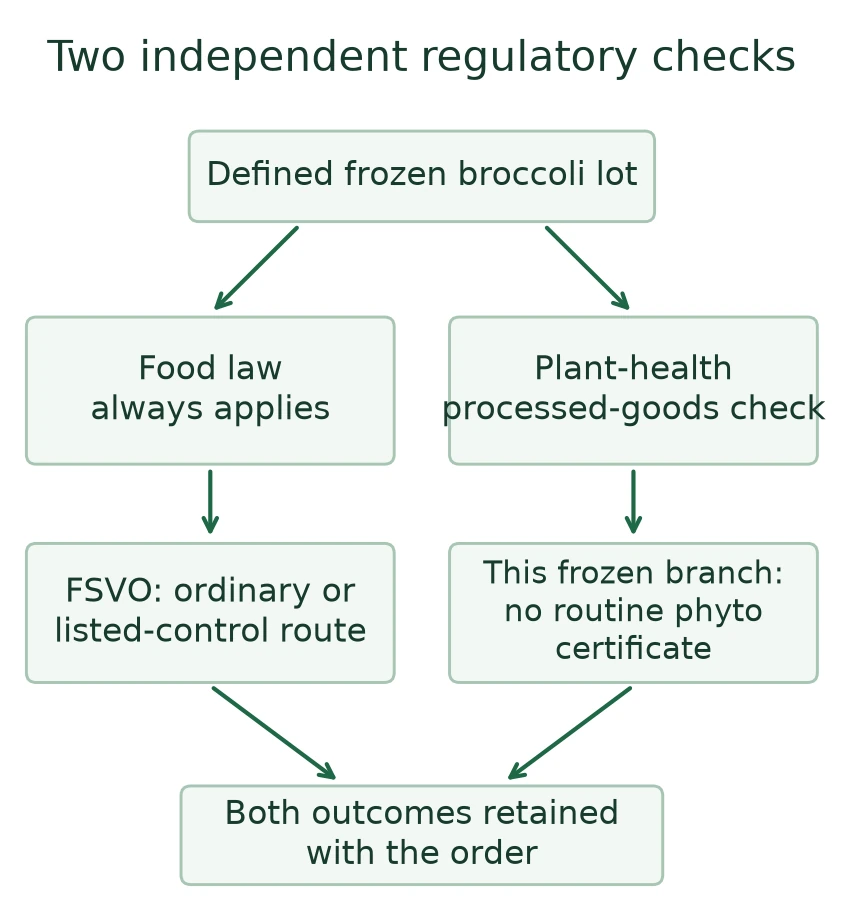
The diagram connects the decisions described in this section.
Swiss food-label guidance covers the product name, ingredients, net quantity, date, storage and use conditions, responsible business and country of production. Mandatory information normally appears in at least one Swiss official language, with legible, durable print. The importer should approve the exact market-facing artwork before retail repacking or sale. For industrial bulk cartons, the buyer still needs accurate case identity and accompanying traceability, while the final consumer pack is reviewed separately. Avoid using a Swiss flag or Swiss-looking origin cue on China-grown and China-processed broccoli. A private-label design can be approved only after the importer has checked how Swiss origin and ingredient rules apply to the final presentation.
Prepare the shipment, documents and cold-chain evidence
We would propose a lot dossier before the reefer is booked. It begins with the signed broccoli specification: botanical and commercial name, 100% broccoli ingredient status, floret calibration, stem profile, allowable fines and clumps, frozen condition, packing configuration, shelf-life basis and "cook before eating" use. It then identifies the production lot, raw-material source, packing date, carton codes and pallet count. The commercial invoice and packing list should use the same product description and declared origin. A certificate of origin, if a valid preference is sought, follows the relevant agreement and broker instructions rather than serving as a decorative export paper.
On the manufacturing side, we would connect intake, trimming, washing, blanching, cooling, IQF freezing, size grading, foreign-material control, packing and frozen storage to a batch record. Color sorting can help identify pieces with abnormal appearance; an X-ray system, if the contracted line has one, detects density differences. Neither should be claimed as a substitute for the other, and neither should be promised without the actual facility and line being confirmed. A metal-control step has its own validation and challenge records. The supplier's lot release should be based on the signed specification and applicable test plan, not a general marketing certificate.
The cold-chain plan should identify the temperature set point, pre-cooled reefer condition, loading interval, cartons and pallet arrangement, seal number and data logger location. Storage at −18°C or below is the proposed product condition from the GreenLand broccoli specification. A reefer display at arrival cannot prove the entire voyage stayed within range; the importer should retain a continuous record and investigate any excursion in relation to product temperature, duration and food-safety or quality consequence. The carrier moves the cargo and supplies transport records; the importer and supplier decide how to handle a held lot under their contract.
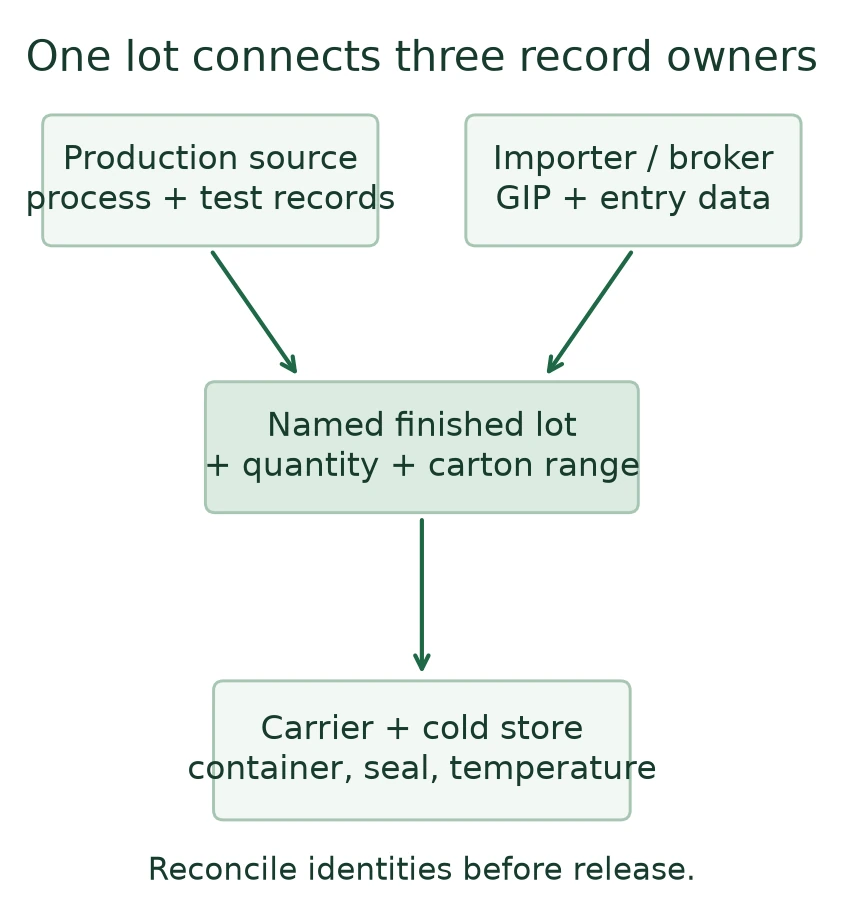
The diagram connects the decisions described in this section.
We should send document drafts early enough for the Swiss buyer to review terms, label data and the customs description. A last-minute mismatch in the GIP holder, consignee name, pallet count or origin statement can cost more than a slight difference in product price. A useful pre-shipment call has the importer, broker, forwarder and supplier looking at the same SKU sheet and expected arrival date. Each party leaves with an owner for the missing document, rather than a general assurance that "paperwork is ready."
Declare through the applicable Swiss customs channel
The FOCBS importation checklist says goods entering Switzerland must be declared, and a broker or transport firm may perform tasks for the importer. It explains that e-dec Import can transmit a declaration at the earliest on the working day before import. The system returns a "free" or "blocked" result; a blocked declaration requires presentation of accompanying documents and may lead to an examination. Customs duties, VAT and other levies depend on tariff number, quantity, weight, value and origin. These inputs must correspond to the final invoice and the actual loaded cargo.
For 16 October 2026 planning, FOCBS's Passar Import page is decisive: Passar 2.0 import declarations are limited to pilot companies until broader availability, and other companies should continue e-dec Import. A business partner ID and the correct ePortal roles are prerequisites for a pilot participant; the ID alone is insufficient. During the parallel period, legacy debtor accounts remain relevant for e-dec Import. We would ask the broker which channel it is authorized to use, record that answer, and avoid treating a marketing announcement about Passar as proof that this shipment can use it.
The declaration stage is also distinct from food assessment. A customs release or "free" selection does not magically validate a mislabeled or noncompliant food. Likewise, a food inspector's hold can prevent movement or sale even if an invoice and tariff entry are otherwise complete. For goods entering by a route through another country, the forwarder also needs transit and border arrangements; the Swiss broker remains responsible for the Swiss declaration. Incoterms define commercial obligations, but they do not transfer statutory importer duties merely by choosing a delivery phrase in the sales contract.
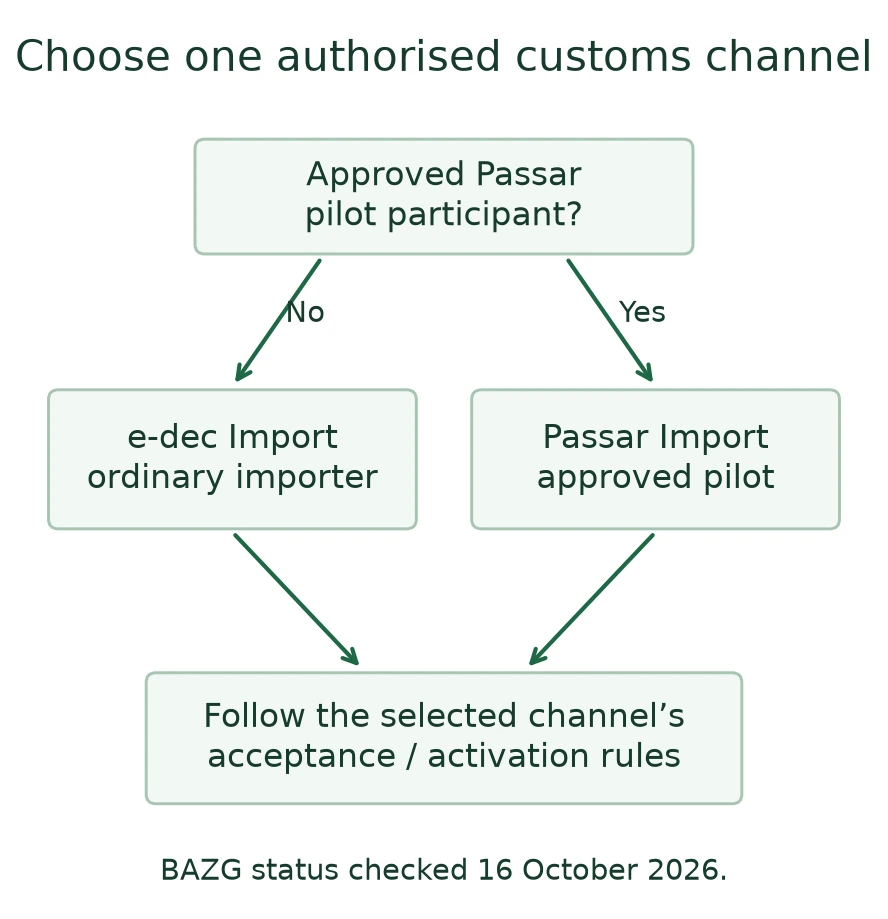
The diagram connects the decisions described in this section.
The output the buyer should archive is the customs decision or assessment, payment evidence where applicable, the final declaration, origin document used, GIP and quota references, and the chain of transport records. If there is a correction, preserve both the original entry and the amended decision. This makes a later audit or customer complaint traceable to a known lot and legal import event. GreenLand can supply corrected manufacturing and shipment data when requested, but cannot decide the Swiss tariff or authorize the buyer's release of goods.
Release the lot for Swiss sale after food and customs checks
At the cold store, receiving begins with seal and carton checks, a comparison of pallet and lot counts against the packing list, and a controlled sample of the frozen product. The buyer should inspect free flow, clumps, excess loose ice, color, floret size, stem proportion, crushed heads and foreign material against the signed tolerance. A cooking trial from the same representative sample can assess color, tenderness and usable yield. The sample method and acceptance rule must be fixed in the contract before a dispute arises, including whether a defect is counted by piece or weighed fraction.
For microbiology, pesticide residues and contaminants, the buyer should compare batch results and any official sampling outcome to the legal or contractual criteria that actually apply. A report saying "pass" without analyte names, units and method limits is weak evidence. Some criteria are mandatory law; others are buyer preferences. We would identify them separately so a buyer's stricter contract does not get misrepresented as a Swiss statutory limit. If results are pending, the lot remains on hold in the warehouse system, even when the truck has physically reached its destination.
The importer can release the goods to customers only when the relevant official restrictions are satisfied, the customs process is complete, the label and traceability are approved, and the receiving result meets the purchase specification. A discrepancy can call for segregation, retesting under a defined protocol, rework where lawful, return or destruction. The supplier should receive the lot code, photographs, temperature trace and test report promptly so the investigation concerns the same goods the buyer inspected. Our proposed corrective-action record would link the finding back to field lot, processing lot, pack run and outbound shipment, then document disposition and prevention steps.

Actual GreenLand floret-size inspection photograph.
The customer channel also affects the final handoff. A food manufacturer may decant the bulk liner into a cooked meal, so its receiving team needs a usable-yield and cook-performance trial as well as the regulatory dossier. A foodservice distributor may need outer cartons that survive repeated cold-store handling and a clear lot code visible without opening every case. A retail packer needs approved consumer artwork, net-weight control and a reconciliation between imported bulk lots and smaller finished packs. These are different downstream operations, but each should be able to trace a complaint or withdrawal from its finished unit back to the imported production lot. The importer should test that trace path with a sample order before expanding volume.
For repeat buying, the first shipment becomes the practical reference. Keep the signed specification, approved artwork, quota and customs assumptions, representative retained sample, test methods and receiving record together. Before the next order, confirm whether the Swiss tariff remarks, FOAG allocation, FSVO protective measures and label rules have changed. That small renewal step is more reliable than copying the prior invoice and assuming the same legal and commercial result. If you need a matching supply offer, send us the floret range, bulk pack, annual and first-order volume, application and arrival window; we can prepare the product-side evidence for your Swiss import team.
Continue with the China-origin IQF broccoli supply plan for the same China-origin, single-ingredient, blanched IQF broccoli order.
Related reading
Use this when the physical route enters the EU before the separate Swiss import decision.
Compare the German border and transit handoff with the Swiss declaration route.
Compare floret, batch and cold-chain decisions for an adjacent market.
Plan your frozen broccoli supply
GreenLand-food is a China-based frozen broccoli supplier and manufacturer discussing factory-direct wholesale supply. Send us your floret size, grade, packing, quantity, cooking application, Swiss destination and requested documents so we can prepare a reviewable proposal for the actual source and order.