



Salted pods and shelled kernels follow different routes
The production plan describes frozen salted edamame and frozen shelled edamame kernels. Both are described for heating before consumption. The salted case uses edamame and edible salt. The kernel case follows a shelling and sorting route. Each order's ingredient statement and soy allergen declaration follow its approved product and label requirements.
The case is an anonymised extract from two documented plan versions. It preserves the branches and control logic so a buyer can see how a process is reviewed. The responsible site confirms the controlled version, actual route and numerical criteria for the line before they are used for acceptance or release.
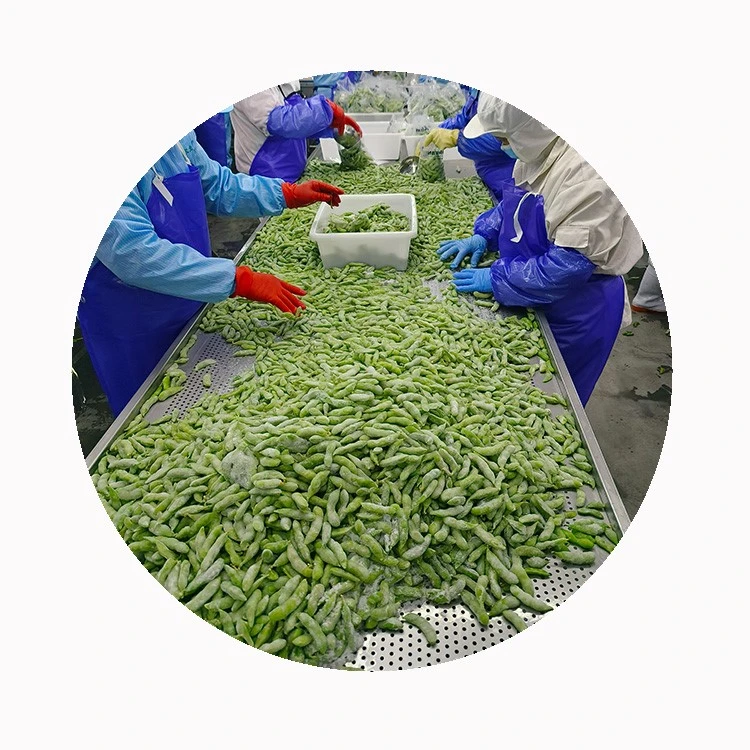
This photo from our edamame product page shows pod sorting. The case worksheets describe the controls for their own production routes.
Salted edamame
Fresh lot → receive and sort → air sort → wash → blanch → cool and pre-cool → brine soak → drain → IQF.
Frozen semi-finished lot → condition and store frozen → thaw → heat in brine → cool and pre-cool → drain → IQF.
Shelled edamame kernels
Fresh lot → receive → shell and sort → wash → blanch → cool and pre-cool → drain → IQF.
The case also describes a frozen input branch. The approved site flow identifies the conditioning or thawing step, then the route through shelling and treatment.
From IQF, the plan describes bulk weighing and frozen storage, and a route through final bagging, seal and weight recheck, metal detection, cartoning, storage and shipment. The diagrams also show a branch from bulk frozen storage to dispatch. The detector location and coverage for that branch need to be established against the site's controlled flow and records.
Packaging starts before the finished bag reaches the line. The case calls for checks on bag and carton condition, supplier documentation and print. It also describes municipal water and chilled water for washing and cooling and separate handling of edible salt. The complete route and specification notes are below. Explore frozen edamame forms.
Food safety team responsibilities · 5 entries
Responsibilities recorded in the case plan.
| Role | Case responsibilities |
|---|---|
| Team leader | Organise the team, verify and review the system, training, internal audit and communication. |
| Deputy / management | Support implementation, resources, customer feedback and recall arrangements. |
| Production management | Oversee production controls, prerequisite programmes, equipment and facilities. |
| Quality control | Inspect incoming materials and production hygiene. monitor, correct and verify relevant controls. |
| Purchasing | Manage and control supplies and supplier-related requirements. |
Ingredients, utilities and packaging · 5 entries
Incoming material and supporting-process checks described in the case.
| Input | Case characteristics and checks |
|---|---|
| Fresh edamame | Fresh vegetables from the growing base or external registered source described in the case. Check lot origin, supply evidence for external material, pre-harvest residue documentation, characteristic colour, size and flavour, pest damage, decay and visible foreign material. The receiving description identifies clean transport in crates or bags. The hazard analysis addresses possible pathogens, residues and the inherent soy allergen. |
| Edible salt | The salted route uses edible salt from an approved source. The ingredient description covers appearance and flavour, particle size, sodium chloride, moisture, insoluble and soluble impurities, metals and other relevant composition criteria. Check the supplier's specification, delivery condition and lot identity. Store in a dry segregated area, identified and rotated by receipt. |
| Water and ice water | The case specifies treated municipal water and chilled water prepared from it. The water description includes clarity, turbidity, odour and visible material. It lists chemical criteria covering lead, arsenic, copper, cyanide, volatile phenols, free chlorine, chloroform, carbon tetrachloride and nitrite. It also describes routine residual-chlorine and microbiological verification. |
| Food-contact composite bags | Check the seal edges, laminate condition, cracks, odour and visible changes. The material description includes extraction residue, permanganate consumption and metals criteria. Review food-contact documentation and supplier inspection evidence. Keep clean and protected. Confirm the case's UV and ozone treatment against the approved bag and site procedure. |
| Corrugated cartons | Check cleanliness, labels and print, dimensions, compression and burst strength, and board thickness against the packaging specification. Confirm the quantity and condition at delivery. Store in a dry, ventilated area, identified and protected from contamination. |
Finished product descriptions · 2 entries
The two product descriptions use separate specifications. The current site confirms the actual order criteria.
| Product | Inputs and process | Physical checks | Microbiology in the source | Chemical checks in the source | Use, pack and distribution |
|---|---|---|---|---|---|
| Frozen salted edamame | Fresh or frozen edamame and edible salt. The case describes a fresh route and a frozen semi-finished route with brine treatment, cooling and IQF. | Characteristic colour, uniform shape and size and normal flavour. The plan checks for pest damage, decay, damaged material, visible foreign matter, off-odour and fibrous texture. | Total colony count and a pathogen criterion are listed. The applicable specification identifies organisms, sampling plan, method and limits for the product and use. | The source lists lead, cadmium, total arsenic, total mercury, HCH (hexachlorocyclohexane) and DDT. The site and buyer check the applicable market limits, residue definitions and sample basis. | Heating before consumption. Declare soy and confirm the ingredient statement and cooking instructions. Food-grade composite bag inside a corrugated carton, with retail or bulk weights matched to the order. Review the approved shelf life, storage and transport conditions and protect bags during distribution. |
| Frozen edamame kernels | Fresh or frozen edamame. The kernel route includes shelling, washing, blanching, cooling and IQF. The frozen-input branch describes conditioning and thawing before shelling. | Characteristic colour, uniform shape and size and normal flavour. The plan checks for pest damage, decay, damaged material, visible foreign matter, off-odour and fibrous texture. | Total colony count and a pathogen criterion are listed. The applicable specification identifies organisms, sampling plan, method and limits for the product and use. | The source lists lead, cadmium, total arsenic, total mercury, HCH (hexachlorocyclohexane) and DDT. The site and buyer check the applicable market limits, residue definitions and sample basis. | Heating before consumption. Declare soy and confirm the ingredient statement and cooking instructions. Food-grade composite bag inside a corrugated carton, with retail or bulk weights matched to the order. Review the approved shelf life, storage and transport conditions and protect bags during distribution. |
Process steps and supporting branches · 21 entries
The source diagrams and descriptions cover fresh and semi-finished routes, utilities, final packing and bulk dispatch.
| Step / branch | Case description |
|---|---|
| Fresh route · raw material acceptance | Check quality, origin and pre-harvest residue evidence. |
| Fresh route · temporary storage | Temporarily store incoming material if processing cannot begin. The QC record links the storage condition and time to the lot. |
| Fresh route · preparation | Select defects and foreign material. shell edamame for kernels. |
| Salted pods · air sorting | Remove light foreign material and sort again. |
| Both · washing | Use flowing wash water and remove mud, sand and loose material. QC measures and records residual chlorine on the approved schedule. |
| Both · blanching | Check the treatment temperature and time and retain the line reading. The plan also describes a first-run enzyme check for applicable products. The issued process defines where that check applies. |
| Both · cooling and pre-cooling | After spray cooling, the case describes a cooling tank and a chilled pre-cooling tank. QC checks and records water temperature and residual chlorine at the identified points. |
| Salted pods · salt and brine | Receive salt, inspect supplier evidence, store and prepare brine. the fresh route includes brine soaking. |
| Salted pods · semi-finished branch | Condition and freeze semi-finished product. release and thaw it, boil in brine, cool and pre-cool before draining. |
| Kernels · frozen-input branch | The product description includes conditioning and thawing before shelling and blanching. The separate treatment entry in the kernel worksheet must be reconciled with the controlled route. |
| Both · draining and IQF | Drain surface water and individually quick-freeze. monitor process parameters under the approved plan. |
| Both · weighing and bulk packing | Sort out ice and defective material at the freezer outlet. Record semi-finished inspection and the scheduled microbiological and residue sampling. Weigh and identify the bulk packs, then link them to frozen storage. |
| Both · frozen storage | Store identified lots in frozen storage. record warehouse conditions. |
| Both · final packing | Withdraw identified product for final sorting and packing. Remove defective product and foreign material. Weigh, seal and recheck pack weight and closure. Use the specified bag and carton marks and maintain the packing batch link. |
| Both · metal detection | The case worksheet calls for all products to pass detection. verify where this applies to each route. |
| Both · cartoning | Pack and check identification and weight. |
| Both · finished frozen storage | Identify lots, record receipts and monitor storage conditions. |
| Both · shipping | Review finished inspection, container cleanliness and seal condition before loading. Check carton condition, labels and counts. Retain loading photos, packing list and temperature evidence as called for by the order. |
| Supporting · water and ice | Municipal water supports washing and cooling. chilled water supports pre-cooling. |
| Supporting · packaging materials | Receive, store, identify and prepare bags and cartons. check supplier documents, print and approved pre-use treatment. |
| Bulk dispatch branch | Case diagrams show a direct path from bulk frozen storage to shipment. QA must establish whether and where it receives metal detection. |
How to read the edamame controls
Read the worksheets against the approved flow for the relevant edamame route. Each entry names a hazard, gives the reason for its classification and identifies the control the site relies on. Water, sanitation, personnel hygiene, maintenance, pest control and material handling underpin the analysis. FAO hygiene and HACCP toolbox.
At edamame intake, the source lot and the sample basis determine whether the residue or metals evidence answers the receiving question. A pre-harvest report helps evaluate the incoming raw lot. If the buyer requests a finished-product test, the certificate of analysis (COA) should identify the frozen lot and state the agreed test panel and sample basis.
Open edamame can pick up contamination from water, equipment or handling after the heat step. A blanching record identifies the measured point and line load. Follow the same run into the cooling record to check which water and hygiene controls applied during the transfer and cooling steps.
Some organisms can survive freezing. Follow the case controls before IQF and check how the processor protects the edamame during subsequent handling and packing. FAO technical guidance on freezing fruit and vegetables.
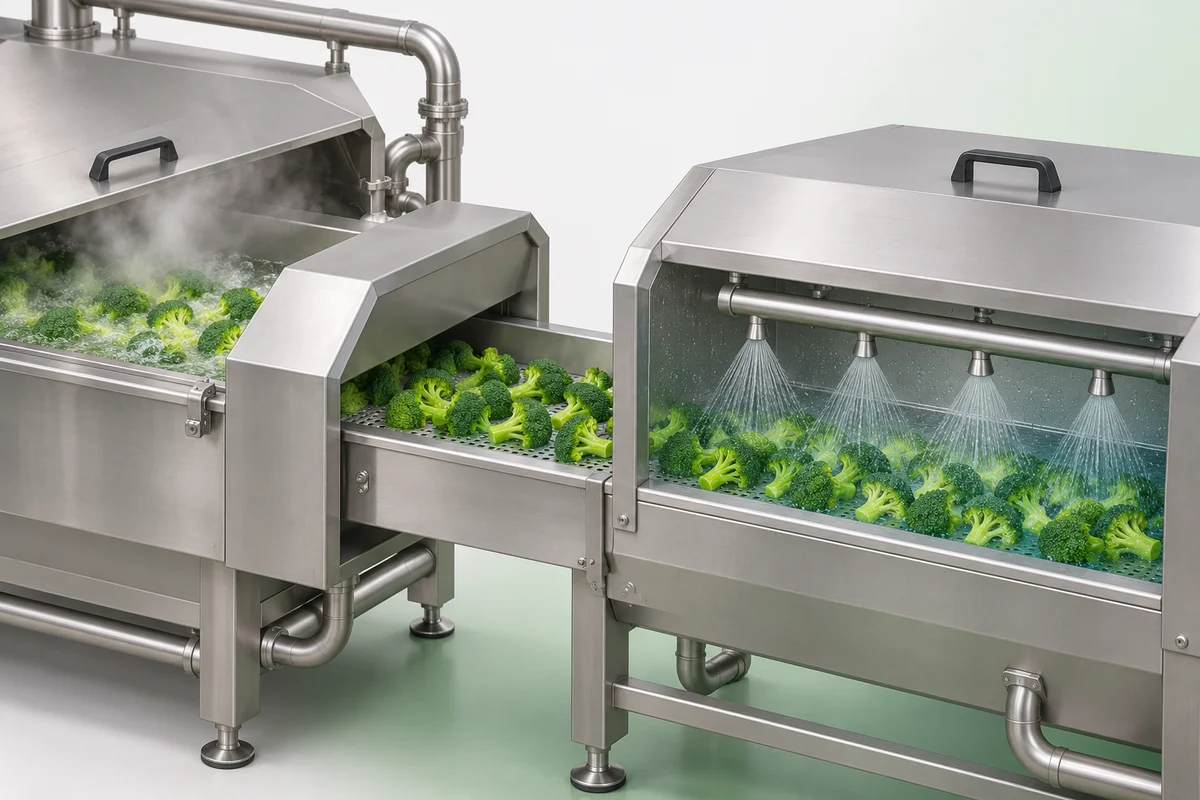
Process illustration. After blanching, the transfer into cooling has its own water and handling checks.
Trace a physical finding to the step and control that address it. Sorting can remove field material, an equipment check can identify loose parts, and a detector addresses metal fragments within its validated capability. A damaged bag seal calls for a separate packing check.
Ask for validation to see why the chosen control suits the product and the line. Look at the run record to see whether the operator met the required condition. Verification records show how the site reviewed monitoring, instruments and corrective action.
Hazard analysis for salted edamame and kernels
The two worksheets consider biological, chemical and physical hazards step by step. They group soy under chemical hazards in the source. Soy identity, segregation and the declared allergen need to be reviewed for the actual product and any shared line. The worksheets record the reason for a significance decision and the control relied on for that step. A dash represents an empty source field. A classification describes this case and its route.
A significant hazard can be addressed at another step or through a prerequisite programme, depending on the site's analysis. For example, loose metal may be considered in sorting or cooling even though the detector is recorded later. An entry for a water or seal hazard identifies the control used there without changing the CCP schedule.
For salted edamame, follow the fresh route and the frozen semi-finished branch separately. The worksheet connects salt receipt and brine preparation to the product that passes through those steps.

Frost-coated whole edamame pods, matching the unshelled product form.
Salted edamame hazard worksheet · 94 entries
The case lists the brine-heating control in this worksheet as CCP2a. The approved schedule establishes its applicability. Scroll across for the basis, control and CCP columns.
| Stage | Hazard type | Identified hazard | Significant? | Case basis | Case control | Effectiveness recorded | CCP? |
|---|---|---|---|---|---|---|---|
| Raw material acceptance | Biological | Pathogen contamination | Yes | May occur during crop growth | Blanching and thorough cooking before consumption, as described in the case | Effective per worksheet | No |
| Raw material acceptance | Chemical | Pesticide residues and heavy metals | Yes | Cultivation and the surrounding environment may contribute pesticide residues and heavy metals | CCP1 · obtain the specified supplier and pre-harvest test documents | - | Yes |
| Raw material acceptance | Chemical | Allergen | Yes | The crop itself contains an allergen | Separate or protect, store separately and identify allergen material | - | No |
| Raw material acceptance | Physical | Metal and glass fragments | Yes | Foreign material may be present from crop production | Washing, worker sorting and metal detection for metal fragments | - | No |
| Temporary cool-room storage | Biological | Pathogen contamination | No | The case worksheet relies on blanching | - | - | - |
| Temporary cool-room storage | Chemical | None recorded | - | - | - | - | - |
| Temporary cool-room storage | Physical | Metal fragments | No | Case worksheet describes occurrence as rare | - | - | - |
| Sorting and preparation | Biological | Pathogen contamination | No | Prerequisite programme and blanching | - | - | - |
| Sorting and preparation | Chemical | None recorded | - | - | - | - | - |
| Sorting and preparation | Physical | Metal fragments | Yes | Loose equipment screws | Worker sorting, equipment maintenance and metal detection | Effective per worksheet | No |
| Air sorting | Biological | Pathogen contamination | No | Prerequisite programme and blanching | - | - | - |
| Air sorting | Chemical | None recorded | - | - | - | - | - |
| Air sorting | Physical | Metal foreign material | Yes | Loose or detached air-sorter screws | Packing-line sorting, metal detection and equipment prerequisites | Effective per worksheet | No |
| Tap water | Biological | Pathogen contamination | Yes | The case cites the drinking-water standard and water-source or network conditions | Laboratory tests residual chlorine and microbiology on the case-plan schedule | Effective per worksheet | No |
| Tap water | Chemical | Toxic or harmful substances | No | The case cites the drinking-water standard and water-source or network conditions | - | - | - |
| Tap water | Physical | None recorded | - | - | - | - | - |
| Ice water | Biological | Pathogen contamination | No | The case cites the drinking-water standard and water-source or network conditions | - | - | - |
| Ice water | Chemical | Toxic or harmful substances | No | The case cites the drinking-water standard and water-source or network conditions | - | - | - |
| Ice water | Physical | None recorded | - | - | - | - | - |
| Salt acceptance | Biological | Pathogen contamination | No | Case worksheet describes pathogen contamination as rare | - | Effective per worksheet | - |
| Salt acceptance | Chemical | Heavy metals | Yes | Potential introduction during processing | Approve supplier, obtain supporting evidence and inspect incoming salt under the prerequisite programme | - | No |
| Salt acceptance | Physical | Metal, glass and other foreign material | No | Not previously detected in the material, according to the case worksheet | - | - | No |
| Salt storage | Biological | Pathogen contamination | No | Not previously observed, according to the case worksheet | - | - | - |
| Salt storage | Chemical | None recorded | - | - | - | - | - |
| Salt storage | Physical | None recorded | - | - | - | - | - |
| Brine preparation | Biological | Pathogen contamination | No | Not previously observed, according to the case worksheet | - | - | - |
| Brine preparation | Chemical | None recorded | - | - | - | - | - |
| Brine preparation | Physical | None recorded | - | - | - | - | - |
| Washing | Biological | Pathogen contamination | No | Prerequisite programme and blanching | - | Effective per worksheet | - |
| Washing | Chemical | None recorded | - | - | - | - | - |
| Washing | Physical | Metal fragments | No | Loose equipment screws | Worker sorting, equipment maintenance and metal detection | - | No |
| Blanching | Biological | Pathogen contamination | Yes | Inadequate temperature control can permit microbial growth | CCP2 · monitor blanching temperature and time | Effective per worksheet | Yes |
| Blanching | Chemical | None recorded | - | - | - | - | - |
| Blanching | Physical | Metal fragments | No | Loose equipment screws | Worker sorting, equipment maintenance and metal detection | Effective per worksheet | No |
| Cooling | Biological | Pathogen contamination | No | Personnel, tools or environment may introduce contamination | Prerequisite programme | Effective per worksheet | No |
| Cooling | Chemical | Residual chlorine | No | Product subsequently enters the pre-cooling tank | - | - | - |
| Cooling | Physical | Metal fragments | Yes | Loose equipment screws | Downstream worker sorting and metal detection | Effective per worksheet | No |
| Pre-cooling | Biological | Pathogen contamination | No | Personnel, tools or environment may introduce contamination | Prerequisite programme | Effective per worksheet | No |
| Pre-cooling | Chemical | Residual chlorine | Yes | Improper chlorine addition may create a chemical hazard | Prerequisite programme | - | - |
| Pre-cooling | Physical | Metal fragments | Yes | Loose equipment screws | Downstream worker sorting and metal detection | Effective per worksheet | No |
| Brine soaking | Biological | Pathogen contamination | No | Case worksheet cites cold and salt as factors limiting growth | - | Effective per worksheet | No |
| Brine soaking | Chemical | None recorded | - | - | - | - | - |
| Brine soaking | Physical | None recorded | - | - | - | - | - |
| Semi-finished product conditioning | Biological | Microbial growth | No | The case worksheet relies on subsequent blanching | - | - | - |
| Semi-finished product conditioning | Chemical | None recorded | - | - | - | - | - |
| Semi-finished product conditioning | Physical | None recorded | - | - | - | - | - |
| Frozen storage | Biological | None recorded | - | - | - | - | - |
| Frozen storage | Chemical | None recorded | - | - | - | - | - |
| Frozen storage | Physical | None recorded | - | - | - | - | - |
| Thawing | Biological | Microbial growth | No | The case worksheet relies on subsequent blanching | - | - | - |
| Thawing | Chemical | None recorded | - | - | - | - | - |
| Thawing | Physical | None recorded | - | - | - | - | - |
| Brine boiling | Biological | Pathogen contamination | Yes | Inadequate temperature control can permit microbial growth | Worksheet-only CCP2a · monitor heat treatment temperature and time. QA review required | Effective per worksheet | Yes |
| Brine boiling | Chemical | None recorded | - | - | - | - | - |
| Brine boiling | Physical | Metal fragments | No | Loose equipment screws | Worker sorting, equipment maintenance and metal detection | Effective per worksheet | No |
| Draining | Biological | Pathogen contamination | No | Personnel, tools or environment may introduce contamination | Prerequisite programme | Effective per worksheet | No |
| Draining | Chemical | None recorded | - | - | - | - | - |
| Draining | Physical | Metal fragments | Yes | Loose equipment screws | Downstream worker sorting and metal detection | Effective per worksheet | No |
| Packaging receipt | Biological | Secondary pathogen contamination | No | Improper packaging may introduce contamination | UV treatment before use, with parameters from the approved site plan | Effective per worksheet | No |
| Packaging receipt | Chemical | Packaging migration and residue indicators, including heavy metals and solvents | No | Supplier process or inputs may fail specification | Supplier approval, packaging conformity evidence and prerequisite programme | Effective per worksheet | No |
| Packaging receipt | Physical | Metal fragments | No | Case worksheet describes occurrence as rare | - | - | - |
| Packaging storage | Biological | Pathogen contamination | No | Storage environment may introduce contamination | Environmental prerequisite programme | - | - |
| Packaging storage | Chemical | None recorded | - | - | - | - | - |
| Packaging storage | Physical | None recorded | - | - | - | - | - |
| Packaging preparation | Biological | Pathogen contamination | No | The case describes UV treatment before use. approved treatment parameters require QA review | - | - | - |
| Packaging preparation | Chemical | None recorded | - | - | - | - | - |
| Packaging preparation | Physical | None recorded | - | - | - | - | - |
| IQF freezing | Biological | Pathogen contamination | No | The case cites frozen storage as limiting microbial growth | - | - | - |
| IQF freezing | Chemical | None recorded | - | - | - | - | - |
| IQF freezing | Physical | Metal fragments | Yes | Loose equipment screws | Downstream worker sorting and metal detection | Effective per worksheet | No |
| Weighing and bulk packaging | Biological | Pathogen contamination | No | Personnel, tools or environment may introduce contamination | Prerequisite programme | Effective per worksheet | No |
| Weighing and bulk packaging | Chemical | None recorded | - | - | - | - | - |
| Weighing and bulk packaging | Physical | None recorded | - | - | - | - | - |
| Frozen storage | Biological | Microbial or pathogen growth | No | The case cites frozen storage as limiting microbial growth | - | - | - |
| Frozen storage | Chemical | None recorded | - | - | - | - | - |
| Frozen storage | Physical | None recorded | - | - | - | - | - |
| Release for final packaging | Biological | Pathogen contamination | No | Personnel, tools or packaging environment may introduce contamination | Prerequisite programme | Effective per worksheet | No |
| Release for final packaging | Chemical | None recorded | - | - | - | - | - |
| Release for final packaging | Physical | None recorded | - | - | - | - | - |
| Sealing and weighing | Biological | Pathogen contamination | Yes | A poor seal can lead to secondary contamination | Prerequisite programme | Effective per worksheet | No |
| Sealing and weighing | Chemical | None recorded | - | - | - | - | - |
| Sealing and weighing | Physical | None recorded | - | - | - | - | - |
| Metal detection | Biological | None recorded | - | - | - | Effective per worksheet | - |
| Metal detection | Chemical | None recorded | - | - | - | - | - |
| Metal detection | Physical | Metal fragments | Yes | Metal may enter with raw materials or during production | Metal detection CCP. the worksheet specifies all products | - | Yes |
| Cartoning | Biological | None recorded | - | - | - | - | - |
| Cartoning | Chemical | None recorded | - | - | - | - | - |
| Cartoning | Physical | None recorded | - | - | - | - | - |
| Frozen storage | Biological | Microbial or pathogen growth | No | The case cites frozen storage as limiting microbial growth | - | - | - |
| Frozen storage | Chemical | None recorded | - | - | - | - | - |
| Frozen storage | Physical | None recorded | - | - | - | - | - |
| Shipping | Biological | None recorded | - | - | - | - | - |
| Shipping | Chemical | None recorded | - | - | - | - | - |
| Shipping | Physical | None recorded | - | - | - | - | - |
For kernels, look for shelling and sorting, then match the treatment and cooling records to the lot. The worksheet identifies how material from equipment is addressed downstream.

Loose frozen shelled edamame kernels, without pods.
Edamame kernel hazard worksheet · 77 entries
The case lists disinfectant concentration and contact time in this worksheet as CCP2b. The approved schedule establishes its applicability. Scroll across for the basis, control and CCP columns.
| Stage | Hazard type | Identified hazard | Significant? | Case basis | Case control | Effectiveness recorded | CCP? |
|---|---|---|---|---|---|---|---|
| Raw material acceptance | Biological | Pathogen contamination | Yes | May occur during crop growth | Blanching and thorough cooking before consumption, as described in the case | Effective per worksheet | No |
| Raw material acceptance | Chemical | Pesticide residues and heavy metals | Yes | Cultivation and the surrounding environment may contribute pesticide residues and heavy metals | CCP1 · obtain the specified supplier and pre-harvest test documents | - | Yes |
| Raw material acceptance | Chemical | Allergen | Yes | The crop itself contains an allergen | Separate or protect, store separately and identify allergen material | - | No |
| Raw material acceptance | Physical | Metal and glass fragments | Yes | Foreign material may be present from crop production | Washing, worker sorting and metal detection for metal fragments | - | No |
| Temporary cool-room storage | Biological | Pathogen contamination | No | The case worksheet relies on blanching | - | - | - |
| Temporary cool-room storage | Chemical | None recorded | - | - | - | - | - |
| Temporary cool-room storage | Physical | Metal fragments | No | Case worksheet describes occurrence as rare | - | - | - |
| Semi-finished product conditioning | Biological | Pathogen contamination | No | Prerequisite programme and blanching | - | - | - |
| Semi-finished product conditioning | Chemical | None recorded | - | - | - | - | - |
| Semi-finished product conditioning | Physical | Metal fragments | Yes | Loose equipment screws | Worker sorting, equipment maintenance and metal detection | Effective per worksheet | No |
| Preparation and shelling | Biological | Pathogen contamination | No | Prerequisite programme and blanching | - | - | - |
| Preparation and shelling | Chemical | None recorded | - | - | - | - | - |
| Preparation and shelling | Physical | Metal fragments | Yes | Loose equipment screws | Worker sorting, equipment maintenance and metal detection | Effective per worksheet | No |
| Sorting | Biological | Pathogen contamination | No | Prerequisite programme and blanching | - | - | - |
| Sorting | Chemical | None recorded | - | - | - | - | - |
| Sorting | Physical | Metal fragments | Yes | Loose sorter screws | Worker sorting, equipment maintenance and metal detection | Effective per worksheet | No |
| Tap water | Biological | Pathogen contamination | Yes | The case cites the drinking-water standard and water-source or network conditions | Laboratory tests residual chlorine and microbiology on the case-plan schedule | Effective per worksheet | No |
| Tap water | Chemical | Toxic or harmful substances | No | The case cites the drinking-water standard and water-source or network conditions | - | - | - |
| Tap water | Physical | None recorded | - | - | - | - | - |
| Ice water | Biological | Pathogen contamination | No | The case cites the drinking-water standard and water-source or network conditions | - | - | - |
| Ice water | Chemical | Toxic or harmful substances | No | The case cites the drinking-water standard and water-source or network conditions | - | - | - |
| Ice water | Physical | None recorded | - | - | - | - | - |
| Washing | Biological | Pathogen contamination | No | Prerequisite programme and blanching | - | Effective per worksheet | - |
| Washing | Chemical | None recorded | - | - | - | - | - |
| Washing | Physical | Metal fragments | No | Loose washer screws | Worker sorting, equipment maintenance and metal detection | - | No |
| Blanching | Biological | Pathogen contamination | Yes | Inadequate temperature control can permit microbial growth | CCP2 · monitor blanching temperature and time | Effective per worksheet | Yes |
| Blanching | Chemical | None recorded | - | - | - | - | - |
| Blanching | Physical | Metal fragments | No | Loose equipment screws | Worker sorting, equipment maintenance and metal detection | Effective per worksheet | No |
| Disinfectant treatment | Biological | Pathogen contamination | Yes | Improper disinfectant concentration may allow microbial growth | Worksheet-only CCP2b · monitor disinfectant concentration and time. QA review required | Effective per worksheet | Yes |
| Disinfectant treatment | Chemical | None recorded | - | - | - | - | - |
| Disinfectant treatment | Physical | None recorded | - | - | - | - | - |
| Cooling | Biological | Pathogen contamination | No | Personnel, tools or environment may introduce contamination | Prerequisite programme | Effective per worksheet | No |
| Cooling | Chemical | Residual chlorine | No | Product subsequently enters the pre-cooling tank | - | - | - |
| Cooling | Physical | Metal fragments | Yes | Loose equipment screws | Downstream worker sorting and metal detection | Effective per worksheet | No |
| Pre-cooling | Biological | Pathogen contamination | No | Personnel, tools or environment may introduce contamination | Prerequisite programme | Effective per worksheet | No |
| Pre-cooling | Chemical | Residual chlorine | Yes | Improper chlorine addition may create a chemical hazard | Prerequisite programme | - | - |
| Pre-cooling | Physical | Metal fragments | Yes | Loose equipment screws | Downstream worker sorting and metal detection | Effective per worksheet | No |
| Pre-cooling | Physical | Metal fragments | No | Loose equipment screws | Worker sorting, equipment maintenance and metal detection | Effective per worksheet | No |
| Draining | Biological | Pathogen contamination | No | Personnel, tools or environment may introduce contamination | Prerequisite programme | Effective per worksheet | No |
| Draining | Chemical | None recorded | - | - | - | - | - |
| Draining | Physical | Metal fragments | Yes | Loose equipment screws | Downstream worker sorting and metal detection | Effective per worksheet | No |
| Packaging receipt | Biological | Secondary pathogen contamination | No | Improper packaging may introduce contamination | UV treatment before use, with parameters from the approved site plan | Effective per worksheet | No |
| Packaging receipt | Chemical | Packaging migration and residue indicators, including heavy metals and solvents | No | Supplier process or inputs may fail specification | Supplier approval, packaging conformity evidence and prerequisite programme | Effective per worksheet | No |
| Packaging receipt | Physical | Metal fragments | No | Case worksheet describes occurrence as rare | - | - | - |
| Packaging storage | Biological | Pathogen contamination | No | Storage environment may introduce contamination | Environmental prerequisite programme | - | - |
| Packaging storage | Chemical | None recorded | - | - | - | - | - |
| Packaging storage | Physical | None recorded | - | - | - | - | - |
| Packaging preparation | Biological | Pathogen contamination | No | The case describes UV treatment before use. approved treatment parameters require QA review | - | - | - |
| Packaging preparation | Chemical | None recorded | - | - | - | - | - |
| Packaging preparation | Physical | None recorded | - | - | - | - | - |
| IQF freezing | Biological | Pathogen contamination | No | The case cites frozen storage as limiting microbial growth | - | - | - |
| IQF freezing | Chemical | None recorded | - | - | - | - | - |
| IQF freezing | Physical | Metal fragments | Yes | Loose equipment screws | Downstream worker sorting and metal detection | Effective per worksheet | No |
| Weighing and bulk packaging | Biological | Pathogen contamination | No | Personnel, tools or environment may introduce contamination | Prerequisite programme | Effective per worksheet | No |
| Weighing and bulk packaging | Chemical | None recorded | - | - | - | - | - |
| Weighing and bulk packaging | Physical | None recorded | - | - | - | - | - |
| Frozen storage | Biological | Microbial or pathogen growth | No | The case cites frozen storage as limiting microbial growth | - | - | - |
| Frozen storage | Chemical | None recorded | - | - | - | - | - |
| Frozen storage | Physical | None recorded | - | - | - | - | - |
| Release for final packaging | Biological | Pathogen contamination | No | Personnel, tools or packaging environment may introduce contamination | Prerequisite programme | Effective per worksheet | No |
| Release for final packaging | Chemical | None recorded | - | - | - | - | - |
| Release for final packaging | Physical | None recorded | - | - | - | - | - |
| Sealing and weighing | Biological | Pathogen contamination | Yes | A poor seal can lead to secondary contamination | Prerequisite programme | Effective per worksheet | No |
| Sealing and weighing | Chemical | None recorded | - | - | - | - | - |
| Sealing and weighing | Physical | None recorded | - | - | - | - | - |
| Metal detection | Biological | None recorded | - | - | - | Effective per worksheet | - |
| Metal detection | Chemical | None recorded | - | - | - | - | - |
| Metal detection | Physical | Metal fragments | Yes | Metal may enter with raw materials or during production | CCP3 · the worksheet specifies all products pass metal detection | - | Yes |
| Cartoning | Biological | None recorded | - | - | - | - | - |
| Cartoning | Chemical | None recorded | - | - | - | - | - |
| Cartoning | Physical | None recorded | - | - | - | - | - |
| Frozen storage | Biological | Microbial or pathogen growth | No | The case cites frozen storage as limiting microbial growth | - | - | - |
| Frozen storage | Chemical | None recorded | - | - | - | - | - |
| Frozen storage | Physical | None recorded | - | - | - | - | - |
| Shipping | Biological | None recorded | - | - | - | - | - |
| Shipping | Chemical | None recorded | - | - | - | - | - |
| Shipping | Physical | None recorded | - | - | - | - | - |
The three CCPs in the edamame schedule
The summary identifies raw material acceptance for pesticide residues and heavy metals, blanching for pathogen contamination and metal detection for metal fragments. Each row shows how the check is made, which role records it, how a deviation is handled and what gets verified.
Temperature and dwell time at a blancher refer to a measured condition on the approved route. The processor's validation should identify the measured point, process purpose, product form, load and instrument. If the product flow or the line changes, the food safety team assesses whether the existing validation still covers it. The case's intended use remains heating before consumption.
The table identifies the parameters to check. Request the actual time and temperature criteria, test-piece materials and sizes, monitoring interval and approval details for the applicable site and pack. AFFI resources on thermal process validation.
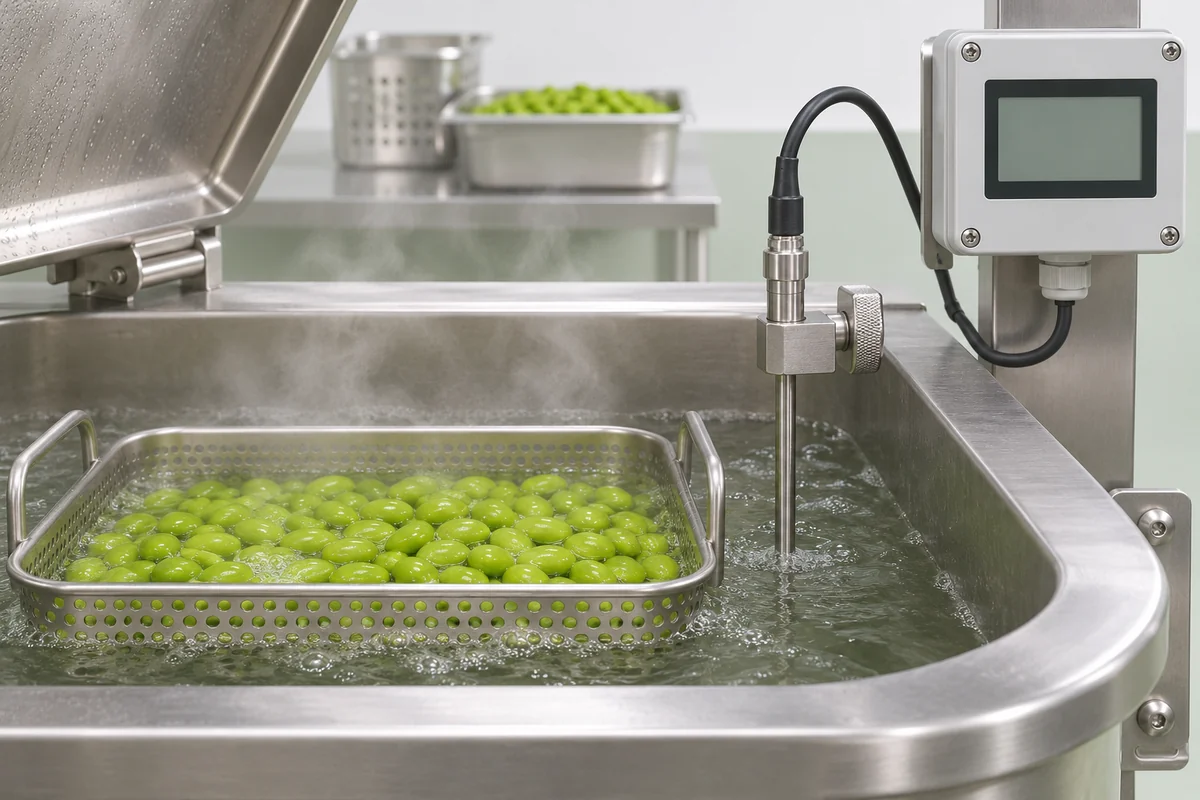
Process illustration. A process record identifies the measuring point, dwell-time method and product route.
Controls, monitoring and corrective action
The case summary identifies three CCPs. The responsible site confirms the current limits and monitoring instructions for the product and route.
| CCP and hazard | Critical limit / criterion | Monitor what and how | Frequency and person | Corrective action | Verification | Records |
|---|---|---|---|---|---|---|
| CCP1 · raw material acceptance · pesticide residues and heavy metals | For growing bases, review pre-harvest pesticide-residue evidence. For external bases, review the supply certificate and pre-harvest report. The approved receiving criteria identify which documentation must match the lot. | Review the growing-source or supply evidence, pre-harvest pesticide-residue report and the applicable product conformity evidence. | Per batch. raw-material acceptance personnel | Reject unqualified suppliers or materials | Review supplier qualifications and acceptance records under the approved plan | Supplier evaluation, acceptance and corrective-action records |
| CCP2 · blanching · pathogens | Temperature and time from the approved site plan | Observe and record blanching temperature and time | Per batch. equipment operator | Rework affected product according to the approved disposition procedure | Calibrate treatment and timing equipment on the approved schedule | Treatment operation and corrective-action records |
| CCP3 · metal detection · metal fragments | Detector challenge criteria from the approved site plan | Monitor metal detection using the detector and approved test pieces | Per batch. metal-detection operator. challenge frequency requires QA reconciliation | Find and eliminate cause, recheck detector, isolate and evaluate affected product | Review monitoring records, challenge at startup/shutdown and during operation. maintain detector under approved schedule | Detector monitoring, deviation tracking and maintenance records |
Basis cited for the case limits
The stated bases help identify which technical and order documents to request for the applicable site.
| Control | Documentary basis |
|---|---|
| CCP1 | Destination-market pesticide-residue standards and supplier or product evidence. |
| CCP2 | Company experience, laboratory verification, food technology and cited pathogen lethality references. |
| CCP3 | Customer requirements, equipment capability and a cited seafood HACCP guidance discussion. the summary and detailed basis do not list identical metal categories. |
The salted worksheet also lists a brine-heating control as CCP2a. The kernel worksheet identifies a separate disinfectant concentration and contact-time control as CCP2b. Both need reconciliation with the issued CCP schedule before assigning either to a current production route. For metal detection, the schedule and descriptions must agree on the challenge materials, frequency, reject check and where the bulk route is screened.
The case cites destination requirements, experience or verification and equipment capability in its basis for limits. The current site supplies the validated critical limit and its monitoring instruction. The buyer's specification or applicable market criteria supply the separate product acceptance conditions. Keeping those references distinct helps reviewers see which requirement applies when a result or a reading is out of range.
How a metal detection failure affects lot release
Consider an edamame pack that triggers a metal detector, or a scheduled challenge that fails to show the detector and reject device working. In a rejected-pack event, the operator keeps the pack identifiable and separate. A failed challenge raises a different question. The processor needs to determine the time interval for which detection was unverified and identify the product that moved through during that interval.
The following example shows how the evidence would move from the line to the order file. The actual processor follows its signed procedure and authorised release rules.
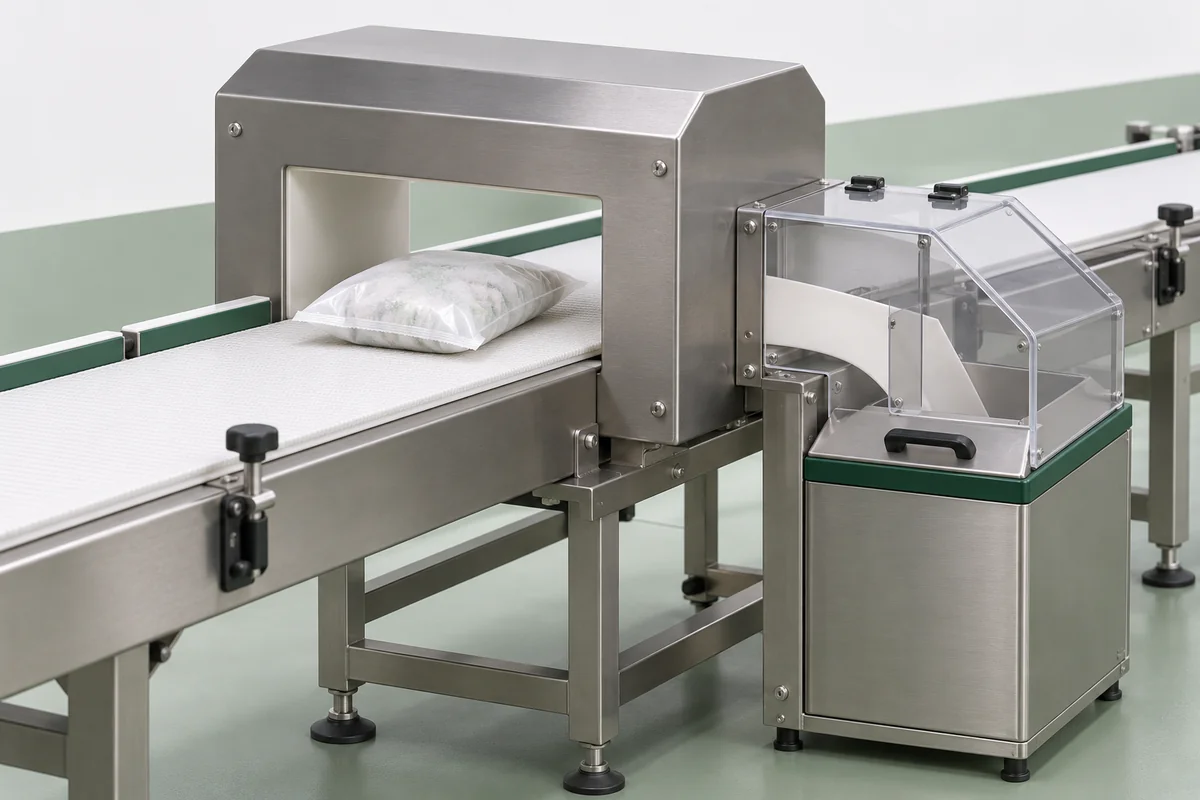
Process illustration. A rejected pack stays separate while the detector and affected production interval are evaluated.
- Identify and isolate. Mark the time, line, product and lot. Secure the rejected pack or place the affected production on hold. Use the last acceptable challenge, the process record and pack codes to establish the boundary, then widen it if the evidence requires.
- Restore and check the control. Investigate the alarm or test failure, including equipment condition and the reject system. Document any adjustment or repair. Verify the detector and rejection response with the site's approved test pieces and pack setup before relying on the line again.
- Decide what to do with the held product. The authorised quality role evaluates the affected quantity and decides whether approved re-screening, rework, rejection or disposal applies. Record the decision, the resulting lot status and the evidence needed for release.
- Match the disposition to the order. Where the affected lot belongs to a GreenLand order, we reconcile the factory decision against the lot codes, quantities and shipment file. If product has already moved, the processor and relevant parties use the traceability and notification procedure for that event.
This record lets a buyer ask a precise question after seeing a COA or a release note. Which units did the investigation cover? The answer should name the production interval and the resulting carton or pallet range so the receiving team can identify any goods that remain on hold.
Which edamame records belong to your shipment
Before shipment, ask us for the evidence appropriate to the named product, site and lot. The signed specification identifies the form, pack, intended use, market and agreed checks. The production file links the incoming or reworked material to the relevant processing run and finished pack codes. Inspection and testing records should identify which product and lot were sampled and which criteria were applied.
The final pack and loading file connects the carton range with the packing list, relevant COA, disposition status, cold storage and transport references. A reefer set point, a temperature logger trace and a product-temperature check describe different measurements. We agree which measurements the order calls for and help match them to the right shipment.

Illustration. The carton code and the logger record are separate references in the shipment file.
For an audit, include the legal site, product form and activities in the certificate scope review. Ask which records can be supplied for the specific lot and whether anything in the buyer's approval requires a site review or a third-party inspection. If an input, label or lot code changes, the order file needs a clear link to the revised approval so the receiving team can follow it.
Send us the specification or label and the checks your quality team wants to see. For a shipment already received, a photo of the carton mark and the quantity affected will help us identify the packing batch and the records behind it. Review factory audit and inspection support.
Review your frozen edamame order with GreenLand-food
GreenLand-food is a frozen edamame supplier in China. We work with the qualified manufacturer to arrange factory-direct wholesale supply and match the agreed checks and shipment documents to your order.
Send your product form, specification, packing, quantity, intended use, destination, private-label requirements and the documents your QA team needs.