Photo collage of strawberries, blackberries, raspberries and blueberries
Whole frozen strawberries in a blue liner with a caliper
Whole and halved frozen strawberries showing pale cut surfaces
Whole frozen strawberries beneath a metal sizing gauge
Whole frozen strawberries measured with a caliper
1/
Organic Frozen Strawberries
We supply certified organic IQF strawberries for importers, food factories, distributors and private-label brands when the current organic certificate scope covers the required farm, handler, processing facility, product and destination market. The standard unsweetened product contains certified organic strawberry only.
We match the organic program, whole-berry size, cut form, Brix, defect tolerance, microbiological limits, packing and shipment documents before production. Organic status is supported by valid certification and lot traceability; appearance or a pesticide test alone does not establish an organic claim.
7–11°Bx unsweetened IQF
15–25 mm / 25–35 mm
Bulk and private label
Certified lots by market
−18°C cold chain
Certified Organic IQF Frozen Strawberries for Bulk and Private Label
We supply certified organic IQF strawberries for importers, food factories, distributors and private-label brands when the current organic certificate scope covers the required farm, handler, processing facility, product and destination market. The standard unsweetened product contains certified organic strawberry only.
We match the organic program, whole-berry size, cut form, Brix, defect tolerance, microbiological limits, packing and shipment documents before production. Organic status is supported by valid certification and lot traceability; appearance or a pesticide test alone does not establish an organic claim.
7–11°Bx unsweetened IQF15–25 mm / 25–35 mmBulk and private labelCertified lots by market−18°C cold chain
Actual frozen strawberries with a caliper show how whole-berry diameter is checked. The image demonstrates size inspection, not organic certification.
Organic Is a Controlled Claim, Not a Visual Grade
The commercial description states the form and claim together: certified organic IQF whole strawberries, certified organic sliced strawberries, certified organic diced strawberries or certified organic strawberry puree. A red colour, clean appearance, "natural" wording or a residue result cannot replace certification. We use the word organic only for an order connected to the applicable certificate, certified operation and traceable lot.
Certified organic lot
The certificate scope, operator identity, product category, standard and validity period must match the order route.
100% organic ingredient
The unsweetened offer contains certified organic strawberry only; any processing aid or additional ingredient changes the label review.
Conventional lot
Conventional strawberries remain separately identified and cannot be relabelled organic because a residue screen is satisfactory.
Market-specific label
USDA Organic, EU organic and other marks follow different approvals. We review artwork against the certificate and destination program.
Organic Compliance File for the Destination Market
For the United States, a single-ingredient certified strawberry may use the "100 percent organic" category when every ingredient and processing aid meets that category. A processed product represented as "organic" must contain at least 95 percent organic ingredients, excluding water and salt. The final label, certifier statement and seal use remain subject to the accredited certifier's approval.
For European Union imports, the exporter, control body, importer and first consignee information must align with the shipment. An appropriate electronic certificate of inspection, or e-COI, is required for organic products imported into the EU. We therefore collect the destination, importer and control-body details early enough for the shipment file rather than treating organic paperwork as a generic certificate attachment.
Certificate scope
Operator, farm/handler, processing activity, product category, standard, certifier, certificate number and validity.
Lot integrity
Organic raw material code, intake quantity, production yield, packing quantity, hold/release status and shipment allocation.
Segregation
Identified storage locations, line clearance, packaging control and records separating organic and conventional material.
Shipment document
Destination-specific organic transaction or inspection documentation, plus invoice, packing list, origin and transport files.
Buyer Risks and Our Control Points
Buyer concern
Order risk
Our control
Release evidence
Certificate does not cover the order route
The organic claim may be rejected by the buyer, certifier or importer
We compare standard, operator, product scope, processing activity, validity and destination before quotation release
Applicable current certificate copy
Organic and conventional lots are mixed
Loss of organic integrity and incorrect mass balance
We identify intake, storage, production, rework, packing and dispatch quantities by status and lot
Lot ledger and production reconciliation
Uneven whole-berry size
Inconsistent retail presentation, dosing and thaw time
We grade by the agreed diameter range and inspect a representative sample
Size record and approved reference
White shoulders, green tips or dark fruit
Weak colour and uneven flavour after thawing
We sort maturity and colour before and after freezing
Defect count or weight result
Broken pieces and fines
Lower usable yield for visible-fruit applications
We define broken material by weight and match packing/handling to the target
Frozen sample separation result
Clumping and excessive frost
Poor free flow and inaccurate industrial dosing
We manage draining, freezing, frozen handling and bag sealing
Free-flow and pack inspection
Unclear COA or mixed test methods
QA cannot compare repeat lots
We place specification limits, methods and batch Actual Results in separate fields
Lot-linked COA and reports
Whole and halved frozen strawberries show two visible-fruit formats and the natural internal-colour variation assessed during product approval.
Available Forms and Starting Sizes
We quote each form against its own measurement method. Whole berries are graded by diameter; slices by thickness; dice by length, width and height; bits by particle range; puree by Brix, pH, acidity, screen and consistency.
Whole IQF: 15–25 mm, 25–35 mm, mixed 15–35 mm, or contracted range.
Halves: longitudinal halves from suitable berries, with maximum broken/fines tolerance.
Slices: 6–10 mm thickness; 8–10 mm is a common industrial request.
Diced: 10 × 10 mm standard; 6 × 6 mm can be discussed for smaller inclusions.
Bits / crumbles: economical fruit material for puree, filling, sauce and blending.
Puree: seeded or seed-reduced, raw or pasteurized frozen, supplied under a separate specification.
The values below are our starting quotation basis. They are specification limits, not claimed laboratory results for an unproduced lot. The final signed specification can tighten or adjust individual fields for the application, origin, grade, crop and destination program.
One organic ingredient; no added water, sugar, syrup, colour or preservative in the standard program
Organic program
USDA NOP, EU Organic or another contracted market program
Quoted only when the applicable current certificate and trade route are available
Botanical name
Fragaria × ananassa
Commercial cultivated strawberry
Origin / varieties
China; Sweet Charlie, Hongyan and contracted processing cultivars
Final cultivar follows crop availability and order
Whole size
15–25 mm, 25–35 mm or 15–35 mm
Measured at the widest diameter under the agreed sampling plan
Brix
7.0–11.0°Bx
Crop-natural soluble solids, measured on a prepared sample at the specified temperature
pH
3.0–4.0
Important for beverage, dairy, sauce and fruit-preparation formulation
Colour
Natural red to deep red, characteristic of ripe fruit
No serious browning, blackening or abnormal pale/green appearance
Flavour / odour
Characteristic strawberry; no fermented, musty or other off note
Assessed frozen and after controlled thawing
Frozen condition
Free-flowing, firm in frozen state, without excessive surface ice
Supports dosing, repacking and portion control
Shelf life / storage
24 months at −18°C or below, unopened
Continuous frozen storage and transport required
Size, Grade and Defect Limits
We use buyer-agreed commercial limits rather than presenting every order as an official USDA grade. U.S. Grade A can be used as a reference framework when the contract requires it, but the order must state the exact style, sample size, defect definitions and acceptance method.
Defect
Grade A commercial starting limit
Method
Broken pieces
≤5.0% by weight
Separate and weigh from frozen sample
Squashed / misshapen whole fruit
≤3.0% by weight
Visual definition agreed with reference
White shoulder / green or underripe area
≤3.0% by weight
Frozen-state visual sorting
Clearly discoloured / oxidized fruit
≤2.0% by weight
Frozen and thawed visual review
Clumped units
≤2.0% by weight
Units not separable by gentle hand pressure
Mould / decay
Not detected in inspection sample
Escalate and investigate if observed
Foreign material / insects / stones
Absent
Sorting, detection and sample inspection
The metric gauge makes whole-berry diameter and natural size distribution visible for graded IQF strawberry orders.
Product & handling footage
Strawberry Weighing & Packing Video
We share a general strawberry weighing and packing view, with whole fruit visible in the footage.
Weighing / packing
Strawberry weighing and packing
We share strawberry handling around a scale and selected packing views. Whole fruit is visible in this clip.
The strawberry production-flow collage shows raw material, destemming, washing, draining, freezing, sorting, weighing and packing. It does not itself prove organic certification.
Raw Material and Processing Control
We select ripe processing strawberries by colour, maturity, firmness, aroma and defect condition. Incoming lots are checked for traceability, mould, decay, fermentation, insects, soil and other extraneous material. Calyx and stems are removed, and fruit is washed under controlled water and sanitation procedures.
After washing, surface water is reduced before freezing. This step matters because excessive retained water can increase frost and clumping. Whole or cut fruit then passes through the appropriate freezing program. Standard whole berries, halves, slices and dice are individually quick frozen; puree is pulped and handled under its own raw or pasteurized process.
Frozen product is sorted for colour, maturity, free-flow condition, damage and foreign material. We check weight, seal condition, code, carton marks and detection controls before frozen storage. Standard IQF strawberries are not normally blanched, juiced or moulded into silicone ice-cube trays.
For an organic run, the production file also records line clearance, identified raw-material and packaging release, separation from conventional product, organic rework control, finished yield and any loss. Labels and preprinted bags remain controlled so an organic mark is not applied to a conventional lot.
Microbiological and Chemical Safety Specification
The following microbiological values are a practical starting program for raw IQF strawberries. Pasteurized puree uses a separate, tighter program. The final plan states the laboratory method, sampling frequency, number of units and destination requirement.
Parameter
Raw IQF starting limit
COA / report note
Aerobic plate count
≤100,000 CFU/g
Numerical Actual Result by batch when included
Yeasts
≤1,000 CFU/g
Method and reporting limit stated
Moulds
≤1,000 CFU/g
Separate from visual mould defect inspection
Coliforms
<100 CFU/g
Destination method applies
E. coli
<10 CFU/g
Numerical result or below reporting limit
Salmonella
Absent in 25 g
Pathogen result tied to lot
Listeria monocytogenes
Absent in 25 g where contracted
Final criterion follows market and intended use
Hepatitis A virus
Not detected in 25 g when included in the buyer test plan
Qualitative RT-qPCR result and method stated
Norovirus GI / GII
Not detected in 25 g when included in the buyer test plan
GI and GII results reported separately
Lead / cadmium
Pb ≤0.10 mg/kg; Cd ≤0.030 mg/kg for EU-oriented supply
Maximum limits, not assumed batch results
Pesticide residues
Destination MRL list; EU default 0.01 mg/kg where no specific MRL exists
Active-substance panel and crop batch identified; compliance with an MRL does not by itself establish organic status
Separate Specification for Frozen Strawberry Puree
Puree must not inherit the whole-fruit size and defect table. We quote it as a single-strength ingredient with its own physical, chemical and microbial controls. A typical pasteurized frozen starting program is shown below.
Field
Pasteurized puree starting specification
Application control
Ingredient
100% strawberry; processing aid declared if used
No hidden sugar or water
Brix / pH
≥6.0°Bx; pH 3.0–4.0
Supports formula and acidity review
Titratable acidity
0.50–1.20% as citric acid
Measured with agreed endpoint
Screen
0.3–0.6 mm
Controls seed/fibre texture
Total plate count
≤300 CFU/ml
Pasteurized program only
Yeast / mould
Yeast ≤100 CFU/ml; mould ≤10 CFU/ml
Tighter than raw IQF fruit
Coliforms / E. coli
No growth under the contracted method
Method and reporting limit on COA
How We Prepare Whole Strawberry for Frozen Supply
We prepare whole IQF strawberries to the agreed raw-material, grade and packing specification. This diagram shows the typical whole-berry process. Sliced fruit, pieces, puree and syrup-packed orders follow their own confirmed preparation, freezing and packing steps.
Typical process flow. Final processing and step order follow the confirmed specification. Site photos show the captioned subjects and may illustrate a representative form; process illustrations show typical operations. Storage and loading photos are generic frozen-food references.
Production and handling stages
Raw Material InspectionWe check identity, condition and the agreed raw-material criteria.
Initial SortingWe remove visible defects and unsuitable material.
WashingWe follow the confirmed cleaning and water-control route.
Hulling & TrimmingWe remove the green calyx and trim as required while keeping the agreed whole-berry form.
Size & Form GradingWe match size and form to the approved specification.
DrainingWe remove excess surface water before freezing.
IQF FreezingWe quick freeze prepared pieces and review separation.
Frozen Product InspectionWe review the agreed defects, form, separation and frozen condition.
Weighing, Packing & Metal ControlWe check net weight, pack integrity and agreed metal controls.
Batch Review & ReleaseWe match lot identity and records to the agreed release checks.
Frozen StorageWe maintain the agreed frozen-storage conditions and lot identity.
Reefer LoadingWe review cartons, lot records and refrigerated shipment arrangements.
Strawberry Raw-Material Inspection
We connect field or supplier-lot identification with incoming reception, processing date and finished-product batch. Raw fruit inspection focuses on ripeness, natural red colour, calyx condition, decay, mould, foreign matter and processing suitability.
The image shows general strawberry receiving and sorting evidence. It supports the raw-material control module, but it is not presented as a photograph of every order or a substitute for that batch's inspection record.
Actual strawberries are visible in the stainless-steel washing system; draining, sorting, freezing and foreign-material control follow this stage.
Batch COA and Traceability File
We prepare the batch COA around the signed specification. The specification column shows the acceptance limit; the Actual Result column shows the corresponding production-lot measurement. Where a numerical result exists, it is reported as a number or as below the laboratory reporting limit-not copied from the maximum limit.
Identity
Product form, size/cut, lot number, production date, best-before date, origin and packing.
Safety results
Microbiology plus scheduled residue, heavy-metal or other market-specific tests.
Organic integrity
Applicable certificate, source lot, intake and yield reconciliation, segregation records, label release and destination transaction or inspection document.
Shipment file
Packing list, invoice, certificate of origin, health or phytosanitary document where applicable, bill of lading and temperature records.
General company certification display. It is not presented as an organic certificate or a batch COA; the applicable current documents are supplied for the quoted order.
10 metric tons for standard bulk; normally 15 metric tons for custom printed packing
Mixed loading
3–5 metric tons per compatible frozen-fruit SKU, subject to pack and production plan
20-foot reefer
Approximately 10–12 metric tons
40-foot high-cube reefer
Approximately 20–24 metric tons
Lead time
Normally 15–25 days after specification, packing and order schedule are settled
Port / trade terms
Qingdao or contracted China port; FOB, CFR or CIF
Application Matching
Beverage and smoothie production
Use whole, halves or dice when fruit pieces enter the blender; use puree for pumpable dosing. Brix, pH, seed/fibre level and pack size matter more than visual whole-berry grade.
Bakery and dessert
Select slices or halves for visible toppings, dice for inclusions and bits/puree for fillings. Define thickness, broken rate, drip loss and colour after the customer's heat process.
Dairy and fruit preparation
Dice, bits and puree support yogurt, ice cream and cultured-product lines. The order should define seed texture, acidity, pasteurization status and downstream kill step.
Retail frozen packs
Whole 15–25 mm or 25–35 mm fruit gives a clear consumer-facing form. We review net weight, free flow, bag artwork, barcode, language and carton marks.
Foodservice and HORECA
500 g, 1 kg and 2.5 kg packs reduce repeated handling. Whole and halves serve visual applications; pieces and puree provide economical yield for sauces and bases.
Industrial jam and sauce
Bits, crumbles, block fruit or puree can reduce cost where perfect whole shape has no value. We still control colour, flavour, Brix, mould risk and foreign material.
Applications & Quality Requirements
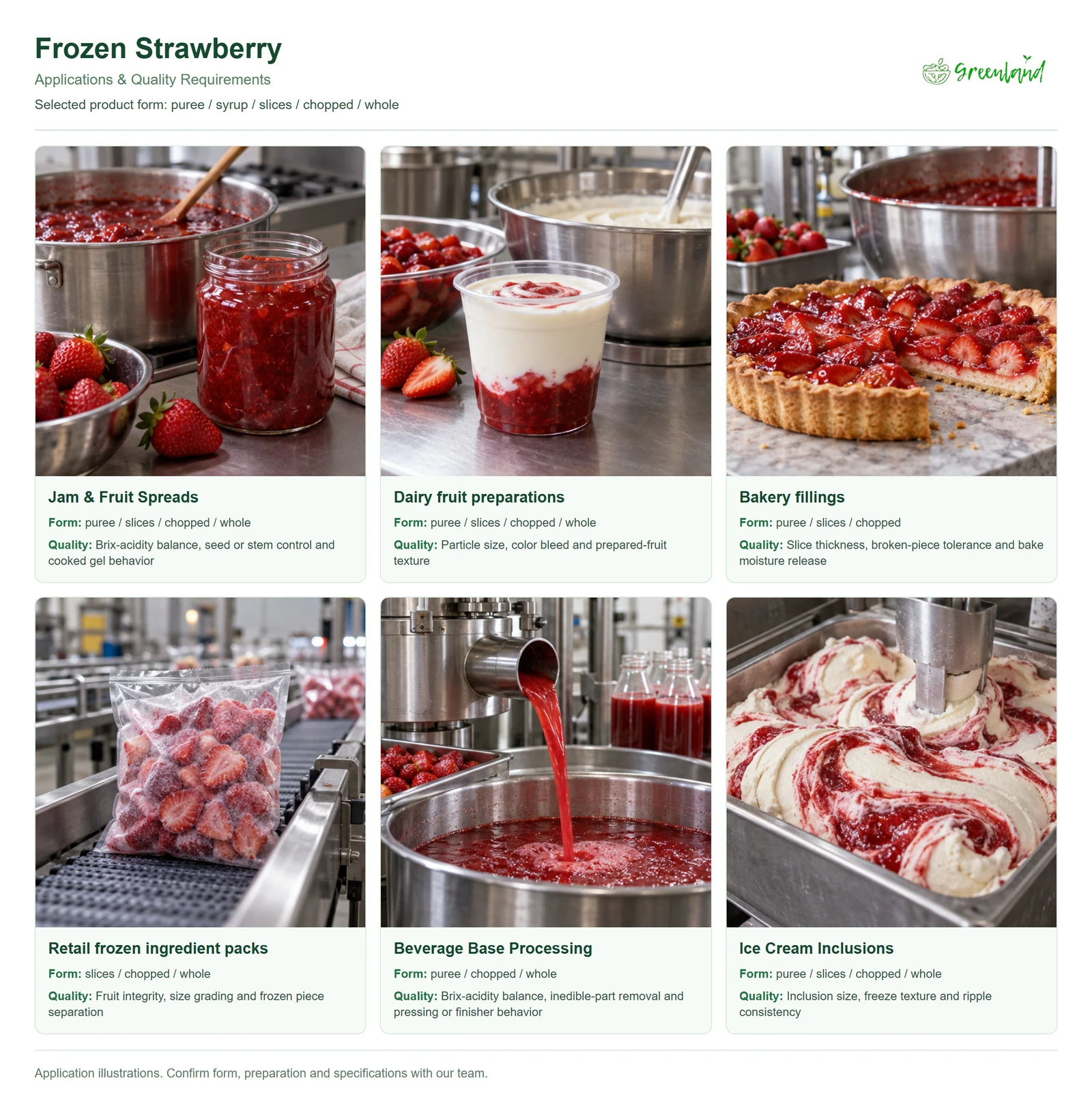
We match Organic Frozen Strawberries to your processing or packing line. Product form to confirm: Whole berries, slices, pieces, puree or syrup-packed fruit. Tell us the intended use and target texture so we can review the relevant size, grade, preparation and packing requirements before quotation.
Application illustrations. Product form, preparation and suitability follow the confirmed specification. Open the overview to inspect the image.
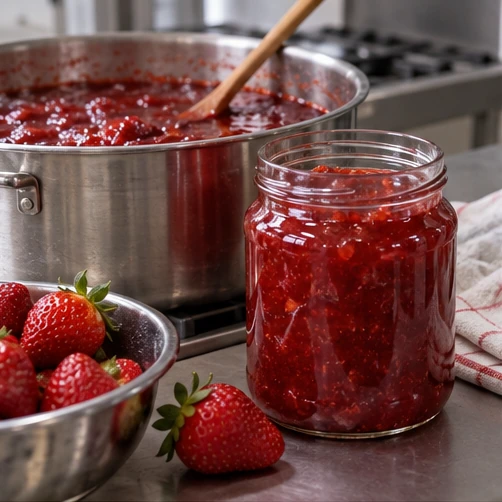
Jam & Fruit Spreads
For: Preserve and fruit preparation manufacturers
Form: puree, slices, chopped, whole
We review puree, slices, chopped, whole for your jam & fruit spreads programme. Confirm Brix-acidity balance, seed or stem control and cooked gel behavior. Pulp or size-reduce as required; validate cooking, gel formulation and filling controls.
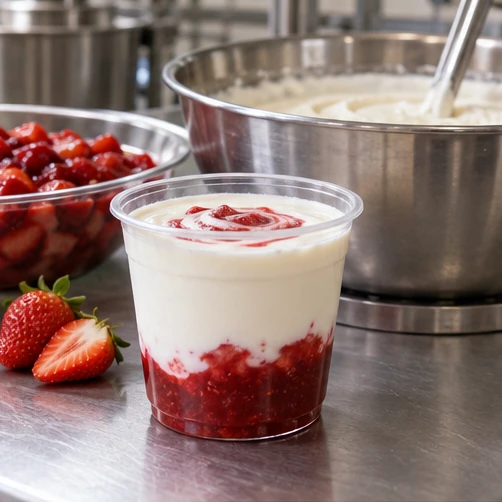
Dairy fruit preparations
For: Fruit preparation and dairy purchasing teams
Form: puree, slices, chopped, whole
We review puree, slices, chopped, whole for your dairy fruit preparations programme. Confirm particle size, color bleed and prepared-fruit texture. Prepare and validate the fruit component before dairy addition; check acidity, enzyme activity and microbiological suitability.
Bakery fillings
For: Bakery ingredient purchasing teams
Form: puree, slices, chopped
We review puree, slices, chopped for your bakery fillings programme. Confirm slice thickness, broken-piece tolerance and bake moisture release. Cook or formulate the filling and validate bake performance; freezing is not a kill step.
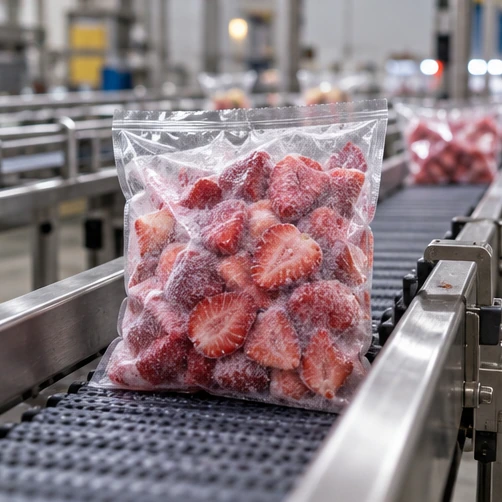
Retail frozen ingredient packs
For: Retail packers and private label purchasing teams
Form: slices, chopped, whole
We review slices, chopped, whole for your retail frozen ingredient packs programme. Confirm fruit integrity, size grading and frozen piece separation. Confirm consumer intended use and preparation instructions; no automatic thaw-and-eat positioning. Label the confirmed consumer preparation method and expected handling; do not imply unvalidated thaw-and-eat suitability.
Beverage Base Processing
For: Juice processors and beverage ingredient manufacturers
Form: puree, chopped, whole
We review puree, chopped, whole for your beverage base processing programme. Confirm Brix-acidity balance, inedible-part removal and pressing or finisher behavior. Buyer must extract/filter as appropriate and validate beverage heat treatment or equivalent safety process.
Ice Cream Inclusions
For: Ice cream ingredient procurement teams
Form: puree, slices, chopped, whole
We review puree, slices, chopped, whole for your ice cream inclusions programme. Confirm inclusion size, freeze texture and ripple consistency. Validate fruit preparation, freezing texture and safe addition stage; raw frozen fruit is not ready-to-eat by default.
Match the Application with the Purchasing Specification
Application
Selected form
Quality points to confirm
Jam & Fruit Spreads
puree, slices, chopped, whole
Brix-acidity balance, seed or stem control and cooked gel behavior
Dairy fruit preparations
puree, slices, chopped, whole
particle size, color bleed and prepared-fruit texture
Bakery fillings
puree, slices, chopped
slice thickness, broken-piece tolerance and bake moisture release
Retail frozen ingredient packs
slices, chopped, whole
fruit integrity, size grading and frozen piece separation
Beverage Base Processing
puree, chopped, whole
Brix-acidity balance, inedible-part removal and pressing or finisher behavior
Ice Cream Inclusions
puree, slices, chopped, whole
inclusion size, freeze texture and ripple consistency
Send us the product, required form, final application, key quality requirements, packing, quantity and destination market. We will review the supply programme and confirm the order specification with your team.
We hold and ship frozen strawberries at −18°C or below. Before dispatch, we review lot separation, carton condition, code, quantity, reefer cleanliness, set point and loading arrangement. The customer's receiving team should check seal, product identity, carton condition, temperature evidence and signs of thaw/refreeze damage.
Repeated temperature fluctuation can increase surface frost, clumping, soft texture and drip loss. A single air-temperature reading during open-door unloading does not define product condition by itself; the receiving decision should use product core condition, recorder history, inspection sample and contracted tolerance.
A wrapped export pallet shows carton labels, stacking and shipment handling. It is general frozen-fruit packing evidence, not proof of an organic strawberry lot.
Palletized cartons inside a refrigerated container show a general frozen-fruit loading arrangement; the image does not establish organic status.
Private Label and Pallet Planning
For private-label supply, we review bag size, material structure, seal width, coding area, ingredient statement, nutrition basis, storage instruction, country of origin, barcode, label language and destination claims. Organic wording, certifier identification, operator code and permitted seal use are checked against the applicable certification program before artwork approval and printed-material release.
Pallet use changes payload and airflow. We calculate carton dimensions, stacking pattern, pallet height, gross weight and container load together. Container quantities remain planning ranges until the exact packing and carrier payload are known.
Sample Approval and Industrial Trial Plan
We use sampling to turn a visual product request into a repeatable commercial standard. A sample should carry the product name, form, size, lot number, production date, storage requirement and ingredient declaration. The sample represents that lot; it does not remove natural crop variation or replace the signed specification for future production.
During approval, record the thawing method and inspection temperature. Whole strawberries can look acceptable while frozen but release excessive liquid, soften rapidly or reveal pale internal tissue after thawing. We recommend assessing frozen colour and free flow first, then checking aroma, flavour, internal colour, texture and drip under a controlled thawing procedure. The retained approved sample provides a sensory reference, while numerical limits and defined methods remain the contractual acceptance basis.
Beverage trial
Record dosage, blending time, seed/fibre behaviour, Brix, pH, colour and settling after the customer's heat or filling process. Compare whole fruit, dice and puree on usable yield rather than price per kilogram alone.
Bakery trial
Record slice or dice integrity, water release, colour migration and shape after baking, proofing or refrigerated holding. Define acceptable fines and broken material for the visible application.
Dairy trial
Review acidity interaction, colour, particle distribution and flavour after culture, pasteurization or frozen-dessert processing. State whether the fruit ingredient needs a validated kill step before addition.
When the industrial trial is approved, we transfer the agreed fields into the sales specification and order file: product form, size/cut, grade, Brix, pH, defect tolerances, microbiological program, packing, label, pallet plan and documents. This reduces the risk of approving one form and receiving another commercial grade at shipment.
Receiving Inspection and Claim Evidence
At destination, receiving inspection should use a representative sampling plan rather than one carton selected from the container door. Record the container number, seal, arrival time, reefer setting, temperature information, pallet and carton condition, product code and the number of sampled units. Photographs should retain the carton label and lot identity whenever possible.
Frozen inspection covers free flow, clumps, frost, colour, size/cut, broken pieces, packaging leakage and foreign material. Controlled thawing then supports evaluation of aroma, flavour, texture, internal colour and drip. If a result is outside the agreed tolerance, isolate the affected lot and preserve unopened cartons, opened sample, temperature record, laboratory report and dated photographs. This evidence is more useful than a general description such as "soft fruit" or "poor quality."
Receiving point
Evidence to retain
Decision value
Shipment identity
Container, seal, bill of lading, pallet and lot codes
Links the inspection to the delivered consignment
Frozen condition
Temperature record, core check where agreed, frost and clump photographs
Separates product defects from transport or handling events
Physical conformance
Sample weight, size readings, defect separation and scale photographs
Allows comparison with the contracted limit and method
Laboratory concern
Sealed sample chain, method, laboratory result and remaining retained product
Supports a batch-specific technical investigation
Repeat-Order and Specification Change Control
Strawberry colour, firmness and Brix naturally move with cultivar, field, maturity and crop period. We control repeat orders through written tolerances and batch records rather than promising that every berry will look identical. If the origin, cultivar, factory, process, size distribution, packing material or test method changes, the commercial effect is reviewed before the new basis is used.
The traceability chain connects raw-material source and reception lot to processing date, production shift, packaging batch, finished-product code, cold-store position and shipment. For a complaint or withdrawal exercise, this structure supports backward review of raw fruit and production records and forward identification of the shipments that received the finished lot.
Your purchasing team should also compare total usable cost. A lower-priced mixed-size berry with 10% broken material can be more expensive for retail or visible dessert use than a contracted 25–35 mm grade with a 5% limit. For puree or jam, the same broken material may provide economical yield. We therefore match grade to application instead of applying the most expensive visual grade to every program.
Frequently Asked Questions
1. What proves that the frozen strawberries are organic?
A current certificate must cover the relevant operator, activity, product and market program, and the shipment must link to a traceable certified lot. Appearance and residue testing alone are not organic proof.
2. Which strawberry forms can you supply?
We supply whole berries, halves, 6–10 mm slices, 10 × 10 mm dice, bits/crumbles and frozen puree under form-specific specifications.
3. What whole-berry sizes are available?
Common ranges are 15–25 mm, 25–35 mm and mixed 15–35 mm. We can write another range into the order when crop and sorting capability permit.
4. What is the Brix range?
Unsweetened IQF strawberries normally use a 7–11°Bx starting range. Frozen puree starts from ≥6°Bx, while sweetened fruit requires a separate finished Brix.
5. Can the product be labelled 100 percent organic?
A single-ingredient certified strawberry can fit that category for the U.S. when all ingredients and processing aids comply. The accredited certifier must approve the final label and seal use.
6. What is the maximum broken rate?
Our Grade A commercial starting limit is ≤5% by weight for broken pieces. A tighter visible-fruit program can be quoted against sample and crop.
7. Does an EU organic shipment require an e-COI?
Yes. Organic products imported into the EU require the appropriate electronic certificate of inspection. Exporter, control body, importer, first consignee and consignment data must align.
8. What packing options are available?
Common packs include 1 × 10 kg, 4 × 2.5 kg, 10 × 1 kg and 20 × 500 g. We also prepare contracted foodservice and private-label packs.
9. What is the MOQ?
Standard bulk orders start from 10 metric tons. Custom printed packing normally starts from 15 metric tons, with mixed frozen-fruit loading discussed separately.
10. Can you provide a batch COA?
Yes. The COA can include lot identity, sensory results, Brix, pH and contracted microbiology. Actual Results represent the corresponding production batch.
11. Can residues and heavy metals be tested?
Yes. We align the panel with the destination market. EU-oriented starting limits include Pb ≤0.10 mg/kg and Cd ≤0.030 mg/kg for strawberries.
12. How should the product be stored and shipped?
Store and transport at −18°C or below. Avoid repeated thawing and refreezing because it can increase frost, clumping, soft texture and drip loss.
13. Can I order private-label organic frozen strawberries?
Yes, when the certified route and MOQ fit the project. We review organic wording, certifier details, permitted seal, ingredient statement, barcode, language, carton marks and pallet plan before print release.
We review the selected form, grade, process and packing against the technical schedule below. Published and TDS values are specification references for order review. External benchmarks apply only within their stated scope. Acceptance is governed by the signed SKU specification; the identified lot COA reports actual measured results.
Check raw-material identity and variety/source declaration against the ordered programme. Programme: Starting specification.
Origin / varieties - Starting specification
China; Sweet Charlie, Hongyan and contracted processing cultivarsPublished reference
Confirm method, representative sample and acceptance basis in the signed specification. Programme: Starting specification.
Colour - Starting specification
Natural red to deep red, characteristic of ripe fruitPublished reference
Compare with the approved sensory reference using the stated frozen/thawed/prepared condition. Programme: Starting specification.
Flavour / odour - Starting specification
Characteristic strawberry; no fermented, musty or other off notePublished reference
Compare with the approved sensory reference using the stated frozen/thawed/prepared condition. Programme: Starting specification.
Squashed / misshapen whole fruit - Grade A commercial starting limit
≤3.0% by weightPublished reference
Visual definition agreed with reference. Programme: Grade A commercial starting limit.
Clearly discoloured / oxidized fruit - Grade A commercial starting limit
≤2.0% by weightPublished reference
Frozen and thawed visual review. Programme: Grade A commercial starting limit.
Style-specific measurement
For solid cuts, report each required dimension and the in-size fraction; for minced material, report particle distribution; for moulded puree or portions, report unit mass and refining grade separately.
Apply the measurement method to the selected physical style; do not use a portion weight as a solid-cut dimension.
Sensory acceptance
Characteristic colour, flavour and texture for the declared product; no abnormal odour or visibly deteriorated material.External referenceCodex
Compare an identified frozen sample with the approved grade and defect schedule. External technical reference; confirm SKU and market applicability.
02 / Physicochemical & Residue Controls
Parameter
Specification / reference
Verification & order basis
Brix - Starting specification
7.0–11.0°BxPublished reference
Measure representative prepared sample with a temperature-compensated refractometer. Programme: Starting specification.
pH - Starting specification
3.0–4.0Published reference
Use calibrated pH meter or titration on the stated sample preparation. Programme: Starting specification.
Lead / cadmium - Raw IQF starting limit
Pb ≤0.10 mg/kg; Cd ≤0.030 mg/kg for EU-oriented supplyPublished reference
Use a validated analytical method for this matrix; report sample basis, unit, preparation and lot result. Programme: Raw IQF starting limit. Published commercial target; verify current destination limits, edible-part basis and any processing factor before approval.
Pesticide residues - Raw IQF starting limit
Destination MRL list; EU default 0.01 mg/kg where no specific MRL existsPublished reference
Use a validated analytical method for this matrix; report sample basis, unit, preparation and lot result. Programme: Raw IQF starting limit.
Thaw yield / drip loss
For a drip-sensitive grade, define thawing conditions, draining apparatus and duration before setting a numerical target.
Record initial sample mass and drained liquid mass; drip loss (%) = 100 × drained liquid mass / initial sample mass.
Pesticide residue schedule
Named active ingredients and commodity-specific limits are selected for the destination market. EU source
Link farm spray history, laboratory LOQ and batch result to the destination MRL. EU database is one market reference; apply the actual destination rule.
Lead, cadmium and other contaminants
Apply the limit for the exact commodity and processed form in the destination market. EU source
State analyte, preparation basis, method, LOQ and lot result. Do not transfer a fresh-commodity limit to a processed form without the required assessment.
03 / Microbiological Criteria
Parameter
Specification / reference
Verification & order basis
Aerobic plate count - Raw IQF starting limit
≤100,000 CFU/gPublished reference
Report the named organism, analytical method, sample mass, sampling plan and lot result; use CFU/g for enumeration and a stated mass for detection. Programme: Raw IQF starting limit.
Yeasts - Raw IQF starting limit
≤1,000 CFU/gPublished reference
Report the named organism, analytical method, sample mass, sampling plan and lot result; use CFU/g for enumeration and a stated mass for detection. Programme: Raw IQF starting limit.
Moulds - Raw IQF starting limit
≤1,000 CFU/gPublished reference
Report the named organism, analytical method, sample mass, sampling plan and lot result; use CFU/g for enumeration and a stated mass for detection. Programme: Raw IQF starting limit.
Coliforms - Raw IQF starting limit
<100 CFU/gPublished reference
Report the named organism, analytical method, sample mass, sampling plan and lot result; use CFU/g for enumeration and a stated mass for detection. Programme: Raw IQF starting limit.
E. coli - Raw IQF starting limit
<10 CFU/gPublished reference
Report the named organism, analytical method, sample mass, sampling plan and lot result; use CFU/g for enumeration and a stated mass for detection. Programme: Raw IQF starting limit.
Salmonella - Raw IQF starting limit
Absent in 25 gPublished reference
Report the named organism, analytical method, sample mass, sampling plan and lot result; use CFU/g for enumeration and a stated mass for detection. Programme: Raw IQF starting limit.
Listeria monocytogenes - Raw IQF starting limit
Absent in 25 g where contractedPublished reference
Report the named organism, analytical method, sample mass, sampling plan and lot result; use CFU/g for enumeration and a stated mass for detection. Programme: Raw IQF starting limit.
Hepatitis A virus - Raw IQF starting limit
Not detected in 25 g when included in the buyer test planPublished reference
Report the named organism, analytical method, sample mass, sampling plan and lot result; use CFU/g for enumeration and a stated mass for detection. Programme: Raw IQF starting limit.
Norovirus GI / GII - Raw IQF starting limit
Not detected in 25 g when included in the buyer test planPublished reference
Report the named organism, analytical method, sample mass, sampling plan and lot result; use CFU/g for enumeration and a stated mass for detection. Programme: Raw IQF starting limit.
Enteric-virus risk programme
For a direct-consumption berry programme, assess hepatitis A and norovirus controls and any buyer-required verification. FDA
Use an appropriate validated method and sampling plan; support testing with farm, worker and water hygiene controls. FDA prevention guidance is a risk-control reference; it does not assign a universal numerical batch limit.
Acceptance schedule
Select the test panel and limits by intended use (ready-to-eat or further processing), product form and destination. EU source
State organism, analytical method, sample mass and n/c plan; report actual lot results. A universal APC, coliform, Salmonella or Listeria limit is not assigned to every frozen product.
04 / Freezing & Cold Chain
Parameter
Specification / reference
Verification & order basis
Frozen storage and transport
≤−18 °CTDS reference
Product core check and logger record. Selected form and grade must match this TDS reference. Applies to: Frozen Strawberry frozen formats.
Frozen condition - Starting specification
Free-flowing, firm in frozen state, without excessive surface icePublished reference
Confirm method, representative sample and acceptance basis in the signed specification. Programme: Starting specification.
Shelf life / storage - Starting specification
24 months at −18°C or below, unopenedPublished reference
Keep inherent moisture, loose ice and permanently frozen clusters as separate inspection categories.
Weigh separated loose ice and welded clusters against initial sample mass; distinguish natural paired pieces or blocks.
Product thermal centre
−18°C or colder after freezing and thermal stabilization; maintain the agreed frozen distribution condition.External referenceCodex
Probe the thickest representative pack and retain storage/transport temperature records. Codex quick-frozen reference; selected product form and route must be frozen.
Frozen condition at dispatch
Hard frozen, correctly sealed and coded, without thaw/refreeze evidence or excessive loose ice. Codex
Check pack integrity, free-flow or block condition as declared, carton condition and loading temperature.
05 / Pack Size & Shelf Life
Parameter
Specification / reference
Verification & order basis
Bulk packing
1 × 10 kg PE liner/carton; 4 × 2.5 kg; 10 × 1 kgPublished reference
Check approved pack drawing, calibrated scale and production records.
Declared net contents
Verify each selected pack format against the artwork and applicable quantity-control rule. Codex
Calibrated checkweigher or scale; defined sample and tare.
Shelf-life basis
The labelled period applies only to its validated pack and continuous stated storage condition. Codex
Review stability study or approved shelf-life file and production-date code.
06 / Process Controls
Parameter
Specification / reference
Verification & order basis
Raw-material preparation checks
Separate unsweetened IQF, syrup-packed fruit, puree and freeze-dried styles; hull before the declared processing route.
Verify the selected product flow and the relevant trimming, sorting and pretreatment record.
CCP designation
Use the site-approved HACCP plan to identify true CCPs and their validated critical limits. Codex
Check hazard analysis, monitoring, deviation and corrective-action records. A quality-control step is not automatically a CCP.
07 / Ingredients, Additives & Allergens
Parameter
Specification / reference
Verification & order basis
Organic programme verification
Use organic wording only when raw materials, processing, packing and the final product are covered by a valid certificate for the destination scheme.
Verify operator/product scope, validity, component certificates and shipment documentation against the ordered lot.
Added glaze / coating declaration
Declare any intentionally added water glaze, syrup, oil or coating and the measurement basis; loose ice is assessed separately.
Verify formula/addition records; agree a deglazing or coating test and net-content basis where applicable.
Ingredient statement
100% strawberry; processing aid declared if usedTechnical control
Compare approved formula, product label and supplier bill of materials. Published product statement; verify final commercial formula.
Additive use
Declare any colour-protection agent, acidulant or other additive by ingredient and maximum permitted use for the target market. NHC standard
Check approved formula, actual addition record and market-specific additive category. GB 2760-2024 applies to China; export rules are checked separately.
Allergen and cross-contact assessment
Declare inherent allergens and assess shared-line cross-contact from the actual facility schedule. FDA
Review line matrix, cleaning validation and buyer label approval. Do not claim a shared-line allergen or allergen-free status without facility evidence.
08 / Defects & Foreign Matter
Parameter
Specification / reference
Verification & order basis
Broken pieces - Grade A commercial starting limit
≤5.0% by weightPublished reference
Separate and weigh from frozen sample. Programme: Grade A commercial starting limit.
Clumped units - Grade A commercial starting limit
≤2.0% by weightPublished reference
Units not separable by gentle hand pressure. Programme: Grade A commercial starting limit.
Mould / decay - Grade A commercial starting limit
Not detected in inspection samplePublished reference
Escalate and investigate if observed. Programme: Grade A commercial starting limit.
Foreign material / insects / stones - Grade A commercial starting limit
AbsentPublished reference
Sorting, detection and sample inspection. Programme: Grade A commercial starting limit.
Stalks or stalk parts: Codex reference tolerance
≤3 stalks or parts each >3 mm in one dimension count per 500 g drained fruitExternal referenceCodex
Thaw until practically free of ice crystals; drain on a 3 mesh/cm (8 mesh/inch) screen for two minutes; assess 500 g drained fruit. Recover specified plant material from drained syrup; wash off post-freezing dry sugar before draining whole berries. Codex reference for quick-frozen Fragaria grandiflora L. or Fragaria vesca L. offered for direct consumption. Puree, freeze-dried fruit and products intended for further industrial processing are excluded.
Thaw until practically free of ice crystals; drain on a 3 mesh/cm (8 mesh/inch) screen for two minutes; assess 500 g drained fruit. Recover specified plant material from drained syrup; wash off post-freezing dry sugar before draining whole berries. Codex reference for quick-frozen Fragaria grandiflora L. or Fragaria vesca L. offered for direct consumption. Puree, freeze-dried fruit and products intended for further industrial processing are excluded.
Thaw until practically free of ice crystals; drain on a 3 mesh/cm (8 mesh/inch) screen for two minutes; assess 500 g drained fruit. Recover specified plant material from drained syrup; wash off post-freezing dry sugar before draining whole berries. Codex reference for quick-frozen Fragaria grandiflora L. or Fragaria vesca L. offered for direct consumption. Puree, freeze-dried fruit and products intended for further industrial processing are excluded.
Intrinsic defect classification
Calyx/stem, white immature tissue, mould, damaged fruit and excessive broken pieces.
Record each defect class separately by count or mass; state sample size, denominator and combined-limit rules.
Hazardous foreign matter
No foreign matter detected in the defined inspection sample; reject and investigate any finding.External referenceCodex
Define visual-inspection sample size and detector challenge in the signed quality schedule. "None detected" is a sampling statement, not an absolute guarantee of zero particles.
09 / Packaging Materials & Label
Parameter
Specification / reference
Verification & order basis
Food-contact pack
Specify inner-contact material and obtain the applicable food-contact compliance declaration. NHC standard
Review film structure, supplier DoC, migration evidence and actual intended conditions. GB 4806 series is China-specific; EU export also checks Regulations 1935/2004 and 10/2011.
Carton and seal integrity
Define carton stacking strength, bag seal and puncture resistance for the confirmed net weight and pallet plan. EU source
Inspect pack drawing, compression/seal test and shipment configuration.
Label verification
Match product name, ingredient/allergen statement, net weight, lot/date, shelf life and storage instruction to the destination artwork. Codex
Approve artwork against the signed specification and destination rules.
10 / Detection & Traceability
Parameter
Specification / reference
Verification & order basis
Foreign-body detector
Validate Fe, non-Fe and stainless-steel challenge pieces for the actual product, aperture, pack and line; record the proven sensitivity. Codex
Challenge at defined start, changeover, interval and end points; retain rejection records. Do not copy generic detector sizes into a plant capability claim.
Lot traceability
Link input source lot, processing run, packaging code, test records, frozen storage and shipment to one finished lot. Codex
Trace one sample lot forward and backward in a recorded mock recall. Recall speed is stated only when the site has a validated target and record.
Order approval: Confirm the selected form and grade, ingredient formula, intended use, destination market, packing, sampling plan and test panel. The signed specification controls acceptance; the identified lot COA reports actual results.