



Frozen Strawberries 1kg
Description
Technical Parameters

Choose the 1 kg Strawberry Specification by Channel
The same 1 kg net weight can serve very different operations. We therefore separate the pack configuration from the berry specification and confirm both on the proforma invoice and approved product specification.
Distributor / Foodservice
Whole 15–35 mm or 25–35 mm berries in clear or printed 1 kg bags. We focus on free-flowing condition, bag seal integrity, carton strength and repeatable count and color.
Private Label Retail
Whole or selected-size fruit with buyer artwork, barcode, nutrition panel, ingredient statement, date coding and destination-language review. Printed-film MOQ and lead time are quoted separately.
Bakery / Dairy / Beverage
Halves, 10 or 12 mm slices, and 10–15 mm dice reduce preparation time. We match Brix, piece integrity and defect tolerance to fruit filling, yoghurt, smoothie, sauce or beverage processing.
Industrial Fruit Preparation
Grade, Brix, pH, broken rate and microbiological limits carry more weight than retail appearance. We provide a batch COA showing actual results against the agreed order limits.
Buyer Risks and Our Order Controls
| Buyer concern | Where the order can fail | Our control | Release evidence |
|---|---|---|---|
| Mixed berry size | Variable piece count, thawing rate or retail appearance | We agree 15–25, 25–35, 15–35 or 35+ mm and inspect representative samples. | Approved sample, specification and batch check |
| Pale, dark or soft fruit | Weak visual yield and excessive breakdown after processing | We grade color, ripeness, damage, mushy fruit and broken pieces to written limits. | Grade record and COA fields where agreed |
| Low sweetness or formula variation | Extra sugar or recipe correction in fruit preparation | Standard Grade A starts at 7°Bx; selected contracts can start at 8°Bx. | Batch Brix actual result on COA |
| Clumping and heavy frost | Poor dosing, underweight usable fruit and possible temperature abuse | We inspect free-flowing condition, non-separable clumps, bag seals and frozen storage. | Pre-shipment appearance and loading record |
| Incorrect 1 kg label | Customs, retail or warehouse rejection | We review net content, ingredient, lot, dates, storage, origin, barcode and carton marks before printing. | Approved artwork and packing checklist |
| Missing QA documents | Delayed release or incomplete supplier file | We list required COA, micro, residue, heavy-metal and traceability documents in the order file. | Batch and shipment document package |
Whole, Halves, Slices and Dice
Whole berries remain the main frozen strawberries 1kg offer. Cut forms are separate commercial specifications because their piece integrity, yield and intended use differ. We do not substitute one form for another without written approval.

Whole IQF fruit shows separated pieces and the natural color variation expected from frozen strawberries.

Halves expose internal color and are specified separately from whole berries for bakery and fruit-preparation use.
Bulk lined packing is available for industrial orders; the 1 kg program uses individually sealed inner bags.
15–25 mm, 25–35 mm, or 35 mm up for count and appearance control.
15–35 mm for foodservice and processing where exact count is less critical.
Halves and nominal 10 or 12 mm slices; piece tolerance follows the approved sample.
10×10×10, 12×12×12 or 15×15×15 mm for controlled dosing and blending.
Commercial Specification: Frozen Strawberries 1kg
These values form a detailed quotation basis. The signed order specification prevails for each contract, while the COA reports actual results measured on the corresponding production batch.
| Product | IQF Frozen Strawberries / Frozen Strawberries 1kg |
|---|---|
| Ingredient | 100% strawberries; standard unsweetened item with no added sugar |
| Varieties | American No.13, Sweet Charlie and Honey by crop and approved supply plan |
| Origin / season | China; principal processing season April–July, with frozen stock planning for year-round shipment |
| Processing | Selected, washed, de-stemmed, sorted, individually quick frozen, graded and packed |
| Forms / sizes | Whole 15–25 mm, 25–35 mm, 15–35 mm or 35+ mm; halves; slices 10 or 12 mm; dice 10, 12 or 15 mm |
| Grade | Premium A+ or Grade A according to the defect table and approved sample |
| Brix / pH | Grade A minimum 7°Bx; selected contracts minimum 8°Bx; typical crop range 7–11°Bx. pH 3.0–4.0. |
| Appearance | Characteristic natural red to pink-red color, substantially free-flowing, clean and free from abnormal odor |
| Standard retail/foodservice pack | 1,000 g declared net content per food-grade bag; 10 bags per export carton |
| Other packing | 2.5 kg bags or 10 kg bulk lined carton by order; private-label printed film by artwork and MOQ |
| Shelf life / storage | 24 months from production at −18°C or below; protect from thawing and refreezing |
| MOQ | Normally one 20 ft frozen container or a mixed-container plan; printed private-label film is quoted by bag quantity |
| Loading reference | Approximately 23–25 metric tons per 40 ft reefer without pallets; final quantity depends on carton, pallet and weight limits |
| Lead time | Normally 15–21 days after specification, artwork, packing and order schedule are confirmed |
| Trade / ports | FOB, CFR or CIF; Xiamen, Qingdao or Dalian according to origin stock and shipment plan |
| Document support | Product specification, batch COA, packing list, commercial invoice, bill of lading, origin and health documents, plus agreed test reports |
| Intended use | Default commercial specification is for further processing or preparation. Ready-to-eat status requires a separately agreed and validated program. |
Grade and Defect Limits That Can Be Put on the Purchase Order
"Grade A" is useful only when the defects are measurable. We use the table below as a detailed starting standard and adjust the sampling method, unit basis and final acceptance level before order release. For whole fruit, the color and damage framework is aligned with recognized frozen-strawberry grading principles, while tighter commercial limits can be agreed for retail packs.
| Parameter | Premium A+ starting limit | Grade A starting limit | Why it matters |
|---|---|---|---|
| Good pink/red color | ≥90% by count | ≥85% by count | Retail appearance and fruit-preparation color |
| Materially dark / low-color fruit | ≤3% by count | ≤5% by count | Reduces visual inconsistency |
| Damaged fruit | ≤1.5% w/w | ≤2.5% w/w | Controls decay marks, cuts and objectionable damage |
| Partial plus mushy whole fruit | ≤5% w/w | ≤10% w/w | Controls usable whole-fruit yield |
| Calyx, leaves and short stems | ≤2 pieces/kg | ≤4 pieces/kg | Shows effectiveness of de-stemming and final sorting |
| Non-separable clumps | ≤2% w/w | ≤5% w/w | Protects dosing and portion control |
| Fruit below 16 mm in calibrated whole grade | ≤3% by count | ≤5% by count | Prevents undersize drift in selected packs |
| Foreign material | Absent | Absent | Food-safety and customer-complaint control |
| Abnormal flavor or odor | Absent | Absent | Confirms characteristic product condition |

The visual shows strawberries being selected before freezing; we use this stage to remove calyx, damaged fruit and unsuitable ripeness.
Processing Flow and Product-Specific Control Points
1. Raw material reception: we record crop source and lot, then inspect maturity, color, decay, foreign matter and temperature. Fruit that cannot meet the approved grade is separated before processing.
2. Washing and de-stemming: we wash the fruit and remove stalks, calyx and leaves. The controls target soil, plant matter and visible defects without presenting washing as a substitute for a validated pathogen-control program.
3. Form and size control: whole berries are calibrated; halves, slices and dice are checked against nominal cut and approved tolerance.
4. IQF freezing: pieces are frozen individually to limit large blocks. Product exits the process frozen and proceeds to grading and packing without intentional thawing.
5. Final inspection and packing: we inspect color, damage, clumps, plant matter, seals, weight and coding, then connect the packed lot to frozen-storage and shipment records.

The production sequence shown covers raw fruit, stalk removal, washing, draining, freezing, sizing, sorting, weighing, sealing and frozen storage.
Microbiological, Chemical and COA Framework
The table below is a detailed commercial release basis for a standard further-processing item. Destination law, intended use and buyer risk assessment may require different limits or methods. If the product will be sold as ready-to-eat, that status must be stated in the RFQ and handled under a separately agreed validated program.
| Test item | Standard order limit | COA / report entry |
|---|---|---|
| Aerobic plate count | ≤100,000 CFU/g | Actual result, method and batch |
| Yeast | ≤5,000 CFU/g | Actual result |
| Mold | ≤5,000 CFU/g | Actual result; commercial acceptance is not based on an enforcement action level |
| Coliforms | ≤100 CFU/g | Actual result when included |
| Escherichia coli | <10 CFU/g | Actual result / detection level |
| Salmonella | Absent in 25 g | Detected / not detected by agreed method |
| Listeria monocytogenes | Absent in 25 g for the standard proposed plan | Detected / not detected when ordered |
| Lead (EU reference) | ≤0.10 mg/kg wet weight | Actual result on the agreed surveillance or batch report |
| Cadmium (EU reference) | ≤0.030 mg/kg wet weight | Actual result on the agreed surveillance or batch report |
| Pesticide residues | Each active substance within destination-market MRL; EU default 0.01 mg/kg where no specific MRL applies, subject to statutory exceptions | Compound list, LOQ and actual result on the agreed report |
| Brix / pH | Per signed grade: ≥7°Bx or ≥8°Bx; pH 3.0–4.0 | Actual batch results |
Hepatitis A and norovirus testing is not represented as a routine COA item. We add it only when the destination program, intended use or buyer agreement calls for a defined method, sampling plan and acceptance rule.
What a Useful Batch COA Shows
A product specification gives the permitted limit; a COA records what was measured for the produced lot. We do not present a specification limit as though it were an actual laboratory result. The batch COA can contain the following fields according to the signed test plan:
Product name, form, size, grade, production date, best-before date, lot number and packing.
Color, appearance, odor, Brix, pH, defects, clumps and net-weight checks where agreed.
Specification limit, actual result, unit and test method for the selected indicator and pathogen panel.
Conformity conclusion and authorized review connected to the packed and shipped batch.
Residue and heavy-metal reports may be issued by crop surveillance, production batch or shipment plan rather than printed automatically on every basic COA. Tell us the destination market and required report frequency in the RFQ so the commercial offer includes the correct testing cost and timing.
1 kg Bag, Carton and Private-Label Control
Our standard offer places ten 1,000 g bags in one export carton. We confirm whether the bag is clear, plain printed, sticker-labelled or fully private label. The film structure and thickness are selected for frozen use and the sealing trial must suit the chosen fruit form; sharp frozen edges and rough handling can challenge a weak seal.
The artwork checklist covers product name, ingredient statement, declared net content, storage statement, preparation or intended-use wording, origin, nutrition panel when required, lot coding, production and best-before dates, manufacturer/exporter/importer details, barcode, recycling marks and destination language. We review print position and readable code area before mass production.
Carton confirmation covers 10 × 1 kg configuration, board strength, inner layout, carton mark, lot identification and pallet requirement. We inspect bag count, seal, coding and weight during packing. The declared net content is 1,000 g; the release check follows the destination's legal-metrology rule and the agreed buyer standard.
Private-label printed film has a separate MOQ because printing cylinders, film production and artwork approval affect the schedule. For a first order or a multi-SKU trial, a plain bag plus compliant buyer label may provide a lower-risk entry plan.

This generic export-packing image shows pallet stabilization and carton labels; it is not presented as a strawberry-specific packed lot.
Application Matching Without Changing the Order Standard
Bakery and Fillings
We recommend halves, 10–12 mm slices or dice when deposit accuracy matters. State whether visible fruit pieces must survive mixing and heating; this affects form, broken tolerance and Brix.
Dairy and Fruit Preparation
Dice or broken whole fruit can suit yoghurt and fruit bases. We match Brix and pH to the processor's formulation rather than promising one crop value for every batch.
Beverage and Smoothie Processing
Mixed-size whole, halves or dice may reduce raw-material cost where final blending removes visible piece differences. The microbiological and intended-use plan still requires explicit agreement.
Foodservice Distribution
The 1 kg bag controls portion handling for kitchens and regional distributors. We emphasize bag strength, separated fruit, carton coding and reliable frozen delivery.
Retail Frozen Brand
Selected whole berries provide a stronger visible pack. We coordinate grade, printed film, barcode, market language, pallet pattern and outer-carton marks as one approval sequence.
Jam, Sauce and Industrial Use
Appearance grade can be balanced against Brix, color and defect limits. We quote the economically relevant specification instead of charging for calibrated whole fruit that will be crushed.

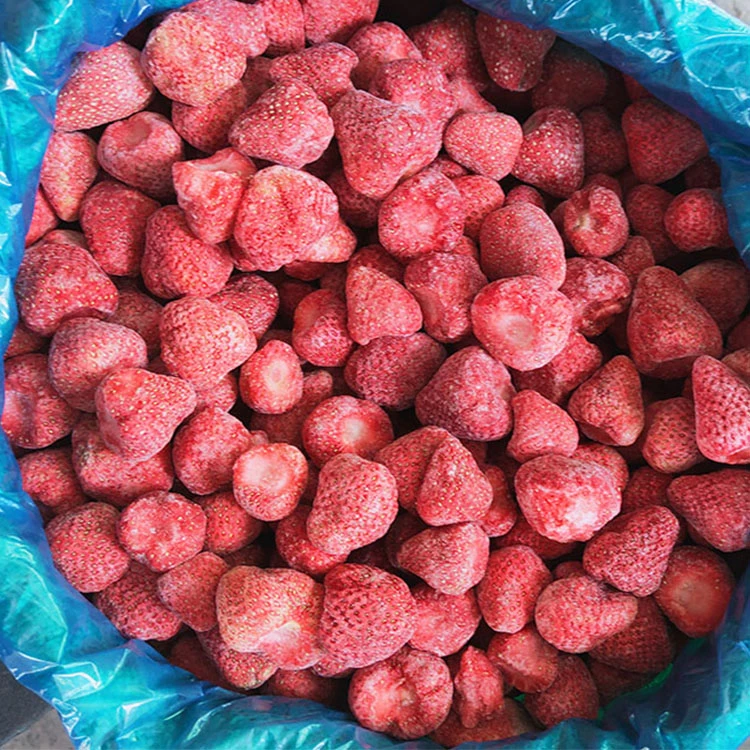
Actual bulk strawberry appearance: liner cleanliness, frost, fruit condition and foreign matter remain visible inspection points.
Documents and Lot Traceability
We connect the finished lot number with raw-material reception, production date, processing line, packing shift, inner-bag and carton coding, frozen storage and shipment. This link helps your QA team investigate a complaint without treating an entire season as one unidentified batch.
The standard shipment file can include commercial invoice, packing list, bill of lading, certificate of origin and health or phytosanitary documentation when applicable to the destination. The buyer's supplier-approval file can also include the signed specification, certificate copies for the relevant producing facility, batch COA and agreed third-party reports.
We provide residue, heavy-metal, microbiological or pre-shipment inspection reports according to the signed order plan. Document names, report frequency, test methods and issuing laboratory should be listed before production, especially for retailer programs.
Review our traceability approach or see the frozen-food quality-control system.
Cold Storage, Loading and Receiving Control
Frozen condition must be protected after packing. We hold the product at −18°C or below, plan reefer loading around carton and pallet configuration, and provide shipment records according to the contract. A 40 ft reefer can carry approximately 23–25 metric tons without pallets, while palletized loads normally carry less because pallet dimensions, airflow, axle weight and destination limits affect the final plan.

General cold-storage evidence for frozen export handling; the image is not described as a dedicated strawberry warehouse.

General container-loading evidence: pallet pattern and carton dimensions change the final quantity and airflow plan.

Actual caliper check of frozen whole fruit supports size verification during sample and batch inspection.
Sample Approval and Repeat-Order Standard
A photograph cannot define the full grade. For the first order, we prepare the sample against a written draft specification and ask your team to evaluate frozen appearance, thawed appearance where relevant, size distribution, color, firmness, drip, flavor, Brix and intended-process performance.
After approval, we identify the sample and attach the final measurable limits to the order. Crop variation remains natural, but the acceptance framework does not change silently. If a new crop, variety, cut or packing plan requires a revision, we issue the revised parameters before production.
For repeat orders, send the previous contract or lot reference. We use it to compare form, grade, Brix target, defect limits, 1 kg artwork, carton marks, documents and loading plan instead of rebuilding the standard from a short product name.
Frozen Strawberries 1kg FAQ
1. What is the standard Frozen Strawberries 1kg carton?
Our standard proposal is ten 1,000 g bags in one export carton. Bag material, print, labels, carton dimensions and palletization are finalized with the order.
2. Are the strawberries sweetened?
The standard item is 100% strawberry with no added sugar. Sweetened or syrup-packed products are different formulations and are not substituted for the unsweetened IQF specification.
3. Which whole strawberry sizes are available?
We quote 15–25 mm, 25–35 mm, 15–35 mm and 35 mm up. The approved size range, undersize tolerance and sampling basis appear in the order specification.
4. Can you supply sliced or diced frozen strawberries in 1 kg bags?
Yes. Nominal 10 or 12 mm slices and 10, 12 or 15 mm dice can be packed in 1 kg bags when the order volume and line plan are workable.
5. What Brix can be specified?
Grade A starts at 7°Bx; selected programs can start at 8°Bx. Crop batches commonly fall within 7–11°Bx, and the COA shows the actual result for the relevant lot.
6. How do Premium A+ and Grade A differ?
Premium A+ uses tighter color, damage, broken, plant-matter and clump limits. Grade A remains a defined commercial grade, not an unrestricted mixed-quality product.
7. Is the product ready to eat?
Our default commercial specification is intended for further processing or preparation. If your market requires a ready-to-eat program, state this before quotation so the hazard controls, test plan and label wording can be separately agreed.
8. Which microbiological results can appear on the COA?
The agreed panel may include aerobic plate count, yeast, mold, coliforms, E. coli, Salmonella and Listeria monocytogenes. The COA states the limit and the batch's actual result.
9. Do you provide pesticide-residue and heavy-metal reports?
Yes, according to destination rules and the agreed crop, batch or shipment testing plan. The report lists methods, detection limits and actual results without unsupported absolute residue claims.
10. Can you produce private-label 1 kg bags?
Yes. We review artwork, legal text, nutrition panel, barcode, date and lot coding, bag film, carton marks and destination language. Printed-film MOQ and lead time are quoted with the design.
11. What is the MOQ?
The normal basis is one 20 ft frozen container or a workable mixed-container order. Private-label film may require a higher bag quantity than plain or labelled packing.
12. How much loads in a 40 ft reefer?
A non-palletized plan is approximately 23–25 metric tons. Pallets, carton dimensions, airflow, route and legal weight limits reduce or change the final quantity.
13. What is the shelf life and storage temperature?
Shelf life is 24 months from production when continuously stored at −18°C or below. Repeated thawing and refreezing can damage texture, increase clumps and invalidate the agreed condition.
14. What information should I send for a precise quotation?
Send form, size, grade, Brix, defect limits, 1 kg bag type, annual and first-order quantity, destination port, intended use, documents, private-label needs, pallet plan and required delivery date.
Send a Complete 1 kg Strawberry RFQ
To quote the correct fruit instead of a generic market price, send your required form and size, Premium A+ or Grade A, Brix minimum, defect tolerances, microbiological and chemical report plan, 10 × 1 kg bag specification, private-label artwork status, quantity, pallet requirement, destination port, trade term and target delivery date.
We will align the product specification, sample, packing, documents and loading plan before the production schedule is released.
Hot Tags: frozen strawberries 1kg, China frozen strawberries 1kg manufacturers, suppliers, factory, frozen quinces, frozen tayberries, frozen sweetsops, frozen custard apples, frozen fruit thanksgiving snacks, frozen fruit healthy snacks
Technical specification · reference schedule
Frozen Strawberries 1kg
We review the selected form, grade, process and packing against the technical schedule below. Published and TDS values are specification references for order review. External benchmarks apply only within their stated scope. Acceptance is governed by the signed SKU specification; the identified lot COA reports actual measured results.
01 / Physical & Sensory
| Parameter | Specification / reference | Verification & order basis |
|---|---|---|
| Forms / sizes | Whole 15–25 mm, 25–35 mm, 15–35 mm or 35+ mm; halves; slices 10 or 12 mm; dice 10, 12 or 15 mmPublished reference | Measure a defined frozen sample with caliper or size gauge; report distribution and tolerance. |
| Grade | Premium A+ or Grade A according to the defect table and approved samplePublished reference | Confirm method, representative sample and acceptance basis in the signed specification. |
| Appearance | Characteristic natural red to pink-red color, substantially free-flowing, clean and free from abnormal odorPublished reference | Compare with the approved sensory reference using the stated frozen/thawed/prepared condition. |
| Style-specific measurement | For solid cuts, report each required dimension and the in-size fraction; for minced material, report particle distribution; for moulded puree or portions, report unit mass and refining grade separately. | Apply the measurement method to the selected physical style; do not use a portion weight as a solid-cut dimension. |
| Sensory acceptance | Characteristic colour, flavour and texture for the declared product; no abnormal odour or visibly deteriorated material.External reference Codex | Compare an identified frozen sample with the approved grade and defect schedule. External technical reference; confirm SKU and market applicability. |
02 / Physicochemical & Residue Controls
| Parameter | Specification / reference | Verification & order basis |
|---|---|---|
| Brix / pH | Grade A minimum 7°Bx; selected contracts minimum 8°Bx; typical crop range 7–11°Bx. pH 3.0–4.0.Published reference | Measure representative prepared sample with a temperature-compensated refractometer. |
| Lead (EU reference) | ≤0.10 mg/kg wet weightPublished reference | Use a validated analytical method for this matrix; report sample basis, unit, preparation and lot result. Published commercial target; verify current destination limits, edible-part basis and any processing factor before approval. |
| Cadmium (EU reference) | ≤0.030 mg/kg wet weightPublished reference | Use a validated analytical method for this matrix; report sample basis, unit, preparation and lot result. Published commercial target; verify current destination limits, edible-part basis and any processing factor before approval. |
| Pesticide residues | Each active substance within destination-market MRL; EU default 0.01 mg/kg where no specific MRL applies, subject to statutory exceptionsPublished reference | Use a validated analytical method for this matrix; report sample basis, unit, preparation and lot result. |
| Brix / pH | Per signed grade: ≥7°Bx or ≥8°Bx; pH 3.0–4.0Published reference | Measure representative prepared sample with a temperature-compensated refractometer. |
| Thaw yield / drip loss | For a drip-sensitive grade, define thawing conditions, draining apparatus and duration before setting a numerical target. | Record initial sample mass and drained liquid mass; drip loss (%) = 100 × drained liquid mass / initial sample mass. |
| Pesticide residue schedule | Named active ingredients and commodity-specific limits are selected for the destination market. EU source | Link farm spray history, laboratory LOQ and batch result to the destination MRL. EU database is one market reference; apply the actual destination rule. |
| Lead, cadmium and other contaminants | Apply the limit for the exact commodity and processed form in the destination market. EU source | State analyte, preparation basis, method, LOQ and lot result. Do not transfer a fresh-commodity limit to a processed form without the required assessment. |
03 / Microbiological Criteria
| Parameter | Specification / reference | Verification & order basis |
|---|---|---|
| Aerobic plate count | ≤100,000 CFU/gPublished reference | Report the named organism, analytical method, sample mass, sampling plan and lot result; use CFU/g for enumeration and a stated mass for detection. |
| Yeast | ≤5,000 CFU/gPublished reference | Report the named organism, analytical method, sample mass, sampling plan and lot result; use CFU/g for enumeration and a stated mass for detection. |
| Mold | ≤5,000 CFU/gPublished reference | Report the named organism, analytical method, sample mass, sampling plan and lot result; use CFU/g for enumeration and a stated mass for detection. |
| Coliforms | ≤100 CFU/gPublished reference | Report the named organism, analytical method, sample mass, sampling plan and lot result; use CFU/g for enumeration and a stated mass for detection. |
| Escherichia coli | <10 CFU/gPublished reference | Report the named organism, analytical method, sample mass, sampling plan and lot result; use CFU/g for enumeration and a stated mass for detection. |
| Salmonella | Absent in 25 gPublished reference | Report the named organism, analytical method, sample mass, sampling plan and lot result; use CFU/g for enumeration and a stated mass for detection. |
| Listeria monocytogenes | Absent in 25 g for the standard proposed planPublished reference | Report the named organism, analytical method, sample mass, sampling plan and lot result; use CFU/g for enumeration and a stated mass for detection. |
| Enteric-virus risk programme | For a direct-consumption berry programme, assess hepatitis A and norovirus controls and any buyer-required verification. FDA | Use an appropriate validated method and sampling plan; support testing with farm, worker and water hygiene controls. FDA prevention guidance is a risk-control reference; it does not assign a universal numerical batch limit. |
| Acceptance schedule | Select the test panel and limits by intended use (ready-to-eat or further processing), product form and destination. EU source | State organism, analytical method, sample mass and n/c plan; report actual lot results. A universal APC, coliform, Salmonella or Listeria limit is not assigned to every frozen product. |
04 / Freezing & Cold Chain
| Parameter | Specification / reference | Verification & order basis |
|---|---|---|
| Frozen storage and transport | ≤−18 °CTDS reference | Product core check and logger record. Selected form and grade must match this TDS reference. Applies to: Frozen Strawberry frozen formats. |
| Shelf life / storage | 24 months from production at −18°C or below; protect from thawing and refreezingPublished reference | Verify unopened-pack validation, declared storage condition and production/best-before coding. |
| Separation & loose-ice assessment | Keep inherent moisture, loose ice and permanently frozen clusters as separate inspection categories. | Weigh separated loose ice and welded clusters against initial sample mass; distinguish natural paired pieces or blocks. |
| Product thermal centre | −18°C or colder after freezing and thermal stabilization; maintain the agreed frozen distribution condition.External reference Codex | Probe the thickest representative pack and retain storage/transport temperature records. Codex quick-frozen reference; selected product form and route must be frozen. |
| Frozen condition at dispatch | Hard frozen, correctly sealed and coded, without thaw/refreeze evidence or excessive loose ice. Codex | Check pack integrity, free-flow or block condition as declared, carton condition and loading temperature. |
05 / Pack Size & Shelf Life
| Parameter | Specification / reference | Verification & order basis |
|---|---|---|
| Other packing | 2.5 kg bags or 10 kg bulk lined carton by order; private-label printed film by artwork and MOQPublished reference | Check approved pack drawing, calibrated scale and production records. |
| Declared net contents | Verify each selected pack format against the artwork and applicable quantity-control rule. Codex | Calibrated checkweigher or scale; defined sample and tare. |
| Shelf-life basis | The labelled period applies only to its validated pack and continuous stated storage condition. Codex | Review stability study or approved shelf-life file and production-date code. |
06 / Process Controls
| Parameter | Specification / reference | Verification & order basis |
|---|---|---|
| Processing | Selected, washed, de-stemmed, sorted, individually quick frozen, graded and packedPublished reference | Check the approved product flow, line settings and identified production record; validate numerical critical limits within the site HACCP plan. |
| Raw-material preparation checks | Separate unsweetened IQF, syrup-packed fruit, puree and freeze-dried styles; hull before the declared processing route. | Verify the selected product flow and the relevant trimming, sorting and pretreatment record. |
| Declared route | Selected, washed, de-stemmed, sorted, individually quick frozen, graded and packed | Verify approved process flow, line record and finished-product identity. Page-described route; numerical set-points require the approved line SOP. |
| CCP designation | Use the site-approved HACCP plan to identify true CCPs and their validated critical limits. Codex | Check hazard analysis, monitoring, deviation and corrective-action records. A quality-control step is not automatically a CCP. |
07 / Ingredients, Additives & Allergens
| Parameter | Specification / reference | Verification & order basis |
|---|---|---|
| Ingredient | 100% strawberries; standard unsweetened item with no added sugarPublished reference | Verify approved formula, supplier declarations and line-specific allergen assessment. |
| Added glaze / coating declaration | Declare any intentionally added water glaze, syrup, oil or coating and the measurement basis; loose ice is assessed separately. | Verify formula/addition records; agree a deglazing or coating test and net-content basis where applicable. |
| Additive use | Declare any colour-protection agent, acidulant or other additive by ingredient and maximum permitted use for the target market. NHC standard | Check approved formula, actual addition record and market-specific additive category. GB 2760-2024 applies to China; export rules are checked separately. |
| Allergen and cross-contact assessment | Declare inherent allergens and assess shared-line cross-contact from the actual facility schedule. FDA | Review line matrix, cleaning validation and buyer label approval. Do not claim a shared-line allergen or allergen-free status without facility evidence. |
08 / Defects & Foreign Matter
| Parameter | Specification / reference | Verification & order basis |
|---|---|---|
| Stalks or stalk parts: Codex reference tolerance | ≤3 stalks or parts each >3 mm in one dimension count per 500 g drained fruitExternal reference Codex | Thaw until practically free of ice crystals; drain on a 3 mesh/cm (8 mesh/inch) screen for two minutes; assess 500 g drained fruit. Recover specified plant material from drained syrup; wash off post-freezing dry sugar before draining whole berries. Codex reference for quick-frozen Fragaria grandiflora L. or Fragaria vesca L. offered for direct consumption. Puree, freeze-dried fruit and products intended for further industrial processing are excluded. |
| Blemished fruit: Codex reference tolerance | ≤5 % m/m of drained fruitExternal reference Codex | Thaw until practically free of ice crystals; drain on a 3 mesh/cm (8 mesh/inch) screen for two minutes; assess 500 g drained fruit. Recover specified plant material from drained syrup; wash off post-freezing dry sugar before draining whole berries. Codex reference for quick-frozen Fragaria grandiflora L. or Fragaria vesca L. offered for direct consumption. Puree, freeze-dried fruit and products intended for further industrial processing are excluded. |
| Dissimilar varieties: Codex reference tolerance | ≤6 % m/m of drained fruitExternal reference Codex | Thaw until practically free of ice crystals; drain on a 3 mesh/cm (8 mesh/inch) screen for two minutes; assess 500 g drained fruit. Recover specified plant material from drained syrup; wash off post-freezing dry sugar before draining whole berries. Codex reference for quick-frozen Fragaria grandiflora L. or Fragaria vesca L. offered for direct consumption. Puree, freeze-dried fruit and products intended for further industrial processing are excluded. |
| Intrinsic defect classification | Calyx/stem, white immature tissue, mould, damaged fruit and excessive broken pieces. | Record each defect class separately by count or mass; state sample size, denominator and combined-limit rules. |
| Hazardous foreign matter | No foreign matter detected in the defined inspection sample; reject and investigate any finding.External reference Codex | Define visual-inspection sample size and detector challenge in the signed quality schedule. "None detected" is a sampling statement, not an absolute guarantee of zero particles. |
09 / Packaging Materials & Label
| Parameter | Specification / reference | Verification & order basis |
|---|---|---|
| Food-contact pack | Specify inner-contact material and obtain the applicable food-contact compliance declaration. NHC standard | Review film structure, supplier DoC, migration evidence and actual intended conditions. GB 4806 series is China-specific; EU export also checks Regulations 1935/2004 and 10/2011. |
| Carton and seal integrity | Define carton stacking strength, bag seal and puncture resistance for the confirmed net weight and pallet plan. EU source | Inspect pack drawing, compression/seal test and shipment configuration. |
| Label verification | Match product name, ingredient/allergen statement, net weight, lot/date, shelf life and storage instruction to the destination artwork. Codex | Approve artwork against the signed specification and destination rules. |
10 / Detection & Traceability
| Parameter | Specification / reference | Verification & order basis |
|---|---|---|
| Foreign-body detector | Validate Fe, non-Fe and stainless-steel challenge pieces for the actual product, aperture, pack and line; record the proven sensitivity. Codex | Challenge at defined start, changeover, interval and end points; retain rejection records. Do not copy generic detector sizes into a plant capability claim. |
| Lot traceability | Link input source lot, processing run, packaging code, test records, frozen storage and shipment to one finished lot. Codex | Trace one sample lot forward and backward in a recorded mock recall. Recall speed is stated only when the site has a validated target and record. |
Previous
Strawberry Frozen Treat


