We supply IQF frozen white button mushrooms, also traded as frozen champignon mushrooms or frozen Agaricus bisporus, for importers, distributors, food factories, foodservice operators, central kitchens, frozen retail brands and private-label programs. Our main commercial forms include whole mushrooms, caps, sliced mushrooms, quarters, diced mushrooms and pieces prepared to defined size and defect tolerances.
A reliable mushroom order needs more than the words “whole” or “sliced.” We connect the product form with cap diameter, slice thickness, processing route, color, stem length, broken-piece level, drip loss, free-flowing condition, microbiology, packing and cold-chain delivery. This gives your purchasing and QA teams one measurable standard for quotation, sample review, production, COA and arrival inspection.
Send us your required form, size, processing route, packing, quantity, application and destination port. We will prepare the quotation against the specification shown below and list any buyer-specific limits directly in the commercial specification.
IQF Frozen White Button Mushrooms for Bulk Food Processing
We supply IQF frozen white button mushrooms, also traded as frozen champignon mushrooms or frozen Agaricus bisporus, for importers, distributors, food factories, foodservice operators, central kitchens, frozen retail brands and private-label programs. Our main commercial forms include whole mushrooms, caps, sliced mushrooms, quarters, diced mushrooms and pieces prepared to defined size and defect tolerances.
A reliable mushroom order needs more than the words "whole" or "sliced." We connect the product form with cap diameter, slice thickness, processing route, color, stem length, broken-piece level, drip loss, free-flowing condition, microbiology, packing and cold-chain delivery. This gives your purchasing and QA teams one measurable standard for quotation, sample review, production, COA and arrival inspection.
Send us your required form, size, processing route, packing, quantity, application and destination port. We will prepare the quotation against the specification shown below and list any buyer-specific limits directly in the commercial specification.
Whole white button mushrooms are measured by cap diameter so the delivered size range can be checked against the order specification.
Product Identity and Market Terms
Botanical identity:Agaricus bisporus. Ingredient: 100% white button mushroom for the plain product line. The ingredient declaration records any permitted processing aid or added ingredient when used in a separate specification.
The terms white button mushroom, white mushroom, champignon mushroom and common mushroom can refer to the same cultivated species in commercial trade. We keep white button mushrooms separate from brown cremini, mature portabella, shiitake, oyster mushroom, nameko and mixed mushroom products. The product name on the specification, COA, carton mark, invoice and shipping documents uses the same declared identity.
"White button top mushrooms" is retained only as a secondary market term. The main export description is IQF Frozen White Button Mushrooms because it states the species group, frozen condition and commercial product clearly.
Buyer Risks and Our Control Points
White button mushrooms are sensitive to raw-material maturity, surface damage, oxidation, washing, cutting, freezing speed and temperature fluctuation. We convert these risks into inspection items that can be measured before the lot is released.
Buyer Concern
Order Risk
Our Control
Delivered Evidence
Mixed mushroom identity
White button mushrooms are mixed with another species or maturity type.
We declare Agaricus bisporus, white color type, product form and ingredient on the specification and lot file.
Specification, COA identity line and carton code.
Uneven whole size
Small and large caps behave differently in filling, cooking and retail display.
We grade by cap diameter and inspect size conformity from representative cartons.
Measured size result and inspection photos.
Uneven slices
Thin slices break or dry quickly; thick slices change cooking time and dosing.
We measure cap diameter, slice thickness, stem length, oversize and undersize pieces.
Cut-size result on the batch COA.
Browning and dark spots
Raw-material age, bruising or process delay reduces visual value.
We inspect color, brown spots, rust spots, black tissue, decay and mechanical damage.
Defect count, retained sample and approved appearance reference.
High broken rate
Whole or sliced product arrives as fragments and lowers usable yield.
We control handling, freezing, packing fill and finished-product mechanical damage.
Broken-piece percentage by batch.
Clumps and excess ice
Product cannot be dosed freely on a processing line.
We check individual separation, large frozen clumps, surface ice and carton ice accumulation.
Free-flow inspection and product-temperature record.
Foreign material
Soil, compost, wood, insects or non-vegetable material creates a rejection risk.
We inspect raw material, washing, sorting, finished product and packed cartons; packed product passes metal detection.
Foreign-material result and metal-detector record.
Missing batch documents
QA approval, customs clearance or repeat-order comparison is delayed.
We connect lot code, specification, COA, packing, storage and shipment records.
Batch file and shipment document package.
Raw Mushroom Selection
We receive cultivated white button mushrooms with the species, growing source, harvest date or receiving date, maturity and intended processing route recorded by lot. Raw mushrooms must be sound, appropriately mature, full-fleshed and suitable for freezing. We reject decay, wet breakdown, abnormal odor, serious bruising, extensive open veil, insect damage and mushrooms that cannot meet the contracted cut.
Whole and cap products require stronger shape integrity than pieces intended for sauces or fillings. Sliced products require a cap and stem structure that can pass through cutting without creating excessive fines. We therefore grade raw material according to the finished form instead of using one receiving standard for every application.
Color inspection covers white to cream surface color, slight natural gray cast, gill condition, brown or rust spots and dark damaged tissue. Soil and growing-medium residue are removed during trimming, washing and sorting rather than hidden by a general appearance claim.
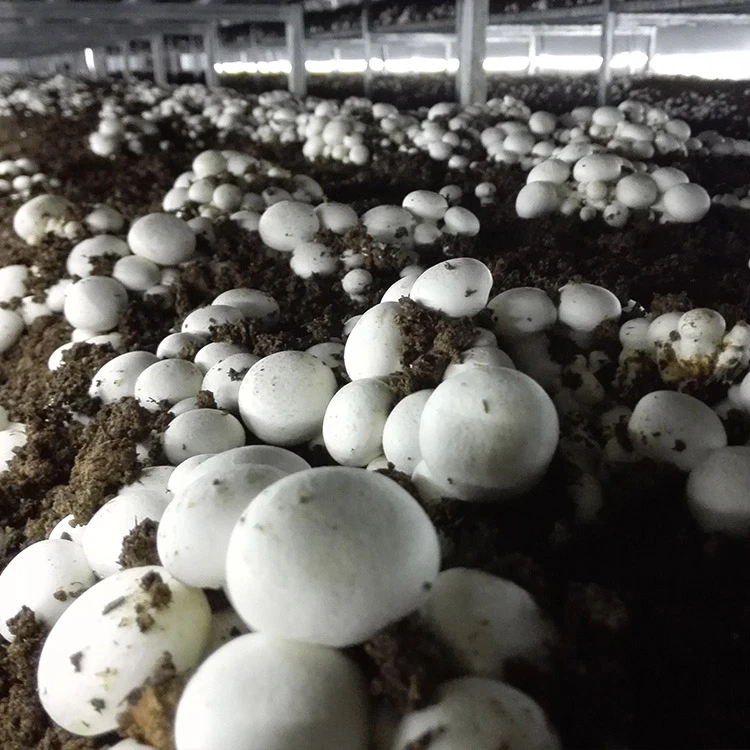
Cultivated white button mushrooms are identified at the raw-material stage before size grading and processing.
Product Forms and Exact Size Options
We quote each form as a separate commercial product. The order specification states the measurement basis, permitted size range and defect tolerance so whole mushrooms, caps, slices and diced pieces are not compared as if they were interchangeable.
Whole Mushrooms
Commercial diameter groups: 20–30 mm, 30–40 mm, 40–50 mm and 50–60 mm. Whole products retain the cap and an attached trimmed stem. We inspect diameter, stem length, open veil, shape, broken units and surface defects.
Caps / Destemmed Caps
Cap ranges include 19–32 mm, 32–38 mm, 32–45 mm, 38–45 mm and 19–57 mm. The specification states the maximum remaining stem and whether minor cap breakage is permitted.
Sliced Mushrooms
Standard slice: cap diameter 20–55 mm and thickness 4–6 mm. Additional thickness options are 4.8 mm, 6.4 mm, 8.0 mm and 9.5 mm. We record thickness, diameter, long stems, broken slices and fines separately.
Diced Mushrooms
Defined dice sizes include 4.8 mm, 6.4 mm, 9.5 mm and 19.0 mm. Diced product is evaluated for particle dimensions, small fines, irregular pieces, free-flowing condition and dosing consistency.
Quartered
Whole mushrooms are cut into four approximately even sections. We inspect the retained cap-and-stem identity, uneven fragments, broken pieces and size distribution.
Pieces and Stems
Irregular cap and stem pieces are supplied as a separately declared processing grade for sauces, fillings and soup bases. They are not described or priced as whole or regular sliced product.
Sliced white button mushrooms show the cap, gill and stem cross-section used for thickness, diameter and broken-piece inspection.
A caliper check provides a repeatable dimension result instead of relying only on visual judgment.
Processing Routes: Fresh IQF, Blanched IQF and Roasted IQF
Processing route changes color, texture, flavor, moisture release and final line performance. We identify the route in the product name and specification instead of placing different treatments under one generic frozen mushroom description.
Route
Main Product Character
Control Points
Application Fit
Fresh / Unblanched IQF
Minimally processed mushroom flavor and defined frozen pieces.
Raw-material turnover, browning, washing, dewatering, freezing speed, drip loss and cooking performance.
Sauces, soup bases, fillings and processes that cook the mushroom after dosing.
Blanched IQF
Heat-treated before freezing for a controlled color and process condition.
Blanch time and temperature, cooling, dewatering, texture, flavor, peroxidase result and weight yield.
Ready meals, foodservice and industrial processes requiring a pre-treated ingredient.
Fire-Roasted / Grilled IQF
Visible roasted character and stronger cooked flavor.
Roast level, color, added oil or seasoning declaration, moisture, burned pieces and flavor consistency.
Pizza, baked meals, premium sauces and prepared-food formulas where roasted notes are required.
The plain product specification lists mushrooms as the only ingredient. Citric acid, salt, oil, seasoning, sulphite or another processing ingredient is declared by name when used in a different product route. We do not apply "no additives" to every route without the corresponding ingredient statement.
Commercial Processing Flow
We prepare White Button Top Mushrooms to the agreed product form, pretreatment, grade and packing specification. The diagram shows a typical production process; we confirm preparation and step order for your order.
Typical process flow. Final processing and step order follow the confirmed specification. Site photos show the captioned subjects and may illustrate a representative form; process illustrations show typical operations. Storage and loading photos are generic frozen-food references.
Production and handling stages
Raw Material InspectionWe check identity, condition and the agreed raw-material criteria.
Initial SortingWe remove visible defects and unsuitable material.
WashingWe follow the confirmed cleaning and water-control route.
Stem Trimming & PreparationWe prepare the agreed product form and remove the specified inedible parts.
Pretreatment by SpecificationWe follow the declared raw or heat-treated program.
DrainingWe remove excess surface water before freezing.
IQF FreezingWe quick freeze prepared pieces and review separation.
Frozen Product InspectionWe review the agreed defects, form, separation and frozen condition.
Weighing, Packing & Metal ControlWe check net weight, pack integrity and agreed metal controls.
Batch Review & ReleaseWe match lot identity and records to the agreed release checks.
Frozen StorageWe maintain the agreed frozen-storage conditions and lot identity.
Reefer LoadingWe review cartons, lot records and refrigerated shipment arrangements.
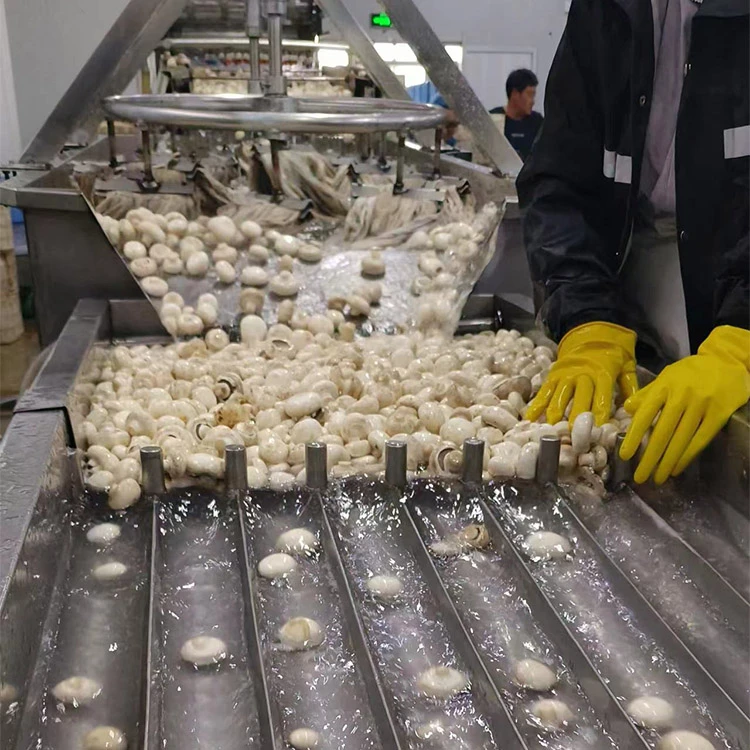
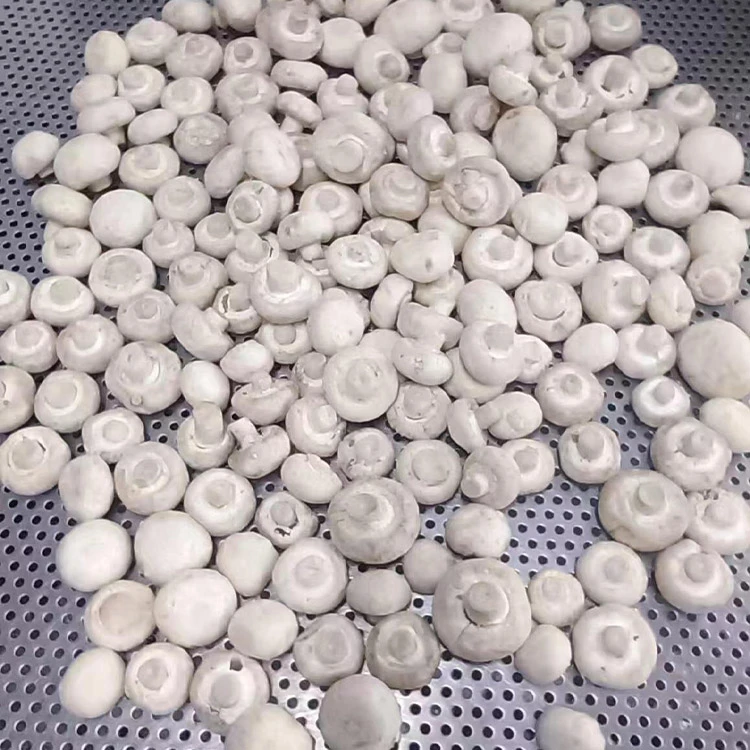
The image shows white button mushrooms in a stainless-steel washing and transfer stage before freezing.
Commercial Processing Flow
1. Receiving and identity check: We record raw-material source, mushroom identity, receiving date, maturity, condition and intended product form.
2. Trimming and preliminary sorting: We remove growing medium, damaged bases, decay, abnormal color and unsuitable mushrooms before cutting.
3. Washing: We clean the mushroom surface and inspect washing-water condition, product flow and visible residue. Excessive soaking is avoided because it can affect texture and water behavior.
4. Size grading and cutting: Whole mushrooms are graded by diameter. Slices, dice and quarters are cut to the declared dimension and checked for long stems, fines and irregular fragments.
5. Pretreatment: Unblanched, blanched and roasted routes are kept separate. Heat-treated products are cooled and drained before freezing.
6. IQF freezing: Product is frozen as separate pieces and brought to a finished frozen condition suitable for storage at −18°C or below.
7. Final inspection and packing: We check color, cut, defects, clumps, foreign material, temperature, net weight, sealing, coding and metal detection before cold storage.
Application and Specification Matching
Pizza and Baked Meals
We use regular slices when visible mushroom shape and even topping distribution matter. The RFQ should specify thickness, cap diameter, broken-slice limit, processing route and water-release target so the topping does not create an uncontrolled wet surface.
Sauces and Fillings
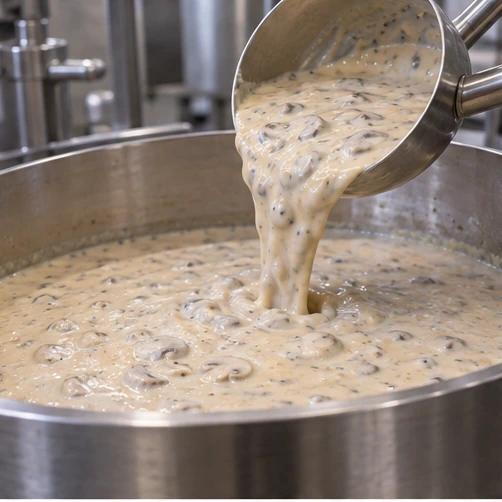
Diced mushrooms, pieces and regular slices can be matched to kettle mixing, pumping and portioning. Particle size, fines, drip loss, flavor and pack weight affect usable yield more than visual whole-cap quality.
Soups and Ready Meals
Whole 20–30 mm mushrooms, quarters or 4–6 mm slices provide recognizable pieces. We align the form with the final heating time, portion weight, texture target and retail presentation.
Foodservice and Central Kitchens
Foodservice packs require easy dosing, stable frozen separation and practical inner-bag weight. We prepare whole, sliced or pieces in 1 kg, 2 kg, 2.5 kg and 5 kg formats linked to the kitchen's daily usage.
Retail and Private Label
Retail programs normally need stronger visual uniformity, a defined broken limit, controlled pack weight, consumer-facing label text, barcode, date coding and carton marks. Whole and regular sliced mushrooms are kept separate from economical pieces.
Industrial Repacking
Bulk repackers need repeatable size, free-flowing product, strong inner liners and carton codes that remain traceable after receiving. We connect the bulk lot with COA, pallet quantity and shipment records.
Applications & Quality Requirements
We match White Button Top Mushrooms to your processing or packing line. Product form to confirm: Mushroom caps. Tell us the intended use and target texture so we can review the relevant size, grade, preparation and packing requirements before quotation.
Application illustrations. Product form, preparation and suitability follow the confirmed specification. Open the overview to inspect the image.
Pizza Production
For: Pizza manufacturers and foodservice distributors
Form: caps
We review caps for your pizza production programme. Confirm Slice thickness, water release and colour after baking. Test the mushroom in your actual bake cycle before approval. Your team prepares the required cut or refined component before this application.
Cream Sauce Manufacturing
For: Sauce manufacturers
Form: caps
We review caps for your cream sauce manufacturing programme. Confirm Particle size, cooking yield and mushroom flavour. Match the pieces to the sauce dosing and heating process. Your team prepares the required cut or refined component before this application.
Soup & Stock Production
For: Soup manufacturers and central kitchens
Form: caps
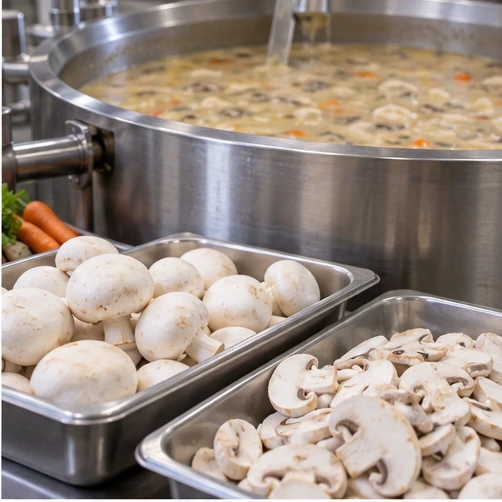
We review caps for your soup & stock production programme. Confirm Cap condition, stem allowance and cooked texture. Confirm the heat process and piece distribution in the finished soup.
Savoury Filling Production
For: Prepared-food manufacturers
Form: caps
We review caps for your savoury filling production programme. Confirm Dice distribution, moisture release and filling consistency. Review drainage and cooking requirements before combining with other filling ingredients. Your team prepares the required cut or refined component before this application.
Prepared Meal Components
For: Ready-meal manufacturers
Form: caps
We review caps for your prepared meal components programme. Confirm Piece uniformity, portion accuracy and reheating texture. Validate the selected form in your meal heating process. Your team prepares the required cut or refined component before this application.
Match the Application with the Purchasing Specification
Application
Selected form
Quality points to confirm
Pizza Production
caps
Slice thickness, water release and colour after baking
Cream Sauce Manufacturing
caps
Particle size, cooking yield and mushroom flavour
Soup & Stock Production
caps
Cap condition, stem allowance and cooked texture
Savoury Filling Production
caps
Dice distribution, moisture release and filling consistency
Prepared Meal Components
caps
Piece uniformity, portion accuracy and reheating texture
Send us the product, required form, final application, key quality requirements, packing, quantity and destination market. We will review the supply programme and confirm the order specification with your team.
The following standard gives purchasing, QA, production and logistics teams one working description. A buyer-specific order can use a tighter value, but the revised value must appear in the signed commercial specification rather than in informal correspondence.
Product Name
IQF Frozen White Button Mushrooms
Other Market Names
Frozen Champignon Mushrooms; IQF White Mushrooms; Frozen Agaricus bisporus; White Button Mushroom Caps
Botanical Name
Agaricus bisporus
Ingredient
100% white button mushrooms for the plain product; every additional ingredient is declared for the relevant route
Origin
China
Forms
Whole, caps/destemmed caps, sliced, quartered, diced, pieces and stems
Whole Size
20–30 mm; 30–40 mm; 40–50 mm; 50–60 mm cap diameter
Cap Size
19–32 mm; 32–38 mm; 32–45 mm; 38–45 mm; 19–57 mm
Sliced Size
20–55 mm cap diameter, 4–6 mm thickness; optional 4.8, 6.4, 8.0 or 9.5 mm thickness
Diced Size
4.8 mm; 6.4 mm; 9.5 mm; 19.0 mm
Processing Routes
Fresh/unblanched IQF; blanched IQF; fire-roasted or grilled IQF as separately declared products
Color
Natural white to cream, with slight natural gray cast permitted; no abnormal black tissue or severe discoloration
Flavor and Odor
Typical white button mushroom flavor and odor; no fermented, chemical, moldy, rancid or other objectionable odor
Texture
Full-fleshed and tender; excessively soft, fibrous or rubbery pieces ≤10% w/w after the defined evaluation
Size Conformity
≥85% within the declared size range
Mechanical Damage
≤10% w/w
Brown/Rust Spots and Visible Damage
Combined affected pieces ≤10% w/w
Frozen Clumps
Clumps larger than 25 mm ≤10% w/w; product remains commercially free-flowing
Foreign Material
Grit, soil, compost, wood, decay, insects, insect fragments and non-vegetable foreign material absent; harmless extraneous vegetable material ≤1 piece per 2.8 kg
Drip Loss
Grade A ≤20%; Premium A+ ≤15% by the defined thaw-and-drain test
We inspect whole mushrooms, caps, slices and dice using the measurement rule written in the specification. The size result reports the percentage within the declared range, not only an average. Oversize, undersize, long stems and fines are recorded separately when they affect application performance.
Mechanical damage includes ragged, crushed or visibly broken pieces that reduce the contracted form. Standard Grade A allows no more than 10% by weight. Product affected by brown or rust spots, serious bruising or related visible damage is also limited to 10% by weight under the combined defect line.
Texture evaluation identifies pieces that are excessively soft, fibrous or rubbery after the stated thawing or cooking method. The standard limit is 10% by weight. Decay, mold, fermented odor and chemically abnormal odor are rejection defects rather than normal appearance variation.
The finished product must pour and separate under normal frozen handling. Clumps larger than 25 mm are limited to 10% by weight. Large ice masses, water pooling and carton ice accumulation are not accepted as normal IQF condition.
White button mushrooms are visually checked for color, integrity, remaining stem, damage and foreign material.
Drip Loss, Thawing and Cooking Performance
Mushroom performance cannot be judged from frozen appearance alone. We use a defined thaw-and-drain test for order comparison: weigh a 500 g frozen sample, thaw at 4±2°C for 16 hours in a perforated food-grade tray, drain for two minutes and calculate released liquid as a percentage of the original frozen weight. Grade A is ≤20%; Premium A+ is ≤15%.
The same method must be used for repeat orders. Changing the thawing temperature, sample depth, time or draining method can change the result. The COA therefore records the test method with the actual batch result rather than reporting an unsupported description such as "low moisture."
For cooking performance, a defined sample is heated using the buyer's industrial method and reviewed for mushroom identity, texture, water release, color, flavor and abnormal odor. Pizza, sauce, soup and ready-meal projects can use different acceptable outcomes, but each repeat order follows the same written method and approved reference sample.
Microbiological Specification
Freezing does not replace hygiene control. We connect raw-material condition, washing, personnel hygiene, equipment sanitation, post-process handling, packing and frozen storage with the finished-product microbiological result.
Parameter
Specification
Result Format
Aerobic Plate Count
≤50,000 CFU/g
Actual CFU/g
Coliforms
≤200 CFU/g
Actual CFU/g or MPN/g
Escherichia coli
<10 CFU/g
Actual CFU/g or MPN/g
Coagulase-positive Staphylococcus aureus
<10 CFU/g
Actual CFU/g or MPN/g
Yeast & Mould
≤200 CFU/g
Actual CFU/g
Salmonella
Negative in 25 g
Detected / Not detected
Listeria monocytogenes
Negative in 25 g
Detected / Not detected
A result outside the signed specification places the lot on hold. The shipment COA uses the production-lot result; it does not repeat the maximum limit in the Actual Result column.
Residues, Heavy Metals, Sulphite and Physical Hazards
Our pesticide report lists the tested analytes, reporting limit and batch-measured result. Each result must remain within the destination-market maximum residue level. For an EU program, the general default MRL is 0.01 mg/kg where no specific MRL is established for the active-substance and product combination.
For EU-oriented cultivated Agaricus bisporus, the heavy-metal limits used in the specification are lead ≤0.30 mg/kg and cadmium ≤0.050 mg/kg on the applicable wet-weight basis. The batch report provides the measured values and test method rather than stating only "complies."
The plain no-sulphite-added route declares no added sulphite and uses an SO₂ reporting target below 10 mg/kg at the stated method limit. If a sulphite treatment is used in another route, the substance and level are declared in the ingredient and safety documentation. This distinction prevents an untested "sulphite-free" claim.
Finished cartons pass a metal-detection program with challenge sensitivities of Fe 2.5 mm, non-ferrous 3.0 mm and stainless steel 3.5 mm. Challenge checks are recorded at production start, defined operating intervals, product or pack change, restart and production end.
This general packed-carton line shows in-line inspection after sealing; product-specific challenge results are recorded by lot.
Sampling, Retention and Lot Release
A production lot contains one mushroom identity, form, size, processing route, production date, line or shift and packing format. We select at least five cartons across the lot and take 500 g from each selected carton, creating a minimum 2.5 kg composite for dimension, appearance and physical inspection.
Dimension checks use enough individual units to represent the declared form. Foreign-material review uses an expanded sample when the commercial specification requires the one-piece-per-2.8 kg limit. Microbiological and chemical samples are sealed, identified and connected to the same lot code used on the packed cartons.
We retain two intact finished packs from each lot through the defined retention period. QA reviews product identity, specification, actual inspection data, microbiology, residues or metals where required, metal detection, weight, sealing, labeling and cold-storage status before release.
A held lot cannot be released only because a previous lot passed. The release decision belongs to the tested production lot and its associated records.
Batch COA: Specification Limit and Actual Result
We issue the COA against the corresponding production lot. Each result line uses four fields: Parameter, Specification, Actual Result and Test Method. "Actual Result" means the measured or observed result for that lot; it is not copied from the specification limit.
COA Group
Parameters
How the Result Is Reported
Identification
Product name, botanical name, ingredient, form, processing route, grade, origin, lot and packing
Declared identity connected with carton and shipment code
Dimensions
Cap diameter, slice thickness, dice size, stem length, size conformity, oversize and undersize
APC, coliforms, E. coli, S. aureus, yeast, mould, Salmonella, Listeria
CFU/g, MPN/g or detected/not detected
Chemical Safety
Pesticide analytes, Pb, Cd and SO₂ when applicable
Actual mg/kg result and method
Packing and Cold Chain
Net weight, seal, code, carton condition, product temperature and metal detection
Measured weight, temperature and recorded challenge result
Release
QA status and release date
Released, held or rejected with authorized signature
Bulk, Foodservice, Retail and Private-Label Packing
Bulk processing: 1×10 kg, 2×5 kg, 20 lb or 40 lb carton. A food-grade inner liner separates the product from the export carton and is sealed to protect the frozen condition.
Foodservice: 10×1 kg, 5×2 kg or 4×2.5 kg. These formats help central kitchens and catering operators portion frozen mushrooms without opening a full bulk liner.
Retail and private label: 20×500 g, 10×1 kg and additional retail weights are prepared with the buyer's artwork. We review product name, ingredient, net weight, storage instruction, cooking statement, lot-code position, production and best-before date, barcode, language, importer information and recycling marks.
Carton review covers strength, inner-pack count, gross and net weight, sealing, tape, marks and pallet pattern. We keep whole, regular sliced and economical pieces clearly identified so the packing description matches the product inside.
Sliced white button mushrooms are weighed into a lined carton; net weight, liner, carton and code are part of packing inspection.
This is a general certificate display. Applicable certificates are supplied by facility, scope, validity and destination-market requirement; it is not a white-button-mushroom batch COA.
Certificates, Export Documents and Traceability
We separate food-safety system certificates from batch documents. BRC, HACCP, ISO, HALAL, KOSHER or other certificates are presented with the issuing body, certified site, scope and validity period. FDA-related evidence is described as facility registration or related documentation, not as FDA product certification.
The standard shipment file can include the signed specification, batch COA, microbiological report, pesticide-residue report, heavy-metal report, ingredient statement, allergen statement, sulphite declaration, Non-GMO statement, packing list, commercial invoice, certificate of origin, health certificate, bill-of-lading information and container/seal record.
Traceability links raw-material receiving code, mushroom identity, processing route, production line, date, shift, packing material, finished carton code, cold-storage position, pallet, container and shipping document. This lets your QA team compare an arrival sample with the corresponding specification and COA.
For repeat orders, we retain the same parameter names and test bases so changes in size, defects, drip loss or microbiology remain visible from one lot to the next.
Frozen Storage, MOQ and Reefer Loading
Finished white button mushrooms remain at −18°C or below through frozen storage and export transport. The shelf life is 24 months under continuous frozen conditions. Repeated thawing and refreezing is avoided because it can increase clumping, ice, drip loss, darkening and texture damage.
Standard MOQ is 10 MT per product specification. Mixed-container programs use 3–5 MT per SKU and must reach a practical total reefer load. A 20 ft reefer carries approximately 10–12 MT; a 40 ft reefer carries approximately 18–25 MT depending on carton dimensions, inner-pack format and pallet requirement.
Loading ports include Xiamen, Dalian and Qingdao. Standard lead time is 15–21 days after the order and packaging file are approved. The final loading plan states SKU, carton count, net weight, pallet quantity, container type, destination port and required shipment documents.
Before loading, we inspect container cleanliness, dryness, odor, damage, air channels and door seal. Shipment records identify product temperature, reefer set point, container number, seal number, carton quantity and batch allocation.
This general cold-storage image supports frozen warehousing and temperature-control capability; it is not presented as a white mushroom-only room.
General reefer loading evidence shows carton handling, temperature checks and container records used for frozen export shipments.
Why Source White Button Mushrooms with GreenLand-food
Specification depth: We define species, form, processing route, size, thickness, defects, drip loss, microbiology, packing and cold-chain terms in one commercial standard.
Application matching: We connect whole, caps, slices, dice and pieces with pizza, sauce, soup, ready meal, foodservice, retail and repacking requirements.
Batch evidence: We provide a COA with actual production-lot results, plus supporting test, packing, traceability and shipment records.
Packing options: We prepare bulk cartons, foodservice packs, retail bags and private-label programs with artwork, code, barcode and carton-mark review.
Export coordination: We connect MOQ, mixed-container allocation, frozen storage, loading plan, destination port and document needs before shipment.
Whole-product appearance is reviewed for natural white-to-cream color, cap integrity, remaining stem and visible defects.
Bulk sliced product is evaluated for usable slices, broken pieces, color, fines, clumps and packing condition.
IQF Frozen White Button Mushroom FAQ
1. What is the correct product identity?
The product is cultivated white button mushroom, Agaricus bisporus. White mushroom and champignon mushroom are common market names. Brown cremini, portabella and other mushroom species are kept as separate products.
2. Which frozen white button mushroom forms do you supply?
We supply whole mushrooms, caps, regular slices, quarters, defined dice and pieces-and-stems processing grade. Each form has its own size, breakage and application standard.
3. What whole mushroom sizes are available?
Commercial whole-size groups are 20–30, 30–40, 40–50 and 50–60 mm cap diameter. Caps can also use 19–32, 32–38, 32–45, 38–45 or 19–57 mm specifications.
4. What is the standard sliced mushroom specification?
The standard slice uses 20–55 mm cap diameter and 4–6 mm thickness. Additional nominal thickness options are 4.8, 6.4, 8.0 and 9.5 mm.
5. Are the mushrooms blanched or unblanched?
We supply fresh/unblanched IQF and blanched IQF as separate product routes. Fire-roasted or grilled IQF is also listed separately because its ingredients, color, flavor, moisture and cost are different.
6. How do you control browning and dark spots?
We control raw-material turnover, bruising, trimming, washing, process delay, pretreatment, freezing and frozen storage. Brown or rust spots and related visible damage are measured against a maximum 10% combined limit.
7. What are the broken-piece and texture limits?
Standard Grade A mechanical damage is ≤10% by weight. Excessively soft, fibrous or rubbery pieces are also limited to ≤10% using the stated evaluation method.
8. How is drip loss tested?
A 500 g frozen sample is thawed at 4±2°C for 16 hours in a perforated tray and drained for two minutes. Grade A is ≤20%; Premium A+ is ≤15%.
9. What microbiological limits appear on the COA?
The standard includes APC ≤50,000 CFU/g, coliforms ≤200 CFU/g, E. coli <10 CFU/g, yeast and mould ≤200 CFU/g, and negative Salmonella and Listeria monocytogenes in 25 g.
10. Do you provide pesticide and heavy-metal results?
Yes. The batch file can include pesticide analytes with actual results and reporting limits, plus Pb and Cd results. The EU-oriented limits stated here are Pb ≤0.30 mg/kg and Cd ≤0.050 mg/kg.
11. Which packing formats are available?
Options include 1×10 kg, 2×5 kg, 4×2.5 kg, 10×1 kg, 20×500 g, 20 lb and 40 lb cartons. We also prepare retail and private-label formats with artwork and code review.
12. What is the MOQ and loading quantity?
Standard MOQ is 10 MT per specification. Mixed-container allocation is 3–5 MT per SKU. Loading is approximately 10–12 MT in a 20 ft reefer and 18–25 MT in a 40 ft reefer.
13. What documents are supplied with the shipment?
The shipment file can include the signed specification, batch COA, microbiological and chemical reports, ingredient and sulphite declarations, invoice, packing list, certificate of origin, health certificate, loading record and container/seal information.
14. How should bulk frozen mushrooms be stored and transported?
Keep the product at −18°C or below in frozen storage and reefer transport. Avoid repeated thawing and refreezing. The stated shelf life is 24 months under continuous frozen conditions.
Send Your White Button Mushroom RFQ
For a complete quotation, send us the product form, whole diameter or slice/dice size, processing route, grade, defect and drip-loss limits, packing, quantity, destination port, application, private-label requirement, required certificates and batch documents.
We will return a commercial offer aligned with those fields so your purchasing and QA teams can compare product, usable yield, packing and shipment scope on the same basis.
We review the selected form, grade, process and packing against the technical schedule below. Published and TDS values are specification references for order review. External benchmarks apply only within their stated scope. Acceptance is governed by the signed SKU specification; the identified lot COA reports actual measured results.
Residue insoluble in hydrochloric acid after ashing; use relevant CXS 234-1999 method. No fixed sample mass stated in §3.3.6. Only a single-species quick-frozen edible-fungus SKU meeting CXS 38 §2.1.12: cleaned, washed and blanched before freezing. Confirm botanical species and blanching route; unblanched supply is outside this definition.
Prepared yield / water release
Evaluate thawed or cooked yield under one agreed preparation protocol; differentiate natural exudate from added water or loose ice.
Report initial mass, preparation conditions, drained edible mass and yield percentage.
Pesticide residue schedule
Named active ingredients and commodity-specific limits are selected for the destination market. EU source
Link farm spray history, laboratory LOQ and batch result to the destination MRL. EU database is one market reference; apply the actual destination rule.
Lead, cadmium and other contaminants
Apply the limit for the exact commodity and processed form in the destination market. EU source
State analyte, preparation basis, method, LOQ and lot result. Do not transfer a fresh-commodity limit to a processed form without the required assessment.
03 / Microbiological Criteria
Parameter
Specification / reference
Verification & order basis
Aerobic Plate Count - Specification
≤50,000 CFU/gPublished reference
Report the named organism, analytical method, sample mass, sampling plan and lot result; use CFU/g for enumeration and a stated mass for detection. Programme: Specification.
Aerobic Plate Count - Result Format
Actual CFU/gPublished reference
Report the named organism, analytical method, sample mass, sampling plan and lot result; use CFU/g for enumeration and a stated mass for detection. Programme: Result Format.
Coliforms - Specification
≤200 CFU/gPublished reference
Report the named organism, analytical method, sample mass, sampling plan and lot result; use CFU/g for enumeration and a stated mass for detection. Programme: Specification.
Coliforms - Result Format
Actual CFU/g or MPN/gPublished reference
Report the named organism, analytical method, sample mass, sampling plan and lot result; use CFU/g for enumeration and a stated mass for detection. Programme: Result Format.
Escherichia coli - Specification
<10 CFU/gPublished reference
Report the named organism, analytical method, sample mass, sampling plan and lot result; use CFU/g for enumeration and a stated mass for detection. Programme: Specification.
Escherichia coli - Result Format
Actual CFU/g or MPN/gPublished reference
Report the named organism, analytical method, sample mass, sampling plan and lot result; use CFU/g for enumeration and a stated mass for detection. Programme: Result Format.
Report the named organism, analytical method, sample mass, sampling plan and lot result; use CFU/g for enumeration and a stated mass for detection. Programme: Specification.
Coagulase-positive Staphylococcus aureus - Result Format
Actual CFU/g or MPN/gPublished reference
Report the named organism, analytical method, sample mass, sampling plan and lot result; use CFU/g for enumeration and a stated mass for detection. Programme: Result Format.
Yeast & Mould - Specification
≤200 CFU/gPublished reference
Report the named organism, analytical method, sample mass, sampling plan and lot result; use CFU/g for enumeration and a stated mass for detection. Programme: Specification.
Yeast & Mould - Result Format
Actual CFU/gPublished reference
Report the named organism, analytical method, sample mass, sampling plan and lot result; use CFU/g for enumeration and a stated mass for detection. Programme: Result Format.
Salmonella - Specification
Negative in 25 gPublished reference
Report the named organism, analytical method, sample mass, sampling plan and lot result; use CFU/g for enumeration and a stated mass for detection. Programme: Specification.
Salmonella - Result Format
Detected / Not detectedPublished reference
Report the named organism, analytical method, sample mass, sampling plan and lot result; use CFU/g for enumeration and a stated mass for detection. Programme: Result Format.
Listeria monocytogenes - Specification
Negative in 25 gPublished reference
Report the named organism, analytical method, sample mass, sampling plan and lot result; use CFU/g for enumeration and a stated mass for detection. Programme: Specification.
Listeria monocytogenes - Result Format
Detected / Not detectedPublished reference
Report the named organism, analytical method, sample mass, sampling plan and lot result; use CFU/g for enumeration and a stated mass for detection. Programme: Result Format.
Acceptance schedule
Select the test panel and limits by intended use (ready-to-eat or further processing), product form and destination. EU source
State organism, analytical method, sample mass and n/c plan; report actual lot results. A universal APC, coliform, Salmonella or Listeria limit is not assigned to every frozen product.
04 / Freezing & Cold Chain
Parameter
Specification / reference
Verification & order basis
Storage Temperature
−18°C or belowPublished reference
Probe the product thermal centre after stabilization; retain cold-chain records.
Separation & loose-ice assessment
Keep inherent moisture, loose ice and permanently frozen clusters as separate inspection categories.
Weigh separated loose ice and welded clusters against initial sample mass; distinguish natural paired pieces or blocks.
Product thermal centre
−18°C or colder after freezing and thermal stabilization; maintain the agreed frozen distribution condition.External referenceCodex
Probe the thickest representative pack and retain storage/transport temperature records. Codex quick-frozen reference; selected product form and route must be frozen.
Frozen condition at dispatch
Hard frozen, correctly sealed and coded, without thaw/refreeze evidence or excessive loose ice. Codex
Check pack integrity, free-flow or block condition as declared, carton condition and loading temperature.
Check approved pack drawing, calibrated scale and production records.
Shelf Life
24 months under continuous frozen storage at −18°C or belowPublished reference
Verify unopened-pack validation, declared storage condition and production/best-before coding.
Declared net contents
Verify each selected pack format against the artwork and applicable quantity-control rule. Codex
Calibrated checkweigher or scale; defined sample and tare.
Shelf-life basis
The labelled period applies only to its validated pack and continuous stated storage condition. Codex
Review stability study or approved shelf-life file and production-date code.
06 / Process Controls
Parameter
Specification / reference
Verification & order basis
Processing Routes
Fresh/unblanched IQF; blanched IQF; fire-roasted or grilled IQF as separately declared productsPublished reference
Check the approved product flow, line settings and identified production record; validate numerical critical limits within the site HACCP plan.
Raw-material preparation checks
Confirm Agaricus identity and cap/whole/cut style; inspect trimming, washing and any blanching route.
Verify the selected product flow and the relevant trimming, sorting and pretreatment record.
Blanching / enzyme inactivation
Time and temperature are product- and cut-specific; confirm residual-enzyme endpoint when relevant. Codex
Record validated line set-points and product sample test; assess colour and texture after treatment. Only classify as a CCP when the site's HACCP plan identifies it as one.
Cooling and dewatering
Control prompt cooling and surface-water removal before IQF to avoid clumping and loose ice. Codex
Review line time/temperature record, draining check and frozen separation.
CCP designation
Use the site-approved HACCP plan to identify true CCPs and their validated critical limits. Codex
Check hazard analysis, monitoring, deviation and corrective-action records. A quality-control step is not automatically a CCP.
07 / Ingredients, Additives & Allergens
Parameter
Specification / reference
Verification & order basis
Ingredient
100% white button mushrooms for the plain product; every additional ingredient is declared for the relevant routePublished reference
Verify approved formula, supplier declarations and line-specific allergen assessment.
Added glaze / coating declaration
Declare any intentionally added water glaze, syrup, oil or coating and the measurement basis; loose ice is assessed separately.
Verify formula/addition records; agree a deglazing or coating test and net-content basis where applicable.
Additive use
Declare any colour-protection agent, acidulant or other additive by ingredient and maximum permitted use for the target market. NHC standard
Check approved formula, actual addition record and market-specific additive category. GB 2760-2024 applies to China; export rules are checked separately.
Allergen and cross-contact assessment
Declare inherent allergens and assess shared-line cross-contact from the actual facility schedule. FDA
Review line matrix, cleaning validation and buyer label approval. Do not claim a shared-line allergen or allergen-free status without facility evidence.
08 / Defects & Foreign Matter
Parameter
Specification / reference
Verification & order basis
Size Conformity
≥85% within the declared size rangePublished reference
Measure a defined frozen sample with caliper or size gauge; report distribution and tolerance.
Mechanical Damage
≤10% w/wPublished reference
Classify on the defined sample by count or mass; record individual categories, denominator and any combined limit.
Vegetable-origin admixture as defined in §2.2.6; no fixed sample mass stated in §3.3.6. Only a single-species quick-frozen edible-fungus SKU meeting CXS 38 §2.1.12: cleaned, washed and blanched before freezing. Confirm botanical species and blanching route; unblanched supply is outside this definition.
Codex reference: maggot damage for cultivated fungi
total ≤1; serious subset ≤0.5 % m/mExternal referenceCodex
Serious damage means ≥4 maggot holes; separate damaged material by mass; no fixed sample mass stated. Only a single-species quick-frozen edible-fungus SKU meeting CXS 38 §2.1.12: cleaned, washed and blanched before freezing. Confirm botanical species and blanching route; unblanched supply is outside this definition. Applies only when raw material is documented as cultivated.
Record each defect class separately by count or mass; state sample size, denominator and combined-limit rules.
Hazardous foreign matter
No foreign matter detected in the defined inspection sample; reject and investigate any finding.External referenceCodex
Define visual-inspection sample size and detector challenge in the signed quality schedule. "None detected" is a sampling statement, not an absolute guarantee of zero particles.
09 / Packaging Materials & Label
Parameter
Specification / reference
Verification & order basis
Food-contact pack
Specify inner-contact material and obtain the applicable food-contact compliance declaration. NHC standard
Review film structure, supplier DoC, migration evidence and actual intended conditions. GB 4806 series is China-specific; EU export also checks Regulations 1935/2004 and 10/2011.
Carton and seal integrity
Define carton stacking strength, bag seal and puncture resistance for the confirmed net weight and pallet plan. EU source
Inspect pack drawing, compression/seal test and shipment configuration.
Label verification
Match product name, ingredient/allergen statement, net weight, lot/date, shelf life and storage instruction to the destination artwork. Codex
Approve artwork against the signed specification and destination rules.
10 / Detection & Traceability
Parameter
Specification / reference
Verification & order basis
Species and source identity
Link declared edible species, cultivated/wild status and source lot to the packing lot; retain component identity for a blend. Codex
Reconcile source declaration, intake record and final ingredient statement.
Foreign-body detector
Validate Fe, non-Fe and stainless-steel challenge pieces for the actual product, aperture, pack and line; record the proven sensitivity. Codex
Challenge at defined start, changeover, interval and end points; retain rejection records. Do not copy generic detector sizes into a plant capability claim.
Lot traceability
Link input source lot, processing run, packaging code, test records, frozen storage and shipment to one finished lot. Codex
Trace one sample lot forward and backward in a recorded mock recall. Recall speed is stated only when the site has a validated target and record.
Order approval: Confirm the selected form and grade, ingredient formula, intended use, destination market, packing, sampling plan and test panel. The signed specification controls acceptance; the identified lot COA reports actual results.