


Can You Freeze Garlic Scapes? Trimming and Cooked Use
Oct 19, 2026
Leave a message

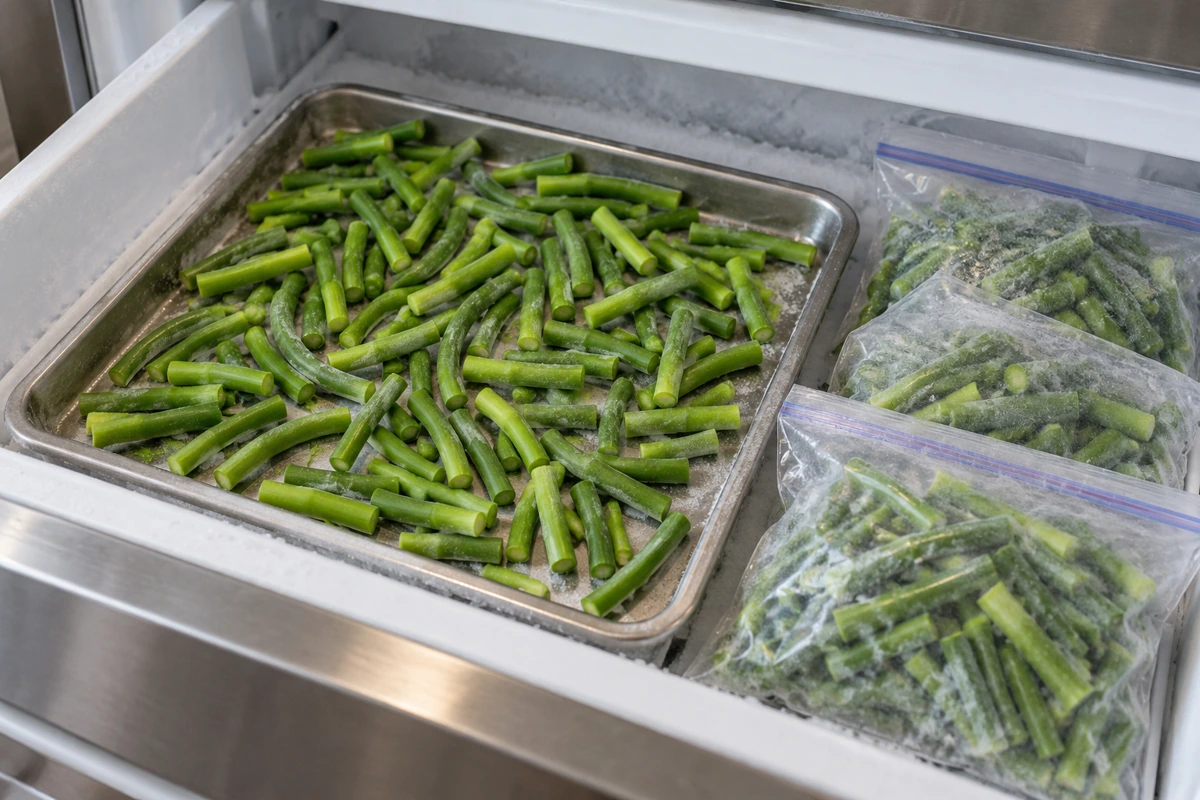
For a commercial buyer, freezing suitability is only the starting point. The order still needs a defined cut, treatment status, packing arrangement and cooked acceptance reference. A household freezing method can explain the sequence, while the commercial product requires its own process controls and evidence. The most useful specification begins with the food the customer intends to make.
What freezing changes in a garlic scape
A garlic scape is a flower stalk, with a different structure from the cloves in a bulb. Its long cylindrical form can contain tender tissue and more resistant material within the same stalk. Freezing preserves the prepared ingredient for later use, but it cannot improve poor trimming or reverse a fibrous raw-material condition. That is why a scape destined for a vegetable side dish should be evaluated differently from one intended to be finely dispersed in a cooked filling.
Water within plant tissue forms ice during freezing. The resulting changes help explain why a thawed vegetable may release liquid and lose some of its fresh firmness. The degree of change depends on the material and the full handling route. A clear promise that every frozen scape will retain the bite of a freshly harvested stalk would therefore be misleading. The relevant test is whether the prepared product performs acceptably in the intended recipe.
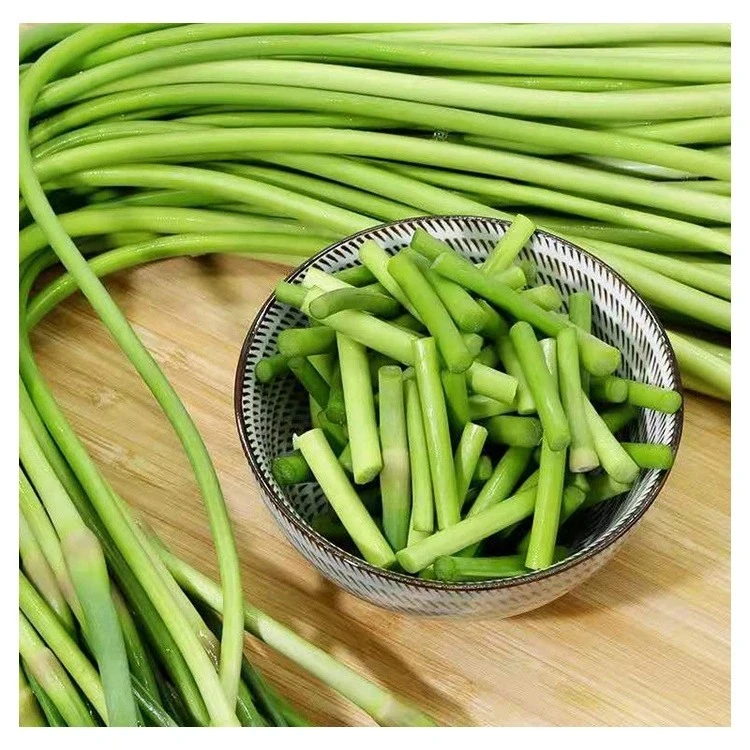
Whole scapes and cut stalk sections provide a raw-material reference for the usable form.
Inspect a whole-stalk reference to understand the product before choosing a cut. The pointed upper structure and the lower cut end may need different trimming decisions from the main usable stalk. The photograph of whole scapes can establish this visible form; it does not tell you how a future frozen lot was harvested, treated or stored. Those facts must come from the product and shipment records.
Illinois Extension recognizes freezing scapes either raw or after blanching. This is useful evidence that more than one preparation route exists. It does not mean the routes produce identical eating quality or that either can be selected without considering storage and use. A buyer should ask which route applies to the offered SKU and assess that product through the complete intended cooking method.
Freezing also has a safety boundary. The National Center for Home Food Preservation explains that freezing does not sterilize food. A soft thawed stalk is therefore not proof that it has been cooked or made ready to eat. For a purchased product, follow the label and supplier's validated preparation instructions. For a commercial process, the treatment and final use need to fit the operator's food-safety system. Quality observations about color, clumping or tenderness cannot replace that assessment.
Trim for the dish you intend to make
Trimming is the point at which the usable stalk is separated from material likely to interfere with the final dish. Examine the lower end for drying, damage or resistant tissue and assess the upper bud area for the texture required. Avoid assuming that a fixed distance removed from every stalk produces the same quality. Stalks vary, and the important boundary is the condition of the material that remains.
For home preparation, wash the scapes and use clean equipment before cutting. Keep the usable pieces separate from the trimmed material so that tough ends do not find their way back into the freezing tray. If the stalks are being prepared for a meal with recognizable vegetable pieces, test a small safely cooked portion before processing the entire batch. Discovering persistent fibers after freezing a large quantity creates avoidable work later.
Choose the cut around the actual eating and handling requirement. A short cross-cut piece distributes readily through rice or an egg dish. A longer segment gives a more visible vegetable presence in a stir-fry. A finely chopped preparation may suit a cooked filling, but small particle size does not guarantee a pleasant texture when resistant fibers remain. Remove unsuitable material before relying on the cutting equipment to solve the problem.
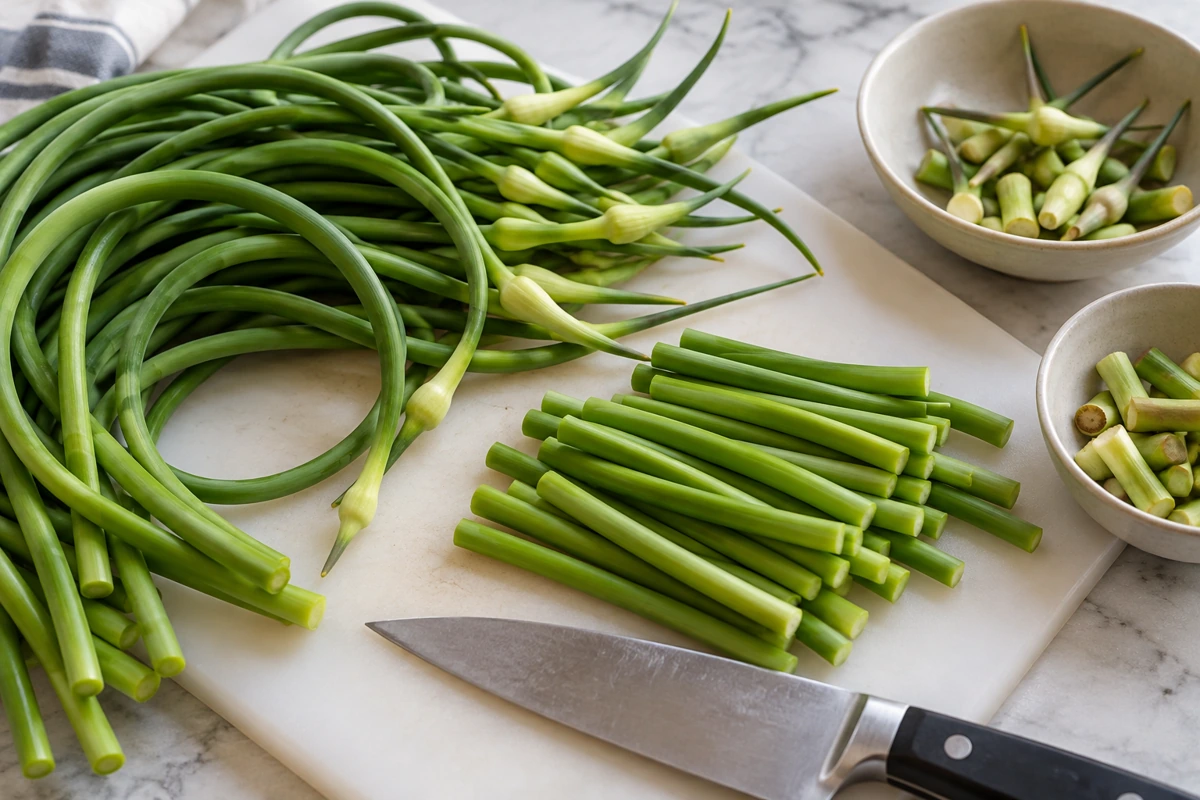
Keep removed ends separate from the usable cut before freezing.
The decision also affects how the frozen product is portioned. Long pieces can bridge across a small opening or tangle when scooped. Very short pieces may be easy to dispense but can disappear visually in a mixed dish. Trial the cut with the actual spoon, feeder or portioning method. A convenient preparation at the cutting board can be inconvenient when the ingredient is frozen and needs to enter a busy production line.
For an order specification, describe the distribution of lengths rather than only the desired nominal value. Ask how fragments and oversize pieces will be assessed and whether the result is based on count or mass. Those choices matter because a few long stalk sections can have a greater effect on eating quality than their weight suggests. The buyer and supplier should be able to perform the same check and reach a comparable conclusion.
Trimming yield should be visible in the cost comparison. A lower raw-material price may lose its advantage if extensive removal is needed to reach the approved result. Conversely, a well-prepared frozen cut can reduce the buyer's handling work. Use actual trial weights to evaluate that difference. A photograph or a general quality description cannot establish how much usable ingredient reaches the recipe.
Keep the removed fraction identifiable during development. If most loss comes from the lower ends, the sourcing discussion differs from a batch dominated by broken pieces or damaged stalks. Record the reason for removal alongside its weight. This lets the supplier understand which preparation change would improve the buyer's yield. It also prevents a later operator from interpreting every visually unusual piece as waste when the agreed cooked use would accept it.
Choose and document the preparation route
The preparation route determines what happens between trimming and freezing. Published household methods differ: some freeze raw pieces, while others use a brief hot-water treatment followed by rapid cooling. Le Petit Mas, a scape producer, describes a blanch, cool, dry and tray-freeze sequence for home use. Its kitchen directions provide context, but they should not be converted into a commercial critical limit for every cut or batch size.
Blanching is commonly used in vegetable freezing to control quality changes associated with enzyme activity. It also changes the tissue before the product reaches its final recipe. The resulting balance depends on the actual product and treatment. A buyer who wants a distinct stalk bite should therefore evaluate the offered prepared sample, while a buyer seeking a softer ingredient may prefer a different result. Neither preference establishes a universal processing rule.
For a repeatable development trial, keep the route explicit:
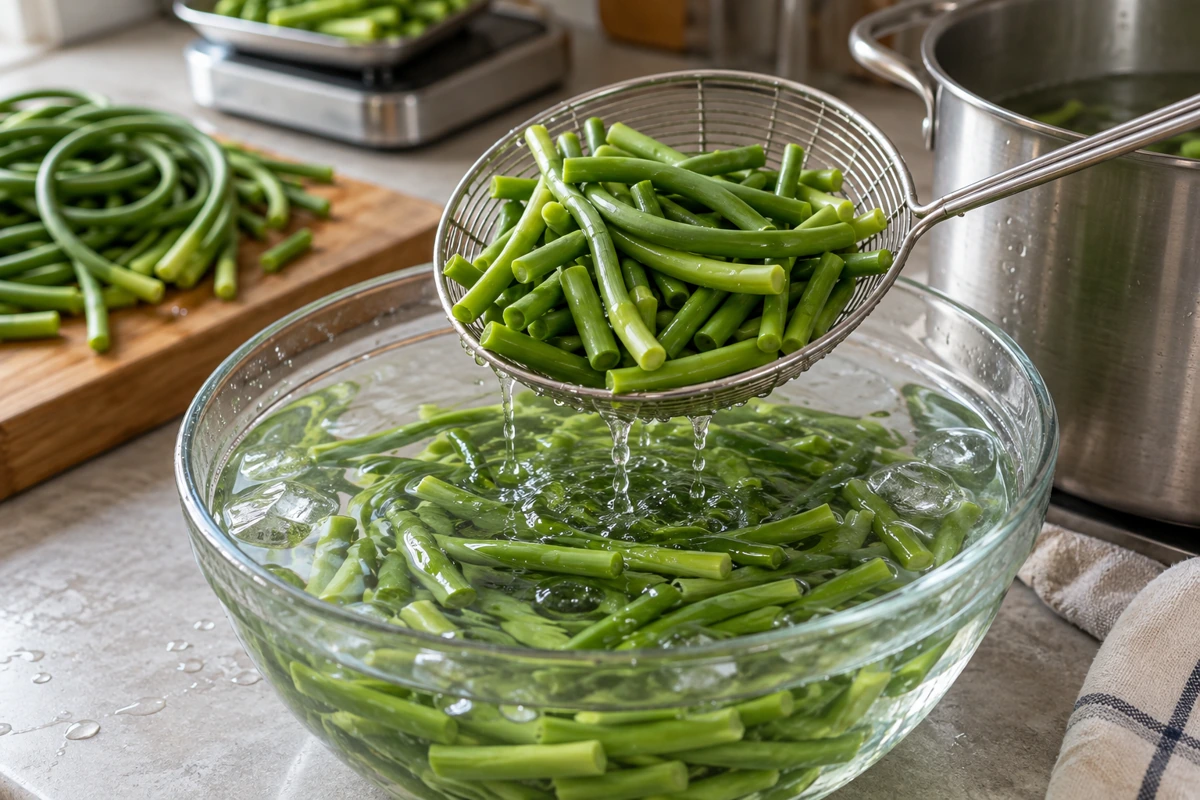
Cooling and surface drainage are distinct operations in the preparation route.
- Identify the usable stalk material and prepare the agreed cut.
- Apply the selected preparation treatment under the relevant instructions or validated process.
- Where cooling follows heating, use the established cooling method and then drain surface water consistently.
- Freeze and pack the prepared portions, retaining the date, treatment and sample identity.
- Cook a representative portion through the intended final method and record the result.
This sequence separates operations that are often compressed into a single phrase such as prepared and frozen. It makes a later problem easier to investigate. If two samples differ in texture, the team can ask whether the difference began with the stalk, the cut, the treatment or the final cook. Without that record, the only available description may be that one bag seemed softer.
Surface water deserves its own observation. Water left between pieces can freeze into bridges and make portioning difficult. Removing that excess water is different from squeezing the vegetable or discarding all liquid after thawing. The chosen drainage method should be consistent enough that comparative trials start with similar material. Record whether the recipe uses the entire thawed contents or only drained pieces.
Commercial documentation should state the treatment actually applied and the intended customer preparation. A label that says blanched does not automatically support a ready-to-eat claim. If the final food will be served without a further heat step, that route needs separate qualification. The formulation, equipment and handling after preparation can matter as much as the ingredient's appearance when it leaves the freezer.
Freeze portions that remain practical to use
The best frozen portion is one that can enter the planned recipe without unnecessary handling. At home, spreading prepared pieces in a single layer before packing can reduce the chance of one solid mass forming. This is a practical tray-freezing method; it should not be described as proof of industrial individually quick frozen processing. Commercial IQF claims refer to the actual production route and product behavior, not simply to pieces that look separate in a photograph.
Keep the portion size close to the amount normally used. A small household cooking charge may fit a compact freezer bag, while a foodservice kitchen may prefer an inner pack that matches one pan batch. A manufacturer may need a larger pack suitable for controlled feeding. The useful unit is the amount the operator can handle while maintaining the required storage and preparation conditions.
Leave enough space during the initial freezing stage for the intended method to work. A tightly packed warm mass has different heat-transfer demands from separated pieces. Follow the freezer manufacturer's loading guidance and the applicable food-preservation method. For commercial production, freezing capacity and the product's process controls require confirmation on the actual line. The article cannot establish a freezing time from a household tray photograph.
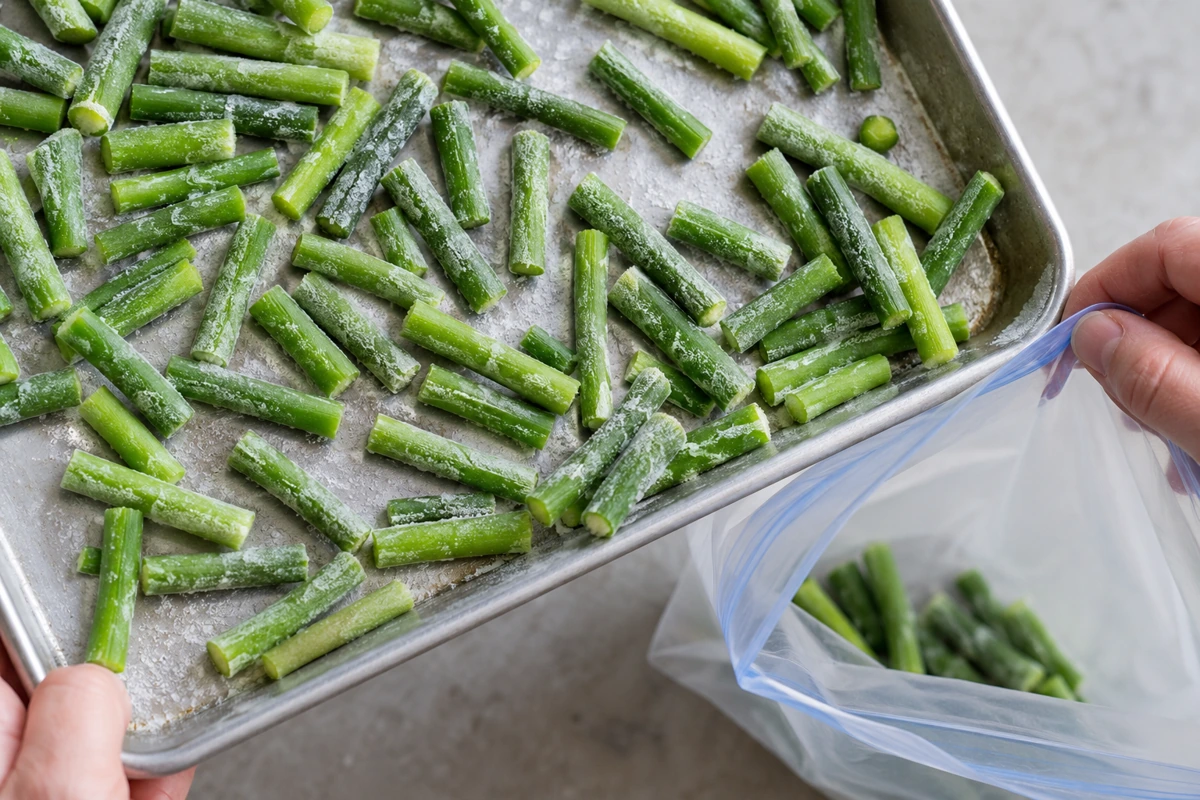
Spacing pieces during tray freezing can reduce the formation of one compact mass.
Once the pieces are frozen, protect them promptly in appropriate packaging. A tray left exposed is useful for separation but poor as long-term storage. The packaging should limit moisture movement, withstand the frozen condition and close reliably. Avoid choosing a thin household bag solely because it is transparent or convenient. The material needs to be suitable for the intended freezer use and handling.
If the product is packed as a block or a portioned paste, describe that form clearly. A block may be entirely workable for a kettle that receives the full amount, yet inconvenient for a kitchen that needs a small addition. A chopped paste may give even flavor distribution but remove the visible stalk identity. These are legitimate formats when deliberately selected. They should not be substituted silently for loose cut pieces in a repeat order.
Try the pack with the actual operator before approving it. Observe opening, portion removal, transfer and resealing where relevant. Count the handling steps and inspect whether fragments collect in the bottom of the bag. A successful cooked trial can still lead to an awkward commercial product if the pack makes every shift spend extra time separating or measuring the ingredient.
For a mixed vegetable recipe, test whether the frozen scapes distribute evenly with the other components. Differences in piece shape can cause some ingredients to collect near the top or bottom during handling. A measured portion from one location may then contain more scapes than another. The relevant test is the normal mixing and dispensing operation, using the actual pack and cut, rather than an individually arranged sample bowl.
Keep packaging and handling tied to quality
Packaging protects the prepared product from exposure and physical damage during storage and use. Inspect the seal and the bag surfaces, including corners that may be stressed by frozen pieces. Excessive air space, a poor closure or a damaged liner can make quality less predictable. The product's own storage instructions should govern the holding condition, and a commercial order should state the agreed condition and the evidence retained through transport.
Surface frost and clumping are observations to record, not complete diagnoses. Frost may occur for several reasons, and a cluster of pieces does not reveal the full temperature history by itself. Review the pack condition, the recorded handling and the product's ability to portion. Where the condition differs from the approved reference, hold the affected material for assessment rather than assuming either that it is harmless or that it proves a specific failure.
At home, label the pack with the preparation date and a description that distinguishes raw, treated and cooked portions. In a business, use the established lot and stock-rotation system. The identifier should connect the material in the freezer with the specification and the recipe trial. A bag of short green stalks can be difficult to distinguish from another prepared allium once it has been removed from its original carton.
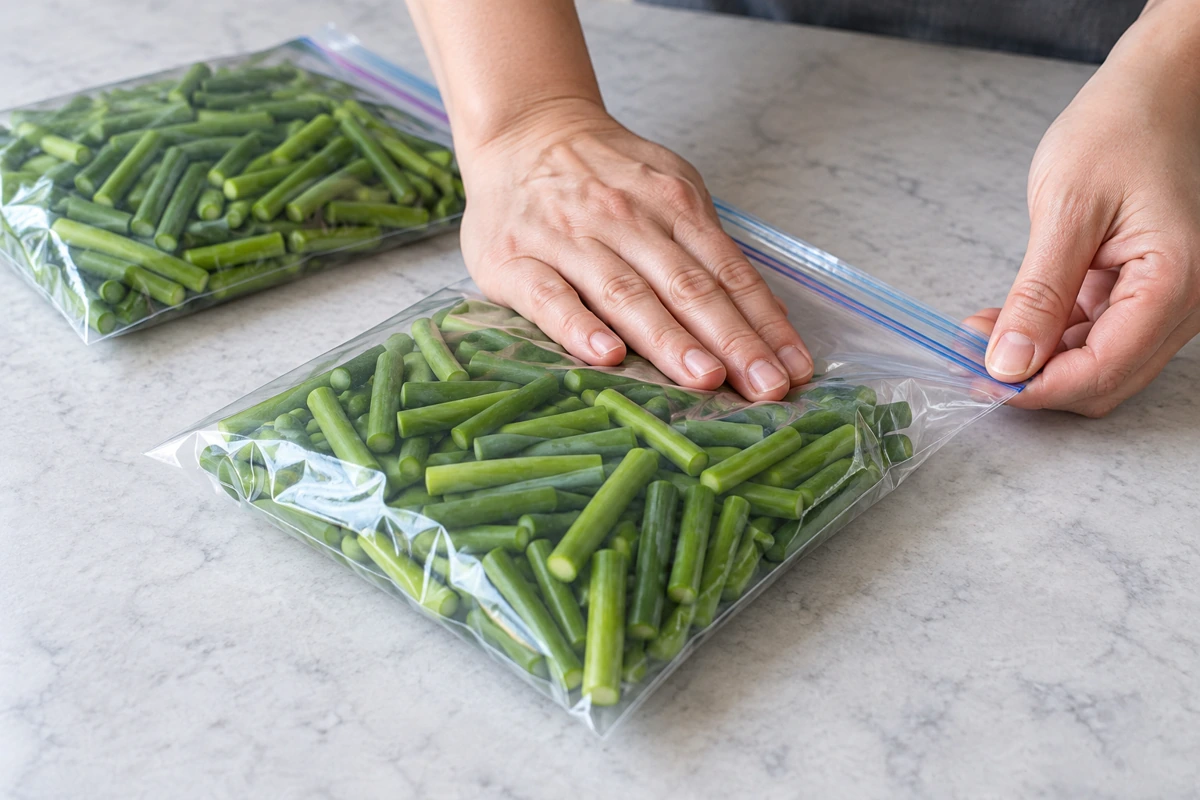
A suitable closure and practical portion size support frozen handling.
Quality life is product-specific. Internet recipes give different storage periods because they describe different preparations, packs and household conditions. Those numbers do not establish the shelf life of a commercial frozen scape SKU. Request the declared shelf life and storage conditions for the actual product, and examine how the remaining life fits the shipping route and planned usage rate. A long nominal life is less useful if the buyer cannot consume the minimum pack quantity within its operating plan.
Avoid repeated unnecessary warming while selecting small portions. Plan the cooking charge, remove what is needed under the operation's controls and return the remainder promptly to the required storage condition. If a pack cannot be portioned without a long handling interval, reconsider the pack size or frozen form. The solution is often a better purchasing specification rather than a more complicated kitchen routine.
An oil-containing scape preparation requires particular clarity. Oil can be part of a frozen recipe, but it does not make the mixture suitable for room-temperature storage. Keep any such product under its established storage and use instructions. A freezer method should never be repurposed as an unvalidated canning or ambient-preservation method simply because the finished jar looks familiar.
Cook the thawed or frozen pieces deliberately
The choice to cook from frozen or use a controlled thaw should follow the product instructions and the recipe. Cooking from frozen can be convenient for small pieces in a hot dish, while a development process may require a defined thaw to measure drainage or prepare a uniform sample. The two routes can deliver different water and heating conditions. Compare them deliberately rather than switching between them without recording the change.
For soup, the released liquid may become part of the broth. For a dry sauté, the same liquid may need to evaporate before browning develops. For rice, adding a large wet charge late in the process can change the texture of the entire pan. Think about the scapes as both vegetable material and a source of water during preparation. That perspective makes the cooking sequence easier to design.
Evaluate tenderness after the required cooking is complete. A piece that looks soft can still leave a resistant strand. If the whole piece remains firm, review the cut and the cooking exposure. If soft tissue surrounds persistent fiber, revisit trimming and raw-material selection. Extending the cook indefinitely may damage the rest of the dish without making the problem material suitable.

A cooked rice application uses the scapes as both vegetable pieces and seasoning.
The aroma should be assessed within a normal serving. Scapes can provide a green garlic note that is useful in soups, eggs, noodles and vegetable mixtures. A concentrated tasting from a small pan may seem stronger than the same addition distributed through a full recipe. Use weighed additions and record final yield so that the result can be repeated. When comparing lots, keep salt, sauce and other strong seasonings consistent.
For prepared foods, include every relevant stage in the trial. A scape added to a filling may be cooked again after the product is assembled. A frozen meal may be reheated by a consumer using a different appliance from the development kitchen. The accepted ingredient should remain appropriate through that intended route, under the product's validated instructions. Immediate post-cook quality is only one point in the evaluation.
Keep a simple reference record with photographs and written sensory notes. Describe clean bite, resistant strands, visible piece distribution, free liquid and garlic character in ordinary language. Use the same plate, lighting and serving temperature where possible. This creates a more useful discussion with the supplier than a statement that the frozen product was too soft or lacked freshness.
Specify commercial scapes by the prepared result
A commercial specification should connect what is purchased with what the buyer makes. Start with identity, accepted stalk material, cut distribution and declared treatment. Add the frozen form, net weight, inner packing and storage condition. Then describe the prepared result and the method used to assess it. This links the raw receiving decision with the foodservice or manufacturing application.
Use representative samples from the proposed supply rather than treating a single attractive photograph as approval. Ask whether the sample reflects the actual cut and treatment and whether the same form can be repeated in the planned order. If the buyer's process is sensitive to fragments or long pieces, discuss the measurement method before setting a limit. The specification should define the denominator and the condition of assessment so that both parties can interpret the result consistently.
The cooked reference is especially useful when the buyer's language is subjective. Tender can mean a crisp bite in a stir-fry or a soft inclusion in a filling. A prepared sample and method reveal that difference. The agreement can then state how fibrous pieces are evaluated and what happens if the lot departs from the reference. Those are negotiated application requirements, not universal limits for garlic scapes.
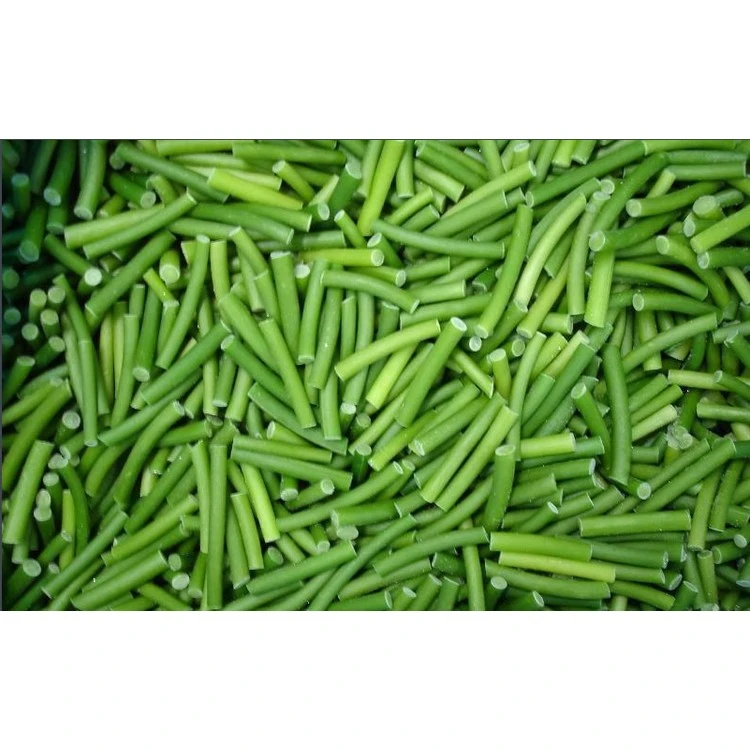
A cut-stalk sample makes the visible length distribution easier to examine.
Include the practical commercial inputs in the inquiry. The supplier needs the application, quantity, destination and packing request before confirming MOQ, lead time or a shipment arrangement. Private-label work also needs the intended product name, preparation wording and artwork requirements. Requested reports should match the actual product and destination rather than being collected as a generic list with no connection to the order.
Our frozen garlic scapes supply page provides the product route for those discussions. We can review the cut and cooked-use reference with your purchasing team and clarify which preparation and packing details need confirmation. A frozen ingredient becomes easier to buy when the desired outcome is specific enough to test.
Retain that outcome as the basis for repeat orders. If the crop material, cut, treatment or pack changes, repeat the part of the trial affected by the change. Freezing can make scapes available beyond a short harvest window, but consistent use still depends on the material selected, the way it is prepared and the food it is expected to become.
Source frozen garlic scapes with GreenLand-food
GreenLand-food is a professional frozen garlic scapes supplier and manufacturer in China, providing factory-direct wholesale supply for foodservice, importers and food manufacturers.
Send your product form, specification, packing, quantity, application, destination, private-label needs and requested documents. Include your prepared-product reference so we can discuss the cut and order requirements.