


Chayote Peel, Seed and Cut-Size Defects: A Buyer Specification
Oct 19, 2026
Leave a message

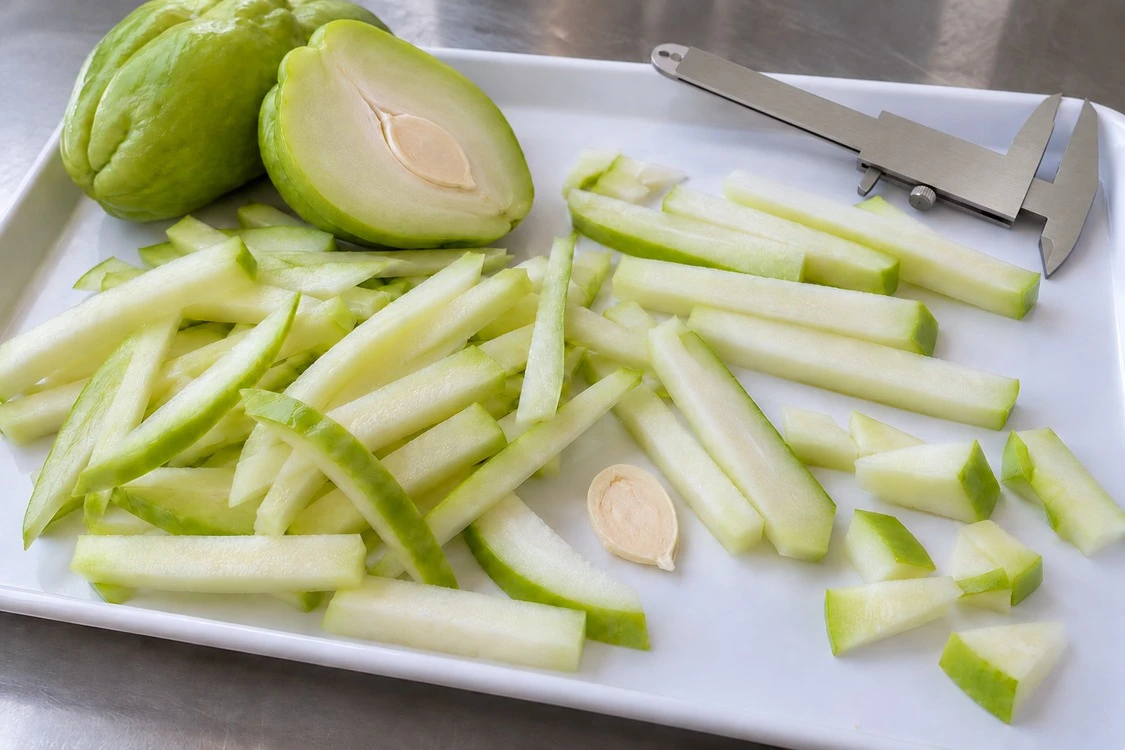
There is no universal defect percentage that can be copied into every frozen chayote order. USDA AMS states that it has no U.S. grade standards for chayote squash. Codex CXS 216-1999 addresses chayotes supplied fresh to consumers and expressly excludes industrial processing. Its fresh-fruit classes and surface-defect allowances therefore do not establish a frozen-strip contract. The proposed approach below helps a buyer and supplier write a measurable agreement for the ingredient they actually intend to use.
Define the frozen cut before setting defect limits
Name the ingredient and its state before discussing a defect. A specification for peeled frozen chayote strips should identify chayote, the agreed edible part, the cut and the treatment information relevant to use. A whole fresh fruit, a peeled strip and a proposed dice cannot share an undifferentiated size rule. The current GreenLand chayote reference shows slender strips; a different cut needs a separate sample and description. Keep that form identity consistent across the quotation, sample label and order.
The word peeled needs its own interpretation. It can describe a preparation step without telling an inspector how much visible peel may remain. The word cored has a similar limitation if the document never defines the central material to be removed. Translate those process words into observable product requirements. A receiving team sees the delivered pieces, so it needs a rule that can be applied to those pieces under a stated inspection method.
Confirm the measurement state. Frozen pieces can carry surface ice that hides a thin peel edge or changes apparent dimensions. Thawed pieces may soften, bend and release liquid. Either state can be used for a defined purpose, but the method should say which one applies and how the sample reaches it. Avoid comparing a supplier's frozen assessment with a buyer's fully thawed assessment as if the two were automatically equivalent.
Separate commercial appearance from food safety concerns. A short piece of sound chayote may be inconvenient in a visible vegetable blend, while a hazardous foreign object calls for a different response under the food safety system. A peel remnant is part of the ingredient and needs evaluation against the intended form. Its presence should not be casually described as the same kind of defect as glass or metal. Clear categories make the receiving decision more proportionate and understandable.
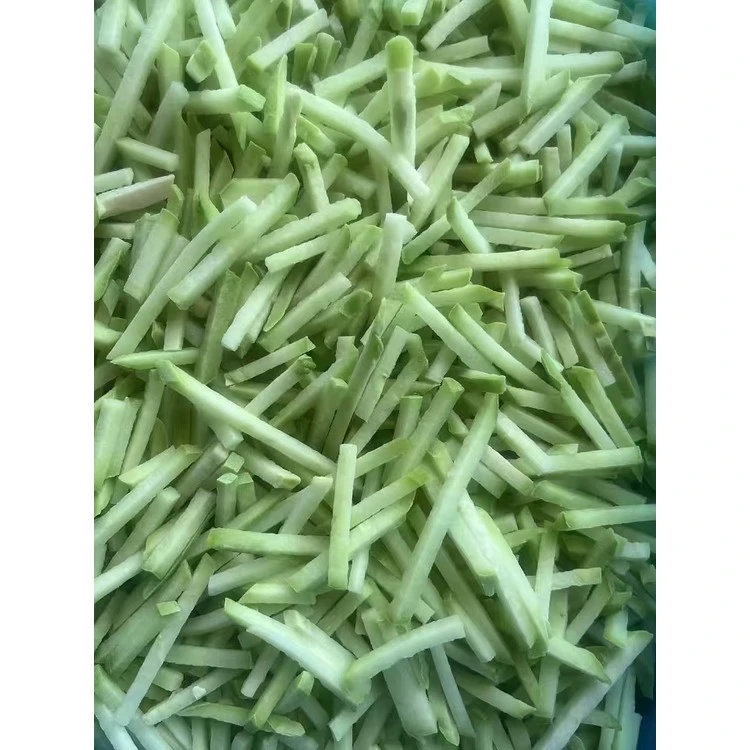
The published sample shows slender strips. A different cut requires its own sample and specification.
Read any referenced standard for scope before adding its name. The Codex chayote standard describes fresh produce and whole-fruit classes, while the USDA page explicitly notes the absence of a U.S. grade standard for this commodity. A marketplace label such as Grade A or Class I does not supply the missing frozen cut definition. If a supplier uses a commercial grade name, ask for the actual criteria behind it and identify it as a contractual grade.
Decide which characteristics are essential to the finished dish. A pale strip visible in a meal tray may need tighter control of peel appearance and minimum length than material chopped further into a filling. That does not remove the need for sound raw material and safe handling in the latter use. It means that appearance and dimensional rules should have a functional reason. Unnecessary restrictions can add sorting or trimming work without improving the customer's product.
Keep the scope statement short enough to appear on the first page of the specification. It should tell the reader what material is being purchased, how it will be used and which documents govern inspection. The detailed clauses can then explain each feature without repeatedly redefining the product. This structure helps prevent a later dispute from beginning with two teams silently inspecting different concepts of frozen chayote.
Describe peel remnants so inspectors agree
Describe a peel remnant by what an inspector can see. For peeled strips, that may be a visible area of skin remaining on the flesh, a narrow edge ribbon or a detached piece of peel. These forms can affect appearance differently. Decide whether they share one category or require separate reporting. A detached green fragment in a pale blend can be noticeable even when its mass is small, while a thin attached edge may be less visible in the finished dish.
Choose the measurement basis to match the concern. If the concern is how many strips show peel, a count of affected pieces can be useful. If the concern is the quantity of detached peel entering a formulation, a mass-based measure may be more relevant. If the visible area on each piece matters, the method needs a defined way to assess that area. Do not use the word percent without stating what quantity forms the numerator and denominator.
A count-based rule needs an affected-piece definition. Does any visible peel count, or only a remnant exceeding an agreed descriptive or dimensional threshold? Where does a thin green edge end and a peel-bearing surface begin? Use clear photographs and plain wording to resolve these questions before inspection. The photographs should show the actual cut at a useful scale, including borderline examples. They support the rule rather than replacing it with subjective impressions.
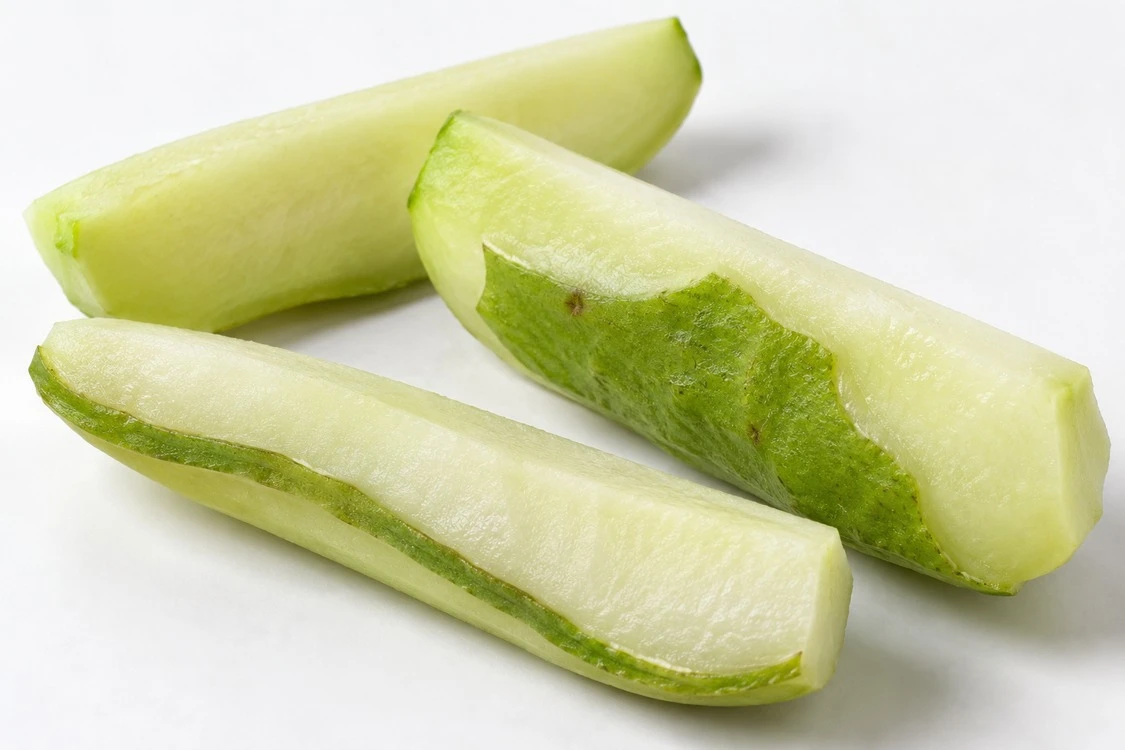
Illustration: Thin green peel remaining along a chayote strip.
Avoid inferring toughness from color alone. A green edge identifies visible skin, but its eating effect should be checked in the intended preparation. A customer may object because of appearance, texture or both. Record the reason so the supplier can understand the requested control. If the cooked peel is unacceptable, define the sensory assessment separately from the frozen visual measurement. One observation should not silently stand in for the other.
Inspect both sides and edges of the sampled pieces under consistent light. Pale flesh and a thin green strip can be difficult to distinguish against a strongly colored tray. A plain contrasting surface helps, and the pieces should be spread rather than piled. State how attached frost is handled if it prevents observation. Do not scrape or wash the sample in a way that removes the very peel material being measured without recording that treatment.
For a hypothetical count example, ten peel-affected pieces in a sample of two hundred assessed pieces would be five percent by count. That calculation does not describe peel area or peel mass, and it does not establish an acceptable limit. It simply shows why the denominator must be named. A second sample containing the same number of affected pieces but much larger peel patches could have the same count result and a different visual impact.
Keep the agreed peel examples with the specification version and approved sample identity. If a later order changes from a visible pale side dish to a heavily seasoned filling, review whether the existing appearance rule remains appropriate. The review should be explicit. A supplier should not infer that a new application automatically permits more peel, and a buyer should not reject a lot using a stricter unwritten expectation introduced after production.
Separate seed material from sound flesh
Chayote contains one central seed surrounded by flesh. In a cut ingredient, seed material can appear as a whole seed, a cut seed fragment or material associated with the central portion. Those categories need to be described accurately. The fact that a fresh recipe may use the seed does not decide whether it belongs in a peeled, seed-removed frozen product. The purchase agreement should state what the customer requires in the supplied cut.
Use an anatomical reference when developing the definition. A lengthwise cut through a representative fresh fruit helps the teams see the seed and the surrounding flesh before discussing fragments in the frozen product. The reference should avoid confusing chayote with vegetables that contain many small dispersed seeds. Actual cut samples then show how the material appears after preparation. Keep the reference as an explanation of identity, not proof that every lot has identical maturity or structure.
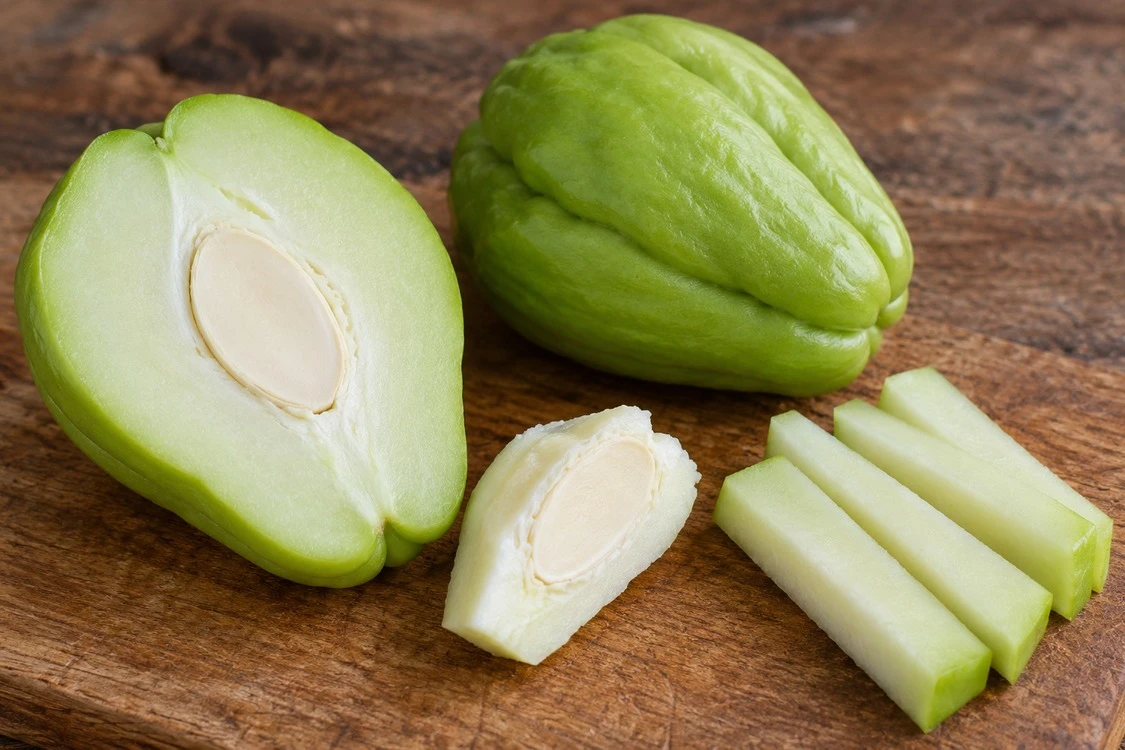
Illustration: Chayote single seed and surrounding flesh beside cut strips.
Distinguish seed material from sound pale flesh that happens to be curved or softer. A loosely written rule such as no soft centres can encourage inspectors to reject acceptable flesh based on appearance alone. If softness matters, use the agreed cooked or conditioned texture method. If identity is uncertain, retain the piece for review and record it as uncertain rather than assigning a confident category without evidence. This protects both the inspection result and the supplier investigation.
For a seed-removed specification, state how incidental fragments will be handled and measured. Detached fragments may be easier to recover and weigh than to count, because cutting can turn one seed into several pieces. A count of fragments therefore depends on fragmentation as well as the amount present. If count is used for a particular receiving concern, name it as fragment count and define the sample basis. Avoid presenting it as a percentage of original seeds removed.
A central piece may also fail a dimensional rule. Decide whether it will be recorded under more than one category and how the total defective share will avoid double counting. Separate attribute results can legitimately overlap, provided the report makes that clear. A combined rejected-mass figure needs each physical piece assigned only once under an agreed priority or recorded as a unique rejected unit. The classification procedure should be written before inspectors begin sorting.
Check the finished application if seed-related material affects bite or shape. Some pieces may behave differently during cooking, but a general assertion that all central material collapses is too broad for a contract. Evaluate the actual supplied sample under the buyer's method and use the result to define the requirement. The specification can then connect a visible exclusion with a practical reason in the meal, rather than relying on an assumed universal texture difference.
Keep reference photographs of confirmed seed fragments and confirmed acceptable flesh. Include a scale where it helps recognition and preserve the source sample identity. When inspectors disagree, compare the disputed material against those references and escalate uncertainty through the agreed review process. A well-defined seed requirement prevents both unwanted material in the blend and excessive rejection caused by misidentifying ordinary chayote flesh.
Measure strip dimensions and short pieces consistently
For strips, record length, width and thickness as separate dimensions. A single size statement such as ten millimetres leaves the reader unsure which axis is meant. Length affects the visible strip and the way it sits on a fork or spoon. Width and thickness affect the amount of flesh in a cross-section and its fit with other ingredients. State the intended dimensions and tolerances for the actual cut rather than relying on a supplier photograph for scale.
Define how an irregular piece is measured. A curved strip can have a different straight-line span from its length along the curve. A tapered end can make the narrowest width unrepresentative of the main body. The parties should agree practical measurement positions and handling, including whether the piece may be gently straightened. Excess pressure can flatten a softened sample, so the procedure should avoid introducing deformation that changes the result.
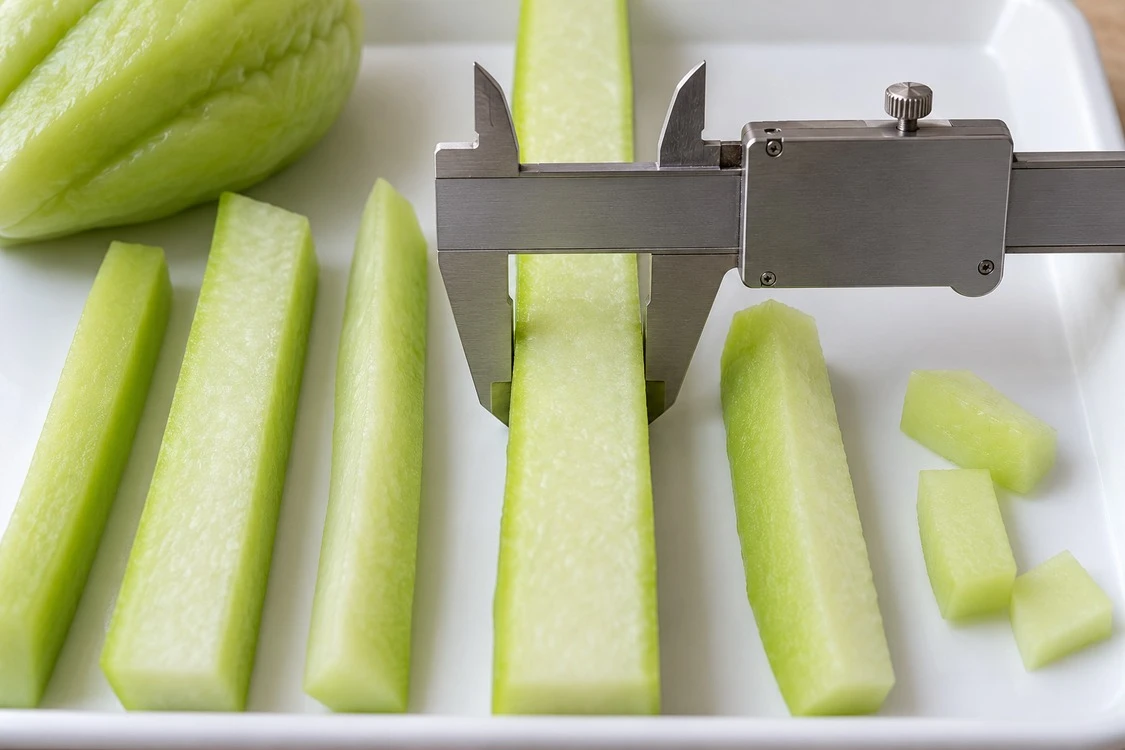
Illustration: A caliper positioned across a chayote strip width.
Use a suitable tool and resolution for the tolerance being discussed. A ruler may be adequate for a broad length category, while width or thickness may need a more precise instrument. The operator still needs a consistent contact method. Record the condition of the sample and the instrument used. A precise display does not make an inconsistent measurement reliable, particularly when frozen surface ice or soft tissue affects where the jaws touch.
Short pieces need a clear definition too. Some may be intentional end cuts; others may result from breakage. If the buyer's concern is the final visible length, a short-piece category can be more observable than an attempt to infer the cause of every fragment. If cause matters for investigation, record suspected breakage separately with photographs. Do not ask a receiving inspector to diagnose cutting history from a fragment when the evidence cannot support that conclusion.
Choose count or mass according to the decision. Count emphasizes how many pieces fall outside the dimensional range. Mass describes how much material falls into that category and can be more relevant to usable yield. They can lead to different results when the out-of-range pieces are much smaller or larger than the acceptable strips. If both are useful, report both with their own denominators instead of treating one as a conversion of the other.
A useful comparison includes the distribution, not only the average. A sample containing many very short pieces and several very long pieces can have an acceptable average length while looking inconsistent in a meal. Report the agreed categories or individual measurements needed to understand the spread. The appropriate detail depends on the inspection plan and the risk being controlled; the aim is to reveal variation that affects the customer.
Confirm the dimensional requirement through the actual use. A strip that meets the frozen measurement may still shorten or split during preparation, while a slightly irregular strip may work well in a soup. Keep frozen cut compliance and cooked performance as separate requirements when both matter. Their relationship should be established through the sample trial, so the specification controls a useful ingredient rather than geometry for its own sake.
Sample and calculate without double counting
Define the lot and sampling plan before taking the sample. A shipment can contain more than one production lot, and a single accessible carton may not represent them all. The buyer and supplier should agree how cartons or packs are selected, how increments are taken and how results support the acceptance decision. Use the customer's established quality system or an appropriate agreed plan. The worked calculations in this article do not supply a statistical sampling standard.
Keep a record of where each portion came from. If the plan combines increments into a composite, retain the information needed to connect that composite to the selected packs. If pack-level variation matters, keep those observations separate rather than pooling everything immediately. This is particularly useful when short pieces settle differently or when one pack's condition differs from the rest. The sampling design should match the question being asked about the lot.
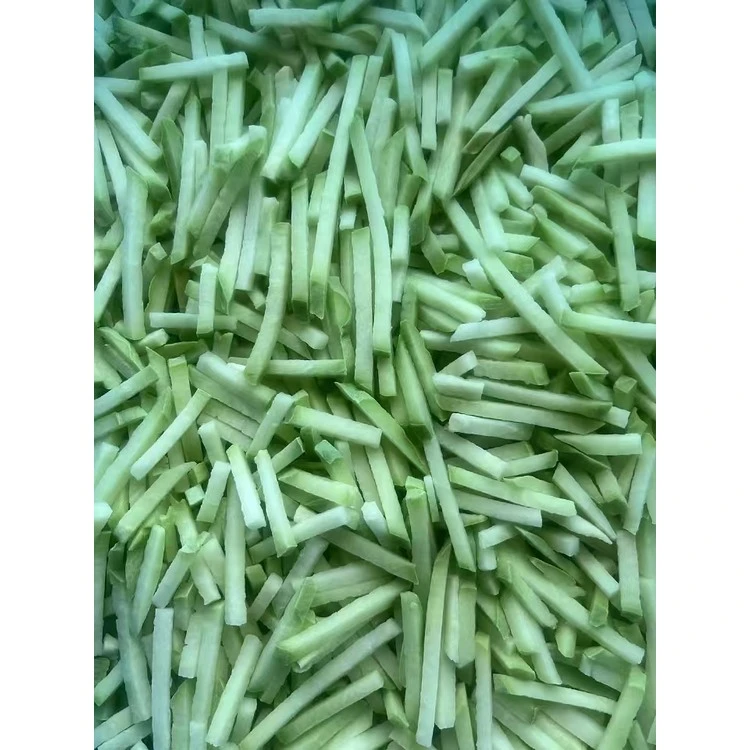
The published sample shows slender strips. A different cut requires its own sample and specification.
State the sample mass or count and the preparation condition before sorting. If the procedure includes removing loose ice, thawing, draining or another conditioning step, define it consistently. These actions can change the denominator or reveal defects that were previously hidden. A report should make clear whether the measured mass is frozen product, conditioned chayote or another agreed basis. Unstated water handling can make two apparently conflicting results impossible to reconcile.
Sort against the agreed defect definitions and keep uncertain pieces available for review. Record peel, seed material and dimensional results separately. If a piece has more than one attribute, it can appear in more than one attribute report, but the combined defective share must account for the overlap. A practical method is to track unique rejected pieces or assign each piece to a defined primary category for the combined calculation. Explain which approach was used.
For a hypothetical mass example, a 500-gram conditioned sample might contain 20 grams of short pieces. The short-piece mass share would be four percent on that stated basis. If five grams of those same pieces also contain peel, adding the two attribute masses would overstate the unique rejected quantity. This example illustrates overlapping categories and arithmetic only. It is neither a proposed contractual limit nor evidence of an actual inspected chayote lot.
Record raw measurements, calculation and decision separately. The inspection result says what was observed under the method. The acceptance rule says what action follows. A lot may require hold, clarification, further investigation or another action defined in the agreement. Retesting should follow that agreement rather than continuing until a preferred result appears. Preserve the original result and any subsequent explanation so the history remains understandable.
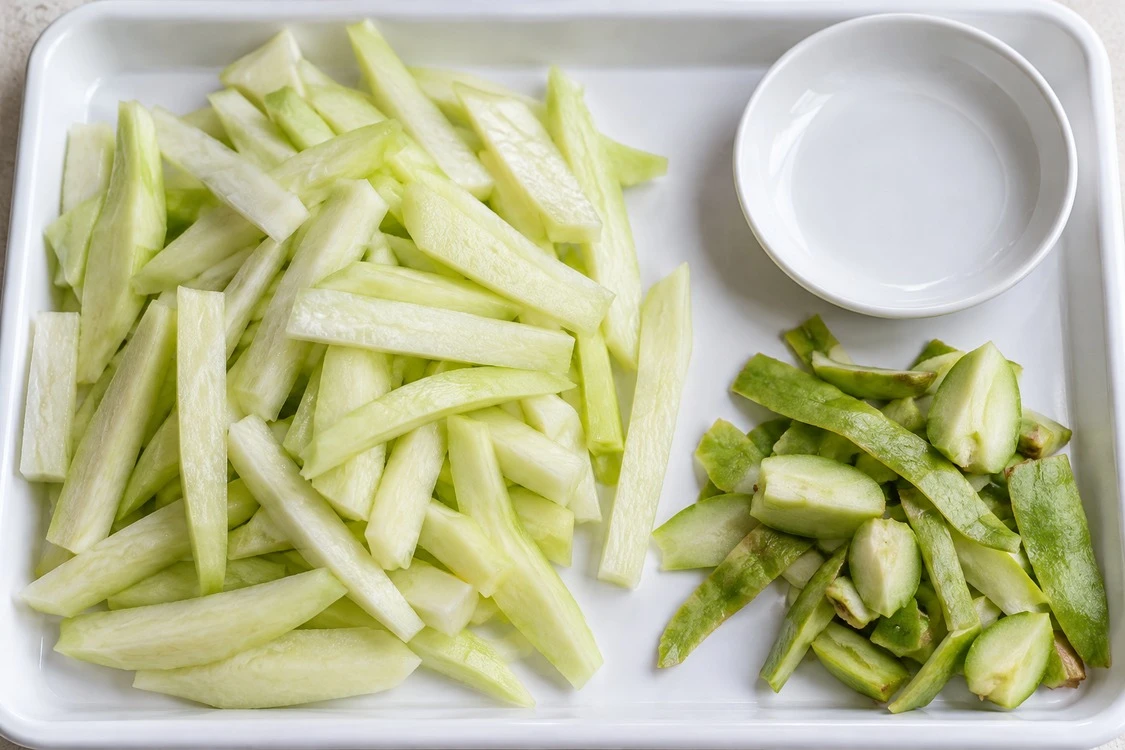
Illustration: Separated peel-bearing pieces and sound strips on a tray.
Photographs support the report when they show the whole assessed spread and representative defects at a useful scale. A close-up of the worst piece alone does not establish prevalence, while a distant image of a large pile may hide the issue. Keep both context and detail where needed. Link the images, weights, lot codes and inspection conditions in one record so a supplier or independent reviewer can assess the evidence without reconstructing the procedure from scattered messages.
Approve the specification with the finished application
Approve the proposed defect rules against the finished food. Prepare the actual chayote cut in the intended recipe, including any reheating or holding that affects the customer experience. Look at whether peel-bearing edges are visible, whether seed-related material changes the bite, and whether the dimensional spread causes uneven presentation or handling. The trial should explain why each requirement matters. It can also reveal a restriction that adds work without improving the meal.
A visible vegetable blend and a processed filling may justify different commercial appearance limits. The distinction must be agreed before production and remain consistent with the applicable safety and quality requirements. If a buyer needs two grades for different applications, give them separate identities and approval records. Calling both premium chayote invites confusion when staff later compare samples that were designed for different uses.
Write the final clauses in observable terms. Identify the peeled or other agreed form, the seed treatment, the dimensional axes, the defect categories and the method used to assess each. Add the agreed limits and acceptance procedure only after they have been established. A supplier should be able to prepare an inspection record that answers the same questions the receiving team will ask. The document should not depend on unwritten preferences held by one development chef.
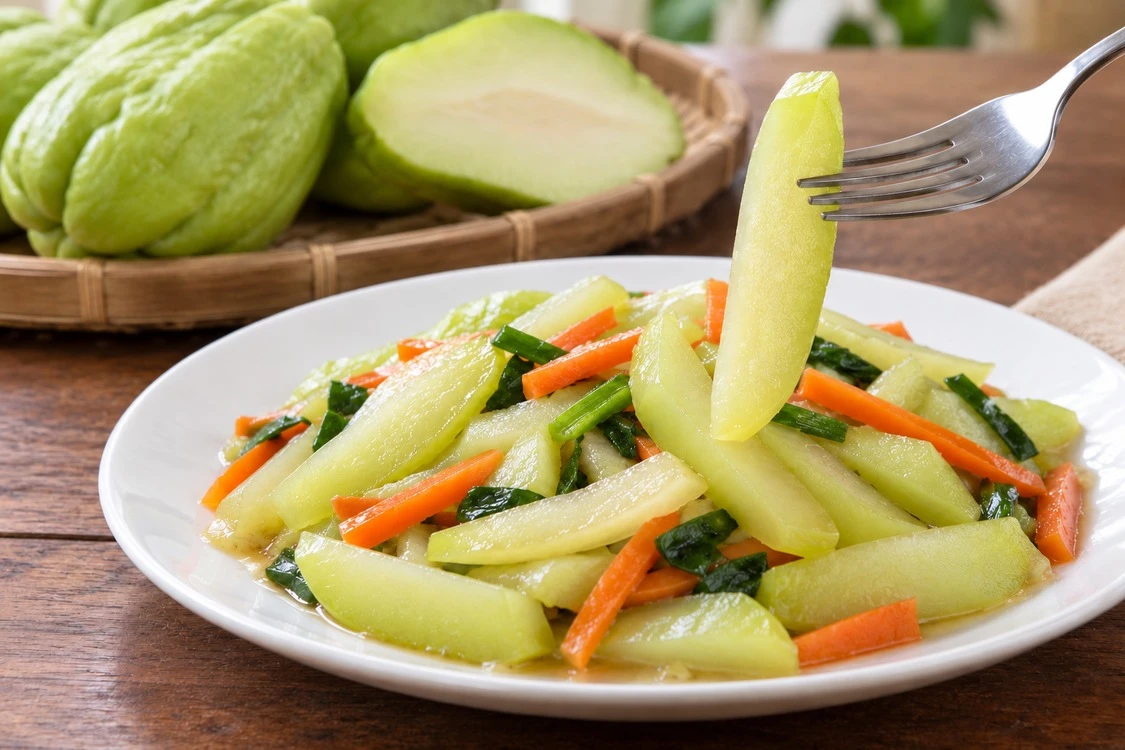
Illustration: Cooked chayote strips lifted from a vegetable blend.
Keep food safety evidence alongside the commercial specification without merging the two. The destination, intended use and customer program determine the relevant requirements and records. A passing peel or size inspection cannot establish microbiological safety, residue compliance or a validated cooking process. Likewise, a laboratory report does not demonstrate that the strips meet a visual length requirement. Request evidence that matches each question and applies to the actual product or lot as appropriate.
Review changes that could affect the agreement. A new cut, different application, revised peel requirement or altered inspection condition may need a new sample or focused trial. Keep version control so the supplier and buyer use the same current document. An old approved photograph can remain useful history, but it should not silently override a later written change. Clear dates and sample identifiers make routine repeat ordering much easier to manage.
When sending an inquiry to GreenLand-food, include the intended chayote strip form, the application and the characteristics that matter most. If you already have limits, send the measurement method with them. If the specification is still being developed, a sample and a description of the finished dish are useful starting points. Packing, quantity, destination, private-label needs and requested documents can then be reviewed for the defined supply.
A successful specification lets two competent inspectors reach comparable observations from equivalent samples. It also lets the development team explain why those observations matter at the plate. Peel, seed and cut size each deserve a clear definition, an honest denominator and an agreed decision. That combination gives purchasing a workable basis for approval, repeat orders and any later quality discussion.
Continue reading
Place the chayote defect rules inside a full purchasing specification.
Keep quality defects distinct from foreign-material safety controls.
Relate the cut distribution to the buyer's processing application.
Source Frozen Chayote with GreenLand-food
GreenLand-food is a frozen chayote supplier and manufacturer in China supporting factory-direct wholesale enquiries. Send your product form, peel and seed requirements, cut specification, packing, quantity, application and destination. Include private-label needs and requested documents so we can discuss a sample and a clear purchasing specification.