


Checking Berry Blend Composition When Fruit Sizes Differ
Oct 19, 2026
Leave a message

A blend can meet its overall mass recipe while individual scoops contain different proportions. It can also look balanced in a photograph while missing the specified mass contribution of a component. For purchasing, connect the written formula to a sampling and sorting method that both parties can reproduce. The result should explain the material examined and the decision it supports, without claiming more certainty than the sample provides.
Write the composition on a defined mass basis
Start with the complete formula. Name every fruit and its target contribution, identify the supplied form of each component, and state the basis on which the percentages apply. An unsweetened IQF mixture, a blend with added sugar and a fruit preparation containing syrup are different products. Their percentages cannot be compared responsibly without knowing what is included in the denominator.
For an unsweetened blend, a proposed specification might express each component as a percentage of the identified berry ingredient mass. If loose ice, added ingredients or other material can be present, describe how they are handled in both the formulation and inspection method. Do not quietly discard them and report a percentage on a different basis from the order. Their presence may need a separate quality or net-content assessment.

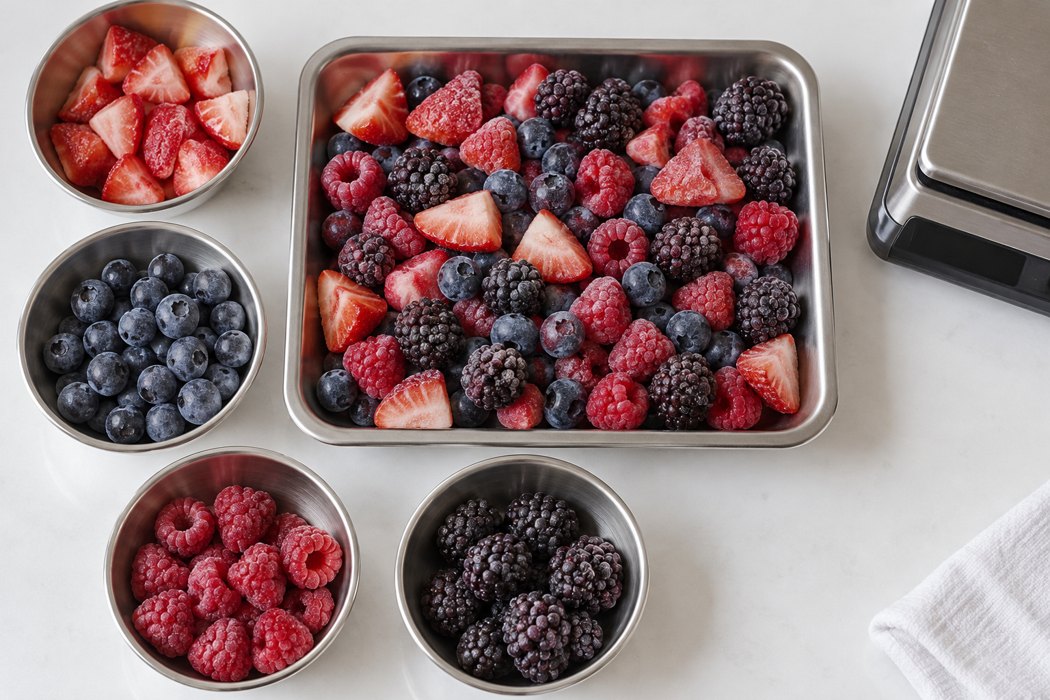
Different berry forms are visible in the supplied mixture.
The genuine product photograph shows several berry forms together but supplies no measured formula. Large dark berries and smaller red berries can occupy different visible areas even at comparable mass contributions. Use the photograph to discuss identity and appearance, then use the specification and representative sample for composition. Image area is not a substitute for weighing the components.
Commercial examples illustrate the need to identify the actual recipe. The USDA February 2022 frozen-fruit procurement specification defines a particular mixed-berry cup using whole blueberries and diced strawberries by weight, with its own tolerance and packing medium. It is a product-specific purchasing specification. Its formula and tolerance should not be transferred to a different four-berry IQF mix as a universal legal or quality standard.
State tolerances precisely. A limit described as "plus or minus five percent" is ambiguous unless the document explains whether it means percentage points or a relative percentage of the target. For a hypothetical target of 20%, five percentage points gives a different interval from a 5% relative allowance. The acceptance document should write the intended lower and upper limits explicitly and state the sample unit to which they apply.
Keep the approved formula version linked to the order. If the recipe changes, update the component list, proportions, relevant grade descriptions and any required label review together. The supplier's production formulation and the buyer's receiving assessment should refer to the same version. Otherwise a correctly measured sample can still be compared with the wrong target and generate a dispute that has nothing to do with mixing performance.
Understand why counting pieces changes the answer
Piece count gives every counted unit equal weight. Mass fraction gives each unit a contribution according to its mass. These are different measurements. A large strawberry half may weigh several times as much as a small blueberry, so a dish containing many blueberries can still contain a substantial strawberry mass. The visible number of pieces cannot establish the mass formula unless the relationship has been specifically measured and justified.
Consider a simple arithmetic example using invented average piece masses. Ten strawberry pieces averaging 8 grams contribute 80 grams. Forty blueberries averaging 2 grams also contribute 80 grams. Strawberry represents one fifth of the counted pieces but one half of the combined mass. The example demonstrates the denominator difference; it does not state typical berry sizes or prescribe a commercial blend.
Fragments make count comparisons still harder. One raspberry can become several recognizable fragments during handling. Counting those fragments as separate berries increases the apparent raspberry count without adding raspberry material. If the specification uses a whole-fruit count for a separate purpose, define what qualifies as one whole unit and how broken material is reported. Keep that assessment separate from the component's total mass contribution.
| Component | Pieces | Illustrative mass per piece | Combined mass |
|---|---|---|---|
| Strawberry | 10 | 8 g | 80 g |
| Blueberry | 40 | 2 g | 80 g |
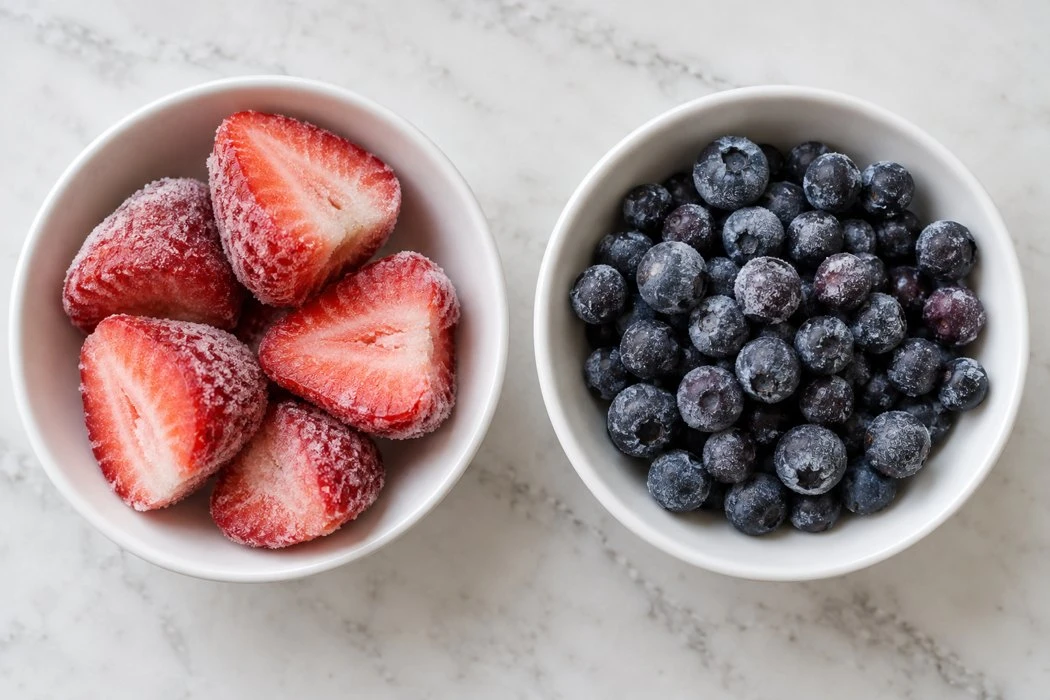
A piece count does not assign the same contribution as a mass measurement.
Volume and image area introduce other biases. Fruit shape, cavities, packing gaps and the position of large pieces affect how a scoop or shallow dish looks. A photograph taken from above emphasizes the exposed layer; fruit underneath is hidden. A volumetric scoop can be a useful serving tool, but the mass and composition it delivers need their own measurement when they control the product outcome.
Use the appropriate result for the decision. Mass composition supports a mass-based recipe. A whole-piece count can support a requirement for recognizable fruit units. A serving distribution study can address whether an ordinary portion contains the desired mix of components. None of these should be relabeled as another merely because it is easier to collect. The report can contain several measures when the application genuinely requires them.
When a buyer says the bag contains "too many strawberries," ask what was observed. The complaint may concern oversized pieces, excessive strawberry mass, a top layer dominated by strawberry, or uneven small portions. Each is a legitimate question, but each needs a different check. Clarifying the observation before testing lets the supplier respond to the actual product problem and avoids an irrelevant argument about piece count.
Sample across packs before judging the formula
Define the lot and the sampling objective before opening bags. A single development sample can help assess a candidate formula, while a receiving sample is intended to support a decision about an identified shipment or lot. The number and selection of units should follow the agreed plan and commercial risk. This article proposes assessment considerations; it does not establish a universal statistical sampling plan.
Retain pack identity. Record the lot code, carton or pallet location where relevant, pack size and selection method. If the investigation concerns a suspected mixing inconsistency, samples from different positions can help reveal it. A conveniently accessible top bag may be useful for an initial look, but it should not be described as a representative sample of the entire delivery without a defensible selection basis.
Avoid selecting only the largest or most colorful pieces when taking a portion. Use a procedure that gives the intended material a fair opportunity to enter the sample and that preserves the frozen condition. If a bag is sampled at different depths, record the positions and how the portions are obtained. The method should minimize selective loss of small berries and fragments while keeping the operation practical.
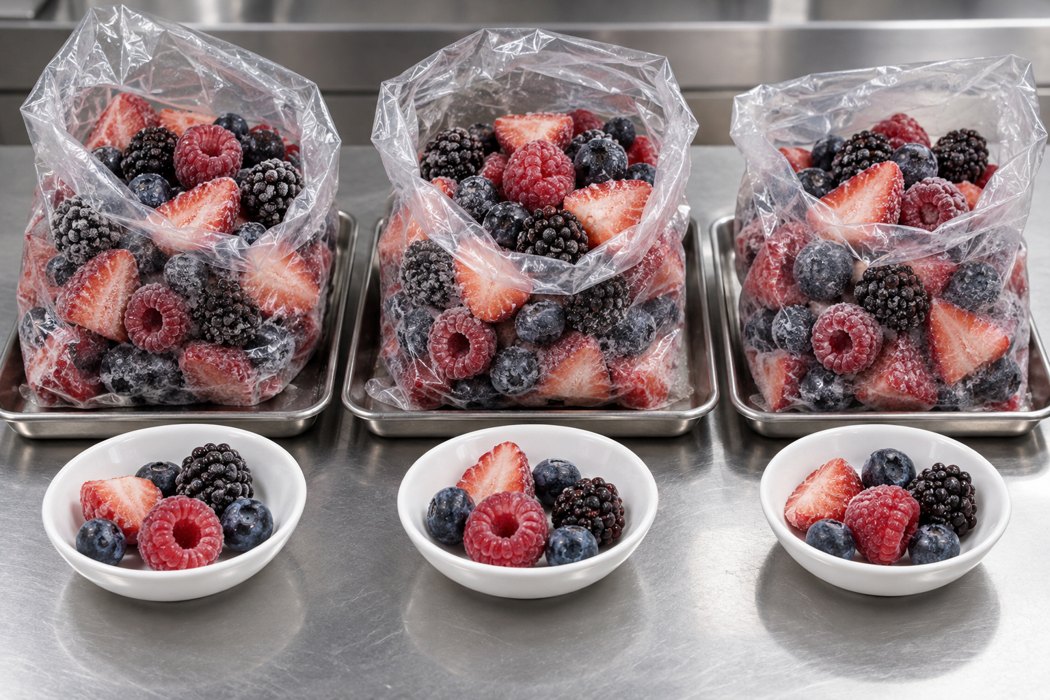
Keep each pack and its own sample separate before deciding whether to combine them.
Decide whether individual packs or a composite sample will control acceptance. Combining portions can provide information about their aggregate composition, but it can hide differences between packs. If pack-to-pack consistency matters, retain separate results before calculating any combined value. A lot average may be acceptable while some retail units fail the customer's presentation or ingredient-distribution requirement.
Document how samples are combined. Equal masses from each selected unit answer a different question from combining the complete contents of packs with different sizes. When calculating an overall mass fraction, use the summed component masses divided by the summed denominator masses where that matches the intended basis. A simple average of percentages is appropriate only when its weighting represents the agreed question.
Protect the sample from changes during handling. Keep it in the defined frozen state as far as the method requires, use suitable containers and record the time out of storage. Thawing can release liquid and make component separation more difficult. A sample that changes before sorting may still provide useful information, but the report must state its condition and the limits that condition places on the measurement.
Sort and weigh without losing part of the sample
Prepare separate identified containers for the named berry components and any material that cannot be assigned confidently. Use a balance suitable for the sample and the required resolution, with the relevant checks completed under the site's procedure. Record tare values and actual masses. A neat row of dishes is useful only when every dish can be connected to the original sample and the stated denominator.
Sort recognizable whole berries and identifiable fragments into their corresponding component fractions when the method permits. Keep uncertain fragments in a separate category instead of assigning them according to color alone. A dark fragment might be difficult to identify once frozen liquid covers its surface. The specification or agreed method should explain how that unresolved material affects the composition result and whether additional assessment is needed.
Reconcile the recovered mass. Compare the sum of all sorted fractions, loose material and any collected liquid with the starting sample mass on the same basis. Differences can arise from material left on tools, container changes, spillage or a changing sample state. Investigate a material discrepancy before presenting the component percentages as a complete analysis. State any accepted recovery tolerance in the agreed method rather than inventing one after the measurement.
An illustrative worksheet could start with a 1,000-gram sample and recover 400 grams of strawberry, 300 grams of blueberry, 200 grams of raspberry, 90 grams of blackberry and 10 grams of unassigned fragments. Reporting 40%, 30%, 20% and 9% preserves the original sample denominator and shows the unresolved 1%. Renormalizing only the identified fruit to 100% answers a different question and would hide that unresolved material if the report omitted it.
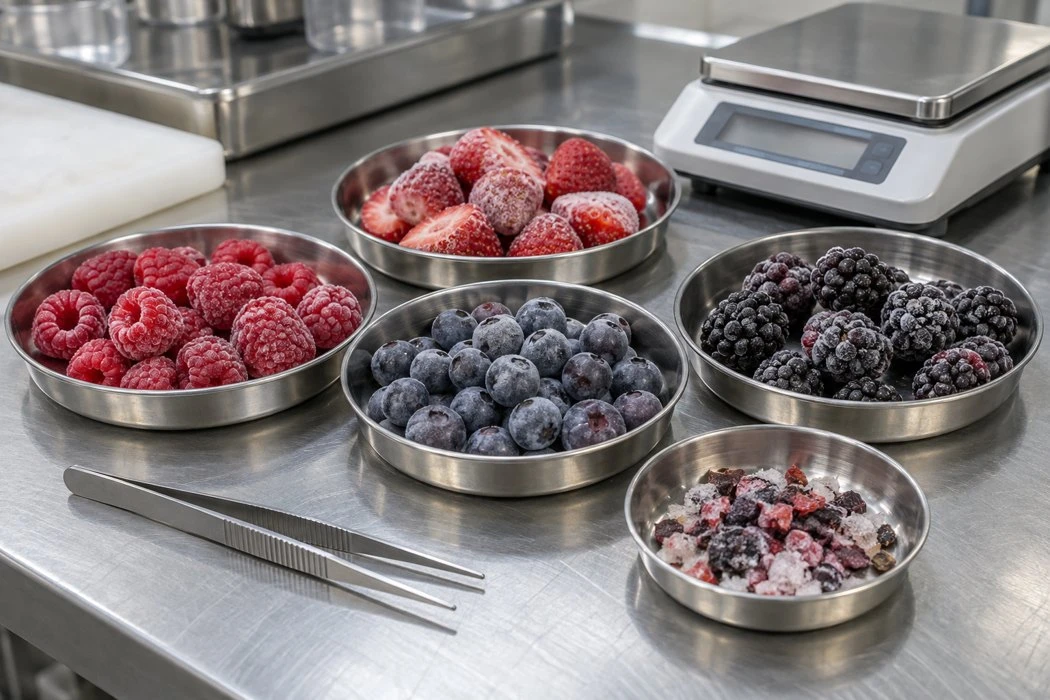
Retain an unassigned fraction when berry identity cannot be established confidently.
- Identify and weigh the complete sample.
- Sort the defined fractions under the agreed conditions.
- Weigh each fraction and reconcile the recovered mass.
- Calculate component results using the stated denominator.
Keep photographs of the sorted fractions and the original sample with the mass record. The images can help explain identity decisions and visible form, but the balance readings provide the numerical evidence. If identification remains uncertain, report a bounded result or request an agreed follow-up method. A precise percentage with an unexplained fragment allocation can be less reliable than a clearly stated uncertainty that the parties can resolve.
Keep the original numerical record at sufficient resolution for a later recalculation. Rounding each small fraction before summing can create an apparent recovery difference that comes from reporting, while dropping an unresolved fraction changes the measurement basis. Calculate from the retained mass readings, state the rounding rule used in the report and avoid displaying more precision than the weighing and identification method supports. When buyer and supplier results differ slightly, compare these calculation details before assuming that the physical mixtures differed.
For a repeat program, preserve the method version alongside the formula version. A change in how strawberry fragments are identified, whether loose ice enters the denominator or how composite samples are weighted can shift the reported percentages without any deliberate recipe change. Review those method changes openly and, where needed, examine the same sample by both versions to understand their practical effect.
Check small servings separately from the lot average
An overall recipe does not guarantee that each small scoop contains the same proportions. The components differ in size and shape, and the portion contains a limited number of pieces. The effect is especially visible when a single large strawberry piece contributes a substantial share of a small serving. A buyer who needs a consistent topping should therefore define a serving-level question in addition to the lot's mass formula.
Use the actual portioning method in a development trial. Identify the scoop or dispenser, the intended portion quantity, the product state and the normal handling sequence. Collect successive portions without arranging the fruit by hand to make them look balanced. Record each portion separately, including its total mass and the component observations relevant to the application. The sample should represent ordinary use rather than an idealized photograph.
The photographs of small cups illustrate why this matters. One portion can be visually dominated by a strawberry piece while another contains more small dark berries. That appearance alone does not prove that the bulk recipe is wrong. It identifies a distribution question that can be measured. Keep the composition of the full source sample and the distribution of its portions as separate results.
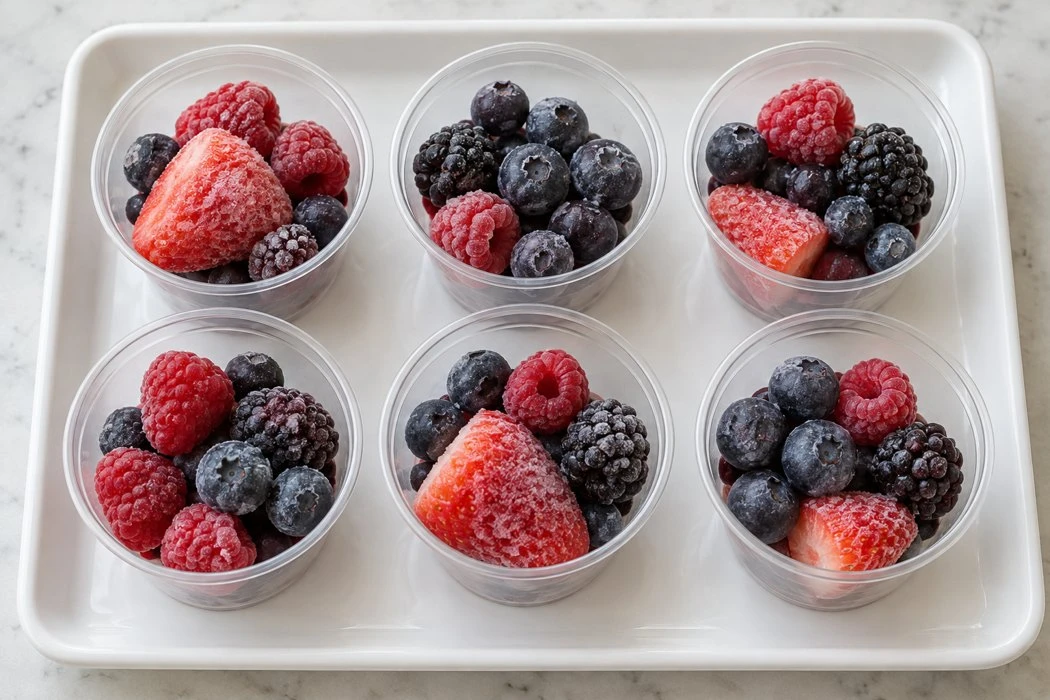
Ordinary portions can differ even when the larger mixture follows its mass recipe.
Choose a useful serving criterion. The application may require at least one recognizable example of a particular fruit, a limit on oversized pieces, a portion-mass range or an acceptable overall appearance. These criteria are not interchangeable. A requirement for every small cup to contain each of four fruits may need a different component size or a controlled assembly method; changing the bulk percentages alone may not achieve it reliably.
When investigating segregation, preserve the order in which portions were taken and the relevant pack position. Differences between early and late portions can suggest where to investigate the handling or dispensing process. They do not establish a cause by themselves. Repeat the comparison under controlled conditions and review the actual material and equipment before attributing the effect entirely to one berry's shape or density.
The final application approval can retain both records: the blend meets the agreed mass composition, and the intended portioning process meets the serving requirements. If only the first passes, the customer can consider a different cut, pack size, handling method or assembly approach. This keeps a valid recipe result from being used to dismiss a real serving problem and avoids rejecting the formula for a problem created elsewhere in the workflow.
Retain component size and whole-piece requirements
Composition and component quality need their own fields. A blend can contain the agreed raspberry mass while much of that mass is in fragments. It can contain the agreed strawberry mass while pieces are too large for the intended spoon or dispenser. If those attributes matter, specify them for the relevant fruit rather than assuming that a passing overall formula covers them.
The genuine steel-table mixed-berry photograph shows why component descriptions need to be concrete. Strawberry pieces, raspberries and dark berries have different visible forms. The photograph is useful for discussing the product, but it does not establish a measured size distribution or whole-piece percentage. A sample assessment should use the defined method and retain the result for each component that controls the application.

Visible components include different shapes and exposed cut surfaces.
State the size measurement clearly. A maximum dimension, a sieve range and a named cut description can produce different classifications. The method should identify which one applies and how irregular pieces are treated. If the buyer uses the term "dice," confirm the intended cut and tolerance rather than assuming that every strawberry piece has an exact cube geometry. The acceptance target should reflect the actual offered material.
Keep defect reporting from double counting or obscuring the composition. An identifiable damaged blueberry still contributes blueberry material to a composition assessment if the method defines it that way, while it may also belong in a defect category. Explain the relationship between the two results. Removing defects before calculating the formula can make the reported mixture differ from the delivered material unless that preparation is explicitly required.
Consider the effect of a component change on the finished use. Smaller strawberry pieces may distribute more evenly but expose more cut surface; a different raspberry form may change visible shape and handling. These are reasons to run the relevant application trial, not predictions that one form will always be better. Link the component specification to the customer's yogurt, bakery, beverage or foodservice requirement.
We can help confirm the offered mixed-berry forms and sample requirements before quotation. Send the component list, target mass recipe, size or whole-piece needs, packing quantity and intended use together. That allows the supplier discussion to address the ingredient the customer will actually receive, rather than treating the same blend name as proof that two offers are equivalent.
Turn the result into a usable acceptance decision
The report should begin with what was examined: the identified lot, selected units, sample condition, total mass and method. Present component masses before or alongside percentages, then show the denominator and any unresolved fraction. Keep individual unit results available where they matter. A purchasing team should be able to understand a discrepancy without reconstructing the arithmetic from photographs and scattered notes.
Compare the result with the correct version of the specification and its stated tolerance. If a boundary is approached, consider the method's resolution, recovery and relevant uncertainty through the agreed decision procedure. Do not invent an acceptance margin after seeing the result. The parties should know in advance how a borderline finding, an incomplete mass recovery or an unassigned fragment fraction will be handled.
For a disagreement, preserve the sample and records according to the agreed retention procedure. Share the actual sorting definitions and calculation basis with the other party. Two results can differ because one team excluded loose ice, another renormalized identified fruit, or the samples came from different units. Align those details before concluding that either team measured incorrectly or that the lot was deliberately misformulated.
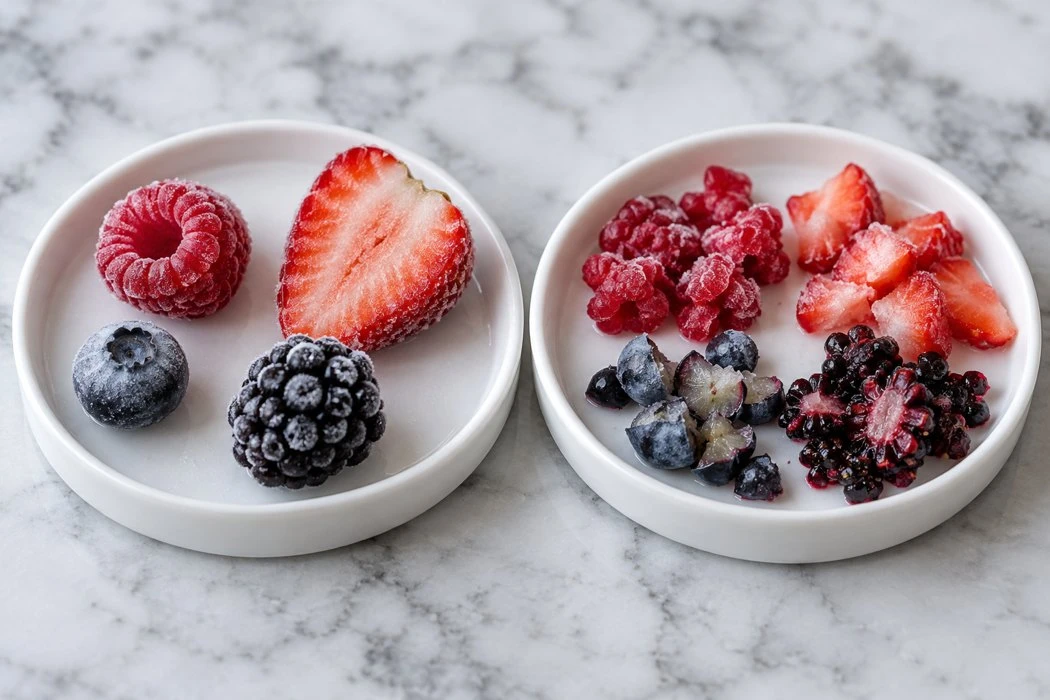
Report component mass and physical form as distinct observations.
If the formula fails, identify which components and sample units are affected, and review the relevant production and packing records. If the formula passes but portions are uneven, investigate the serving requirement and handling method. If component form fails, address that specific grade or size requirement. Keeping these outcomes distinct helps the supplier propose a correction that matches the observed problem.
The approved record should carry forward into repeat orders. Retain the recipe version, component forms, sampling method, acceptance limits, sample photographs and application requirements. Define which changes trigger another review, such as a substituted berry, altered cut, revised pack quantity or new portioning equipment. This makes the approval durable enough to guide purchasing while keeping its limits explicit.
An unresolved fraction can also be shown as a limited range when that helps the agreed decision. In the earlier invented example, 300 grams of identified blueberry in a 1,000-gram sample establishes a 30% identified blueberry fraction. If all 10 grams of unassigned material could plausibly be blueberry, its total contribution could be as high as 31% on that same basis. This calculation does not identify the fragments; it shows how much the uncertainty could matter. Resolve the identity before approval when that difference crosses the agreed limit.
For a continuing supply program, trend results only when the sampling and calculation basis remain comparable. A new sample size, a changed fragment definition or a switch from individual-pack results to a composite can alter the series. Mark that change in the record rather than interpreting the resulting shift immediately as a production change. Comparable records allow the team to ask a meaningful question about consistency over time.
Composition control is most useful when it remains connected to the actual use of the blend. A mass result can verify the recipe represented by the sample; it cannot guarantee every small serving or every visual attribute. Combine that result with the component and application checks that matter to the customer, then record a decision whose scope can be understood by the supplier, receiving team and product developer alike.
Related reading
Frozen Strawberry Inspection & Sampling SOP (Inbound Acceptance)
Connect pack identity and inspection observations to a documented receiving sample.
GreenLand Food - Frozen Strawberries Specification Sheet
Define strawberry form, size and the technical fields behind a component specification.
Approved Frozen-Fruit Sample Ageing: When to Replace the Benchmark
Check whether an aged approved sample still supports the comparison.
Source frozen mixed berries with GreenLand-food
GreenLand-food is a professional frozen mixed berries supplier and manufacturer in China, providing factory-direct wholesale supply for importers, food manufacturers, foodservice distributors, and private-label programs.
Send your berry component list, target proportions by weight, required forms, packing, quantity, intended application, destination, private-label needs and requested documents. Include the sample quantity and assessment method so we can confirm an appropriate quotation and supply specification.