


Importing Frozen Produce into Chile: A Buyer Guide for China-Origin IQF Broccoli
Oct 16, 2026
Leave a message

For China-grown, China-processed, single-ingredient blanched IQF broccoli florets entering Chile in industrial bulk, the importer needs two separate health decisions: a Certificado de Destinación Aduanera (CDA) to move food from the customs enclosure to an authorized warehouse, then an approved Autorización de Uso y Disposición (UyD) before use or sale. The customs declaration, and any applicable SAG plant-health control, sit alongside those steps. Neither a reefer delivery nor a CDA alone releases the broccoli to the market.
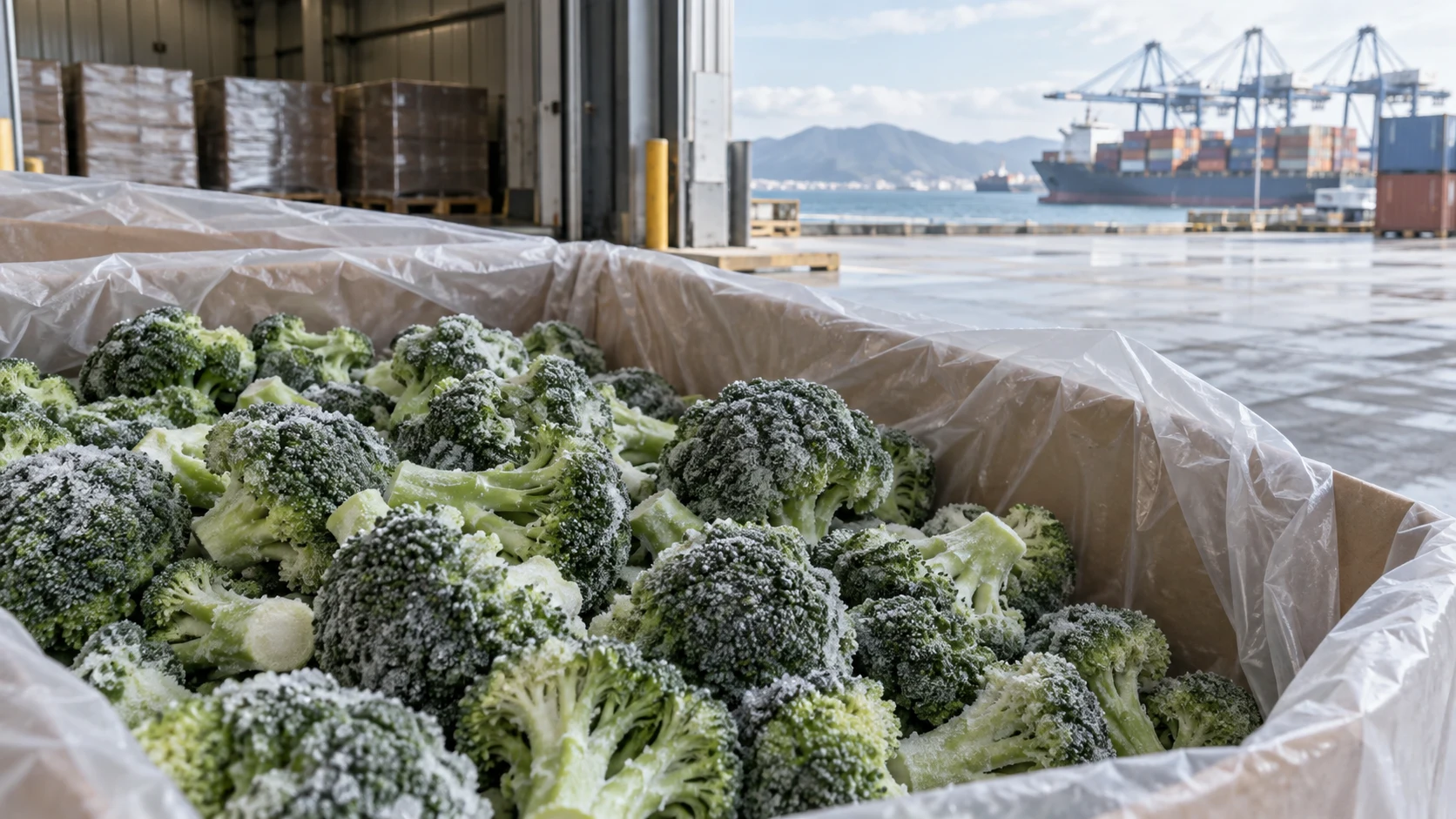
A proposed frozen broccoli handoff for a Chilean buyer.
This guide follows one cook-before-eating SKU so the roles are clear. Chile's importer of record files or instructs its representative; GreenLand-food proposes a traceable product and shipment dossier from China. The freight carrier controls physical movement and temperature records. SEREMI de Salud decides the food route, SAG decides plant-health treatment when applicable, and Aduanas decides customs clearance. Changing the product to fresh broccoli, a seasoned mix, an organic item or a ready-to-eat vegetable requires a new review.
Reviewed 16 October 2026.
Fix the exact broccoli SKU and Chilean importer
Start with a product description that survives every handoff. Our reference article is broccoli florets, Brassica oleracea var. italica, grown, cut, blanched and IQF frozen in China, with broccoli as the only ingredient. They arrive as loose, free-flowing florets in food-grade lined bulk cartons for industrial cooking. The process is not sterilization, and blanching should not be presented as a validated pathogen kill step. The case and technical sheet should say that effective cooking is required before consumption. If a customer asks for a raw salad application, the safety assessment and microbiological category change.
The Chilean buyer names one legal importer and the receiving warehouse before placing the shipment. On its current COMEX food-import page, Chile's Ministry of Health says the applicant for both CDA and UyD is the person or entity responsible for importing the food. For CDA, it requests the signed compliance declaration, international transport document, commercial invoice, packing list, SII initiation-of-activities certificate and, if the warehouse belongs to another party, evidence linking the applicant to that installation. The warehouse must be authorized by the health authority and able to hold the full load. These are operational inputs, not documents the Chinese exporter can file in place of its Chilean customer.
We would send the importer a draft description, ingredient statement, process flow, technical specification and carton-marking proposal. The importer should compare them against the final invoice, broker classification and SEREMI portal fields. "Frozen broccoli" alone hides whether the shipment consists of whole heads, florets, a mixture or a prepared food. A wrong form on the invoice can create conflicting customs and sanitary records even when the physical cartons are sound. The same manufacturing lot code should carry through the specification, packing list, certificate and outer carton.

Actual GreenLand broccoli form used to discuss the contracted grade.
It is useful to agree at the outset who holds the stock if a laboratory result is disputed. The importer controls the Chilean warehouse and official applications; a customs agent may transmit the entry; the carrier brings the reefer; the downstream processor decides whether the floret cut works in its line. A sales contract can assign the cost of rejected material or storage, but cannot make GreenLand-food the Chilean statutory applicant by wording alone. Our frozen broccoli florets page identifies the product family; the purchase order still needs a batch-specific agreed grade.
Classify tariff and separate customs from health control
The starting international customs heading for frozen vegetables is 0710. Broccoli without sauce or other ingredients belongs in the "other vegetables" branch rather than the spinach or sweet-corn branches, but the Chilean broker should confirm the live national tariff item from the final composition and process. A supplier's HS code on an invoice is a useful prompt for that review, not a customs ruling. A mix containing cauliflower, a prepared dish or a non-water cooking step can alter the classification. Tariff classification also influences the Chile–China trade-agreement analysis, so this decision belongs before the landed-cost quote is treated as final.
The importer or appointed customs agent prepares the Chilean import declaration with seller, buyer, value, quantity, origin, transport document, invoice, packing list and tariff item. Aduanas' acceptance and payment of any duties and taxes address the customs side. They do not establish that the food can be sold. MINSAL says all human foods, including raw materials and additives, require CDA when they enter Chile and that Aduanas asks for it. That is why the broker should see the CDA result and warehouse address before trying to remove the reefer from the customs area. The release schedule must leave time for both the customs and sanitary steps.
For an industrial buyer, the customs description should also distinguish the net food mass from gross shipping weight and outer packing. Freight quotations, invoice quantities and sanitary application fields may use different units, yet all must reconcile to the same cartons. If a 10 kg case has a liner and corrugated shell, list the net broccoli weight separately from the case gross weight. Reconcile any pallets borrowed, exchanged or returned under the carrier contract. A discrepancy that looks small on one pallet can turn into a material difference across a full reefer and invite a needless document correction.

One product description supports customs, applicable SAG review and two distinct SEREMI decisions. The diagram maps responsibility rather than suggesting that each decision is interchangeable.
Ask the broker to model the actual tariff and origin route, including any preference under the Chile–China agreement only if the origin rule and acceptable proof are satisfied. China as the shipping country does not automatically establish preferential origin; here the cultivation and processing evidence should align with the declaration. Any preference is separate from SEREMI food authorization. We would supply an origin statement and supporting manufacturing records as agreed, while the importer validates the preference claim and makes the entry.
For the first order, set out four named results in a simple shipment register: customs declaration accepted, CDA approved, any required SAG decision obtained, and UyD approved. A "cleared" note from a forwarder may describe only one of them. We suggest the importer keep the actual agency reference number, date, lot identity and release condition beside each result. This takes little work and prevents a cold store from treating a gate pass as authority to dispatch food to a customer.
Book the authorized cold store and file the CDA
The MINSAL COMEX instructions say CDA allows removal of imported food from the customs enclosure and its transfer to the specified warehouse authorized by SEREMI de Salud. The applicant uses the SEREMI en Línea route linked on that page. The filed address, physical receiving capacity and contractual right to use that warehouse should be settled before arrival. A third-party freezer contract should identify the actual importer and the space available for this load. If the declared warehouse changes, MINSAL explains that the CDA must be amended; quietly diverting pallets to another cold store is a regulatory breach.
For the local filing, the official COMEX instructions distinguish the responsible regional office: CDA goes to the SEREMI for the port of entry; UyD goes to the SEREMI for the storage location. The importer or authorized customs agent follows the linked SEREMI en Línea service, selects the food CDA or food UyD procedure, and retains its application and resolution references. Both offices can therefore differ when port and freezer are in different regions. We provide the product, process, lot and shipping inputs; the Chilean applicant supplies its SII and authorized-warehouse records. Obtain the current fee assessment in the selected service or from that SEREMI before filing; no unverified national fee is quoted here. Access to the public portal was blocked during our browser review, so a completed login or application is not claimed.
The applicant should upload a signed CDA declaration, international transport document, commercial invoice, packing list and SII initiation-of-activities certificate. If the cold room is not its own, include a lease, declaration or other document establishing the relationship. MINSAL also describes supporting evidence when the invoice holder and CDA applicant differ, and it may request additional justified evidence. A bill of lading still in draft may need coordination with the arrival file; names and pack counts should agree before final submission. We would review the exporter-side drafts for consistency, but the importer files and signs its own application.
MINSAL currently states that SEREMI has three days to respond to a CDA application, and an incomplete filing receives five days to cure under Law 19.880. Those are published procedural periods, not a promise that a vessel, port or warehouse will be ready on the same date. Book the freezer with room for inspection delay and keep reefer power and temperature monitoring in the port plan. A commercial quotation should show who pays storage or demurrage if release waits for corrected documents.
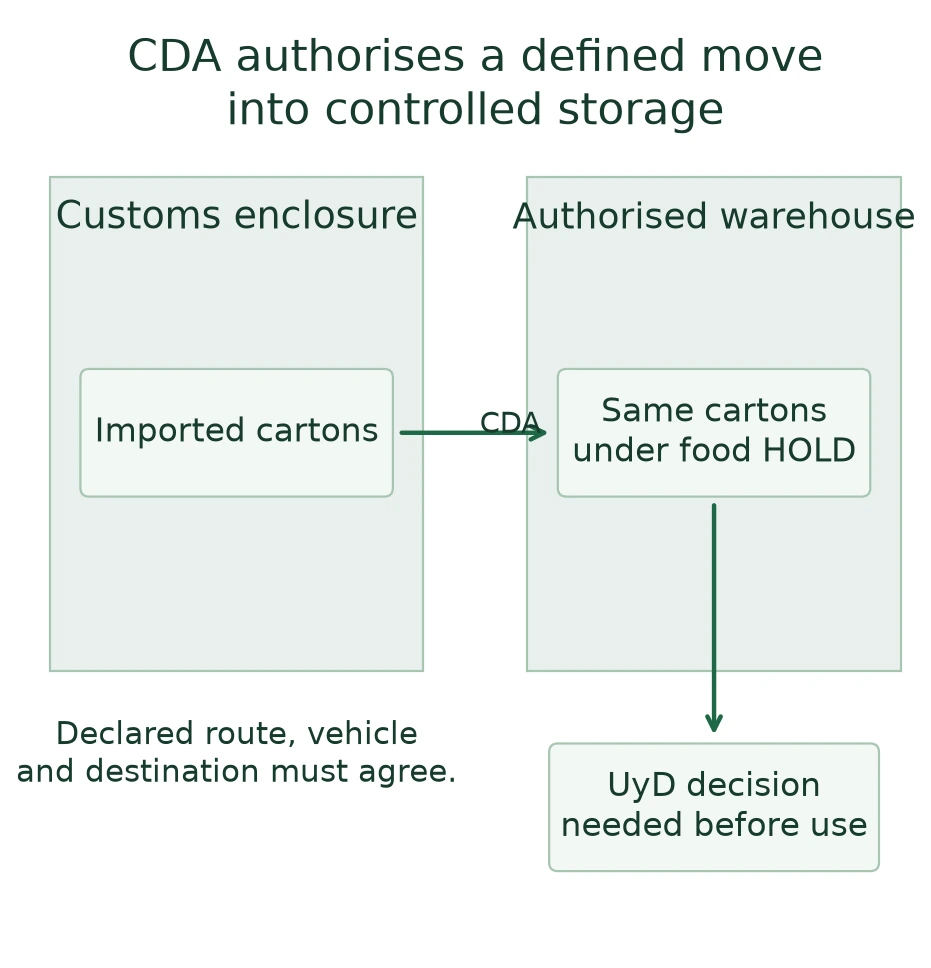
CDA controls the movement from the customs enclosure to the declared authorised warehouse. Stock remains held for the subsequent UyD decision.
Once issued, present the CDA to Aduanas and move the goods only to the approved address under the conditions recorded. The result is custody at an authorized warehouse. MINSAL is explicit that CDA does not authorize selling the broccoli. We advise the importer to mark the stock "held pending UyD" in its inventory system. An invoice to a customer or a forwarder's delivery receipt does not close that hold. This is the point where a practical stock-control instruction is as important as a legal explanation.
The approved warehouse should have an intake slot that allows the driver to back the reefer to a temperature-controlled dock or keep doors open for only the minimum practical period. Record each pallet's condition before it disappears into racking. If an authority needs access to sampled cartons, plan that access with the warehouse rather than unloading and reloading the entire container repeatedly. The operating plan should state where the goods remain under hold, who may move them and how any official seals or samples are tracked. A first shipment often reveals these small handoff gaps more readily than it reveals a problem with the actual broccoli.
Decide the SAG phytosanitary branch for frozen florets
Chile's plant-health treatment cannot be inferred from the word "vegetable." The current SAG Resolution 1,284/2021 annex classifies freezing and ultrafreezing of vegetables, whole or cut, in phytosanitary risk category 2, subsection 4.1, for documentary verification. It separately lists cooking or precooking in category 1. Our broccoli is blanched and frozen; a generic "precooked" note does not prove that SAG will move this exact finished SKU into category 1. The importer should document the actual thermal step, freezing process, pack, origin and intended use, then confirm the treatment against the SAG import-requirements service or with SAG before dispatch.
The SAG agricultural import page explains that an importer or customs agent declares goods requiring SAG approval at the point of entry and supplies a phytosanitary certificate when one is required. It describes documentary review, possible physical verification according to the risk category and a final Informe de Inspección de Productos Agropecuarios (IIPA). Where the condition or origin lacks a published rule, an interested party can submit Formulario N°1 to a SAG sectoral or regional office for an official pronouncement. That procedure should be used for a genuine classification or authorization doubt; it is not a substitute for the routine SEREMI food applications.
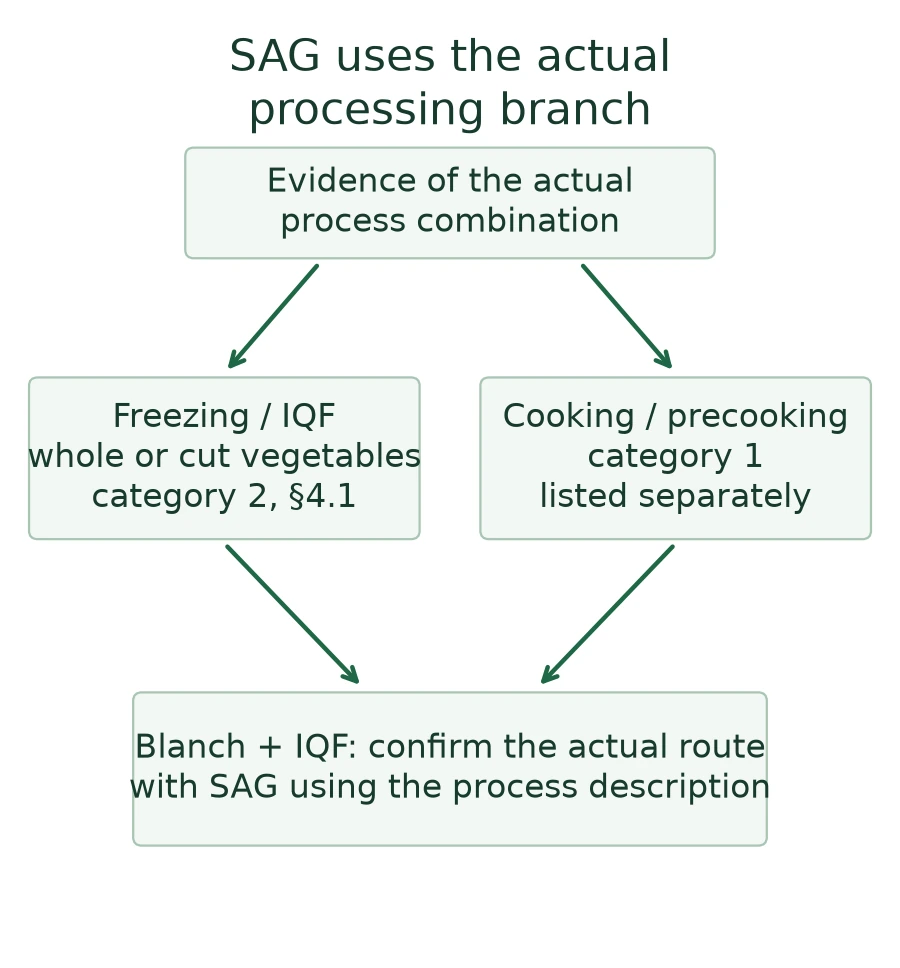
SAG lists freezing and cooking in different categories. Evidence of a brief blanching stage does not itself select the cooking branch for the completed IQF product.
For this blanched IQF lot, we would provide a signed process description that distinguishes washed raw broccoli, the blanching stage, cooling, freezing and final packaging. The buyer can attach that to its SAG enquiry. If the agency confirms only documentary verification, arrange the declared product and supporting papers exactly as instructed. If SAG instead imposes a certificate or another measure for the actual country and condition, build that requirement into the China export timetable before loading. A certificate guessed after the vessel sails is a poor remedy for a missing pre-shipment document.
SAG's plant-health decision answers whether the article can enter without posing an unacceptable pest risk. It does not replace the MINSAL judgment on whether frozen food is fit for human consumption. Nor does a customs tariff code by itself settle the SAG processing category. The three authorities use some shared descriptions, so the buyer gains from one coherent technical file, but each result should be recorded under its own name.
Prepare and submit the UyD food-release dossier
After CDA-authorized transfer, the responsible importer requests Autorización de Uso y Disposición from the SEREMI responsible for the warehouse location. MINSAL says the required file includes the signed UyD declaration, CDA supporting documents, a document issued by the competent authority in the origin country confirming fitness for human consumption, label artwork or a photograph for each finished product, technical sheets, the Aduanas import declaration and proof that the load is in the warehouse. It may ask for contaminant, microbiological or quality analyses and any SAG approval that applies. The origin document may be a sanitary certificate, free-sale certificate or equivalent according to product type; the importer should confirm the exact acceptable format for this SKU before GreenLand-food commissions it.
The SEREMI may review documents and grant direct release, inspect the cargo, or take samples for analysis. MINSAL says the authority has 30 days to respond, with a national average around one week, depending on file completeness and whether inspection or testing is required. This published average should not become a fixed delivery promise. The importer should plan the first warehouse booking and downstream production date around a possible sample hold. A second lot might clear differently if its risk profile or documents differ.
Chile's consolidated Reglamento Sanitario de los Alimentos, February 2026 provides a useful SKU-specific check. Section 14.4 covers frozen fruits and edible vegetables that require cooking: mesophilic aerobic count n=5, c=3, m=5×10⁴ and M=5×10⁵ per gram; Enterobacteriaceae n=5, c=3, m=5×10³ and M=5×10⁴ per gram; Salmonella absent in 25 g with n=5 and c=0. The sampling-plan notation matters. "One negative Salmonella test" is not equivalent to an n=5 official criterion. A lab request should identify the matrix, five-unit sampling basis, method, limit of detection and lot covered. These are legal criteria, not a universal supplier claim that every past lot has passed.
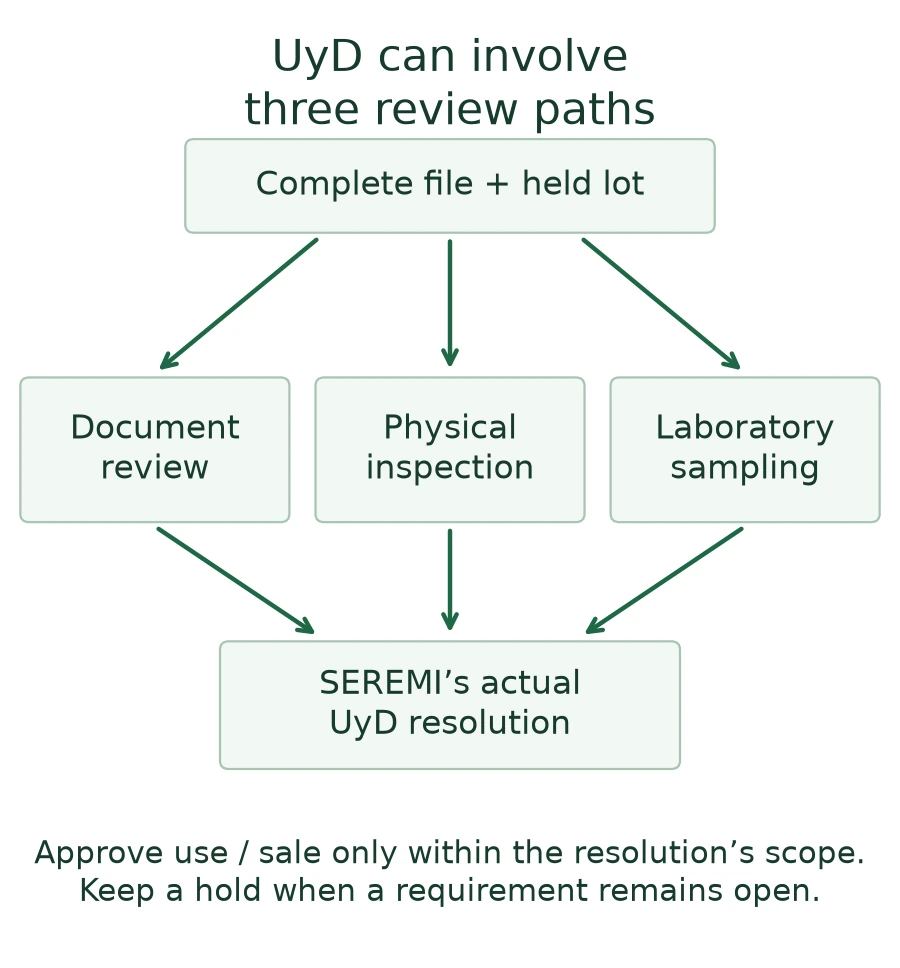
SEREMI can decide from the file, inspect the lot or sample it. The actual UyD resolution controls whether use or sale is allowed.
The RSA also defines a frozen food by reaching −18°C at the thermal centre and requires frozen storage at −18°C or below with continuous recording; interurban frozen transport must maintain product temperature at −18°C or lower. Our proposed shipping condition should align with these provisions, while the importer checks the final label and any specific residue or contaminant rules for the crop and measured substance. A pesticide report needs the active ingredient, legal residue definition, broccoli category, result in mg/kg, uncertainty and analytical method. A buyer-set tighter limit belongs in the contract and should be labeled as such, not attributed to Chilean law.
Chile's Resolution 892/2020, Technical Standard 209, is the pesticide decision reference, including its 2024 table amendments. Article 6 specifies a priority sequence of Codex, EU and US values and a 0.01 mg/kg default when the sequence yields no established MRL. Articles 4–5 also address authorization, prohibited residues and rodenticides, and Article 7 preserves specific prohibitions. Consequently, a supplier cannot pick whichever country's number is easiest to meet. For every relevant spray-program substance, we would record the current applicable commodity and residue definition, prohibition check, source of the selected value and method capability before releasing the source. The finished-lot report must identify the sampled frozen matrix and lot. Any processing comparison needs a supported basis; the presence of a blanching step is insufficient to assume a reduction. This order-specific comparison is the basis for our raw-material acceptance and laboratory instruction.
The laboratory plan should specify when and where a sample is taken. Raw broccoli intake, post-blanch material, packed finished cartons and a Chilean arrival sample answer different questions. A result for a different crop field or an earlier production day cannot be relabeled as this container's release evidence. We would propose a lot-sampling schedule that follows the buyer's risk priorities and the applicable Chilean criteria. The importer can then decide which reports to attach to UyD and which to retain for its own supplier qualification. If SEREMI takes an official sample, its method and decision govern that official outcome independently of our internal report.
Move the reefer through inspection and customs clearance
The physical sequence starts before the ship berths. The forwarder should confirm port appointment, powered reefer position, seal number, bill of lading, collection window, driver, approved cold-store destination and contingency for delayed inspection. The importer should ensure the customs agent sees the same invoice, pack count, tariff description, CDA and, if applicable, SAG documents as the SEREMI application. We would make export-side corrections while the documents are drafts, not after the container is at the gate.
At arrival, retain the carrier's temperature log and document any period without power or any opened seal. A container controller showing −18°C at pickup does not prove every carton stayed within specification for the voyage. The receiver should measure representative product temperatures with a calibrated instrument, record pallet and carton condition, reconcile lot and quantities, and isolate damaged or thawed units. If the port or authority selects a physical check, keep the goods accessible without warming the whole load unnecessarily. A cold-chain excursion needs a quality investigation with time, temperature and product evidence; it is not solved by resetting the controller.
The broker completes the customs entry and follows Aduanas' assessment and payment route. The health-authorized movement under CDA then brings the broccoli to the declared warehouse. Any SAG IIPA result, if the agency has jurisdiction over the actual SKU, is kept with the shipment file. These outcomes should be reported separately. The cargo can be in a freezer yet still be legally held pending UyD. This distinction is especially important for a distributor whose warehouse software automatically makes received stock available to sales staff.
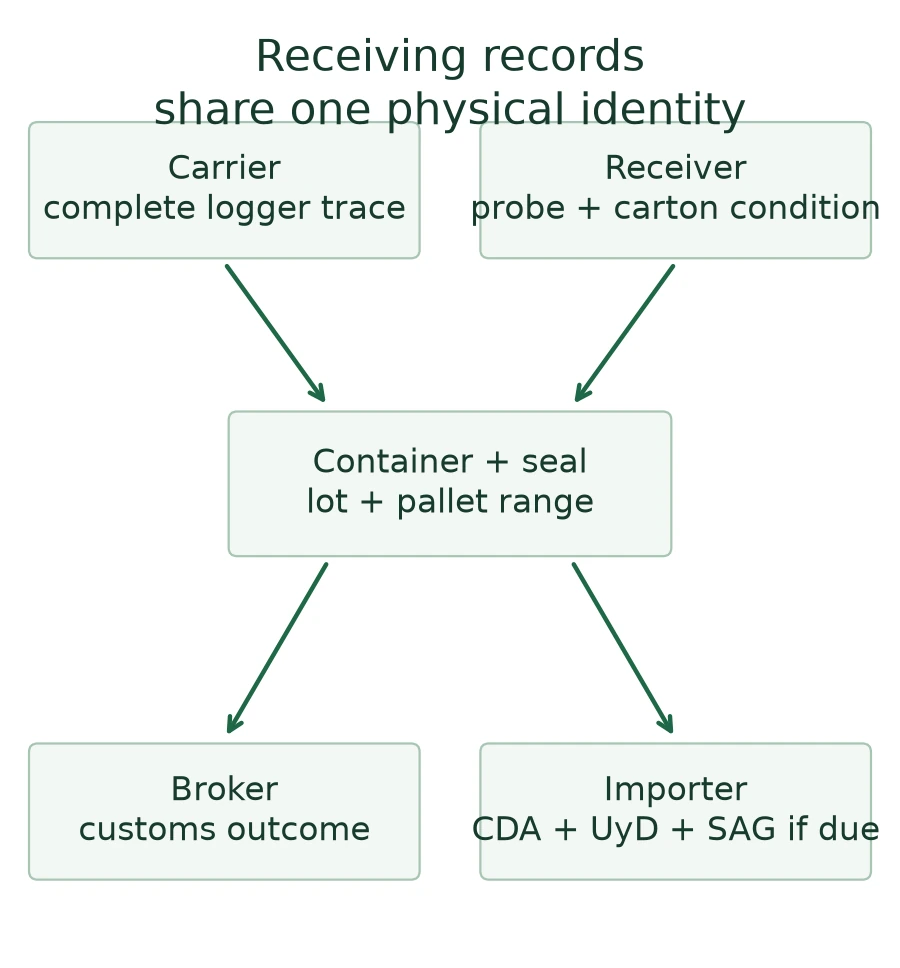
Carrier data, receiving measurements and authority decisions belong to the same physical lot.
Before the first order, agree who can instruct a re-export, relabel, additional analysis or destruction if a regulator rejects the lot. The purchase contract can allocate costs and evidence responsibilities, while the local importer follows the agency's actual resolution. We would avoid a blank promise that GreenLand-food can make a noncompliant lot releasable. The defensible control is to send matching technical, label and test material early enough for the importer to identify a problem before the container leaves China.
Release the lot to use or sale after UyD approval
MINSAL says an approved UyD allows the importer to use, consume or commercialize imported food, provided the label is brought into compliance before sale. Treat that resolution as the food-release signal. The warehouse should record its reference number, approved product and lot, and any conditions. Separately, the importer should have the customs clearance and any SAG decision that applies. Only then should a commercially acceptable lot move from regulatory hold to usable or saleable inventory. A buyer's own product acceptance may still be stricter than the law.
For the first Chilean batch, we would ask the receiver for a short, structured report: seal and logger ID, arrival temperature and calibrated probe reading, carton integrity, net mass check, floret-size distribution, visible stem and fines, representative cooked appearance and any complaints against the agreed specification. The measurements should refer to the sampled cartons and lot, not a generic adjective such as "good quality." Where the buyer requires a 30–50 mm main grade or a 10 kg lined carton, record the sample basis and acceptance tolerance in the signed order. Those are negotiated commercial targets, not Chilean statutory limits.
Keep a record linking raw-material source, production date, test sample, packing line, carton code, pallet, container and Chilean receiving location. If a laboratory result or customer complaint arrives later, this file lets both businesses identify the affected units and hold them without freezing all unrelated stock. We would share the trace elements and any requested batch evidence available for the actual shipment, while the Chilean importer owns the local recall and authority communication duties. Do not print an unverified quality certificate number or claim that an inspection happened when it has only been planned.

Actual GreenLand floret-size inspection photograph.
The order should close with a practical review of three questions: Did the agreed grade run well in the intended cooking line? Did documents clear through CDA, any SAG step, customs and UyD without correction? Did the cold chain and packaging arrive intact? The answers determine whether to keep the cut, pack and shipping instructions for the next container. They also make a second purchase a controlled repeat rather than a fresh improvisation.
Continue with the China-origin IQF broccoli supply plan for the same China-origin, single-ingredient, blanched IQF broccoli order.
Related reading
Compare food and customs controls if your physical route transits the EU.
Compare the same floret specification under a different market's entry rules.
Plan your frozen broccoli supply
GreenLand-food is a China-based frozen broccoli supplier and manufacturer discussing factory-direct wholesale supply. Send us your floret size, grade, packing, quantity, cooking application, Chilean destination and requested documents so we can prepare a reviewable proposal for the actual source and order.