


How to Cook Kidney Beans Safely Before Freezing or Serving
Oct 19, 2026
Leave a message

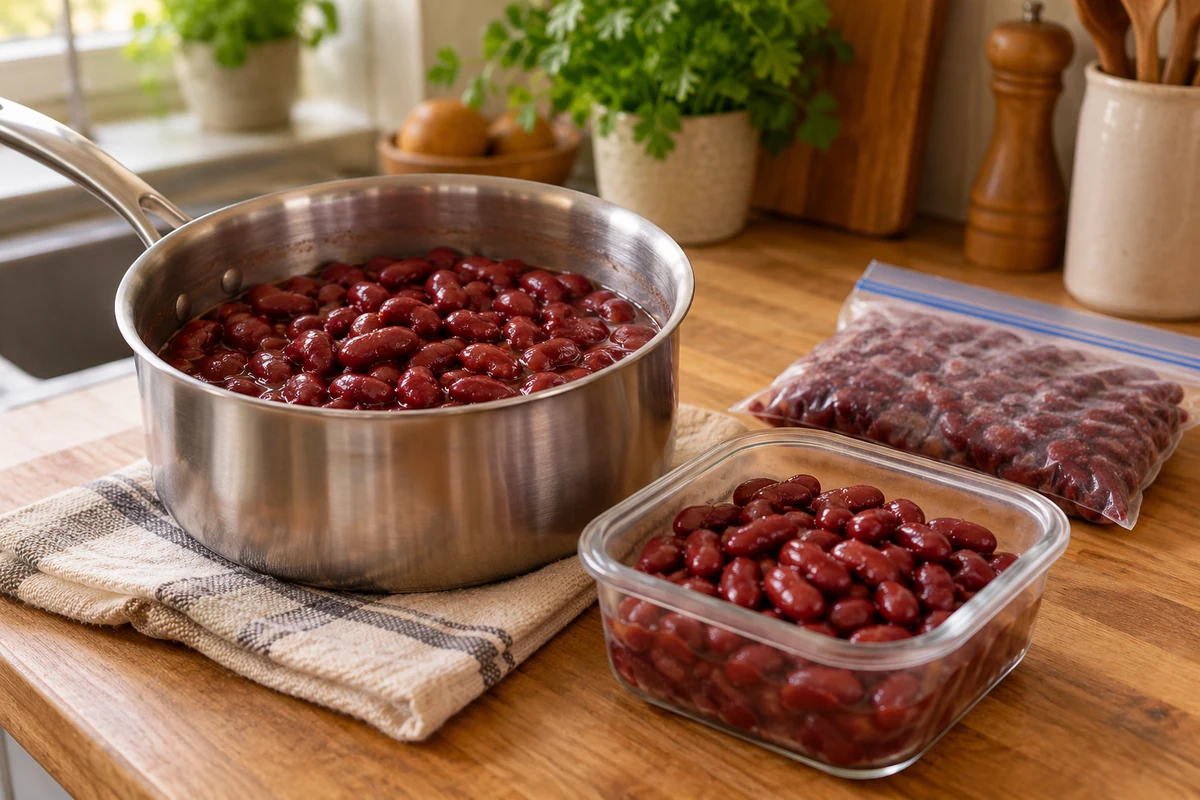
That distinction matters when a kitchen wants to prepare several meals in advance, and it matters just as much when a food manufacturer buys frozen beans. A red bean can look plump and attractive without its appearance telling you how it was processed. A carton marked IQF describes the freezing format; the buyer still needs an explicit statement of cooking status and instructions for the intended use.
At GreenLand, we would start a kidney-bean sourcing discussion with those two questions: what state are the beans in, and what will happen to them after delivery? Whole beans for a chilled salad, beans reheated in chili and beans incorporated into a frozen meal have different handling and texture requirements. The following guide sets out a source-specific household preparation route, then explains the separate decisions involved in cooling, freezing and commercial supply.
Identify the kidney beans before choosing a method
A bag of dry mature kidney beans is a raw ingredient. Rinsing removes loose material, and soaking hydrates the seeds, but neither establishes that they are ready to eat. Keep the bag or its product information with the preparation record so that the next person using the kitchen knows what was started. A container of soaked beans without a description is easy to confuse with a container of cooked beans once both have swollen.
For dry beans, read the product name and preparation instructions before choosing equipment. Red kidney beans are a type of common bean, Phaseolus vulgaris. The phrase red beans is less precise: it can also refer to other common-bean types or to adzuki, a different species. A recipe written for another bean does not automatically supply the correct treatment for dry kidney beans. When the identity is unclear, resolve it with the seller before planning the batch.
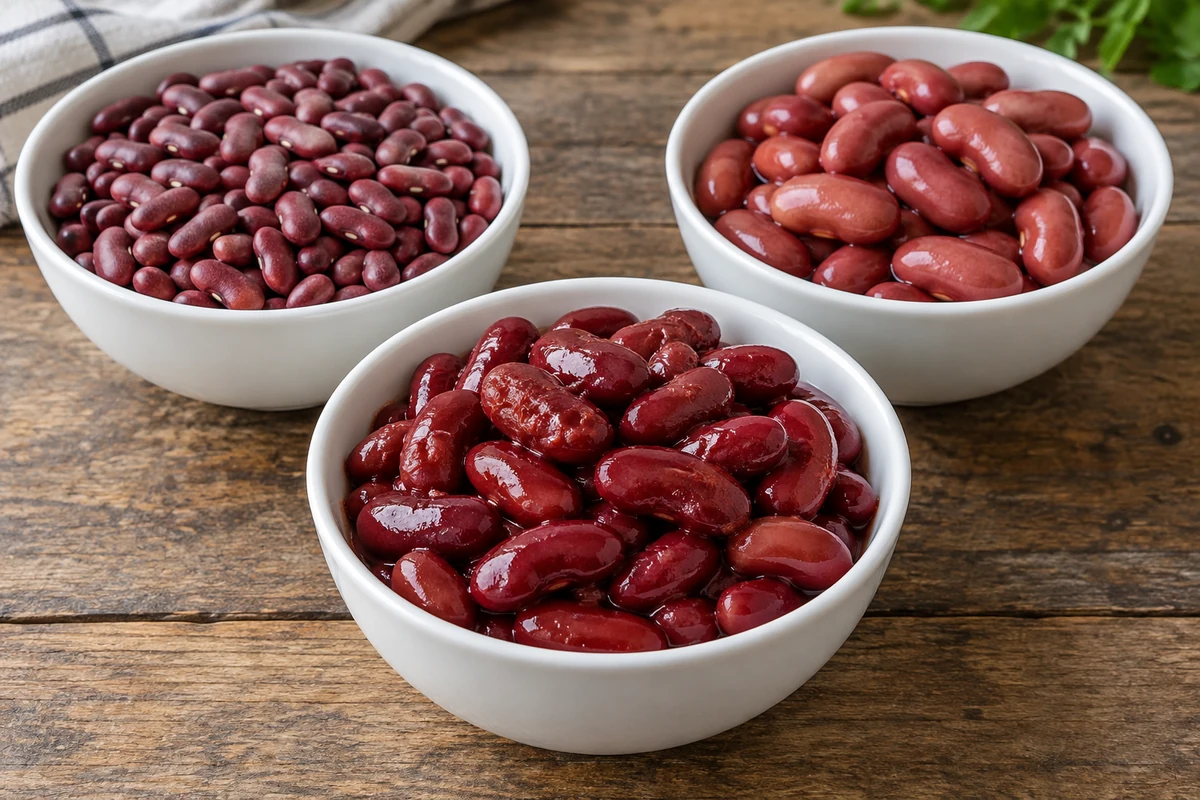
Dry, soaked and cooked kidney bean samples. Illustrative food photograph.
Fresh immature beans are another starting state. They have not passed through the same drying and rehydration sequence as mature dry seeds. A commercial frozen product may originate from fresh harvested material or from a different preparation route. Ask the supplier which applies. Do not convert a dry-bean soaking instruction into a mandatory treatment for every frozen kidney-bean product, and do not remove the need for cooking merely because the frozen material looks hydrated.
Canned kidney beans have already received a heat treatment. Health Canada states that the canning treatment is adequate for the lectin hazard and that canned red kidney beans do not need further cooking for that purpose. After opening, however, they need appropriate handling and storage, and a recipe may still call for heating. This makes them different from raw dry beans, not exempt from ordinary food hygiene. The distinction is described in Health Canada's guidance on lectins in dry legumes.
A frozen package needs closer reading because frozen and cooked are independent descriptions. Look for an explicit cooking statement, storage conditions and directions. If the product is described only as blanched, ask what that treatment was designed to achieve and what further cooking is required. Blanching may be part of a vegetable process, but its name alone does not establish adequate control of kidney-bean lectin. The same applies to a photograph of loose, frost-covered beans.
This initial check also prevents recipe errors. Dry weight, hydrated weight and cooked drained weight are different quantities. If a chili formula calls for cooked drained beans, weighing the same number of grams from a dry bag will change both the bean content and the cooking workload. Write the weight basis beside the quantity. A kitchen that keeps those words on its prep sheet has a much clearer starting point than one that records only "kidney beans."
For a bought-in ingredient, retain the lot identity and the supplier's directions with the sample. If two lots arrive with different cooking descriptions, treat that as a substantive change to investigate. It should not disappear into a general frozen-vegetable stock code. Staff need to know whether the next operation is initial cooking, reheating or preparation for a permitted ready-to-eat use.
Follow a complete soak-and-boil protocol
The main concern with raw or undercooked kidney beans is phytohaemagglutinin, commonly shortened to PHA. It is a naturally occurring lectin. The FDA links high levels in raw or undercooked beans with nausea, severe vomiting and diarrhea and gives a specific soaking and boiling recommendation. Use the complete recommendation; taking the soaking instruction from one source and the shortest boiling time from another produces a new method that neither source actually supplied. See the FDA's Natural Toxins in Food guidance.
For a household batch of dry kidney beans, the FDA route can be organized as follows. Follow any additional applicable package instructions, and keep the initial safety treatment separate from later recipe finishing.
- Confirm that the ingredient is dry kidney beans. Sort and rinse the beans, then arrange the batch, water and suitable pot before starting.
- Soak for at least five hours. Soaking is a preparation step; do not taste the soaked beans to decide whether they are ready to eat.
- Drain away the soaking water and use fresh water for cooking.
- Bring the beans in fresh water to a boil and boil for at least thirty minutes, maintaining the water needed for the batch. Start timing the boiling stage when the boil is established.
- Continue cooking as needed for a properly cooked, tender result and the intended dish. Do not shorten the specified boiling treatment to preserve a firmer appearance.
EFSA's January 2026 consumer advice uses a related but separately stated protocol: soak pulses for six to twelve hours until softened, change the water, then boil for at least thirty minutes at 100°C and cook until soft. The authority notes that preparation time depends on the pulse variety. If following that route, preserve all its conditions. The EFSA explanation of undercooked beans and lectins is especially useful when an online recipe presents tenderness alone as the endpoint.
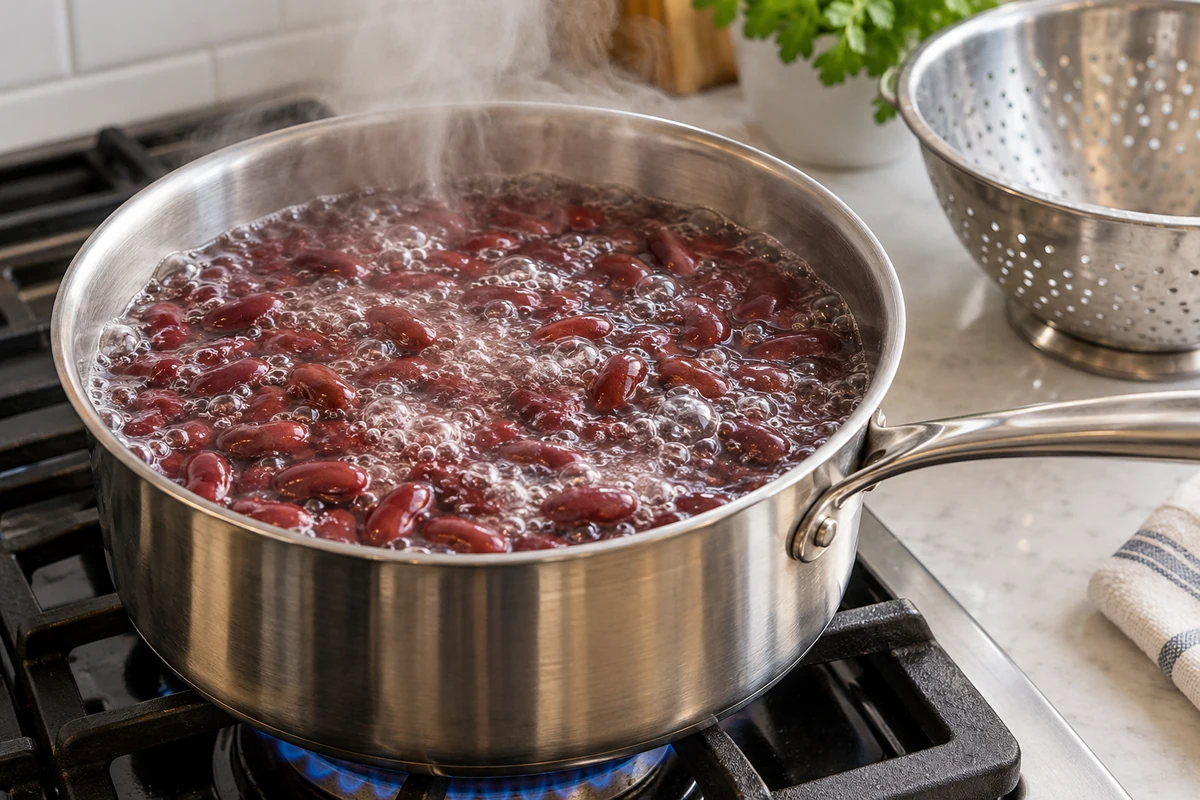
Hydrated kidney beans boiling in fresh water. Illustrative food photograph.
Readers may also encounter the older Health Canada page specifying at least five hours of soaking and at least ten minutes of vigorous boiling for dry red kidney beans. That is its own published protocol. It should not be silently substituted for the thirty-minute FDA or current EFSA instruction quoted here. A purchasing document or kitchen procedure should identify its chosen authoritative basis clearly, rather than listing an unexplained range of ten to thirty minutes.
A time on a recipe card also needs a defined start. Time spent warming a cold pot is not the same operation as time at a boil. If the batch is increased, the pot and heat source may take longer to bring the water to that condition. Keep the procedure understandable to the person doing the work: the water change, the boiling stage and the later texture adjustment should each be recognizable actions.
Do not use taste as a test during the raw or incompletely treated stages. After the required cooking method has been completed, inspect several beans for the texture the dish needs. A cooked batch with unevenly firm centers calls for further attention, not selective use of the softer beans while assuming the rest are equivalent. The safety treatment and the desired eating texture both have to be satisfied before cooling a batch intended to be labeled cooked.
These are domestic preparation instructions. They do not validate a commercial kettle, continuous cooker, retort or other industrial process. A manufacturer needs an appropriate process assessment for its actual material and equipment. Copying the household time into a supplier specification would leave the most important question unanswered: whether the entire commercial batch receives the necessary treatment under its operating conditions.
Match the equipment to the safety step
A slow cooker is not an appropriate substitute for the initial treatment of dry red kidney beans. A long cooking duration does not by itself demonstrate that the required heat conditions were reached. UC Master Food Preservers reiterates the FDA soaking and thirty-minute fresh-water boiling route and advises against cooking uncooked kidney beans in a slow cooker. Its kidney-bean safety article helps explain why a convenient all-in-one chili method can be unsuitable when it starts with dry beans.
If a slow-cooker recipe is the intended final dish, begin with commercially canned beans or beans already properly cooked through an appropriate method, and follow the recipe and appliance instructions for the later cooking and holding operation. That is a different task from asking the appliance to treat raw kidney beans. Keep the preparation description on the recipe so that a later substitution from canned to dry beans does not remove the required earlier step.
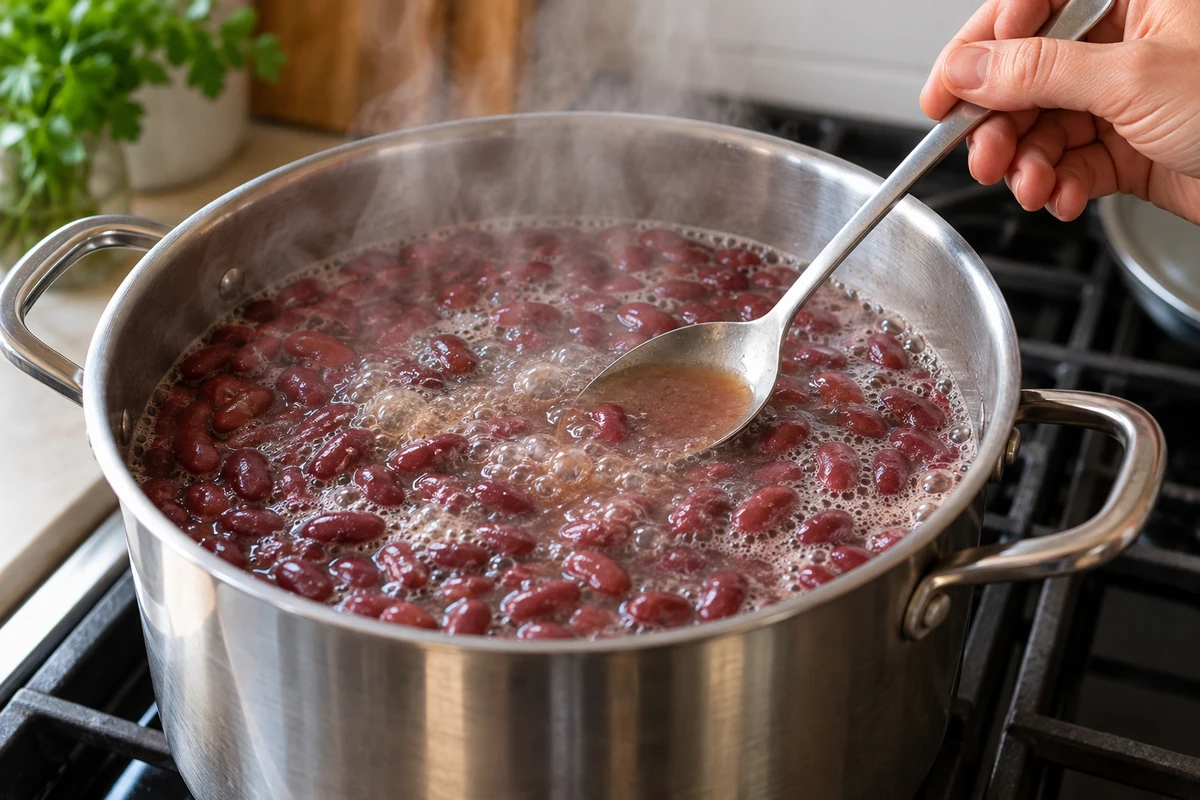
Checking a boiling kidney bean pot and water level. Illustrative food photograph.
Pressure cookers require their own reliable instructions. Do not convert thirty minutes of atmospheric boiling into an invented pressure-cooker duration, or borrow a setting intended for lentils. The appliance, pressure, fill level, bean state and recipe all matter to the method being followed. When instructions are unclear about kidney beans, use a clearly applicable tested method or obtain authoritative advice rather than shortening the cycle because the beans seem soft.
Altitude is another reason to avoid treating every boiling pot as identical. EFSA's consumer advice explicitly refers to 100°C. A visible boil at altitude does not automatically establish that temperature. A high-altitude kitchen should use applicable authoritative local guidance and suitable equipment rather than assuming that the sea-level condition has been met. This is especially important when a recipe has been copied between sites without its operating assumptions.
Choose a pot that accommodates the hydrated beans and sufficient water with room for safe handling. A crowded pot is harder to observe and stir without spilling. Plan how water will be maintained during the boil, keep the batch supervised and avoid dividing attention between several newly scaled recipes. These are practical implementation choices, not a new validated treatment. Their purpose is to make it easier to carry out the chosen method as written.
For a development kitchen, record the ingredient state, batch quantity, vessel and actual sequence. If a trial uses a small saucepan, do not call the successful dish proof that a much larger kettle is ready to run. The equipment change deserves a separate review. Likewise, changing from loose beans in water to beans in a thick sauce changes the process being evaluated. The finished dish may still be viable, but the original trial no longer describes every relevant condition.
Texture adjustments belong after that distinction is settled. A buyer may want intact beans, limited loose skins and a creamy interior. Those are useful quality criteria, but they are not reasons to reduce a necessary cooking stage. If the accepted safe method gives an unsuitable texture, reconsider the ingredient specification or application. Do not make an underprocessed bean the solution to a visual problem.
For staff training, a short demonstration can make the written method easier to follow. Show where the soaking water is discarded, when timing begins and how a cooked batch is identified before moving to cooling. Record the responsible person and any interruption. The aim is a repeatable sequence that another trained colleague can understand, including what to do when the planned conditions were not achieved.
Cool promptly and freeze in practical portions
Once properly cooked, kidney beans become a perishable prepared food. Lectin control does not complete the entire food-safety job: subsequent handling must also control opportunities for microbial contamination and growth. Plan the cooling containers and refrigerator space before cooking so that the batch does not wait in a deep pot while someone searches for suitable packaging. The freezer is a storage destination, not a way to repair an uncertain cooking or cooling history.
For household handling, CDC advises refrigerating cooked leftovers within two hours, or within one hour when exposed to temperatures above 90°F. It recommends several clean shallow containers and allows small portions of hot food to go into the refrigerator. Its storage guidance specifies a refrigerator at 40°F or below and freezer at 0°F or below. These instructions appear in CDC's food-poisoning prevention guidance. They should not be presented as a commercial cooling validation for a production-sized batch.
Decide whether the beans will be frozen with some cooking liquid or drained for the intended recipe. A portion destined for soup may be convenient with liquid; a weighed addition to chili may need a defined drained basis. Make that choice consistently so the next recipe does not receive an unpredictable amount of water. Drainage is a formulation and handling decision, not evidence that the beans were safely cooked.
Use practical portions rather than one large mass that must be repeatedly opened and partly thawed. A small household batch can be divided by meals. A development kitchen can divide its trial by the actual quantity needed for each later assessment. Label the portions with the ingredient, cooked status, preparation date and intended use. In a business setting, link the prepared batch to the incoming lot and the operation's own traceability system.
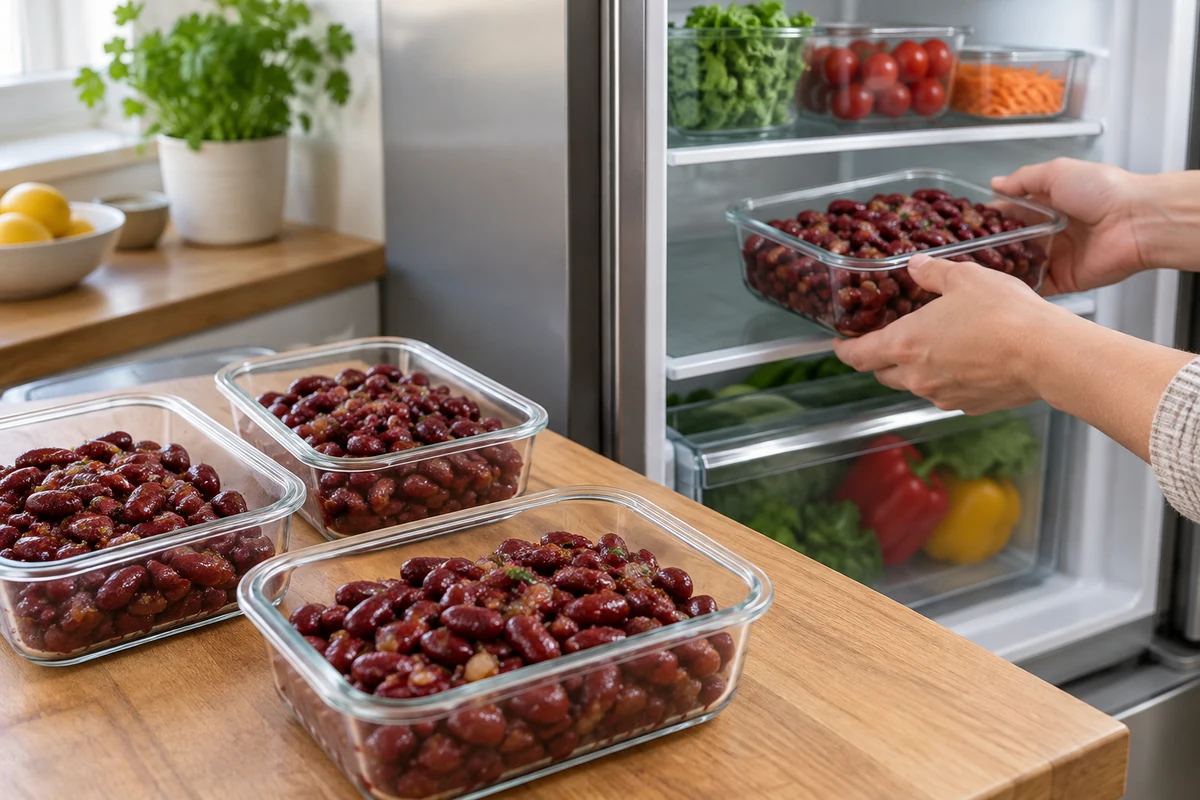
Small shallow containers of cooked kidney beans ready for refrigeration. Illustrative food photograph.
For loose portions, a clean tray can help keep properly cooled beans separate during freezing, but the additional handling must fit the food-safety procedure. A flat portion pack may be more convenient when the complete contents will go into one recipe. Neither format has an automatic safety advantage without its handling conditions. Choose a freezer-suitable pack that protects the product and allows the planned portion to be removed without crushing the beans.
Keep the distinction between freezing and sanitizing explicit. FoodSafety.gov states that freezing does not destroy harmful germs. Its four steps to food safety also emphasizes prompt refrigeration in shallow containers. Freezing therefore cannot be used as the corrective action for a batch left warm too long, nor can an attractive frozen appearance confirm that its earlier preparation was adequate.
Commercial operations need their own applicable cooling limits, monitoring and corrective actions. The batch size, container depth, loading arrangement and available cooling capacity should be considered by the responsible food-safety team. A photograph of shallow trays or a cold-room display does not establish performance throughout a load. For a supplier review, ask how the process is verified under actual operating conditions and how a deviation is handled before product is released.
Quality should be assessed after the planned storage and thawing sequence as well. Look for broken skins, clumps, excessive loose liquid and changes in bite, using a consistent sample method. Those observations can help select a portion format or revise the recipe. They do not set a universal shelf life. Establish storage duration and label instructions from the relevant product evidence and controls rather than transferring a household freezer estimate onto a wholesale specification.
Thaw and reheat without losing the cooking history
A frozen portion should retain its identity all the way to service. If it was fully cooked before freezing, the later operation is reheating or permitted cold preparation according to its directions. If it was frozen without an established adequate cooking treatment, it still requires an appropriate initial cooking method. The word frozen cannot bridge that gap, and a missing label should not be replaced by a guess based on softness.
For household leftovers, CDC lists refrigerator thawing among safe methods and says not to thaw on the counter. It specifies 165°F for leftovers and casseroles, checked with a food thermometer. Use that reheating guidance for previously properly cooked food. Reaching a leftovers reheating temperature is not a replacement for the distinct kidney-bean lectin treatment when the original cooking history is unknown.
Refrigerator thawing gives the cook a controlled way to portion a previously cooked batch before adding it to a dish. Keep the container covered and manage any released liquid according to the recipe. If the product directions allow cooking from frozen, follow those directions instead. The method should match the actual package and application; there is no useful universal thawing time for every bag size, bean quantity and refrigerator arrangement.
A thick chili or casserole needs attention to the whole food mass during reheating. Stir where the method permits, allow for the specified standing time when using a microwave, and check the relevant temperatures with a suitable thermometer. A bubbling edge or steam at the surface does not describe the center of the portion. Follow the product or recipe instructions and the food-safety requirements applicable to the kitchen.
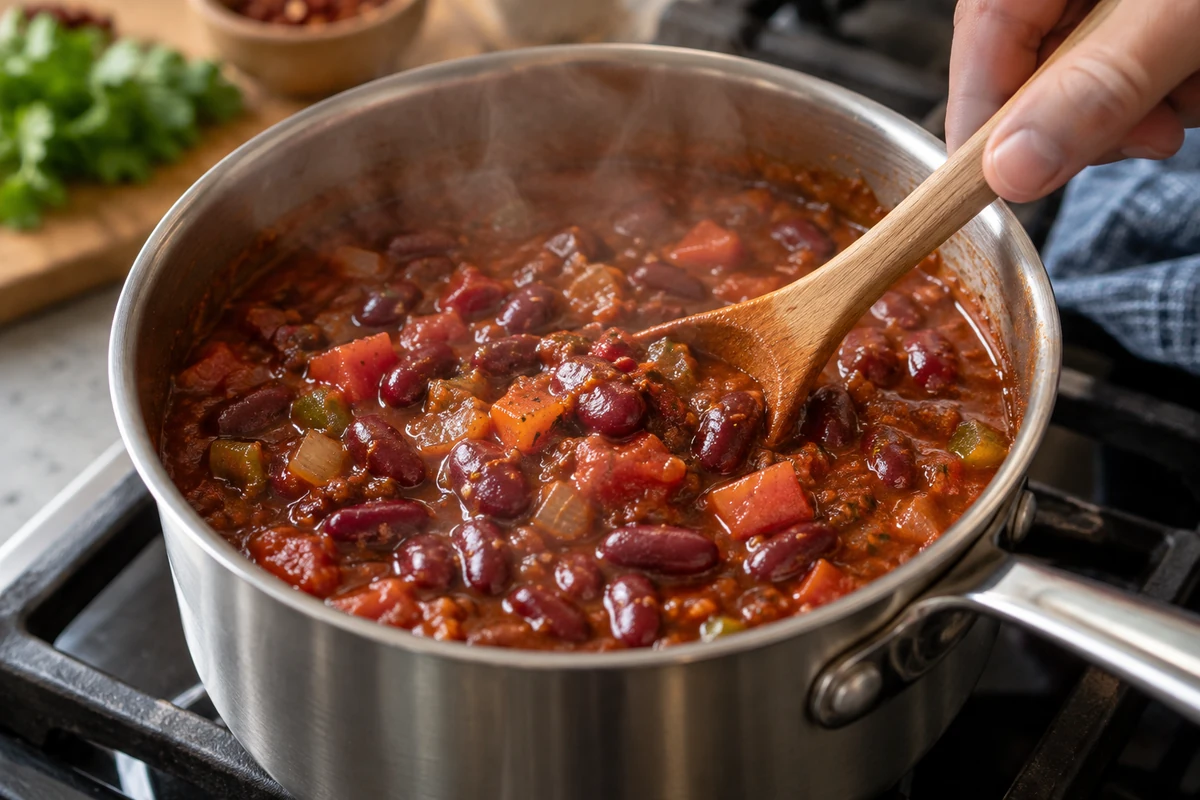
Stirring cooked kidney beans through reheating chili. Illustrative food photograph.
For a chilled bean salad, confirm that the purchased product is suitable for that use and identify any cooking required before cooling and mixing. A statement such as fully cooked can answer a processing question without supplying all the handling conditions for ready-to-eat service. Ask for clear instructions rather than assuming the beans can be thawed and eaten because another supplier's product can. The salad's other ingredients and assembly process also need their own controls.
Quality trials should reproduce the intended service sequence. Assess beans after cooking, after freezing and thawing, and after the final heating or chilled holding step used in the actual application. Compare whole-bean appearance, interior texture, skin separation and the amount of liquid released. A sample that looks good immediately after preparation may behave differently after stirring through a sauce or waiting for service.
Keep changes interpretable. If a trial simultaneously changes bean supplier, sauce acidity, portion weight and reheating method, a disappointing result will be hard to diagnose. Start with a known recipe and change one material factor at a time where practical. Record the starting state and cooked drained quantity alongside the result. This makes the trial useful for purchasing as well as for the cook who performed it.
When the earlier handling history is uncertain, separate that uncertainty from an ordinary texture complaint. Extra reheating is not a general rescue method for inadequately controlled food. Follow the operation's disposal or deviation procedure and seek qualified advice where needed. A clear record and sensible portioning are more useful than repeatedly trying to recover a container whose preparation date or processing state has been lost.
Ask what was controlled before the beans were frozen
For bulk purchasing, begin with a written description of the material: kidney-bean identity, maturity, preparation route and supplied cooking state. Ask whether the beans were produced from dry mature material or another starting form, what the declared heat treatment means, and what the customer is expected to do next. The answer should align across the specification, label and sample instructions. An unexplained difference between those documents needs resolution before a trial is approved.
Request evidence appropriate to the claimed process and intended market. That may include the supplier's process description, the basis for controlling the relevant hazards, monitoring arrangements and instructions for use. The exact documentation should be reviewed by the buyer's qualified technical team. A general certificate or finished-product photograph is not a substitute for information about the actual kidney-bean process being purchased.
The real GreenLand product photographs shown here identify the advertised frozen kidney-bean form. They allow a buyer to discuss visible appearance and packing presentation. They do not prove a particular cooking treatment, ready-to-eat status or industrial validation. We would connect a request for bulk frozen red kidney beans with the current specification and intended application before proposing a sample preparation method.
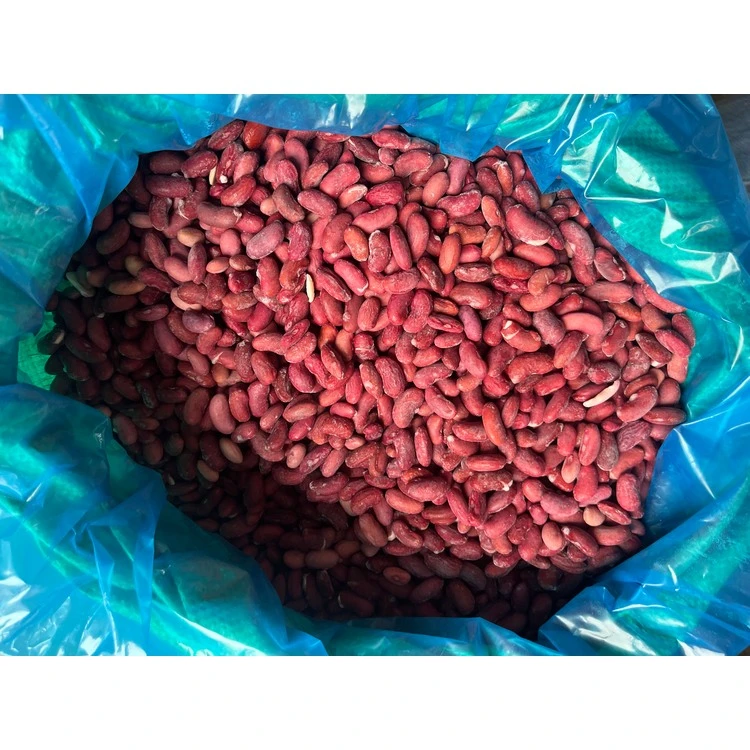
Red kidney beans in a lined carton.
Agree on quality measurements separately from the safety requirements. Whole-bean percentage, broken pieces, skin separation, free-flowing condition and cooked texture can be useful acceptance criteria when their sampling methods are defined. Specify the point of measurement: frozen on receipt, after the instructed cooking, or after the finished dish's reheating cycle. Without that detail, two people may report different results from the same lot while both believe they followed the specification.
Compare cost on the usable quantity in the recipe. A price per kilogram of frozen product does not alone show the number of accepted portions, the labor required or the effect of drainage and breakage. Run a documented application trial and record the accepted yield. Treat those figures as results for the tested sample and conditions, not as a permanent promise for every lot or a substitute for agreed tolerances.
A useful inquiry includes destination market, dish, serving route, pack size and the equipment available for preparation. State whether the product will be sold to consumers with cooking instructions, used in a central kitchen, or incorporated into a further processed food. These details determine which questions the supplier and buyer must settle before shipment. They also prevent a cooked ingredient and a cook-before-use ingredient from being compared as if they were the same offer.
The buying decision is complete when the ingredient and the next operation are both clear. For a home cook, that means a properly identified bean, a complete authoritative cooking method and safe subsequent handling. For a commercial buyer, it means the same clarity translated into the supplier's specification, process evidence, application trial and release criteria. Freezing can then support a practical supply plan without hiding an unresolved cooking step.
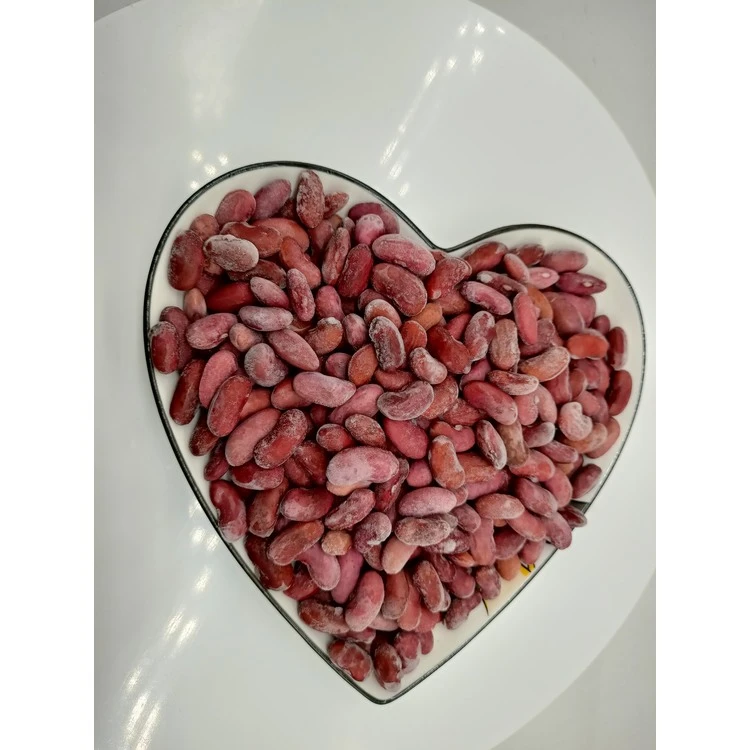
Red kidney beans in a loose sample dish.
Continue reading
Compare portioning and finished-texture choices for another cooked pulse, while retaining the separate kidney-bean cooking requirements.
Source frozen red kidney beans with GreenLand-food
GreenLand-food is a professional frozen red kidney beans supplier and manufacturer in China, providing factory-direct wholesale supply for importers, food manufacturers, foodservice distributors, and private-label programs.
Send the product form, specification, packing, quantity, application, destination, private-label needs, and requested documents.