


Red Beans vs Kidney Beans: Names, Shape and Cooking Requirements
Oct 19, 2026
Leave a message

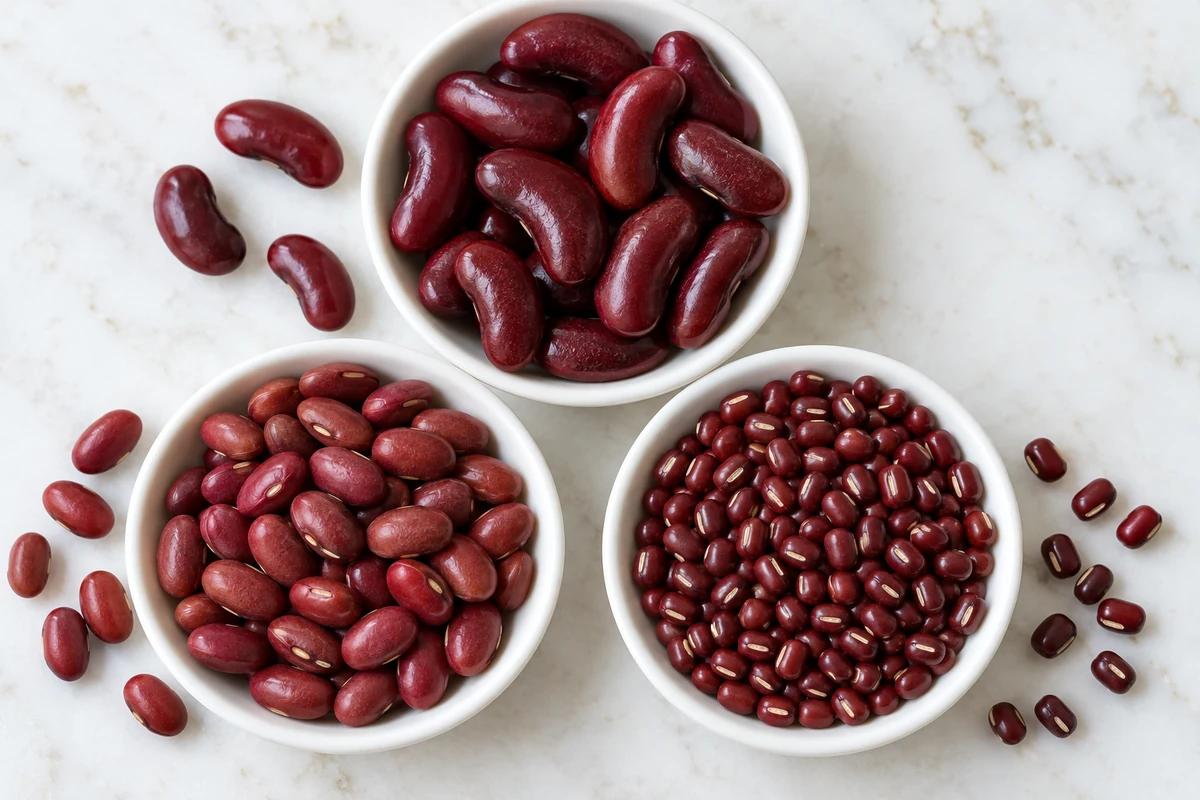
Shape helps with identification, but the product declaration and supplier specification should settle it. Kidney beans usually have a pronounced curved outline, while small red common beans and adzuki tend to be smaller. Size and color vary, so a red seed in a photograph is not enough to establish the species or commercial type.
Processing state is the second essential check. Dry raw beans, soaked beans, canned beans and frozen beans can have very different preparation requirements. A frozen appearance does not prove adequate cooking. For a commercial order, we would confirm the exact bean identity and documented treatment before discussing the texture required in chili, rice dishes, fillings or prepared meals.
Red bean is a market name with several meanings
The ambiguity starts with ordinary language. A recipe may use "red beans" because its intended audience already knows the local ingredient. That can work within a familiar kitchen, but it creates uncertainty when the recipe is transferred across countries or used to brief an international supplier. The buyer should translate that shorthand into an exact ingredient description.
Red kidney beans are a type of common bean, Phaseolus vulgaris. The same species includes many other seed colors and commercial forms. Kew's common-bean record describes this diversity. Sharing a species does not make every common-bean type identical in size, cooking behaviour or suitability for a particular dish.
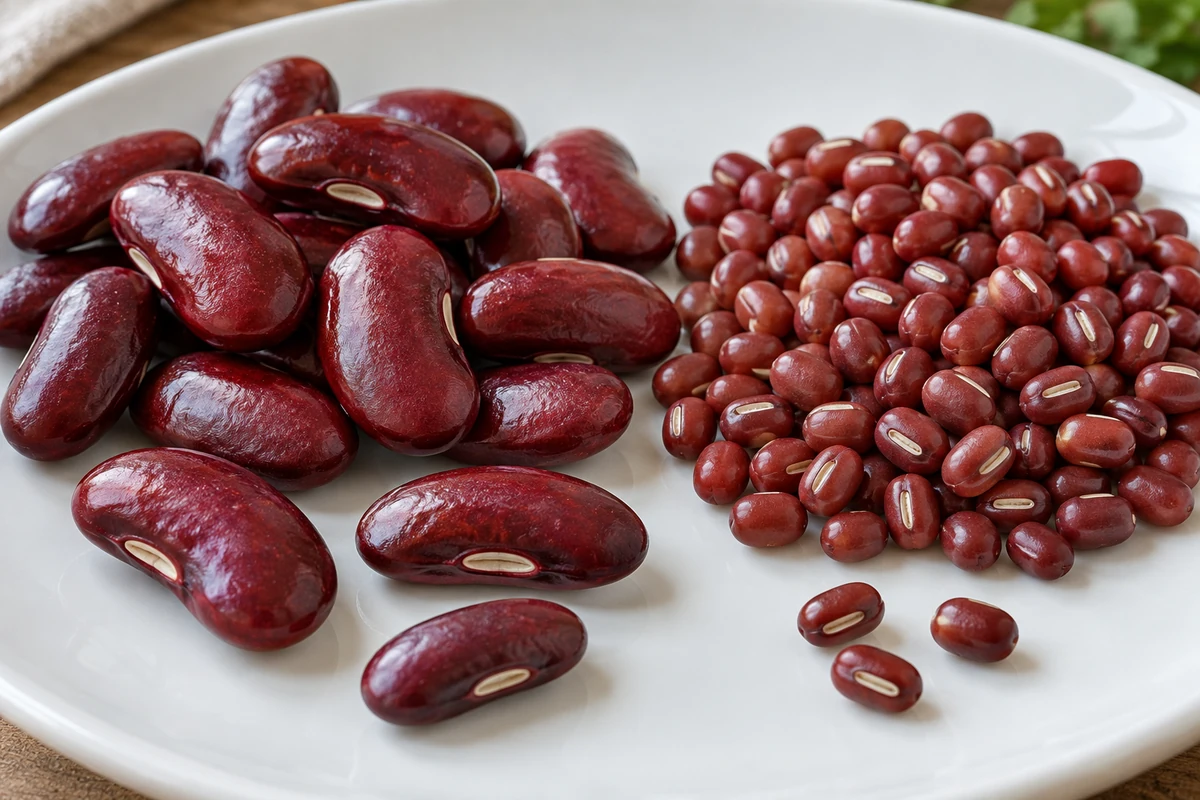
Different seed forms behind the name red bean. Illustrative food photograph.
Small red common beans can also belong to Phaseolus vulgaris. They should not automatically be identified as adzuki because the package says small red beans. A historical Canadian bean classification document distinguishes Mexican red and kidney beans within the common-bean group from adzuki. That source is useful for botanical terminology; its older pesticide-label context is not current legal advice for a food label.
Adzuki, also written azuki or aduki, is Vigna angularis. Kew's accepted species record lists the adzuki name under that species. In many East Asian food contexts, a red-bean filling refers to an adzuki preparation. A buyer seeking that ingredient should specify it directly rather than relying on color or a generic English translation.
This distinction matters even when both products will be cooked and mashed. A filling developed with adzuki can differ from one made with a red common bean in flavor, skin behaviour and the texture achieved after processing. A substitution may be possible in a deliberately revised recipe, but the replacement should not be treated as the same ingredient simply because both make a reddish paste.
Regional names also need care in purchasing documents. A supplier may understand a familiar term differently from the buyer's development team. Include the common commercial name, scientific identity where needed, reference photographs and the required form. Keep that description consistent in the sample request, quotation, specification and label proof so the ambiguity is resolved once rather than rediscovered at delivery.
If the available information conflicts, ask for clarification before approval. A name that suggests adzuki and a sample that resembles a large kidney bean should trigger an identity review. The appropriate response is a corrected specification or a confirmed alternative, rather than an assumption based on the recipe's color. That small check protects both the intended eating quality and the preparation route.
| Name in an inquiry | Identity to confirm | Useful purchasing distinction |
|---|---|---|
| Red kidney beans | Phaseolus vulgaris, kidney type | State light or dark red type, supplied form and cooking status |
| Small red beans | Often a small red type of Phaseolus vulgaris | Do not automatically interpret as adzuki |
| Adzuki / azuki / aduki | Vigna angularis | Confirm this species for a specified adzuki filling |
| Red beans without qualification | Unresolved market name | Request exact identity before recipe or process approval |
Use shape and size as clues, then confirm identity
Kidney beans commonly show a curved, elongated outline with a clear indentation along one side. Light-red and dark-red types can look different even within that recognizable form. Small red common beans tend to present a smaller, more oval appearance. Adzuki is often recognized by its small seed and a conspicuous pale hilum, the scar where the seed was attached inside the pod.
These are practical visual clues, not an authentication method on their own. Cultivar variation, seed condition and the way a photo is taken can change the apparent size or color. A close-up without a scale can make a small seed appear as large as a kidney bean. Use the supplier's declared identity and an actual representative sample to support the visual assessment.
For a commercial sample, examine a spread of beans rather than a selected handful. Observe the distribution of size, shape and color, and record broken seeds or mixed-looking pieces separately. A few unusual beans may reflect normal variation or a quality issue that needs review. The acceptance decision should use agreed definitions and sampling rather than an impression from one attractive photograph.
Cooking changes appearance too. Hydrated and cooked beans become larger and can develop split skins or exposed pale interiors. Frozen surfaces may carry frost that makes the color look lighter. Compare samples in matching states when assessing the quality target. A dry dark-red bean and a frosted prepared bean are not a fair color comparison.
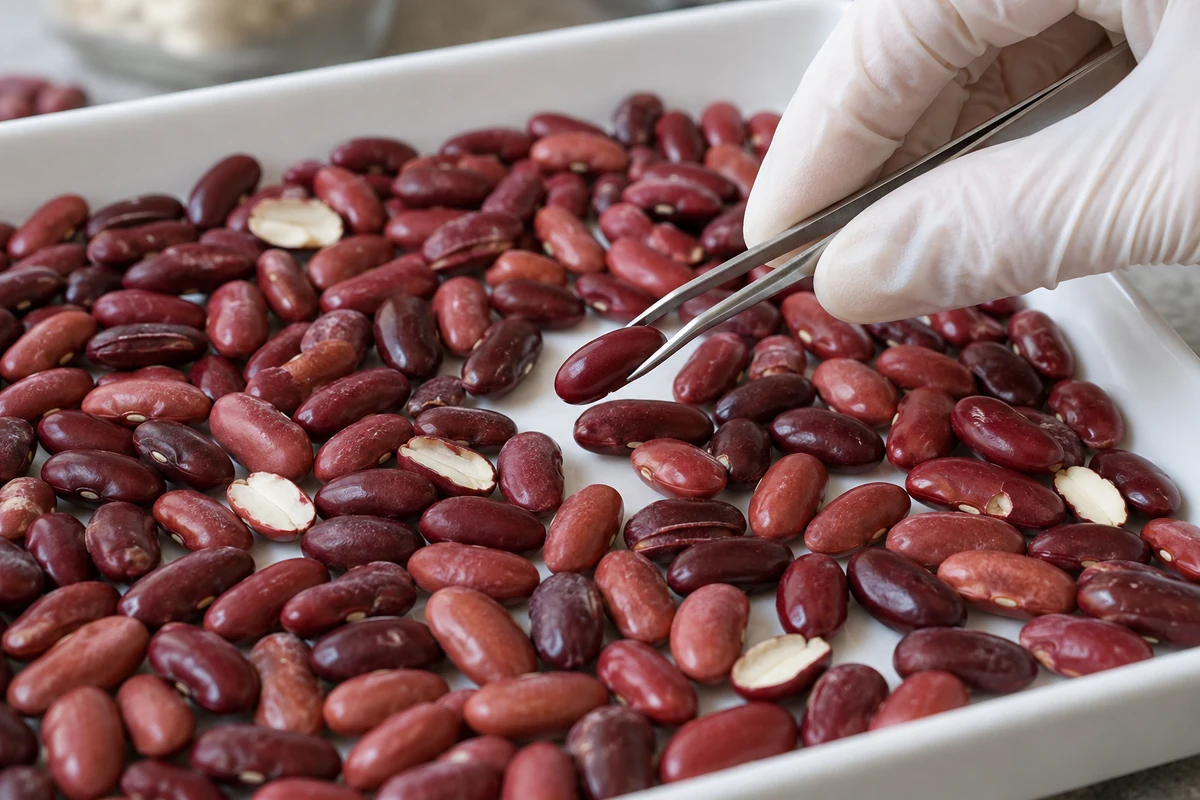
Kidney bean shape, color and split-seed variation. Illustrative food photograph.
For a visible ingredient in a meal, size influences portion distribution. Larger kidney beans can create a substantial bite and a recognizable presence in each serving. Smaller beans distribute differently through rice, soup or a filling. Equal weights therefore do not necessarily create the same number of beans or the same visual balance on the plate.
Skin integrity is another separate characteristic. Some applications accept broken beans because the contents contribute to a thick sauce or paste. Others require intact pieces that remain recognizable after mixing and reheating. Record the condition after the intended process, because a dry or frozen sample can look intact and then split during preparation.
Avoid converting a visual tendency into a universal performance claim. It is too broad to promise that every kidney bean holds its shape better than every adzuki or small red bean. Maturity, raw-material history and processing can change the outcome. The actual application trial is the place to establish whether the offered lot provides the intended bite and appearance.
Once the identity is confirmed, photographs become useful shared references. A frozen view records what the buyer receives, while a prepared view records the expected application result. Keep both linked to the same sample and specification. That helps receiving, production and purchasing teams discuss the same material without expecting one photograph to answer every question.
Match the supplied form before comparing recipes
Dry mature beans require hydration and appropriate cooking before use. Their purchased weight differs from the weight available after preparation. Canned beans have already undergone a cooking process and are supplied with a declared ingredient list and, commonly, packing liquid. Frozen beans need their treatment history confirmed because freezing alone does not describe what happened beforehand.
A frozen product may be a green immature vegetable seed, a hydrated mature seed, a partly treated ingredient or a fully cooked bean. Those possibilities should not be grouped under one assumed cooking instruction. For red kidney beans, the exact SKU must make clear whether adequate cooking has been completed or whether the buyer is responsible for a full cooking step.
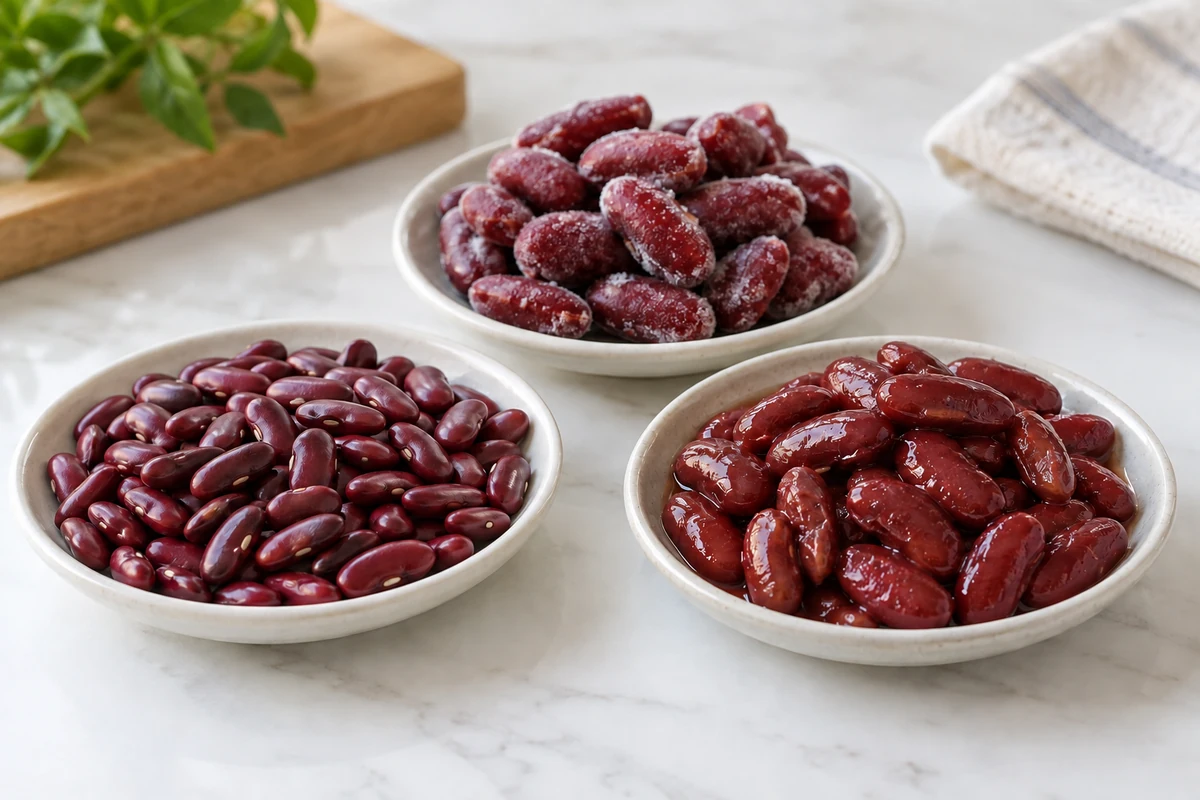
Dry, cooked and frozen kidney bean sample forms. Illustrative food photograph.
The distinction between a cooked ingredient and a ready-to-eat finished use also matters. A supplier may provide a documented cooked bean intended for further processing under controlled conditions. That description does not automatically authorize every cold salad or no-cook application. Review the intended use, handling requirements and supporting process information before designing the finished food.
Use the same weight basis when comparing offers. A kilogram of dry beans, a kilogram of canned product including liquid and a kilogram of prepared frozen beans provide different amounts of usable material. Define whether the cost comparison uses net purchased weight, drained bean weight or acceptable finished portions. Record the preparation method used to obtain that amount.
For canned products, identify whether the reference recipe uses the beans drained, rinsed or with their liquid. Rinsing and draining can change seasoning and the liquid carried into the recipe. For frozen products, distinguish loose surface ice or thaw liquid from usable beans. Applying the same recipe weight without defining these details can create a different formulation unintentionally.
Nutrition comparisons require the same discipline. Dry and cooked values per hundred grams describe different water contents, and a sweetened paste or salted packing liquid introduces additional ingredients. Use data relevant to the supplied product and the final recipe when preparing labels or reviewing claims. A generic comparison chart cannot replace that calculation.
When moving from a kitchen recipe to manufacturing, record all preparation changes. A cook may tolerate variable draining or adjust sauce by eye, while a factory needs a reproducible starting amount. That does not make the kitchen method wrong; it means the commercial process requires a more explicit description. The supplier's sample and the buyer's trial should use the same definitions.
We would confirm the incoming form before proposing a frozen red kidney bean program. A buyer seeking a documented cooked component has a different need from a plant prepared to perform the complete cooking process itself. Making that requirement explicit helps select an appropriate offer and prevents a convenient frozen format from obscuring an unresolved preparation obligation.
Cooking requirements follow the bean and its processing state
Raw or insufficiently cooked kidney beans can contain harmful levels of phytohaemagglutinin, a lectin. The FDA's household guidance recommends soaking kidney beans for at least five hours and then boiling them in fresh water for at least thirty minutes. That source-specific advice is a useful safety reference for dried beans; it is not a validated production schedule for every commercial batch.
EFSA's January 2026 consumer guidance recommends a six-to-twelve-hour soak for pulses, changing the water and boiling for at least half an hour at 100°C, with cooking continued until soft as needed. Its scope and wording should be retained when cited. Different published protocols should not be merged into a shorter invented method.
Those instructions concern preparation of the relevant raw dried material. A commercially canned kidney bean has already been cooked; follow its label and normal handling requirements. A frozen bean needs its actual status checked. It may be inappropriate either to assume it only needs warming or to apply a dry-bean soaking routine to a product whose documented preparation is different.
For commercial frozen kidney beans, the technical file should establish the treatment applied and the required further process. A brief blanch cannot be assumed to control lectins adequately, and freezing does not supply that control. Visual softness, red color or the presence of an IQF claim cannot demonstrate that the necessary cooking has occurred.
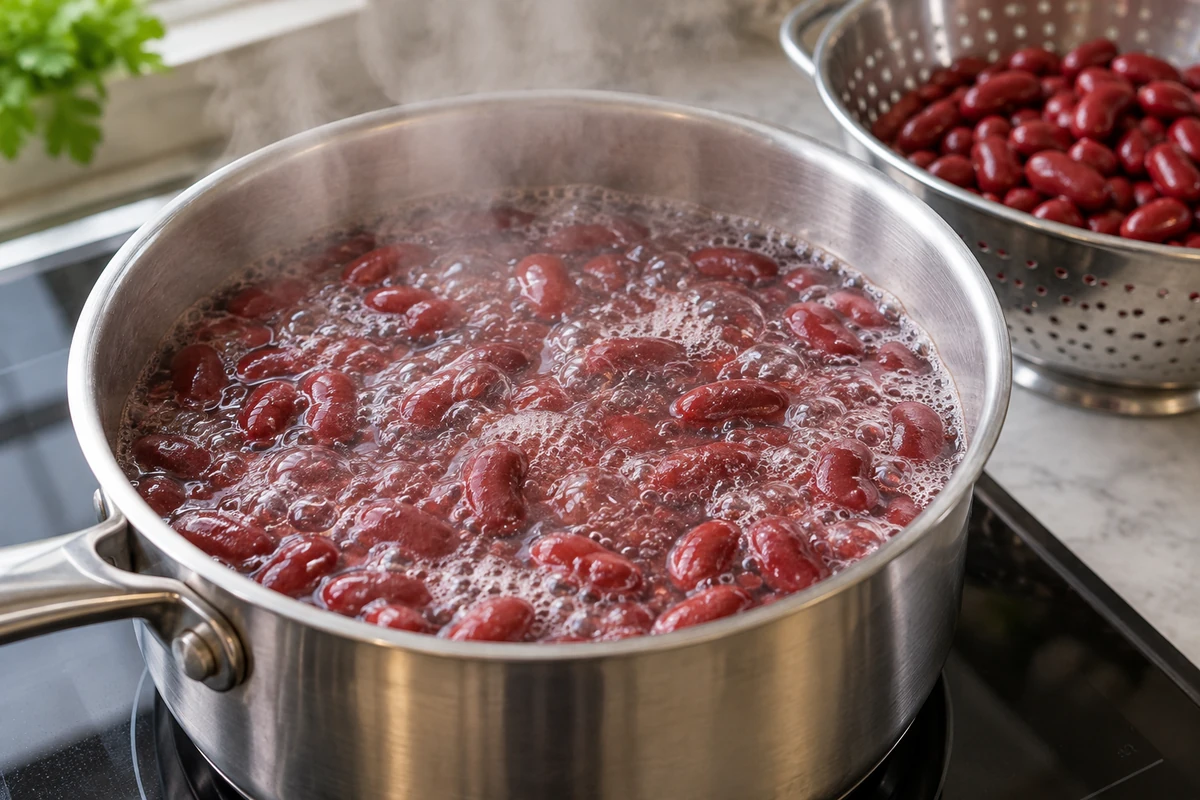
Kidney beans boiling in ample fresh water. Illustrative food photograph.
The safety decision should be made before sensory evaluation or recipe optimization. Once the approved treatment has been established, texture testing can assess whether the beans remain suitable for the dish. If the required process produces too many broken pieces, the response is to review the raw material and process design with qualified technical staff, rather than shorten treatment to preserve appearance.
Do not transfer a kidney-bean schedule to every product called red beans. Adzuki and small red common beans still need appropriate preparation, but their identity and supplied state should be known first. The absence of the word kidney on a vague package is not evidence that minimal heating is sufficient. Obtain clear instructions for the actual food.
Cooking equipment also changes the question. A slow cooker, pressure cooker, microwave and open boiling pot do not provide interchangeable conditions. Use an established method appropriate to the equipment and ingredient, and have a commercial process validated for its real operating range. A recipe time without information about starting state, load and product geometry is incomplete evidence.
After adequate cooking, subsequent handling remains important. Cooling, packing, freezing and any later reheating need appropriate controls for the finished product. Successful lectin treatment does not resolve every microbiological or storage issue. Keep the cooking evidence and the rest of the food-safety process connected to the lot rather than treating one completed heat step as approval for all later uses.
Test the bean in the dish it must support
Identity sets the correct starting point, while the recipe establishes the quality target. A chili or bean salad often needs recognizable whole pieces with a tender centre and an acceptable skin. A sweet filling may prioritize paste texture, flavor and consistency during filling. A rice dish may depend on how evenly the beans distribute and how they behave during holding.
For a whole-bean dish, assess the prepared beans plainly before adding them to the complete recipe. Record skin resistance, interior tenderness and the proportion of broken pieces after the approved cooking process. Then evaluate them in the sauce or dressing, including the normal mixing and service interval. A strong seasoning can conceal flavor differences without concealing a tough skin.
For a filling, compare the intended bean type in the actual grinding or mashing process. Observe skin residue, the amount of liquid required and the consistency after cooling. Adding sugar or fat changes the formulation, so keep those additions consistent during the first comparison. A red common bean paste may be a possible product, but it should not be assumed to reproduce an adzuki filling unchanged.
The product's name and description should follow the ingredient actually used. If a customer specifically requests adzuki, a kidney-bean alternative needs clear approval. If a menu promises kidney beans, a smaller red bean may change both the eating experience and the declared identity. A substitution is a product decision, even when the final color appears similar.
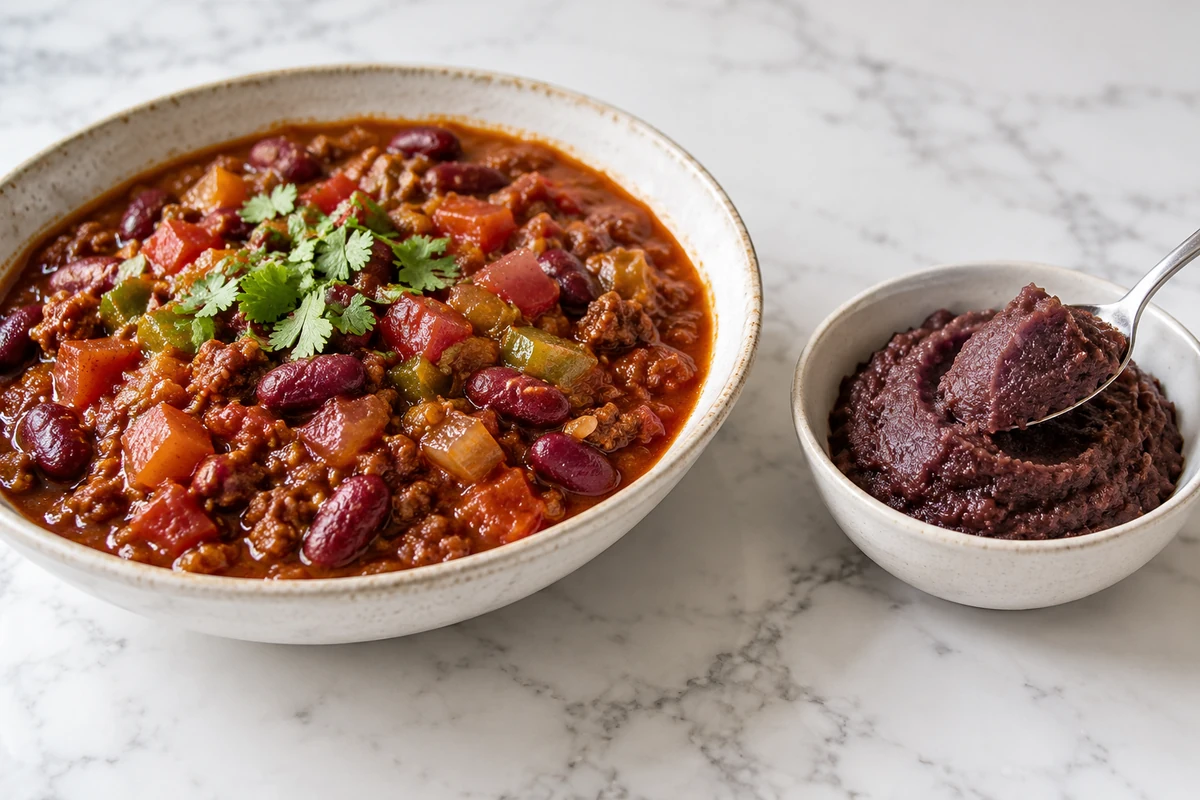
Whole kidney beans in chili and adzuki bean paste. Illustrative food photograph.
- Confirm each candidate's species, commercial type, supplied form and required preparation.
- Prepare representative samples through their appropriate approved processes, then record usable drained weight and relevant losses.
- Compare equal usable bean amounts in the same recipe, keeping other ingredients and portion size controlled.
- Assess the food after the intended mixing, holding, freezing or reheating route, with observations tied to the customer's acceptance target.
- Repeat the preferred option with representative lots and write the accepted identity and quality limits into the purchase specification.
The trial may show that an alternative works well after a deliberate recipe adjustment. Record that result as a revised formulation, including any changed liquid, seasoning or bean proportion. This gives purchasing an accurate basis for costing. It also prevents a successful modified dish from being described later as proof that the two beans were interchangeable in every respect.
Evaluate the final portion rather than only the bulk bowl. Large kidney beans can settle or distribute differently from smaller beans in filling or portioning equipment. Examine several portions across the run for bean amount and appearance. A consistent bulk mixture can still produce uneven individual servings if the equipment does not handle the chosen bean form well.
Keep commercial decisions attached to observed performance. A lower ingredient price can be offset by higher preparation loss, more broken pieces or a formulation change. Conversely, a suitable prepared form may simplify the buyer's process. The useful comparison is the cost of an acceptable finished portion under the actual operating conditions.
For example, a rice-meal developer may find that the smaller approved bean gives more pieces per portion while the larger kidney bean creates a stronger visible cue. Neither observation establishes a nutritional or safety advantage. Ask the panel to assess the same bean mass in the same meal, then inspect several filled trays for distribution. If the marketing image depends on large recognizable kidney beans, an equally tasty smaller bean may still fail that particular brief. Record the reason for acceptance or rejection so a later price negotiation does not unintentionally reverse a product decision.
Specify identity and cooking status on the order
Write the exact bean name and species where ambiguity exists, then state the supplied maturity and processing state. For red kidney beans, make the cooking status unmistakable. The specification should distinguish a verified cooked ingredient from a product requiring full further cooking, with instructions and supporting evidence appropriate to the intended use.
The GreenLand frozen red kidney bean detail page is a starting point for that discussion. The real product views show red kidney beans in commercial and loose sample presentations. They support a conversation about visible form and condition. Adequate cooking and suitability for a particular prepared food must be established separately through the relevant documentation.
After the processing state is accepted, define the quality characteristics that affected the trial. These may include size distribution, split skins, broken beans, color range and loose material. Agree the sampling and assessment method so the supplier and receiving team judge the lot on the same basis. A general grade name may need additional application-specific limits.
Retain a reference sample description for both the supplied product and its prepared result. The frozen condition helps receiving staff recognize the offer, while the application result shows what the buyer expects after its process. Link the records by sample and lot identity. This makes it easier to investigate whether a later difference originated in the ingredient or in preparation.
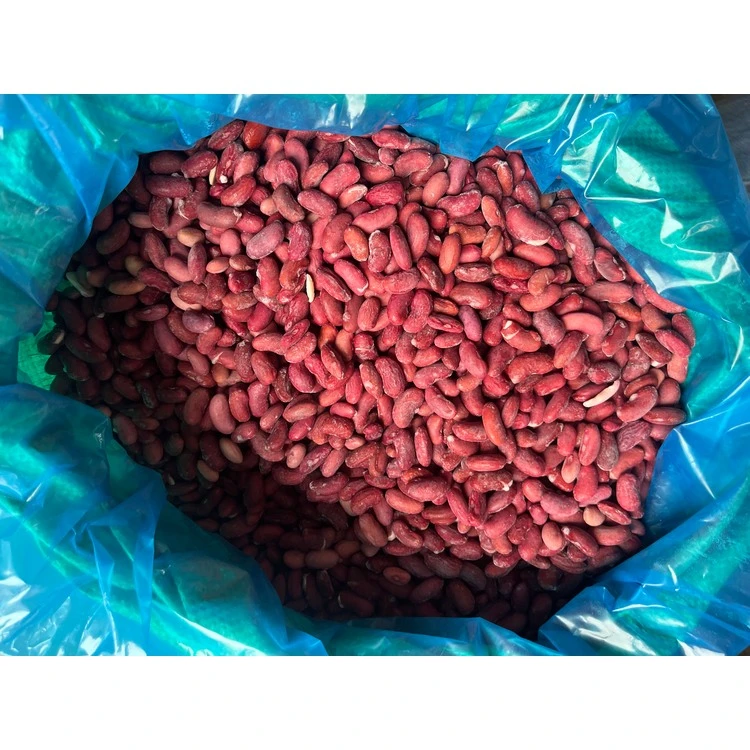
Red kidney beans in a lined carton.
Packing should support traceability and the actual production routine. Agree the net weight, inner liner or bag, case marks and lot code. Keep the product identity and use instruction consistent across the specification, label and shipment documents. In a mixed shipment, similar-looking red-bean products should remain clearly distinguishable by SKU and lot.
For quotations, provide the destination, quantity, packing format and intended dish alongside the required cooking state. We can then confirm sample availability, order terms and the documents relevant to that program. A general frozen-bean offer does not establish availability of every cultivar, pack or processing arrangement at the same lead time.
At arrival, inspect packaging and frozen condition while reviewing the lot file. Clumps, frost, damage or an identity mismatch should be documented under the agreed receiving procedure. A cold temperature reading cannot resolve missing cooking evidence, and a complete document file cannot excuse a damaged or incorrectly identified shipment. Both aspects need an appropriate acceptance decision.
The clearest order leaves no uncertainty about which red bean is being supplied and what the customer must do with it. Once those points are settled, shape, texture, portioning and price can be compared meaningfully. That is the foundation for using a familiar ingredient name across markets without carrying its ambiguity into the finished food.
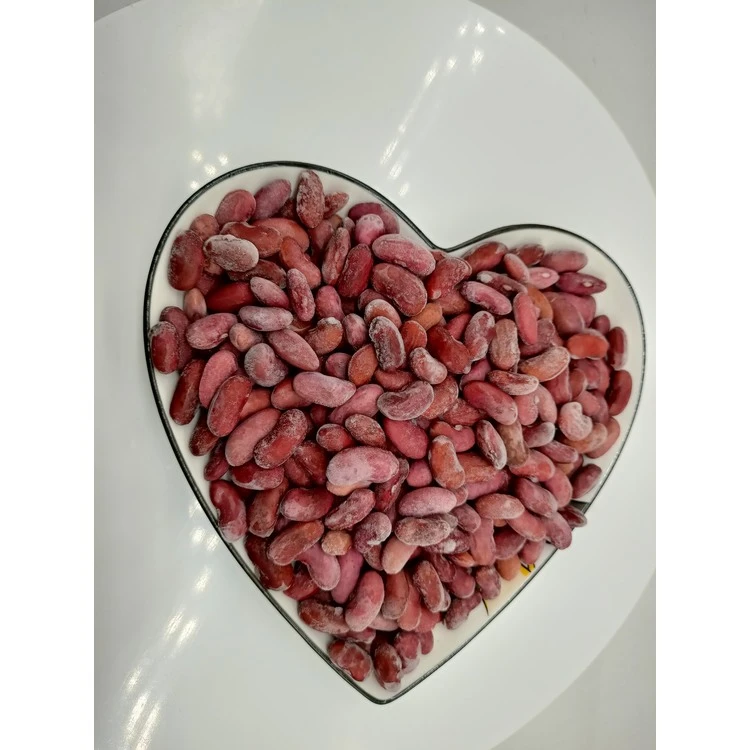
Red kidney beans in a loose sample dish.
Continue reading
Are Edamame and Lima Beans the Same?
See how species and maturity resolve a second common bean-name confusion before a substitution trial.
Source frozen red kidney beans with GreenLand-food
GreenLand-food is a professional frozen red kidney beans supplier and manufacturer in China, providing factory-direct wholesale supply for importers, food manufacturers, foodservice distributors, and private-label programs.
Send the product form, specification, packing, quantity, application, destination, private-label needs, and requested documents.