


Choosing Dragon Fruit Ripeness for Freezing and Processing
Oct 19, 2026
Leave a message

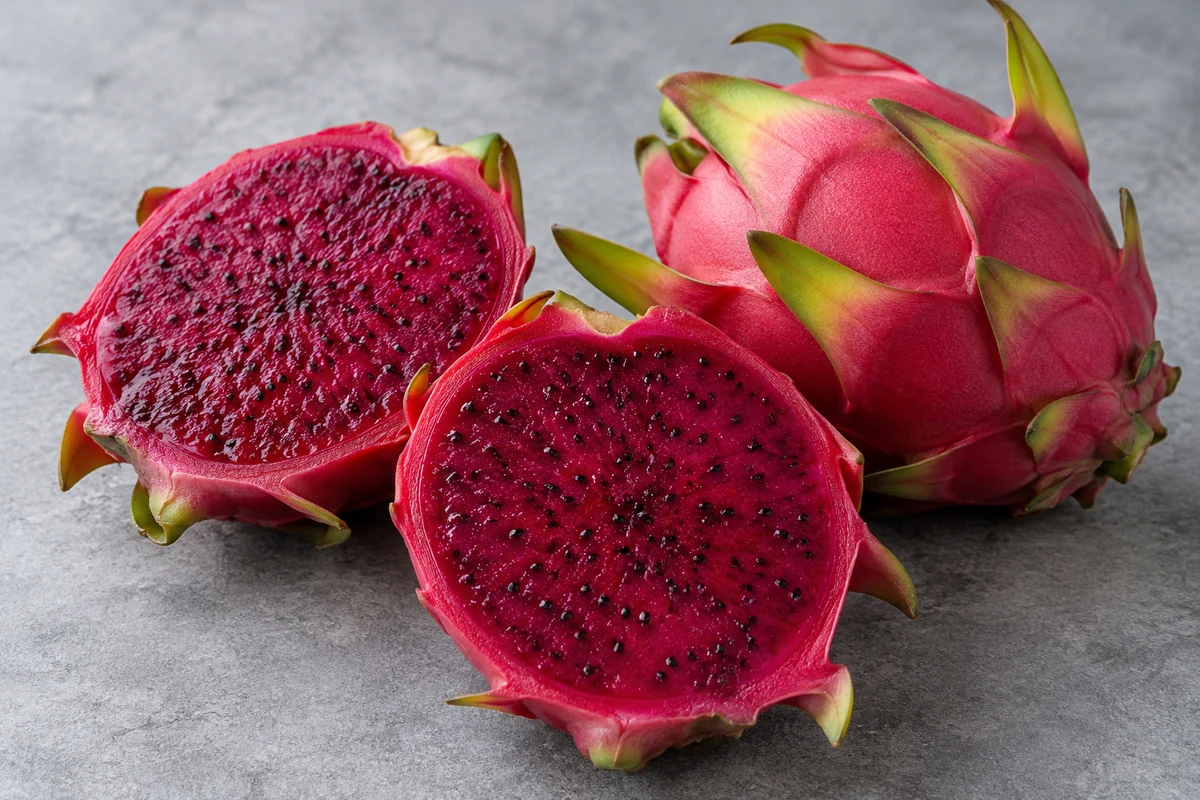
This window can differ between red-flesh dice intended to color a beverage and white-flesh pieces that must remain visible in a fruit mix. Cultivar, growing conditions, harvest timing and the interval before processing also affect the decision. At GreenLand-food, we help your purchasing team connect the selected flesh type and frozen form to a practical sample approval. We confirm numerical targets for an agreed lot and method where they are needed, rather than treating one published harvest day or Brix reading as the answer for every order.
Read maturity in its cultivar and harvest context
Harvest maturity is the fruit's stage of development when it leaves the plant. Receiving condition describes what arrives at the processor after transport and holding. These are related, but a sound harvest record does not replace examination of the received fruit. A delivery can contain fruit picked at different stages, and storage or physical damage may make some units less suitable by the time peeling begins. Record the relevant source, cultivar or commercial type, harvest information where available, and the actual arrival condition.
The UC Davis postharvest fact sheet identifies dragon fruit as nonclimacteric. Its guidance supports choosing suitable maturity before harvest rather than relying on later holding to develop an immature fruit's eating quality. For a processor, this means that firm flesh alone is an incomplete buying criterion. A fruit that resists the blade may still lack the flavor needed in the finished recipe. Assess the firmness and eating-quality requirements together, with tasting limited to material suitable for that assessment.
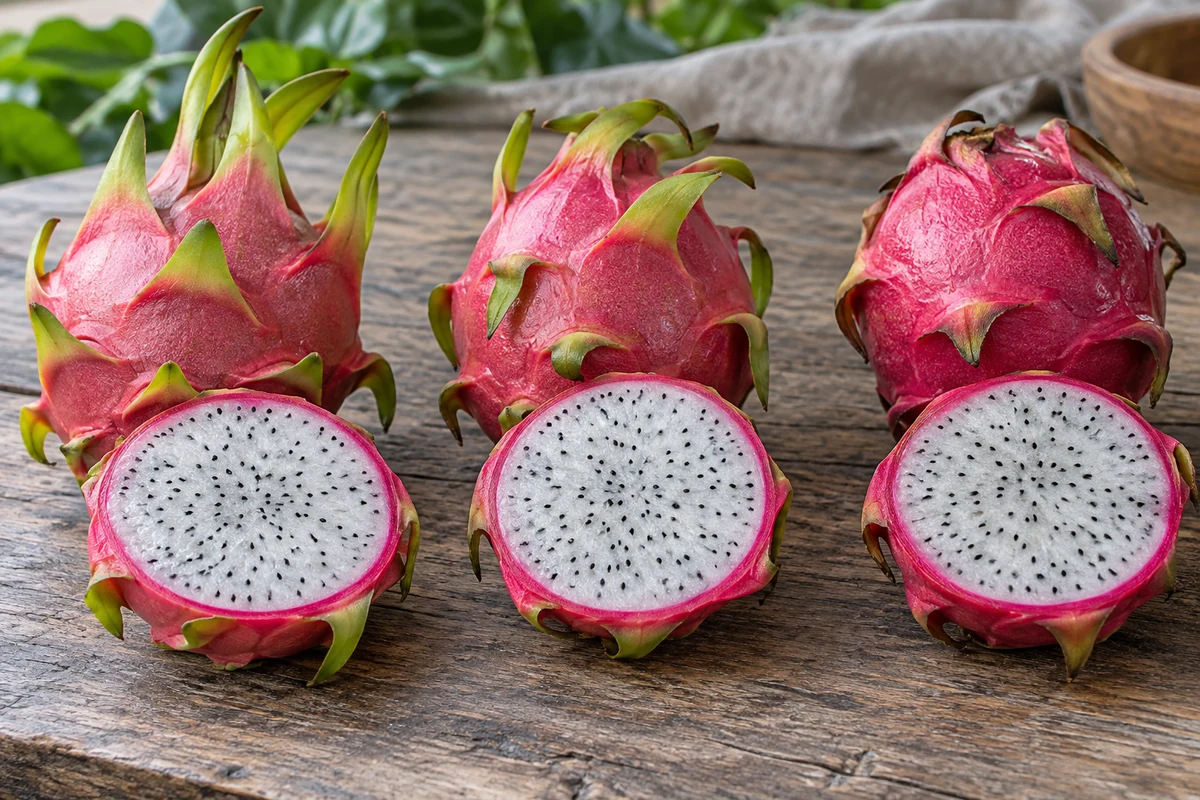
External appearance is a screening observation; confirm the flesh and relevant measurements.
Use peel color and bract condition as screening observations within an identified fruit type. Look for unusual variation across the delivery, then open representative fruit to understand the interior. A photograph of three increasingly red skins cannot prove a universal maturity sequence: color varies with cultivar, and bracts also change with handling and water loss. The picture can help a team agree what it is observing. A useful receiving decision needs the interior findings and relevant records behind that observation.
Published days after flowering provide research context for a defined cultivar and location. They are useful when the grower has reliable flowering records and the production conditions are comparable. They should not become an unconditional acceptance limit for another supply route. The National Taiwan University maturity toolkit combines several maturity indicators and distinguishes harvest uses. This supports a combined assessment; it does not remove the need to establish an order-specific window for fruit that will be diced and frozen.
Ask how the source controls variation when flowers or picking dates are spread across a production block. A mixed delivery can meet an average measurement while containing both firm, underdeveloped fruit and very soft fruit. Segregating meaningful groups during a trial helps reveal that distribution. Keep the groups traceable through cutting and freezing until their performance is understood. Blending them too early can make the average look acceptable while leaving the processor with unpredictable cutting losses or inconsistent flavor.
Open fruit before judging a receiving lot
Open fruit from more than one part of the receiving lot. Choose units according to the agreed sampling approach, keeping any intentionally selected problem fruit separate from the representative sample. Compare the center and outer flesh, the peel boundary and any localized damage. Uniformity across an opened fruit and across several fruit can matter as much as the appearance of the best individual. Note what was inspected so that the receiving record can be interpreted by someone who did not see the delivery.
Look for sound flesh that supports the intended preparation. Translucent or water-soaked areas, pronounced softening, abnormal odors, decay and damage require assessment under the site's rejection procedure. These observations cannot all be assigned to maturity from appearance alone. Physical injury, handling and physiological disorders can produce overlapping signs. Keep uncertain material separate while the responsible team investigates it. A processing-grade description must still refer to sound, suitable fruit; it cannot serve as a route for using decayed or otherwise unacceptable material.

Flesh color and maturity remain separate approval observations.
Inspect the flesh-color identity as well as its intensity. Red or magenta flesh and white flesh are separate commercial inputs, even when the outside skin looks similar. A beverage customer may notice a pale red lot in the finished drink, while a white-fruit blend may be affected by accidental inclusion of red pieces. The GreenLand frozen dragon fruit product information separates these styles. Their sampling references and order descriptions should preserve the same distinction.
Take a standardized photograph of the cut interior when visual condition is part of the agreement. Use consistent lighting, background, distance and exposure, and place the comparison fruit in the same state. Different phone settings can make pale flesh look brighter or red flesh look more saturated. Keep the original image and its sample identity with the receiving notes. If color has a numerical acceptance requirement, agree the instrument, preparation and reporting method instead of relying exclusively on a photograph.
An interior review also makes trimming yield visible. Record whether localized defects can be removed under the approved procedure and how much sound flesh remains. A raw-fruit price comparison can change when one lot requires extensive trimming or cannot support the selected cut. Keep this yield separate from later breakage and thaw loss. Each operation answers a different cost question, and the combined usable yield should retain enough detail to show where material was lost.
Measure soluble solids on a representative pulp sample
A refractometer reading can help compare soluble solids when sampling and preparation are controlled. Report the method and recognize what the measurement represents. A Brix reading in fruit juice is used as a soluble-solids indicator; it does not directly establish sweetness, total sugar for nutrition labeling or the entire eating quality of the fruit. Acidity and the rest of the recipe influence flavor perception. Agree whether the buyer needs a raw-fruit screening measurement, a finished frozen-product result or both.
Define which fruit and which parts supply the pulp or juice. A drop taken from one attractive piece can give a precise-looking reading for a very limited sample. Use the representative preparation agreed for the receiving purpose, and record whether individual fruit are measured separately or combined. Individual readings show spread; a composite provides a combined result for the included material. If the acceptance concern is uneven maturity, a composite alone may conceal the very variation the team wants to control.
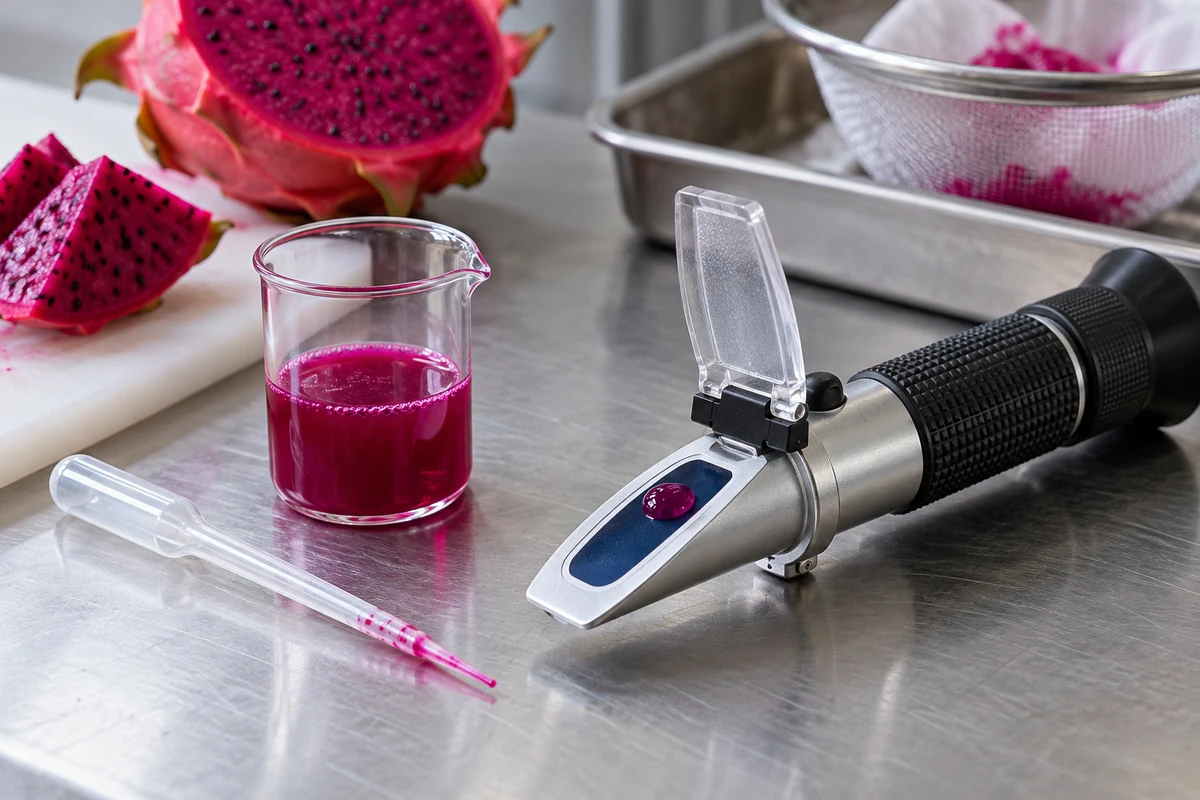
Standardize juice preparation and follow the instrument instructions before comparing readings.
Follow the instrument's instructions for calibration, temperature conditions and sample placement. Prepare the pulp or juice consistently and document any filtration or separation used to obtain a readable sample. Seeds, pulp particles, trapped air and inconsistent sampling can complicate comparison between operators. Clean the instrument appropriately between samples. A supplier result and a receiver result are easier to reconcile when both use a named preparation and method, with enough information to review how the sample was obtained.
Avoid converting a vendor's advertised minimum into a universal technical standard. A 2026 original maturity study of red and white dragon fruit reports changes across defined developmental stages in its study population. Such findings show why maturity affects composition, while the particular values and optimal day remain tied to that material and study. Use published evidence to choose what to measure, then qualify the limit against the actual source and finished application.
If acidity matters to the formula, name its measurement separately. pH and titratable acidity describe different properties and are not interchangeable entries on a specification. A ratio between soluble solids and acidity also requires a consistent acidity basis. Decide which result changes the purchasing or formulation decision before asking for additional testing. A short list of well-defined, relevant measurements is more useful than several unexplained numbers that neither the supplier nor the receiving team can reproduce.
Consider a hypothetical delivery containing two maturity groups. If equal masses of low-solids and higher-solids fruit are combined for analysis, a satisfactory composite can conceal the spread between individual fruit. A separate-flesh inspection may still reveal that one group cuts poorly or gives an unsuitable flavor. The receiving plan should therefore follow the risk: retain individual observations when variation matters, and use a composite only for the purpose it can represent. No particular composite result establishes the proportion of acceptable fruit without the relevant unit data.
Match firmness to cutting, freezing and final use
Firmness needs an operational meaning. A hand squeeze of a whole fruit, a cut-edge observation and an instrument reading on peeled flesh examine different things. For a preliminary trial, record how the flesh behaves during peeling and under a consistent cutting method. Count or weigh the resulting sound pieces and fragments according to written definitions. This makes the result relevant to production even when the team does not have an instrumental firmness method available for that development stage.
When an instrument is required, agree the probe, test position, sample dimensions, temperature and reporting basis with the responsible laboratory or technical team. Results obtained with different geometry or sample condition should not be compared as if they were the same measurement. The commercial specification should identify the method or an agreed equivalent. Retain the observations that explain why a particular range was chosen, especially if it controls raw-fruit selection before the buyer sees the frozen ingredient.
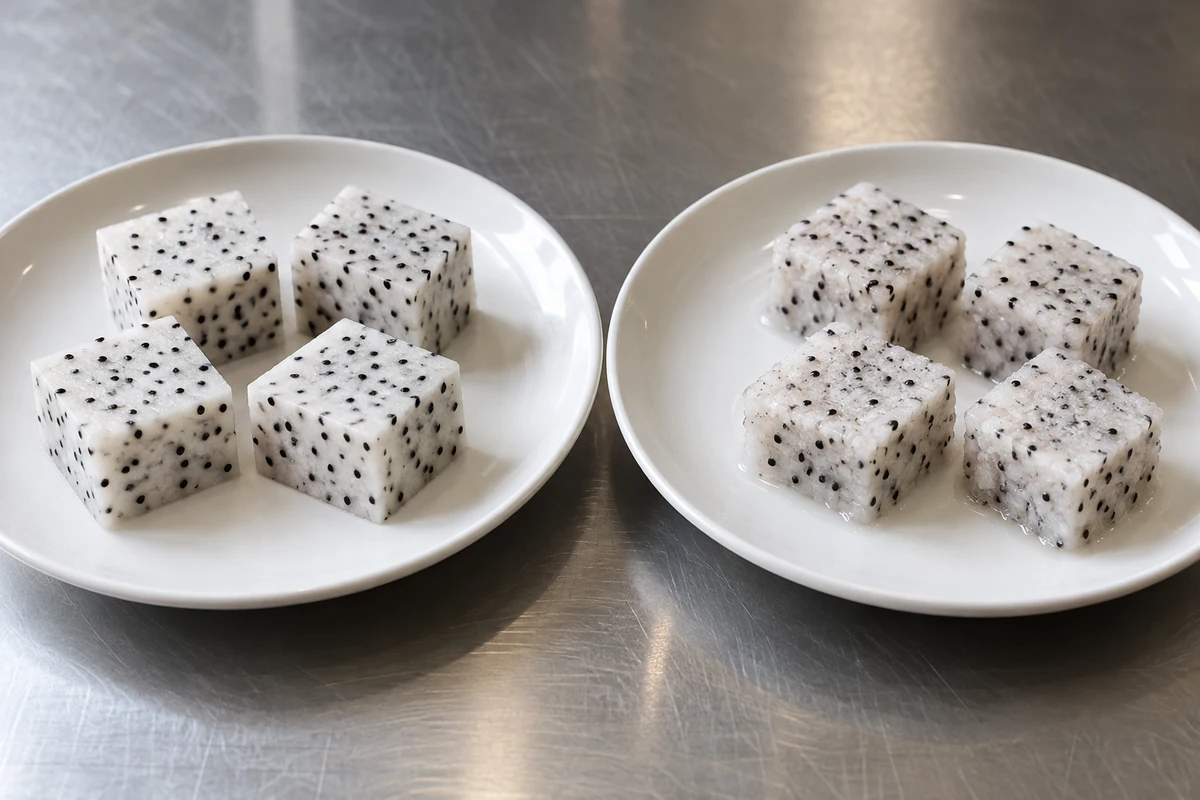
Define the cut-edge response under a repeatable method; appearance alone is not a numerical firmness test.
The best cutting condition also has to survive the rest of the process. Firm pieces may leave the cutter cleanly but develop an unwanted eating texture or flavor in the recipe. Softer sound flesh may suit a screened beverage preparation yet give an unacceptable proportion of fragments when sold as visible dice. Evaluate the target form before deciding that a firmer or softer group represents better quality. The price and yield comparison should follow the approved use of the fruit.
Use small, consistent comparisons during development. For example, compare two observed firmness groups with the same flesh type, blade condition and cut target. Keep each group's fruit separate, record trimming and cut losses, and handle both through the same subsequent operations. These are proposed trial conditions, and they do not establish a finished acceptance method by themselves. The useful outcome is a reproducible relationship between the selected raw-fruit condition and the frozen product that a customer can use.
Treat extreme softness or watery tissue as a reason for investigation rather than a shortcut to a processing grade. A formula that will eventually be blended still needs suitable raw material and the approved safety controls. The technical team should distinguish natural texture variation from deterioration or damage that makes the fruit unacceptable. Maintain the rejection decision and traceability record when material is excluded. Reassigning a sound lot to another approved form requires its own specification, quotation and intended-use agreement.
Keep flesh color and maturity as separate decisions
A stronger magenta color can be commercially valuable in a drink or smoothie base. It does not independently establish flavor, maturity uniformity or suitability for a clean dice. Keep flesh identity, color reference and physical performance as separate fields. A customer may be able to adjust a recipe for one difference while another requires a different raw material. Describing all three under a single grade letter leaves too much room for the supplier and receiver to approve different things.
White-flesh pieces need a reference suited to their own appearance. Define how the receiver will examine shade, browning, peel remnants and the normal seed pattern. A red-flesh color target cannot be used to decide whether a white piece is acceptable. The two forms may also reach the customer's line through different handling or formulation paths. Keep them separately identified in samples, bags, cartons and the order, unless a specifically approved blend calls for both.

White-flesh pieces need their own appearance and preparation reference.
Judge red color in the intended matrix when it is the main reason for buying the fruit. A frozen cube on a dark tray can look intense, while the same mass dispersed through a pale drink or dairy base gives another impression. Record the fruit dose, base composition and preparation condition. A promising result in one recipe cannot establish the effect in a different formula. The customer needs to confirm the appearance at the relevant stage of its process and holding period.
Keep changes in color separate from the movement of colored liquid. A pink halo around a piece shows pigment distribution in the surrounding food; it does not directly measure pigment degradation. The color may also appear different because the fruit has been diluted, mixed or photographed under another light. If pigment stability is a commercial requirement, the trial needs appropriate measurements and controlled conditions. Fruit identity and a strong frozen appearance provide useful starting information, but they cannot answer every stability question.
For purchasing, identify the minimum information that keeps repeat deliveries comparable. This may include flesh type, a controlled color reference, application preparation and the way results are judged. Add a numerical color requirement only when the method and reason are clear. Confirm the ingredient declaration and any treatment that could affect the result. The broader GreenLand fruit sourcing guide places these application choices alongside other frozen-fruit forms without replacing a product-specific trial.
Compare maturity groups through the same freezing trial
A freezing pilot tests whether a proposed maturity group produces the required ingredient. Keep the raw-fruit groups identifiable and use the same preparation, cut dimensions, draining, loading and freezing procedure for each comparison. Record relevant product conditions and the actual endpoint. The trial should be small enough to control and large enough to reveal the handling issues that matter. A domestic tray test can support early development, but commercial line approval needs evidence from the selected production route.
Check usable yield at defined stages. Start with the prepared raw-fruit mass or another clearly stated basis, record trimming and cutting loss, then inspect the frozen product. Note separation, irregular pieces and any damage during transfer to the pack. Inspect a representative packed sample as well as loose output. If a group looks good on a tray but breaks during normal filling, the chosen maturity window has not yet demonstrated the customer's complete requirement.
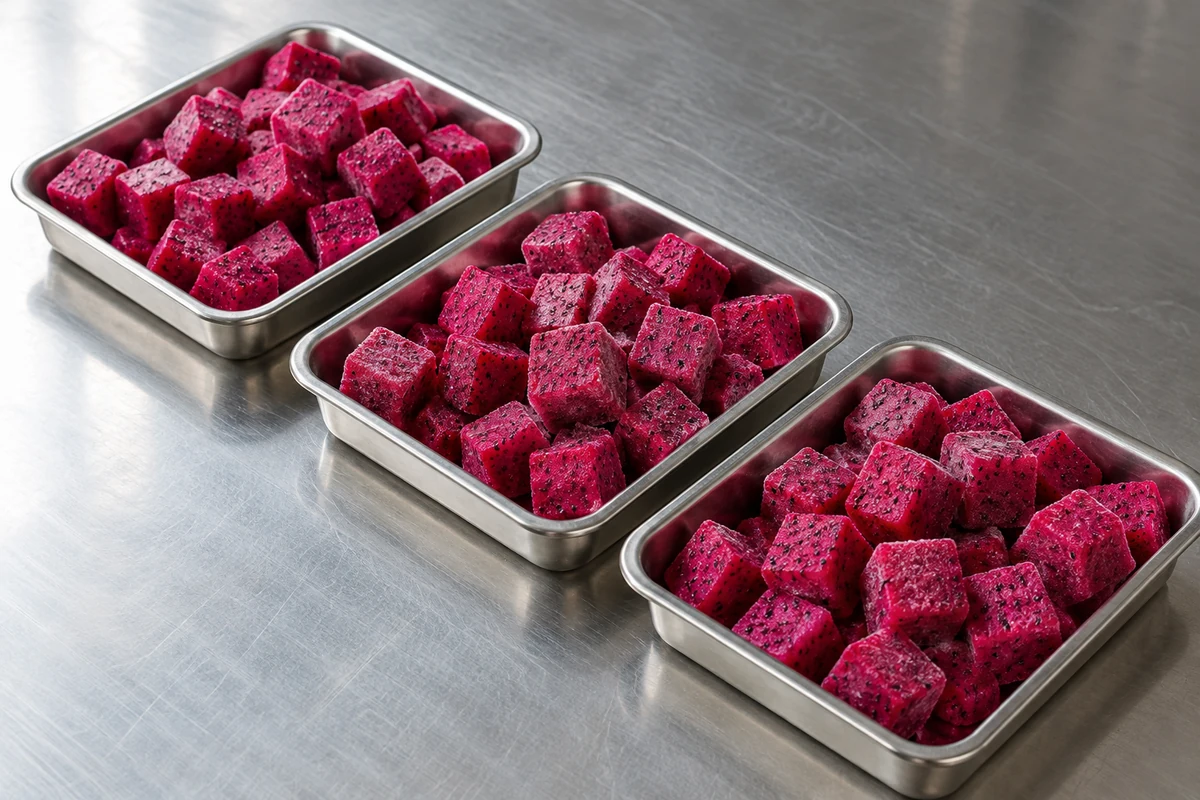
Compare groups with the same cut and frozen state. These illustrative samples carry no maturity ranking or measured outcome.
Continue the comparison through the intended preparation. For fruit blended from frozen, record how it feeds and the properties of the resulting base. For visible pieces, apply the agreed chilled thawing or mixing method and assess the surviving form, liquid release and eating quality. State whether the released liquid remains in the recipe. A drained sample and an undrained sample can produce different yield and color results even when they began with the same fruit.
Repeat the promising conditions across relevant deliveries. One pilot may show that a source can produce an acceptable sample, while repeated observations help establish whether the proposed window is practical over the supply period. Review variation within the delivery as well as differences between deliveries. If a requirement can be met only by extensive sorting, make that cost and yield consequence visible before fixing the commercial grade. A broader usable window may be appropriate for a different approved application.
Keep trial changes and limits identifiable. When a later source lot requires a different cut, blend dose or handling step to obtain an acceptable result, it represents a changed approval condition. Record the change and confirm whether the customer can use it. A supplier should not silently widen the maturity window after a successful sample. The frozen reference and the process record need to describe the product that repeat orders will actually receive.
Compare yield using the same starting basis. A hypothetical 100 kilograms of received fruit yielding 60 kilograms of acceptable dice has a 60 percent yield on received mass, before any later loss in the customer's process. A result calculated from already peeled flesh has another denominator. State the stages clearly when comparing sources, because peel removal, trimming and cutting losses can otherwise disappear from an apparently attractive cost-per-kilogram figure. These example quantities illustrate the calculation and are not GreenLand production results.
Turn a successful maturity window into order controls
Translate the successful trial into receiving and release criteria that another team can apply. Include the identity of the fruit, raw condition where relevant, the finished frozen form and the method behind any numerical limit. State which attributes are screened before cutting and which are checked on the finished sample. A raw-fruit criterion may help control production, but the buyer still needs the specified frozen ingredient. The two stages should support the same application requirement.
Give variation a clear place in the agreement. If the concern is inconsistent flavor or cutting behavior, identify how many independent units will be examined and how the results affect the lot decision. An average soluble-solids reading alone may be insufficient for that purpose. A formal sampling plan should be agreed by the responsible parties for the lot and risk involved. Development sample numbers are useful trial choices; they should not be presented as a universal regulatory plan.
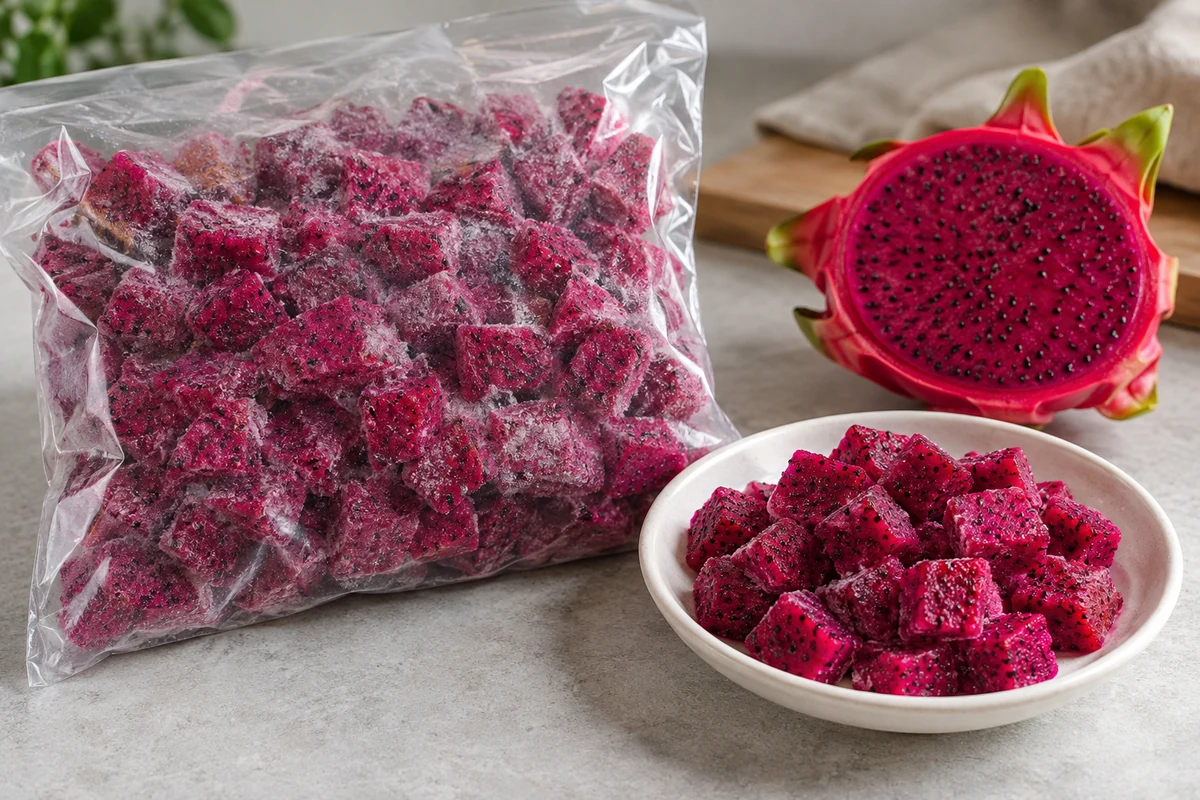
Connect the packed sample to the selected form and approval record.
Keep safety and market requirements alongside the quality work. Ripeness, attractive flesh and a suitable Brix reading do not establish the microbiological or chemical compliance of a lot. Confirm intended use, any further processing by the customer, requested analytes, applicable methods and the represented shipment. Freezing does not replace the selected hygiene and safety controls. Reports and declarations should identify the relevant product and lot rather than relying on an unrelated sample from an earlier supply program.
Discuss availability, crop timing and lead time using the approved form. A tighter maturity selection can affect the amount of suitable raw material, preparation yield and scheduling. Packing material, order quantity and destination documentation may add their own timing requirements. Request a quotation that names these conditions and the agreed product. For a private-label order, review the ingredient and product identity before approving artwork, and keep the red or white flesh style consistent across the sample, carton and label.
We supply frozen dragon fruit against the confirmed form and order specification, and we help buyers review the sample in their own process. Share the intended application and the observations that would cause your team to accept or reject it. The next useful step is a representative frozen sample with a defined preparation and a record of the relevant maturity inputs. That record gives purchasing, production and receiving staff a common reference when they plan supply or investigate a later difference.
Source Frozen Dragon Fruit with GreenLand-food
GreenLand-food is a professional frozen dragon fruit supplier and manufacturer in China, providing factory-direct wholesale supply for importers, food manufacturers, foodservice distributors and private-label programs.
Send your product form and flesh color, specification, packing, quantity, application, destination, private-label needs and requested documents. We help confirm the sample and order requirements for the selected supply.