


Dragon Fruit Sorbet: Seed Texture, Fruit Solids and Scoopability
Oct 19, 2026
Leave a message

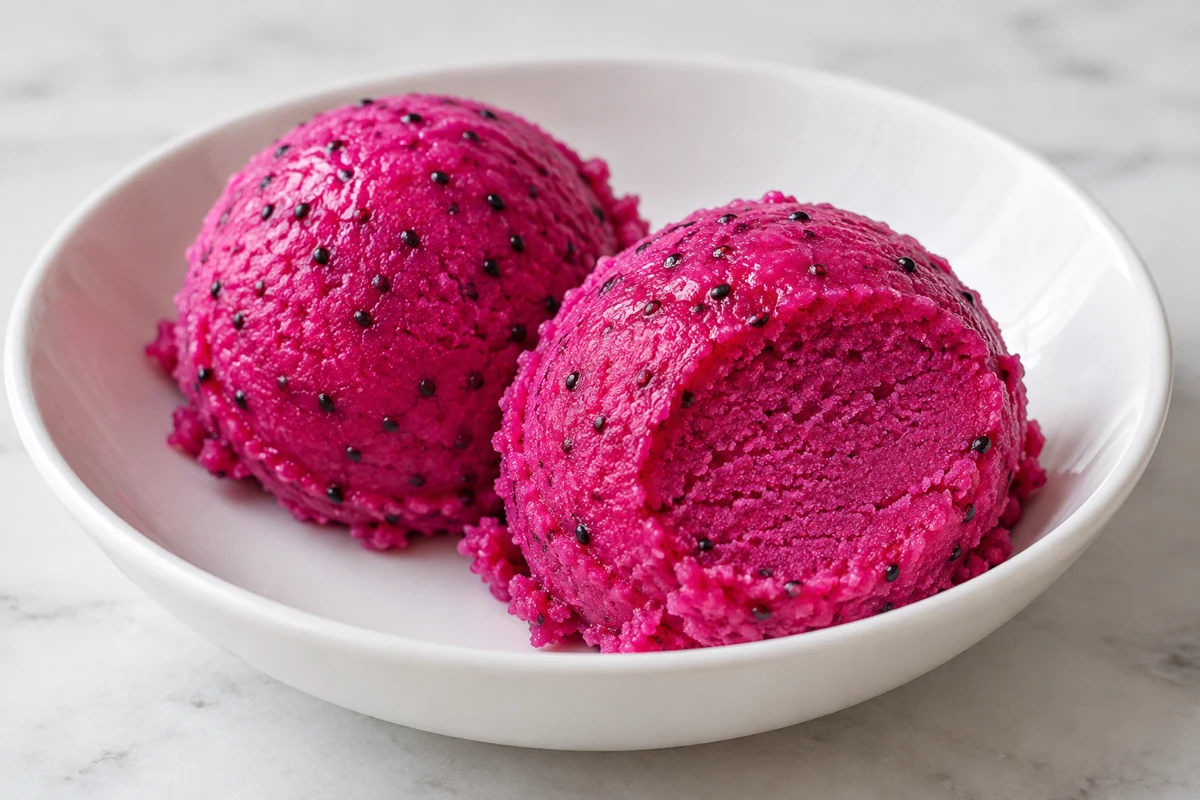
Begin with an identified fruit lot, measure the prepared fruit through a consistent method, and compare complete mixes after the same freezing and hardening treatment. Judge them at the intended serving temperature and after realistic storage. A freshly processed bowl of frozen fruit and a hardened sorbet tub are different operating formats. The quantities and comparisons below are proposed development trials, not tested GreenLand recipes or guaranteed results. We help buyers connect the approved application with a frozen fruit specification that can support repeat orders.
Choose fruit for the texture you will serve
Decide how the product will reach the customer before choosing the fruit form. A made-to-order dessert may blend or mechanically process frozen pieces immediately before service. A conventional sorbet mix is prepared as a liquid, frozen with agitation, packed and hardened before later scooping. A machine that processes a fully frozen pint follows another route. Equipment-specific recipes can be useful starting references, but their results cannot be assumed to transfer to a batch freezer or a retail tub stored for weeks.
Red-flesh dragon fruit produces the familiar magenta dessert, while white-flesh material supports a pale version with visible black seeds. Confirm the flesh color in the purchase description. The current GreenLand product program identifies red dice and separately reviewed white pieces. A ready-made puree or concentrate requires separate availability and specification confirmation. Ask whether it is plain fruit, a blend or a sweetened preparation, because any additional sugar, water or stabilizer changes the sorbet calculation before your own ingredients are added.

Corresponding GreenLand product photograph: red-flesh frozen dice. Appearance supports identity; it does not establish an analytical or safety result.
For dice that will be pureed, inspect size distribution, clumping, peel remnants and usable yield. A very tight cosmetic cube tolerance may offer little benefit if the fruit is completely blended, but poor preparation or unexplained hard material remains a problem. Compare the frozen condition with the agreed sample and record what happens during controlled preparation. If released juice is included in the recipe, include it consistently. Draining one sample and retaining the liquid in another makes their composition difficult to compare.
Flavor should be assessed in the intended sorbet, at the temperature where it will be eaten. A strong red appearance can create expectations that mild fruit flavor does not satisfy. Companion fruit, citrus or other permitted ingredients may help define the flavor, but each addition changes the product identity and formula. Decide whether the menu promises a primarily dragon fruit profile or a named blend. The specification and label review should follow that decision, with the actual fruit percentages available to the purchasing and development teams.
Take representative samples from more than one pack or position in the lot according to the agreed sampling plan. Prepare them using the same thawing, blending and screening method. Keep the lot reference with both the analytical readings and the frozen dessert trial. A small, unusually ripe sample can lead to a formula that performs poorly when ordinary commercial variation arrives. Repeating the selected trial with another acceptable lot is a useful check before committing to a large menu or retail program.
The frozen dragon fruit product page gives the starting point for a sample request. Tell us whether the fruit will be processed into a hardened sorbet, used in a machine at service, or supplied in a portioned fruit blend. That application determines which physical attributes deserve a tight order limit and which can be evaluated through the finished dessert.
Set a clear seed texture target
Dragon fruit naturally contains small black seeds. They contribute to its appearance and can remain noticeable in a finely processed dessert. Define what the customer expects before trying to remove them. A product described as fruit sorbet may accept visible specks and a slight seed sensation, while another concept may require a more uniform texture. A request for smoothness should distinguish ice crystals, intact seeds, fractured seed particles and other hard inclusions, because each calls for a different response.
Start with an unscreened puree made through a controlled, equipment-appropriate process. Record blender or mill settings, batch size and temperature change. Taste only material suitable for the intended use under the approved handling procedure. If the seed sensation is acceptable, avoid adding a screening operation solely to match an unrelated dessert's appearance. Screening introduces equipment, labor, product loss and another surface requiring hygienic control. Its benefit should be visible in the product that the customer actually buys.
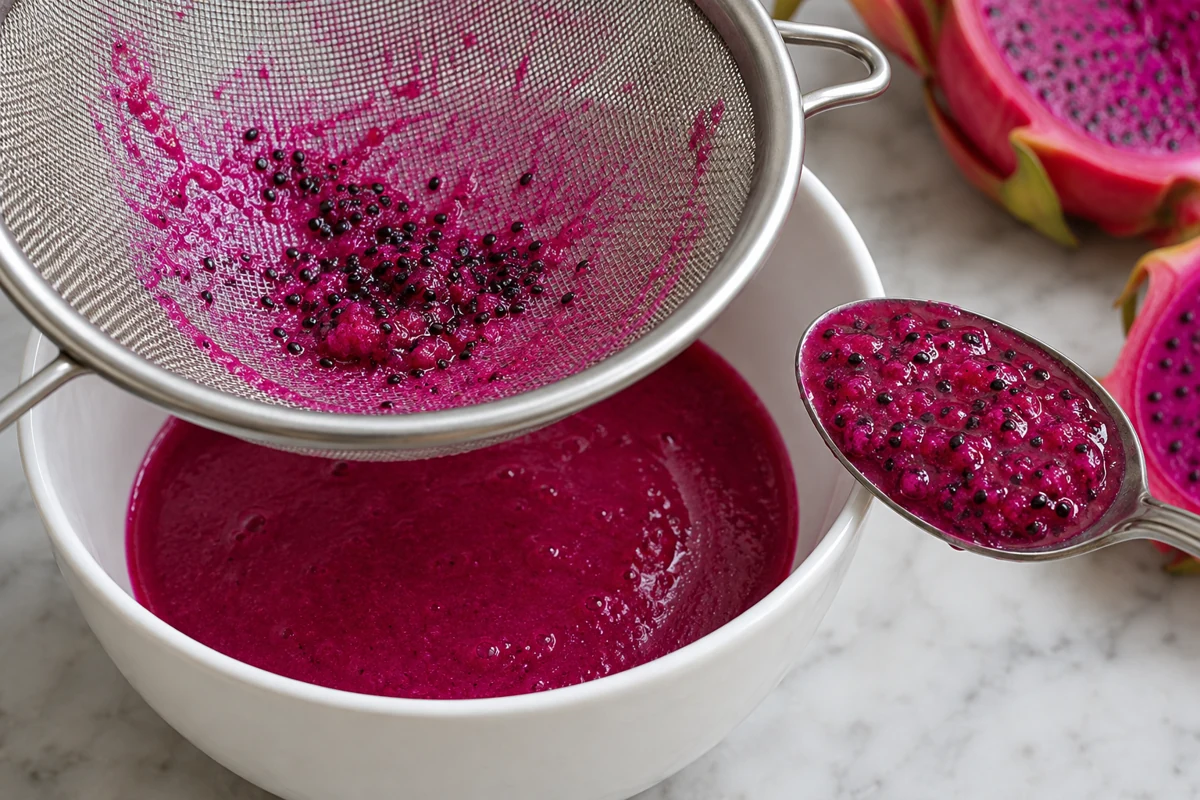
Screen residue includes attached pulp as well as seeds, so measure recovered yield rather than assuming only seeds are lost.
If seeds are objectionable, compare a defined screening route with the original puree. Record screen opening, feed preparation, recovered mass and retained material. The retained fraction may contain fruit pulp and juice as well as seeds, so the yield loss is not simply the seed mass. Photograph the recovered puree and retained fraction for internal reference. A fine screen that produces a visually smoother liquid may also remove body that contributes to the sorbet's eating texture.
Recheck the recovered puree's composition before freezing. Using the same weight of screened and unscreened material does not guarantee the same fruit solids or sensory behavior. A comparison intended to assess seed sensation should account for those changes explicitly. If the screened version needs a reformulated sugar or solids system, identify it as a separate formula trial. This keeps the team from attributing every difference in hardness or melting to the absence of seeds.
Excessive processing is another variable to examine. Longer blending can alter particle size and raise temperature, while seed fragmentation may change the sensation from occasional small seeds to finer particles. The effect needs observation with the actual equipment and fruit. Record what the panel perceives instead of assuming that more blending always creates a smoother result. Stop and inspect when unexpected hard particles appear, following the site's foreign-material procedure rather than treating all dark material as normal seed.
Put the accepted seed texture into the product reference. Use a description, photographs and, where feasible, an agreed analytical or sieve method that relates to perception. Retain a finished sample under documented frozen conditions for a defined comparison period. Future lots can then be assessed against the same target. If the buyer later changes the menu to a finer dessert or a different serving format, review the seed decision along with the formula and process.
| Seed route | What to record | Interpretation limit |
|---|---|---|
| Unscreened puree | Equipment, process and seed sensation | Visible seeds do not quantify coarse ice |
| Screened puree | Screen, retained material and recovered mass | The loss includes pulp and juice, not only seeds |
| Longer blending | Temperature rise and particle sensation | More processing does not guarantee a smoother dessert |
Measure fruit solids before balancing sugars
Measure soluble solids through a defined method on a representative prepared sample. A refractometer reports a reading commonly expressed as degrees Brix, based on refractive index. In fruit, that reading reflects dissolved substances and should not be treated as a complete analysis of all sugars or all solids. Suspended pulp, seeds, sample temperature and preparation can affect how a method is applied. Follow the instrument and laboratory procedure, including any clarification step and temperature correction.
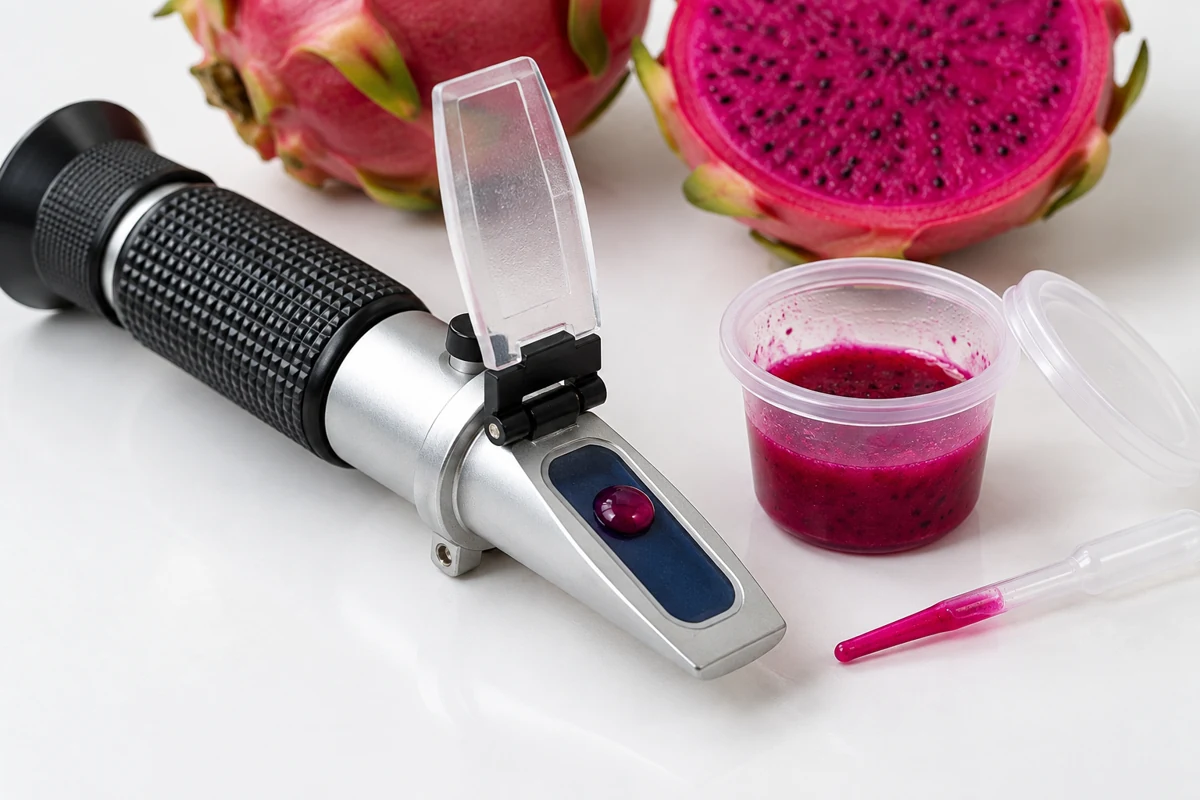
Prepare the refractometer sample according to its method; this open-prism illustration shows preparation before the reading.
Total solids include material that a soluble-solids reading does not fully describe. Fruit pulp and other insoluble components contribute to the mix's body, while dissolved sugars influence sweetness and freezing behavior. Two fruit preparations with the same Brix can therefore produce different desserts. A purchasing team should specify which measurement it needs and why. Asking only for a high Brix value can overlook pulp texture, flavor and the amount of usable fruit recovered after screening.
Sugars affect the amount of unfrozen water at a given temperature. The University of Guelph's explanation of sweeteners describes this freezing-point effect and the different behavior of sweetening ingredients. The principle is relevant to sorbet, but ice-cream ingredient percentages are not automatic targets for a fruit-only dessert. A sorbet developer must consider the complete fruit and sugar system, the desired sweetness and the temperature where the product will be served.
Use mass balance to make assumptions visible. As a simplified example, 600 grams of prepared fruit measured at 12 degrees Brix contributes approximately 72 grams of soluble solids on that measurement basis. Adding 180 grams of sucrose and 220 grams of water makes a 1,000-gram trial with an estimated 252 grams of soluble solids before accounting for other ingredients or methodological limitations. This arithmetic is a planning estimate, not a validated prediction of sugar composition, total solids, freezing curve or scoopability.
If the next fruit lot measures differently, calculate the effect before making an adjustment. Changing only added sugar can alter sweetness as well as hardness. Changing fruit dose also changes color, seeds, flavor and pulp. A blend of permitted sugars may offer different choices, but glucose products, dextrose and syrups need their actual composition and solids information. Equal weights of a powder and a syrup are not equivalent. Keep water carried by every ingredient in the complete formula.
Confirm the prepared mix analytically where the specification requires it, then freeze and taste it. A calculation narrows the development space; it cannot capture every sensory effect. Record acidity, flavor and appearance alongside solids and sugar assumptions. Dragon fruit's mild flavor may need careful balancing, and a formula that is easy to scoop can still be too sweet or lack fruit character. Select the formulation from the combined evidence rather than a single target number.
Build and compare complete trial mixes
Start with a manageable set of complete formulas that each total the same batch mass. Keep fruit lot, preparation, process and serving temperature fixed. One trial might use a sucrose-only addition, while another replaces part of that sugar with a clearly specified glucose ingredient. The replacement must account for ingredient solids and water. State the question for each comparison before making the mix: lower perceived sweetness, different firmness at service, or improved texture after storage.
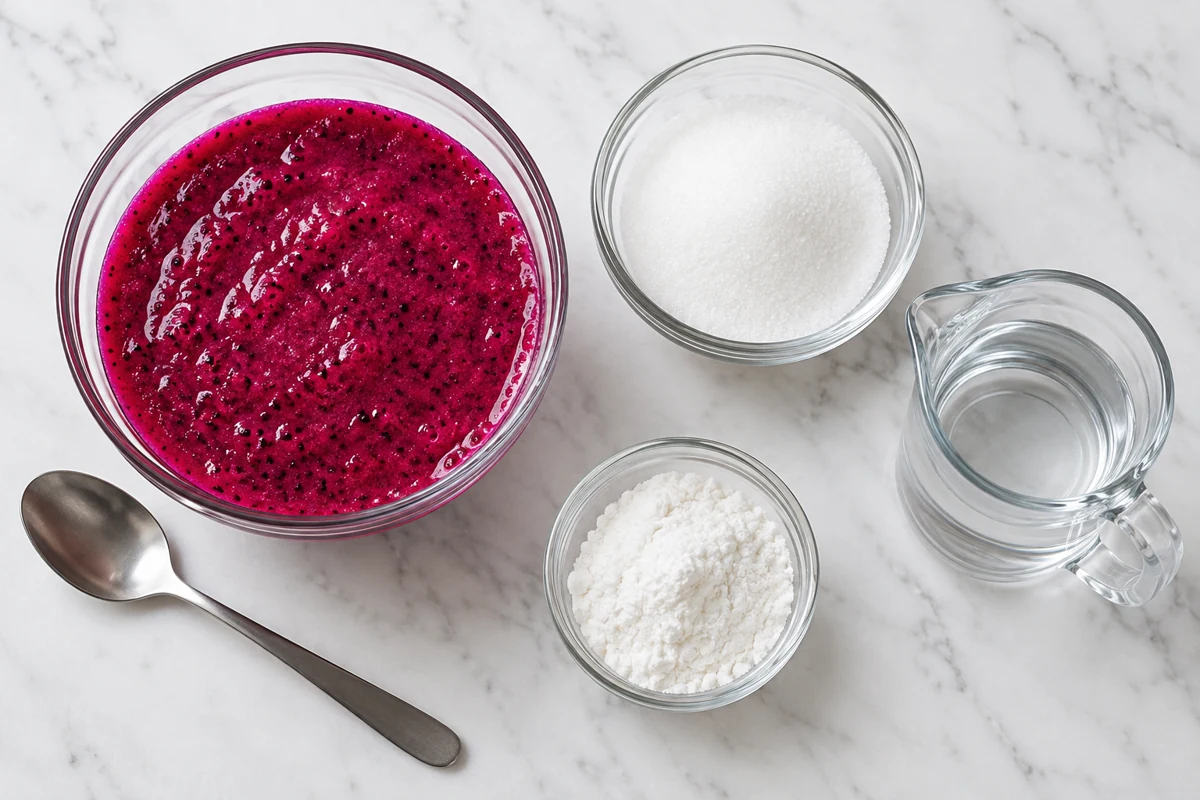
Account for every ingredient in the complete mix. The image does not represent the example formula quantities.
Avoid changing fruit dose, sugar type, stabilizer and serving temperature together in the first experiment. If the result improves, the team will struggle to identify the useful change. A staged sequence is easier to interpret. Establish an acceptable fruit and seed preparation, compare a limited sugar series, then examine any stabilizer or process refinement that the product needs. Keep a baseline formula in each round so improvements can be checked against the same reference rather than remembered impressions.
Stabilizers require their own technical review. Their suitability depends on the ingredient, dose, hydration requirements, acidity and process. Follow the supplier's technical instructions and the applicable market rules. A powder that disperses poorly can create lumps, while an excessive addition can produce an undesirable gumminess. Do not assume that a stabilizer corrects a poorly balanced formula or compensates for uncontrolled temperature cycling. It addresses particular physical behavior within a complete formulation and process.
Heating may be required for an ingredient system or for the validated safety process. Record which part of the mix is heated, the actual product history and how it is cooled. Red dragon fruit pigments can respond to heat and other conditions, so evaluate color and flavor after the complete treatment. Preserving a bright color does not justify adding untreated fruit after a kill step without the appropriate controls. The safety design applies to the final mixture and all subsequent handling.
Use coded samples and a consistent tasting order where practical. Ask the panel to describe sweetness, fruit character, acidity, seed sensation, iciness, body and finish separately. A single preference score can hide the reason for rejection. One person may prefer a softer dessert because it is easier to scoop, while another objects to its sweetness. Recording individual attributes lets the developer address the disagreement through a purposeful next trial rather than adding ingredients without a clear objective.
Repeat the preferred formula after storage under the intended conditions. A mix that is appealing immediately after freezing can behave differently after hardening and distribution. Include the package and portion depth planned for sale, because those affect freezing and later tempering. Preserve the final formula in grams and percentages, with ingredient specifications and a version number. That record turns a promising kitchen result into a formulation another operator can reproduce and a purchasing team can cost accurately.
Freeze, harden and temper consistently
Use the equipment's approved operating method and record the mix starting temperature, charge size, cycle and discharge condition. For a batch freezer, the mechanical process affects ice formation and air incorporation. For a machine that processes a frozen block or pint, the loading and freezing instructions are different. Compare formulas within the same operating route first. Otherwise, equipment effects may be mistaken for differences in fruit quality or sugar balance.
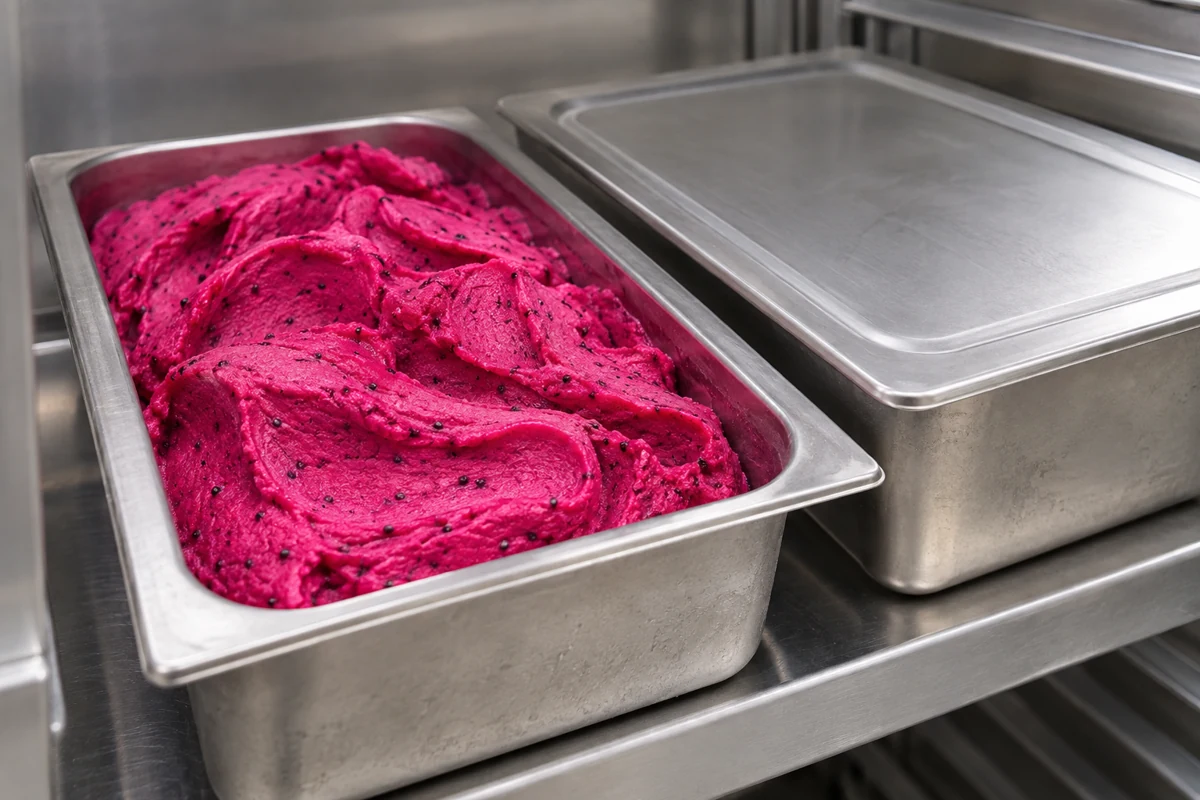
Pan depth, fill and covering belong in the hardening trial; a shelf photograph cannot establish a cooling rate.
Hardening continues the cooling of a freshly frozen dessert after it is packed. Container depth, fill mass, freezer loading and airflow influence how quickly the product reaches its intended storage condition. Keep these factors consistent during trials and record the product condition through an appropriate method. A shallow development tray and a deep commercial tub are not interchangeable. If the final pack changes, repeat the relevant hardening and serving evaluation using that pack.
Temperature stability matters during storage. The University of Guelph's freezing discussion explains that frozen-dessert ice crystals can change through recrystallization. This provides a reason to control storage and handling; it does not establish a shelf life for dragon fruit sorbet. Evaluate the actual product through the expected distribution and service conditions, and keep temperature records when a texture complaint needs investigation.
Define tempering as a controlled preparation for service. A tub taken from frozen storage may be too firm to scoop at once, while excessive warming can create a soft outer layer around a hard center. Record the starting condition, container size, tempering environment and the method used to assess serving readiness. Avoid a universal countertop waiting time. A small sample cup and a full foodservice tub respond differently, and room conditions change across outlets and seasons.
Separate working stock from backup stock where the service plan allows. Repeatedly moving the same tub between a warm counter and deep storage exposes the product to a different history from uninterrupted frozen storage. Evaluate the intended practice and define how opened tubs are identified and managed. The site's food-safety plan and the manufacturer's instructions govern handling. The visible ability to form a scoop cannot establish that a repeatedly handled product remains suitable for service.
When the texture becomes coarse, inspect the complete history before reformulating. Check initial mix composition, freezing cycle, hardening load, storage records and service handling. Compare a retained sample from the same production batch if available. A sugar adjustment may make a temperature-damaged product softer without addressing the root cause of the ice texture. A clear process record helps distinguish an ingredient problem from a freezing or distribution issue and supports a useful discussion with the supplier.
Judge scoopability and melt together
Test scoopability at a defined product condition using the intended scoop and container. Record the portion mass and whether the operator can form a clean scoop without excessive force or repeated passes. For internal comparison, use a consistent trained method or an appropriate instrument if the project requires one. Serving readiness should be based on observed product behavior and the approved handling procedure, not on an attractive photograph taken under unknown conditions.
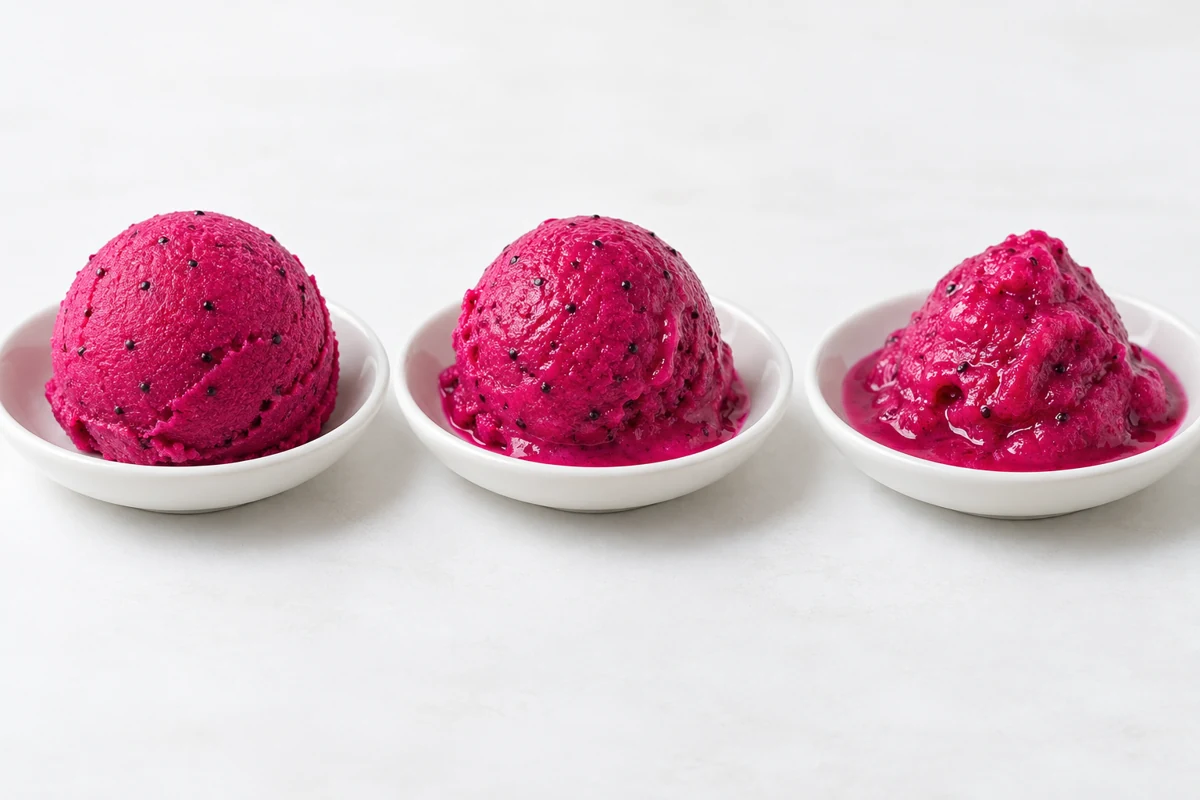
Illustrative shape-loss states without measured timing. Compare equal portions in a recorded service environment.
Inspect the cut surface and mouthfeel. A product can be soft enough to scoop yet contain coarse ice, and a smooth-looking scoop can feel gritty because of seed fragments or another ingredient. Ask tasters to identify the source of the sensation as carefully as possible. Compare unscreened and screened references when seeds are under review, and compare fresh and stored samples when ice texture is the concern. These targeted comparisons are more informative than a general complaint that the sorbet is not creamy.
Use a separate melt observation with equal portion masses, identical dishes and a recorded environment. Observe at intervals chosen for the intended service journey. Describe shape loss, liquid pooling and any separation of pulp from liquid. The illustrated states in this article show the kinds of differences a team might observe; they do not represent measured times or results. Record your actual observations and use them to decide whether the dessert can reach the customer in its intended condition.
Consider the complete plated dessert. A warm sauce, fresh fruit garnish or room-temperature plate can change the experience. If the sorbet is served beside another component, test that assembly at the intended timing. A formula approved as a plain scoop may need a different service method in a plated restaurant dessert. For takeaway, evaluate the package, fill mass and journey, including the appearance when opened. The customer encounters the assembled product, so the trial should eventually reproduce it.
Balance softness with shape retention. Increasing the proportion of ingredients that depress the freezing point may make scooping easier at a given temperature, but the effect on sweetness and melting still needs evaluation. Changing the serving temperature may provide a different solution. Compare these options explicitly instead of optimizing one property in isolation. The preferred result should meet the service requirement while preserving the intended fruit character and portion control.
Check serving yield during a realistic run. Product left in the tub, melted residues, inconsistent scoop weights and discarded portions affect cost. A nominal tub weight does not guarantee a fixed number of saleable servings. Weigh consecutive portions from different operators and record usable output. If one formula requires more effort or produces a wider portion spread, include that operational consequence in the decision. The lowest ingredient cost per kilogram may not produce the lowest cost per accepted dessert.
A repeatable trial sequence
- Condition each trial to the defined service state under the approved handling method.
- Form and weigh portions using the intended scoop.
- Observe equal portions in identical dishes at recorded intervals.
- Evaluate flavor, seed sensation, ice texture and usable yield alongside shape loss.
Purchase fruit against the finished sorbet
Translate the accepted trial into an ingredient specification that the receiver can apply. Name flesh color, fruit form, preparation, ingredient declaration and relevant defects. Define the method for measuring soluble solids or other analytical attributes, and state whether it applies to whole prepared fruit, screened puree or another fraction. Add the seed texture and recovered-yield requirements if they materially affect the product. The approved sample supports these written terms rather than replacing them.

Corresponding GreenLand product photograph: white-flesh pieces. Approve this distinct material separately rather than assuming equivalence to red fruit.
White-flesh pieces should be approved separately if they are part of the range. They can produce a different visual concept, but their photograph does not establish equivalent sweetness, pulp behavior or freeze performance. Repeat the formula evaluation using the actual white-fruit lot. If a buyer wants both red and white versions, keep their identities and acceptance references distinct so purchasing, production and artwork use the correct material. A substitution should trigger the review appropriate to its effect on the finished dessert.
Confirm suitability for the intended use and the required safety controls. FDA storage guidance explains that freezing does not kill most bacteria and that commercial preparation instructions matter. A frozen ingredient intended for further processing should not be assumed suitable for an uncooked dessert. Review the supplier's control system, relevant lot documents and the validated process for the complete sorbet, including any ingredients added after treatment.
Specify packing around the production operation. Small packs may simplify dosing for a service machine, while a larger processor may prioritize efficient controlled preparation and recovered yield. Confirm net weight, liner, carton, lot coding, storage instructions and the evidence supporting the selected shelf life. Discuss estimated volume, ordering frequency, destination and lead time. We confirm these commercial details for the approved SKU and route rather than assigning one pack format or minimum order to every sorbet project.
At the first commercial receipt, inspect representative packs and reproduce the agreed application check. Compare prepared-fruit measurements, seed behavior, mix performance and the finished dessert with the approved reference. Keep the trial linked to the received lot and the actual freezing conditions. If a difference appears, repeat the check under controlled conditions before changing the recipe or accepting a permanent tolerance adjustment. That record gives the purchasing and production teams a shared basis for a claim or approval.
Send a sample request with the intended sorbet format, red or white flesh, fruit dose, seed preference, available processing equipment, pack size and serving conditions. Include quantity, destination and the documents needed for your release procedure. GreenLand-food can then discuss an appropriate frozen fruit sample and order specification. The final purchasing decision should reflect the dessert that your team can produce, store and serve consistently, with its flavor, texture and usable yield all understood.
Source Frozen Dragon Fruit with GreenLand-food
We are a frozen dragon fruit supplier and manufacturer in China, offering factory-direct wholesale supply for importers, food manufacturers and foodservice programs. Product form, packing and order terms are confirmed for the selected SKU.
Send the red or white flesh requirement, cut, application, trial criteria, packing, quantity, destination and requested documents so we can discuss a suitable sample and quotation.