


Frozen Dragon Fruit Smoothie Bowls: Thick Base, Portion Ratio and Melt Time
Oct 19, 2026
Leave a message

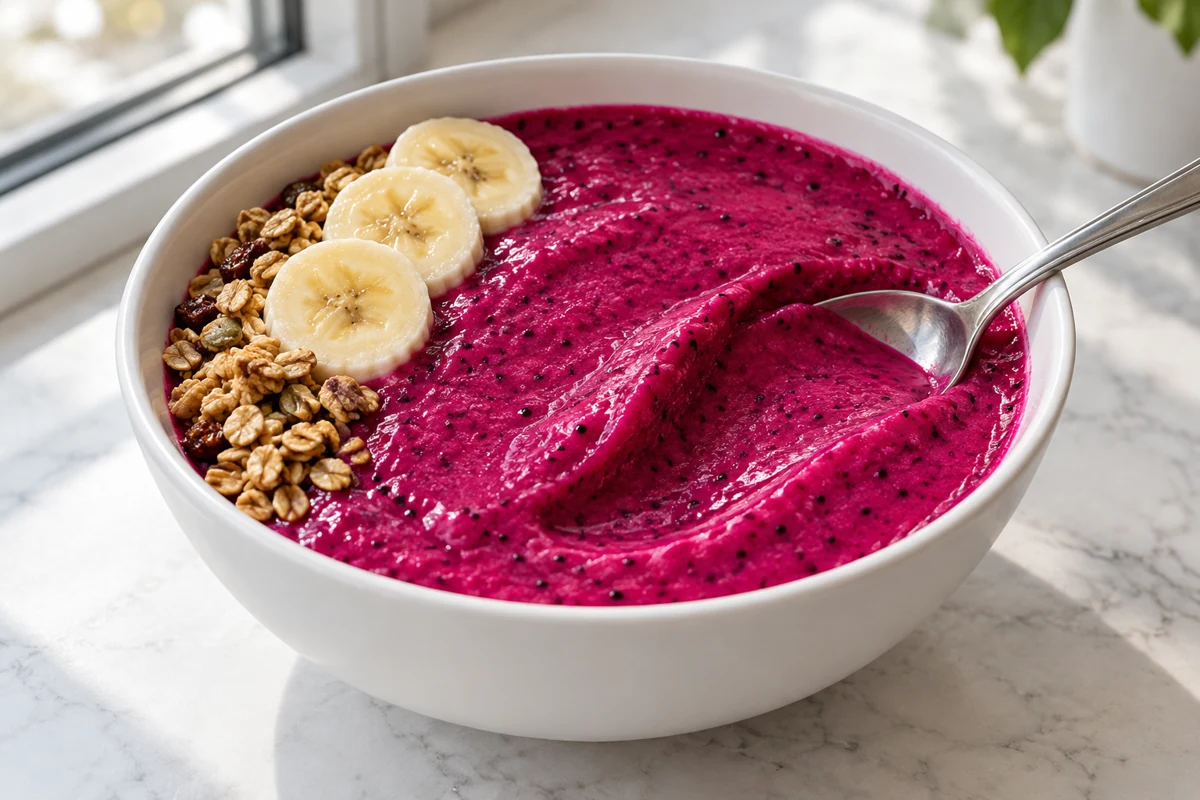
For a foodservice program, there is no universal dragon fruit ratio or guaranteed melt time. Fruit composition, companion ingredients, bowl shape, portion size and room conditions all affect the result. The useful specification is a recipe and handling method that repeatedly delivers an acceptable bowl at the actual handoff time. The trial quantities below are development starting points; they are not tested GreenLand recipes or shelf-life claims. We help purchasing teams connect the approved fruit sample with the application requirements that matter for repeat orders.
Choose the fruit form and flesh color
Red-flesh dragon fruit provides the familiar magenta bowl appearance. White-flesh fruit contains the characteristic black seeds but produces a different color result. Specify flesh color before comparing suppliers, because a quote for white pieces cannot be evaluated against a red bowl photograph. The current GreenLand dragon fruit program describes red dice and separately approved white pieces. A puree, sweetened base or mixed-fruit preparation needs its own ingredient declaration and confirmation of availability; those names should never be treated as interchangeable order descriptions.
For a blender, the useful attributes of dice include their size distribution, tendency to clump and consistency of feed. Large frozen pieces may require a different loading method from smaller pieces. A bag containing many fines can pack more densely into a scoop even when the declared cut size is unchanged. Measuring by weight reduces that portion error, while a practical blending check reveals whether the proposed cut moves through the chosen jug. Inspect the unopened pack, then take samples from several positions before drawing conclusions about the lot.

Corresponding GreenLand product photograph: red-flesh frozen dice. Appearance supports identity; it does not establish an analytical or safety result.
The strongest color in a sample does not establish its sweetness, solids or suitability for uncooked service. Compare the fruit in the actual bowl formula and request the ingredient statement for the selected SKU. If a declaration says only dragon fruit, confirm whether any processing aids or additives require separate disclosure in the destination market. If the base contains syrup or other fruit, record their contribution before adjusting your own liquid and sweetener. These details affect both recipe balance and the wording on a retail pack or menu.
Keep the small black seeds in the first application trial. They are part of the fruit's normal appearance, but their perception depends on blend duration, portion temperature and companion ingredients. Ask the tasting panel to describe any objection precisely: visible specks, a faint crunch, gritty fragments or a separate hard inclusion. A generic request for a smooth bowl can conceal different expectations. If screening is required, the process changes yield and handling; test the screened material separately rather than assuming the original dice price represents usable puree cost.
Approve the fruit and the recipe together. Retain a representative frozen sample from the development lot under documented conditions and photograph its prepared bowl under consistent lighting. That reference helps explain future deviations, although a photograph cannot verify microbiological safety or temperature history. The frozen dragon fruit product page provides the order discussion, while the application trial establishes what your kitchen needs from that order.
Build a base by weight
A useful first experiment keeps the fruit blend constant and changes only added liquid. For example, assemble 400 grams of frozen fruit from 200 grams of red dragon fruit, 140 grams of banana and 60 grams of mango. Compare additions of 30, 50 and 70 grams of the same chilled liquid, provided each charge is suitable for the blender's operating limits. These are deliberately spaced trial conditions, not a recommended commercial formula. If the machine cannot circulate the lowest-liquid mix safely, record that result and stop the attempt.
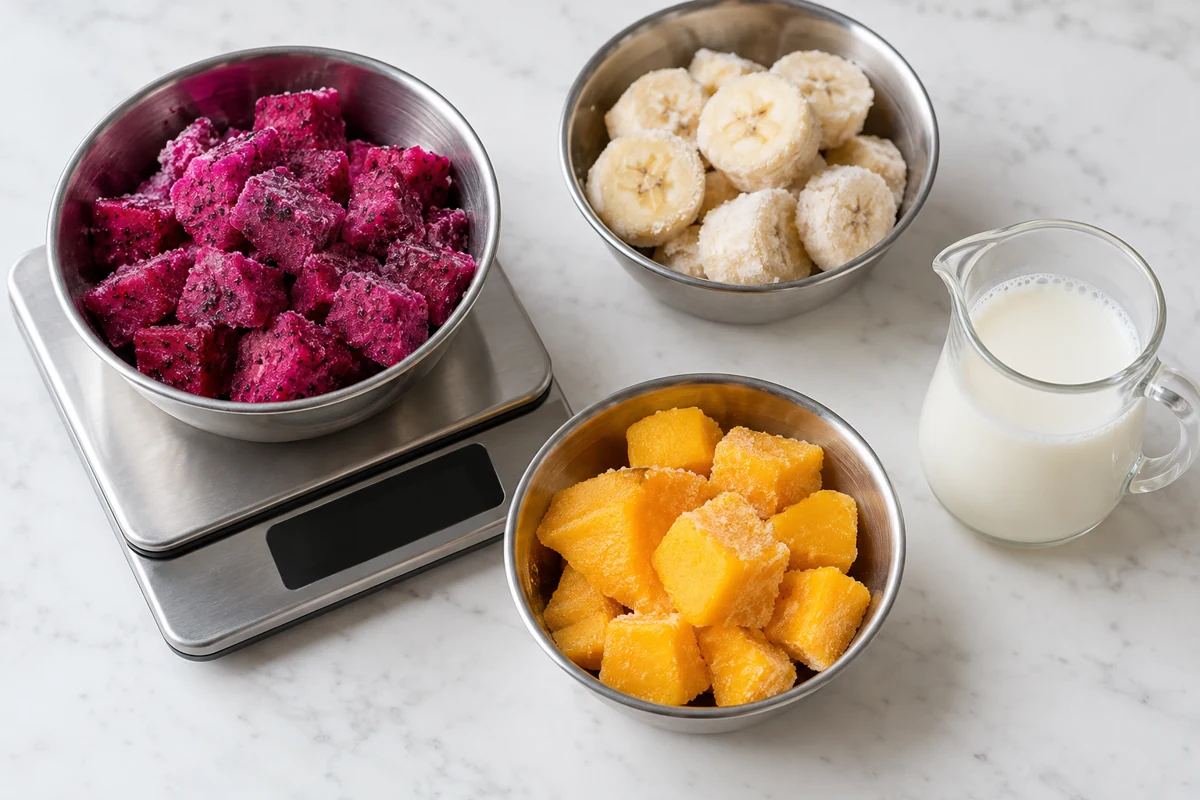
Keep fruit weights fixed while testing liquid additions; the photograph illustrates the components, not the numerical trial.
The resulting total batch masses are 430, 450 and 470 grams. The red dragon fruit remains half of the fruit blend, but its share of the complete base changes to approximately 46.5, 44.4 and 42.6 percent. This distinction matters when a recipe is described as fifty percent dragon fruit. State the denominator: fruit blend, finished base or complete topped bowl. Use the same denominator in costing, production instructions and any composition review. A scoop or cup measure makes that agreement much harder to reproduce.
Evaluate companion fruit as an ingredient with its own effect. Banana can add body and a recognizable flavor; mango can contribute sweetness and a different pulp texture. Their maturity, frozen condition and ingredient declarations still matter. If a chain wants a banana-free product, run a separate development series with the replacement. Adding more liquid to make a difficult alternative blend move may solve the immediate equipment problem while creating a bowl that softens too quickly at the counter.
Choose the liquid for the intended flavor and label, then keep it fixed through the first series. Water, juice, dairy milk, coconut products and other plant drinks differ in dissolved solids, fat, protein and stabilizers. Equal weights do not imply equal sensory results. Record the brand or specification and whether the container was shaken before dosing. A change from a thin coconut beverage to a rich coconut preparation is a formulation change even if both appear on a kitchen sheet as coconut milk.
Weigh small liquid corrections and include them in the batch record. If an operator repeatedly adds an extra splash, the approved formula has ceased to describe the actual product. After the best initial trial is selected, repeat it on another day and with another acceptable fruit lot. Judge flavor after the product reaches the intended eating condition as well as immediately after blending. Extremely cold fruit can conceal differences that become apparent while the customer finishes the bowl, including excessive sweetness, weak aroma or a watery finish.
| Trial | Frozen fruit | Added liquid | Total base | Red fruit / base |
|---|---|---|---|---|
| A | 400 g | 30 g | 430 g | 46.5% |
| B | 400 g | 50 g | 450 g | 44.4% |
| C | 400 g | 70 g | 470 g | 42.6% |
Blend to a repeatable endpoint
Start from the blender manufacturer's permitted loading order, minimum charge and frozen-food instructions. Jug geometry and blade design affect circulation, so a sequence that works in one machine may stall another. Use only the correct fitted tamper when the equipment permits operation with a tamper. Stop the machine before scraping with a utensil, and follow its instructions for access to the blades. A recipe should describe the actual equipment model or a validated equivalent alongside ingredient weights.
For development, record the mass of the charge, ingredient temperatures, cycle setting, interruptions and discharge temperature. Total clock time alone can be misleading. A thirty-second interruption to scrape the jug differs from thirty seconds of active blending, and repeated active cycles introduce more energy. Record both elapsed time and active running time. If the motor protection system trips, treat that as a failed operating condition requiring correction; it should not become part of the standard kitchen method.
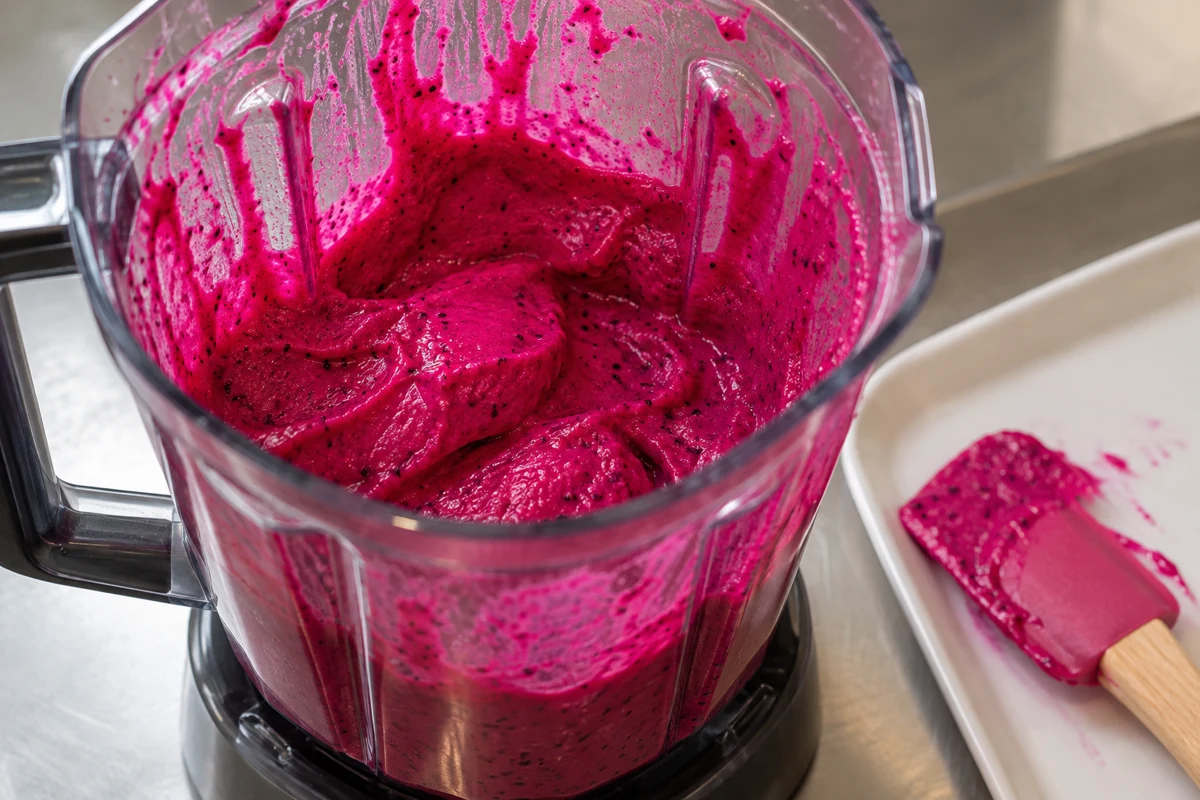
Assess the smooth base with the machine stopped and use the equipment-approved access method.
Define smoothness with an observable endpoint. A spoon drawn through the base should reveal whether recognizable frozen pieces remain, whether the surface holds a soft ridge and whether liquid immediately floods the channel. Use the same spoon and similar movement for comparisons. A photograph can document the appearance, but a staff member should also taste an appropriately handled sample for coarse frozen particles and seed sensation. A base can look uniform at the surface while hiding hard pieces lower in the jug.
Temperature helps explain differences between apparently identical blends. Measure the mixed base using a suitable clean probe and a consistent method, avoiding contact with the jug or blade assembly. An infrared reading of the top surface does not automatically represent the temperature of the whole portion. Record the instrument, measurement position and delay after stopping. Establish an acceptable discharge range from your own successful trials; selecting an arbitrary number from an unrelated recipe would create a false sense of control.
Equipment condition belongs in the investigation when performance changes. A worn blade, a different jug, an oversized charge or a freezer that runs warmer during service can alter circulation and texture. Compare these factors before increasing the fruit's broken-piece allowance or blaming the supplier. A simple sequence of checks often resolves the problem: confirm weights, confirm ingredient state, repeat on the approved equipment, and compare with the retained reference lot. Keep any unexplained deviation visible until the responsible variable has been identified.
The final operating instruction should allow staff to stop at the approved texture within equipment limits. It should also state what to do when the endpoint is missed. Repeatedly adding frozen fruit to rescue a thin batch changes yield, flavor and cost. A controlled remake or an approved correction rule is easier to manage across outlets than improvisation, especially when the base includes allergens or ingredients that carry different menu claims.
Measure melt through the service window
Define melt time as a specific quality event. Possible endpoints include a ridge losing its shape, a topping sinking, a visible liquid ring forming, or the base becoming pourable. These events occur at different times and answer different questions. For a spoonable bowl, the relevant event may be loss of support under the heaviest topping. For delivery, it may be liquid separation after the package reaches the customer. A single statement that a bowl lasts ten minutes leaves the acceptance decision unclear.
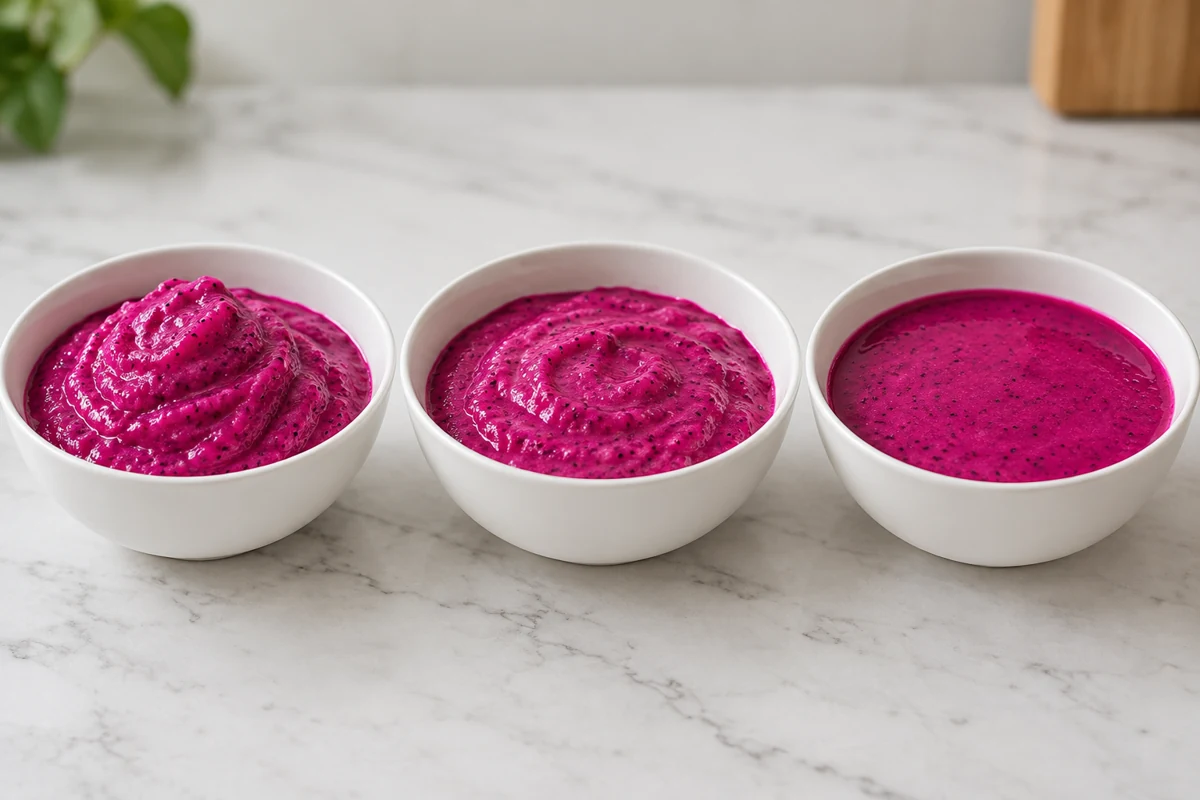
Illustrative softening states. Measure the time to your chosen endpoint in the actual bowl and service conditions.
Run a controlled comparison using the intended bowl, base weight and toppings. Record the room temperature, container starting condition, discharge temperature and time of filling. Observe at fixed intervals chosen to cover the actual service journey, such as immediately after filling and at five, ten and fifteen minutes. Those observation points are a proposed trial schedule. They are not a prediction that the product remains acceptable or safe for any particular period. Stop tasting when the food-safety procedure requires it.
Keep one set untopped to study the base and another set assembled exactly as sold. Heavy fruit pieces, warm nut butter or a generous syrup addition may change surface behavior. Compare like portions and use fresh bowls for observations that disturb the sample. Repeated stirring or scooping can change melting, so do not treat a heavily handled sample as equivalent to one waiting untouched. Photographs should use the same angle and distance, with enough of the bowl visible to show its shape and fill depth.
Test practical container alternatives if the first result misses the service requirement. A wide shallow bowl presents a different geometry from a narrower deeper one. Chilling the service bowl may help the initial condition, but the handling step needs to be practical during a busy shift. Assess the lid, stacking arrangement and carry bag for takeaway service. Condensation, leakage and topping movement can spoil the customer experience even when the base itself remains acceptably thick.
Repeat the selected setup under a realistic busy period. Include the time spent adding toppings, waiting for collection and moving through the store. If your quality limit is reached before the normal handoff, shorten the queue or change the preparation method before promising a longer service window. A recipe adjustment is only one option. A separate topping station, preweighed components or making the base closer to collection may provide a more dependable result without changing the flavor customers expect.
Keep sensory acceptance distinct from food safety. Color, smell and a thick texture cannot establish that a bowl is safe. FDA storage guidance explains that freezing does not kill most bacteria and that label preparation instructions matter. Use ingredients suitable for the intended uncooked use and manage time and temperature through the applicable food-safety plan. A melt comparison is a quality study, not a microbial challenge test.
A repeatable trial sequence
- Define the quality endpoint and the real service journey.
- Prepare equal portions in the intended bowls under recorded conditions.
- Observe at chosen intervals without repeatedly disturbing the same comparison sample.
- Repeat the selected method through a busy service period and a second acceptable fruit lot.
Portion the base and toppings separately
Write the base portion in grams and give toppings their own quantities. A nominal 400-gram bowl could contain 320 grams of base and 80 grams of toppings, or a much smaller base covered by a larger topping load. Those products have different eating characteristics and ingredient costs. Select the portion around the menu proposition, then test whether the container presents it well. A visually full bowl does not by itself show that the standard serving has been delivered.
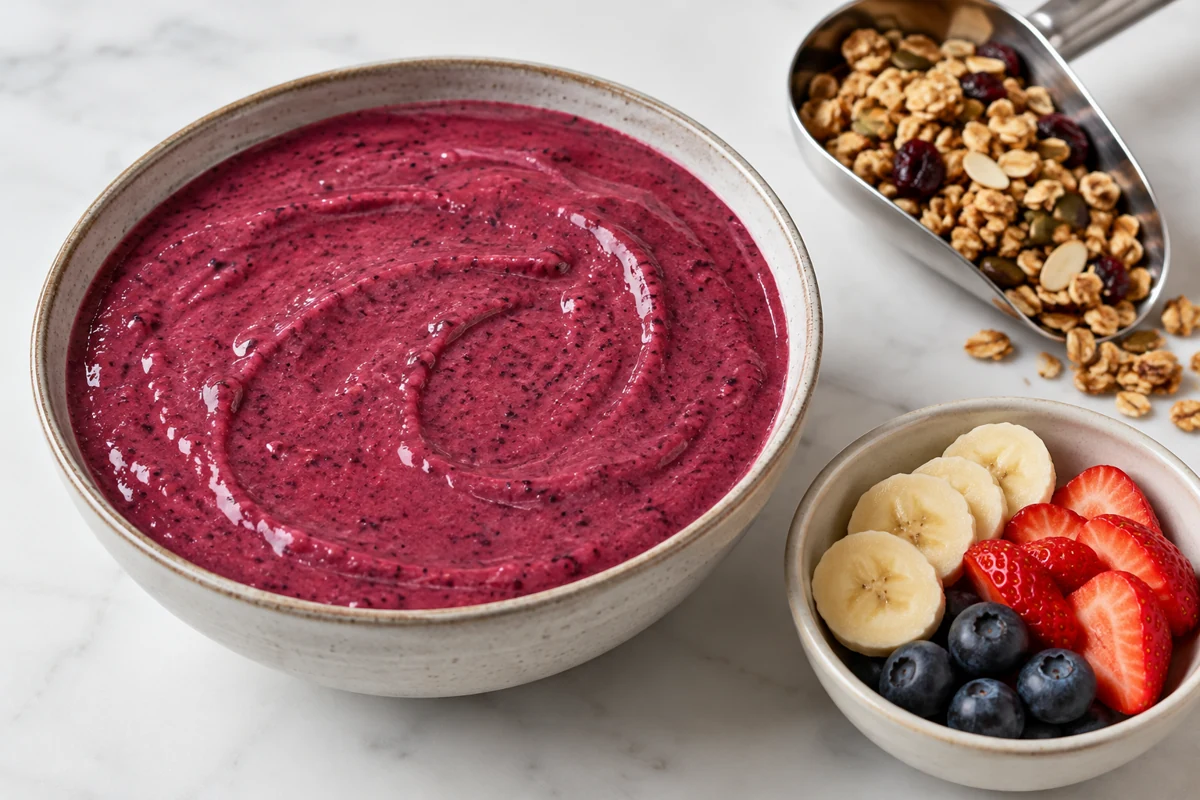
Base mass and topping mass deserve separate instructions because the topping load changes support and cost.
For a development example, compare 300 grams of one approved base with either 45 or 70 grams of the same topping mixture. Keep the relative topping ingredients constant so the effect of total load can be assessed. Examine support, ease of scooping, flavor balance and the appearance at handoff. The lighter topping version may expose more of the magenta base; the heavier version may offer a different eating experience. Choose from observed results and the menu's cost target rather than assuming that more toppings always create more value.
Yield is the amount of finished base that reaches saleable bowls. Material left on the jug walls, spilled during transfer or discarded after a failed batch affects the true cost. Weigh the complete prepared batch and the usable portions during a realistic run. If a 900-gram batch produces only two 400-gram portions plus unrecoverable residue, the purchasing calculation should not assume every gram becomes revenue. Equipment design and the transfer method may be as relevant as the fruit price.
Separate frozen component packs can simplify dosing, but verify their contents after transport and handling. Different shapes and densities may segregate in a large mixed bag. Staff who scoop from the top may receive a different fruit ratio from staff using the final portion. Individually weighed components, complete single-batch packs or a controlled mixing procedure are possible solutions. Compare their labor, packaging and freezer-space requirements before selecting a format for multiple outlets.
Account for toppings that introduce allergens or require special temperature control. The base may use a plant drink while granola contains nuts or other declarable ingredients. Dedicated utensils and the applicable allergen procedure remain necessary during assembly. When the menu changes, review the whole bowl rather than only its fruit base. A swap in granola or yogurt can affect both the product declaration and the melt trial, so keep the approved topping specification attached to the recipe.
At the counter, a scale can be used for periodic verification even when staff normally use a portion tool. Test the tool with the actual thick base; an air pocket or an inconsistent leveling method changes delivered mass. Record several consecutive portions from different operators and compare the spread with your commercial tolerance. Training then addresses the specific source of variation instead of asking staff to make every bowl look similar by eye.
Organize frozen handling around the queue
Bring out only the frozen components needed for the planned preparation period. A large open bag beside the blender may become progressively warmer as orders arrive, changing the final texture even when the recipe stays fixed. Define where backup stock sits, how working portions are replenished and how unused material is managed. The manufacturer's storage and use instructions and the site's food-safety controls govern these decisions. Quality observations should support that system rather than replace it.
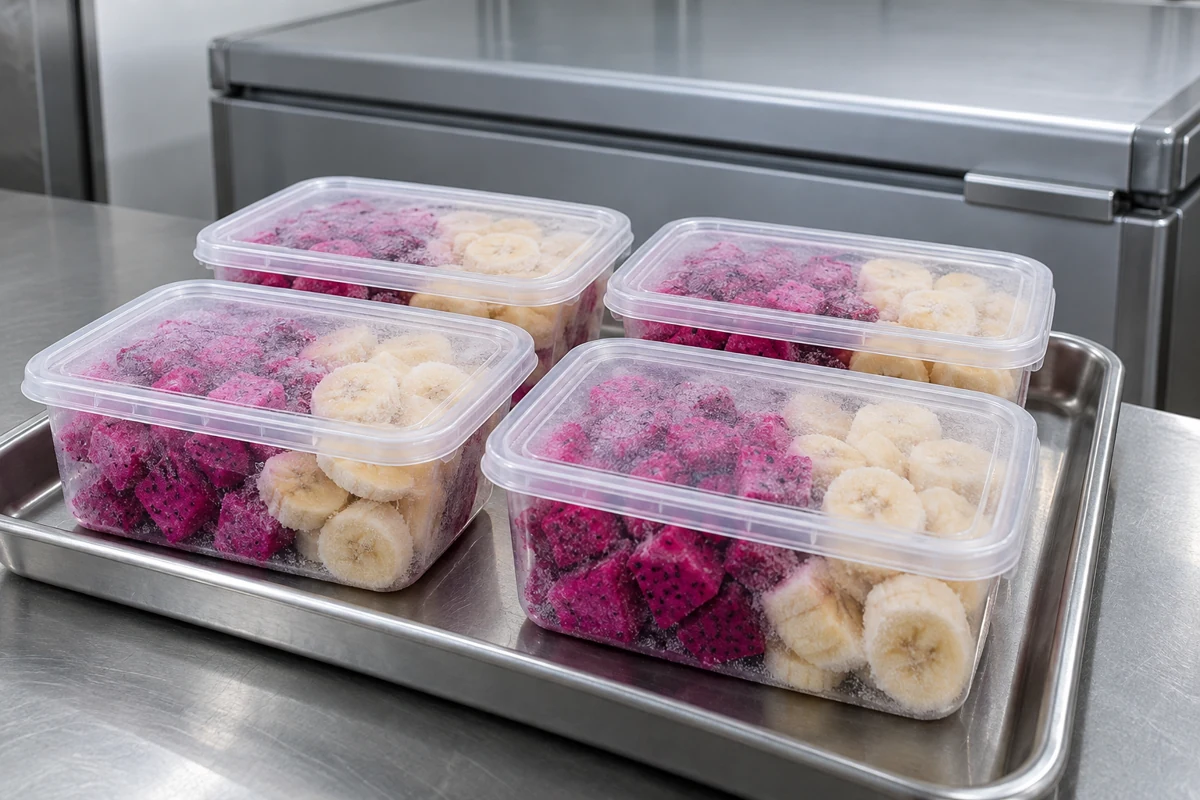
Closed portion packs can organize dosing. Their contents and storage practice still need an approved operating method.
Frozen pieces that remain free flowing are easier to weigh and feed consistently. If a pack is heavily clumped, inspect its condition and temperature evidence before use. Clumping can have several causes, so a photograph alone cannot establish a thaw-and-refreeze event. Record the lot, affected quantity, seal condition and observations at receipt. Compare the result with the agreed pack standard and contact the supplier with evidence that distinguishes a handling issue from the approved product form.
Avoid using uncontrolled thawing as a routine way to make the blender work. If the equipment requires a tempering step, specify and validate it with the intended product, portion size and kitchen conditions. A small component pack and a large carton do not warm at the same rate. The outside can soften while the center remains hard. Measuring the state of the material actually entering the blender is more useful than relying on a fixed countertop waiting time.
Design the work sequence around the busiest realistic order pattern. If a single jug produces one bowl at a time, doubling the charge to clear a queue may exceed the approved load or create uneven blending. Test larger charges as a separate condition. Record cycle time, cleaning time, transfer loss and the final quality of the first and last portion. A faster-looking workflow can reduce usable output if it produces variable texture or leaves assembled bowls waiting too long.
Cleaning and replenishment deserve scheduled capacity. Fruit residue around lids, seals and utensils needs the manufacturer's cleaning method and the site's sanitation procedure. Keep cleaned utensils separate from those waiting to be washed, and manage ingredient changes with the applicable allergen controls. A service plan that assumes uninterrupted blending throughout the shift overlooks these necessary tasks. Purchasing an appropriate pack size can reduce repeated opening and handling, but it does not remove the need for hygienic preparation.
For a chain rollout, provide staff with photographs of the accepted base and a short description of the visible endpoint. Combine that reference with weights, equipment settings and disposition instructions. Ask each outlet to document its first trials using the actual freezer and service bowl. Differences between locations may reveal equipment or workflow constraints before the menu launches. The objective is a method the outlet can repeat under its own conditions, supported by an ingredient specification the supplier can interpret.
Approve the supply specification against the bowl
The purchase description should identify frozen dragon fruit, flesh color, cut, ingredient declaration and intended application. Add the sample method used to judge size, defects and free-flowing condition. Where color or soluble solids are critical, agree the measurement conditions and acceptable range from representative lots. A statement such as premium quality does not explain whether a receiver should reject a pale piece, a small amount of fines or a batch that requires additional blending.

Corresponding GreenLand product photograph: white-flesh pieces. Approve this distinct material separately rather than assuming equivalence to red fruit.
White-flesh pieces can support a separate pale bowl concept, but they should be reviewed as a different input. Their photograph helps purchasing teams recognize the identity difference; it does not establish that their sweetness or blending performance matches red dice. If a shortage prompts a proposed substitution, repeat the relevant formula and service checks before approval. Preserve the original red specification for the original menu so a temporary supply decision does not silently redefine the product.
Request the safety and traceability evidence relevant to your intended use. Confirm whether the selected fruit is suitable for direct preparation without a kill step, and establish the applicable supplier verification, microbiological criteria and handling instructions. A certificate or batch result has a defined scope and cannot replace the complete control system. Ask that documents identify the represented lot, method and date where relevant. The supplier's general website description is useful for discussion, but the accepted order file governs release.
Packing should fit both import logistics and the kitchen. Confirm net weight, inner pack, carton dimensions, labeling, lot coding and storage instructions. Discuss forecast quantities, order frequency, destination and lead time before assuming that a small trial pack is the eventual commercial format. Include the required shelf-life evidence for the specific SKU and packaging. We confirm these order details against the selected supply program rather than assigning a universal pack, minimum quantity or delivery promise to every bowl project.
Use a simple acceptance exercise when the first commercial shipment arrives. Inspect representative packs while frozen, prepare the approved formula on the approved equipment, and compare discharge condition, usable yield and service performance with the retained reference. Keep the record tied to the lot. If a result differs, repeat the check with controlled ingredients and equipment before changing the formula. That approach gives both purchasing and operations a shared basis for discussing a claim or accepting a variation.
The most useful inquiry describes the complete bowl requirement: red or white flesh, preferred cut, base portion, companion ingredients, blender setup, topping load and intended handoff time. Include packing, estimated volume, destination and requested documents. A supplier can then propose a sample that addresses the actual application, and your team can approve it through a repeatable trial. The resulting recipe and ingredient agreement give the next order a clear target to meet.
Source Frozen Dragon Fruit with GreenLand-food
We are a frozen dragon fruit supplier and manufacturer in China, offering factory-direct wholesale supply for importers, food manufacturers and foodservice programs. Product form, packing and order terms are confirmed for the selected SKU.
Send the red or white flesh requirement, cut, application, trial criteria, packing, quantity, destination and requested documents so we can discuss a suitable sample and quotation.