


EU ICS2 and ENS for Frozen Produce: A Shipment Data Handover
Oct 20, 2026
Leave a message

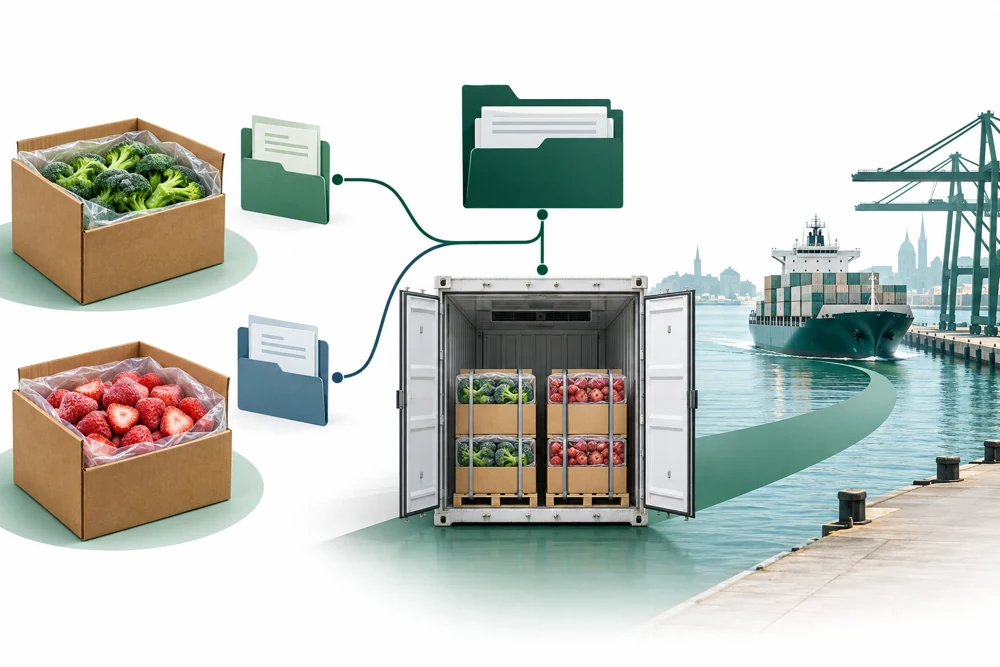
Agree who supplies master and house data, which parties file it, the linking references and the actual mode-specific cut-off. Ask for the accepted ENS and any risk response for the complete data chain before treating the security handover as closed.
Reviewed 20 October 2026. Shipment requirements are checked for the actual product, route and filing date.
Find the first EU entry and the required ENS filer
Trace the vessel from China to its first port in the EU customs territory. The commercial destination may be an inland warehouse in Germany, but the first entry could be a port in another Member State. Security data is lodged for the office of first entry, and risk analysis may cover cargo that will later be discharged elsewhere. The EU implementing rules describe first-port risk analysis for multi-port vessel movements. A buyer should ask the ocean carrier for its first EU call and the planned routing rather than assume the final delivery country is the ENS jurisdiction.
The carrier is normally the principal ENS obligor because it brings the goods into the EU and controls the active means of transport and master record. Where a forwarder or NVOCC holds house, buyer or seller particulars the carrier lacks, the parties choose either to share them for one complete filing or contract for linked partial filings. The Commission's current ICS2 FAQ says a contractual agreement should allocate each filing. The order file should identify the carrier, every house or commercial-data holder who will self-file, their EORIs, the transport-contract number used for linking and the response monitor. A freight quote or 'broker handles ICS2' note is insufficient.
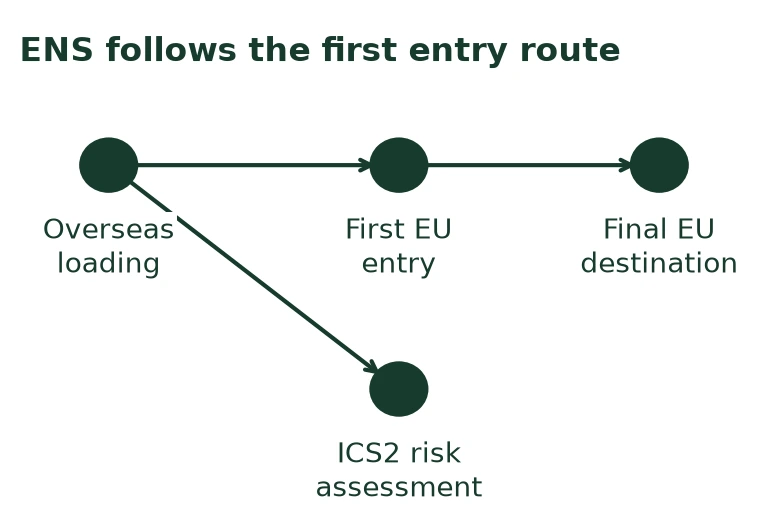
The first entry route controls the ENS assessment; the final sales destination alone does not define it.
The route also determines timing. A deep-sea container from China normally falls under Article 105(a) of Commission Delegated Regulation 2015/2446: at least 24 hours before loading onto the EU-bound vessel. The same article has different limits for bulk or breakbulk and listed short-sea origins. A cartonized reefer container is still containerized cargo; "bulk pack" on a food specification does not convert it into maritime bulk cargo. Ask the carrier which leg is the relevant EU-bound loading event, especially after transshipment. Reserve a working cut-off earlier than the legal limit so a rejected house filing can be repaired.
At the start of a purchase order, create a route sheet: origin factory and stuffing location, load port, vessel and voyage, possible transshipment, first EU customs entry, discharge port, inland destination, master bill, each house bill and responsible filing parties. The product file holds the commercial seller, buyer, actual shipper/consignee and party-to-party contract. Keep revisions. A vessel roll can change the first EU entry or loading clock without changing a single frozen-strawberry carton. The logistics owner must inform every ENS filer of that route change, not only the customs broker handling final import.
The first decision receipt is a signed filing responsibility map. It states who supplies each field, who transmits master and house data, which EORI or other identifier links the filings, who receives system responses and who can make amendments. GreenLand supplies origin-side facts we can substantiate. The EU importer and its agents approve commercial and classification details, and the carrier and forwarder meet their transport obligations. A freight quote alone is not evidence that the necessary linked ENS filings will be completed.
Map master, house and actual commercial parties
ICS2 needs data at the level that lets customs identify the real consignment. The ocean carrier knows its master bill, vessel and container. A forwarder issuing a house bill may know the actual seller, buyer, consignor and consignee at the lower transport level. If commercial data is not shared with the carrier, the responsible party may need to lodge a partial ENS itself. The Commission's current ICS2 FAQ describes multiple filing and the responsibility to supply lower-level information. The buyer should avoid assuming that a master bill bearing a forwarder's name contains all the ultimate commercial parties.
Make a document map before shipping instructions are sent. One row should connect the GreenLand purchase order, invoice and packed lots to the house bill and its parties. Another connects the house bill to the carrier's master bill, container, seal and vessel. In a direct booking, the carrier may receive enough data for a full ENS. In a consolidated booking with several house bills, each house consignment needs its own correct parties and goods lines. Copying the master bill's forwarder as the actual seller on every house record can conceal the transaction customs is trying to risk-assess.

Whole frozen strawberries: identify the actual form, packing and intended use in the shipment file. Product photograph; not evidence of a filing result.
Whole frozen strawberries for your import programme
Tell us your destination, intended use, cut or grade, packing, quantity and preferred shipment window. We can coordinate the proposed source, sample specification and origin documents with your importer and appointed filing team. The actual lot, factory and required documents are agreed before dispatch.
View product and supply details
Request Specifications & QuoteFor example, an IQF cut-green-bean order and a whole-strawberry order may share one reefer but belong to different buyers or house bills. Keep the carton and pallet ranges, weights, product descriptions and source records separate. If a forwarder later splits a bill after a buyer changes the delivery warehouse, the house-level ENS mapping may need revision even though the vessel and container remain the same. The party issuing the house document should send the new identifier and line allocation to the master filer and importer immediately.
Ask for a named multiple-filing agreement: the carrier remains principal ENS obligor; each house or buyer/seller-data holder either shares its particulars or self-files its allocated partial dataset. Exchange the carrier and house-filer EORIs and the transport-contract number that links the parts before filing. Name one carrier-side monitor who checks each expected partial acceptance and the linked complete ENS before loading, with a counterpart at each house filer. A master acceptance alone does not prove the lower-level data arrived. The Commission ICS2 FAQ states these roles and linking inputs.
The packet delivered to the filer should include names and addresses in full, not a chain of abbreviations borrowed from sales messages. Check the actual seller and buyer against the contract, and the consignor/consignee against the bill. If a party is not established in the EU, determine whether a specific EORI is needed for its filing role instead of pasting the importer's EORI into every field. The importer should verify the EORI of the entity named in the customs process. A wrong identifier can prevent linked filings or delay risk analysis.
Retain versioned responses from each filer: master, every expected house or buyer/seller part, the link and a complete ENS status. The carrier-side monitor reconciles these with the bill map before loading and tracks any risk referral to disposition. If a house part is rejected, its filer repairs its own data and retransmits; the carrier reconciles the new receipt and decides whether loading may proceed. GreenLand can correct only the origin facts it supplied. The buyer should receive the acceptance chain, not infer completeness from the master MRN alone.
Describe frozen goods precisely and assign HS6 and EORI
An ENS goods description must identify what the goods actually are. "Frozen food," "agricultural products" or "samples" leaves customs with too little detail. State, for instance, "IQF blanched cut green beans, plain, for further cooking" or "IQF whole strawberries, unsweetened, for fruit preparation," subject to the actual specification. Avoid adding unsupported claims such as ready-to-eat, organic or a particular processing site. The Commission's guidance on acceptable descriptions gives examples of vague terms that should be replaced with concrete goods names.
The six-digit HS code is another input the carrier or house filer may request. It is a classification decision for the specific product; the EU importer and customs adviser should confirm the code and any more detailed EU tariff treatment needed for entry. Beans and strawberries cannot be forced under one code merely because they share a frozen-food category. GreenLand can provide ingredients, cut, blanching status, sugar addition if any, packing and intended use to support classification. Preserve the code proposed, who confirmed it and the date. The final customs declaration can require greater detail and valuation; a six-digit ENS code is not a complete customs tariff decision.
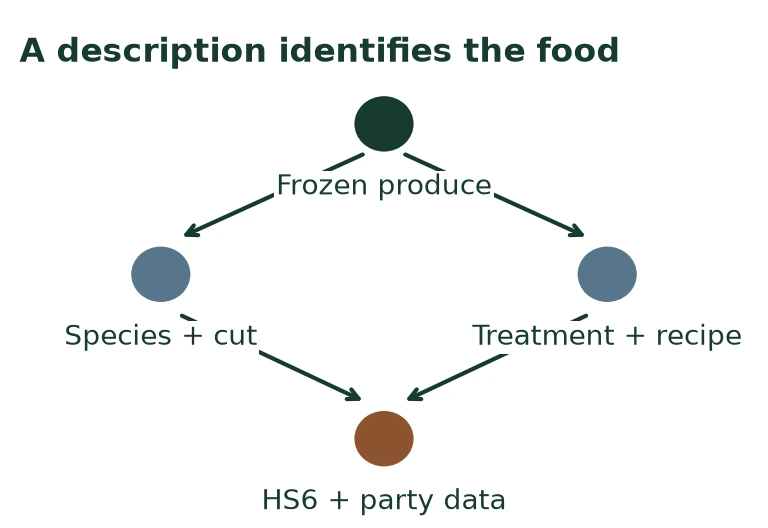
The product description and tariff identity must describe the same physical goods; generic food labels conceal distinctions.
EORI links the economic operator to EU customs systems. Ask which party will be declarant or next filer and have that party verify its own EORI. A forwarder may manage the technical submission, while the buyer's EORI is relevant to consignee or customs entry. Do not use a shipment reference or Chinese business license number in an EORI field. The Commission FAQ describes EORI use when an operator implements its own ICS2 access point. The exact field and registration route depend on the filing model.
Data quality has a current 2026 dimension. The Commission's ICS2 page reports that an updated stop-word list took effect on 3 August 2026. The list addresses vague terms that do not adequately describe goods. A filer should check the current official list and validation rules, then test its product descriptions. Do not promise that a particular phrase is permanently accepted merely because it passed last year. A clear commodity description is a stronger control than trying to outguess a word filter.
The source packet should reconcile net and gross quantities, package count, product form, origin, manufacturer or supplier identity and bill lines. Some of these belong to the ENS and others support customs and food controls, but inconsistencies will prompt questions. An illustrative green-bean specification might state cut length and blanching, while the pack list gives 10 kg cartons and pallet numbers. If the packed product later changes to a seasoned mix, revise the description and classification review; do not let the ENS continue calling it plain cut beans. We can prepare the corrected source record; the importer and filer decide the regulatory update.
Choose a complete ENS or linked multiple filings
The complete-file route is simplest when the carrier receives all required information in usable time and agrees to submit it. In that case the exporter, buyer and forwarder send a controlled data set to the carrier, and the carrier or its system returns the accepted ENS reference. The multiple-filing route is used where the required data is distributed among parties and one or more of them submit partial declarations. The Commission's current FAQ makes clear that a forwarder issuing a house bill can share the details or file a partial ENS. The choice should be made before origin cut-offs, not when the container is already at the terminal.
Put the multiple-filing contract and linking details in the order instruction: carrier as principal ENS obligor; each house or buyer/seller-data holder and whether it self-files; verified carrier and house-filer EORIs; transport-contract number; master and house bill numbers; allocation of datasets; cut-offs; response recipients; and a named carrier-side completion monitor. A service-provider account being active is not evidence that the shipment data were sent. If a partial filing rejects, its owner corrects and retransmits, and the monitor checks the linked complete ENS and any referral before loading. Commission ICS2 FAQ.
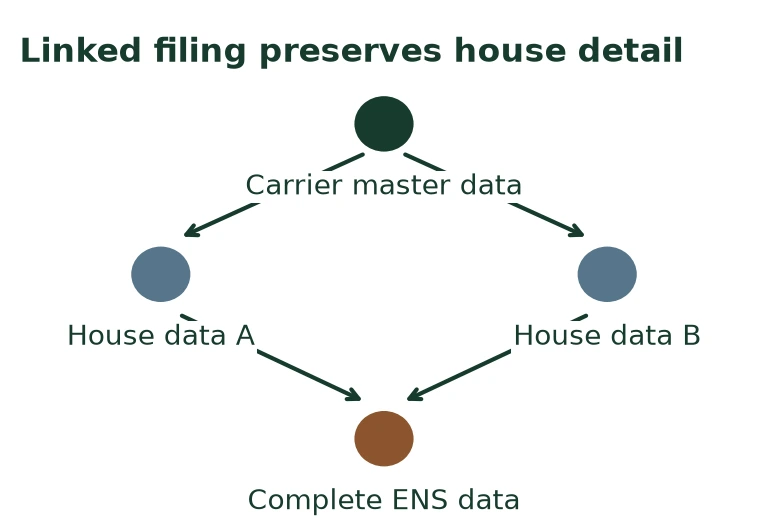
Multiple filing divides data responsibilities, not the need for a complete and linked ENS dataset.
The practical handover has three stages. First, the exporter supplies truthful goods and origin-side data from the final proposed lot and pack. Second, the buyer confirms commercial parties, consignee, EORI and classification with its customs adviser. Third, the carrier and house filer transmit their allocated parts and return response messages. Store who sent what version and when. If the manufacturer changes after a production delay, the exporter updates the buyer and filer, even if the carrier's vessel data has not changed. The filer determines whether that field is within the ENS and amends accordingly.
Avoid overstating the role of an ordinary supplier. GreenLand is not automatically the EU declarant because its food was loaded in China. We may provide a data worksheet, confirm the products and arrange origin-side corrections, but the party named as filer must hold the technical access and legal responsibility for its submission. Similarly, a customs broker appointed for import entry is not automatically the ENS house filer. The buyer should ask for an explicit service scope and system receipt, especially where transport and customs are procured from separate firms.
Use a receipt table: carrier master reference and acceptance; each house or buyer/seller partial reference and acceptance; transport-contract link; complete ENS status; first-entry route; referral disposition; change contact. A rejected partial stays open until its own filer returns a new accepted response and the carrier reconciles the link. The buyer's pre-load review should see every expected part accounted for, not a collection of unlinked screenshots.
| Data layer | Owner to confirm | Receipt to retain |
|---|---|---|
| Master transport | Ocean carrier or its authorized filer | Accepted master ENS reference and linked bill |
| House consignment | House bill issuer/forwarder or delegated filer | Accepted house filing or confirmed carrier full-file route |
| Commercial buyer/seller | Party holding verified transaction details | Data handover/partial filing acceptance where used |
Schedule the mode-specific deadline and response
For the illustrative deep-sea reefer container, Article 105 of Delegated Regulation 2015/2446 sets the normal ENS deadline at 24 hours before loading onto the vessel that will bring the goods into the EU. The same article sets four hours before first-port arrival for relevant bulk or breakbulk and two hours for specified short-sea origins and special routes. Do not classify palletized cartons inside a reefer as maritime breakbulk because the purchase uses "bulk wholesale" language. The transport form, actual origin and route decide which branch applies.
Other modes have different clocks under Delegated Regulation 2015/2446, Articles 106–109. An air sample needs the minimum pre-loading dataset before loading; remaining particulars are due at actual take-off when flight duration is under four hours, or four hours before arrival for longer flights. Road is one hour before arrival at first EU entry. Rail is one hour if the journey from the last third-country formation station is under two hours, otherwise two hours. Inland waterway is two hours. Confirm the actual mode and first-entry clock with the operator. Since 1 June 2026, the Commission says the temporary NCTS Phase 6 derogations ended: every consignment entering the EU needs a valid ENS directly in ICS2 or, in an opt-in country, within a combined NCTS Phase 6 transit declaration. For a road or rail route, record which path, submitting party and accepted reference applies. Commission current ICS2 page.
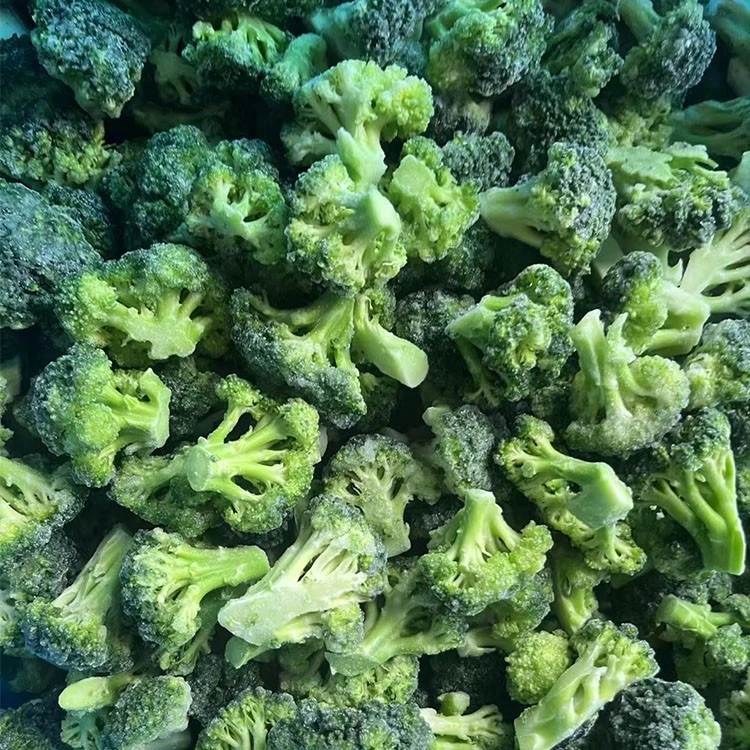
Frozen broccoli florets: identify the actual form, packing and intended use in the shipment file. Product photograph; not evidence of a filing result.
The legal minimum is not the supplier's document deadline. A carrier may close shipping instructions earlier to validate EORI, house parties and goods descriptions, submit the ENS and respond to any referral. Ask for that carrier cut-off in the booking confirmation and calculate it in the correct time zone. Work backward through GreenLand's production release and packing-list finalization. If the product changes after the internal cut-off, escalate immediately to the filer and carrier; do not let the reefer board with data that describes the old load.
Acceptance is not the only possible response. ICS2 risk analysis can generate requests for information or screening, and a serious risk can result in a do-not-load instruction for deep-sea containerized cargo. The Commission FAQ describes notification routing, while the implementing regulation addresses the do-not-load response. Name the person who monitors messages outside ordinary China and EU office hours. If a request arrives, the buyer and supplier should provide actual documents and product facts rather than guessing what will satisfy it.
At each milestone, retain the submitted version, acceptance or error, time and responder. A message accepted at the syntactic level may still lead to risk referrals. A carrier's booking confirmation is not an ICS2 acceptance. A master filing receipt is not proof that the expected house filing is present. Before loading, the carrier and house filer should report whether all allocated parts are accepted and linked, and whether any do-not-load instruction is outstanding. If the status is uncertain, resolve it with the responsible filer before declaring the cargo ready.
| EU entry mode | ENS filing clock | Owner and receipt |
|---|---|---|
| Deep-sea container | Normally 24 hours before loading on the vessel bringing goods into the EU | Carrier and all linked filers; complete ENS/referral status |
| Maritime bulk or breakbulk | Normally 4 hours before first EU port arrival | Carrier; accepted ENS |
| Specified short-sea route | Normally 2 hours before first EU port arrival | Carrier verifies route exception |
| Air | Minimum dataset before loading; remaining data at actual take-off if flight under 4 hours, or 4 hours before arrival if longer | Air carrier and linked filers |
| Inland waterway | 2 hours before first-entry arrival | Operator; accepted ENS |
| Road | 1 hour before first-entry arrival | Carrier/appointed filer; direct ICS2 or opt-in combined NCTS P6 |
| Rail | 1 hour if last third-country formation-station journey under 2 hours; otherwise 2 hours before arrival | Carrier/appointed filer; direct ICS2 or opt-in combined NCTS P6 |
Handle holds, route changes and data corrections
Treat a system rejection as a data problem to diagnose. Identify the exact rejected field and message, source document and owner. A vague description or missing EORI may be corrected by the filer after the buyer provides accurate input. A mismatch between house and master bill may require a forwarder and carrier reconciliation. A customs referral can request additional data or screening rather than a simple field repair. Keep the agency response intact and do not overwrite the original filing to conceal the first error. The corrected transmission needs its own accepted receipt.
If the reefer's vessel rolls or its first EU port changes, the route owner informs both the master and house filers. They determine whether the existing ENS can be amended and how to update the office of first entry, vessel and timing. A split shipment can affect house-bill and product-line allocation. A changed buyer or final consignee can affect commercial party fields. The buyer should send an explicit before/after map instead of a brief email saying "new ETA." The closer the change to loading or arrival, the more important it is to get a positive status from the electronic filer.
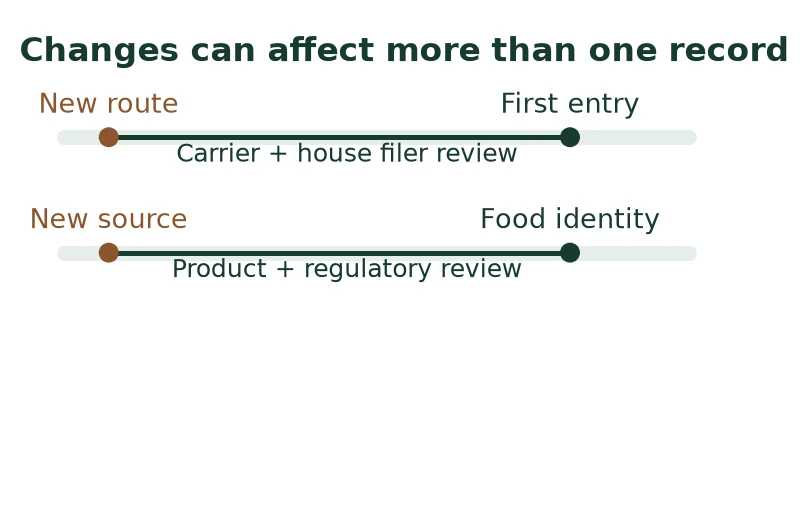
Notify every responsible filer of changes and retain the corresponding accepted responses.
For a do-not-load response, do not release a container to the vessel on a belief that later customs entry will cure it. The carrier, filer and competent customs authority control the next steps. GreenLand can provide factual product identity and source documents requested through the buyer, while the filing party handles the agency communication. Preserve the exact referral, response and disposition. The buyer also needs to manage the commercial consequences: frozen storage, reefer power, demurrage exposure and revised delivery expectations under the contract. These are operational decisions, not automatic waivers of the security requirement.
Technical instructions change. The Commission's 2026 ICS2 page identifies its current documentation library and an updated stop-word list. The party operating the software should confirm the message specifications and test status for its interface, rather than relying on a static article to assert that every operator uses one version. A buyer can require the filer to state the current system route, acceptance evidence and contingency contact. Do not label a message "v3 compliant" without an actual system response. The published reader guide should focus on the durable data and responsibility questions.
At arrival, the sea-vessel or aircraft operator lodges the arrival notification with the first-entry customs office, and the arrival-side party ensures goods are presented to customs. The buyer should ask for those separate handover results after the complete ENS and referral disposition. An ENS MRN is a security reference, not physical availability or release. Import customs and any applicable food/plant controls follow their own decisions. Commission, How ICS2 works.
Keep ENS evidence separate from customs and food release
For an IQF purchase, we would close the origin handover with a controlled product specification, lot and pallet map, invoice, packing list, source identity, origin claim support, container and seal, temperature instruction, booking and master/house bill map. The buyer and filer add the approved HS6 and EORI roles. Then preserve each partial filing's acceptance, the linked complete ENS, referral disposition, sea/air arrival notification and customs presentation, and any amendments. This gives the importer a coherent chain from physical carton to electronic security record. It also makes a discrepancy diagnosable when one of several consignees shares a reefer.
The import customs declaration addresses classification at the required detail, valuation, origin, duties and release. Food and plant-health controls, where applicable to the exact product and origin, have separate authorities and documents. The Commission's customs-controls explanation places ENS risk analysis before later customs controls. Therefore the buyer should plan time and documents for those later decisions. A successful ENS message does not establish that pesticide results, microbiological status, labels or traceability satisfy a Member State's food authority.
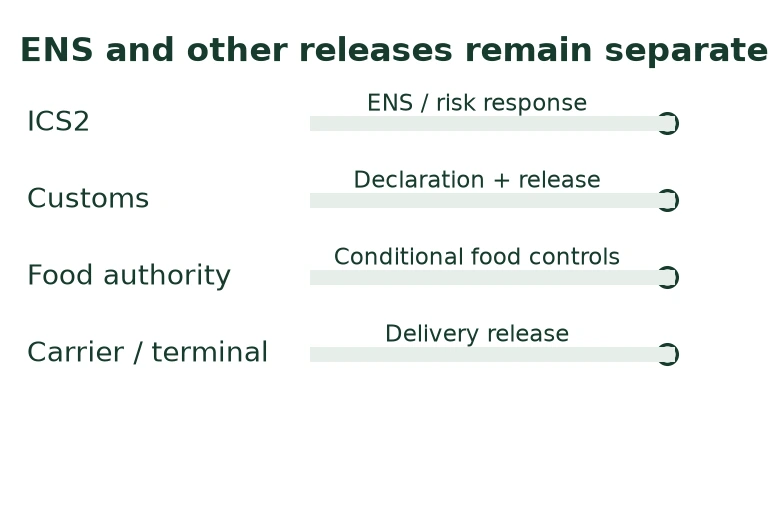
A security reference does not complete a customs declaration or a triggered CHED-D.
The EU frozen-produce import guide covers the broader order route; this page isolates the advance security data task. If the buyer is importing into a specific Member State, its customs agent checks national entry and release steps. GreenLand can provide product and process information relevant to that check, with the actual production site and lot confirmed before any capability or certificate is claimed. The official filing parties own their ENS submissions and customs interaction.
An order review should finish with six questions. Which mode and first EU entry are confirmed? Which party files each master, house and buyer/seller component under the contract? What accepted partial references and complete linked ENS do we have? Are referrals resolved? Who will lodge sea/air arrival notification and present the goods? Do accepted descriptions and bill numbers still match the frozen goods? The receipt ladder is complete ENS and linked parts, referral disposition, arrival notification and presentation, then import declaration and any food-control outcome. Assign an owner and deadline to any missing answer.
Tell us the frozen product, form, use, pack, volume, EU destination, route and origin-side documents your importer needs. We can coordinate a proposed China supplier file and timely corrections with your carrier and customs team. They validate the current ENS filing model, legal deadlines and EORI identities. A buyer gets the most value when the parties agree these inputs before the booking closes, and when each acceptance or exception can be traced back to the shipment that physically sails.
- Determine first entry, mode and the complete or multiple-filing arrangement.
- Carrier and house filers agree parties, goods, references and the legal and commercial cut-offs.
- GreenLand provides the product/source file; filers transmit and resolve rejection or risk messages.
- Track ENS results separately from customs and any food-control decision before delivery.
Use the existing order worksheets
Use T10 to assign each field or document to its provider, reviewer, due time and returned reference. T12 records changed source, product or transport facts; T11 preserves arrival evidence. Keep the legal deadline separate from the agreed earlier handover.
Build your frozen food order with GreenLand-food
GreenLand-food is a professional frozen food supplier and manufacturer in China, providing factory-direct wholesale supply for importers, food manufacturers and foodservice programmes.
Send your product form, specification, packing, quantity, application, destination, private-label needs and requested documents. We will organise the product and order requirements with your purchasing and quality teams.