


FDA Prior Notice for Frozen Food Samples and Commercial Shipments
Oct 20, 2026
Leave a message


Prepare a food-article record for the filer: exact product and FDA identity, manufacturer/source, quantity and packing, transport, recipient and arrival facts. Obtain and reconcile the FDA confirmation before the applicable transport or mailing deadline.
Reviewed 20 October 2026. Shipment requirements are checked for the actual product, route and filing date.
Test whether a sample or commercial lot needs Prior Notice
Begin with what crosses the border and why. FDA's rule covers food for humans and animals offered for US import, including goods for use, storage or distribution, and explicitly includes gifts and trade, quality-assurance, quality-control and market-research samples in its industry guidance. The size of a frozen-strawberry sample does not create a blanket exemption. Nor does an invoice with a nominal customs value decide the FDA question. The importer should determine the legal treatment of the actual movement, including a documented exemption where one truly applies, before a parcel is tendered.
The intended use matters to the product file but is not a universal escape from notification. FDA distinguishes a testing sample no longer in food form, such as its lettuce slurry or sterile juice sample, from an article of food submitted for analysis, such as a lettuce head or canned juice; the latter needs Prior Notice. FDA's narrow enforcement discretion for a food sample imported without notice concerns quantities consistent with quality assurance, research or analysis that are entirely consumed in testing or destroyed afterward. It is an enforcement policy, not a trade-sample exemption or a default for a buyer's sensory trial. Before dispatch, the US recipient and filer record the reviewer, purpose, amount, use and destruction evidence for any proposed policy position. FDA's current Q&A, C.17 and CPG 110.310 give the limits.
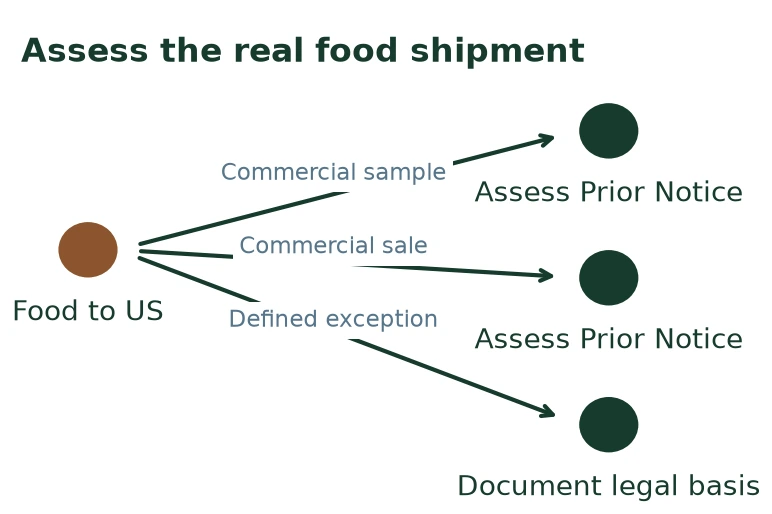
No charge for a sample does not by itself create a Prior Notice exemption.
List each distinct article of food. FDA requires a separate Prior Notice when the complete FDA product code, package size or manufacturer/grower differs; brand names alone do not create a separate article. Thus the same IQF fruit in 10 kg bulk cartons and a different retail package size needs a split even if one reefer and invoice cover both. Green beans and strawberries plainly require separate identities and codes. State the commodity, form, processing, ingredients if any, package size, quantity and intended use. The US filer assigns or verifies the complete FDA product code and legal entry fields; GreenLand provides facts from the actual specification and lot. Keep the sample-to-lot bridge. FDA's current Q&A, D.7.
There are exclusions and special cases in the regulation, and FDA has described enforcement discretion for some noncommercial movements. These must be evaluated against the real shipper, recipient, purpose and food. An individual sending homemade food to another individual for personal use is a different fact pattern from a manufacturer sending samples to a prospective importer. FDA's current Prior Notice Q&A provides scenarios; the importer should keep the conclusion and source used for its own shipment. A courier's informal assurance that "samples are exempt" is not a sufficient record if the underlying facts were never supplied.
The first receipt is a documented coverage decision: notice required or a named exemption/policy position with rationale, reviewer and date. When required, assign a filer and a backup contact before dispatch. If a sales person books a courier pickup before anyone owns the notice, the parcel can reach a hub without its confirmation. We set an internal sample-release gate at origin: no handover to the carrier until the responsible US party or its appointed service confirms the path and gives the required references.
Give the filer an article-level identity and source record
Prior Notice requires information about the food, its manufacturer or grower as applicable, shipper, sender, importer, owner or consignee, location and transport details, with variations by movement and filing channel. Ask the filer for the current data checklist rather than reusing an old worksheet without review. FDA's guide explains the content and timing. The article identity should match the invoice and pack description closely enough that FDA and the carrier can identify the same goods.
For a frozen-strawberry sample, provide the actual product name and form, China origin, manufacturer or responsible processing facility, lot, net quantity, pack, intended recipient, shipment purpose and expected route. If the source is a separate grower or packing facility, do not fill a field with the exporter's address simply because it is on the invoice. A trading seller and manufacturer can be different. Check whether the actual facility is subject to FDA food-facility registration and give the importer the correct site information; the supplier should not advertise an unverified registration number in a public sample brief.
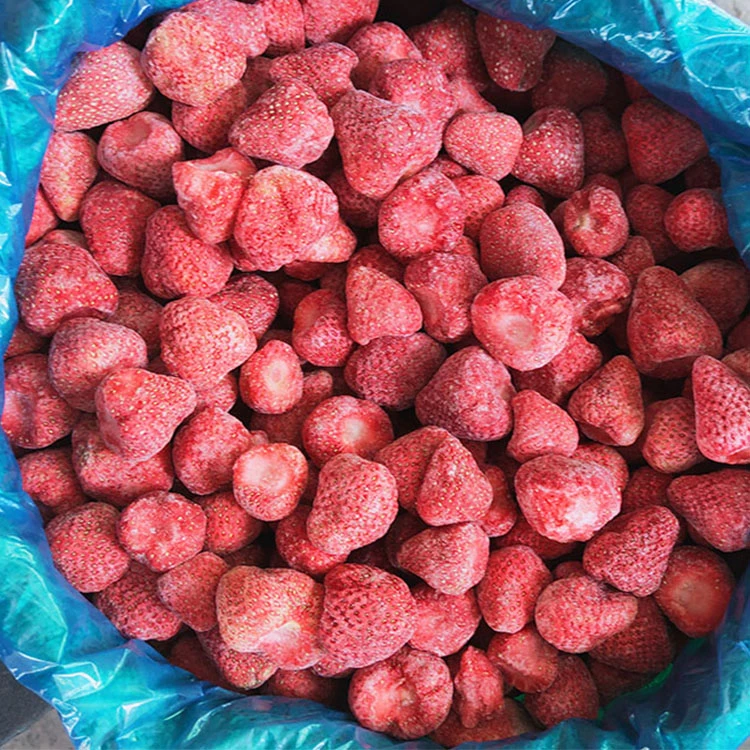
Whole frozen strawberries: identify the actual form, packing and intended use in the shipment file. Product photograph; not evidence of a filing result.
Whole frozen strawberries for your import programme
Tell us your destination, intended use, cut or grade, packing, quantity and preferred shipment window. We can coordinate the proposed source, sample specification and origin documents with your importer and appointed filing team. The actual lot, factory and required documents are agreed before dispatch.
View product and supply details
Request Specifications & QuoteTransport information must be current. Record carrier or postal operator, mode, airway bill or ocean bill where relevant, planned first US arrival, port, shipment/parcel identifier and any intermediate routing the filer needs. A courier tracking number may be generated only after pickup booking; the team should know who will relay it and whether it changes the notice. For an ocean reefer, the bill number and vessel plan connect to the customs and ISF file, but FDA Prior Notice is still its own submission and confirmation. A consignee's cold-store address is not automatically the legal owner or FSVP importer.
Ask whether a government refused entry or admission of the specific food article in this specific shipment for a food-safety reason, including a US refusal. FDA does not seek a commercial quota, tax, permit or documentary refusal in that field, or a refusal of food from a different shipment merely because it came from the same lot. Ask the buyer and supplier for the actual authority notice and reason before answering; retain the reviewer, date and source of a 'none known' response. FDA's current Q&A, D.9 draws this boundary.
A useful worksheet has columns for required field, exact value, source document, data owner, confirmed date and discrepancy. GreenLand can provide product composition, pack and source details from the proposed order. The US filer verifies code, entry parties and transport identity. If the buyer changes the destination or the carrier rolls the shipment, compare the filed data with the new booking before dispatch or arrival. This prevents the familiar failure in which a correct notice describes a parcel that no longer exists.
Do not turn a photo or marketing PDF into legal evidence. A photo of whole IQF strawberries can help the buyer check whether it requested whole rather than cut fruit, but only the controlled specification and actual batch record substantiate what was sent. A laboratory COA has its own test scope and cannot supply missing sender or carrier data. Keep each source in its intended role so the filer can trace a question back to the person able to answer it.
Set the filing channel and deadline for each transport mode
Prior Notice is electronic. A filer may use FDA's Prior Notice System Interface (PNSI) or the applicable CBP interface through ACE/ABI/ITDS, according to current agency and broker capability. For an ordinary commercial ocean shipment, the customs broker may coordinate the FDA data through its entry system; for a separate sample parcel, the sender or authorized service may use PNSI. Any person with knowledge of the required information may submit a notice, but the parties should nominate one filer and avoid parallel, conflicting submissions. The FDA's current Q&A explains the submitter and transmitter concepts.
The minimum lead-time clock runs to first US arrival for ordinary modes: at least two hours for land by road, four hours for rail, four hours for air and eight hours for water. FDA must receive and confirm the notice before the arrival within the regulatory timing. For international mail, submission occurs before the food is sent. FDA's timing table gives these values. An internal deadline should be earlier to cover rejection and correction; label the extra buffer as the importer or carrier's working rule, not as FDA law.
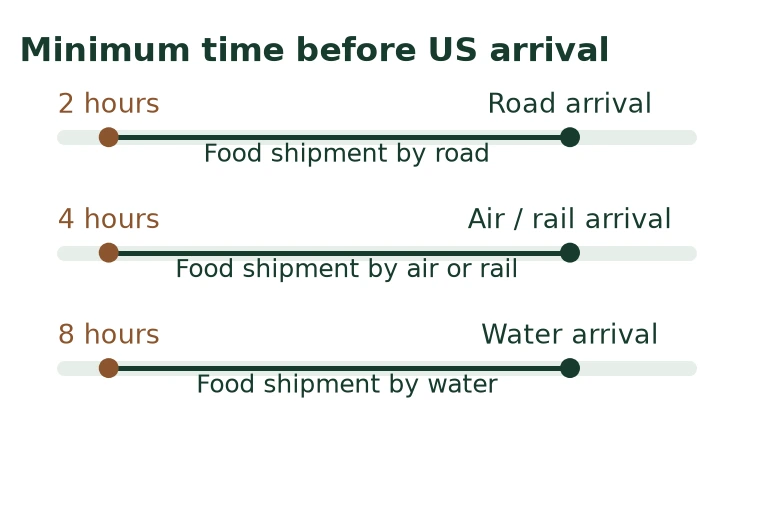
These are FDA minimum arrival intervals. Filing-window limits and international-mail rules also apply.
The upper filing window is also a current rule for non-mail arrivals: under 21 CFR 1.279(b), ABI/ACE/ITDS notice may be submitted no more than 30 calendar days before anticipated arrival, and FDA PNSI notice no more than 15 calendar days before anticipated arrival. The filer should still verify its live interface and avoid a premature seasonal filing based on a provisional lot or vessel. Use stable facts while leaving time to repair a rejection. These are channel limits, not a promise that an early confirmation immunizes later changes.
Work backward from the actual arrival. An air sample booked to arrive at 16:00 local US time needs its four-hour minimum measured against that arrival, with time-zone conversion and any connection delay considered. A deep-sea reefer requires water-mode Prior Notice at least eight hours before first US arrival, while its ISF has a distinct loading-based clock much earlier. A short sea or land transfer may change which regime applies to a movement; the importer and filer should use the actual transport chain and port. Do not apply the ocean ISF deadline to an air sample, or the FDA eight-hour water clock to the security filing.
The outcome the team needs is a FDA confirmation number or equivalent accepted electronic receipt tied to the food article and shipment. A "submitted" screen without confirmation is not the same. The filer should send the reference to the carrier, importer and GreenLand coordinator where needed, and retain its timestamp and article list. If the system rejects a field, correct it and obtain an acceptance before the mode deadline. FDA confirmation permits the shipment to proceed to further assessment; it is not an admission or release decision.
| Arrival mode | Minimum FDA Prior Notice timing | Working receipt |
|---|---|---|
| Road | At least 2 hours before first US port arrival | FDA confirmation and truck/entry match |
| Rail | At least 4 hours before arrival | FDA confirmation and rail movement match |
| Air | At least 4 hours before arrival | FDA confirmation and airway-bill match |
| Water | At least 8 hours before arrival | FDA confirmation and ocean-bill match |
| International mail | Before the food is sent | FDA confirmation number on the accompanying customs declaration |
Treat courier, freight and international mail separately
A courier shipment and a postal shipment may both be small parcels, but they can use different transportation channels. An express courier airway bill is not automatically "international mail" under the FDA mail provision. Identify the operator and service used, then select the right notice timing, data and confirmation placement. UPS, for example, explains how it may request a Prior Notice confirmation or submit on a sender's behalf for a qualifying parcel in its carrier guidance. That operational service does not change the underlying FDA requirement or make every parcel exempt.
For a courier sample, ask who will file: GreenLand's appointed sender, the US receiver, a specialist, or the courier. If the courier offers the service, confirm what information it needs, its cut-off, whether the sender gets the confirmation number, and how an error or hold is reported. The carton label, proforma invoice and filing should use the same product description and actual quantity. A nominal value for customs purposes should be truthful and separately determined; "no commercial value" does not establish that FDA notice is unnecessary.
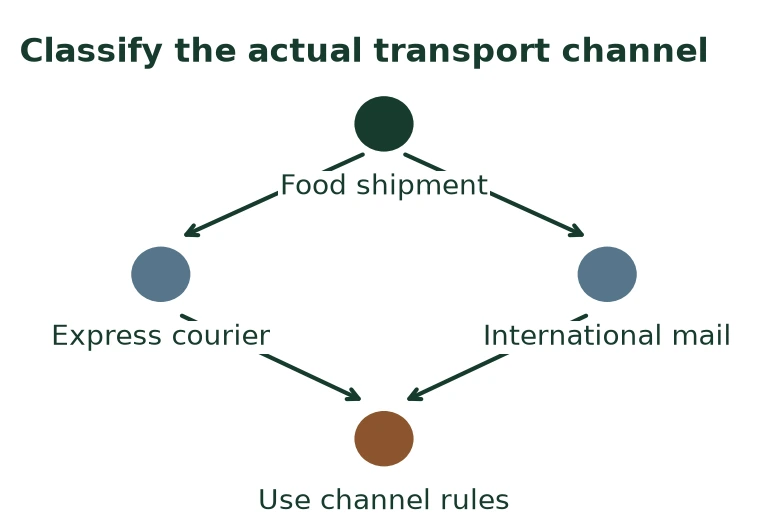
A courier air waybill does not make a parcel international mail; retain the actual service and entry route.
For actual international mail, 21 CFR 1.279(c), (e) requires confirmed notice before the food is sent and the PN Confirmation Number on the customs declaration, such as CN22 or CN23, accompanying the package. A loose number on a parcel label is not the specified placement. Mailing before confirmation cannot be fixed afterward. Ask the postal operator whether it can maintain the agreed frozen condition; a valid filing does not establish suitable cold transport. If it cannot, select a different service and recheck whether the movement is true international mail or an express courier.
Commercial reefer freight involves a broker, ocean carrier and possibly a forwarder or NVOCC. The importer should reconcile Prior Notice article entries with the invoice, packing list, manufacturer, bill and expected arrival. When a container holds both green beans and strawberries, do not let one generic notification obscure the two foods. A single customs entry may include multiple lines, and each FDA-regulated article needs the applicable identification. Ask the broker to return its line-level acknowledgment so the buyer can spot a missing strawberry line before the vessel arrives.
When a parcel is delayed, repacked or redirected, the filer compares each changed required field with 21 CFR 1.282. A rolled vessel or revised anticipated arrival ordinarily falls within the non-mail arrival-information exception; a changed manufacturer does not and requires a new notice if import is still intended. A new food article requires its own notice in a new entry or PNSI envelope, with its own modal clock. Keep the old and new values, confirmation numbers and carrier handover. An ocean ISF correction rule does not determine the FDA decision.
Apply the 2026 mail rule and FDA's 2027 enforcement position
FDA's current Prior Notice page reports a specific new rule for food arriving by international mail. Under 21 CFR 1.281(b)(10), beginning 1 October 2026, submissions are required to include the name of the international mail service and the mail tracking number. The same final rule allows international-mail Prior Notice through PNSI or the CBP ABI/ACE/ITDS route. The source is explicit about the date and the two fields; an older checklist may omit them.
FDA also states that because additional system implementation time may be needed, it does not expect industry to submit the mail service name and tracking number until 1 May 2027. This is the agency's current enforcement expectation, not a statement that the October 2026 rule was repealed. At this guide's review date, 20 October 2026, a filer should read FDA's current notice, consult the live interface and retain the version used. Where the fields are available and the information can be supplied, prepare them. Where the system does not yet accept them, document the FDA position and the submission outcome instead of inventing a blank-field workaround.
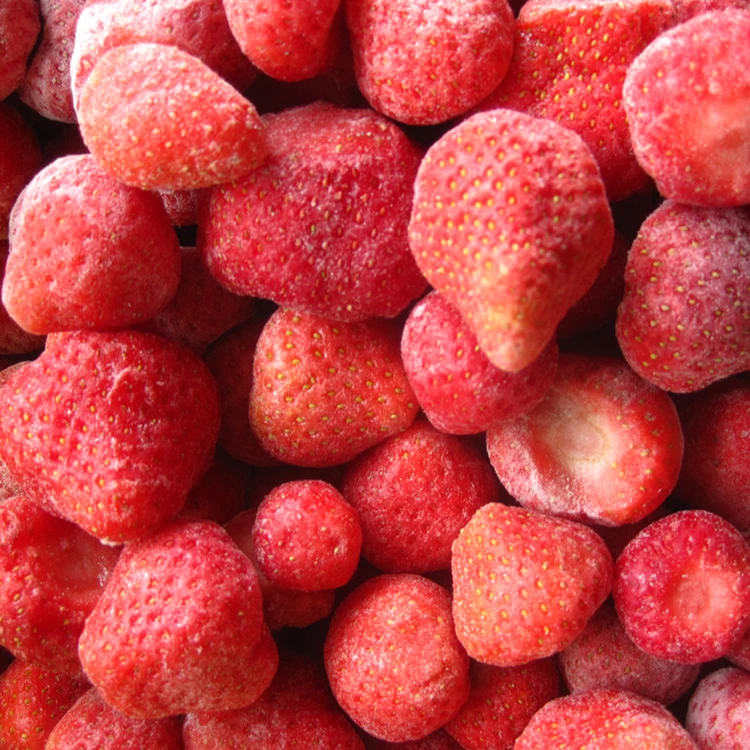
Whole frozen strawberries: identify the actual form, packing and intended use in the shipment file. Product photograph; not evidence of a filing result.
This change concerns international mail. Do not apply its two new fields to every express courier airway bill or ocean reefer as if they were one transport category. Conversely, the existing Prior Notice obligation for applicable food remains during the transition. A sample parcel shipped through true postal mail still needs a submitted and confirmed notice before it is mailed, even if FDA currently does not expect the two new fields until the later date. Confusing the postponed expectation with a postponed notice requirement would expose the parcel to avoidable refusal or delay.
Operationally, the shipper should capture the service name and tracking number during postal booking, check that the item and temperature packaging are accepted, and give the filer time to submit before handover. The PN Confirmation Number goes on the customs declaration accompanying the mail package as required by 21 CFR 1.279(e). Store the postal acceptance receipt, tracking and Prior Notice confirmation together. If the postal operator changes the service or tracking identifier after booking, the filer evaluates whether the accepted notice needs correction under the current agency procedure. A sales team should not send a second parcel using the first parcel's reference.
FDA may update its implementation message. A procurement guide cannot freeze future enforcement policy, so the person actually filing in 2027 should recheck the agency page and system instructions on the submission date. The buyer can ask the filer to record the checked date in the shipment file. This is a narrow, practical control rather than a claim that every future notice will require the same fields or channel mechanics.
Reconcile confirmation, cartons and later changes
The confirmation number is an article-level shipment control. Match each accepted notice to the product, manufacturer or grower, package size, mode, parcel or bill and expected arrival. For international mail, place the PN Confirmation Number on the accompanying customs declaration. For a non-mail PNSI shipment, the PN Confirmation Number must accompany the food and be available to CBP or FDA on arrival; a copy also accompanies applicable food carried by an individual. Give the carrier and receiver the correct reference for their movement. One number detached from its article is insufficient when two foods travel together. 21 CFR 1.279(e)–(g).
Use a reconciliation table in the private order file: GreenLand product code and lot; commercial invoice line; packing-list carton range; FDA product code selected by the filer; notice reference; carrier tracking or bill; responsible importer; and current status. This table does not have to be copied into the public article. It makes a short-loaded carton, substituted lot or split courier consignment visible before dispatch. A change in net weight that leaves the notice inconsistent should be reviewed by the filer, not hidden as a warehouse adjustment.
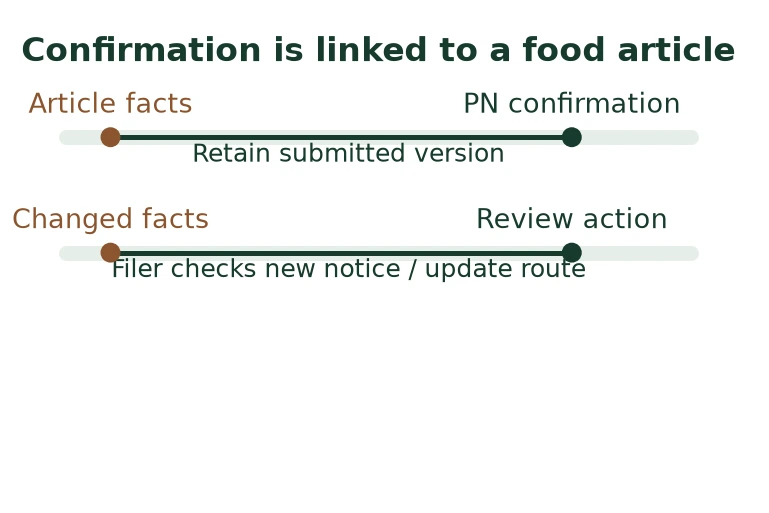
Match the confirmation to the actual food, source and shipment. A confirmation is not FDA release.
If FDA rejects a submission, save the error, repair the owning source field and obtain confirmation. After confirmation, 21 CFR 1.282 requires resubmission when required information changes, except non-mail estimated quantity, anticipated arrival or planned shipment information; the cited mail exception is the anticipated mailing date in §1.281(b)(10). A vessel roll with only a new ETA normally needs no new notice. A changed manufacturer requires a new notice if import remains intended. For PNSI, the transmitter should cancel the old notice in PNSI; for ABI/ACE/ITDS, the broker requests CBP cancellation of the entry, then submits the replacement as appropriate. A newly added strawberry article cannot be appended to a confirmed PNSI envelope or accepted ACE entry: file its separate notice in a new entry/envelope and start its own road, rail, air or water clock. Retain old/new numbers, timestamps and carrier handover. FDA's October 2023 final Q&A, D.10–11, is nonbinding guidance explaining these procedures; the regulation controls.
For international mail, the current rule separately refers to the anticipated-mailing information in §1.281(b)(10). If a postal operator replaces the service or tracking number after confirmation, send the old and new values to the responsible filer and FDA Prior Notice support before posting. Obtain the applicable system instruction and retain its outcome. Do not infer that the new 2026 tracking fields either require a fresh notice in every case or are automatically exempt from correction; the notice still has to identify the food that actually travels.
Prior Notice confirmation does not equal permission for delivery. FDA can examine, sample, hold or refuse an article on other grounds. CBP controls customs entry and release; the carrier or terminal separately releases freight under its own conditions. The buyer should retain the FDA Prior Notice reference alongside, but separate from, the customs entry number, ISF receipt for ocean cargo, FSVP records and carrier delivery order. This avoids a common misunderstanding when a forwarding dashboard shows one green status while a food hold remains open.
If a buyer requests an expedited trial, the correct response is to identify the earliest compliant departure with complete article facts, a suitable frozen transport service and an accountable filer. Rushing an inaccurate notice may cost more time than waiting for the next pickup. GreenLand can confirm which sample and lot are available and prepare the truthful description; the buyer and filer complete the US-facing identity and regulatory steps.
Run a sample-to-container GreenLand handover
The sampling stage starts with a written request: product form, use, recipient, target quantity, destination and whether the buyer wants laboratory testing, trial production or a sensory evaluation. For cut green beans, specify cut length and blanching direction; for strawberries, whole or cut fruit and how it will be used. We confirm the proposed source, pack, lot trace and frozen handling plan that we can actually support. Before pickup, the US recipient nominates the Prior Notice filer and states the required FDA article information. The courier or postal operator confirms the service and route. The file then receives the accepted notice and shipment label.
After the buyer accepts the sample, the commercial order may use a different production lot, pack size, manufacturer, consignee, route and transport mode. Do not reuse the sample's Prior Notice. Build a new order packet with current goods, lot, invoice, packing list, reefer booking, source-site data, first US arrival and line-level FDA information. The commercial buyer identifies its customs IOR and FSVP importer; the broker handles entry and applicable ocean ISF. This sequence is developed further in the US frozen-produce import guide.
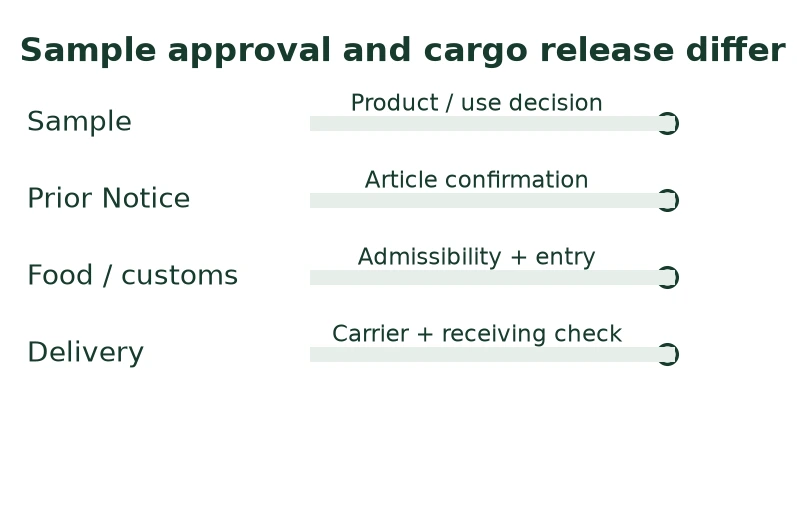
The move from sample to commercial quantity reopens the shipment identity and filing review.
Hold two reviews. Before origin dispatch, compare the packed goods with the notice input and ensure the required accepted confirmation exists. Before US arrival, compare the notice to the final transport and entry data, checking any vessel roll, split bill, changed cold store or replaced lot. The buyer should know whom to call for each error: GreenLand for origin product or packing facts, the carrier for route and tracking, the broker or filer for electronic correction, and the FDA contact for an agency decision. A shared order number makes those conversations traceable without conflating their responsibilities.
Keep the final record set: approved product specification, sample or commercial purpose, invoice, packing list, manufacturer/facility information, temperature and seal evidence where relevant, transport document, Prior Notice submission and confirmation, any correction history and the separate US entry and FDA disposition. If a product is detained or refused, preserve the official notice and follow the importer's response plan rather than rewriting the source records to make the initial filing appear flawless. A transparent record helps determine whether the problem arose in product quality, identity, filing or transport.
For a new frozen-food enquiry, send us the proposed product, form, pack, quantity, application, destination and requested sample or commercial schedule. We can coordinate a proposed GreenLand supply and document handover with your nominated US importer and filer. They confirm the current FDA fields, submit the notice and manage the border decision. The practical goal is that the food described on the accepted notice is the food that actually travels, with the right reference available before the relevant transport event.
- Define each food article, purpose and actual transport channel, and assess any claimed exception.
- Send the current product, source, packing, transport and recipient facts to the named filer.
- Filer uses the applicable FDA channel and timing, returns the confirmation and checks later changes.
- Carrier/importer carries the required reference with the goods; food and customs release remain separate.
Use the existing order worksheets
Use T10 to assign each field or document to its provider, reviewer, due time and returned reference. T12 records changed source, product or transport facts; T11 preserves arrival evidence. Keep the legal deadline separate from the agreed earlier handover.
Build your frozen food order with GreenLand-food
GreenLand-food is a professional frozen food supplier and manufacturer in China, providing factory-direct wholesale supply for importers, food manufacturers and foodservice programmes.
Send your product form, specification, packing, quantity, application, destination, private-label needs and requested documents. We will organise the product and order requirements with your purchasing and quality teams.