


Frozen Produce Supplier Questionnaires: Answers, Evidence and Approval Scope
Oct 21, 2026
Leave a message


Reviewed 21 October 2026. Shipment requirements are checked for the actual product, route and filing date.
Identify the legal supplier and every processing site
Start with the entity that will contract, invoice and answer the questionnaire. Record its legal name, address, role, contact and relation to the manufacturer. A trading company, packing plant, freezing plant and cold store may be separate organizations. If a form asks "Do you manufacture the product?", a supplier should not answer yes merely because it coordinates manufacturing. State whether the response describes owned production, an approved subcontractor or a nominated third-party facility. Then name the site that actually receives raw produce, washes and cuts it, freezes it, packs it, stores it and loads it, as applicable.
Draw the actual route for the proposed SKU. Raw material can be procured from several farms or aggregators, processed at one site, packed at another and stored at a third. The buyer needs to know which handovers occur and which party controls each one. A certificate for a freezing plant does not automatically cover a separate repacker or cold store. Likewise, a corporate questionnaire might describe a central policy while the site operating records show how that policy is performed locally. Capture the differences before scoring answers.

Genuine GreenLand product photograph showing the form only; it is not supplier-approval, production or order evidence.
Scope the actual product and order
Share the product form, pack, destination and required evidence. We can align the specification, quality and supply plan with the buyer decision.
Review a genuine product example
Request Specifications & QuoteUse a site list with role and scope, not a collection of undifferentiated addresses. For each location, record the activities, products, outsourced steps, applicable approval or certification status, and whether it is part of the quoted supply route. Ask which site can change during capacity pressure and how the buyer will be notified. If production may be split, assess both routes; an approval for Plant A should not silently travel with cartons from Plant B. A later site substitution can affect label, origin, traceability, test plan and audit rights even when the product name remains the same.
The FDA supplier evaluation resources describe risk-based supplier verification in the context of applicable US food rules. They do not provide a universal certificate that approves every frozen-food supplier for every market. A buyer should translate its legal and customer duties into the questionnaire's approval scope. For other destinations, the relevant import rules and customer specification may differ. Avoid copying a US answer into an unrelated export program without checking its purpose.
Capture the proposed product form early. IQF broccoli florets, chopped broccoli and mixed vegetables can use different raw materials, cuts, allergen exposure paths and process settings. A broad "frozen vegetables" category may be too coarse for a risk question. Name the SKU, ingredient composition, pack size, intended use, destination and claimed shelf life in the approval file. If any of those fields is undecided, mark the answer provisional rather than presenting it as a closed approval.
Answer each question within a defined product and activity
Rewrite a vague question as a testable claim. "Do you have traceability?" becomes "For the proposed IQF vegetable SKU produced at the named plant and packed in the stated format, can the site link the incoming raw lot, processing run, finished carton code and shipment within its approved retrieval target?" "Are allergens controlled?" becomes a question about actual shared lines, ingredients, cleaning verification and label review for this product. The questionnaire may still require a yes/no box, but the supporting explanation should define the conditions under which that answer is true.
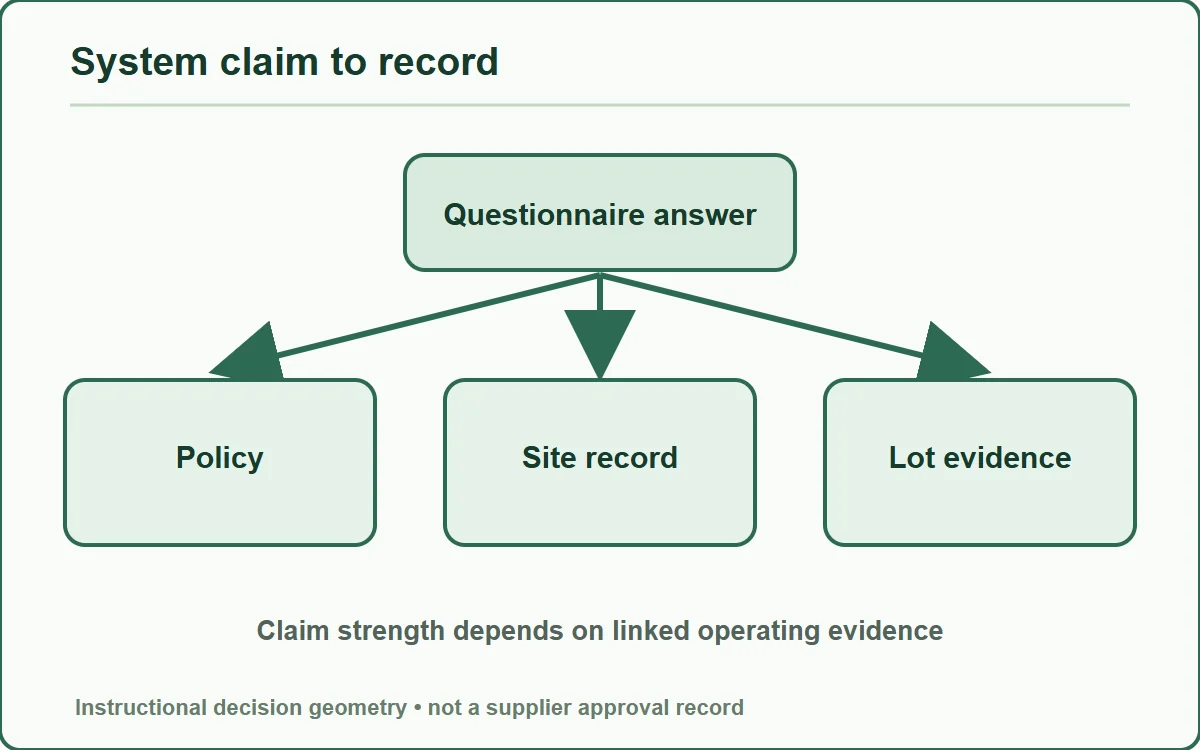
For each row, record four fields: the answer, its exact scope, the evidence reference and the owner who can explain it. A policy document is useful for intent; an operating record shows implementation. A completed training matrix may support competence; a line clearance record supports a particular changeover. Neither alone answers every question. When a buyer requests evidence, provide the smallest meaningful package that demonstrates the claim without sharing unrelated customer or confidential data. Redacted records can be acceptable when the remaining fields still prove date, site, activity, outcome and responsible sign-off.

Article-specific instructional diagram; no actual order or supplier approval is depicted. Swipe horizontally on a narrow screen to read the full illustration.
Different supply-chain activities call for different evidence. Raw-material approval can involve specifications, producer records and risk assessment. Processing controls may involve monitored CCPs or operational prerequisites under the site's food-safety plan. Freezing controls can involve process parameters, product temperature and lot release. Packing controls can involve printed-artwork approval, code verification, metal-detection or other foreign-material checks, and reconciliation of finished cases. Cold storage and transport require their own condition and custody records. A "yes" in the supplier column cannot collapse these activities into one unqualified statement.
The FSA prerequisite guidance explains why basic controls such as supplier management, cleaning and traceability support a functioning food-safety system. It is not a current clause-by-clause certificate for the proposed factory. Ask for a record that belongs to the named site and product flow. If the evidence is an old blank template, mark the control as described but not yet demonstrated for the supply route. If an actual record is unavailable for privacy reasons, agree an alternate verification method rather than calling the question passed.
The answer should also state exclusions. A line may be approved for single-ingredient vegetables but not for a sauce-containing blend. A lab method may cover selected pesticides but not every analyte in the importing market's risk plan. A packaging statement may apply only to one film structure. Explicit exclusions are helpful because they stop an approval being applied beyond its evidence. When the product or destination changes, the buyer can see which rows need reopening.
Read certificate scope and verification evidence
A valid certificate is evidence of an assessed system within a printed scope; it is not proof that a particular lot passed every specification. Read the issuing body, scheme and edition, legal entity, site address, certified activities, product category, exclusions, issue and expiry dates, and any annexes. Check the certificate's current status through the scheme or certification-body channel available to the parties. A screenshot of a logo is not the same as a scope record. A certificate from the right group but the wrong plant is a gap for the proposed route.
BRCGS Food Safety Issue 9 and the IFS Food standard describe audited food-safety schemes. Their existence should not be converted into a claim that the named supplier holds them. If a supplier provides a certificate, compare its exact certified products and processes with the SKU and sites in the questionnaire. Check whether a co-packer, external cold store or outsourced lab is inside or outside scope. A buyer may still approve a route with an outsourced step, but it needs a separate control and evidence decision for that step.

Article-specific instructional diagram; no actual order or supplier approval is depicted. Swipe horizontally on a narrow screen to read the full illustration.
Current status matters. A certificate can expire, be suspended, change scope or move to a new site address. Record the verification date and source, not merely the date the PDF was emailed. When scheme portals restrict data access, request authorized sharing or confirmation from the certification body. The IFS supplier information indicates the role of controlled certificate information; the actual route for verification depends on the scheme and access. Do not label an unverified copy "current" because its printed expiry date has not yet passed.
Separate certification evidence from lot evidence. A certificate may support confidence in the management system; an order-specific COA, test report, temperature record or release note addresses a particular product or shipment under its own scope. A COA should identify the lot, analytes, method, reporting limits, laboratory and date. A blank COA template does not prove a result. Conversely, one good test report does not replace a supplier-system evaluation. Keep the two evidence layers connected but not interchangeable.
If the questionnaire requests confidential information such as full audit reports or customer names, agree a proportionate method: controlled viewing, redacted summary, third-party verification or a targeted audit. The buyer still needs enough information to judge the critical question. A refusal without alternate evidence remains an open gap. A certificate with a broad heading cannot fill that gap if the missing fact concerns a specific outsourced process or customer-specific requirement.
Connect system answers to operating records
Choose a small set of recent, representative records that traces a product through the actual route. Begin with an incoming raw-lot identifier and specification, connect it to the processing date and line, then to freezing and packing runs, finished carton codes, storage movement and shipment tally. The purpose is not to publish a customer's production file. It is to test whether the stated system can retrieve a coherent genealogy at the level the buyer requires. A broken link between finished lot and raw intake is a substantive gap even if the site has a traceability policy.
Look at normal operation and exceptions. A temperature-monitoring procedure should have actual recorded checks and a response when a reading is outside its criterion. A metal-detection or other foreign-material control should show challenge checks, rejects and disposition under the site plan. A label-control answer should connect the approved artwork to line start, code checks, reconciliation and changeover. A supplier-change procedure should show who evaluates a new raw source and how affected specifications are updated. The record should demonstrate that the people who own the process use it, not merely that a document exists in a folder.
Article-specific instructional diagram; no actual order or supplier approval is depicted. Swipe horizontally on a narrow screen to read the full illustration.
Pick the evidence window thoughtfully. Records from one exemplary day may not show a seasonal raw-material switch, a night shift or a line changeover. Ask for a representative period or a targeted exception example, with privacy protection as needed. If there was a deviation, a good record should show detection, segregation, investigation, disposition and corrective action. An entirely spotless file can be legitimate, but it does not by itself demonstrate that the system can manage a problem. The buyer should not reward absence of reported issues without understanding the site's escalation practice.
Laboratory evidence needs the same scope discipline. A report may be from a qualified external lab and still test the wrong lot, wrong analytes or wrong product form. Check sample identity, date, chain of custody, method, reporting limits, result units and whether the result meets the order's specific criterion. Do not invent a universal acceptable pesticide or microbial number in a supplier questionnaire. The value and method must come from the destination law, buyer specification and risk decision. If a test is pending, mark the approval conditional or hold the order step that depends on it.
The genealogy can be tested with a mock withdrawal or trace exercise if the buyer's program requires it. Record the start point, units located, records used, time, gaps and corrective action. Do not equate a completed drill with proof that every future lot will be retrievable. It is evidence of system capability at a time. The ongoing approval file should include how often the buyer expects fresh evidence and which changes trigger a new evaluation.
Separate critical approval conditions from an overall score
A numerical score can help organize many questionnaire rows, but it should not average away a critical failure. A supplier might answer 95 of 100 questions satisfactorily and still lack an approved production site, a required market document, or a validated control for a hazard relevant to the SKU. Define critical conditions before reviewing the submission. Examples may include legal eligibility, traceability to lot, approved product specification, relevant hazard controls, certificate status where contractually required, and an agreed response to an open nonconformity. The exact list depends on the product and buyer.
Use three decision states: approved for the defined scope, conditional with named restrictions and evidence due, or not approved for that scope. "Conditional" should say what may proceed and what must wait. A buyer might permit sampling and packaging development while forbidding commercial production until a site audit closes. Another may allow production but hold shipment pending a lot test result, if its risk and contract permit. The record must identify the person with authority for that decision. An account manager's wish to meet a booking date cannot convert a quality hold into a release.

Article-specific instructional diagram; no actual order or supplier approval is depicted. Swipe horizontally on a narrow screen to read the full illustration.
Mark unanswered questions as unknown, not pass. If a critical row lacks evidence, score it separately and set an explicit gate. The FDA risk-based supplier resources reinforce that verification activities are selected in relation to risk and supplier performance in applicable contexts. They do not authorize a generic "high total score means approved" rule. A buyer should document why the chosen evidence is sufficient for the actual SKU, site and market.
Consider a hypothetical file: 47 routine answers are complete, two minor document references need correction, and one critical finished-lot trace link is missing. The combined completion percentage looks strong. The appropriate decision is still to hold the affected approval scope until the link is demonstrated or a documented alternate control is accepted. This is an illustrative decision pattern, not a statement about any GreenLand order or supplier. It shows why a gate-based review produces a different outcome from a simple average.
The approval letter or record should state the permitted products, sites, activities, destination markets, packaging formats, and expiry or review date. It should also list exceptions and buyer-owned conditions. Without that scope, a sales or procurement team can later extend a narrow approval to a new frozen product or subcontractor without realizing the evidence did not cover it.
Close gaps with owners, evidence and a dated decision
Create a gap log with the exact question, why the submitted evidence is insufficient, risk or approval effect, supplier owner, buyer reviewer, requested evidence, due date, and status. Avoid vague entries such as "need better QA documents." "The provided certificate names Plant A; the quoted IQF peas will be packed at Plant B; provide Plant B scope or approved outsourced-packing control" tells the supplier what to resolve. A dated request makes the path to approval observable and prevents the issue being lost in a long email chain.
When evidence arrives, verify that it closes the stated gap rather than simply adding a file. A new certificate might still omit the packing activity. A trace report might link finished lot to a shift but not raw source. A supplier statement could be valid but need a representative operating record. Mark the original gap closed only after the reviewer records what was checked, which version, and why it satisfies the requirement. Keep superseded submissions so a later reviewer can understand the sequence.

Article-specific instructional diagram; no actual order or supplier approval is depicted. Swipe horizontally on a narrow screen to read the full illustration.
Some gaps need corrective action rather than more paperwork. If a line record shows a missed code check, ask for the site's investigation, affected-lot disposition, root cause and effectiveness check under its system. If an outsourced cold store lacks a defined temperature escalation route, the parties may need a process change and service agreement. The buyer should distinguish a document omission from an operational control weakness. A PDF can close the former; the latter requires implemented action and evidence.
Set the decision date against the commercial plan, but do not let the plan invent evidence. Production, testing, printed packaging and vessel booking have lead times. A conditional approval may allow work on an independent path, such as artwork proofing, while the critical plant-scope question is open. Record which commitments are at risk and who will tell the customer if the date moves. An approval decision can be timely without being premature when the team identifies its critical path early.
After the decision, issue a concise scope statement and archive the reviewed evidence references. A supplier can then quote against known requirements, and the buyer can see what changes would reopen approval. The file should state whether it is a new approval, an extension, a temporary exception or a refusal, with a named decision owner and next review trigger. That is much more useful than a spreadsheet cell that says "approved" without context.
Maintain approval through changes and performance
Approval is not permanent. Define triggers that require notification and review: new production or packing site, changed legal entity, material raw-source change, new ingredient or allergen exposure, changed freezing or foreign-material control, altered label or package, certificate suspension or scope change, repeated complaints, recall, or a significant temperature or traceability failure. Some changes warrant a targeted document check; others may require new samples, an audit or a commercial hold. The original approval scope tells the team which kind of change matters.
Monitor the evidence that bears on the approved route. Track complaint patterns, lot rejection, COA trends where relevant, delivery and document accuracy, responsiveness to corrective actions, and the timeliness of change notifications. Do not reduce performance to one percentage if a severe issue needs immediate action. A high on-time delivery rate cannot offset an unresolved food-safety control. Conversely, a single minor paperwork correction need not erase a well-supported approval when the buyer's process permits a proportionate response.

Genuine GreenLand product photograph showing the form only; it is not supplier-approval, production or order evidence.
Reverify certificates and site information on a scheduled cycle, and check transaction-specific records for each order as required. The IFS Food standard and BRCGS issue description describe system assessments; they should be read in their current editions and exact scope. A renewed certificate may change an address or category. Record the current verification source and date. Never assume an old PDF remains valid merely because the supplier relationship is long-standing.
When a new SKU is proposed, reuse the stable evidence thoughtfully but reopen product-specific questions. A frozen corn line with a different allergen, pack or intended market may need additional checks even if the legal supplier is unchanged. An approval file should make extension efficient: identify what is already verified and what must be newly established. This avoids both blanket rework and unsupported automatic approval.
The result is a living, bounded supplier decision. Every affirmative answer has a subject, an activity, evidence and a reviewer. Every gap has an owner and date. Every approval says what it covers. That discipline lets procurement move quickly while preserving the buyer's ability to explain why this product from this route was accepted.
Build your frozen food order with GreenLand-food
GreenLand-food is a professional frozen food supplier and manufacturer in China, providing factory-direct wholesale supply for importers, food manufacturers and foodservice programmes.
Send your product form, specification, packing, quantity, application, destination, private-label needs and requested documents. We will organise the product and order requirements with your purchasing and quality teams.