


Hold and Release for Frozen Produce: Pending and Adverse Test Results
Oct 21, 2026
Leave a message
Reviewed 21 October 2026. Shipment requirements are checked for the actual product, route and filing date.
GreenLand can coordinate the product identity, factory records, laboratory communication and shipment information needed by the responsible quality and importing teams. The technical decision belongs to the designated competent person, and official restrictions remain subject to the relevant authority. We agree those responsibilities before testing so that a sales email does not become an accidental release instruction.
Give each lot a physical and electronic status
Define a lot at the level supported by production and traceability records. A purchase order may contain several raw-material lots, processing runs or packing dates. Conversely, one production lot may be split among several customer orders. Record those relationships before assigning a HOLD label. A container number identifies a shipment unit; it does not automatically define a manufacturing lot or the scope of an analytical sample.
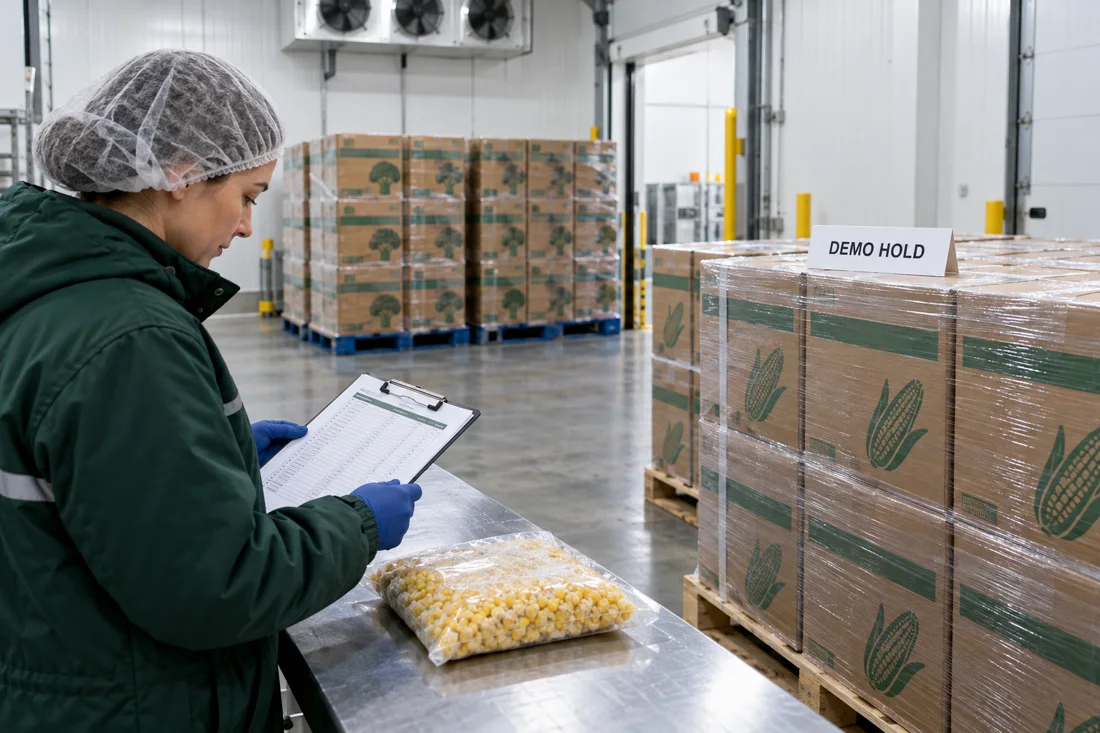
The physical restriction should be recognisable to warehouse staff and reflected in the system used to allocate and dispatch stock. Identify the storage position, product, lot, quantity, pack and reason code. The record should show who created the hold and when. Avoid a description such as "broccoli problem" that could apply to several pallets. If a system cannot block allocation electronically, document the compensating physical and supervisory controls.

Original GreenLand product photograph: Corresponding GreenLand mixed-vegetable product photo; formula must be verified by weight.. Product-form reference; not evidence from the DEMO order, sampling event or shipment.
Agree a small set of status terms and explain them. Pending testing, pending review, held for investigation, authorised for a specified use, rejected and disposed can be useful distinctions. They are operational states, not laboratory result categories. A product may have a negative result while remaining pending review because a sample identity is unresolved. Another may be authorised only for an approved processing route under the actual legal and contractual conditions.
Access to changing a stock status needs its own control. Commercial staff can communicate dates and request decisions; the designated release authority approves the disposition. Record the approval reference and retain the earlier state. If a hold is expanded from one pallet to several production runs, preserve both the original scope and the expanded scope with the reason. Quietly replacing yesterday's spreadsheet removes information the later investigation may need.
Plan for split ownership. A factory, separate cold store, consolidation warehouse and carrier may each hold part of the quantity. Their local labels or system codes may differ. The coordination record should identify the responsible contact and acknowledgement for each location. Sending a hold request is an action; receiving confirmation that stock is blocked is a separate event. Use that distinction in the customer update.
The initial hold notice should be concise enough to execute quickly: product and lot, locations, quantities, restriction, owner, time and next review. Attach the relevant report or incident reference through the controlled file. It should give warehouse and shipping teams a specific instruction while leaving the technical conclusion to the review. A crowded email containing speculation can delay the simple action of preventing an unintended dispatch.
Separate pending, presumptive, confirmed and invalid results
Read the original report wording before interpreting a result. A method may produce a presumptive finding that requires confirmation. Another may issue a final result under its validated procedure. The report can also be invalid, qualified, outside the requested scope or unable to support a conformity statement. Preserve those terms in the lot file and ask the laboratory what the method permits the responsible reviewer to conclude.
Pending results require the release rule agreed for the order. Identify which tests must be completed before dispatch and which documents support other stages. A customer can request pre-shipment pesticide results, for example, while separate hygiene checks belong to the factory programme. The hold should state precisely which missing evidence prevents the next action. "All tests outstanding" is unhelpful if the actual unresolved item is one matrix-specific single-residue analysis.
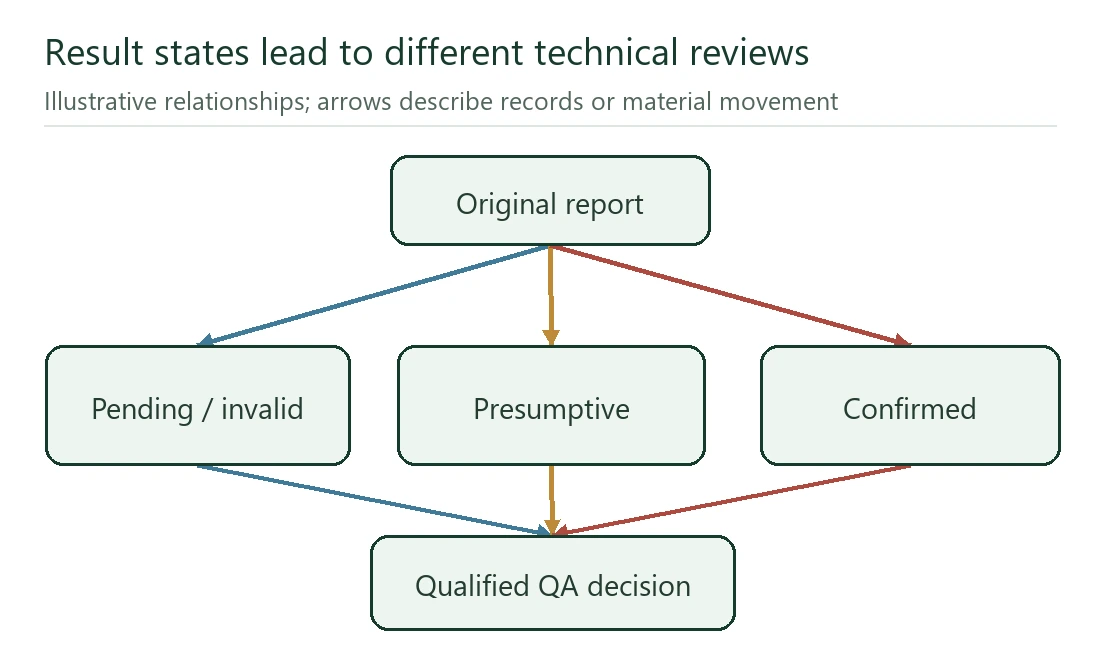
Frozen produce result state review. Illustrative method and DEMO data where shown. Swipe horizontally on a narrow screen to read the full illustration.
A presumptive microbiological finding needs prompt attention under the applicable method and food-safety plan. Record the notification time, confirmation pathway and immediate product controls. The laboratory's fastest instrument stage is not necessarily the complete reporting timeline. Request the remaining steps and expected update time. Procurement can then plan the order without describing an unfinished analysis as a confirmed result or a complete pass.
For chemistry, retain comparison signs, units, reporting basis and the exact acceptance limit. A reported value below a quantification limit is not a measured zero. A borderline number may need the laboratory's reporting precision, uncertainty information and applicable decision rule. These questions should be settled by the qualified reviewer and relevant requirement, rather than by rounding a spreadsheet cell until it appears to meet the contract.
An invalid or unsuitable sample does not resolve the product's status. Find out whether the problem arose from collection, custody, transport, sample quantity, matrix interference or a method limitation. The corrected plan should address that cause. Resubmitting an identical sample under the same unsuitable conditions wastes time and can create another report with the same limitation. The inventory restriction remains linked to the unresolved release question.
The US corrective-action rule in 21 CFR 117.150 provides one jurisdictional example of written corrective procedures and evaluation of affected food. Its applicability must be established for the operation. An international buyer can still use the management questions-what happened, which food is affected and who approves disposition-without presenting the US rule as a universal clearance standard.
Trace the potentially affected production window
Begin with the event that prompted the hold and identify the relevant boundary. A wrong date-code recipe may start at a coder intervention. A detection-device verification failure may require review back to the last satisfactory check under the site's procedure. A raw-material issue can connect several finished lots through shared input. A microbiological investigation may require a broader assessment of line use, time and possible transfer routes.
Build a timeline from records that were made during the operation. Include raw-material receipt and issue, production start and stop, line or equipment identifiers, cleaning, maintenance, packing changes, rework and sampling. Keep timestamps in a consistent time zone or show the conversion. An order packed across midnight can carry more than one date code while sharing equipment or ingredients. A single calendar date is therefore a weak substitute for the actual run history.
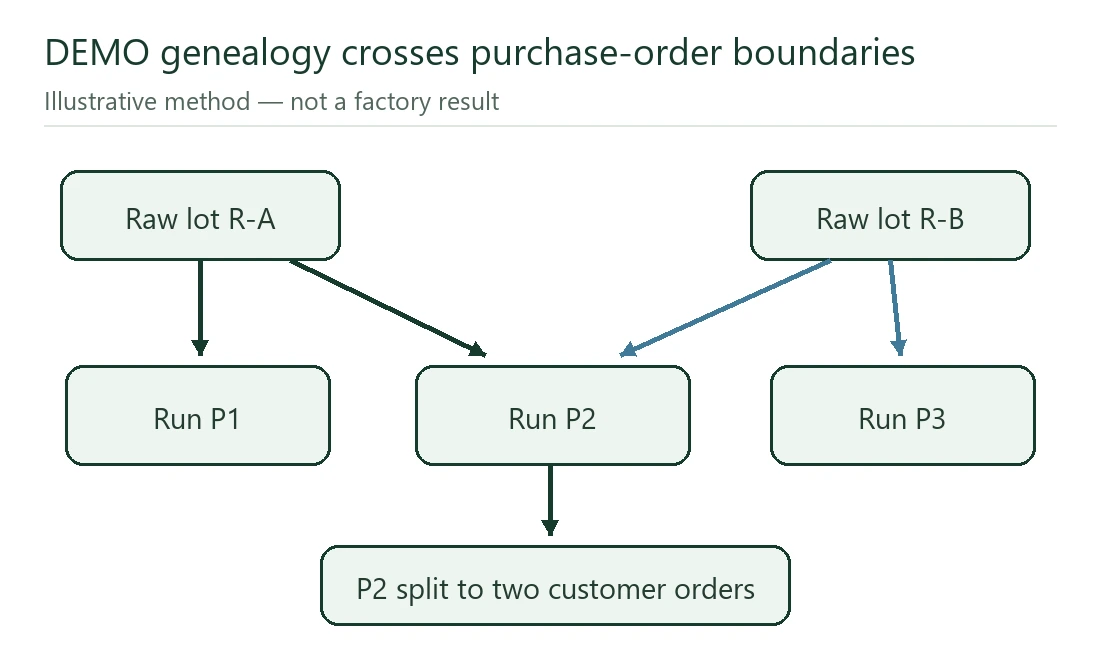
Frozen produce production genealogy. Illustrative method and DEMO data where shown. Swipe horizontally on a narrow screen to read the full illustration.
Link the timeline to stock genealogy. Show how a raw lot entered processing, whether material was mixed, which packing lots were created and where those packs went. Include retained samples, laboratory samples, trial output, rework and rejected material where they affect reconciliation. A shipment list containing only customer sales omits quantities that can help establish the affected boundary.
Document the evidence for excluding a lot as carefully as the evidence for including it. A different product name does not establish a clean boundary if both products used the same potentially affected route. A different packing date may or may not matter. The reviewer should identify the relevant physical or process separation and its supporting record. This makes a narrower decision defensible instead of merely convenient.
Keep the investigation scope provisional until the responsible team has enough evidence to confirm it. Start with the immediate controls needed for known stock, then widen or refine the scope as justified. Each revision should identify what changed and why. A provisional hold can be broader than the final affected quantity, provided the record preserves the review. Precision improves as evidence arrives; it should not be invented in the first notification.
For a DEMO incident, raw lot R-A enters runs P1 and P2, while R-B enters P2 and P3. Packing run P2 is split between two customer orders. An issue traced to R-A cannot be evaluated by looking at only one customer's purchase order. The investigator needs the input allocation and any mixing or carry-over assessment. These invented relationships demonstrate a traceability task and do not establish a real contamination event.
Use further testing to answer a defined question
State the purpose of additional testing before collecting another sample. Reanalysis of the original test portion, analysis of a retained split and a new sample from stock address different questions. They may investigate analytical performance, sample heterogeneity or the present condition of a defined lot. Record which question is being asked, the method, sample origin and the decision that the additional result can support.
Preserve the original result and any laboratory amendment. A later report should identify whether it supplements or formally supersedes an earlier report under the laboratory's procedure. The supplier's summary should retain that relationship. A forwarded PDF with a different number is insufficient when the customer cannot establish whether the original finding was invalidated, confirmed or simply followed by another sample result.
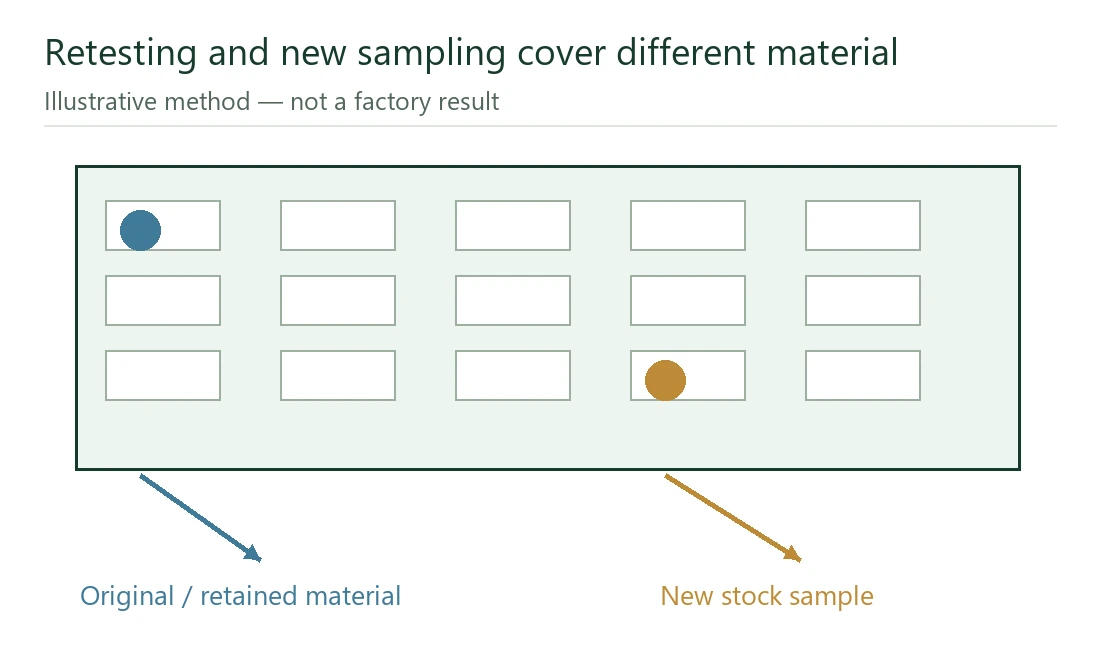
Frozen produce sample material scopes. Illustrative method and DEMO data where shown. Swipe horizontally on a narrow screen to read the full illustration.
For microbiological findings, a negative result from additional units does not automatically erase a valid positive. Distribution within a lot and the sampling plan matter. The applicable authority, method and food-safety programme determine the appropriate response. Additional work should support investigation and disposition within that framework. It should not become a search for a favourable report to replace an inconvenient result.
Environmental follow-up also has a defined scope. Sampling a cleaned piece of equipment can assess the corrective work at that site. It does not directly describe the condition of previously manufactured cartons. Product history, intended use and transfer assessment remain relevant. Keep evidence for cleaning effectiveness, line restart and earlier product disposition in connected but distinct records.
The Canadian Listeria control guidance and Health Canada's RTE policy show conditional follow-up approaches for specific finding types. Their numerical sequences belong to their Canadian RTE context. The order reviewer should identify the actual applicable rule instead of adopting a familiar example for every frozen product.
Agree who pays for extra analysis, who selects the laboratory and who receives original reports before an argument develops. Commercial responsibility for cost is separate from technical authority to decide product status. A contract can establish the process for a disagreement, while the applicable food-safety obligations still govern the product. Record any independent assessment and preserve the laboratory's full sample and method qualifications.
Reconcile quantities before authorising disposition
Create a quantity ledger using one clear unit and basis. Net product kilograms, gross cartons and pallet counts are different measurements. If the hold begins in cartons, retain case configuration and net weight so the reviewer can convert quantities consistently. Record partial cartons, damaged packs and any authorised sampling withdrawals. Avoid rounding away small balances that later become unexplained inventory.
Consider a DEMO 1000 kg lot packed in100 cartons of10 kg net. The current ledger shows800 kg at the factory under hold,150 kg dispatched to an external receiver,10 kg allocated to retained samples and40 kg supported by an authorised disposal record. The arithmetic accounts for1000 kg, but the external150 kg still needs its receiver status confirmed. A balanced ledger therefore does not by itself establish that all affected food is controlled.
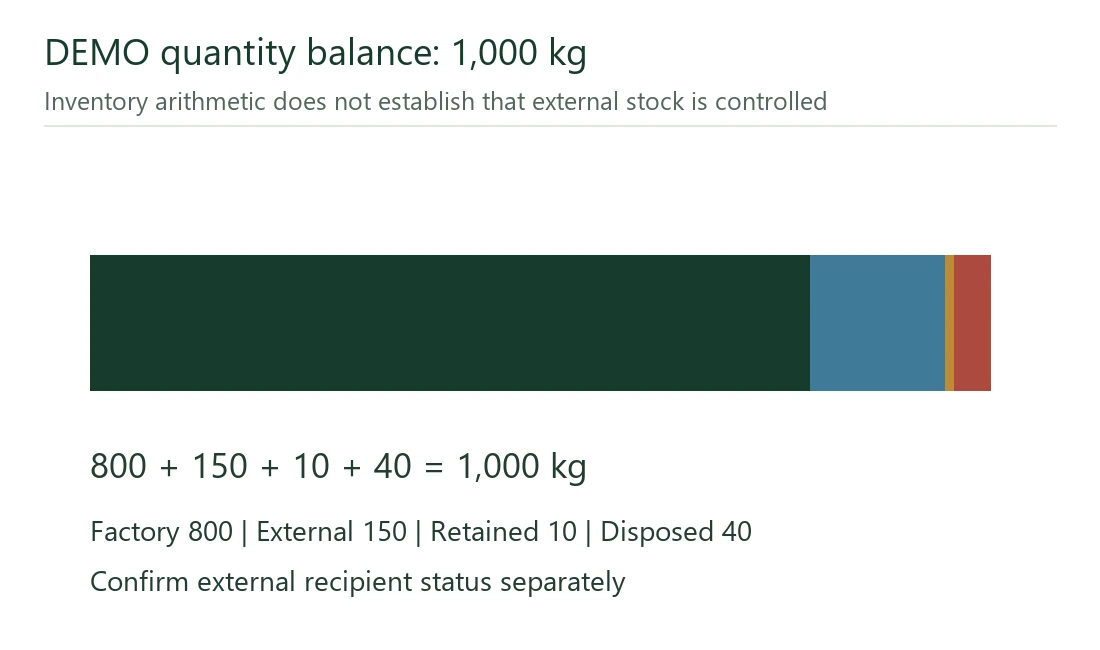
Frozen produce quantity reconciliation. Illustrative method and DEMO data where shown. Swipe horizontally on a narrow screen to read the full illustration.
The receiver record should identify the consignment, actual quantity received, remaining quantity, any onward distribution and the restriction applied. Record the confirmation time and contact role. If part of the stock has moved, trace the next location rather than marking the original receiver's whole quantity as safely blocked. The distribution assessment belongs with the responsible incident team and relevant legal obligations.
Authorised rework requires its own input and output records. State the permitted processing route, responsible site, quantities transferred, validation or approval reference where required and the identity of resulting product. Moving cartons into a rework area does not complete their disposition. The ledger should prevent the same kilograms being counted both as held original stock and as released reworked output.
Disposal and return likewise need completion evidence. An instruction to destroy is different from a record that the specified quantity was destroyed. A return booking is different from physical return and receipt. Retain the documents appropriate to the actual method and local requirements, with the lot, quantity, date and responsible party. Commercial credit paperwork should reconcile with the physical disposition without being treated as proof of it.
We can use the quantity ledger to coordinate factory, cold-store and shipment information for a customer investigation. The quality team then records which quantities are eligible for the proposed next step. If the balance is incomplete, the file should explain the gap and the action to resolve it. A shipment deadline or financial settlement should not quietly convert an unknown quantity into an accounted one.
Handle shipped or officially detained stock through the right owner
Once goods have shipped, identify their actual location and custody. A container can be at the origin terminal, in transit, at destination, under examination or inside a customer's cold store. Each position has a different practical owner for access, power supply, sampling and movement. Record the carrier, booking and container references alongside product lots so the incident team can connect a commercial shipment to the affected stock.
The importer or designated local party tracks authority instructions at destination. The supplier provides the requested origin, processing, sample and test records through the agreed channel. Keep the authority's case reference, written restrictions, authorised sampling or testing and actual decision. A supplier-generated release note cannot substitute for an authority's permission where an official hold remains in force.
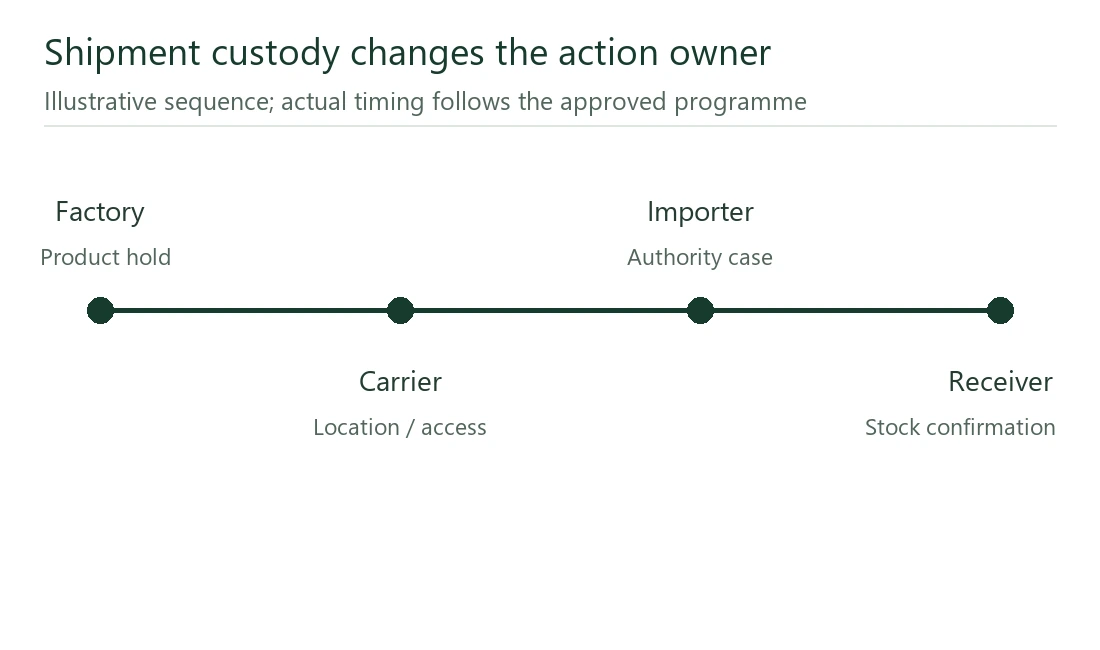
Frozen produce shipment custody. Illustrative method and DEMO data where shown. Swipe horizontally on a narrow screen to read the full illustration.
Temperature and packaging evidence can support an investigation without deciding laboratory conformity. Preserve logger data, reefer records where available, loading photographs, seal history, arrival observations and sample custody. An intact seal can help establish a handover history, while leaving the original product's microbiological or chemical status unresolved. A single temperature-display photograph also cannot reconstruct a full voyage.
Agree the customer communication cadence. The first notice should identify confirmed scope, immediate controls and the next update time. Subsequent notices add evidence and decisions with their references. Distinguish a laboratory's expected reporting date from an authority's expected review date. Both can change, and neither should be presented as a guaranteed clearance date.
If distributed food may require withdrawal or recall, the responsible businesses follow their incident arrangements and applicable notification obligations. The FSA incident guidance is a useful example of the distinction between product control within the chain and actions involving consumers. The actual destination rules and responsible parties govern the response to a particular shipment.
Close the hold with a signed release or disposal record
The closure record should identify the product, lot, quantity, evidence reviewed, decision, authorised use or destination, restrictions and approving person. Link the original report, subsequent analysis, investigation, quantity ledger and any authority instruction. Keep the approval date and time. A warehouse operator should be able to locate the decision reference without interpreting an entire email conversation.
Release can apply to a defined subset when the evidence supports that boundary. Identify the exact pallets, cartons or resulting product, and retain the restriction on the balance. If the decision changes after new information, preserve the earlier approval and record the revision. This is especially important where stock has been allocated to several orders with different destinations or contractual requirements.

Original GreenLand product photograph: Corresponding GreenLand mixed-vegetable product photo; formula must be verified by weight.. Product-form reference; not evidence from the DEMO order, sampling event or shipment.
Close corrective actions separately from the immediate stock decision when further work remains. A lot might have an authorised disposition while equipment redesign, staff training or supplier reapproval is still open. Give each action an owner, deadline and effectiveness check. A closed customer claim does not automatically close the underlying preventive action, particularly when the same cause could affect a later order.
A DEMO communication log can make the control sequence easy to test. At14:00 the quality coordinator receives a laboratory notification and records its exact status. At14:10 the warehouse blocks the identified factory stock. At14:25 a separate cold store acknowledges its instruction, while the external receiver's quantity remains unconfirmed. At15:00 the order update reports those three facts separately. These invented times demonstrate a record structure; they are not GreenLand response-time promises or a rule that every incident must follow that timetable.
The next update should resolve the external quantity or retain it as an open action with a named owner. If the receiver reports that part of the quantity moved onward, add the next location and preserve the first response. Do not replace "awaiting acknowledgement" with "held" merely because a message was delivered. The incident team needs the actual control status to determine its next steps. This distinction becomes particularly useful when offices, cold stores and importers operate in different time zones.
Test the release mechanism as well as the notification. A second authorised person can check that the decision reference identifies the correct lot and subset, that the warehouse system applies the approved status and that the next picking instruction uses the revised record. The check is about the actual transition, rather than another signature on the same PDF. If the wrong pallet remains available for picking, an excellent investigation report has not yet produced an effective inventory control.
Retain the original reports and transaction history according to the applicable record-retention requirements and the agreed customer programme. Make a corrected document distinguishable from the superseded version. When the file is shared externally, protect unrelated customer and commercial information while keeping the identifiers and qualifications required for interpretation. A redacted report and its unredacted controlled original should remain connected in the index. That arrangement supports review without turning confidentiality into a reason to remove essential evidence.
For a repeat shipment, review whether the incident changed the agreed sampling, laboratory, specification, processing route or release conditions. Version the relevant documents and communicate the revised plan before production. GreenLand can organise that order handover so the buyer sees which requirement changed, which records will be supplied and who will approve the next batch.
Give any temporary approval its actual boundary. A decision limited to one lot, one customer application or one further-processing route should not become standing permission for every later order. The next reviewer needs the accepted quantity, permitted use, relevant conditions and the point at which a fresh review is required. Keep those limits on the release record that the warehouse and sales team actually use.
The outcome is a product decision that another qualified reviewer can reconstruct. Inventory, reports and approvals point to the same lot and quantity. That gives the purchasing team a reliable status to plan around while preserving the technical and regulatory responsibilities attached to the food.
Build your frozen vegetables order with GreenLand-food
GreenLand-food is a professional frozen vegetables supplier and manufacturer in China, providing factory-direct wholesale supply for importers, food manufacturers and foodservice programmes.
Send your product form, specification, packing, quantity, application, destination, private-label needs and requested documents. We will organise the product and order requirements with your purchasing and quality teams.