



Frozen Sliced Green Beans
Description
Technical Parameters
IQF Frozen Cut Green Beans for Technical B2B Procurement
We supply IQF Frozen Cut Green Beans made from young, tender Phaseolus vulgaris L. pods for importers, frozen vegetable distributors, ready-meal plants, mixed-vegetable packers, central kitchens, foodservice programs and private-label brands. Our standard item is a round green bean cut transversely into controlled segments. It is not a yardlong bean, runner bean or lengthwise French-cut product.
The standard commercial specification is diameter 6-10 mm, transverse cut length 20-40 mm, at least 90% size conformity, 0% added glaze and negative peroxidase. Premium A+ programs raise dimensional conformity to at least 95% and tighten color, fibre, stem, blemish, breakage and clump limits. We connect the specification to sampling, batch COA, laboratory reports, packing records and farm-to-container traceability.
Product Identity: Cut, Not Sliced
Product: IQF Frozen Cut Green Beans
Scientific name: Phaseolus vulgaris L.
Plant part: immature edible pod
Standard pod type: round green bean
Ingredient: 100% green beans
We use "cut green beans" for pods cut crosswise into segments. A 20-30 mm, 20-40 mm, 30-50 mm or 40-60 mm piece is a transverse cut. "French-Cut," "French-Style" and "Sliced Lengthwise" describe thin strips cut along the pod and must be declared as a separate style in the product name, specification, COA and carton label.
Runner beans are Phaseolus coccineus L.; yardlong or asparagus beans are Vigna unguiculata subsp. sesquipedalis. Flat or Romano beans have a visibly flatter, broader pod profile. We quote these types under separate specifications so the contracted order cannot silently change species or pod form.

A product photo beside the identity section shows the transverse cut and supports diameter discussion before sample approval.
Grade A and Premium A+ at a Glance
| Control Item | Standard Grade A | Premium A+ |
|---|---|---|
| Diameter / length conformity | Each ≥90% by count | Each ≥95% by count |
| Characteristic green color / color defectives | ≥95% / ≤5% | ≥98% / ≤2% |
| Pieces below 10 mm | ≤3% by weight | ≤1% by weight |
| Major / total blemishes | ≤1% / ≤3% | ≤0.5% / ≤2% |
| Mechanical damage | ≤3% | ≤1.5% |
| Edible / inedible fibrous units | ≤1% / ≤0.1% | ≤0.5% / absent in 500 g |
| Tough strings | ≤0.5% | Absent in 500 g |
| Overmature units / loose seeds | ≤2% / ≤1% | ≤1% / ≤0.5% |
| Stem ends / extraneous vegetable material | ≤2 pieces/500 g / ≤1 piece/kg | ≤1 piece/500 g / absent in 1 kg |
| Clumps / loose surface ice | ≤2% / ≤2% | ≤1% / ≤1% |
| Added glaze / mould / decay / foreign material | 0% / absent | 0% / absent |

Whole and transverse-cut pieces must be identified separately in the quotation and carton mark.
Whole Green Bean Grades
We offer whole pods when intact appearance is part of the retail or foodservice specification. Extra fine whole beans are 5-6.5 mm in diameter and 60-100 mm long. Very fine are 6-8 mm × 60-120 mm; fine are 7-9 mm × 60-120 mm; medium are 8-10 mm × 70-130 mm; and large are 10-12 mm × 70-140 mm. Random whole grades use the signed diameter and length distribution rather than an undefined "special shape."
The whole-pod minimum length is 44 mm. Grade A requires ≥90% length conformity, broken whole pods ≤10% and whole pods below 44 mm ≤5%. Premium A+ requires ≥95% length conformity, broken whole pods ≤5% and pods below 44 mm ≤3%.
Diameter Grades for Cut Programs
Commercial diameter options are 5-6.5, 6-8, 7-9, 8-10, 10-12, 6-10 and 6-12 mm. Grade A requires ≥90% of inspected units inside the contracted range; Premium A+ requires ≥95%. Undersize and oversize are each controlled to ≤5% for Grade A and ≤3% for Premium unless the signed size table sets a stricter limit.
Transverse Cut, Short Cut, Diagonal and French-Cut Specifications
Transverse Cut
Lengths: 20-30, 20-40, 25-35, 30-40, 30-50 and 40-60 mm, plus fixed 25, 30 or 40 mm. Grade A conformity ≥90%; Premium ≥95%. Fixed-cut tolerances are ±5 mm for Grade A and ±3 mm for Premium. Pieces below 10 mm: ≤3% / ≤1%.
Short Cut
Primarily 10-20 mm, with 15 ±3 mm available. Grade A conformity ≥90%; Premium ≥95%. Pieces below 10 mm and above 20 mm are each ≤5% for Grade A and ≤3% for Premium.
Diagonal Cut
Oblique pieces in 10-20, 20-30, 20-40 or 30-50 mm ranges. Grade A conformity ≥90%; Premium ≥95%. Ragged or severely torn diagonal ends are controlled to ≤3% / ≤1.5%.
French Cut
Lengthwise strips, not transverse segments. Standard width 2-4 mm, thickness ≤7 mm and natural length 30-100 mm. Width conformity ≥90% / ≥95%; pieces below 19 mm ≤8% / ≤5%; odd cuts ≤5% / ≤3%.
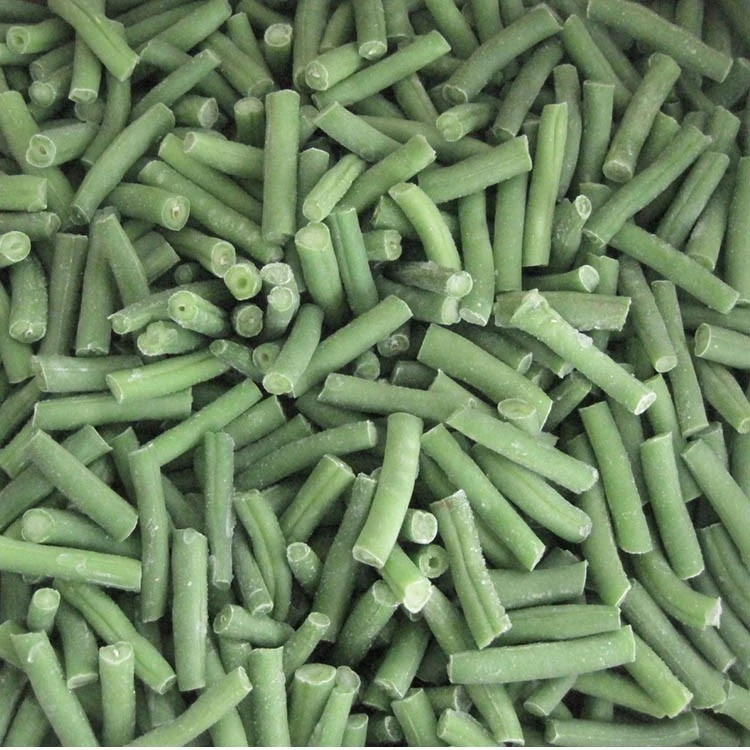
Cross-cut segments used for mixed vegetables, soups, ready meals and foodservice.

This lengthwise presentation is correctly identified as French-Cut; it is not used to illustrate ordinary transverse cuts.
Color, Maturity, Seeds and Fibre
We grade against a natural medium-green to dark-green color typical of the variety and blanching process. Grade A permits color-defective pieces up to 5%, yellow or yellow-green pieces up to 3%, and brown or black pieces up to 1%. Premium limits these to 2%, 1% and 0.5%. Extensive yellowing, grey-green discoloration, mould staining, chemical staining and severe blanching discoloration are rejected. Instrumental CIELAB testing is used only under a defined instrument, illuminant, observer angle, sample temperature, cooked/frozen state and reference sample.
Overmature units have enlarged seeds, thin parchment-like pod walls, seed-distorted shape or a fibrous cooked texture. Grade A limits overmature units to 2%, open or split pods to 2%, and loose seeds to 1%; Premium limits them to 1%, 1% and 0.5%. For an additional maturity index, we separate seeds from a 100 g sample: the seed-to-pod weight ratio is ≤8% for Premium Young Bean Grade, ≤12% for Grade A and ≤18% for Processing Grade.
A tough string is a fibre capable of supporting 250 g for at least five seconds. Grade A allows ≤0.5%; Premium requires none in a 500 g sample. Edible fibrous units are ≤1% / ≤0.5%, while inedible fibre is ≤0.1% for Grade A and absent in a Premium 500 g sample. We cook a representative sample, pull pod-wall and suture fibres, and record edible and inedible fibre separately.
Stem, Vegetable Material, Blemish and Mechanical Limits
| Item | Definition / Grade A | Premium A+ |
|---|---|---|
| Stem ends | ≤2 pieces/500 g | ≤1 piece/500 g |
| Untrimmed stem >10 mm | ≤1 piece/kg | Absent in 2 kg |
| Bean leaf / other harmless vegetable material | Each ≤1 piece/kg | Each absent in 1 kg |
| Major blemish | Defect larger than a 6 mm circle; ≤1% | ≤0.5% |
| Minor / total blemishes | Visible 3-6 mm defect ≤3%; total ≤3% | Minor ≤1.5%; total ≤2% |
| Rust / insect-damaged pieces | Each ≤1% | Each ≤0.5% |
| Mechanical damage | Crushed, split, torn or severely broken units ≤3% | ≤1.5% |
| Ragged edge >8 mm / connected / flattened pieces | Each ≤2% | Each ≤1% |
Cook Test, Sloughing and Product Integrity
Our standard cook test uses 200 g frozen beans in 2 L boiling potable water. We boil for 4-6 minutes, using the shorter time for finer diameters and the longer time for larger pieces, then drain for one minute. We evaluate tenderness, fibre, seed mealiness, pod-wall integrity, sloughing, flavor, odor and color.
Sloughing means the outer pod tissue separates from the main pod wall. Grade A limits sloughing to 5%, cooked integrity must be ≥90%, mushy pieces ≤3% and mealy seeds ≤3%. Premium limits sloughing to 2%, requires ≥95% identifiable cut form, and controls mushy pieces and mealy seeds to ≤1% each. Abnormal cooked odor is absent.
The product remains ready to cook, not ready to eat. For stir-frying, boiling, steaming, roasting, baking, casseroles or cooked sauces, heat the center of the finished food to 70°C for 2 minutes or 75°C for 30 seconds.

Factory equipment and green bean handling images support discussion of sorting, washing, frozen inspection and packing capability.
Blanching, Cooling and IQF Freezing
We blanch green beans at 90-98°C for 60-180 seconds. The operating point is selected inside this range for bean diameter, whole or cut form, maturity, blancher loading and cooling efficiency. Release requires a negative peroxidase result. We check peroxidase at production start, at least every two hours, after blancher adjustment, after a size change and at production end. The record contains blancher temperature, residence time, product size, line speed, result, operator and lot number.
After blanching, we cool with potable water and bring product temperature to a target of ≤15°C before IQF. Conveyor drainage, air movement and visual moisture checks reduce free water that would otherwise cause clumps, loose ice and net-weight variation. IQF tunnel air commonly operates at -30°C to -40°C; finished product exits at a core temperature of ≤-18°C.
Grade A free-flowing product is ≥98%; Premium is ≥99%. Clumps are ≤2% / ≤1%, loose surface ice ≤2% / ≤1%, severe freezer burn ≤1% / ≤0.5%, large ice masses and carton ice accumulation are absent, and added glaze is 0%.

The visible product and equipment support physical-hazard and final-inspection discussion.

Metal detection is placed beside the control values rather than used as decorative factory imagery.
Foreign Matter and Metal Detection
Glass, metal, stone, hard plastic, soft plastic, wood, paper, hair, soil, visible sand, rodent contamination, visible insects, larvae, mouldy material and rotten material are absent. Our internal mineral-impurity target is ≤0.05% by weight. Metal detector challenge values are ferrous 1.5 mm, non-ferrous 2.0 mm and stainless steel 2.5 mm for the contracted pack format.
We challenge the detector at start-up, every two hours, after product or equipment change, after a production stop and at production end. A failed check stops the line, isolates the affected interval, corrects the detector, repeats the challenge and re-screens isolated product before release.
Microbiological Specifications
| Parameter | Further-Processing Grade | Premium Retail Grade | Method |
|---|---|---|---|
| Aerobic plate count | ≤100,000 CFU/g | ≤50,000 CFU/g | ISO 4833-1 |
| Enterobacteriaceae | ≤1,000 CFU/g | ≤100 CFU/g | ISO 21528-2 |
| Coliforms / E. coli | ≤100 / <10 CFU/g | <10 / <10 CFU/g | ISO 4832 / ISO 16649-2 |
| Yeast / mould | Each ≤1,000 CFU/g | Each ≤500 CFU/g | ISO 21527 series |
| Staphylococcus aureus | <100 CFU/g | <100 CFU/g | ISO 6888-1 |
| Bacillus cereus | ≤1,000 CFU/g | ≤100 CFU/g | ISO 7932 |
| Salmonella / L. monocytogenes | Each not detected in 25 g | Each not detected in 25 g | ISO 6579-1 / ISO 11290-1 |
Pesticide, Heavy-Metal and Chemical Controls
We do not use "pesticide-free" or "zero residue" claims. For EU programs, pesticide compliance is assessed against Regulation (EC) No 396/2005 and its current MRLs. US programs use applicable EPA tolerances; Japan uses the Positive List; Canada uses applicable PMRA MRLs. GC-MS/MS and LC-MS/MS reports show the active substance, actual result, unit, LOQ, applicable MRL, conclusion, method, laboratory and lot number.
For EU legume vegetables, the maximum levels shown in the specification are lead ≤0.10 mg/kg and cadmium ≤0.020 mg/kg on a wet-weight basis. Additional contract targets are total arsenic ≤0.50 mg/kg, mercury ≤0.02 mg/kg and sulphur dioxide <10 mg/kg. Chlorate and perchlorate are reported against the current destination-market limit. Heavy metals are tested by ICP-MS; chlorate and perchlorate by LC-MS/MS.
IQF Frozen Cut Green Beans Technical Specification
| Product / species | IQF Frozen Cut Green Beans / Phaseolus vulgaris L. |
|---|---|
| Standard type / style | Round green bean / transverse cut |
| Alternative forms | Whole, short cut, diagonal cut and lengthwise French-Cut; Flat/Romano or runner bean uses a separate specification |
| Standard size | Diameter 6-10 mm × cut length 20-40 mm |
| Processing | Washed, stemmed, trimmed, cut, blanched, cooled, drained, individually quick frozen, sorted, metal detected and packed |
| Composition | 100% green beans; added salt 0%; added sugar 0%; preservatives 0%; artificial color/flavor 0%; added sulphites none; added glaze 0% |
| Peroxidase / GMO / allergens | Negative / Non-GMO / no intentionally added allergens |
| Core / storage / reefer | Product core ≤-18°C; storage -18°C to -22°C; reefer set point -18°C |
| Shelf life / seasons | 24 months; main crops May-July and November-December; year-round supply from frozen inventory |
| Origin / loading ports | Fujian or Shandong, China; Xiamen or Qingdao for the contracted origin and shipment |
Choose the Right Specification by Application
Mixed Vegetables
Short cut 10-20 mm or cut 20-30 mm, diameter 6-10 mm, conformity ≥90%, small pieces ≤3%, loose seeds ≤1%, clumps ≤2%.
Ready Meals
Cut 20-40 mm, diameter 7-9 mm, fibre ≤0.5%, color defectives ≤2% and cooked integrity ≥95% for Premium programs.
Retail Whole
Whole 6-8 or 7-9 mm × 60-120 mm, Premium A+, whole integrity ≥95%, yellow pieces ≤1%, stem ends ≤1/500 g.
Retail Cut
Cut 20-40 mm, diameter 6-8 or 7-9 mm, size conformity ≥95%, small pieces ≤1%, mechanical damage ≤1.5%.
French-Style Retail
Lengthwise width 2-4 mm, thickness ≤7 mm, width conformity ≥95%, odd cuts ≤3%, small pieces ≤5%.
Soups and Stews
Cut 30-50 or 40-60 mm, diameter 8-10 mm, with low sloughing and controlled long-cook integrity.
Stir-Fry and Casseroles
Diagonal 20-40 mm, fine whole or French-Cut 7-9 mm for faster cooking, sauce distribution and visible piece integrity.
Foodservice
Whole or cut 20-40 mm in 10 × 1 kg or 4 × 2.5 kg cartons. Baby-food projects use a separate pesticide, metal, microbe and process specification.
Bulk, Foodservice and Retail Packing
Industrial: 1 × 10 kg, 1 × 20 kg, 2 × 5 kg, 4 × 2.5 kg, 20 lb, 30 lb or 40 lb per carton; 500-550 kg octobin for eligible industrial programs.
Foodservice: 10 × 1 kg, 5 × 2 kg, 4 × 2.5 kg, 6 × 2.5 lb or 12 × 2 lb.
Retail: 20 × 300 g, 20 × 400 g, 20 × 500 g or 10 × 1 kg.
The inner bag is food-grade PE. Bulk liner thickness is 0.06-0.08 mm. The outer case is a five-ply export corrugated carton, with no metal staples; inner bags are heat sealed or securely closed. Private-label programs include printed pouch, neutral bag with label, printed carton, barcode, QR code, nutrition panel, multilingual label, lot code, date code and shipping mark.
MOQ, Loading and Lead Time
Standard MOQ is 12 MT per specification. Trial orders start at 5 MT per SKU when matching standard stock is available; mixed containers use 3-5 MT per SKU. Private-label MOQ is 10-12 MT per artwork and specification. Certified organic programs start at 12-20 MT from covered stock.
A 20-foot reefer loads approximately 12 MT; a 40-foot reefer loads approximately 22-24 MT. Standard lead time is 15-21 days. Stock programs with available packing materials can ship in 7-10 days. Printed retail packing requires 20-30 days after artwork approval. A 1-2 kg sample is prepared in 3-5 working days from matching stock.

The capability image is used beside packing and supply planning, not as proof of a specific green bean batch.
Cold Storage Before Export
We store finished cartons at -18°C to -22°C. Product core temperature before loading is ≤-18°C and the reefer set point is -18°C. The empty container must be clean, dry, odor-free, undamaged and free of pest evidence, with clear air channels and an intact door seal.

Reefer Loading Records
The shipment file includes product temperature, cold-storage record, empty-container inspection, reefer set-point photo, loading photos, container number, seal number and batch loading list. A temperature data logger is included in programs that specify continuous transit records.

Certificate of Analysis and Buyer Documents
Each COA uses four columns: parameter, specification, actual result and test method. The header identifies product, code, scientific name, bean type, style, diameter, length, grade, origin, harvest and production dates, lot, packing, purchase order, testing dates and container number. Actual results are measured batch values; we do not copy acceptance limits into the result column.
The result set covers identity, dimensions, color, flavor, cooked tenderness, maturity, seeds, sloughing, stems, EVM, blemishes, damage, fibres, clumps, ice, peroxidase, core temperature, metal detection, microbiology, lead, cadmium, pesticide compliance, net weight, bag seal, carton, label and lot code. The release decision is signed by QC, laboratory review and QA.

Order documentation lists the applicable certificate holder, site address, number, validity and product scope.

This shared frozen-food traceability framework illustrates the record chain; green bean release uses the product-specific lot and COA described here.
Batch Sampling, Packaging AQL and Traceability
A lot contains one bean type, style, diameter, length, grade, production date, line, shift and pack. We select at least five cartons, take 500 g from each and build a composite of at least 2.5 kg. EVM and stems use at least 1 kg; dimensional and defect checks use at least 300 g and 400 units; diameter and length checks use at least 200 pieces from each selected carton. We run one representative cook test per batch, peroxidase checks during every production batch, microbiological sampling from at least five representative units and temperature checks across at least five cartons.
Packaging inspection uses General Inspection Level II. Critical defects use AQL 0: wrong species or style, undeclared ingredient, open inner bag, missing lot code, foreign material or wrong frozen-storage statement. Major defects use AQL 1.5: wrong diameter or length, underweight, poor seal, incorrect date, unreadable lot code or carton damage affecting product. Minor print, carton and label-position deviations use AQL 4.0.
The traceability chain is farm/grower → field code → species and variety → harvest and receiving dates → raw-material lot → diameter grade → cut style → blanching batch → production line and shift → packing time → finished lot → COA → cold-store position → carton label → container and seal. A lot such as GB260615-G08-L2-A identifies green bean, production date June 15, 2026, grower 08, line 2 and shift A.
How We Control Frozen Green Bean Quality
Farm and Crop Records
We link finished lots to field code, variety, harvest date, pesticide-use record and receiving lot.
Diameter and Length
We measure range conformity, undersize, oversize, fixed-cut tolerance and small pieces.
Maturity and Fibre
We record overmature pods, loose seeds, tough strings, edible fibre and inedible fibre separately.
Blanching Record
We record 90-98°C, 60-180 seconds and a negative peroxidase result for release.
Defect Sorting
We inspect stems, leaves, blemishes, insects, mechanical damage, off-color units and foreign matter.
COA Release
We release against actual dimensional, physical, microbiological, contaminant, packing and temperature results.
Certificates, Export Documents and Support
Our certificate and registration file covers BRCGS, HACCP, ISO 22000, ISO 9001, Kosher, Halal, certified organic programs and FDA Food Facility Registration. The signed order document names the manufacturing site, certificate holder, certificate number, validity period and covered product scope used for that shipment. We provide the signed product specification, batch COA, microbiological report, pesticide report, heavy-metal report, ingredient declaration, allergen statement, Non-GMO statement, sulphite statement, shelf-life statement, blanching record, metal-detection record, invoice, packing list, certificate of origin, health certificate, bill of lading, loading photos and container/seal record.
Use our Frozen Vegetable Solutions for category planning, review the Frozen Food Quality Control System, inspect the Traceability System, or see our Factory Audit and Inspection Support.
IQF Frozen Cut Green Bean FAQ
1. Should the product be called cut or sliced green beans?
Cross-cut segments are Cut Green Beans. Sliced or French-Cut describes lengthwise strips.
2. What species and bean types do you supply?
Our standard product is round Phaseolus vulgaris L. Runner, Romano/flat and yardlong beans use separate product names and specifications.
3. Which diameter and cut-length options are available?
Diameters include 5-6.5, 6-8, 7-9, 8-10, 10-12, 6-10 and 6-12 mm. Cuts include 10-20, 20-30, 20-40, 25-35, 30-50 and 40-60 mm.
4. What size conformity and small-piece limits apply?
Grade A requires ≥90% diameter and length conformity with pieces below 10 mm ≤3%. Premium A+ requires ≥95% conformity with small pieces ≤1%.
5. What is French-Cut?
French-Cut beans are sliced lengthwise to 2-4 mm width, ≤7 mm thickness and 30-100 mm natural length. They are not transverse segments.
6. Are the green beans blanched and ready to eat?
They are blanched at 90-98°C for 60-180 seconds and released with negative peroxidase, but remain ready to cook. Heat the finished food to 70°C for 2 minutes or 75°C for 30 seconds.
7. How are strings, fibre and maturity controlled?
Grade A limits tough strings to ≤0.5%, edible fibre to ≤1%, inedible fibre to ≤0.1% and overmature units to ≤2%. Premium requires no tough strings or inedible fibre in 500 g and limits edible fibre to ≤0.5% and overmature units to ≤1%.
8. What are the stem, blemish and breakage limits?
Grade A permits ≤2 stem ends/500 g, major blemishes ≤1%, total blemishes ≤3% and mechanical damage ≤3%. Premium limits these to ≤1/500 g, ≤0.5%, ≤2% and ≤1.5%.
9. Is ice glaze added?
No. Added glaze is 0%. Grade A clumps and loose ice are each ≤2%; Premium limits each to ≤1%.
10. What microbiological limits are used?
Further-processing limits include APC ≤100,000 CFU/g, coliforms ≤100 CFU/g, E. coli <10 CFU/g, yeast and mould each ≤1,000 CFU/g, with Salmonella and L. monocytogenes not detected in 25 g.
11. What contaminant limits and reports are provided?
The EU table uses lead ≤0.10 mg/kg and cadmium ≤0.020 mg/kg for legume vegetables. Pesticide reports show each result, LOQ and applicable destination-market MRL.
12. What does the batch COA contain?
It contains actual diameter, length, conformity, defects, maturity, fibre, peroxidase, microbiology, contaminants, temperature, packing and release results with test methods.
13. What packing, MOQ and lead time apply?
Bulk, foodservice and retail formats are listed above. Standard MOQ is 12 MT per specification, standard lead time 15-21 days and printed retail packing 20-30 days after artwork approval.
14. What is the shelf life and reefer loading quantity?
Shelf life is 24 months at -18°C or below. A 20-foot reefer loads about 12 MT and a 40-foot reefer about 22-24 MT.
15. What information should be included in an inquiry?
Send bean species/type, whole or cut style, diameter, length, grade, defect and fibre limits, microbiology, pesticide panel, packing, quantity, application, destination market, port and private-label details.
Build Your IQF Frozen Green Bean Specification
Choose the bean type, transverse or lengthwise style, diameter, cut length, Grade A or Premium A+, defect limits, microbiological table, pesticide panel, packing and shipment quantity. We will return a structured specification, sample plan and quotation rather than an undefined "customized" offer.
Hot Tags: frozen sliced green beans, China frozen sliced green beans manufacturers, suppliers, factory, frozen long green beans, cowpea bean, asparagus bean, frozen long bean
Technical specification · reference schedule
Frozen Sliced Green Beans
We review the selected form, grade, process and packing against the technical schedule below. Published and TDS values are specification references for order review. External benchmarks apply only within their stated scope. Acceptance is governed by the signed SKU specification; the identified lot COA reports actual measured results.
01 / Physical & Sensory
| Parameter | Specification / reference | Verification & order basis |
|---|---|---|
| Diameter / length conformity - Standard Grade A | Each ≥90% by countPublished reference | Measure a defined frozen sample with caliper or size gauge; report distribution and tolerance. Programme: Standard Grade A. |
| Diameter / length conformity - Premium A+ | Each ≥95% by countPublished reference | Measure a defined frozen sample with caliper or size gauge; report distribution and tolerance. Programme: Premium A+. |
| Overmature units / loose seeds - Standard Grade A | ≤2% / ≤1%Published reference | Confirm method, representative sample and acceptance basis in the signed specification. Programme: Standard Grade A. |
| Overmature units / loose seeds - Premium A+ | ≤1% / ≤0.5%Published reference | Confirm method, representative sample and acceptance basis in the signed specification. Programme: Premium A+. |
| Product / species | IQF Frozen Cut Green Beans / Phaseolus vulgaris L.Published reference | Confirm method, representative sample and acceptance basis in the signed specification. |
| Standard type / style | Round green bean / transverse cutPublished reference | Confirm method, representative sample and acceptance basis in the signed specification. |
| Alternative forms | Whole, short cut, diagonal cut and lengthwise French-Cut; Flat/Romano or runner bean uses a separate specificationPublished reference | Confirm method, representative sample and acceptance basis in the signed specification. |
| Standard size | Diameter 6-10 mm × cut length 20-40 mmPublished reference | Measure a defined frozen sample with caliper or size gauge; report distribution and tolerance. |
| Thickness & intact-cut inspection | Measure thickness separately from fruit/cap/root diameter or piece length; classify broken cuts and end pieces. | Use a thickness gauge/caliper and separate mass or count for intact and broken fractions. |
| Sensory acceptance | Characteristic colour, flavour and texture for the declared product; no abnormal odour or visibly deteriorated material.External reference Codex | Compare an identified frozen sample with the approved grade and defect schedule. External technical reference; confirm SKU and market applicability. |
02 / Physicochemical & Residue Controls
| Parameter | Specification / reference | Verification & order basis |
|---|---|---|
| Pesticide residue schedule | Named active ingredients and commodity-specific limits are selected for the destination market. EU source | Link farm spray history, laboratory LOQ and batch result to the destination MRL. EU database is one market reference; apply the actual destination rule. |
| Lead, cadmium and other contaminants | Apply the limit for the exact commodity and processed form in the destination market. EU source | State analyte, preparation basis, method, LOQ and lot result. Do not transfer a fresh-commodity limit to a processed form without the required assessment. |
03 / Microbiological Criteria
| Parameter | Specification / reference | Verification & order basis |
|---|---|---|
| Aerobic plate count - Further-Processing Grade | ≤100,000 CFU/gPublished reference | ISO 4833-1. Programme: Further-Processing Grade. |
| Aerobic plate count - Premium Retail Grade | ≤50,000 CFU/gPublished reference | ISO 4833-1. Programme: Premium Retail Grade. |
| Enterobacteriaceae - Further-Processing Grade | ≤1,000 CFU/gPublished reference | ISO 21528-2. Programme: Further-Processing Grade. |
| Enterobacteriaceae - Premium Retail Grade | ≤100 CFU/gPublished reference | ISO 21528-2. Programme: Premium Retail Grade. |
| Coliforms / E. coli - Further-Processing Grade | ≤100 / <10 CFU/gPublished reference | ISO 4832 / ISO 16649-2. Programme: Further-Processing Grade. |
| Coliforms / E. coli - Premium Retail Grade | <10 / <10 CFU/gPublished reference | ISO 4832 / ISO 16649-2. Programme: Premium Retail Grade. |
| Yeast / mould - Further-Processing Grade | Each ≤1,000 CFU/gPublished reference | ISO 21527 series. Programme: Further-Processing Grade. |
| Yeast / mould - Premium Retail Grade | Each ≤500 CFU/gPublished reference | ISO 21527 series. Programme: Premium Retail Grade. |
| Staphylococcus aureus - Further-Processing Grade | <100 CFU/gPublished reference | ISO 6888-1. Programme: Further-Processing Grade. |
| Staphylococcus aureus - Premium Retail Grade | <100 CFU/gPublished reference | ISO 6888-1. Programme: Premium Retail Grade. |
| Bacillus cereus - Further-Processing Grade | ≤1,000 CFU/gPublished reference | ISO 7932. Programme: Further-Processing Grade. |
| Bacillus cereus - Premium Retail Grade | ≤100 CFU/gPublished reference | ISO 7932. Programme: Premium Retail Grade. |
| Salmonella / L. monocytogenes - Further-Processing Grade | Each not detected in 25 gPublished reference | ISO 6579-1 / ISO 11290-1. Programme: Further-Processing Grade. |
| Salmonella / L. monocytogenes - Premium Retail Grade | Each not detected in 25 gPublished reference | ISO 6579-1 / ISO 11290-1. Programme: Premium Retail Grade. |
| Acceptance schedule | Select the test panel and limits by intended use (ready-to-eat or further processing), product form and destination. EU source | State organism, analytical method, sample mass and n/c plan; report actual lot results. A universal APC, coliform, Salmonella or Listeria limit is not assigned to every frozen product. |
04 / Freezing & Cold Chain
| Parameter | Specification / reference | Verification & order basis |
|---|---|---|
| Core / storage / reefer | Product core ≤-18°C; storage -18°C to -22°C; reefer set point -18°CPublished reference | Confirm method, representative sample and acceptance basis in the signed specification. |
| Separation & loose-ice assessment | Keep inherent moisture, loose ice and permanently frozen clusters as separate inspection categories. | Weigh separated loose ice and welded clusters against initial sample mass; distinguish natural paired pieces or blocks. |
| Product thermal centre | −18°C or colder after freezing and thermal stabilization; maintain the agreed frozen distribution condition.External reference Codex | Probe the thickest representative pack and retain storage/transport temperature records. Codex quick-frozen reference; selected product form and route must be frozen. |
| Frozen condition at dispatch | Hard frozen, correctly sealed and coded, without thaw/refreeze evidence or excessive loose ice. Codex | Check pack integrity, free-flow or block condition as declared, carton condition and loading temperature. |
05 / Pack Size & Shelf Life
| Parameter | Specification / reference | Verification & order basis |
|---|---|---|
| Declared net contents | Verify each selected pack format against the artwork and applicable quantity-control rule. Codex | Calibrated checkweigher or scale; defined sample and tare. |
| Shelf-life basis | The labelled period applies only to its validated pack and continuous stated storage condition. Codex | Review stability study or approved shelf-life file and production-date code. |
06 / Process Controls
| Parameter | Specification / reference | Verification & order basis |
|---|---|---|
| Processing | Washed, stemmed, trimmed, cut, blanched, cooled, drained, individually quick frozen, sorted, metal detected and packedPublished reference | Check the approved product flow, line settings and identified production record; validate numerical critical limits within the site HACCP plan. |
| Raw-material preparation checks | Confirm species, round/flat pod type and cross-cut versus lengthwise-sliced style. | Verify the selected product flow and the relevant trimming, sorting and pretreatment record. |
| Blanching / enzyme inactivation | Time and temperature are product- and cut-specific; confirm residual-enzyme endpoint when relevant. Codex | Record validated line set-points and product sample test; assess colour and texture after treatment. Only classify as a CCP when the site's HACCP plan identifies it as one. |
| Cooling and dewatering | Control prompt cooling and surface-water removal before IQF to avoid clumping and loose ice. Codex | Review line time/temperature record, draining check and frozen separation. |
| CCP designation | Use the site-approved HACCP plan to identify true CCPs and their validated critical limits. Codex | Check hazard analysis, monitoring, deviation and corrective-action records. A quality-control step is not automatically a CCP. |
07 / Ingredients, Additives & Allergens
| Parameter | Specification / reference | Verification & order basis |
|---|---|---|
| Composition | 100% green beans; added salt 0%; added sugar 0%; preservatives 0%; artificial color/flavor 0%; added sulphites none; added glaze 0%Published reference | Verify approved formula, supplier declarations and line-specific allergen assessment. |
| Peroxidase / GMO / allergens | Negative / Non-GMO / no intentionally added allergensPublished reference | Verify approved formula, supplier declarations and line-specific allergen assessment. |
| Added glaze / coating declaration | Declare any intentionally added water glaze, syrup, oil or coating and the measurement basis; loose ice is assessed separately. | Verify formula/addition records; agree a deglazing or coating test and net-content basis where applicable. |
| Additive use | Declare any colour-protection agent, acidulant or other additive by ingredient and maximum permitted use for the target market. NHC standard | Check approved formula, actual addition record and market-specific additive category. GB 2760-2024 applies to China; export rules are checked separately. |
| Allergen and cross-contact assessment | Declare inherent allergens and assess shared-line cross-contact from the actual facility schedule. FDA | Review line matrix, cleaning validation and buyer label approval. Do not claim a shared-line allergen or allergen-free status without facility evidence. |
08 / Defects & Foreign Matter
| Parameter | Specification / reference | Verification & order basis |
|---|---|---|
| Characteristic green color / color defectives - Standard Grade A | ≥95% / ≤5%Published reference | Compare with the approved sensory reference using the stated frozen/thawed/prepared condition. Programme: Standard Grade A. |
| Characteristic green color / color defectives - Premium A+ | ≥98% / ≤2%Published reference | Compare with the approved sensory reference using the stated frozen/thawed/prepared condition. Programme: Premium A+. |
| Major / total blemishes - Standard Grade A | ≤1% / ≤3%Published reference | Classify on the defined sample by count or mass; record individual categories, denominator and any combined limit. Programme: Standard Grade A. |
| Major / total blemishes - Premium A+ | ≤0.5% / ≤2%Published reference | Classify on the defined sample by count or mass; record individual categories, denominator and any combined limit. Programme: Premium A+. |
| Mechanical damage - Standard Grade A | ≤3%Published reference | Classify on the defined sample by count or mass; record individual categories, denominator and any combined limit. Programme: Standard Grade A. |
| Mechanical damage - Premium A+ | ≤1.5%Published reference | Classify on the defined sample by count or mass; record individual categories, denominator and any combined limit. Programme: Premium A+. |
| Stem ends / extraneous vegetable material - Standard Grade A | ≤2 pieces/500 g / ≤1 piece/kgPublished reference | Classify on the defined sample by count or mass; record individual categories, denominator and any combined limit. Programme: Standard Grade A. |
| Stem ends / extraneous vegetable material - Premium A+ | ≤1 piece/500 g / absent in 1 kgPublished reference | Classify on the defined sample by count or mass; record individual categories, denominator and any combined limit. Programme: Premium A+. |
| Clumps / loose surface ice - Standard Grade A | ≤2% / ≤2%Published reference | Classify on the defined sample by count or mass; record individual categories, denominator and any combined limit. Programme: Standard Grade A. |
| Clumps / loose surface ice - Premium A+ | ≤1% / ≤1%Published reference | Classify on the defined sample by count or mass; record individual categories, denominator and any combined limit. Programme: Premium A+. |
| Added glaze / mould / decay / foreign material - Standard Grade A | 0% / absentPublished reference | Inspect a defined representative sample; record count or mass basis and disposition. Programme: Standard Grade A. |
| Added glaze / mould / decay / foreign material - Premium A+ | 0% / absentPublished reference | Inspect a defined representative sample; record count or mass basis and disposition. Programme: Premium A+. |
| Major blemish - Premium A+ | ≤0.5%Published reference | Classify on the defined sample by count or mass; record individual categories, denominator and any combined limit. Programme: Premium A+. |
| Minor / total blemishes - Premium A+ | Minor ≤1.5%; total ≤2%Published reference | Classify on the defined sample by count or mass; record individual categories, denominator and any combined limit. Programme: Premium A+. |
| Rust / insect-damaged pieces - Premium A+ | Each ≤0.5%Published reference | Classify on the defined sample by count or mass; record individual categories, denominator and any combined limit. Programme: Premium A+. |
| Intrinsic defect classification | Stem ends, strings, mature seeds, fibrous pods, blemishes and broken pieces. | Record each defect class separately by count or mass; state sample size, denominator and combined-limit rules. |
| Hazardous foreign matter | No foreign matter detected in the defined inspection sample; reject and investigate any finding.External reference Codex | Define visual-inspection sample size and detector challenge in the signed quality schedule. "None detected" is a sampling statement, not an absolute guarantee of zero particles. |
09 / Packaging Materials & Label
| Parameter | Specification / reference | Verification & order basis |
|---|---|---|
| Food-contact pack | Specify inner-contact material and obtain the applicable food-contact compliance declaration. NHC standard | Review film structure, supplier DoC, migration evidence and actual intended conditions. GB 4806 series is China-specific; EU export also checks Regulations 1935/2004 and 10/2011. |
| Carton and seal integrity | Define carton stacking strength, bag seal and puncture resistance for the confirmed net weight and pallet plan. EU source | Inspect pack drawing, compression/seal test and shipment configuration. |
| Label verification | Match product name, ingredient/allergen statement, net weight, lot/date, shelf life and storage instruction to the destination artwork. Codex | Approve artwork against the signed specification and destination rules. |
10 / Detection & Traceability
| Parameter | Specification / reference | Verification & order basis |
|---|---|---|
| Foreign-body detector | Validate Fe, non-Fe and stainless-steel challenge pieces for the actual product, aperture, pack and line; record the proven sensitivity. Codex | Challenge at defined start, changeover, interval and end points; retain rejection records. Do not copy generic detector sizes into a plant capability claim. |
| Lot traceability | Link input source lot, processing run, packaging code, test records, frozen storage and shipment to one finished lot. Codex | Trace one sample lot forward and backward in a recorded mock recall. Recall speed is stated only when the site has a validated target and record. |
Previous
Green Frozen Beans


