


Frozen Tomato Wedges vs Tomato Paste in Sauce: A Solids-Based Cost Comparison
Oct 19, 2026
Leave a message

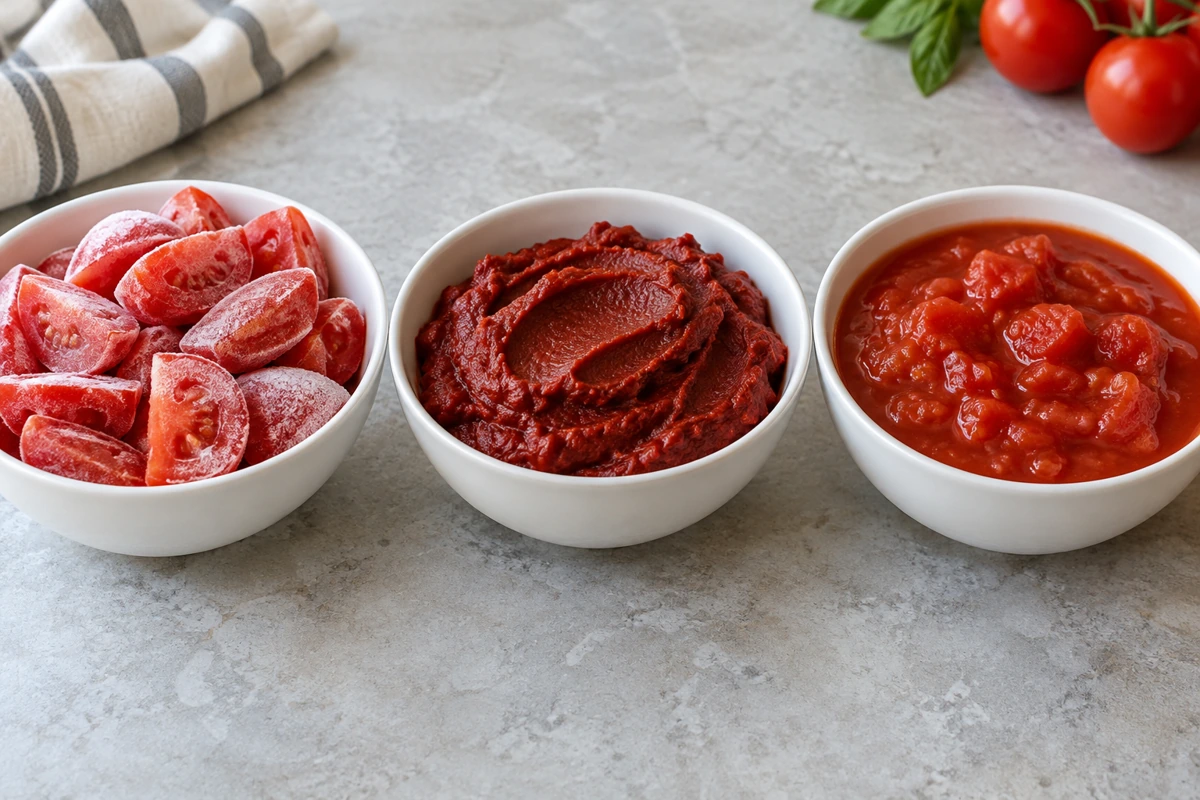
A useful comparison separates four questions: how much relevant tomato solid is purchased, how much reaches the sauce, what processing is required, and whether the finished food meets its texture and flavor target. The calculations below are hypothetical worked examples. They are not GreenLand prices, specifications, production results or a claim that one ingredient is always cheaper.
Start with the sauce that must be delivered
Define the finished product before comparing quotations. A smooth pizza sauce, a chunky pasta sauce and a soup base may need different tomato ingredients even when their measured soluble-solids values are similar. State the required appearance, consistency, flavor, visible pieces and serving route. Without that target, the team can optimize an ingredient calculation and still produce the wrong food.
Frozen wedges preserve a recognizable cut at the point of purchase, although the flesh may soften and release liquid during preparation. The skin and seed contribution also depends on the product and the subsequent process. Paste is a concentrated ingredient with its own finish and processing history. Diluting it can provide a sauce base, but water addition cannot reconstruct a wedge's visible structure.
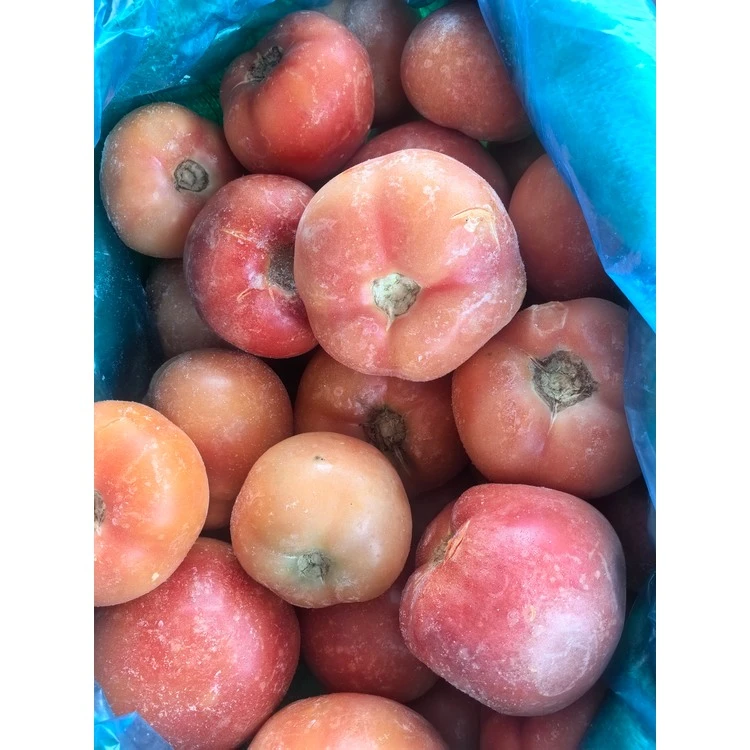
Whole tomatoes with pale shoulders and surface frost; appearance does not establish the solids level of a wedge lot.
The real tomato photographs show whole tomatoes with visible surface frost and wedges in a lined carton. The whole-fruit view includes pale shoulders, which are relevant to discussing selection and color variation. It does not establish a fresh raw-material condition or the soluble-solids level of the offered wedges. A photograph is useful for recognizing the form; measurements and the order specification establish the material used in a cost model.
Our frozen tomatoes product page identifies wedges as the reference form and calls for agreement on cut geometry, skin and seed retention, maturity and juice release. Those details influence both appearance and recovery. Confirm the actual treatment and intended cooking requirements for the proposed SKU rather than assuming every frozen tomato has the same preparation history.
Write the target as a finished-sauce specification that the development team can test. Include the measurement method and serving condition for consistency, the expected piece distribution and the sensory comparison. If the sauce will be frozen in a meal and reheated, evaluate that full route. A sauce that looks suitable immediately after cooking may behave differently after later storage and preparation.
The purchasing question then becomes concrete: which wedge, paste or blend supplies the required result at the lowest acceptable total cost? The answer may change with the recipe, plant capacity, pack format and delivered quote. A concentrated paste may be efficient for a smooth base, while wedges may justify their handling cost where visible tomato pieces are part of the product's value.
Agree what the solids measurement means
Tomato solids are not one interchangeable number. Total solids include both dissolved and insoluble material. A refractometric soluble-solids measurement describes another basis, and natural tomato soluble solids may require the applicable method and corrections. Skin, seeds and other insoluble material can influence texture and recovery without being represented in the same way by a soluble-solids reading.
The USDA tomato-paste standards and methods index lists separate methods for soluble solids, total solids and consistency. This is a useful reason to name the measurement precisely in the quotation and trial report. A certificate showing one basis should not be compared directly with a quotation using another basis simply because both values are expressed as percentages.
Commercial practice can also differ from a casual use of the word Brix. Morning Star's market-price page states that its pricing uses natural tomato soluble solids and explains that its hot-break figures are not equivalent to the listed Brix values. This is a supplier-specific commercial statement, not a conversion rule to apply universally. Ask each supplier for the measurement basis and method behind the quoted concentration.
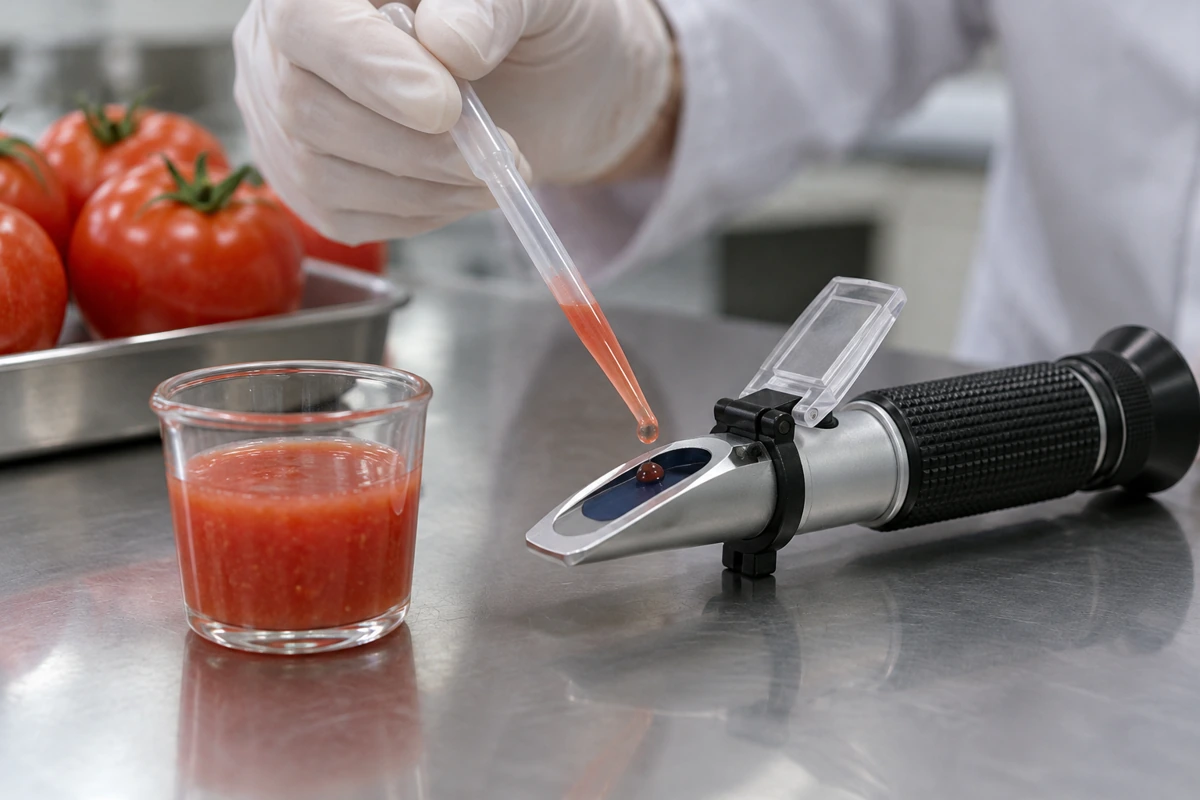
The sample preparation and named solids method define what the measurement means.
For wedges, prepare a representative analytical sample. The liquid released during controlled thawing may contain soluble material, so measuring only a selected piece or discarding the liquid can change the basis. Decide whether the purchase is being evaluated as the entire supplied contents or as a defined drained fraction. Homogenization, sampling and measurement should follow an appropriate agreed method, with the same basis used in the cost model.
Added ingredients complicate the finished-sauce reading. Sugar, salt and other soluble components can affect refractometer results. A final sauce reading therefore cannot automatically be treated as tomato-derived soluble solids. Keep the tomato contribution in the formulation mass balance and record other ingredients separately. If a final specification uses Brix as a practical quality measure, explain what it represents for that recipe.
Use actual measured values or the agreed lot specification for purchasing calculations. The examples in this article assume comparable tomato-derived soluble-solids fractions solely to demonstrate the arithmetic. They do not assign a standard concentration to frozen wedges or a guaranteed grade to paste. If the two ingredients cannot be placed on a common analytical basis, resolve that difference before presenting a numerical cost comparison.
Measurement uncertainty also matters near a commercial decision boundary. A small apparent advantage can disappear when lot variation, sampling and recovery are considered. Retain the reported method and result with the calculation so that a revised analysis can be made when a new lot or quote arrives.
Calculate cost per recovered tomato solid
Start with three values for each ingredient: delivered price per kilogram, the relevant tomato-solids fraction on the agreed basis, and the fraction of those solids recovered into the acceptable sauce. The recovery term should represent solids recovery. It is not automatically the same as the fraction of total wet ingredient mass retained after draining, screening or transfer.
The basic calculation is: cost per kilogram of recovered tomato solids equals delivered ingredient price divided by the product of solids fraction and solids recovery. Use fractions in the denominator. For example, five percent becomes 0.05 and ninety-five percent becomes 0.95. The result is an ingredient-cost measure; it does not yet include processing, storage or the value of a different texture.
Consider this hypothetical comparison. Assume wedges cost 0.80 currency units per kilogram, contain 5% tomato-derived soluble solids on the chosen common basis, and deliver 95% of those solids into the accepted sauce. Assume paste costs 1.60 per kilogram, contains 28% on the same basis, and delivers 98%. These are teaching inputs, not market quotations or claimed product specifications.
| Hypothetical input or result | Frozen wedges | Tomato paste |
|---|---|---|
| Delivered ingredient cost per kg | 0.80 | 1.60 |
| Comparable tomato-solids fraction | 0.05 | 0.28 |
| Recovery of those solids | 0.95 | 0.98 |
| Recovered tomato solids per kg ingredient | 0.0475 kg | 0.2744 kg |
| Ingredient cost per kg recovered tomato solids | 16.84 | 5.83 |
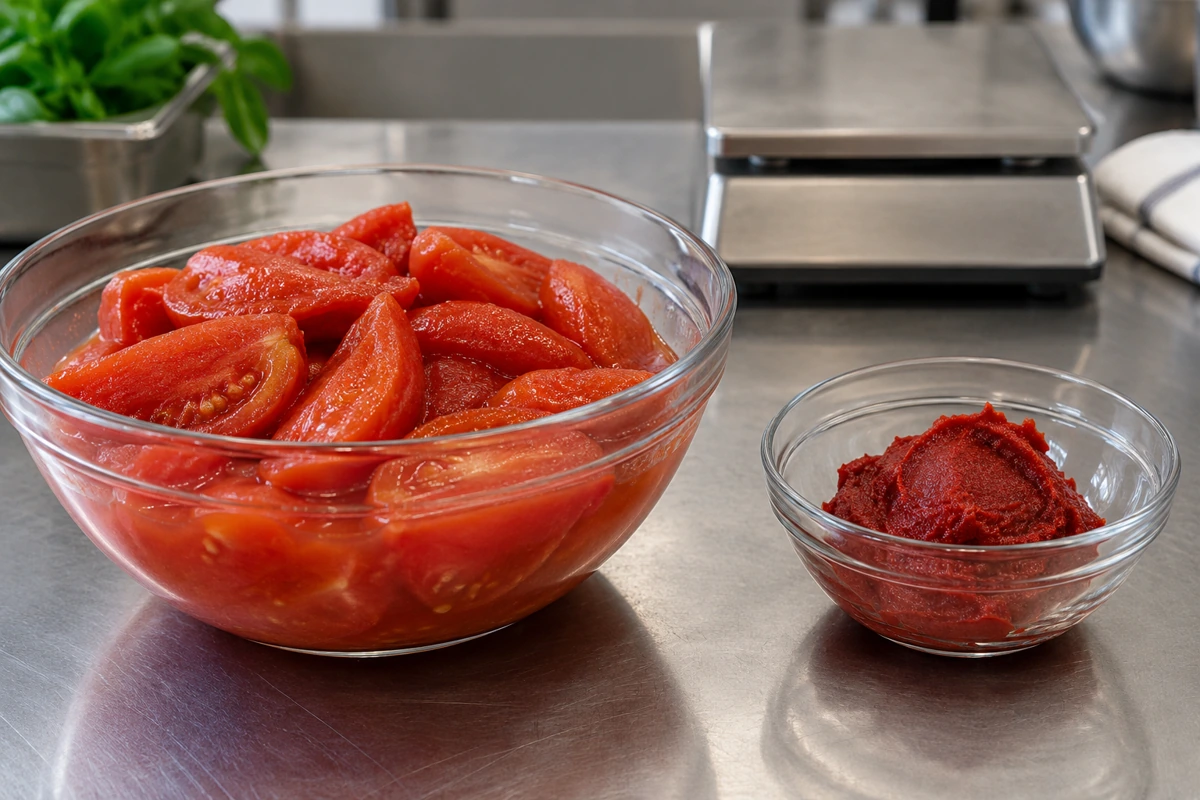
Wedges retain visible juice while the smaller paste portion holds its shape; solids equivalence requires measurement.
In this example, paste has the higher price per kilogram of ingredient and the lower cost per kilogram of recovered solids. That outcome follows from the assumed concentration and recovery. It does not establish equivalent flavor, texture or suitability for a chunky sauce. The calculation answers a narrow purchasing question and leaves the application decision open for the trial.
Suppose the development target requires 8 kilograms of recovered tomato-derived solids on this basis. The example needs about 168.42 kilograms of wedges or 29.15 kilograms of paste. Ingredient cost is approximately 134.74 or 46.65 currency units respectively. These quantities are ingredient equivalents for the stated solids target; they are not complete recipes and should not be read as a direct fresh-tomato substitution rule.
The recovery assumptions deserve measurement. Soluble material can leave with discarded juice, and paste can remain in liners, pipes or mixing equipment. If the loss stream has a different concentration from the incoming ingredient, wet-mass loss alone cannot quantify solids recovery. Measure or estimate the relevant stream on a defensible basis and keep the assumption visible until the plant trial replaces it with evidence.
The same formula can calculate a break-even ingredient price. With all other example values unchanged, wedges would match paste's ingredient cost per recovered solid at about 0.277 currency units per kilogram. That is a mathematical threshold within the example, before processing costs or quality value. It is not a recommended selling price or a prediction of what a supplier should quote.
Account for water removal and batch yield
The solids calculation should be followed by a complete mass balance. Record each ingredient entering the batch, any water added, material removed during screening or drainage, evaporation and the recovered finished sauce. The balance explains how a starting formulation becomes a saleable product. It also helps identify whether a supposed cost saving depends on leaving more water in the finished sauce.
The example above shows why ingredient mass can differ substantially for the same tomato-solids target. The wedge route introduces much more non-soluble-solid mass, most of which may be water but can also include insoluble tomato material. The paste route may require added water to reach the final formulation. Do not call the entire difference evaporation duty without accounting for the actual recipe and all loss streams.
For a simple tomato-and-water model, the desired final mass and solids contribution can help frame the water balance. Real sauces also contain oil, salt, vegetables, starches or other ingredients, each with its own water and solids. Keep those contributions separate. A finished sauce at a chosen refractometer value does not by itself reveal how much tomato material it contains.
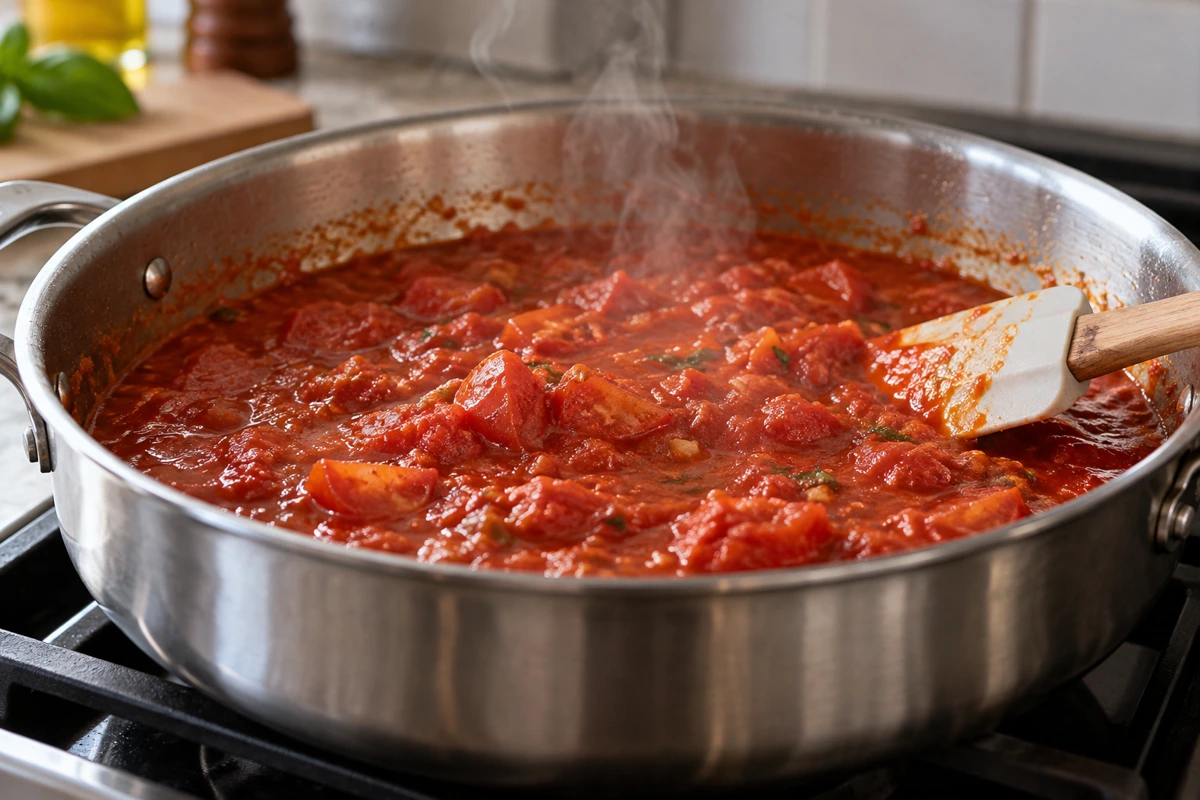
Water removal affects both processing time and the recovered sauce yield.
Water removal has an operating cost. Heating frozen material, melting ice, warming the batch and evaporating water can affect utility consumption and kettle time. The actual cost depends on equipment efficiency, heat recovery, operating conditions and the rate at which the process can remove water without damaging the food. Measure the relevant plant data or use a clearly identified engineering estimate. Avoid inserting a generic energy number and presenting it as a validated factory result.
Capacity can matter as much as the utility bill. If a kettle spends longer concentrating a wedge-rich batch, it may produce fewer batches during the available shift. Conversely, a plant with spare capacity may value that time differently. Include the real production constraint in the comparison rather than assigning the same overhead rate mechanically to every route. A small ingredient saving may be unhelpful if it creates a bottleneck in the operation.
Record usable yield at the correct endpoint. A hot kettle weight, a packed weight and a saleable quantity after quality review are different measures. Transfer residue, rejected packs and rework can change the final figure. Use the cost per accepted finished kilogram when comparing complete production routes, and retain the simpler cost-per-solids calculation as one component of that assessment.
Frozen storage and handling also belong in the model. Wedges require their declared frozen conditions, while paste storage depends on its specific pack and product instructions. Confirm both arrangements with the suppliers. Compare the actual freight, storage space, opening losses and stock rotation for the order quantities being considered, rather than assuming a packaging category has one universal cost.
Compare texture and flavor at the same target
Equivalent tomato solids do not guarantee equivalent sauce behavior. Paste has already undergone a concentration and processing route, and its finish influences the material remaining in the product. Wedges can contribute softened flesh, skin and seeds that behave differently during cooking and milling. The trial must therefore compare the finished sauce at the agreed formulation target and through the intended process.
Morning Star's description of bulk paste production distinguishes break treatment, finishing and evaporation. These are reasons to request the actual paste specification rather than buying concentration alone. The buyer may need a particular consistency or finish, and a different paste with the same nominal concentration may behave differently in the recipe.
Use a defined consistency method. If Bostwick flow or another practical test is selected, record sample preparation, temperature and timing according to the applicable procedure. A comparison made at different dilution or temperature can be misleading. Assess the finished food as well: a sauce that gives a favorable instrument result may coat pasta poorly or release liquid after reheating.
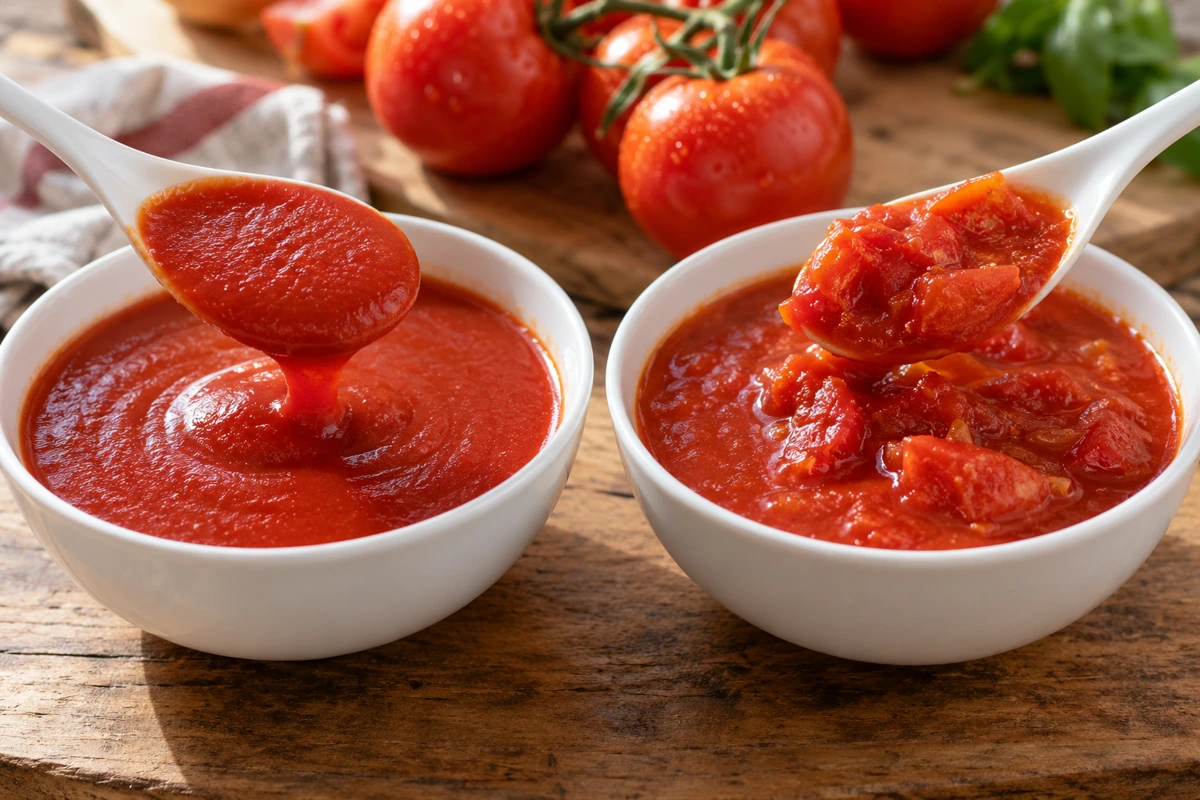
Equivalent solids do not guarantee equivalent texture or visible tomato pieces.
Color should also be compared on a stated basis. HunterLab's tomato sample-preparation note explains the importance of dilution and measurement conditions when comparing concentrated products. An undiluted paste naturally presents a different optical sample from a thin sauce. Judge the color of the complete recipe under consistent conditions and retain the analytical preparation details when measurements support the decision.
Flavor evaluation should use the normal serving amount and the full preparation route. A wedge-rich sauce may offer a different cooked tomato impression, while a paste-rich formula may require a different balance of other ingredients. Keep seasoning constant during the first comparison, then optimize each viable formulation transparently. If one route needs extra ingredients to meet the target, include their cost and labeling effect in the final model.
Visible pieces are a separate specification. Record their size, proportion and survival after cooking, pumping and reheating. A sauce can have the correct average solids and still lack the appearance the customer expects. If wedge pieces are part of the value proposition, the comparison should quantify that result instead of treating every tomato ingredient as interchangeable concentrated flavor.
Evaluate stability after the intended storage cycle. Check free liquid, separation, texture and recovery after normal mixing or reheating. These observations belong to the complete formula and process. They should not be attributed automatically to freezing or to one ingredient without a controlled comparison using the same finished-product target.
Test a wedge and paste blend
A blend can assign different jobs to the ingredients. Wedges may provide visible tomato material, while paste supplies additional concentration and body. This can reduce the need to choose one ingredient exclusively. The blend still requires a clear formulation and trial; it should not become an informal adjustment made differently by each operator when a sauce appears thin.
Use the same hypothetical values to illustrate the calculation. If half of an 8-kilogram recovered-solids target comes from wedges and half from paste, the example requires about 84.21 kilograms of wedges and 14.58 kilograms of paste. The combined ingredient cost is approximately 90.69 currency units. This is the arithmetic midpoint in solids contribution under the stated assumptions, not a complete 50:50 recipe by ingredient weight.
That distinction is essential. Equal ingredient weights would deliver very different solids contributions in this example. A formulation described simply as half wedges and half paste is ambiguous unless the basis is stated. Use mass for the actual recipe and explain any solids-based allocation separately. This prevents a purchasing calculation from being misread as an instruction to the production operator.
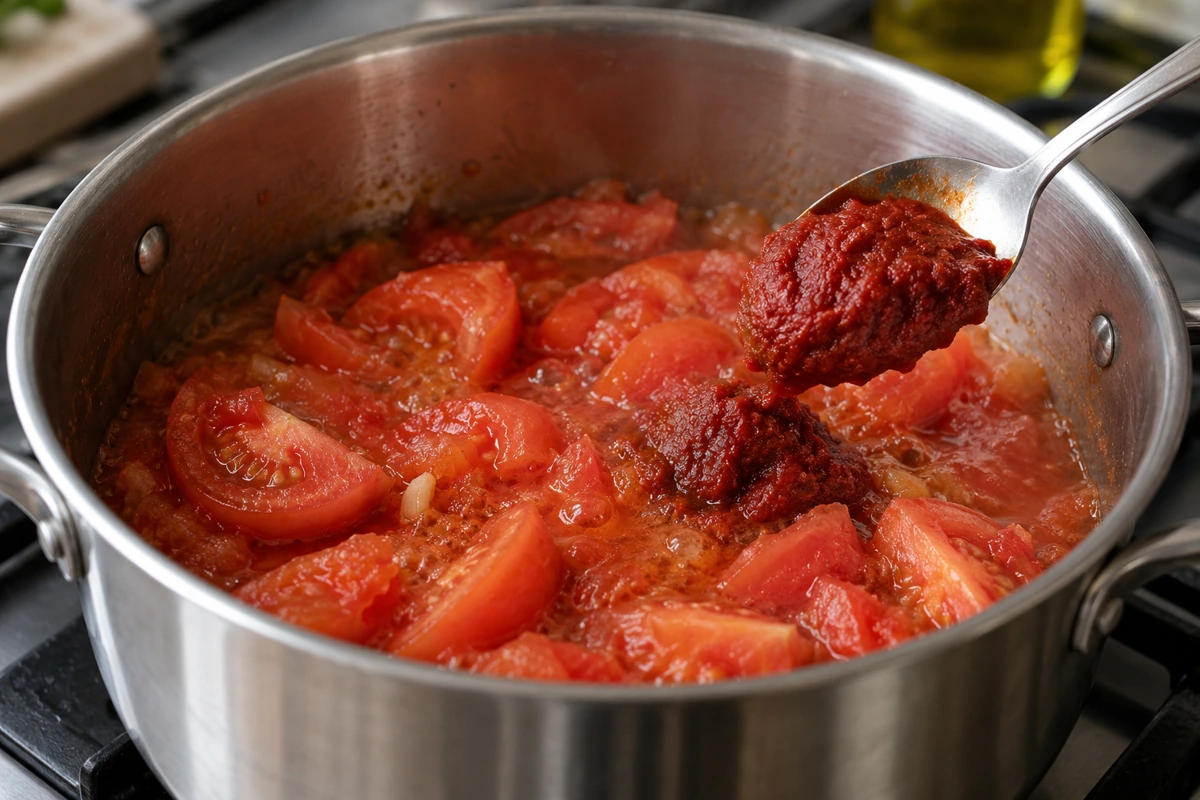
A blend can use wedges for visible material and paste for the continuous sauce phase.
Develop a small set of purposeful trials rather than changing the blend continuously. One trial can establish the required wedge presence, another can test the paste level needed for the sauce phase, and a third can confirm the chosen combination through the complete process. Keep the final target and other ingredient additions controlled so that the comparison answers a defined question.
A repeatable trial sequence can be written as follows:
- Confirm ingredient identity, treatment, analytical basis and representative sample values.
- Calculate the proposed ingredient masses and the complete water and solids balance.
- Prepare the sauce using the planned equipment, loading and process conditions.
- Measure recovered yield and assess consistency, color, flavor and visible pieces at the agreed endpoint.
- Repeat the relevant storage and reheating route before comparing total cost per acceptable finished kilogram.
Record any adjustment made during the trial. Extra water, longer reduction, additional paste or a seasoning change alters both the formula and the cost. The final approved recipe should include those changes explicitly. A trial that reaches the target only through unrecorded intervention cannot support a reliable commercial comparison.
Consider how the blend will be controlled when lots vary. The specification may allow a defined formulation adjustment based on incoming analytical values, or it may require narrower ingredient limits. Either approach needs an approved method and responsibility. The production team should know who authorizes changes and how the final product remains within its agreed requirements.
Build a quote and trial that can be repeated
Request quotations on comparable delivered terms. State the product form, concentration basis where relevant, pack size, quantity, destination and shipment arrangement. Include the intended sauce and any special preparation or documentation requirements. A price for a small order in one pack cannot be compared fairly with a full-load price in another without accounting for the difference.
For frozen wedges, ask for the actual cut geometry, skin and seed retention, treatment, packing and storage specification. Request representative material for the sauce trial and clarify how juice release and recovery will be assessed. For paste, request the concentration method, finish, relevant consistency data, ingredient declaration and pack instructions. These details determine whether the quoted products match the assumptions used in the calculation.
Keep the analytical and commercial records linked. The solids value should correspond to the product being priced or be identified as a specification assumption awaiting confirmation. The recovery value should come from the relevant process or remain clearly labeled as provisional. This prevents a spreadsheet from combining an attractive price from one grade with a favorable concentration from another.

Frozen wedges in a lined carton show the cut and packing form to confirm in the order.
Use sensitivity analysis where the decision is close. Recalculate with the realistic low and high values for concentration, recovery, freight or processing time. The aim is to see whether the preferred route remains useful when normal variation occurs. A small advantage that disappears under a modest change deserves further trial evidence before a purchasing commitment.
At GreenLand-food, we can discuss frozen tomato wedges against your sauce application and prepared reference. Send the required form, specification, packing, quantity, destination, private-label needs and documents. Confirm the actual quote and shipment terms for that request. A paste comparison can be included in your formulation work without implying that every tomato format is offered under the same product specification.
The approved record should contain the final formula, analytical basis, yield, process observations and sensory result. Update the cost calculation when a quote or ingredient specification changes. That keeps the decision grounded in the sauce the business can consistently produce and sell, with the contribution of each tomato ingredient visible in both the recipe and the cost.
Source frozen tomatoes with GreenLand-food
GreenLand-food is a professional frozen tomatoes supplier and manufacturer in China, providing factory-direct wholesale supply for foodservice, importers and food manufacturers.
Send your product form, specification, packing, quantity, application, destination, private-label needs and requested documents. Include your prepared-product reference so we can discuss the cut and order requirements.