


How to Specify a Frozen Berry Blend: Components, Weight Ratios and Substitutions
Oct 19, 2026
Leave a message

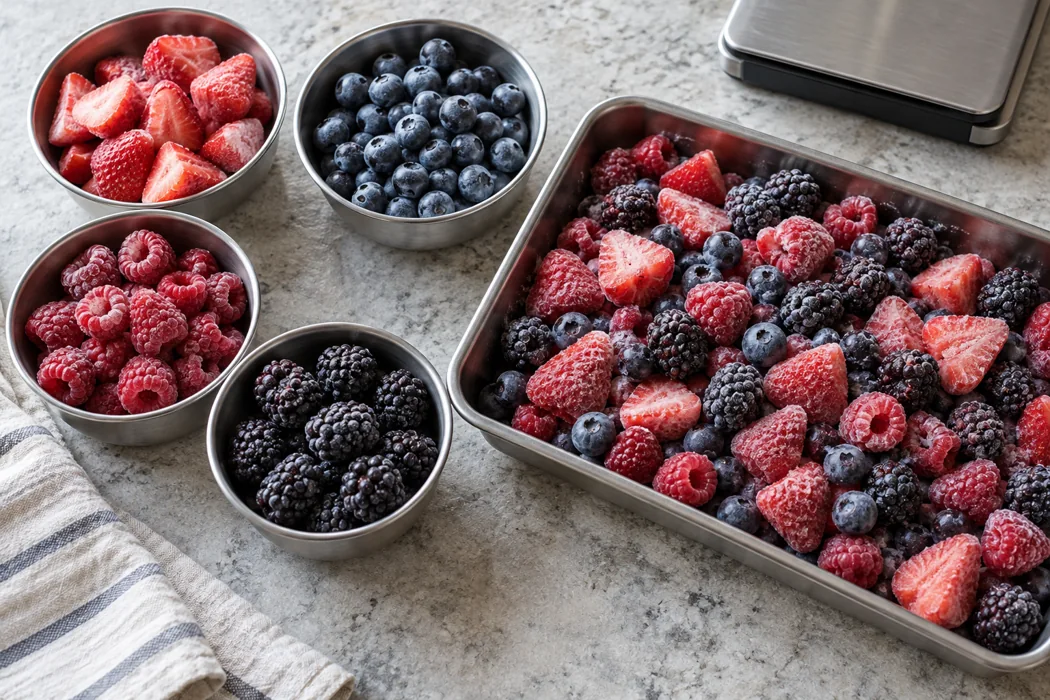
For a buyer, the useful starting point is the finished food. A mix for visible dessert toppings needs different controls from one immediately blended into a sauce. Both need reliable identity and food-safety requirements, but the commercial value of whole fruit, a particular cut and a tightly controlled portion can differ. We recommend approving the formula and its application sample together, then carrying that approval into the order, packing and lot records.
Define each component before agreeing the blend
Begin with a complete list of fruit names. Strawberry, blueberry, raspberry and blackberry describe a familiar combination, yet a commercial "mixed berry" product may contain three of those fruits, add blackcurrant or use another combination. A photograph can help discuss appearance, but it cannot establish an ingredient declaration or a percentage. The approved composition needs its own written record that purchasing, production and the receiving team can all identify.
The component description should continue beyond the common fruit name wherever the distinction matters. Blueberry species or cultivated versus wild supply can affect size distribution and the look of a serving. A raspberry component could be whole fruit, whole and broken material, or crumble. Strawberry may arrive whole, halved, sliced or diced. These are commercial choices with different effects on handling and finished-food appearance, even when the ingredient name printed on a consumer pack stays the same.
Specify the berry form separately for each component. If a request says "whole berry blend" and later allows strawberry dice, the terms are already in conflict. A more useful description might state whole blueberries, whole and broken raspberries, whole blackberries and strawberry halves, with the relevant size or broken-fruit limits agreed independently. Keep any numerical limits clearly identified as the buyer's proposed acceptance criteria until the supplier has confirmed them.

Raspberries, blackberries and small dark berries in a GreenLand-food product photograph; the image does not specify an order formula.
Quality grades also require a reference. The USDA's frozen raspberry grade descriptions distinguish grades for ordinary frozen fruit and for manufacturing. That distinction illustrates why "Grade A" needs its named standard and intended product form. A supplier's internal grade, a voluntary official grade and a buyer's whole-fruit requirement may describe different things. Asking which document defines the term prevents a grade name from becoming a substitute for measurable condition.
Ingredient additions belong in the same identity discussion. Confirm whether the blend is fruit only or contains sugar, syrup, juice, an anticaking ingredient or a prepared fruit component. A sweetened berry preparation can behave differently from plain frozen fruit and can change the label and formulation. Where the product is represented as unsweetened, ask for the actual ingredient statement and the agreed definition used for the destination.
Origin and crop information may be relevant at component level rather than only at the finished mix level. A blend can bring together fruit from separate growing regions and production lots. Request the information required for the customer's approval and market, and establish how it remains connected to the final lot. Avoid assuming that the location where blending takes place establishes where every berry was grown.
The photographs on the corresponding GreenLand-food mixed berry product page are useful references for visible product condition. The formula for an order still needs confirmation. We use the application, component list and requested form to begin that discussion, rather than asking a buyer to infer a specification from the presentation image.
Put weight ratios on a measurable basis
State component proportions as percentages by mass and check that the targets total 100 percent. Equal numbers of four berries do not make equal weights: a strawberry half can weigh much more than a small blueberry. Equal cup volumes introduce another difference because pieces pack together with different air spaces. Weight gives both parties a basis that can be reproduced with a suitable calibrated scale.
An illustrative formula could be 40 percent strawberry, 30 percent blueberry, 20 percent raspberry and 10 percent blackberry. For a 10 kilogram fruit blend, those targets correspond to 4, 3, 2 and 1 kilograms respectively. This example shows the calculation only; it is not a GreenLand standard recipe or a guaranteed available production ratio. The preferred formula should come from sensory and processing trials with the intended components.
Define what is being weighed. For a plain fruit blend, the practical production basis may be the prepared frozen components before mixing. If the contract instead asks for recovered fruit after thawing and draining, the denominator changes and the method must be described. Components release different amounts of juice and lose material differently during separation. A frozen input formula and a drained recovery result answer related but different questions.
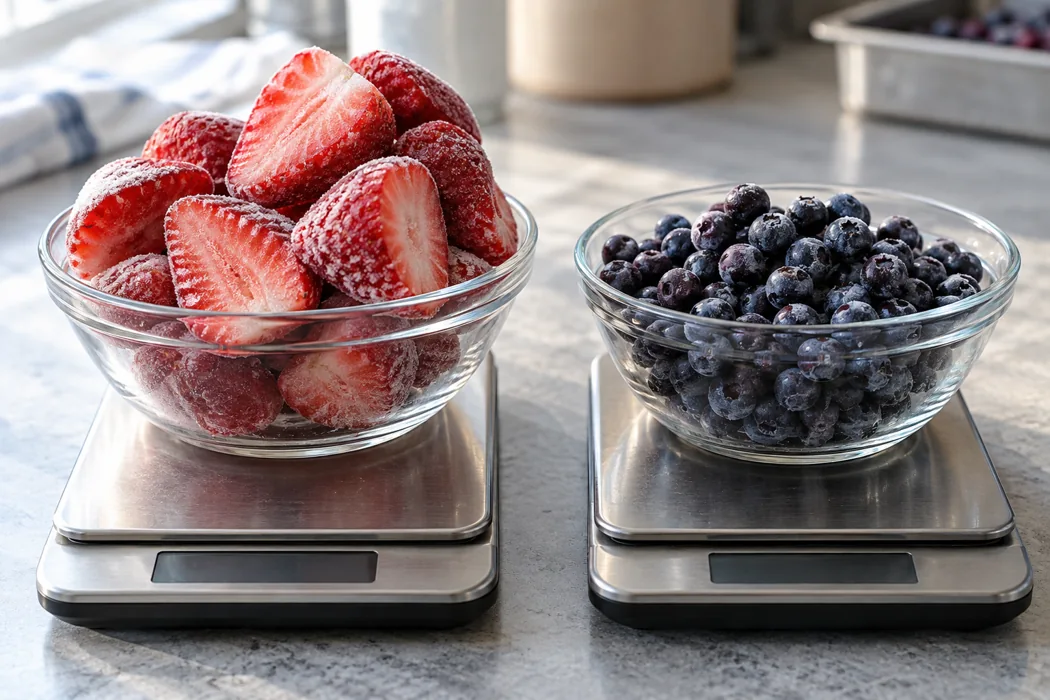
Different fruit sizes make piece counts unsuitable for expressing a blend formula.
Added water, syrup and glaze can make a vague weight basis especially troublesome. Clarify whether the percentage refers to total finished contents, fruit ingredients only, or another legally appropriate declaration basis. Do not silently remove a liquid component from one calculation and include it in another. The procurement formula, nutrition calculation and final label need compatible definitions, with the applicable market rules checked by the responsible label reviewer.
The following comparison shows why the basis should appear beside the numbers.
| Basis | What it describes | Main limitation |
|---|---|---|
| Frozen component input mass | Weighed ingredients entering the blend | Requires reliable weighing and batch records |
| Count of individual pieces | Number of recognizable berries or cuts | Different piece sizes distort mass proportions |
| Cup or scoop volume | Space occupied by the portion | Air gaps and compression change the result |
| Thawed drained mass | Recovered solids after a defined thaw and drain | Juice loss and handling affect each component |
For receiving checks, agree how the input formula will be supported and what physical verification is feasible. Whole fruits may be separated and weighed under controlled conditions. Finely crushed material may not permit reliable component identification after mixing. In that case, documented weighing records, traceable inputs and a validated mixing procedure become particularly important; a photograph of the finished puree cannot recover the original ratio.
The unit of approval matters as well. A production batch might meet its overall formula while a small retail serving contains a different balance because only a few large pieces fit into it. Specify whether the commercial commitment concerns batch composition, packed units, a defined sample or consumer portions. Each additional level of control needs a realistic sampling and production method, and it may influence the chosen cut size or pack format.
Set tolerances that survive sampling
A target ratio needs an agreed allowance for variation, but a tolerance has little meaning without a sampling basis. "Strawberry 40 percent, plus or minus 5" could mean five percentage points, five percent of the target, or an informal expectation. Five percentage points gives a 35–45 percent interval. Five percent relative to a 40 percent target gives a 38–42 percent interval. Write the intended units explicitly.
Do not assign tolerances independently and then forget the total. Every observed component fraction belongs to the same sample and the fractions must add to 100 percent apart from stated measurement treatment. If one component increases, at least one other decreases. A proposed acceptance envelope should be reviewed as a complete composition, including whether it permits combinations that would change the product's flavor or ingredient order.
Choose sample locations to address the way the blend is produced and packed. Material collected only from the top of a carton can miss separation elsewhere. A buyer and supplier can agree increments across relevant packing stages or units, while defining how those increments are selected and handled. The plan should describe the lot, number of units, sample mass, tools, segregation precautions and decision rule. Numbers should be set for the actual risk and process, rather than copied from an unrelated commodity.
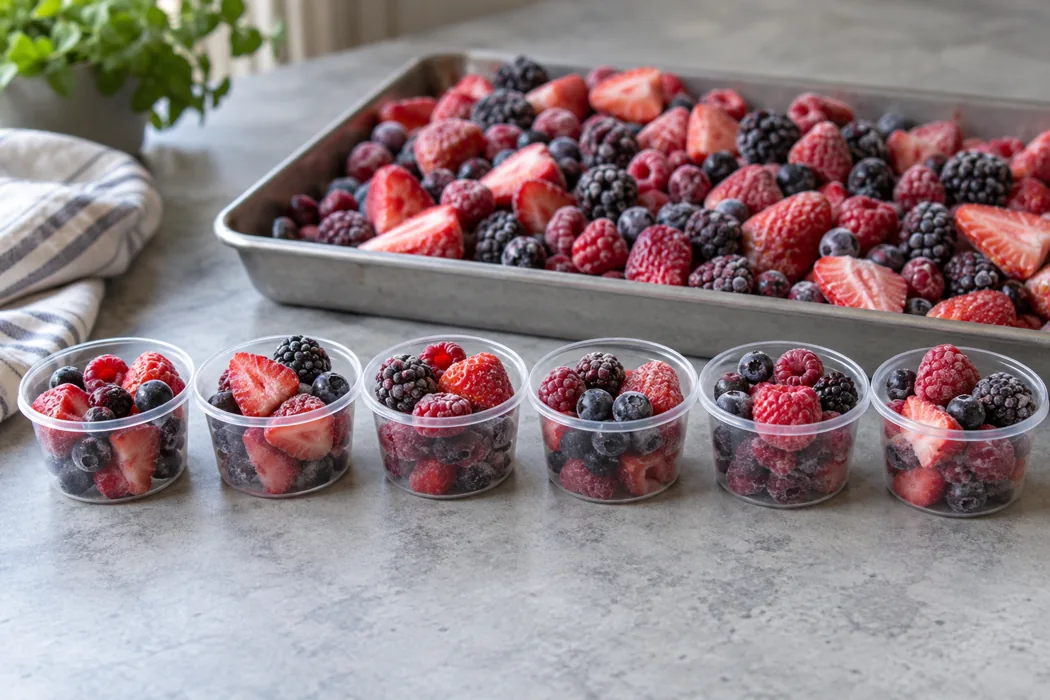
Separate increments help reveal variation hidden by one combined sample.
A combined sample is useful for estimating an overall composition, but combining everything can hide the variability of individual packs. If uniformity across servings is commercially important, preserve some individual observations as well as any composite. Consider two mixes with the same overall blueberry percentage: one may distribute berries relatively evenly, while another gives several blueberry-heavy packs followed by several sparse ones. The overall average alone will not distinguish them.
Keep the separation and weighing method consistent. Record whether the fruit stays frozen during sorting, how fragments are assigned, and how adhering ice or loose juice is treated. If raspberry fragments cannot be distinguished from blackberry fragments, acknowledge that limitation instead of creating precise-looking results from uncertain assignments. A component form that supports reliable checking can be more useful than a very tight tolerance that cannot be measured.
Piece size influences the natural variation in small samples. One extra large strawberry half may move the apparent percentage considerably in a small serving. Increasing sample mass, using smaller specified cuts or accepting a broader portion-level range can each address a different part of the problem. The correct choice depends on what the customer actually needs to remain consistent.
Agree the response to a doubtful result before shipment. A sensible process distinguishes a clear nonconformity from a damaged sample or a method disagreement, defines retention of the original evidence and assigns responsibility for follow-up. Repeatedly drawing samples until one passes undermines the acceptance rule. Our inbound strawberry sampling guide provides background on organizing receiving evidence; the blend requires its own component-specific method.
Match whole fruit and cuts to the application
Whole fruit contributes recognizable shape to a retail bag or topping. That value may justify tighter limits on broken raspberries, soft fruit and detached fragments. A smoothie processor may accept more breakage if the material meets the agreed identity, safety and sensory requirements. The buyer's application determines which physical attributes deserve the tightest control and which would add cost without improving the finished food.
Strawberry cut size often has a large effect on a mixed portion because strawberries can be much larger than the other components. Halves may make the portion look strawberry-heavy even when the mass ratio is correct. Dice can distribute through a bakery batter more evenly, yet cut surfaces may release juice readily during handling. Select the form after checking both the frozen appearance and the result in the customer's recipe.
Raspberry structure brings another consideration. The hollow fruit can fracture during transfer, and fine material can settle differently from larger pieces. An allowance for broken fruit should explain whether it covers recognizable sections, loose drupelets or very fine fragments. These fractions may have different consequences for dosing, bag appearance and seed perception after blending. A single "broken" percentage can conceal those differences.
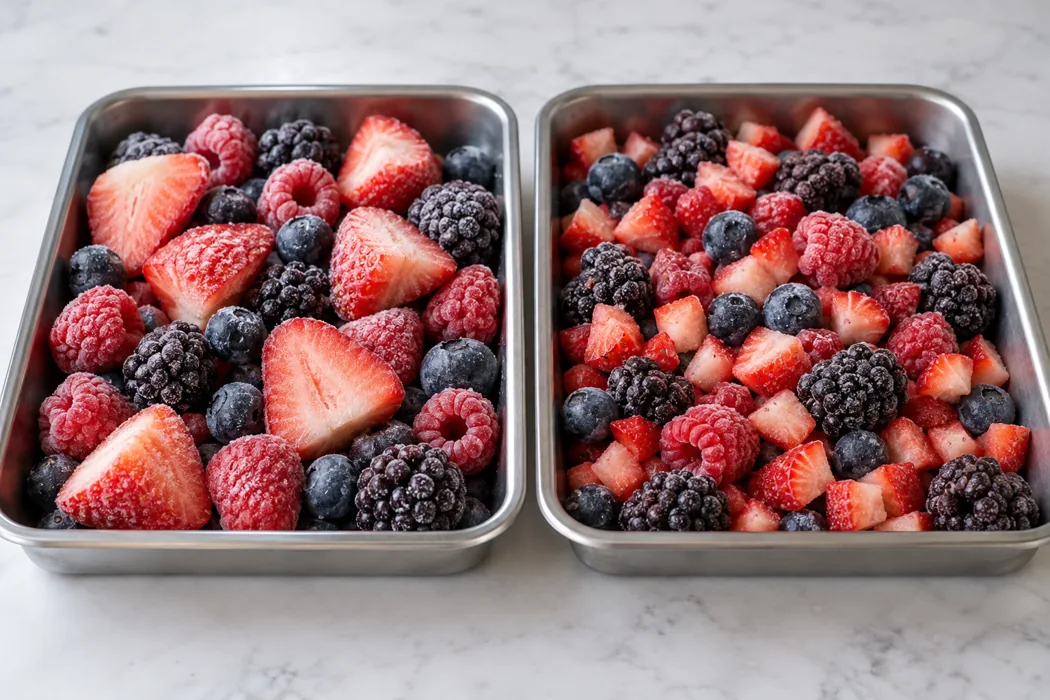
Strawberry cut size changes the physical balance of a mixed berry portion.
Blackberry and blueberry components contribute their own range of sizes, skin condition and seed character. A larger dark berry can make a strong visual impression in a pale dairy base even at a modest proportion. If the finished product will be strained, the recovered yield and retained seed fraction matter more than whole-fruit beauty. Approve the ingredient through the actual refining route instead of assuming that all berry mass becomes saleable smooth puree.
Free-flowing condition deserves a practical definition. A few pieces touching after packing, a loose cluster that separates gently and a hard refrozen block create different handling problems. Agree a check under stated temperature and handling conditions, supported by representative photographs where helpful. Do not use aggressive breaking or warming to make the sample look acceptable if the receiving operation cannot perform the same step.
Application tests should keep the rest of the recipe constant. Compare blends using the same fruit dose, other ingredients, equipment, process and assessment point. If one trial adds extra sugar or liquid without recording it, the apparent improvement may come from the recipe change rather than the berry blend. Record the prepared yield and any fruit or juice discarded during the test.
A single mix can serve several uses, but the approval should identify the limits of that flexibility. A formula accepted for a cooked sauce has not automatically been qualified for an uncooked smoothie or a visible chilled topping. Separate the quality trial from the food-safety route and confirm intended use with the supplier. Freezing preserves the ingredient; it does not by itself provide a validated pathogen-control treatment.
Control substitutions as a formula revision
Substitution should mean a documented change proposal, with enough detail for the buyer to assess the effect. A shortage of one berry can lead to a request to increase another, but a change in origin, cultivar, size, cut or whole-fruit grade may also matter while the headline percentages stay fixed. Define which changes require notification, which require approval and which remain within the existing agreed specification.
For a component replacement, show the original and proposed formulas side by side. The new targets must again total 100 percent. Explain the reason, affected production period, proposed quantity and whether the change is temporary. A temporary formula needs its own identifiable version so that the warehouse and label teams can distinguish it from the usual product.
Evaluate flavor, color and texture in the finished food. Replacing part of a strawberry component with a darker berry may alter color strongly before a casual visual inspection detects the ratio change. Increasing a seedy component can affect a drink even if sweetness is adjusted successfully. The trial should therefore cover the sensory attributes that matter to the actual customer rather than only the appearance of the frozen bag.
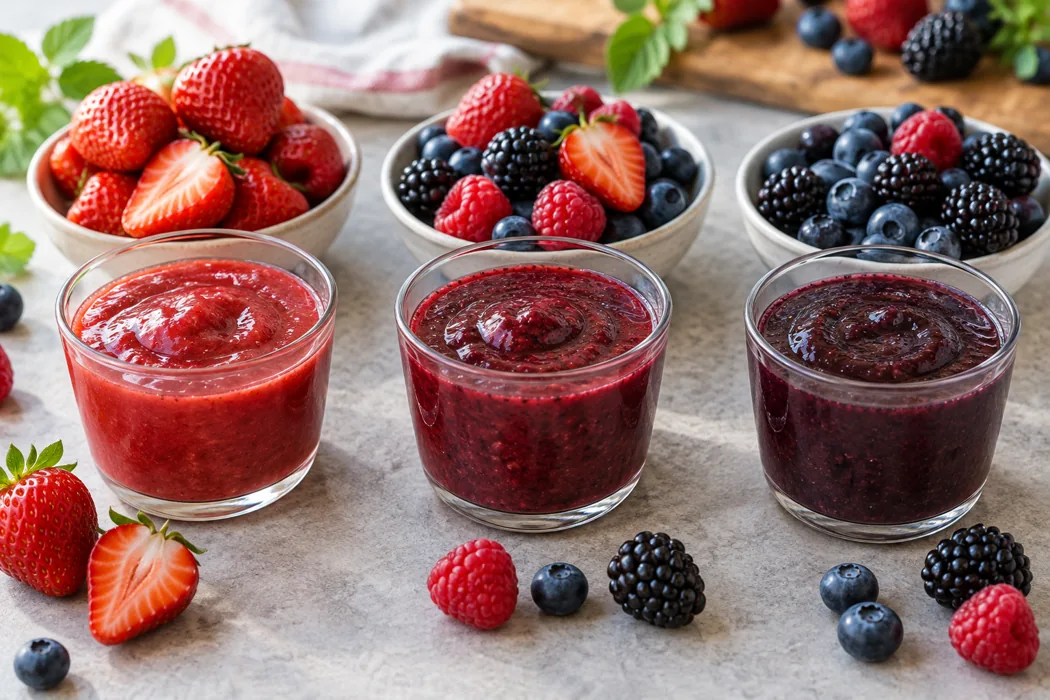
A component substitution can change color and finished-product character.
Nutrition and label implications follow the composition. Ingredient order, highlighted ingredients, images and claims may need review under the destination's rules. A supplier cannot infer from an unchanged product name that the existing artwork remains suitable. Keep label approval connected to the formula version, and ensure old packaging cannot be used inadvertently for an unapproved composition.
The change may also affect safety and traceability information. A new component source can introduce a new grower, processing site or supply route that needs qualification. Existing certificates or test reports must be checked for relevance to the proposed product and facility. A report from the original source is not automatically evidence for a new source, even where the fruit species is the same.
Commercial approval should cover the practical consequences. A different berry may change cost, lead time, carton availability, production scheduling or the minimum economical run. State whether the revised price applies to one shipment or future orders, and clarify any transition stock. The buyer should be able to identify when the revised formula begins and when the standard formula resumes.
Silence should not become the acceptance mechanism. Agree who may approve a change and how that decision reaches production and packing. If the buyer cannot accept the proposed blend, alternatives may include a later shipment, a separate SKU or a different application. Keeping the choices explicit is preferable to allowing a visually similar product to replace the agreed one without a clear record.
Approve a representative blend and its documents
An approval sample should represent the material the buyer expects to receive. Record its component sources, formula version, preparation date and relationship to production. A hand-selected display sample can show the desired appearance, but it cannot establish that routine packed lots will have the same distribution. Ask how the sample was prepared and whether it is a development sample, production sample or retained lot sample.
Compare the frozen sample and the finished application. The frozen check can assess identity, cuts, loose fragments, clumping and visible defects. A controlled thaw or recipe trial can assess juice release, color, seed feel and fruit integrity. Keep preparation conditions with the results so that later samples are compared on a common basis.
The document set should connect the commercial specification to a particular lot. It can include the approved composition, ingredient statement, applicable quality requirements, lot identification, packing information and relevant test or assurance records. Each document needs a clear scope and date. A generic certificate collection may help qualification but cannot replace records that identify the purchased product and production site.

Mixed berries including visible strawberry pieces on a metal sorting surface in a GreenLand-food product photograph.
Separate acceptance criteria from observed results. A specification states what is required; an inspection or analysis report states what was found under a named method. A quotation may describe a proposed option. Treating these documents as interchangeable makes it difficult to know whether a point has been promised, checked or merely discussed.
If a nutrition declaration is required, establish the formula and data basis before final artwork. If a microbiological or residue report is required, agree the applicable criteria, sampling and method with the responsible technical team. Avoid creating a universal test panel from a generic mixed-berry article. The intended use, destination and supply-chain assessment determine what evidence is relevant.
Retain enough approved material and records to investigate a later discrepancy. The retention quantity, storage, duration and access should be suitable for the product and commercial arrangement. A photograph can preserve appearance, while a retained sample may support further examination where its condition remains appropriate. Neither should be presented as a substitute for the other.
We encourage buyers to describe the outcome that must remain stable: visible berry distribution, finished color, smoothie seed feel, sauce yield or another measurable requirement. That allows the sample review to concentrate on the attributes that would change acceptance. The wider frozen fruit solutions page can help frame application and packing options before the blend-specific review.
Carry the approved formula through repeat orders
A repeat order should refer to the approved specification version rather than a product nickname alone. Include the formula, component forms, packing, intended use and the applicable acceptance method. This gives purchasing and production a common reference when crop availability changes or a different employee handles the next shipment.
Track the connection between component lots and the finished blend lot. If a problem concerns one ingredient, the investigation needs to identify which blends received it. Conversely, the buyer may need to trace a finished carton back to several component inputs. Agree the level of traceability and the records available for an investigation before the first commercial delivery.
Packaging can influence the consistency the customer experiences. A large foodservice bag opened repeatedly may be scooped in a way that favors small pieces or exposes the remaining material to warmer conditions. Smaller portion packs may simplify dosing but introduce additional packing cost and their own fill-control requirements. Test the intended pack through the real handling routine.

Retained samples preserve a physical reference for later blend comparisons.
Transport and receiving checks should preserve the distinction between composition and condition. A correctly weighed formula can arrive with unacceptable clumping or damage. A visually attractive mix can have the wrong proportions. Record both types of evidence rather than allowing one passing observation to cancel an unrelated failure.
Review complaints in a way that identifies the actual mechanism. A customer reporting "too many strawberries" may be seeing larger pieces, a genuine mass-ratio change or uneven distribution within a bag. Request the lot code, portion method, sample mass and useful photographs before deciding which explanation fits. If the issue concerns a finished recipe, retain the preparation details as well.
For seasonal or annual supply, discuss component availability early enough to evaluate alternatives. A substitution approved in a controlled development trial is easier to manage than one proposed during a shipment deadline. Keep a separate record of approved alternatives, including any limits on customers, recipes or labels for which they may be used.
The final purchase description should allow another competent person to receive and assess the product without reconstructing the sales conversation. Clear identity, a common weight basis, realistic tolerances, representative sampling and controlled changes make that possible. Send those requirements with the target application and packing so that the next quotation can be assessed against a defined blend.
Source frozen mixed berries with GreenLand-food
GreenLand-food is a professional frozen mixed berries supplier and manufacturer in China, providing factory-direct wholesale supply for importers, food manufacturers, foodservice distributors and private-label programs.
Send your berry components and ratios, required form, specification, packing, quantity, application, destination, private-label needs and requested documents so we can review the supply requirements.