


Napa Cabbage vs Bok Choy and Green Cabbage for Frozen Foods
Oct 19, 2026
Leave a message

A purchase description that says only "Chinese cabbage" leaves too much open. Napa and bok choy can both appear under that name, while a bag of fine chopped napa is functionally different from large napa pieces even when the crop is identical. A noodle soup, a dumpling filling and a ready meal side may therefore need three different approvals.
We would begin a GreenLand discussion with a photograph of the intended ingredient and the food in which it will be used. That makes the first conversation concrete: which vegetable, which part, which cut and which cooked result? The comparison below follows those decisions through preparation, trial and purchasing, without assigning an automatic winner to one vegetable.
Identify the three vegetables before comparing frozen cuts
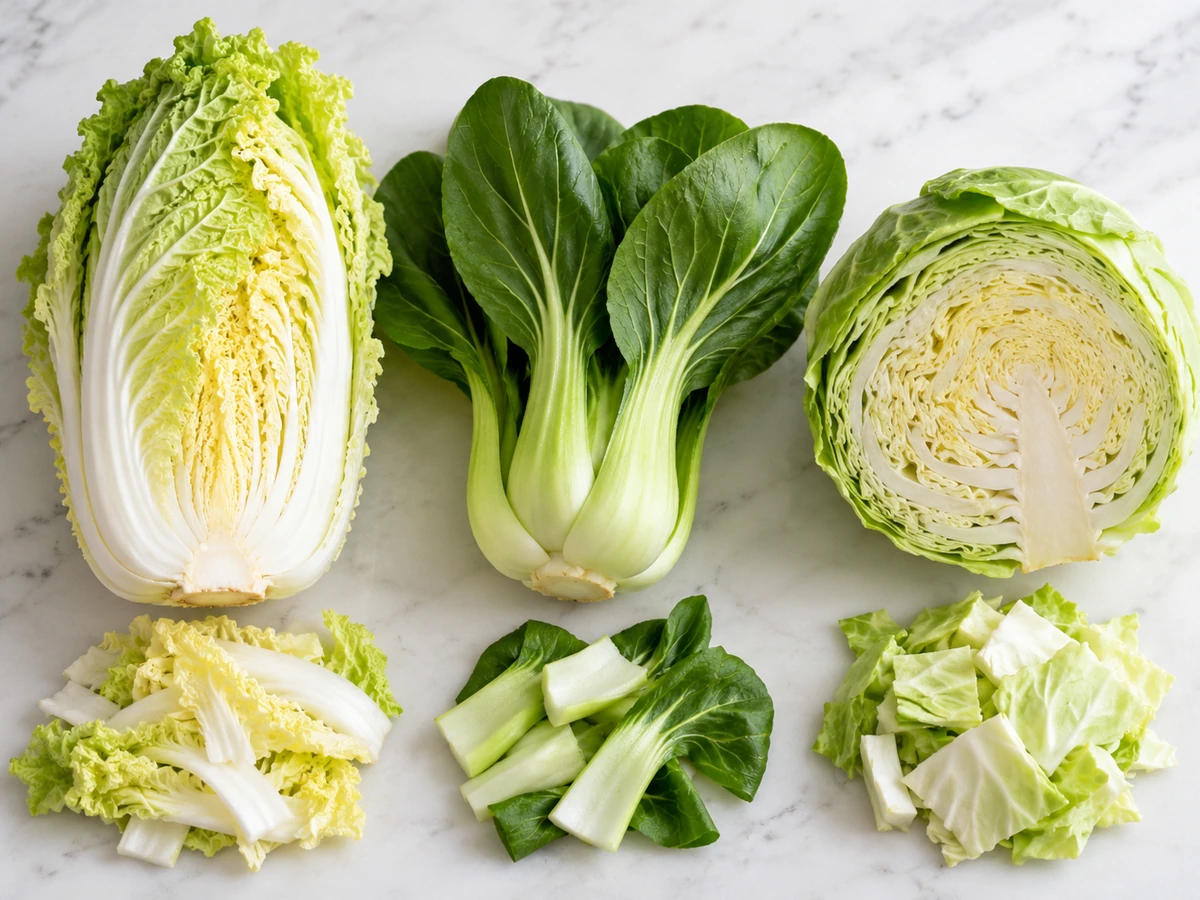
The easiest distinction is the plant's structure. Napa forms an elongated, closely packed head with crinkled pale leaves and broad white ribs. Bok choy grows as a cluster of individual fleshy stalks supporting darker, smoother leaf blades. Round green cabbage forms a compact head of overlapping leaves. The University of Minnesota's crop guide distinguishes napa and bok choy within Brassica rapa, including their different growth habits. That identity remains relevant after cutting, even when the whole plant is no longer recognizable in a bag.
Names should therefore accompany an agreed physical reference. "Napa," "wombok," "Chinese leaf" and "heading Chinese cabbage" may describe the intended napa material in different markets. "Bok choy" and "pak choi" commonly describe the other form. A supplier's translation alone should not decide which arrives. Request the botanical or agreed crop description, cut photograph and sample together, then put the accepted identity into the specification and artwork.
Young bok choy, mature white-stem bok choy and pale-green Shanghai types can also look different. A buyer expecting a small recognizable rosette may be disappointed by chopped mature stalks, even though the name is broadly correct. With napa, the inner pale leaves and outer greener blades can change the appearance of a prepared mix. Round cabbage can likewise differ in density, leaf color and toughness. These are reasons to describe the purchased material precisely; they do not justify guessing cultivar or harvest maturity from one photograph.
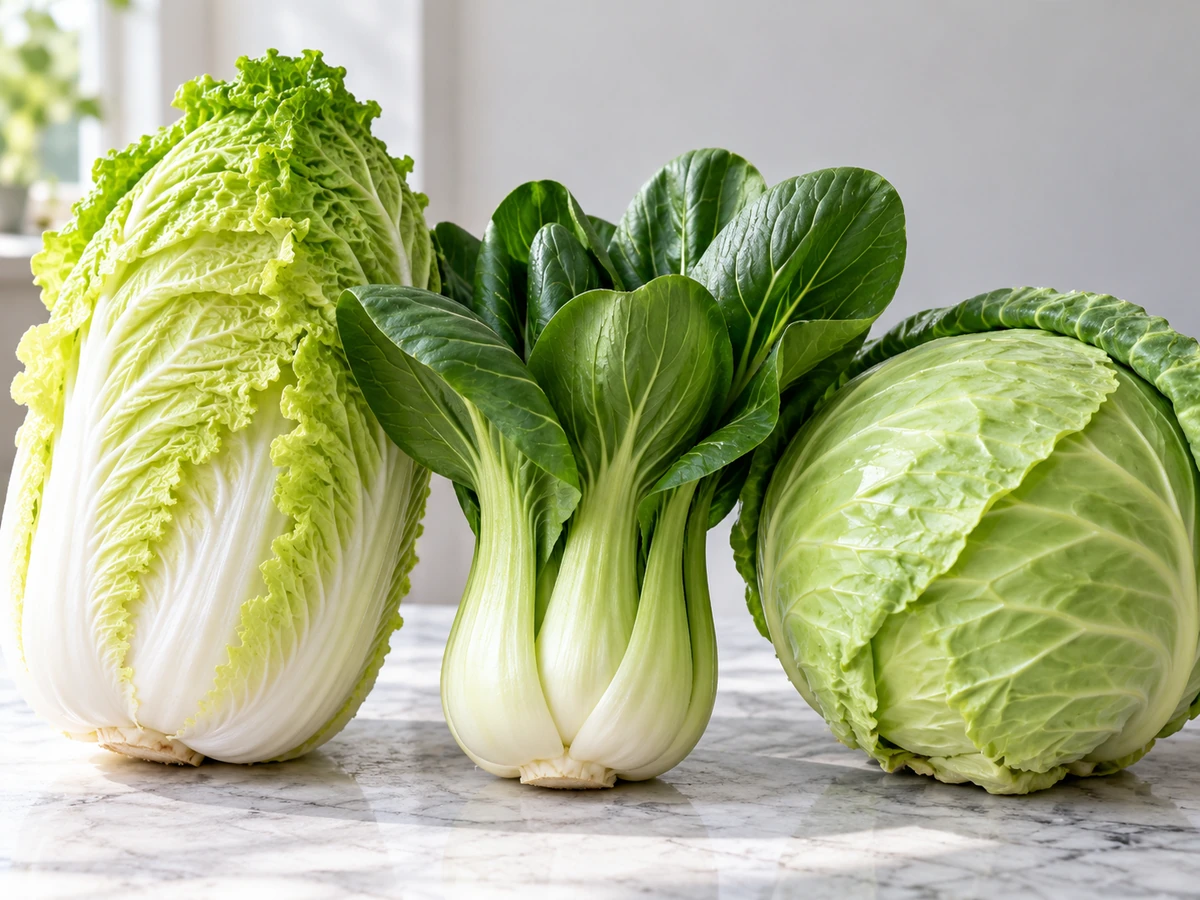
Crinkled napa leaves, fleshy bok choy stalks and tightly layered green cabbage appear side by side.
Once vegetables are finely chopped, the white pieces in a mix deserve attention. Napa ribs, bok choy stalks and round cabbage ribs can all produce pale fragments, but their thickness, shape and relationship to the leaf differ. A product image can help exclude an obvious mismatch, yet a full identity check also needs the supplier description and traceable sample. Photographs should be retained with their source and date so that an attractive reference image does not become detached from the quoted ingredient.
If a label or menu names a particular cabbage, review that description before substituting another crop. Record temporary availability substitutions in the approval so later orders do not alternate between ingredients unintentionally.
For a cross-border order, use the same chosen English product name on the sample request, quotation, approved specification and packing instructions. Where a destination requires another language, review the translation against that identity. If a blend intentionally contains more than one cabbage type, declare the components clearly. This prevents a development-stage substitution from becoming an undocumented change in a repeat order.
Match the leaf and rib structure to the finished food
Leaf and rib are different tissues within the same ingredient. The thin leafy part folds, wilts and occupies volume; the thicker pale part contributes discrete pieces and a different bite. Napa's broad rib can remain recognizable after the blade has softened. Bok choy gives a more obvious stalk-and-leaf contrast, while round green cabbage often produces firmer ribbons when similarly cut. Those descriptions help set a trial expectation, but the frozen product's actual treatment remains decisive.
The UC Davis bok choy fact sheet describes green leaves and lighter fibrous stalks. It concerns fresh produce. In a frozen-food project, its morphology helps explain what to examine; it does not establish a promise that a frozen stalk will retain fresh crunch. A thick piece that looks substantial in the frozen sample may still become soft during a long cook or subsequent reheat.
For a broth-based meal, leaf area can provide a recognizable cabbage presence without requiring a large solid piece in every spoonful. For a fine filling, wide leaf pieces may fold into clumps and distribute unevenly, whereas excessive rib pieces can make the bite feel coarse. For a vegetable side, those same recognizable stalks may be desirable. The useful proportion depends on the food and the point at which it is eaten.

Fine chopped Chinese cabbage contains both pale rib and green leaf fragments.
Assess the prepared mix as well as its separate parts. Fine chopping can make a rib-rich mixture appear pale, while a greener mixture may look larger at the same mass because thin leaves spread across the tray. Comparing photographs by visible area can therefore mislead purchasing. If proportion is commercially important, agree a sorting method and mass basis rather than judging by color alone. Mixed pieces carrying both blade and rib need an explicit treatment in that method.
A simple development conversation can begin with two samples that differ in leaf and rib balance while keeping the nominal cut similar. Cook them in the same base and examine distribution, bite, liquid release and portion appearance. This is a proposed comparison, not a claim that a particular numerical ratio is standard. The selected result should become the reference for later lots, with enough written detail for another person to reproduce the assessment.
We would also separate hard basal material from the ordinary edible rib. A large piece of core can be objectionable for reasons that a normal rib is not. Combining both into a broad "stem percentage" makes the specification harder to interpret and can encourage the wrong correction at preparation.
Choose cuts and freezing formats around the process
Crop identity and cut form are separate purchasing choices. Napa can be requested as a fine chop, larger leaf-and-rib pieces or another agreed presentation. Bok choy can be chopped into stalk segments and leaf pieces, or supplied in a larger recognizable form where available. Green cabbage may be shredded or cut into pieces. Availability and treatment must be confirmed for the actual order; a comparison article cannot establish that every possible form is routinely stocked.
Fine cuts distribute readily through a filling but expose more edges and can produce small fragments. Broad cuts preserve visual identity but may bridge across a scoop, overlap in a pan or cook unevenly if the rib is thick. Long ribbons can wind around mixing equipment or become concentrated in one serving. A nominal width alone does not capture these differences. Length, thickness, the amount of fines and the presence of attached leaf all influence use.
Freezing format adds another decision. Individually separated pieces allow flexible dosing, while a block may suit a process that consumes the entire block under a defined preparation method. A block intended for controlled thawing does not behave like a loose handful dropped into soup. Conversely, buying loose pieces offers little practical benefit if the line always prepares a full batch and the recipe has been validated around a block format.
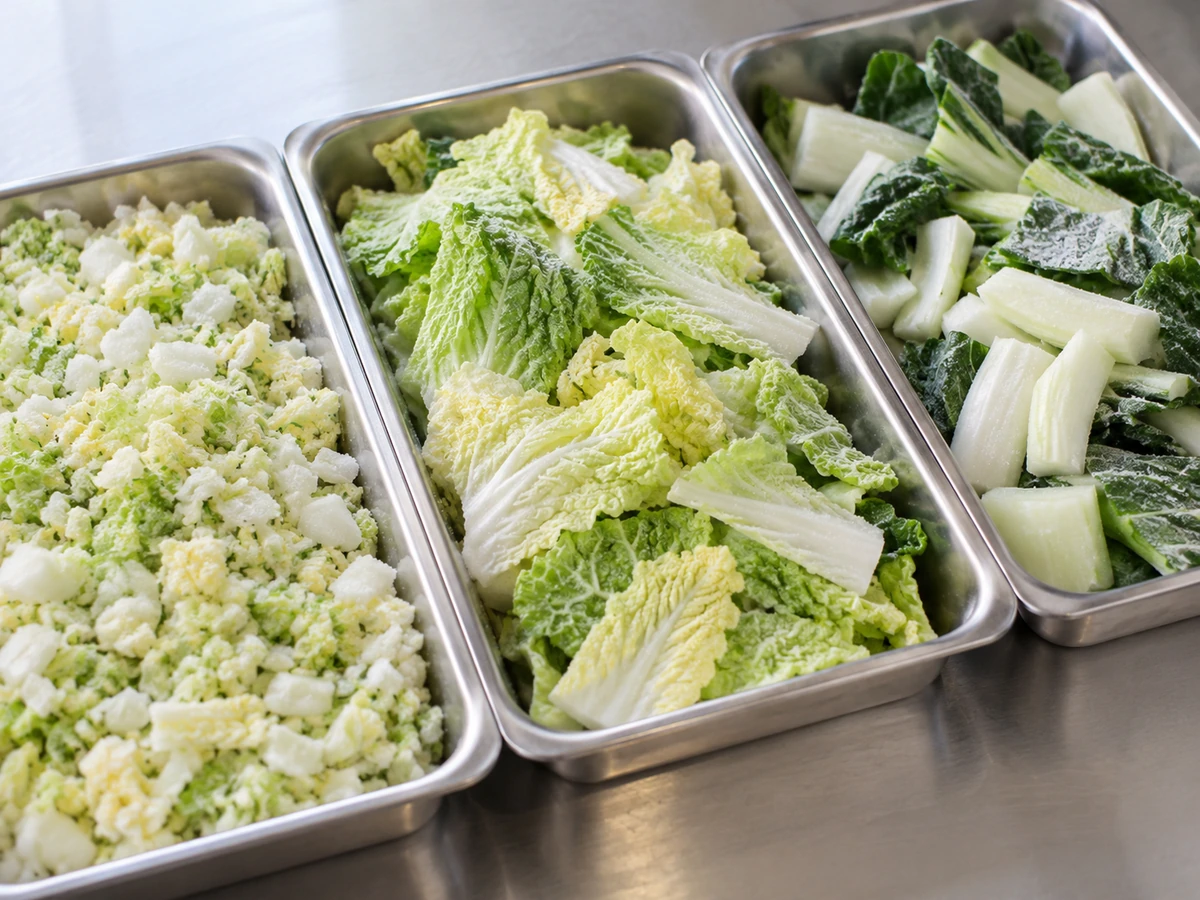
Fine chopped napa, broad napa pieces and bok choy cuts show different particle shapes.
GreenLand's guide to frozen vegetable product forms provides the broader distinction between physical cut and freezing presentation. For these three cabbage choices, make that distinction explicit in the trial record. Describe whether the sample enters cooking frozen, thawed, drained or otherwise prepared, and compare equivalent states when possible. A chilled fresh chop and an icy frozen block are not equivalent starting conditions for evaluating crop choice.
Packaging should support the chosen use. A foodservice operation that takes several portions from one bag needs an opening, reclosure and handling plan compatible with its procedures. A manufacturer consuming a complete inner pack needs that pack weight to match the batch and its equipment. Avoid selecting a larger case merely because its price per kilogram is lower if it forces repeated partial thawing or awkward handling.
The accepted freezing format should also be reflected in the sample sent for approval. A neatly separated handful can look easy to dose while the normal commercial pack handles differently. Request a representative pack where practical and follow the intended opening and preparation sequence. That connects the visual review to the delivered unit and helps the buyer assess labor, portion control and the amount of product retained in the packaging.
Before confirming a cut, ask the receiving and kitchen teams to handle the trial pack. They may notice practical problems that a clean sample tray hides: tightly compacted pieces, long strips catching in a dispenser, or delicate leaves breaking during separation. Include these observations in form approval so that the purchased ingredient fits the work as well as the plate.
Account for water release when changing the ingredient
Frozen cabbage can release liquid during thawing and cooking. Some comes from the tissue, and some may be associated with surface water or adhering ice. A buyer who weighs the incoming frozen material and then weighs drained solids is measuring a preparation yield, not automatically the vegetable's total moisture content. The method used to reach the drained state strongly affects that result.
University of Minnesota freezing guidance explains that ice formation can damage plant structure and soften thawed produce. This supports a realistic expectation of texture change. It does not predict which supplier's napa, bok choy or green cabbage will release the most liquid under a particular industrial process. Cut size, pretreatment and storage history need to be considered with the crop.
Start with the liquid's destination in the recipe. A soup may retain cabbage liquid in its broth, where the concern is final concentration and the amount of visible solids. A dumpling filling may need a defined drainage step before weighing the ingredient into the mix. A stir fry depends on evaporation capacity and an appropriate load. The same released water can be manageable in one application and troublesome in another.
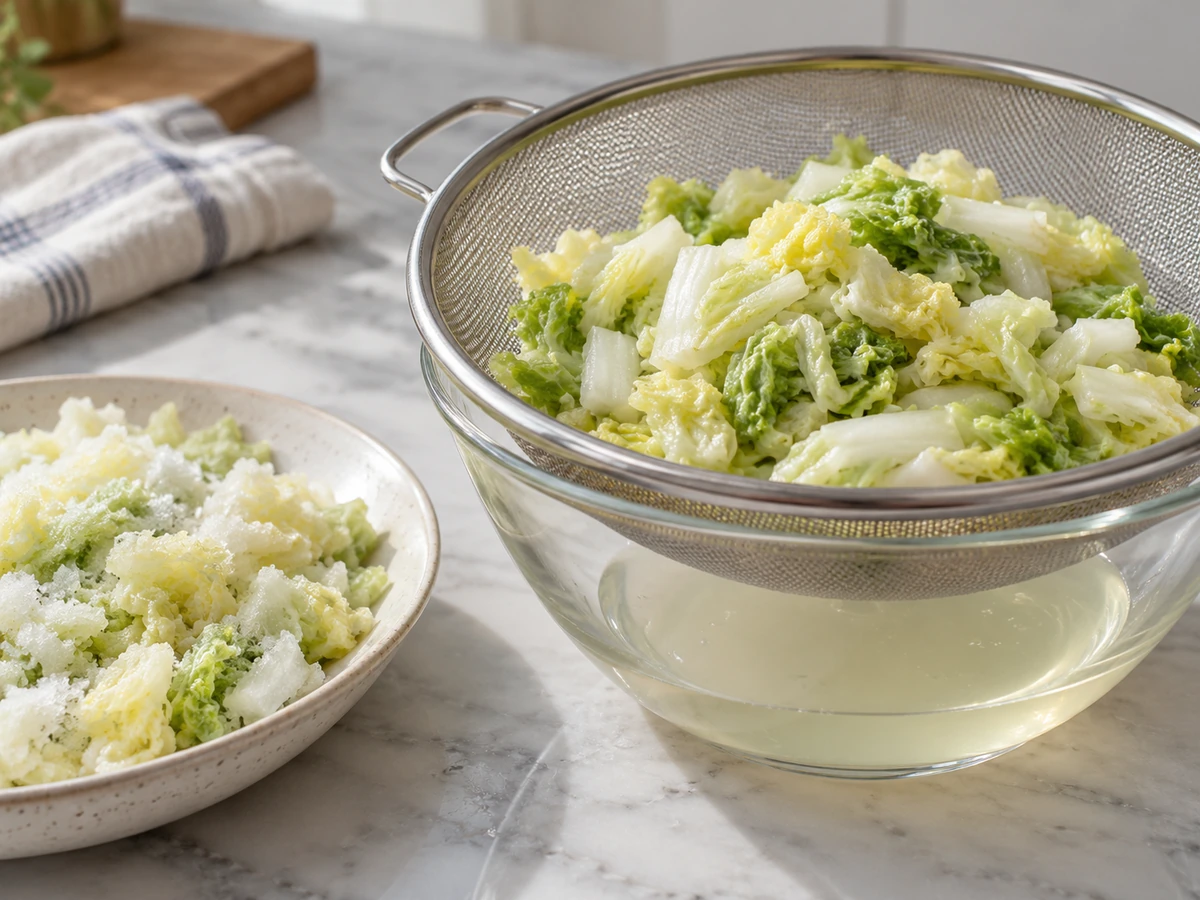
A sieve holds cabbage solids above the liquid collected during drainage.
For a fair comparison, define the initial mass, preparation condition, drainage time, sieve or vessel and any applied pressure. Keep the method unchanged between samples. Gravity drainage and hand squeezing produce different material; calling both "drained cabbage" makes the comparison ambiguous. If the factory uses a press, centrifugal dewatering or another treatment, the trial should reflect the confirmed process or clearly record how the bench method differs.
Record the prepared mass and the observed condition together. A higher retained mass may be useful, but it can also reflect more water left in the material. A drier sample may improve sealing in a filling while reducing usable yield and changing the texture. No single number resolves all these outcomes. Relate the result to the food's finished weight, eating quality and processing behavior.
When changing cabbage type, avoid correcting water, seasoning and binder all at once in the first comparison. Begin with the existing formula and controlled preparation, observe the difference, then make one justified adjustment. Otherwise, the team may approve a heavily reformulated meal without understanding whether the cabbage substitution itself was acceptable. Keep the original comparison result alongside the adjusted version so purchasing can see what the new ingredient requires.
Compare the vegetables in soup, stir fry and fillings
A soup trial asks whether the cabbage remains recognizable, gives the desired tenderness and leaves the broth at the intended strength. Napa is a useful candidate when soft leaves and pale ribs are part of the eating experience. Bok choy can contribute darker leaves and more distinct stalk segments. Green cabbage can give a firmer ribbon and a stronger cabbage presence, depending on the cut and cook. Approve the final portion at the planned service time rather than judging the first spoonful from the pot.
In a stir fry, the equipment and load can overwhelm small differences between crops. A crowded pan may steam all three, while a wide pan with controlled portions gives moisture a route to escape. Fine napa leaves can soften before thick ribs reach the preferred bite. Bok choy stalk sections may likewise need a different sequence from their blades. A premixed frozen cut limits how much separation is possible, so select a cut that works as delivered.
Fillings require another comparison. Finely prepared napa can distribute through meat, mushroom or vegetable mixtures, but its drainage and particle size need to fit the wrapper and depositing process. Bok choy and green cabbage can also be candidates for particular recipes, with their own flavor and texture effects. A substitution must be evaluated after forming, freezing if applicable, and cooking the finished product.
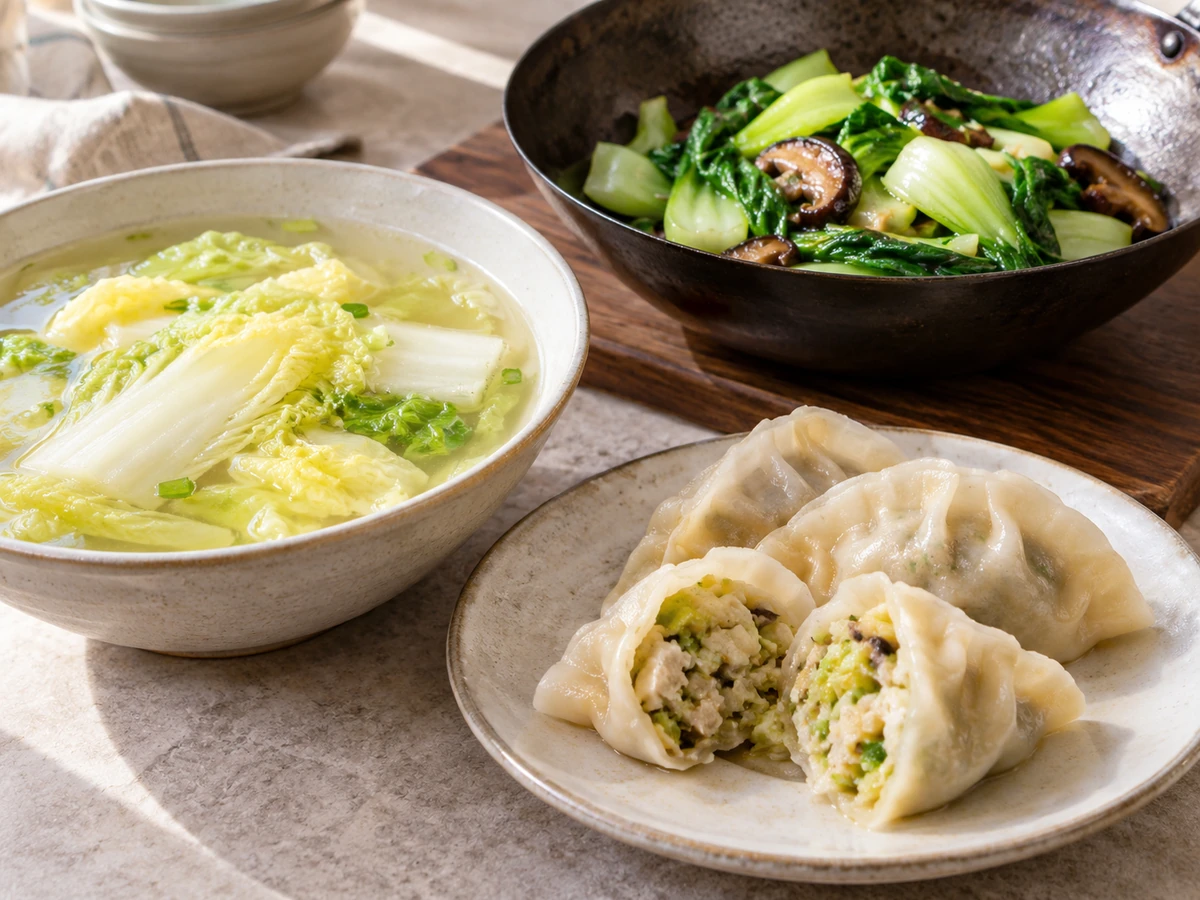
Broad cabbage pieces appear in soup and a wok dish; fine cabbage appears inside a dumpling.
Scroll horizontally to compare all columns.
| Application | Napa cabbage focus | Bok choy focus | Green cabbage focus |
|---|---|---|---|
| Soup or hot pot | Leaf integrity and tender pale ribs | Stalk tenderness and dark-leaf appearance | Ribbon thickness and firmness after holding |
| Stir fry | Water evaporation before leaves collapse | Balance of stalk and leaf cooking | Cut thickness and desired cabbage bite |
| Dumpling filling | Drained yield and fine rib distribution | Stalk particle size and flavor fit | Shred length and texture within the wrapper |
| Reheated ready meal | Survival of delicate leaves through reheating | Stalk center and final leaf color | Softening during the complete heat history |
This comparison identifies trial questions rather than ranking products. An unusually thick napa cut may need more cooking than a thin green-cabbage shred; a heavily pretreated bok choy stalk may be softer than expected. The actual supplied form can reverse a broad culinary expectation. Use the table to select observations and then let the measured trial decide.
Fresh raw applications require separate consideration. The National Center for Home Food Preservation directs frozen cabbage and Chinese cabbage toward cooked use. A fresh salad or kimchi recipe therefore cannot serve as evidence that plain frozen cabbage will provide the same texture or preparation suitability. Where the finished product has a different validated process, assess that product on its own evidence and instructions.
Run a substitution trial through the complete meal process
A substitution trial should begin with the current accepted ingredient and a clear reason for considering a change. That reason may be a desired visual effect, a cut more suitable for equipment, supply planning or cost per finished portion. Write down the quality feature that must be preserved before examining the alternative. Otherwise, a team can gradually redefine success around whichever sample is easiest to obtain.
Keep the first trial small enough to control, but representative of the real process. Use the intended broth or filling base, the actual cabbage preparation state and a practical batch load. Record the added mass, equipment, sequence and endpoint. If the alternative requires another cut, say so: the trial is then comparing two ingredient systems rather than crop species alone. Both comparisons can be useful when described accurately.
At the end of cooking, assess the same attributes on both samples. For soup, these might include recognizable solids and broth strength. For a side dish, examine leaf condition, rib bite and the amount of free liquid in the serving. For a dumpling, inspect filling distribution, wrapper condition and the cooked interior. Use actual observations and retain a reference photograph under the same light.
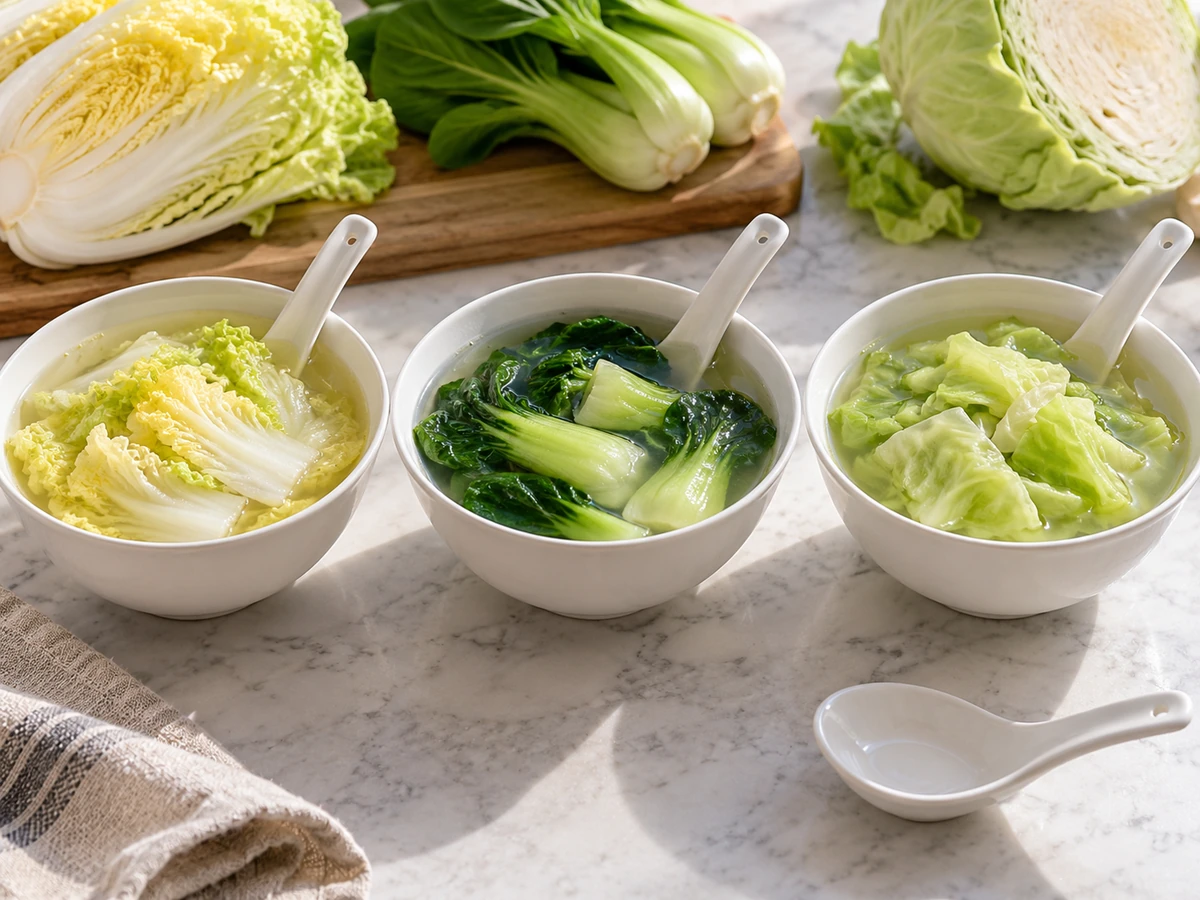
The cooked vegetables retain different visible piece shapes in similar bowls of broth.
Continue through holding and reheating when those stages are part of the product. A cabbage that looks attractive at the stove may break down in a service container or after the consumer reheats a frozen meal. A test stopped at the first cook misses that difference. The relevant endpoint is the food the customer receives, with the site's required safety controls maintained throughout the trial.
Repeat the selected process on more than one pack and, when practical, another production lot. The first sample may be more uniform than routine supply. Ask whether the same cut distribution and treatment can be supplied consistently within an agreed range. Any change in preparation time, drainage loss or labor should enter the cost review alongside ingredient price.
An illustrative cost calculation can clarify the decision without pretending to be a supplier quote. If one ingredient costs less per incoming kilogram but requires more incoming material or more labor to achieve the same finished portion, the apparent saving may disappear. Use measured trial yield and actual quoted prices in the calculation. Keep safety approval, sensory acceptance and commercial costing as identifiable decisions so that a low price cannot silently override a failed product requirement.
Write a purchase description that protects the approved result
The approved purchase description should preserve what made the trial work. Name the crop and form, define the important cut dimensions, state the processing status and describe the preparation condition used for approval. If a particular leaf and rib balance matters, include its method and agreed range. Avoid using "premium," "tender" or "uniform" as the only quality language when teams need to make a receiving decision.
Attach the sample identity to the specification. Record the supplier sample reference, date, pack details and intended application. Photographs can show the expected distribution of pieces and representative borderline material, but they should support a written rule. A close-up selected from the best part of a tray cannot represent the whole lot or replace a sampling plan.
The GreenLand frozen Chinese cabbage product page is the relevant starting point for a napa-type enquiry. We would confirm heading-cabbage identity, available cut, preparation status and the target cooked use before agreeing the order. Product-page imagery shows a reference form; the actual sample and written order establish what is being supplied.

Cut Chinese cabbage is spread across a sorting table.
For repeat supply, identify which changes require review. A different raw-material source, a substantial shift in rib thickness, a changed blanching route or another freezing format can affect the approved meal. The supplier and buyer should agree how such changes are communicated and when a new trial is needed. The objective is to preserve a reproducible result while allowing transparent, evaluated adjustments.
Packing, quantity and timing follow that product decision. Confirm inner-pack weight, carton arrangement, handling requirements and destination with the quotation. Crop timing and available production windows should be discussed against the actual volume and shipment plan; a generic season in an online listing is not a delivery commitment. Requested reports and traceability documents likewise need a defined product and lot scope.
At receipt, compare the delivered identity, pack condition and representative frozen sample with the agreed reference. If a performance concern appears, retain the affected sample and the preparation record before changing the recipe. That evidence helps distinguish a wrong cabbage form from a cooking or handling difference. A useful cabbage comparison ends with both teams able to recognize the approved ingredient and reproduce its role in the finished food.
Source Frozen Chinese Cabbage with GreenLand-food
GreenLand-food is a professional frozen Chinese cabbage supplier and manufacturer in China, providing factory-direct wholesale supply for importers, food manufacturers, foodservice distributors and private-label programs.
Send your product form, specification, packing, quantity, application and destination. Include private-label needs and requested documents so we can confirm the supply details with your purchasing team.