


Romanesco in Mixed Vegetable Portions: Keeping Color and Shape Visible
Oct 19, 2026
Leave a message

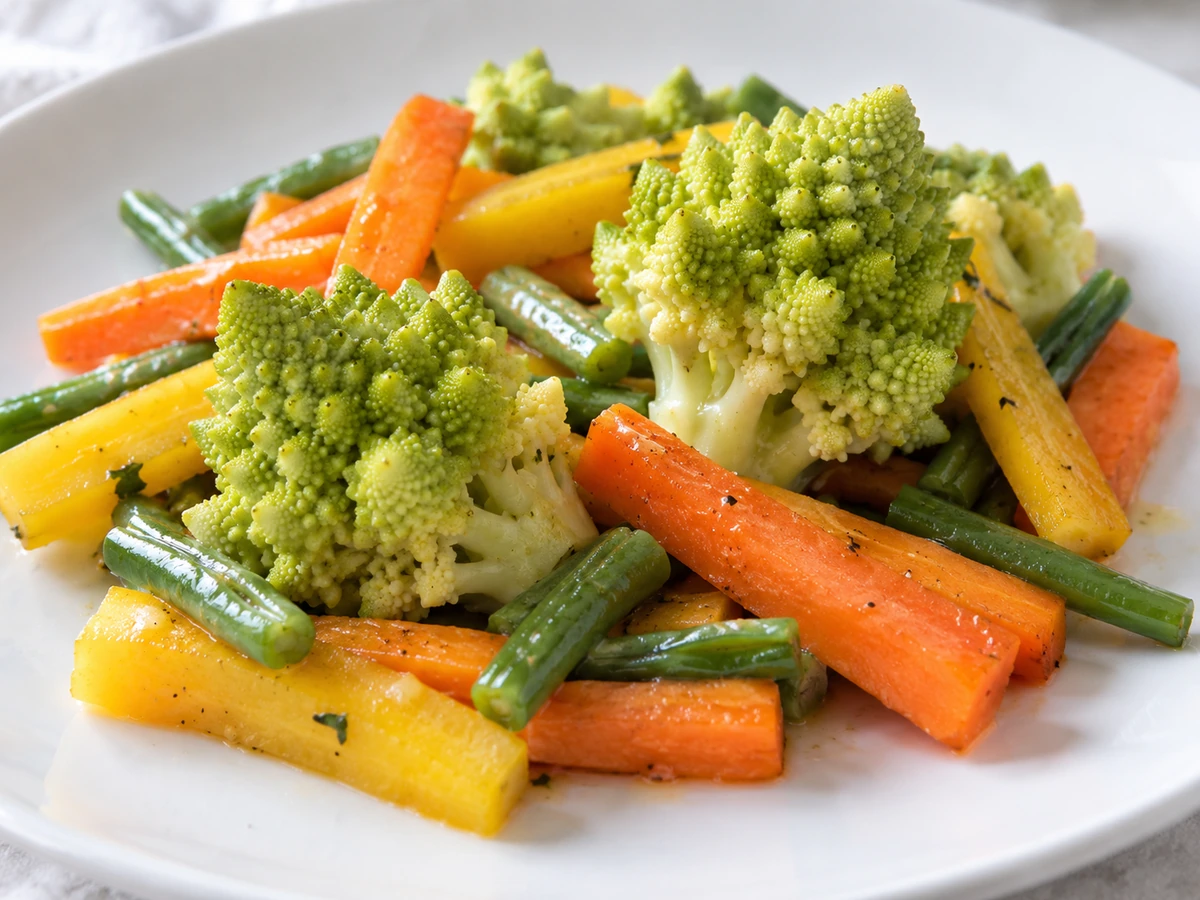
Begin with the finished serving. Decide whether Romanesco should be an occasional accent, a regular visible component or the central feature of the mixture. Then choose the floret form and accompanying cuts, and test a sequence of ordinary portions from the proposed blend. A carefully arranged display plate can show the concept, but it cannot establish what a kitchen or filling line will deliver repeatedly.
For GreenLand-food enquiries, this is a formulation and application discussion as well as a supply discussion. We recommend describing the serving vessel, portion size, cooking route and expected Romanesco presence alongside the requested recipe. The following framework helps a buyer connect the blend formula to a realistic portion, while keeping color, shape, cooking performance and commercial specification in view.
Decide how much Romanesco the eater should see
A blend needs a clear visual purpose before its percentages are chosen. Romanesco can provide a chartreuse point of interest among orange carrots and green beans, or a more prominent crown beside pale cauliflower. In each case the intended effect should be visible at normal eating distance. A tiny fragment that looks attractive in a macro photograph may disappear in a full meal tray.
Describe the expected serving in practical terms. If Romanesco is a named feature on the menu, consider whether most ordinary portions should show one or more recognizable crowns. If it is simply one ingredient in a broad mixture, the expectation may be less specific. Any count or frequency target must be agreed and tested; it should not be inferred from a generic product photograph or a small number of arranged examples.
Look at the whole meal rather than the vegetable component in isolation. Dark sauce, rice, pasta or another green ingredient can change the prominence of the spiral. The container depth also matters: a shallow side dish exposes more of the vegetable surface than a deep cup. Trial the actual vessel and the normal portion weight before deciding that the formula needs more Romanesco.
Separate crown presence from total Romanesco mass. Long stems can contribute substantial ingredient weight while adding less of the pointed surface the buyer wants to show. A blend containing intact crowns with modest stems can present differently from another blend with the same ingredient percentage and more loose stems. The component specification therefore belongs alongside the recipe percentage.
Current commercial mixes illustrate the range of approaches. Darta's Romanesco mix combines Romanesco with cauliflower pieces and baby carrots, while other supplier mixtures use strips and cut beans. These are different product designs. Their existence does not establish an ideal recipe for another buyer; it shows why the component combination needs to follow the application and serving goal.

Actual Romanesco crowns and stems
Write a short visual brief for the sample request. Describe the role of the crown, the preferred size relative to the surrounding vegetables and the appearance after cooking. Attach a photograph of the intended serving if available, making clear whether it is a concept or an approved reference. This gives the supplier a concrete objective and helps the buyer judge samples by the same purpose.
The menu description can help set the expectation. A side called mixed garden vegetables gives the eater a different promise from a dish named for Romanesco. If the ingredient is prominent in the name or pack image, its presence deserves closer attention in the ordinary serving trial. Align that promise with the actual recipe and process before finalizing artwork or menu copy.
Match the surrounding cuts to the spiral floret
The surrounding cuts determine whether Romanesco looks deliberate or awkward in the mixture. Small bean pieces, long carrot strips and broad cauliflower florets occupy space differently. A Romanesco crown can sit above narrow cuts and remain visible, or become concealed beneath larger pieces. Compare components at their actual supplied size rather than judging them from separately scaled product photographs.
Choose a useful relationship between dimensions. The objective is not necessarily identical sizes; a mixture can benefit from contrasting shapes. It does need a combination that portions, cooks and fits the vessel sensibly. A very large crown alongside tiny dice may make filling uneven, while many small green fragments may provide color without a recognizable spiral. Trial the proposed combination in a normal scoop or filling operation.
Stem thickness deserves attention even when crown size looks suitable. A thick Romanesco base may need a different exposure from a thin carrot strip or a short bean. Changing the floret width alone may leave that mismatch unresolved. Ask for the component forms and any relevant treatment state, then judge whether the mixture can reach an acceptable final result under the intended preparation instructions.
Color contrast should be assessed after cooking. Frozen frost can lighten a sample, and a fresh product photo may not represent the cooked component. Orange and yellow carrots can make Romanesco's green shape easier to distinguish, but the exact balance depends on the whole dish. View the trial in ordinary service lighting and with the planned sauce, not only under bright photographic lights.

Romanesco floret size reference
The authentic floret and caliper photographs help identify the available Romanesco form. They are not a specification for an entire mix. Our guide to frozen vegetable cut size explains why dimensions and tolerances need a defined method. For a mixture, apply that thinking to each component and then evaluate how the components work together.
When choosing among sample variants, keep the recipe percentage constant if the purpose is to compare cut size. If both the percentage and the cut change at once, it becomes difficult to identify which caused the better portion. Once a promising size relationship is found, adjust the formula separately and repeat the serving trial. This produces clearer evidence with fewer ambiguous comparisons.
Turn blend percentage into portion expectations
A recipe percentage describes the blend as defined by its formula or measurement method. It does not by itself describe the number of Romanesco pieces in an individual serving. Larger florets mean fewer pieces for a given component mass. Smaller complete florets may distribute more frequently, while fragments add mass without providing the same visible crown. The distinction is central when the appearance is part of the product's promise.
Use a simple calculation to plan a trial, keeping all weights on the same basis. In an illustrative 150 g frozen portion containing a nominal 20% Romanesco by mass, the allocation is 30 g of frozen Romanesco. If a hypothetical intact frozen floret averages 10 g and that allocation consists entirely of such florets, the mass is equivalent to three average pieces. These invented values illustrate the calculation; they neither recommend a recipe nor guarantee three crowns in every portion. Cooked portion weights require a separate measurement because the components may gain or lose different amounts of water.
Real pieces vary in mass, and scooping does not allocate each ingredient perfectly. A serving may contain a larger crown, several smaller ones or an uneven share of surrounding vegetables. The useful next step is to portion the actual sample repeatedly and record what appears. Inspect the normal serving sequence, including early and late portions from the container, rather than repeatedly rearranging the mix until a sample looks ideal.
If the buyer needs a particular visible presence, define it independently from composition. One proposed criterion could describe the share of tested portions containing at least the agreed number of recognizable crowns. Another could specify an acceptable range of Romanesco component mass in defined portions. These are different measurements and require an agreed sampling plan. Neither should be advertised as a guarantee before the actual process supports it.
The historical Alasko Romanesco mix sheet provides an example of a component percentage together with a floret size band. It is useful because both attributes are stated. It does not supply a universal portion-count rule. A buyer developing a different recipe needs its own current component specification and a trial of the filling and cooking sequence.
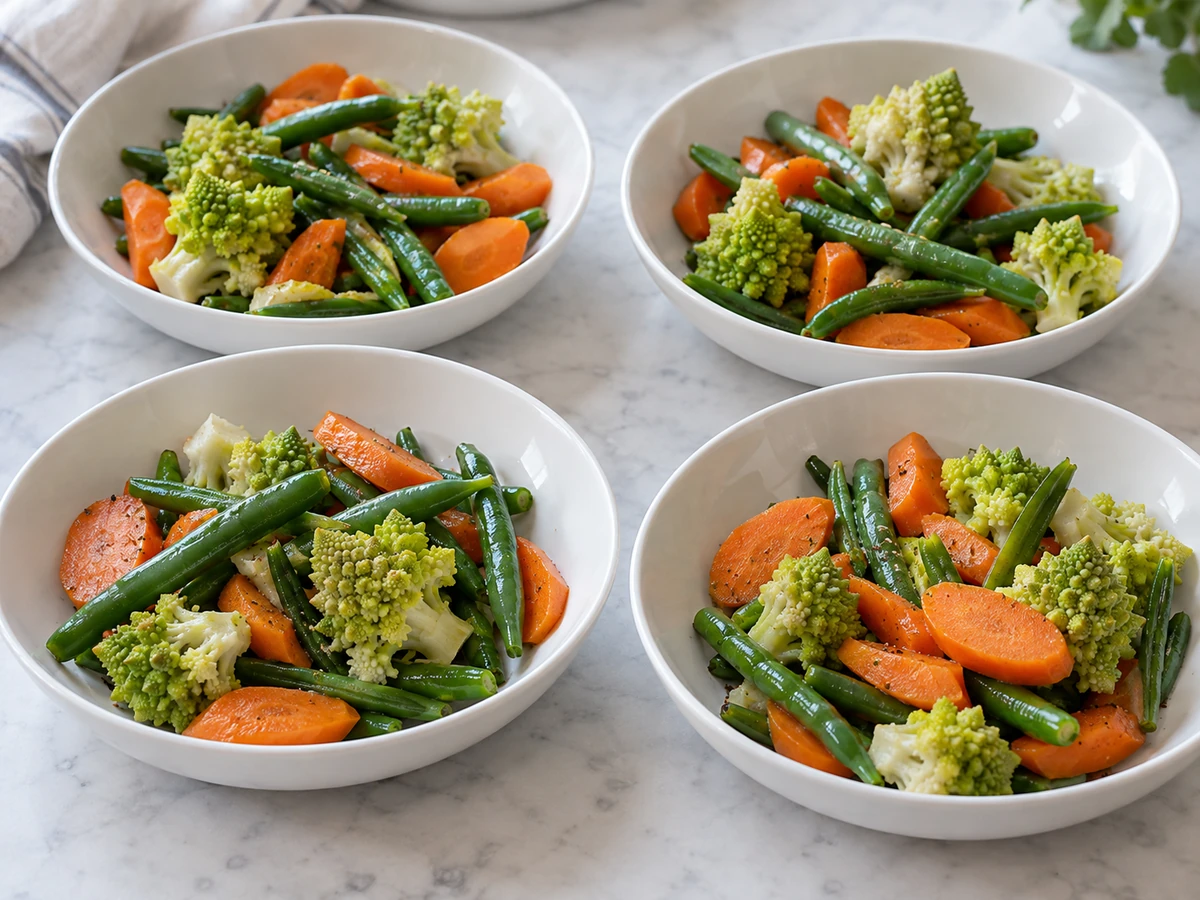
Four bowls show different arrangements of Romanesco and companion vegetables.
Keep mass balance and presentation observations together in the trial report. A visually disappointing serving may still match the formula, which suggests the form or distribution needs work. A visually attractive arranged plate may conceal a recipe inconsistency. Reviewing both prevents a team from correcting the wrong variable or accepting an improvement that exists only in the photographed sample.
Changing the hypothetical average floret mass to 15 g would make the same 30 g frozen allocation equivalent to two average pieces. The formula share remains 20%, but fewer, larger pieces may be distributed less evenly by the same scoop or filler. Test that possibility using the actual piece-weight range and the normal portioning process. Detached stems and fragments still contribute component mass, so record them separately when the goal is a count of recognizable crowns.
Record the range of piece weights or sizes when it materially affects the portion. An average alone can hide a mixture of very large and very small florets. Two samples with the same average may produce different serving consistency if one has a much wider spread. The practical trial should therefore inspect the whole sample distribution and the sequence of portions, rather than choosing a few pieces whose average looks suitable.
Reduce separation while mixing and filling
A mixed vegetable product can separate during handling because its pieces differ in size, shape and movement. Small cuts can settle into spaces while larger crowns remain more exposed. The degree depends on the actual equipment and product, so the buyer should observe the proposed operation rather than assume a general rule predicts every blend. The practical concern is whether normal handling changes the servings over time.
Begin with the free-flow condition of the components. A clump of Romanesco can enter the mix as a concentrated group and later produce uneven portions. Breaking it forcefully may damage the crowns. Record unusual clumping and follow the agreed quality procedure before blending. A recipe calculation cannot compensate for a component that does not behave as intended during mixing and filling.
Use the gentlest mixing action that achieves the required distribution in the actual process. Excessive movement can create fragments, while too little may leave ingredient pockets. A proposed trial can compare defined mixing durations or actions, then inspect both distribution and breakage. Keep the component recipe and starting condition consistent so the result identifies a useful process difference.
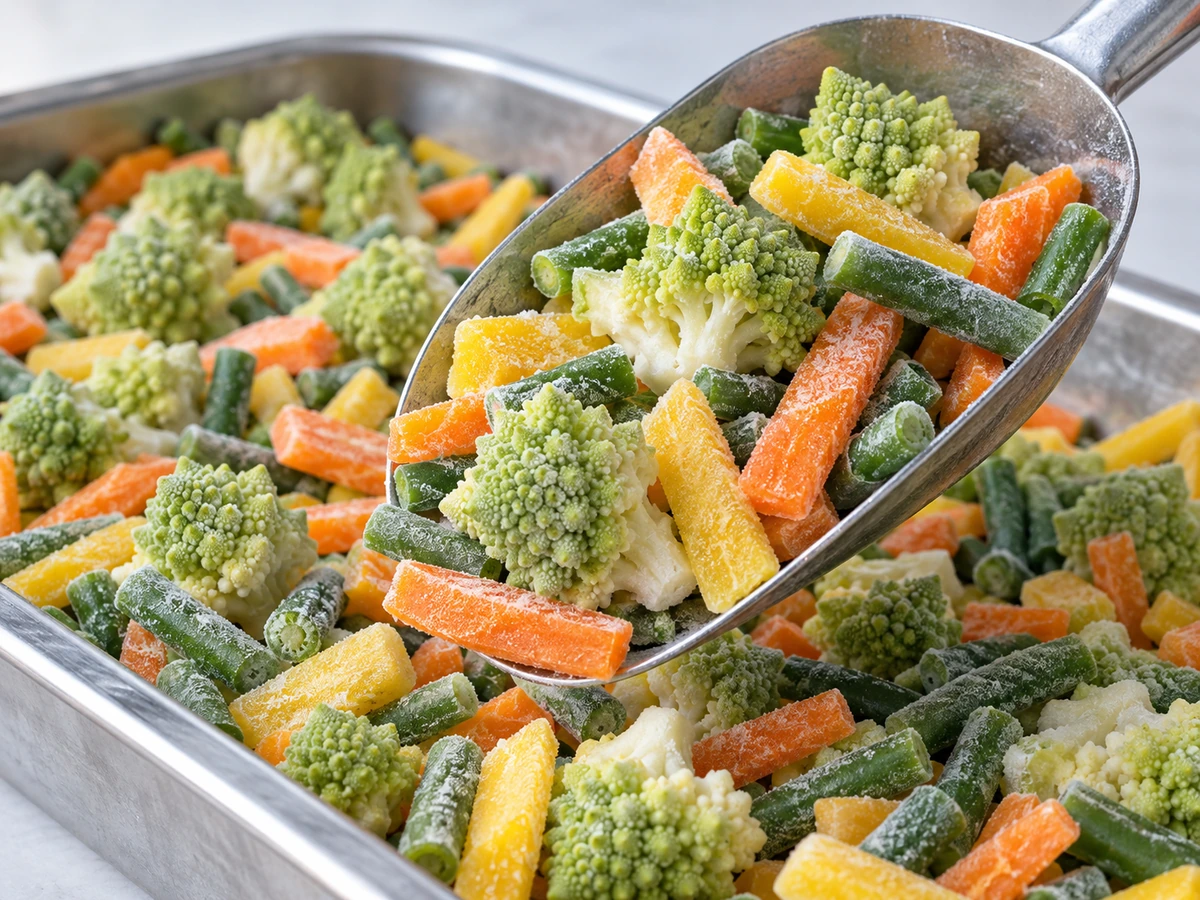
A broad scoop supports the frozen blend close to the tray.
Observe transfer points. A long drop, a narrow opening or repeated passage through a small scoop can affect a pointed floret differently from a carrot strip. The relevant question is what happens to the actual piece at that location. Where a problem appears, test an appropriate change to the transfer or the component form. Do not infer an equipment capability from a generic production photograph.
Inspect sequential portions from the same run. Early, middle and late samples can reveal a pattern that a single composite sample would hide. Keep their identities separate long enough to compare Romanesco presence and visible damage. If a composite is also needed for another test, prepare it under a defined method. The two sampling approaches answer different questions and should retain their separate results.
For manual kitchen preparation, the same principle applies at a smaller scale. A deep tub may need a defined gentle redistribution before serving, and staff need a scoop that accommodates the crown. For industrial filling, the supplier and buyer should agree which process trial and records are relevant. A stable recipe becomes a useful product only when the normal handling sequence delivers that recipe in workable portions.
Observe whether manual selection is improving the trial artificially. An operator who chooses a Romanesco crown for every sample can make a weak distribution look consistent. That may be a valid service method if it is deliberately part of the operation and its labor is acceptable, but it should be recorded. If the commercial process is ordinary scooping or automatic filling, test that process without selecting special pieces. The same principle applies to development photographs: keep an arranged concept plate separate from the sequence of unadjusted trial portions so the team knows which image represents routine output.
Choose cooking that brings the components together
The mix should reach a compatible eating result under its intended cooking method. That requires more than putting attractive colors in one bag. A dense Romanesco stem, a thin carrot strip and a small bean piece may respond differently to heat. Their raw material and any prior treatment also matter. Confirm the product instructions and assess each component after the complete preparation sequence.
Avoid copying cooking times from a different commercial blend. A precooked mixture and a plain frozen mixture may require different handling. Bonduelle's named three-vegetable product gives separate instructions for a portion and a whole pack, illustrating that even the load changes the method. Use the directions and validated procedure appropriate to the product being supplied.
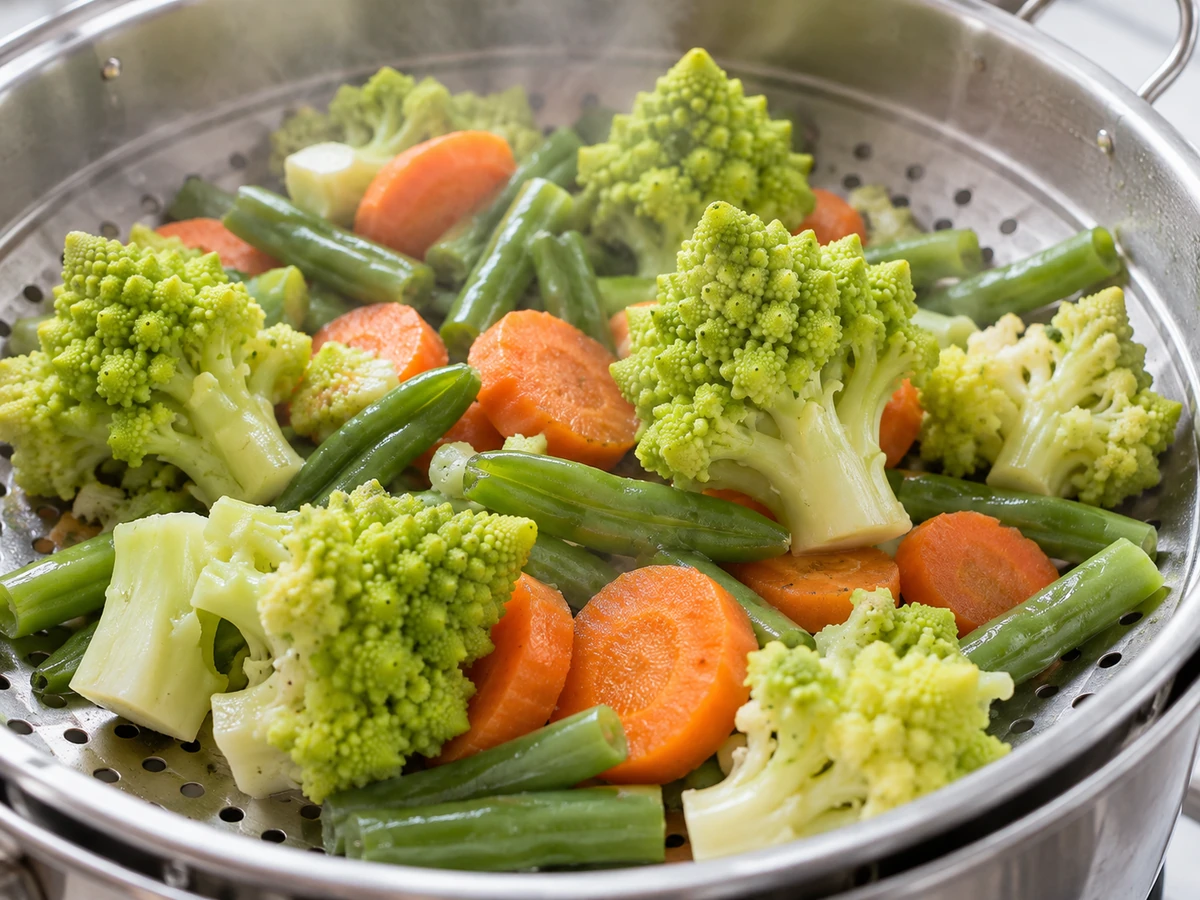
The perforated basket holds recognizable crowns, stems and companion cuts.
A shallow steaming load can help a trial focus on color and shape, while roasting introduces surface drying and browning. A pan provides a different balance of contact heat, moisture and movement. Choose the route that matches the final application, then evaluate whether the accompanying cuts suit it. A formula developed for a steamed side may need revision before it performs well in a roasted meal component.
Record the condition of each vegetable at the end. If the Romanesco stem remains too firm while the carrots are already very soft, a longer cook may improve one component and worsen another. Review component dimensions and treatment state before extending the whole process. The supplier discussion can then address the cause of the mismatch rather than describing the entire blend as inconsistent.
Include the final reheating stage for prepared meals. A mixture that looks balanced after initial preparation can change after assembly, storage and customer reheating. Test the real sequence with the required food-safety controls and serving vessel. A separate bowl of plain vegetables does not reproduce the moisture and heat conditions inside every sauce, rice dish or meal compartment.
The cooking trial should preserve the distinction between safety completion and desired quality. Meet the product's required preparation endpoint, then judge crown retention, component bite and free liquid. Color alone cannot establish a safe cooked state. If the quality fails at an appropriate endpoint, change the formulation or process and repeat the trial rather than approving an undercooked sample because it looks brighter.
Keep the crown visible through sauce and service
Sauce can change the apparent identity of a vegetable mixture. A thin coating leaves spaces between Romanesco's points visible, while a thick opaque sauce can smooth the silhouette. The decision depends on the dish. If the blend is sold for its visible spiral crowns, evaluate the final coated portion before approving the recipe. A photograph taken before sauce addition may overstate the benefit the diner receives.
Consider how the sauce is applied. Placing a measured amount beneath a vegetable serving can preserve more surface detail than repeated mixing through a deep vessel. A gentle fold may suit another application. Test the actual operation and compare the amount of visible crown damage as well as flavor distribution. The goal is an achievable service method, not a special arrangement that staff cannot reproduce at normal volume.
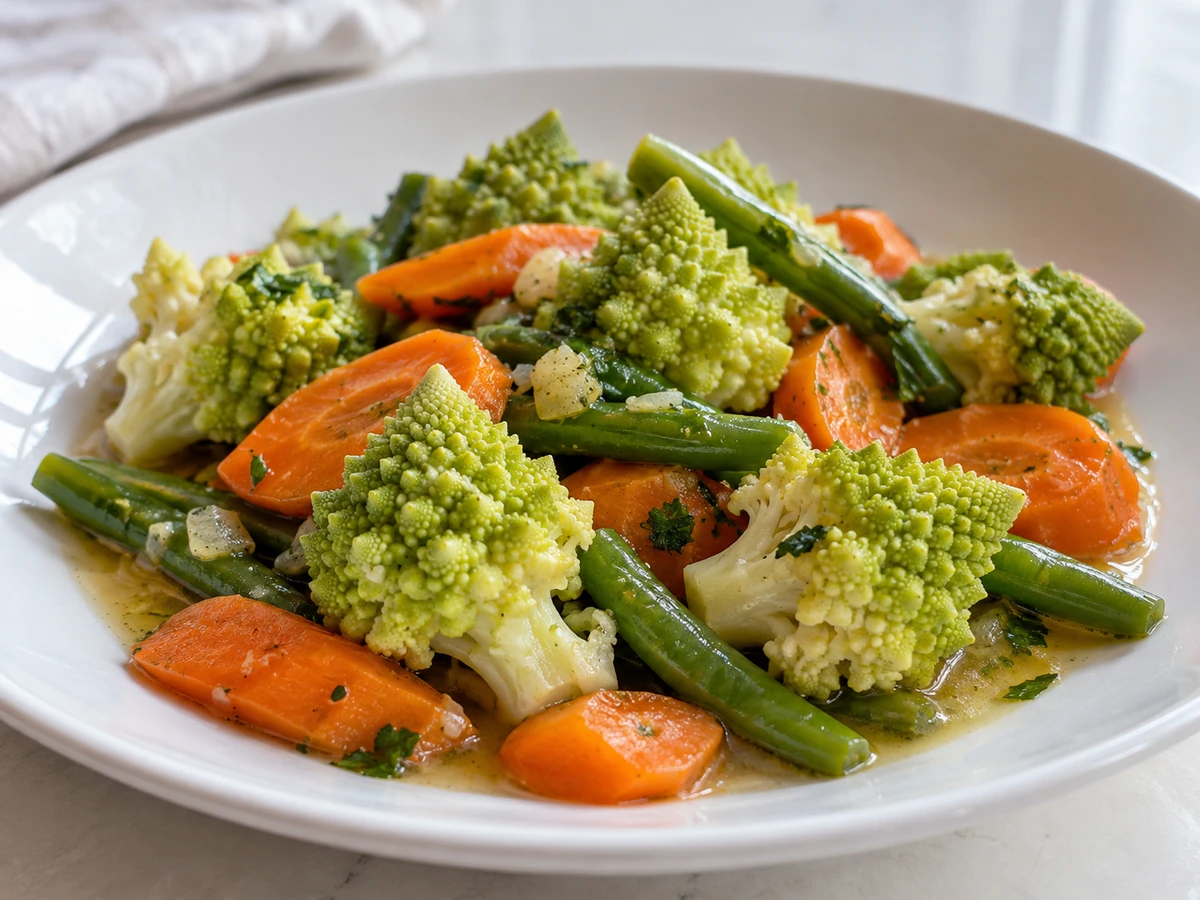
Light sauce collects beneath the mixed vegetables while the pointed crowns remain visible.
Liquid released during cooking also influences presentation. A pool around the serving can dilute a sauce and make fine fragments more obvious. Record the load, draining method and interval before sauce addition. If excess liquid appears, determine where it enters the process. Do not automatically attribute every watery result to the frozen product without reviewing added water, retained condensate and the preparation method.
Choose the serving utensil around the largest important piece. A scoop too small for the Romanesco crown can encourage crushing or selective picking. A very large utensil may make portion weight difficult to control. Trial a practical utensil with the actual mixed cuts and ask staff to serve normally. The result should show whether the mixture can deliver both a sensible weight and a recognizable vegetable appearance.
Holding and replenishment need the same application focus. Follow the operation's validated controls, then assess the mix at the intended service interval. Repeated stirring to keep a large vessel looking uniform may increase damage. Smaller replenishment quantities or a different vessel can be worth testing where the workflow permits. Any change should be evaluated for the complete service requirement rather than appearance alone.
For a retail or private-label concept, use a representative prepared serving in customer-facing photography and instructions. Avoid making an arranged abundance of Romanesco look like an ordinary guaranteed portion unless the actual specification and process support it. A credible product image can still be attractive while showing the blend honestly. It helps align the buyer's sample approval with the eater's eventual experience.
Approve the mix through a sequence of real portions
Start the approval run with the normal pack, portioning utensil and target fill weight, and label the portions in the order they are taken. Define the sample source and the normal handling process, then retain the order of portions taken during the trial. Use the intended scoop, filling method or meal assembly operation. This lets the team see whether the Romanesco remains present and recognizable as the container or run progresses.
Record a few distinct observations for each portion. These might include total portion mass, recovered Romanesco mass where relevant, count of recognizable crowns, obvious fragments and the appearance after cooking. Agree the definitions before the test. A count of crowns should not silently include bud-free stems, and a component mass result should explain whether it was measured frozen or after a specified preparation.
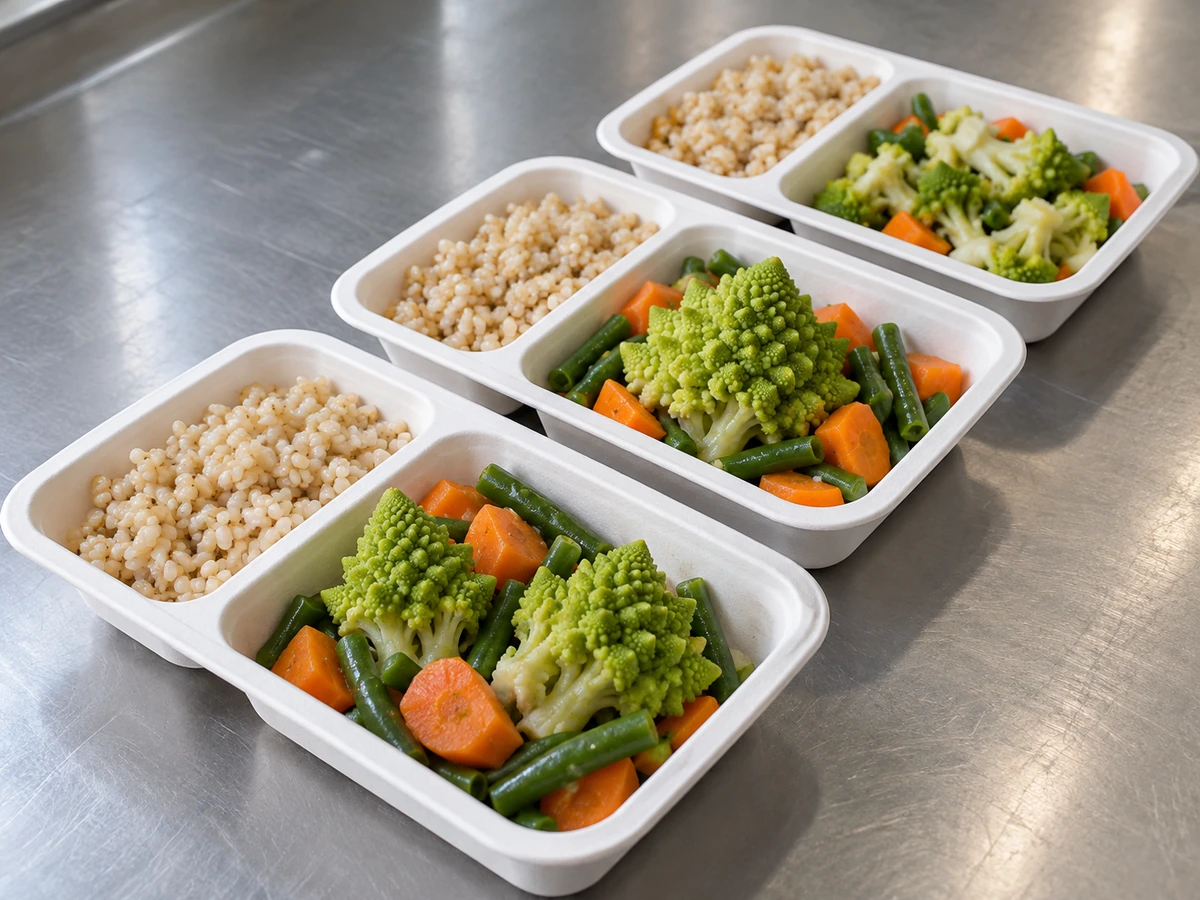
The vegetable compartments show how recognizable crowns and small fragments can be distributed differently across individual portions.
Compare the portions in the actual serving vessel under consistent lighting. Photographs can support the discussion, but keep the raw records as well. If one portion looks weak, investigate whether its Romanesco share was low, its pieces were too small, its crowns were hidden by other vegetables or handling had broken them. Those causes call for different changes to the recipe, form or process.
Repeat a promising formulation under normal load and, where appropriate, with more than one representative production lot. The scope of that work should match the commercial risk and be agreed between the responsible teams. A small development trial can identify a candidate; it cannot by itself establish long-term process capability. State clearly what the evidence supports and what still requires confirmation before launch.
The final purchasing brief should connect the component specification, formula, packing and application. For Romanesco supply, share the preferred crown and stem form, intended blend partners, quantity, destination and documents needed. We can work through those requirements with the purchasing team and confirm the proposed order basis. The vegetable specification guide provides wider context for recording the agreement.
Keep an approved reference showing an ordinary finished portion, together with the method used to produce it. Review the reference when component cuts, recipe percentages, equipment or cooking instructions change. Romanesco's visual contribution depends on those relationships. A blend is ready for routine use when its normal portions carry the intended color and crown shape through the actual cooking and serving sequence.
Retain rejected development variants with a short reason. A blend may have failed because the Romanesco was hidden, the carrots finished too soft or the scoop damaged large crowns. Those observations prevent the next trial from repeating the same unsuccessful combination under a different recipe name. They also let purchasing distinguish an ingredient-form change from a mixing or cooking adjustment.
Before confirming a formula, check whether the final packing supports the chosen service routine. A large bag used over several small cooking batches creates different handling needs from a pack consumed in one run. Confirm the practical portioning method, storage instructions and closure arrangement with the responsible team. The blend's visual consistency should survive normal use of the pack, not only the first carefully prepared sample.
Source Frozen Romanesco with GreenLand-food
GreenLand-food is a professional frozen Romanesco supplier and manufacturer in China, providing factory-direct wholesale supply for importers, food manufacturers, foodservice distributors and private-label programs.
Send your product form, specification, packing, quantity, application and destination. Include private-label needs and requested documents so we can confirm the supply details with your purchasing team.