


Romanesco Floret Breakage and Stem Ratio: A Buyer Acceptance Guide
Oct 19, 2026
Leave a message

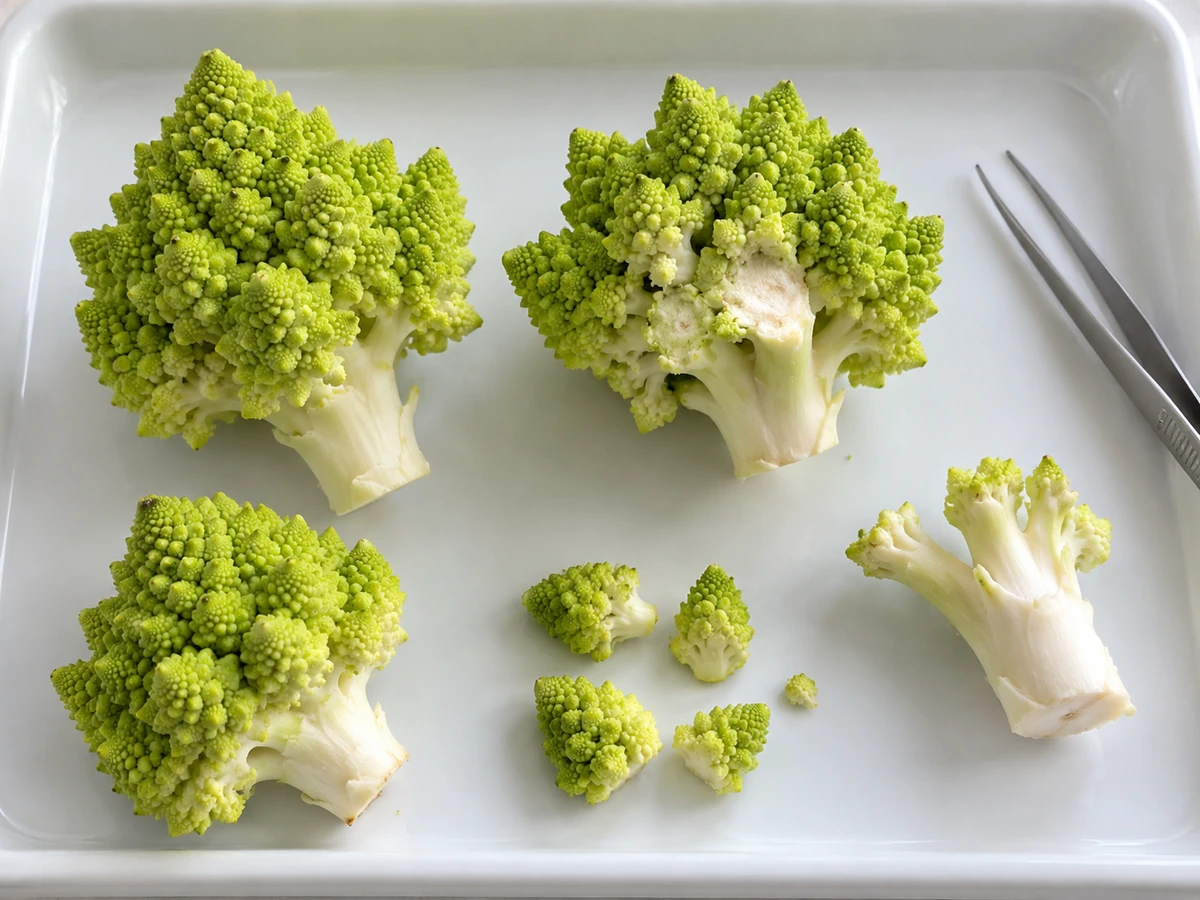
For a visible vegetable side, the buyer usually needs recognizable pointed crowns that survive the intended cooking and serving sequence. The acceptance method should connect that requirement to observations that both parties can repeat. Frozen appearance, cooked performance and food-safety requirements need their own checks; an attractive sample does not establish all three.
The procedure below is a proposed framework for agreement between a buyer and supplier. Its worked numbers are arithmetic examples, not GreenLand lot results, regulatory limits or universal Romanesco grades. We recommend agreeing the definitions, sample selection, measurement state and decision rules before the first commercial shipment. That makes it possible to discuss a difference in evidence rather than discovering after delivery that the same specification sentence meant two different things.
Define which piece counts as a Romanesco floret
Start with a physical reference for the purchased form. A Romanesco floret normally includes a connected crown of pointed green clusters and an attached supporting stem. A piece of stem without a crown is a different category. A small complete floret can also differ from a similarly sized fragment detached from a larger crown. Photographs of the agreed categories help an inspector distinguish those cases consistently.
Decide whether the product is intended to contain complete small florets, divided florets or a broader mixture of pieces. Dividing a large floret through its stem can leave a recognizable portion of crown, while cutting through the crown itself creates a different surface. The word florets does not automatically resolve which forms are acceptable. Include a side view and a crown view of the approved examples.
Set the size basis separately from integrity. Crown width, overall piece length and stem thickness describe different attributes. A piece can fall within a width band while carrying too much attached stem for the application. It can also have an intact crown but sit outside the size range. Keeping these observations separate makes the inspection useful: the supplier can see whether the issue concerns trimming, grading or damage.
Commercial naming needs the same care. A grade adjective is meaningful only when the accompanying specification explains its content. The publicly available Alasko Romanesco mix specification uses its own ingredient ratios, dimensions and defect provisions. It is a historical supplier document, not a universal standard for every product described with the same grade. Obtain the current agreed terms for the actual order.

Actual Romanesco floret form
Define the inspection state. A frozen floret is firmer to handle than a thawed or cooked one, and ice may obscure the outline. State how the sample is presented, how loose surface ice is treated and whether any controlled preparation is needed for a particular observation. Do not let different inspectors improvise washing, thawing or forceful separation before measuring the same attribute.
Finish this first definition with the application. A complete spiral crown may be essential for a plated side, while a prepared mixture may allow some divided florets. A filling or puree can tolerate a different visual form while still needing appropriate identity and safety controls. The acceptance reference should describe the form the buyer will use, so a rejection or concession has a clear commercial reason.
Separate tip damage, fragments and loose stems
Breakage can describe several visibly different conditions. A floret may retain its main structure but lose the top of a cone. A crown may split into two substantial pieces. Small green points may detach as fragments, and the pack may contain loose pale stems. Combining everything into a single undefined broken category hides the differences that matter to the finished dish and to corrective action.
Agree a damaged-floret definition using visible criteria and reference photographs. For example, the parties might define a category by loss of the main pointed silhouette or by exposed cut or fractured crown surface beyond an agreed reference. The final criterion should be inspectable without guessing the original size of missing material. Avoid a definition that asks an inspector to reconstruct the exact shape of every damaged floret mentally.
Define fragments by the agreed size and form rule. A small complete floret should not automatically become a fragment solely because it is small, unless the contract intentionally uses a size-only category. If a sieve is used, specify its opening, handling and the material it is intended to separate. Irregular Romanesco pieces can pass through differently depending on their orientation, so the method needs a repeatable procedure.
Record detached stems separately where they affect value or presentation. A stem attached to a usable crown contributes to that floret's structure; a bud-free loose stem has a different role in a visible portion. The same mass of pale material can therefore produce a different serving depending on how it is attached. This is why "stem content" needs more definition than a single percentage on a quotation.
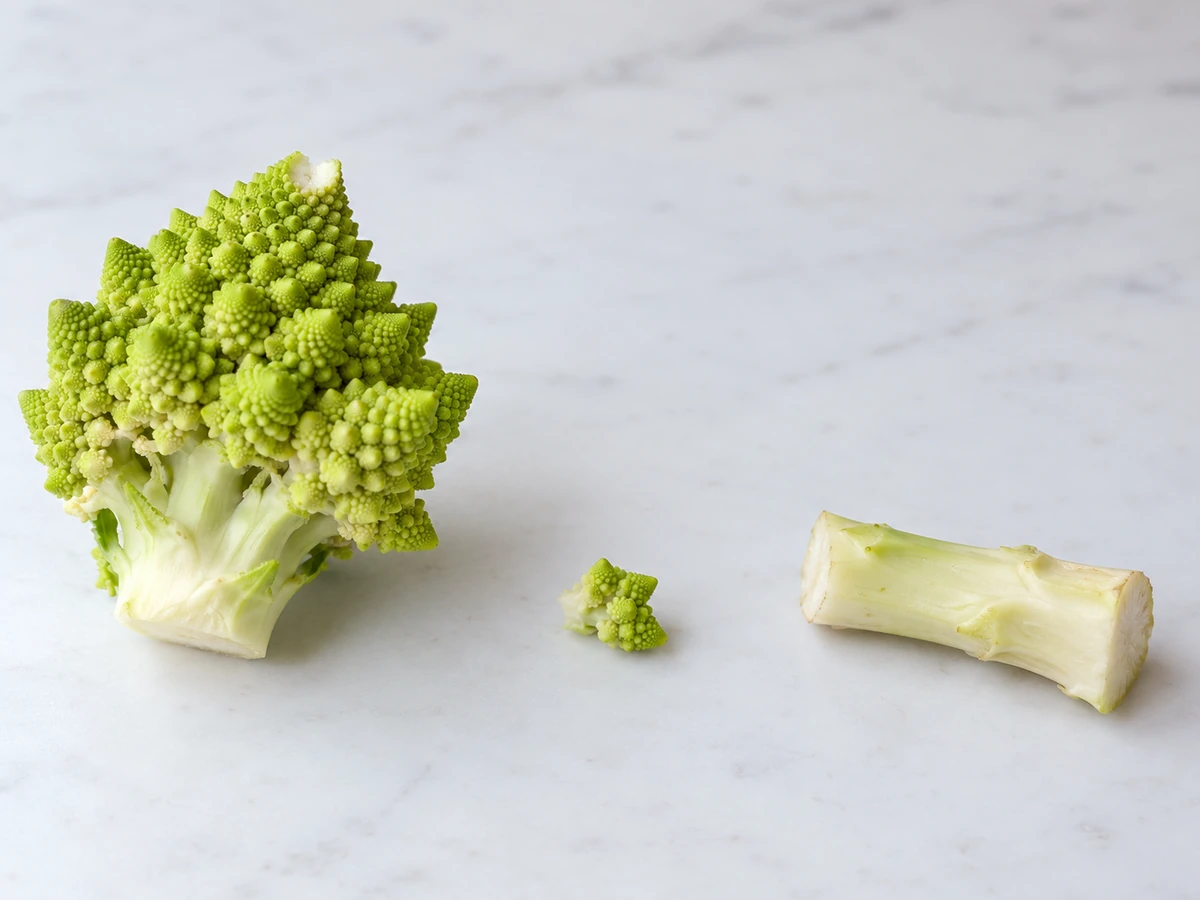
Different visible Romanesco damage forms
Use mutually exclusive sorting categories when you need a total material balance. One practical hierarchy could separate loose ice according to the agreed rule, then detached stems, fragments, damaged connected florets and acceptable connected florets. That hierarchy is a proposal to be adapted, not a fixed industry standard. If separate observations can overlap, label them as overlapping and avoid adding their percentages into a supposed total defect rate.
Food-safety or foreign-material findings need their own escalation procedure. A cosmetic classification should not quietly absorb an observation that requires a different investigation. Keep the appearance inspection connected to the operation's wider quality system, with clear responsibility for holding product and reviewing evidence. A low measured fragment share does not compensate for a separate unacceptable safety finding.
Choose a denominator before setting a limit
Every percentage should answer two questions: what is in the numerator, and what is in the denominator? A mass percentage of loose fragments in the total sampled product differs from the percentage of connected florets judged damaged by count. Both can be useful, but they describe different things. Write the units beside the result so a reader cannot mistake one for the other.
Consider a deliberately simplified arithmetic example. A defined 1,000 g frozen sample contains 40 g classified as fragments under the agreed method. The fragment share is 40 divided by 1,000, multiplied by 100, or 4% by mass. That result says nothing about how many connected crowns have small chipped points. A separate count inspection could find several damaged florets even when the loose-fragment mass is modest.
A count-based example needs an equally explicit population. If 12 of 100 assessed connected florets meet the agreed damaged-crown definition, the result is 12% of assessed connected florets by count. State whether fragments and detached stems are excluded from that counted population and reported elsewhere. Do not silently call this 12% of the whole carton; the counted unit and the sampled material are different descriptions.
Mixed vegetables create another denominator. Suppose a sample contains Romanesco together with carrots and beans. Defective Romanesco mass divided by the whole mixture can look much smaller than the same defective mass divided by the recovered Romanesco component. If the question is Romanesco component quality, the component denominator may be more informative. If the contract specifies total-mixture defects, report that separately and retain enough data to interpret both.
The RRM Romanesco mix sheet illustrates why buyers should read the surrounding method: it combines ingredient proportions, a floret size band and a defect table expressed for a stated sample basis. Its historical figures are supplier-specific examples. Before adopting any similar clause, clarify whether the component or mixture is being assessed and how each unit is counted or weighed.
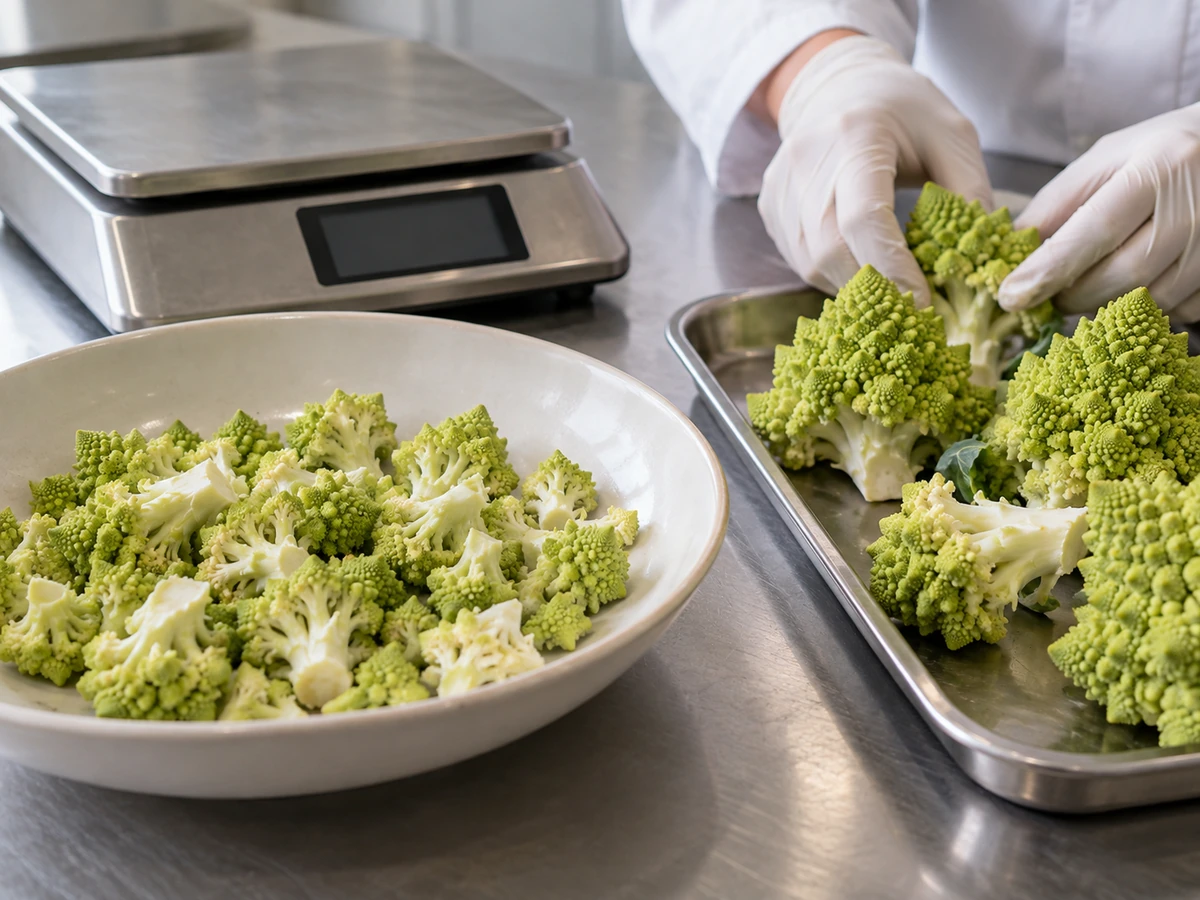
Romanesco pieces beside a weighing dish
Round only after the calculation, using the precision agreed for the method. Preserve the raw masses and counts. Near a contractual limit, a rounded result can hide the difference between an accepted measurement and a result requiring review. Include the equipment resolution and the agreed treatment of borderline observations. The objective is not to produce more decimal places; it is to make the decision traceable to the actual sample.
A supplier comparison should use the same denominator and sample preparation for every offer. Otherwise a lower reported defect percentage may simply reflect a different calculation. Ask for the raw count or mass behind a result when its basis is unclear, and keep the supplier's original value alongside any recalculation. Do not overwrite an original report in a way that makes the revised interpretation look like the supplier's own test.
Measure attached-stem length and mass on defined samples
Attached-stem length and attached-stem mass share answer different questions. Length helps describe the silhouette and overall piece geometry. Mass share estimates how much of the assessed material belongs to the stem category defined by the method. A long thin stem and a short thick stem may rank differently under those two measures. Choose the attribute that relates to the application's concern, or report both with separate definitions.
For a length method, agree the anatomical endpoints and the orientation of the piece. The base cut is usually easy to see; the point where the stem becomes the branching crown can be less obvious. Use a reference photograph showing where the measurement begins and ends. If the crown is irregular, an inspector should not be free to choose whichever branch produces a preferred result.
An attached-stem mass method is destructive. It requires an agreed cut boundary separating stem from crown, a defined sample state and a denominator. A possible trial method weighs a defined set of connected florets, trims each at the agreed boundary, then weighs the removed stems. The removed-stem mass divided by the original assessed-floret mass gives the proposed attached-stem share for that sample. It does not measure detached stems elsewhere in the bag unless those are explicitly included.
Reserve a separate representative portion for the cooking assessment. Cutting stems away changes the geometry and handling of the florets, so trimmed material cannot represent the original product in a crown-retention trial. Keep the destructive measurement portion and the cooking portion linked to the same sampled unit, and identify their different uses in the record.
Keep the removed crown and stem material associated with the sample until the results are checked. If the component masses do not approximately reconcile with the original mass within the method's expected handling and weighing variation, investigate loss, ice treatment or inconsistent preparation. Do not present an unexplained mass discrepancy as a precise stem ratio. The balance helps detect a practical method problem before it becomes a commercial disagreement.

Romanesco floret caliper reference
For repeated inspection, provide a short training set containing clear examples and boundary cases. Have both assessors identify the proposed cut boundary on intact reference pieces before either person trims them. Then use separately assigned representative portions to compare the complete weighing procedure, recording the sample allocation as well as the result. Large differences warrant checking the classification, cut boundary, weighing procedure and variation between the assigned portions. They do not isolate operator precision from sample variation. This is a proposed method-development check; it does not establish formal laboratory validation. Its value is finding ambiguous instructions while both parties can still improve them.
We recommend keeping detached-stem content, attached-stem geometry and cooked stem texture as distinct fields. One can be satisfactory while another fails the intended serving. The authentic caliper photograph shows why dimensions can be discussed, but it is not a report of this method or a measured lot result. Use the agreed sample and current records to support an acceptance decision.
Sample across the lot and preserve the evidence
A sample taken from the easiest bag to reach may not represent the shipment. Before inspection, define the lot being evaluated and the sampling plan appropriate to its size, packaging and risk. Identify which cartons or bags will be selected and how selection avoids a preference for convenient or attractive units. The exact number belongs in the agreed plan; a generic article cannot establish a valid universal sample count.
Preserve the identity of the original sampling units. If several bags are combined immediately, differences between bags can disappear into an average. Depending on the objective, inspect individual units first and prepare a composite only under a defined procedure. A composite can describe an overall sample, while separate units can reveal variation that affects individual buyers or portions. Decide which evidence the acceptance rule requires.
Handle the sample so inspection does not create the defect being measured. Record the receiving condition and avoid unnecessary drops, squeezing or repeated transfers. Spread the material gently on a suitable clean surface under the agreed temperature and time controls. If separating a clump would break crowns, document that condition and follow the method rather than forcing it apart and treating every new fragment as pre-existing damage.
Use photographs as supporting evidence. Include an overall view of each sample and close views of representative categories with a scale where relevant. Keep lighting and camera angle consistent enough to compare shape and color. A photograph of a handful selected for its dramatic damage can explain a defect but cannot establish its frequency. Retain the counts or masses that support the reported rate.
The record should connect the results to the product and procedure. Include lot identification, sampled pack identities, time, sample state, equipment, method version, assessor and raw observations. Where the buyer requires temperature or transport records, keep those associated with the review. These are proposed record fields, not a claim that a particular certificate or data logger exists for every order.
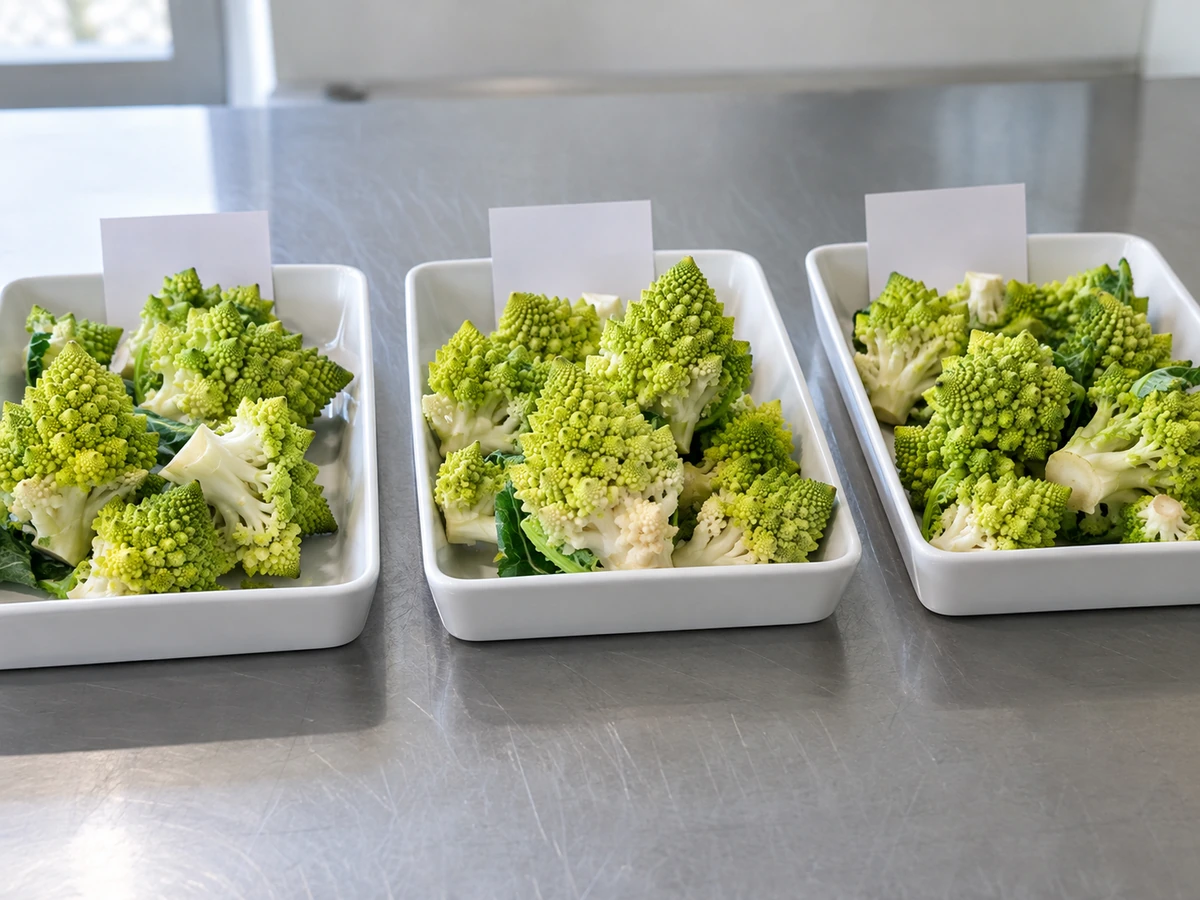
Separate Romanesco sample portions
Agree retention and review arrangements before there is a disagreement. Decide whether physical samples will be retained, under which conditions, for how long and by whom. Preserve the original images and results rather than editing them into a single polished presentation. A later review is easier when both parties can distinguish the sample as received, any preparation performed and the final measured categories.
A proposed inspection worksheet can place sample identity at the top, raw measurements in the middle and the agreed decision at the end. The raw section should show original sample mass, each exclusive sorted-category mass and the counted population where a count method is used. Leave a space for unusual conditions, such as a clump that could not be separated by the prescribed handling. This preserves observations that a percentage alone can conceal.
Photograph borderline examples during method development and agree their classification before routine use. Include an intact small crown, a divided crown with a clean cut and a crown with a fractured point. If the two teams disagree on those examples, improve the definitions rather than asking the inspector to make a commercial judgment at every piece. A small reference set can prevent a recurring source of variation in later results.
Keep the worksheet's calculation fields separate from acceptance limits. The method determines what was observed; the contract determines whether that observation meets the order. This separation makes it easier to reuse a sound inspection procedure for two applications with different appearance requirements without confusing their commercial tolerances.
Check what remains recognizable after cooking
Frozen inspection tells the buyer about the delivered form. A cooking check tells the buyer whether that form performs in the application. Keep the two results separate. A floret with acceptable frozen dimensions may lose its pointed silhouette during cooking or transfer, while a modest cosmetic chip may be unobtrusive in the finished meal. The purchasing decision should reflect both the agreed delivery condition and the intended use.
Specify the cooking test before comparing suppliers or lots. Use the actual product instructions and the buyer's intended equipment, load and service sequence. Record the method and required completion criteria. Do not stop cooking early merely to preserve appearance, and do not impose an arbitrary extended cook on one sample while treating another more gently. A fair comparison needs a consistent and appropriate process.
If the objective is shape retention, define how the cooked material will be observed. One proposed trial counts recognizable crowns in a defined cooked portion after a standard transfer. Another photographs matched individual florets before and after cooking. These answer different questions. The first represents a practical serving; the second follows changes in particular pieces. State which approach is used rather than presenting them as interchangeable.
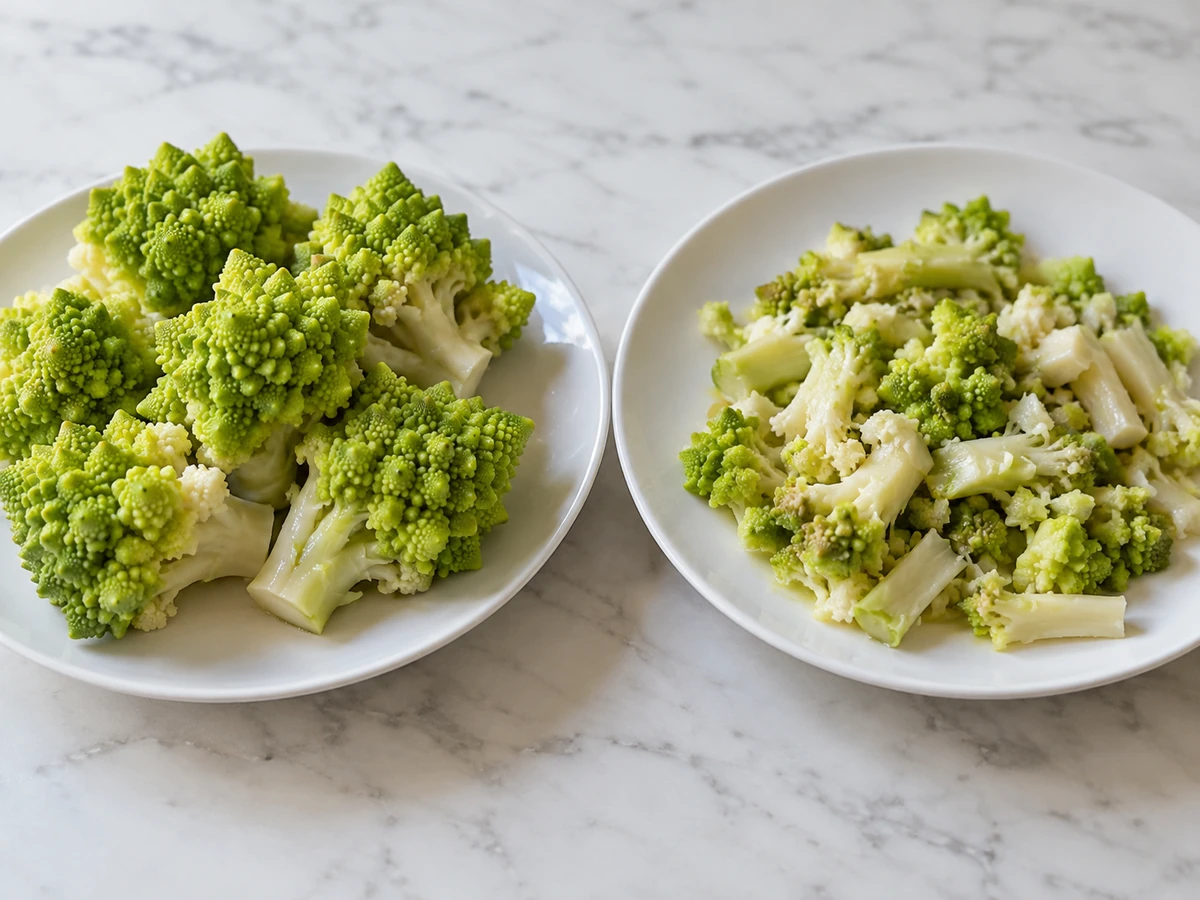
Intact and broken Romanesco after a cooking check
Tracking the same pieces requires care. Keep their identities clear and avoid choosing only ideal specimens. If a floret splits, record the outcome under the predefined rule rather than counting its two resulting pieces as two successful crowns. If independent samples are used before and after cooking, report them as separate populations. Their difference cannot be described as the exact survival rate of the original individual florets.
Include the final handling step. A spoon, conveyor transfer, mixing stage or meal assembly action can change the amount of visible damage. Where the application includes reheating, examine the final reheated portion. Our frozen vegetable texture guide offers broader causes to consider, while the Romanesco trial should focus on the observed stem bite and retained crown form.
Link the outcome to a specific correction. Excess detached stems may require a form or sorting discussion; acceptable frozen crowns that break during aggressive transfer may require a handling change. A cooking check is most useful when it identifies where the product ceases to meet the application's needs. It should support a defined decision, rather than serving as an unstructured tasting session with no agreed consequence.
A buyer can also calculate usable presentation yield under the agreed application test. Define which cooked material qualifies for the intended serving, weigh or count it using the chosen basis, and retain the amount diverted to another approved use. This proposed measure differs from incoming breakage because it includes the consequences of cooking and handling. Keep those causes visible when comparing cost. A lower purchase price does not necessarily mean a lower cost per acceptable plated portion, but the conclusion needs measured yield and the buyer's actual costs. Do not assign an invented savings percentage to a supplier or floret grade.
Agree release decisions and corrective action before shipment
The purchase agreement should explain what happens after the inspection. Define who can release the lot, which findings require a hold, how a disputed measurement is reviewed and when an independent assessment is appropriate. Include the method version and the agreed specification. A limit without a decision procedure can still leave both parties uncertain when the result falls close to the boundary.
Separate acceptance from any later concession. If a buyer agrees to use material outside an appearance requirement for a different application, document the scope and the reason. That decision should not silently change the standard for future deliveries. Confirm that the alternative use remains appropriate under the required safety and legal controls, and that the commercial arrangements are understood by the responsible parties.
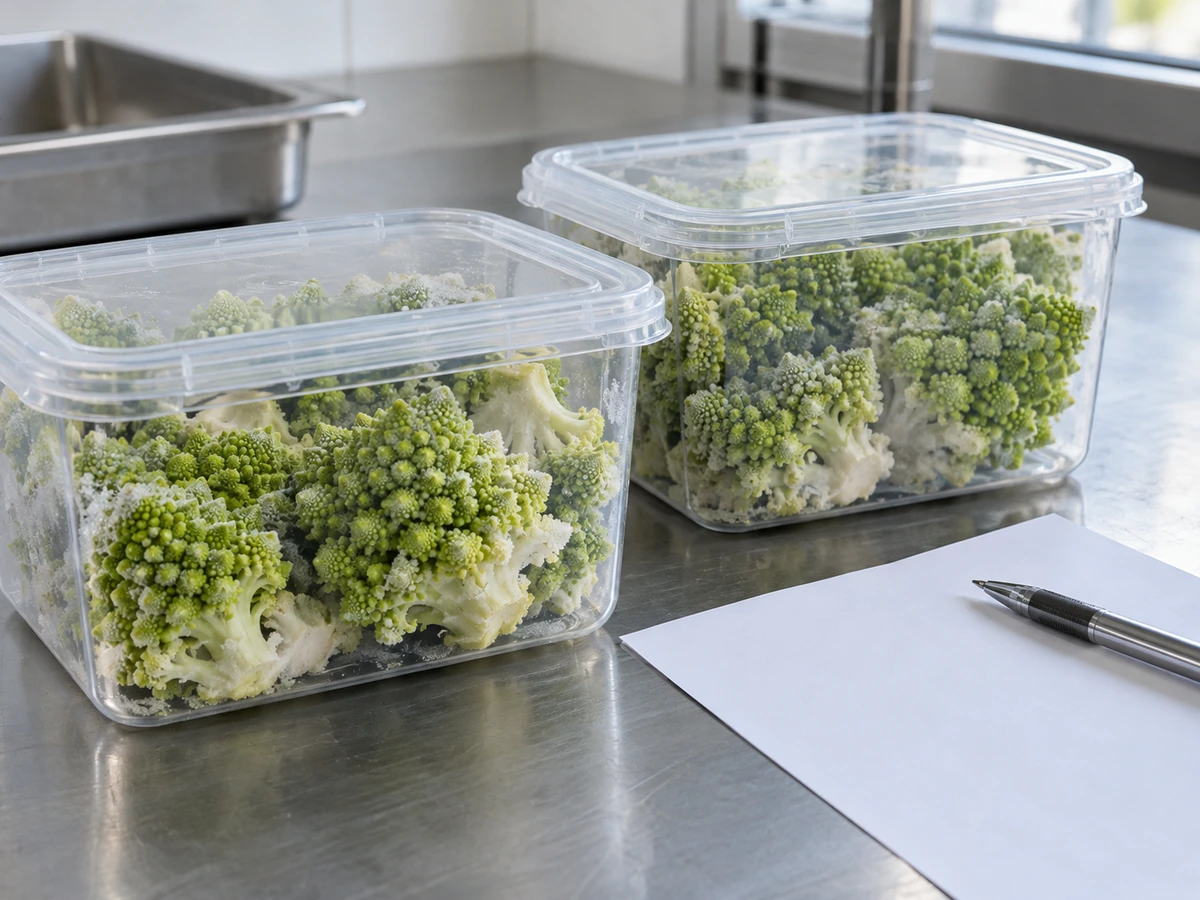
Retained Romanesco samples in clear containers
A corrective-action discussion benefits from the separate categories developed earlier. Too many loose fragments, long attached stems and uneven cooked texture can point to different investigation paths. The evidence may support reviewing raw form, cutting, grading, handling, packaging or the buyer's preparation. Avoid assigning a cause from a single photograph. Ask for the relevant records and compare the observed pattern with the process actually used.
For the next order, revise only what the evidence supports. If the approved form was ambiguous, improve the reference photographs and measurement endpoints. If the sample method caused damage, correct the handling procedure. If the product met the written terms but failed the dish, revisit the application requirement and trial. Treat each revision as a controlled change so the quotation, sample and acceptance record continue to describe the same product.
When enquiring about Romanesco florets from GreenLand-food, send the intended use, preferred form, proposed size and trim criteria, quantity, packing and destination. We can work through the specification and sample basis with your purchasing team. The broader frozen vegetable specification guide helps connect those requirements to documents and order acceptance.
The most useful acceptance sheet is one another trained person can apply to the same material and understand. It identifies the piece, defines damage, keeps denominators clear and preserves the evidence behind the result. For Romanesco, that discipline connects the commercial promise of a visible spiral floret with a delivery and cooking result that the buyer can actually assess.
Source Frozen Romanesco with GreenLand-food
GreenLand-food is a professional frozen Romanesco supplier and manufacturer in China, providing factory-direct wholesale supply for importers, food manufacturers, foodservice distributors and private-label programs.
Send your product form, specification, packing, quantity, application and destination. Include private-label needs and requested documents so we can confirm the supply details with your purchasing team.