


What Is Romanesco? Broccoli, Cauliflower and the Spiral Floret
Oct 19, 2026
Leave a message

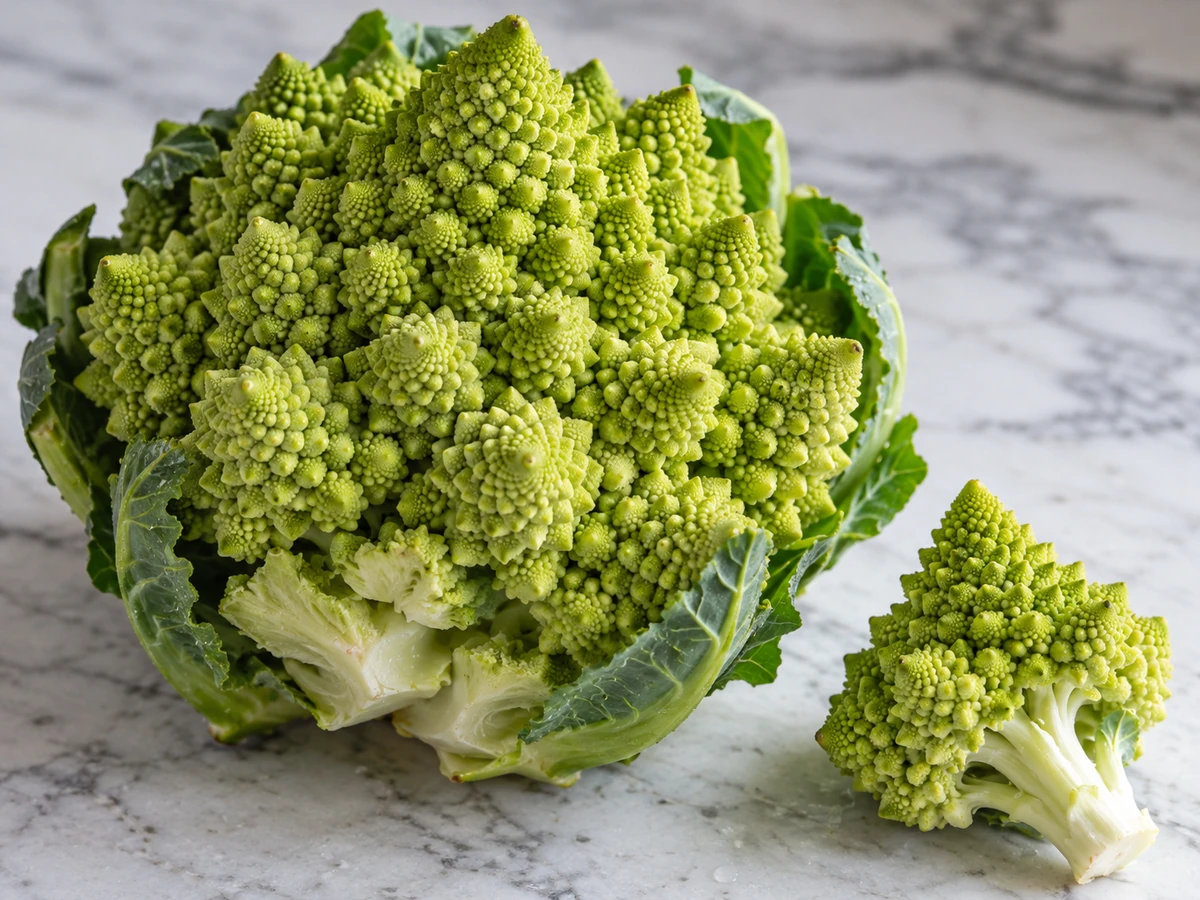
For a frozen-food buyer, that definition is only the beginning. A whole fresh head, a trimmed frozen floret and a carton containing many detached stems can all be described with the same ingredient name. They create different results on a plate. Before choosing Romanesco, decide whether you want the spiral to remain a visible feature, how large a piece fits the serving and how the product will be cooked.
We use those questions to connect the familiar photograph of a whole head with the floret form a purchasing team actually needs. Understanding the structure helps you recognize the product, compare it with broccoli and cauliflower, and write a useful first enquiry without assuming that every bag carrying the name has the same appearance or preparation requirements.
What the Romanesco name identifies
The names Romanesco broccoli and Romanesco cauliflower refer to the same recognizable vegetable in many markets. Terminology is less tidy than the supermarket shelf suggests. The Office québécois de la langue française lists both names and identifies it as Brassica oleracea var. botrytis. That makes "Romanesco" plus a clear description of its form a more useful starting point than arguing over which common name must appear first.
Romanesco belongs to the cultivated cabbage family alongside familiar broccoli and cauliflower forms. It is often casually described as their cross. That shorthand can help someone imagine the color, but it does not establish the breeding history of a particular cultivar. A purchasing specification should identify the actual ingredient and cultivar information where required, rather than treating a popular explanation as botanical documentation.
Look first at the head. A typical Romanesco has yellow-green to chartreuse pointed clusters, with smaller cones arranged around larger ones. The outer leaves surround the head while it grows. A harvested head may retain some leaves and a substantial central stalk; a prepared floret usually retains only the stem needed to support its crown. The difference between those forms is a preparation decision, not a different ingredient.
Color alone is insufficient for identification. Green cauliflower also exists, and broccoli can appear lighter after processing or under strong lighting. The pointed arrangement is more useful than a particular shade in a photograph. A product image should let you see the crown structure and the attached stem. If the surface is hidden by frost, sauce or packaging, ask for a clearer view of the actual sample.
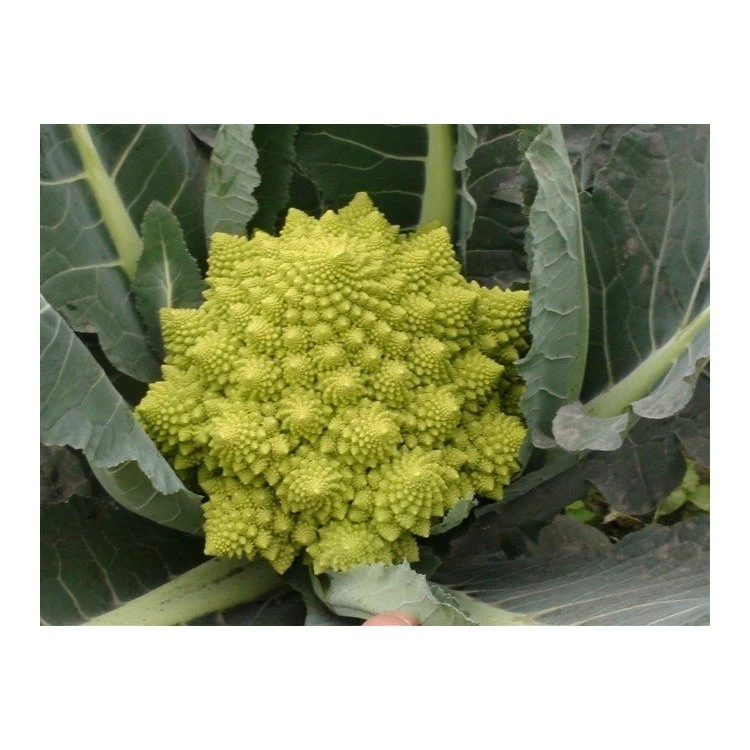
Romanesco head growing among its leaves
Names also travel between languages and menus. A distributor may use Roman cauliflower while a chef says Romanesco broccoli. Keep the agreed product name consistent across the quotation, specification, carton information and sample approval. Where translation could create confusion, add a representative photograph and the agreed botanical identification. That small step reduces the chance of approving an attractive related vegetable that is not the intended product.
The raw growing-head photograph beside this section is useful for recognizing the plant. It cannot establish the quality of a shipment of frozen florets. Treat it as an identity reference, then move to photographs and samples of the purchased form. This distinction becomes especially useful when a category page combines a whole-head image with descriptions of several prepared cuts.
How Romanesco compares with broccoli and cauliflower
Romanesco, ordinary broccoli and white cauliflower share enough kitchen uses that substitutions often work. Their visual roles differ. Broccoli presents rounded clusters of small buds, white cauliflower forms a dense pale curd, and Romanesco presents pointed clusters. A menu built around contrasting colors and silhouettes may change noticeably when one replaces another, even if all three can be steamed or roasted.
The stem-to-crown relationship also affects how the piece occupies a serving. A narrow stem with a broad crown looks different from a long stalk ending in a small head. Buyers comparing sample photographs should place the pieces on the same background and use a consistent scale. Otherwise a tightly framed Romanesco image can appear more substantial than a loosely photographed broccoli sample without representing a real difference in serving size.
For a side dish, a defined Romanesco crown can create a focal point among simpler cuts. In a smooth vegetable sauce, that geometry disappears during processing. Choosing an ingredient for a form that will later be destroyed can add cost without delivering the desired visual benefit. Flavor, supply and formulation may still justify the choice, but those are separate reasons and deserve their own evaluation.
Scroll horizontally to compare all columns.
| Attribute | Romanesco | Broccoli | White cauliflower |
|---|---|---|---|
| Visible crown | Pointed clusters in a repeating spiral | Rounded clusters of small green buds | Dense pale curd |
| Useful identity clue | Conical shape and branching stem | Bud clusters above supporting stalks | Compact white head surface |
| Purchase comparison | Crown integrity and attached-stem form | Floret size, stem form and intended use | Curd size, trim and intended use |
| Application check | Recognizable points after the intended cook | Acceptable crown and stem after the intended cook | Acceptable piece structure after the intended cook |
Do not assume one universal texture ranking. A tender small broccoli floret, a mature cauliflower piece and a carefully trimmed Romanesco floret are not controlled comparisons. Raw material, stem thickness, preparation, freezing history and final cooking all influence the bite. Taste comparable cooked samples under the same intended method if the substitution matters to a finished recipe. Record whether the stem and crown reach an acceptable result together.
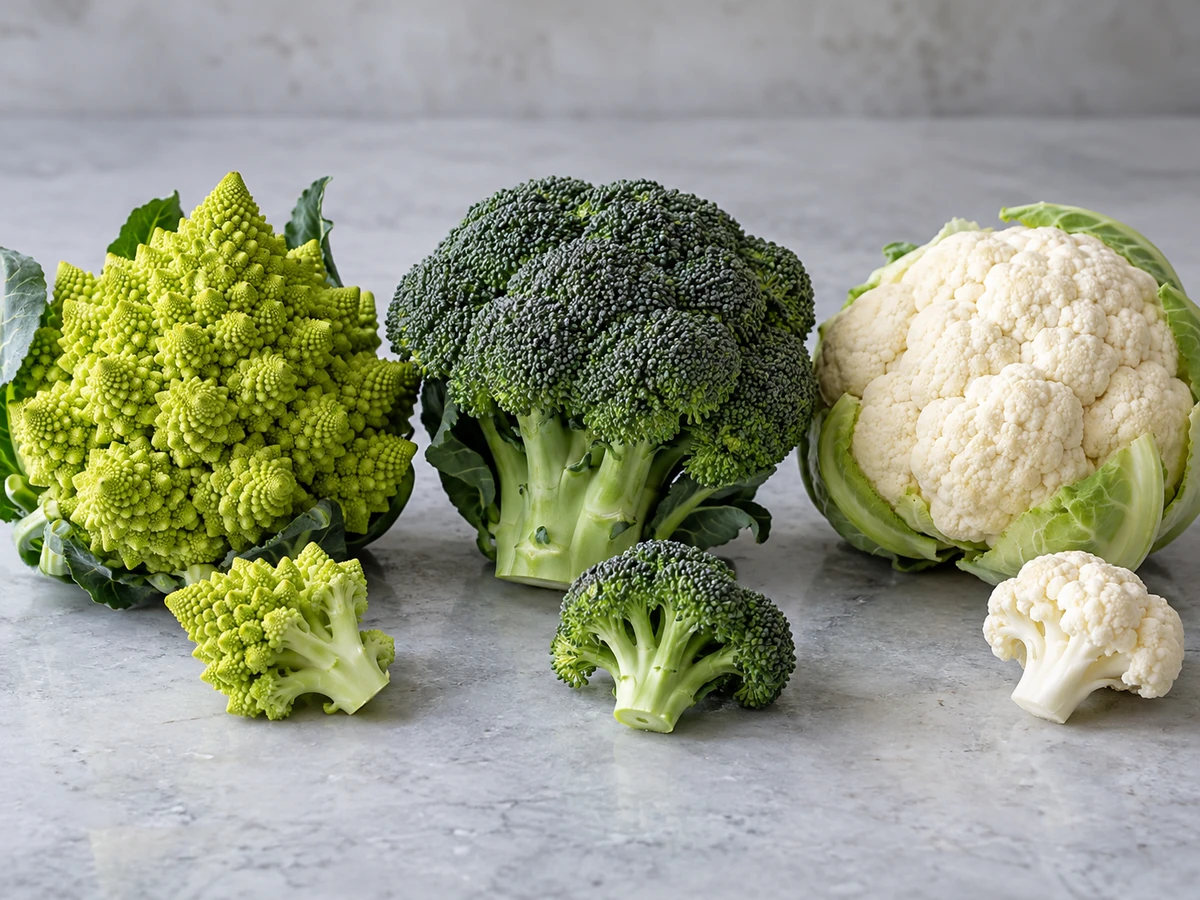
Romanesco beside broccoli and cauliflower
This is also why a recipe written for fresh white cauliflower should be treated as a starting idea when using frozen Romanesco. The purchased florets may already have received a heat treatment, and the pointed surface can respond differently to handling. Keep the recipe's purpose, then follow the actual frozen product's cooking instructions and confirm the finished dish. A change of ingredient does not automatically preserve the original preparation time.
For a purchasing team, the comparison should end in a decision. Choose broccoli when its own color, bud structure and flavor suit the product; choose cauliflower when its pale curd and application performance fit; choose Romanesco when its particular appearance and eating quality add value. The supplier conversation can then focus on the required form and consistency instead of relying on a broad claim that one brassica is always better than another.
For example, a meal developer might want a green vegetable that remains distinct beside orange carrot strips. Romanesco's pointed crown can offer a useful visual difference, but the trial still needs to show that its size fits the meal compartment and its stem reaches the desired bite with the carrots. If the same recipe will be blended into a smooth soup, the visible comparison becomes less relevant and formulation performance carries more weight. These are application decisions, not a ranking of the vegetables' overall quality.
Keep the comparison record short enough to use during purchasing. A photograph of each actual cooked sample, its product identity and the main observations usually communicates more than a list of broad adjectives. The record helps the team explain why it selected Romanesco and which qualities a later substitute would need to preserve.
Why the pointed spiral survives in a floret
The spiral pattern is easiest to appreciate on a whole head, but a well-preserved floret contains a smaller version of the same structure. The University of Wisconsin horticulture description explains the repeating arrangement of cone-shaped clusters and branched growing points. It is a useful biological explanation for the shape people notice; the vegetable remains a natural, variable structure rather than a manufactured geometric object.
A floret has two connected visual parts. Its green crown carries the pointed clusters, while the paler stem provides support beneath them. Cutting through the stem reveals branches leading into the crown. When a piece is separated at an appropriate junction, much of the distinctive silhouette can remain intact. Cutting straight through the top of a crown creates a different appearance, even when the resulting pieces are similar in weight.
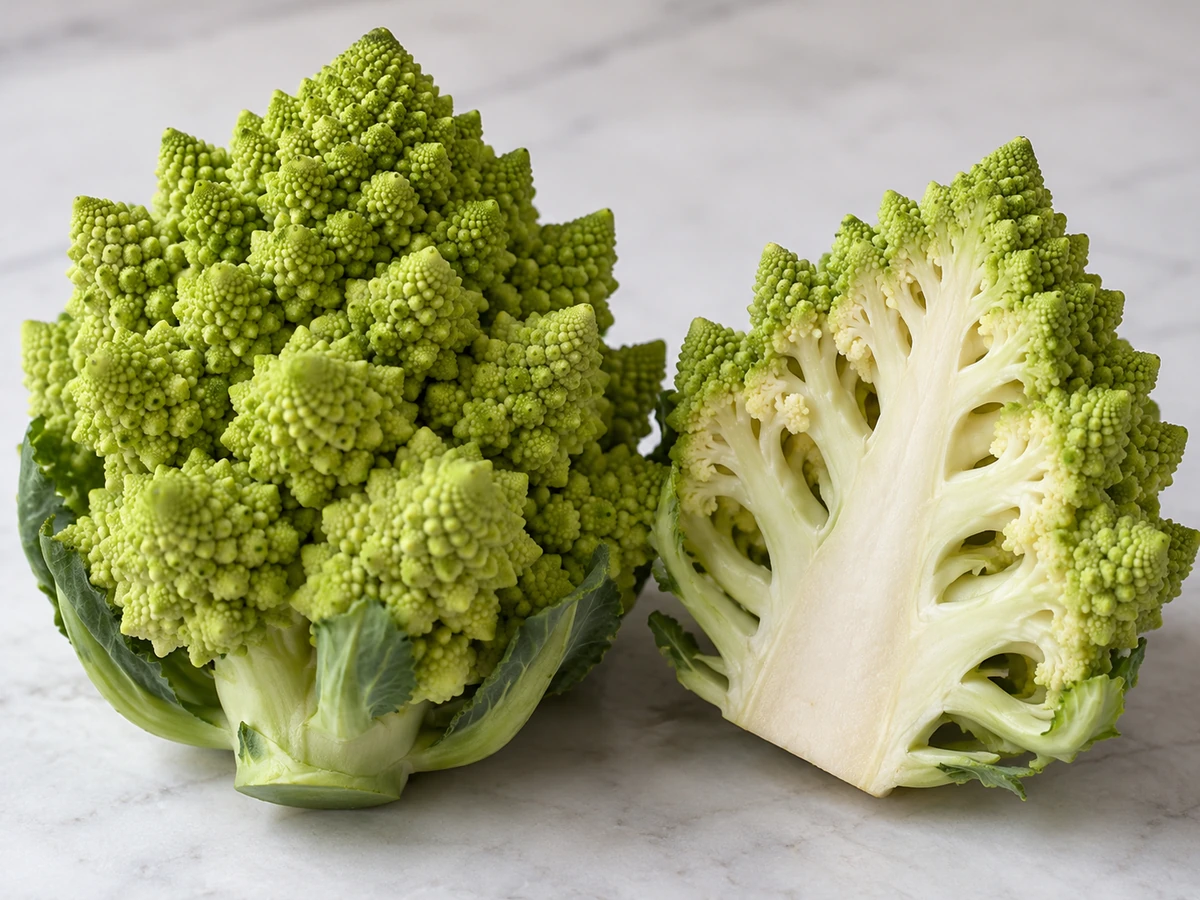
A longitudinal cut reveals the pale branching stems beneath the pointed green crown.
That difference matters when someone asks for small Romanesco. Small can mean naturally smaller complete florets, larger florets divided through their stems, or fragments produced by cutting and handling. These forms may cook acceptably in some recipes, yet they do not make the same visual promise. A photo of the preferred piece is often the quickest way to establish what the buyer means before numerical tolerances are developed.
Fine points are vulnerable to mechanical contact. A crown may lose its tip while most of the floret remains connected; other pieces may separate into smaller clusters. The amount that matters depends on the dish. A few small detached points can be unobtrusive in a mixed side, while a plated course built around individual pointed florets may reveal the same damage immediately. Keep the application visible when deciding how much intact structure is required.
The main stem also contributes usable food, so trimming it away entirely is not automatically an improvement. A modest stem can support the crown through handling and give the cook a place to lift the piece. An excessive length may dominate the portion or require a different cooking exposure. The objective is a form that performs well in the intended service, supported by a clear agreement on trim.
When reviewing pictures, ask to see both the crown and a side view. A top view can hide long stems; a side view alone can understate the crown's breadth. An image with a simple scale helps communicate dimensions, but it cannot replace an agreed measurement method or a representative sample. The structure tells you what to examine. The specification tells both parties how to examine it consistently.
What to expect from flavor and bite
Romanesco is commonly described as mild and slightly nutty. Those words are a useful expectation for a first tasting, although a prepared dish also reflects cooking, seasoning and the particular raw material. Keep the initial evaluation simple. A plain cooked sample reveals the underlying vegetable more clearly than a heavily seasoned sauce, and it lets the kitchen decide how much additional flavor the final application needs.
Assess the stem and the crown separately within the same bite. The stem is thicker and denser than the small outer points, so it can remain firm while the surface becomes soft. A sample that looks attractive on the plate may still have an uneven eating texture. Conversely, a very soft sample may taste pleasant in a blended preparation while failing the requirement for a recognizable vegetable piece.
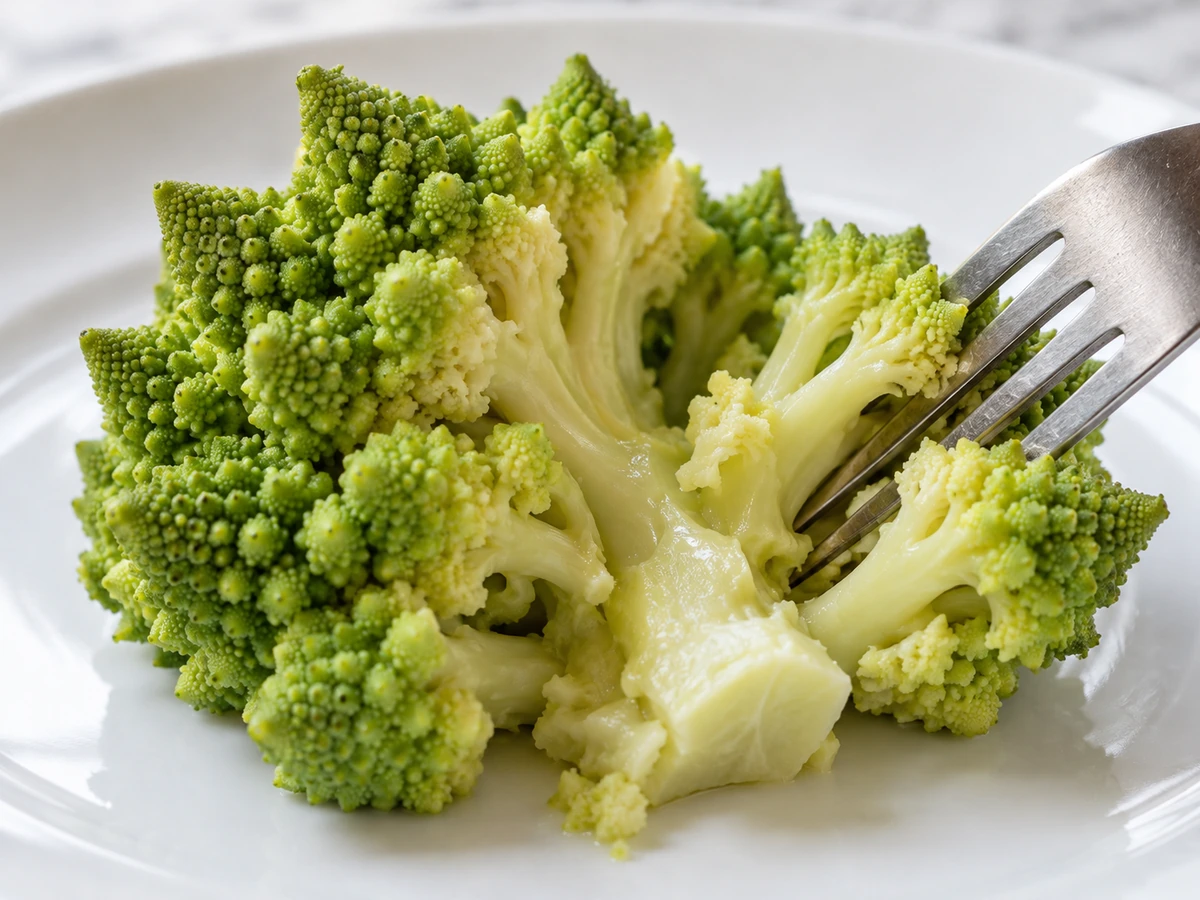
Cooked Romanesco floret opened with a fork
For a practical tasting, use the intended cooking method and a consistent portion. Let evaluators note whether the crown separates during lifting, whether the stem offers the desired resistance and whether water collects around the serving. These are observations that a cook can act on. Vague ratings such as premium texture are harder to translate into a process or a purchase requirement unless they are tied to a reference sample.
The point of service matters too. A floret tasted immediately after cooking may feel different after it has sat with a hot meal or passed through a reheating step. If Romanesco is destined for a prepared meal, evaluate it after that complete sequence. If it is served to order, evaluate the actual interval between cooking and eating. The useful benchmark is the customer's experience, not the best-looking moment during preparation.
Seasoning can complement the mild vegetable without hiding its form. A light coating distributes flavor while leaving the pointed surface visible. A thick coating may fill the spaces between clusters and make the crown look rounded. Neither is inherently wrong, but the choice should follow the purpose of using Romanesco. If the dish advertises the spiral appearance, the final sauce and service method need to preserve that benefit.
Avoid assigning a precise nutritional advantage on the basis of shape or color. Nutrient declarations require an appropriate data source for the product and its prepared state. A vivid green photograph does not quantify vitamins, and a pleasant bite does not prove a particular processing history. For this ingredient choice, begin with identity, flavor and performance; obtain the required composition information separately when developing labels or nutrition claims.
What changes when Romanesco is sold frozen
Frozen Romanesco is usually encountered as prepared florets rather than a whole ornamental head. That form allows the kitchen to portion individual pieces and removes much of the trimming associated with fresh heads. It also changes what a buyer should inspect. Crown integrity, stem length, size distribution and the proportion of loose pieces become more useful than the overall shape of the harvested head.
The word IQF describes an individually quick-frozen format. It does not define a complete quality grade, a specific floret diameter or the amount of stem in the pack. Two IQF offers can be intended for different applications. A free-flowing sample is helpful for portioning, but its separability alone does not establish that the pieces meet a plated-service requirement. Review the form and the final cooked result as well.

Romanesco florets with attached stems
Frozen storage and processing do not make every vegetable ready to eat. The actual product information determines the required preparation. For example, Ardo's Romanesco floret page explicitly directs cooking before eating and refers the reader to pack instructions for timing. That is evidence for that named product; a buyer should obtain the corresponding instructions for the SKU being ordered rather than copying another supplier's method.
Inspect the sample in the condition in which it will be received. Look at whether pieces separate under normal handling, whether substantial loose ice obscures them, and whether the carton or inner bag is damaged. A photograph cannot diagnose a temperature history. When receiving condition raises a question, preserve the packaging and relevant records and review the evidence with the supplier instead of drawing a conclusion from one visual sign.
Our frozen Romanesco product page provides the starting form for that discussion: spiral florets with attached stems. The final order still needs an agreed size and trim description, intended application, packing and required documents. Public product photographs illustrate the form; the approved sample and written specification establish what the purchasing team expects for its own order.
Think about pack size in relation to actual use. A kitchen that removes a small amount repeatedly needs a practical way to handle and close the remaining product under its frozen storage procedure. A manufacturer feeding complete packs into a production run has a different need. Choose the packing around that workflow, then confirm available options and order quantities. Convenience comes from matching the purchased form to the operation.
Where its shape earns a place on the plate
Romanesco earns its strongest visual role when a person can still recognize the crown in the finished dish. A simple vegetable side, a lightly dressed grain bowl or a prepared meal with distinct components can show the points clearly. The same floret hidden beneath a deep sauce may contribute flavor and texture, but the spiral has little opportunity to influence how the serving looks.
Start with the space available on the plate or inside the meal compartment. A very large floret can dominate a small serving, while very small pieces may be difficult to distinguish from other green vegetables. Look at the complete meal at normal eating distance. A close-up promotional photograph can make tiny details appear more prominent than they will be to the diner. Trial the portion in the actual serving vessel.
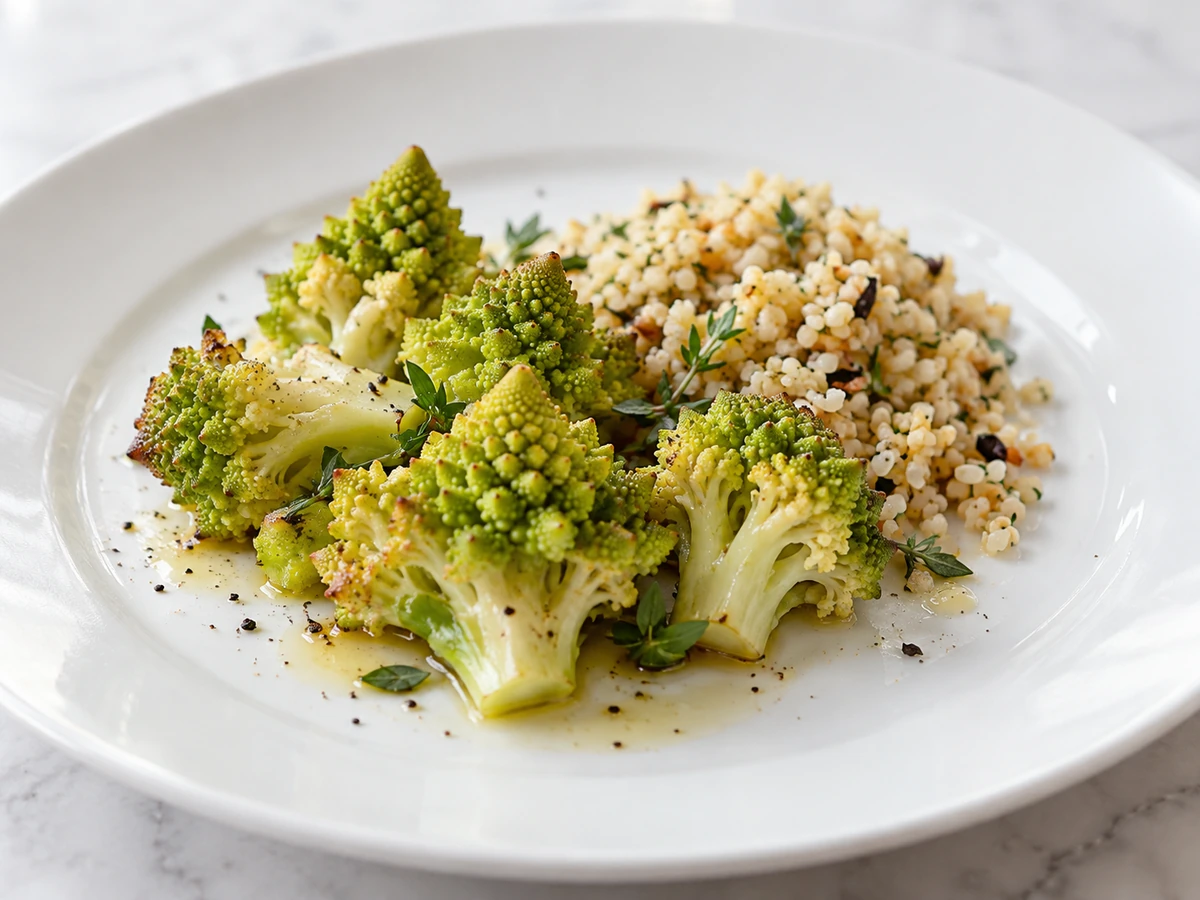
Romanesco as a visible vegetable side
Mixed vegetables introduce a second relationship: the surrounding cuts can reveal or conceal Romanesco. Long carrot strips, small beans and broad cauliflower pieces occupy space differently. A mix containing enough Romanesco by total weight may still produce individual servings in which its crowns are scarce or buried. For an initial ingredient decision, confirm whether the blend needs a visible Romanesco presence and leave detailed distribution limits to the later formulation work.
The cooking route should follow the presentation goal. Moist heat can suit a clean green appearance; dry heat can add browned edges and a different flavor. Both require attention to the thicker stems and finer tips. There is no single appearance that suits every dish. Choose the intended result before asking the kitchen to preserve color, add browning and maintain a particular bite, since those priorities may require compromise.
Handling after cooking can be as visible as the cooking itself. A broad utensil supporting the stem is less likely to concentrate pressure on the crown than a tight grip on its pointed surface. Repeated mixing, deep piles and forceful transfers can remove the details that made the ingredient attractive. Test the same serving actions that staff will use when the meal is produced at normal volume.
There are also sensible applications in which the spiral is secondary. Chopped vegetable fillings or blended preparations may use Romanesco for formulation reasons. In those cases, the buyer can evaluate a suitable form without paying for an appearance the process will remove. Keep the required safety, identity and functional performance intact, while matching visual expectations to the actual product. A useful ingredient choice is one whose benefits survive the way it will be used.
Turn the description into a useful purchase brief
A useful first purchase brief begins with the dish or product being made. State whether Romanesco will be a visible side, part of a vegetable mixture or an ingredient in a prepared meal. Describe the main cooking and reheating steps, the serving size and the appearance that must remain. This gives the supplier a reason for the requested floret form and helps avoid a quotation based only on the ingredient name.
Next describe the piece. A reference photo can show the preferred crown, attached stem and overall proportions. Add the dimensions that matter to your equipment and portion, then agree how those dimensions will be measured. Our frozen vegetable cut-size guide explains why a size description needs a method and a tolerance. Romanesco requires particular care because its crown is pointed and irregular rather than a simple cube.
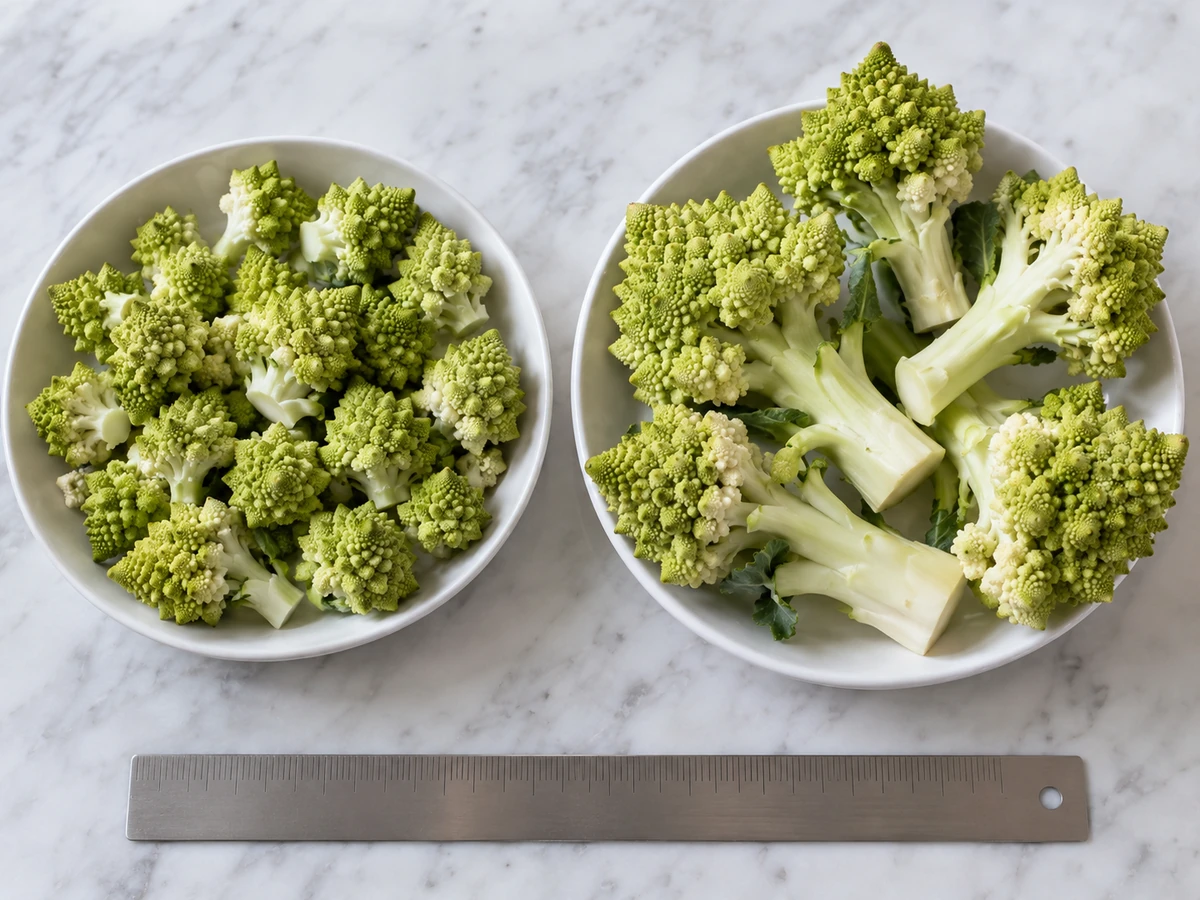
Romanesco samples compared for portion appearance
Keep the first sample evaluation connected to that brief. Inspect the frozen form, cook a representative amount by the intended method, and review the finished portion after normal service handling. Preserve the sample identity and the observations. If the result is close but the stems dominate the plate, the next discussion can focus on trim. If the fine tips disappear during transfer, the next trial can distinguish product integrity from handling pressure.
Commercial details belong alongside the product description. Share the required quantity, destination, packing format and delivery timing, and identify any private-label or documentation needs. Ask the supplier to confirm the available basis for the proposed order. A website category description cannot establish current capacity, a production schedule, a held certificate's scope or the documents available for a specific consignment.
Avoid using a single attractive sample as the entire agreement. Decide how future deliveries will be compared with the approved form and which differences require discussion. The full acceptance method can be developed once the application is clear; at this stage, even a concise record of the intended crown appearance, size range and cooking result is more useful than an unexplained grade adjective.
Send the preferred frozen floret photograph with the cooking and serving description. If the sample needs revision, identify the feature to change: crown width, attached-stem length, the amount of loose material or the result after transfer. We can use those observations to discuss the proposed Romanesco order and the next sample, with the available specification and packing confirmed in the quotation.
Source Frozen Romanesco with GreenLand-food
GreenLand-food is a professional frozen Romanesco supplier and manufacturer in China, providing factory-direct wholesale supply for importers, food manufacturers, foodservice distributors and private-label programs.
Send your product form, specification, packing, quantity, application and destination. Include private-label needs and requested documents so we can confirm the supply details with your purchasing team.