



Iqf Cultivated Blueberries
Description
Technical Parameters
Bulk IQF Fruit Supply
IQF Cultivated Blueberries for Industrial, Foodservice and Retail Programs
We supply whole IQF cultivated blueberries with defined berry-size bands, Brix targets, defect tolerances, microbiological criteria and lot-linked export documents. Buyers can nominate an 8–12 mm processing grade, a 12–16 mm standard grade, a 16 mm+ large grade or a selected 16–18 mm program according to the visual, portioning and cost requirements of the finished product.
Our commercial specification is built before production around the intended use. A bakery requiring berries that remain visible after baking does not need the same size distribution as a smoothie, jam or fruit-preparation line. We therefore align size, whole-berry percentage, soluble solids, defect limits, packaging and microbiological scope with the buyer's application instead of offering one vague "Grade A" description.
Request Specification and QuotationDownload Frozen Food Catalog
What Buyers Are Actually Sourcing
IQF cultivated blueberries are highbush blueberries, commonly supplied from varieties such as Bluecrop, Duke, Legacy and O'Neal according to crop availability. Cultivated berries are generally larger and more uniform than wild blueberries. Their size, recognizable crown, blue-to-dark-blue color and free-flowing frozen format make them suitable for industrial recipes where appearance, piece identity and controlled portioning matter.
"Cultivated" and "wild" are not interchangeable commercial descriptions. Wild blueberries are normally smaller and may give a higher berry count per kilogram, while cultivated blueberries provide a larger visual piece. We identify the raw-material type, variety where required, origin, production lot and contracted size on the product file. This avoids substitutions that change berry count, visual distribution or recipe cost.
The product is washed, inspected, individually quick frozen, sorted and packed. The standard ingredient declaration is 100% cultivated blueberries, with no added sugar, color or preservative. IQF means the berries should remain substantially individual under correct frozen storage; it does not mean every lot is automatically suitable for ready-to-eat use. Intended use, destination rules and the agreed microbiological program are stated in the contract documents.

A frozen blueberry export lot under packaging, weight, label and product checks before loading.
Size Grades and Commercial Options
| Option | Nominal Size | Commercial Position | Typical Use |
|---|---|---|---|
| Processing | 8–12 mm | More berries per kilogram and economical dosing | Smoothies, jam, puree, sauce and blended fruit filling |
| Standard | 12–16 mm | Balanced appearance, count and cost | Bakery, yogurt, foodservice, retail and mixed fruit |
| Large | 16 mm+ | Stronger whole-berry presentation | Visible toppings, premium bakery and retail packs |
| Selected | 16–18 mm | Narrower calibrated range subject to crop availability | Programs requiring controlled visual uniformity |
Size is measured at the berry's widest diameter. Our standard quotation states both the nominal band and the permitted tolerance. For a calibrated program, a practical starting point is at least 90% by weight within the contracted band. Oversize and undersize tolerances can be separated when a depositor, cup filler or optical appearance makes either fraction especially important. A sample approval can be tied to the same written specification used for the production lot.
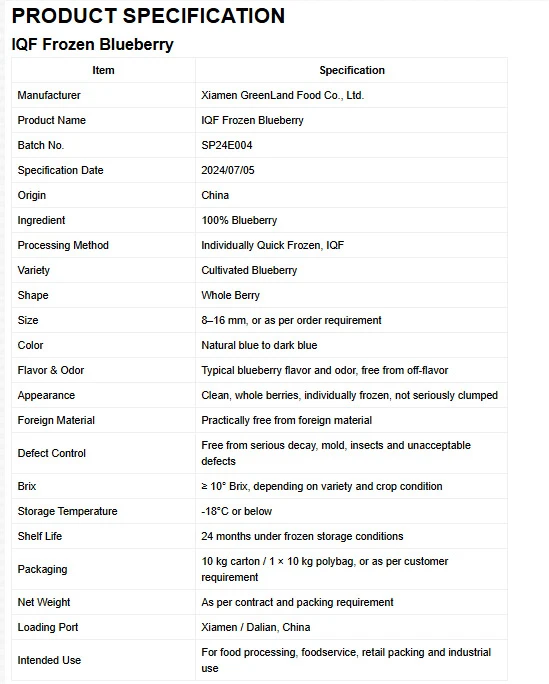
Example blueberry specification format covering identity, size, Brix, packing, storage and intended use.

A document format for microbiological, chemical-safety and traceability fields; final limits follow the signed sales specification.
Detailed Commercial Specification
| Product name | IQF Cultivated Blueberries / IQF Highbush Blueberries |
|---|---|
| Botanical identity | Vaccinium corymbosum |
| Ingredient | 100% cultivated blueberries; no added sugar, color or preservative |
| Variety | Bluecrop, Duke, Legacy, O'Neal or an agreed crop blend |
| Form | Whole, washed, individually quick frozen berries |
| Color | Natural blue to dark blue, with normal bloom variation |
| Flavor and odor | Typical cultivated blueberry character; no foreign or objectionable odor |
| Size | 8–12 mm, 12–16 mm, 16 mm+, or selected 16–18 mm |
| Soluble solids | 10–14° Brix standard crop range; a lot minimum may be contracted |
| Free-flow condition | Substantially free-flowing at −18°C; no severe block formation |
| Storage | Keep at −18°C or below |
| Shelf life | 24 months from production under continuous frozen storage |
| Origin and loading port | China; Xiamen, Dalian or the port stated in the sales contract |
Brix is measured on a representative prepared sample and reported as soluble solids. It is a useful maturity and recipe-control indicator, but it is not a stand-alone guarantee of perceived sweetness because acidity, variety and crop conditions also influence flavor. If a formulation depends on a strict sugar contribution, the quotation should state the minimum accepted Brix and the test method rather than only a broad crop range.
Grade A and Processing-Grade Defect Control
Grade descriptions are meaningful only when they are supported by numerical tolerances. The following Grade A profile is our practical starting specification for quotation. It can be tightened or rebalanced for a confirmed application and sampling plan.
| Inspection Item | Grade A Starting Limit | Why It Matters |
|---|---|---|
| Whole berries | ≥95% by weight | Controls visible piece integrity |
| Total visual defects | ≤2.0% by weight | Limits combined damaged, blemished and unacceptable fruit |
| Broken, split or leaking berries | ≤2.0% by weight, included in total defect review | Reduces juice loss and color bleed |
| Underripe or green fruit | ≤0.5% by weight | Supports consistent color and maturity |
| Shrivelled berries | ≤1.0% by weight | Controls appearance and texture variation |
| Stems | ≤5 pieces/kg | Reduces plant-material complaints |
| Leaves or plant material | ≤2 pieces/kg | Defines a measurable foreign-vegetable-matter limit |
| Decay, mould, insects and critical foreign matter | Absent in the inspected sample | Critical food-safety and acceptability control |
For a processing-grade program, whole berries can start at 85% by weight with broader cosmetic tolerances, while decay, mould, insects and critical foreign matter remain unacceptable. This option is suitable when the berries will be blended, cooked or milled and a higher cosmetic grade would add cost without improving the finished product. The signed specification defines the sample mass, defect categories and whether individual defects are included in or additional to the total tolerance.
Process and Lot Control
- Raw-material reception: we check berry identity, maturity, condition and incoming lot information.
- Cleaning and washing: berries are cleaned and washed under the plant's food-safety program.
- Sorting: unsuitable fruit, stems, leaves and foreign material are removed by the applicable sorting system and manual checks.
- IQF freezing: berries are frozen individually to establish a stable frozen core and free-flowing condition.
- Calibration and inspection: the lot is checked against contracted size, whole-berry, defect and sensory criteria.
- Metal detection and packing: packed product passes the established detection control before final case identification.
- Frozen storage and release: finished lots remain under frozen storage while documents and release checks are completed.

A packed-carton metal-detection control. The equipment image documents the control step and is not presented as a dedicated blueberry-only line.
Microbiological, Residue and Heavy-Metal Requirements
A commercial microbiological profile must match the intended use and destination market. For standard industrial frozen blueberry supply, we can quote the following target limits. A buyer requiring a ready-to-eat program, retailer protocol or different sampling plan should state it at the RFQ stage so the production and testing scope can be priced correctly.
| Test | Standard Quotation Target |
|---|---|
| Total plate count | ≤100,000 CFU/g |
| Coliforms | ≤100 CFU/g |
| E. coli | <10 CFU/g |
| Yeast and mould | ≤1,000 CFU/g |
| Salmonella | Not detected in 25 g |
| Listeria monocytogenes | Not detected in 25 g |
For EU-directed business, pesticide residues are controlled against the applicable commodity MRLs; where an active substance has no specific EU MRL, the default 0.01 mg/kg level applies. Our standard commercial heavy-metal targets are lead ≤0.10 mg/kg and cadmium ≤0.03 mg/kg, with the destination's legally applicable limit taking precedence where it is stricter. Multi-residue scope, laboratory accreditation, number of compounds and testing frequency are stated in the offer because "pesticide test included" is not a complete specification.

An example third-party laboratory report identifying a frozen blueberry sample. Shipment documents are matched to the applicable production lot.
COA: Specification Limits and Actual Lot Results
We provide a lot-linked Certificate of Analysis according to the agreed testing scope. The specification column records the contractual acceptance limit. The Actual Result column records the measured result for the sampled production lot; it is not a repetition of the limit and is not represented as a result before testing. This distinction lets the buyer compare the released lot with the purchase specification.
A complete COA can include product name, botanical or cultivated identity, lot number, production date, best-before date, origin, size, Brix, sensory assessment, whole-berry or defect result, microbiological results and the laboratory method or report reference. Residue and heavy-metal results may be issued on the COA, a separate accredited laboratory report or both, depending on the program.
The document pack can also include a product specification, commercial invoice, packing list, bill of lading, certificate of origin, phytosanitary certificate when required, health certificate when required, temperature record and pallet or carton label artwork. Required documents should be listed before order confirmation because certificate wording and authority requirements differ by importing country.
Traceability and Pre-shipment Checks
Each shipment is identified by a production lot or batch code shown on the carton label and linked to the applicable production records. The traceability file connects raw-material reception, processing, freezing, packing, frozen storage and shipment release. At pre-shipment review, we check product identity, quantity, carton condition, net weight, label information, batch marking and frozen condition against the order.

Carton, label, quantity and cold-chain items listed for a frozen blueberry lot before container loading.
Packaging, MOQ and Private-Label Programs
| Industrial bulk packs | 1 × 10 kg, 2 × 5 kg or buyer-defined lined carton |
|---|---|
| Foodservice packs | 1 kg and 2.5 kg inner bags in an export carton |
| Retail / private label | 200 g, 400 g, 500 g, 1 kg and other approved bag sizes |
| Standard MOQ | 10–12 metric tons for a standard bulk program |
| Custom grade or private label | Normally 15 metric tons; final MOQ depends on film, artwork and size segregation |
| Mixed container | From 3–5 metric tons per SKU where production and loading plans permit |
| Lead time | 15–20 days after specification, packaging and order details are approved |
Private-label work can cover bag dimensions, net weight, multilingual text, nutrition panel input, barcode position, date coding, carton marks and pallet requirements. The buyer supplies the destination-compliant artwork or mandatory label content; we check the production file against the approved version before packing. For accurate pricing, an RFQ should include annual volume, order size, pack format, film structure if prescribed, units per carton and required certifications.
Frozen Storage and Reefer Loading
Finished product is held at −18°C or below. Standard shelf life is 24 months when the sealed product remains continuously frozen. Cartons are checked for integrity and correct markings before loading. A reefer container is pre-cooled and set according to the shipping instruction, and loading is organized to protect airflow around the cargo.
Planning capacity is approximately 10–12 metric tons for a 20-foot reefer and 22–24 metric tons for a 40-foot high-cube reefer. Exact payload depends on carton dimensions, palletization, road weight limits and carrier equipment. The sales confirmation states the practical quantity rather than treating container capacity as a universal fixed number.

General frozen-food cold storage at −18°C; this image documents cold-chain infrastructure, not a blueberry-only room.

General frozen-food reefer loading with carton, temperature and container checks.
Sampling, Measurement and Acceptance Method
A numerical limit is only useful when the inspection method is clear. For physical evaluation, cartons should be selected across the lot rather than taken from one accessible position. The combined sample is kept frozen during handling, mixed to reduce selection bias and divided into the portions required for size, defects, sensory assessment and laboratory work. The agreed sampling plan can identify the number of cartons, sample mass and acceptance rule for the shipment size.
Berry diameter is checked at the widest point with a suitable calibrated gauge or sieve system. Results are expressed as the weight percentage inside, below and above the nominated band. Whole-berry percentage is determined on a weighed frozen sample after separating intact fruit from broken, crushed or leaking pieces. Stems and leaves can be counted per kilogram, while cosmetic defects are normally weighed and reported as a percentage. These units prevent ambiguity between a piece count and a weight tolerance.
Frozen clumping is reviewed before the sample is allowed to thaw. A lot described as free-flowing should pour and separate under normal frozen handling without a severe solid block. A small number of easily separable berry contacts is different from freezer burn, repeated thaw-refreeze damage or a compact mass. Carton temperature, surface ice, bag seal, liner condition and net weight should be examined at the same time because each can help explain an abnormal result.
Brix testing uses a representative prepared portion and a calibrated refractometer. A single unusually sweet or acidic berry should not determine the lot result. Microbiological and chemical samples are taken with clean tools, sealed, identified by lot and sent under conditions that protect sample integrity. The COA or laboratory report states the result and unit, while the underlying test report can state the method, reporting limit and laboratory identity.
If the purchase contract uses retained samples, the retention period, storage temperature, sample quantity and seal identification should be written into the quality agreement. This gives both parties a defined reference if a result is disputed after arrival. The inspection method, not marketing language, determines whether a delivery meets the agreed grade.
Frozen, Thawed and Processing Performance
IQF blueberries change after thawing: the fruit softens and releases some juice as ice crystals melt. The degree of softening and purge varies with variety, maturity, berry size, freezing history and the customer's thawing or heating process. We therefore avoid promising that a thawed berry will behave like fresh fruit. Buyers should evaluate the approved frozen sample in the actual recipe and processing sequence.
For bakery production, large intact berries create a stronger visual piece but may require careful folding and depositing. Smaller calibrated berries distribute in greater numbers and can reduce the risk of one portion receiving very few pieces. For yogurt or ice cream, the berry may be used whole or incorporated into a prepared fruit base; pump opening, shear, dosing accuracy and target piece identity should guide the contracted size. For smoothie, jam, puree and sauce, cosmetic tolerances can be broadened while Brix, flavor, color and safety remain controlled.
When a buyer needs a defined performance test, the specification can include a controlled thaw-and-drain assessment. A weighed frozen portion is thawed for a stated time and temperature, drained using a stated screen and time, then the berry and liquid fractions are weighed. Because results depend strongly on the method, a drain-loss number without those conditions is not comparable. The same principle applies to bake tests: batter formula, berry dosage, oven profile and evaluation point must be consistent.
Products intended for further thermal processing should be identified as such in the product specification. A retail or foodservice program intended for consumption without a kill step requires the appropriate hazard assessment, microbiological criteria, label instructions and destination-market controls. Freezing preserves the product but is not presented as a sterilization step.
Order Specification, Change Control and Claim Evidence
The sales specification should carry a revision number or date and be linked to the purchase order. It records product identity, origin, grade, size, Brix, defect limits, microbiological profile, chemical requirements, packaging, storage, shelf life, intended use and document list. Packaging artwork and carton marks are approved as separate controlled files. This structure keeps a price offer from being mistaken for a complete technical agreement.
If crop conditions require a change in variety, size availability, pack material, production site or testing scope, the affected order details are communicated before the changed product is shipped. No substitution should silently alter the cultivated-blueberry identity or a contracted calibrated size. Where a buyer approves an exception, the approval can be recorded against the order and lot.
For an arrival claim, useful evidence includes the container number, seal number, bill of lading, carton and lot labels, quantity affected, unopened-carton condition, temperature record, photographs, sampling details and test report. A representative sealed sample should remain frozen where practical. This information separates transport damage, temperature abuse, pack failure and specification deviation and enables a focused review.
Our quotation also distinguishes recurring contract tests from periodic monitoring. Lot-release items may appear on every COA, while a broader pesticide screen or heavy-metal panel may follow the agreed frequency or destination program. Buyers can therefore compare offers on the same testing basis, including the number of compounds, method scope, accreditation and report frequency, rather than comparing only a headline price per metric ton.
Application Matching
Bakery: a 12–16 mm or 16 mm+ berry with a high whole-berry percentage supports visible distribution in muffins, cakes, pastries and fillings. Buyers should state whether the fruit is added frozen, folded into batter or used as a topping because handling changes breakage and color migration.
Dairy and frozen desserts: 8–12 mm or 12–16 mm grades allow different piece counts in yogurt, ice cream and fruit preparations. The processing line's pump, shear and dosing system should guide size selection.
Smoothies, beverages, jam and sauce: processing grade can provide the same blueberry identity at a more efficient cost where whole-piece appearance is not the main acceptance point. Brix, color and microbiological requirements remain contract items.
Foodservice and retail: free-flow condition, calibrated size, pack seal, accurate net weight and consistent label coding matter for repeated portioning and shelf presentation. We offer bulk, foodservice and private-label formats rather than treating packaging as an afterthought.
Information to Include in Your RFQ
Send the target size, annual quantity, shipment quantity, destination country, intended use, whole-berry requirement, Brix limit, microbiological standard, residue scope, packaging, label language, certification needs, loading port preference and requested delivery window. If an existing specification is available, we can quote against it item by item. If not, the Grade A starting profile on this page provides a defined basis for comparison.
Frequently Asked Questions
1. What are IQF cultivated blueberries?
They are cultivated highbush blueberries that have been cleaned, sorted and individually quick frozen. The frozen berries are supplied as a free-flowing whole-fruit ingredient, subject to the contracted size, whole-berry and defect specification.
2. What is the difference between cultivated and wild frozen blueberries?
Cultivated blueberries are generally larger and can be calibrated into commercial ranges such as 12–16 mm or 16 mm+. Wild berries are normally smaller and provide a different berry count and visual distribution. We identify the type in the specification and do not treat the terms as interchangeable.
3. Which blueberry sizes can you supply?
Our principal options are 8–12 mm, 12–16 mm and 16 mm+. A selected 16–18 mm range can be arranged subject to crop availability and order volume. The quotation states the allowed size tolerance.
4. What Brix level is available?
The standard crop range is 10–14° Brix. For recipes requiring tighter soluble-solids control, the contract can state a minimum Brix and the sampling method. The actual production-lot result is then reported after testing.
5. What does Grade A mean for your frozen blueberries?
Our Grade A starting profile uses at least 95% whole berries, total visual defects no more than 2.0%, underripe fruit no more than 0.5%, shrivelled fruit no more than 1.0%, stems no more than 5 pieces/kg and leaves or plant material no more than 2 pieces/kg. The signed order specification is the final acceptance document.
6. Can you supply a processing grade?
Yes. Processing grade can begin at 85% whole berries with broader cosmetic tolerances for blending, cooking, milling, jam, sauce or smoothie production. Critical defects such as decay, mould, insects and foreign matter remain unacceptable.
7. Are sugar, color or preservatives added?
No. The standard ingredient is 100% cultivated blueberries with no added sugar, color or preservative. Any customer-specific formulation would be quoted and labelled separately.
8. What microbiological limits do you offer?
Our standard quotation target is total plate count ≤100,000 CFU/g, coliforms ≤100 CFU/g, E. coli <10 CFU/g, yeast and mould ≤1,000 CFU/g, and Salmonella and Listeria monocytogenes not detected in 25 g. Destination or retailer protocols can be quoted separately.
9. Do you provide a COA with actual results?
Yes. The COA identifies the applicable lot and distinguishes the contractual specification limit from the Actual Result measured for that production lot. Test scope can include physical, sensory, microbiological, residue and heavy-metal items.
10. What packaging is available?
Industrial options include 1 × 10 kg and 2 × 5 kg lined cartons. Foodservice options include 1 kg and 2.5 kg bags. Private-label programs can use 200 g, 400 g, 500 g, 1 kg or another agreed net weight.
11. What is the MOQ?
A standard bulk order normally starts at 10–12 metric tons. Custom grade or private-label production normally starts at 15 metric tons. Mixed-container planning can begin at 3–5 metric tons per SKU where schedules and packaging permit.
12. What is the shelf life and storage temperature?
Shelf life is 24 months from production when the sealed product is continuously stored at −18°C or below. The product should remain frozen through storage, handling and transport.
13. How much fits in a reefer container?
Planning quantities are approximately 10–12 metric tons in a 20-foot reefer and 22–24 metric tons in a 40-foot high-cube reefer. Final payload depends on packaging, palletization, carrier equipment and legal weight limits.
14. What details are needed for an accurate quotation?
Please provide size, grade, annual and shipment volume, destination, intended use, Brix, microbiological and residue requirements, pack format, label needs, certifications and delivery window. These fields allow us to quote a defined product rather than an unqualified blueberry price.
Build a Contract-Ready Blueberry Specification
Tell us whether your priority is visible whole berries, calibrated portioning, processing economy, private-label packing or a destination-specific testing program. We will return the applicable size, grade, pack, MOQ, lead time and document scope in the quotation.
Hot Tags: iqf cultivated blueberries, China iqf cultivated blueberries manufacturers, suppliers, factory, frozen blueberry, frozen unsweetened blueberries, iqf frozen blueberries, frozen cultivated blueberries
Previous
Orchard Gold Frozen Blueberries


