We supply IQF frozen riced cauliflower prepared from sound white cauliflower, cut into rice-sized particles, individually quick frozen and packed for industrial processing, foodservice distribution and private-label retail programs. The standard ingredient is 100% cauliflower with no rice, starch, seasoning or sauce added.
A useful specification must go beyond the phrase “cauliflower rice.” We define the nominal cut, undersize fines, oversize pieces, visible stem, discoloration, loose frost, clumping and microbiological release criteria so your purchasing and production teams receive a repeatable ingredient.
4–6 mm standard rice cut
10–20 mm coarse crumble
24 months at ≤ −18°C
COA by production batch
IQF Vegetable Ingredient for Retail, Foodservice and Ready Meals
Frozen Riced Cauliflower with Defined Particle Size, Fines and Moisture Performance
We supply IQF frozen riced cauliflower prepared from sound white cauliflower, cut into rice-sized particles, individually quick frozen and packed for industrial processing, foodservice distribution and private-label retail programs. The standard ingredient is 100% cauliflower with no rice, starch, seasoning or sauce added.
A useful specification must go beyond the phrase "cauliflower rice." We define the nominal cut, undersize fines, oversize pieces, visible stem, discoloration, loose frost, clumping and microbiological release criteria so your purchasing and production teams receive a repeatable ingredient.
4–6 mm standard rice cut10–20 mm coarse crumble24 months at ≤ −18°CCOA by production batch
A caliper view shows the irregular, rice-sized cauliflower particles used for cut assessment.
Commercial product status: our standard frozen riced cauliflower is not ready to eat. It is supplied as a frozen vegetable ingredient for further heat treatment. The cooking process, final center-temperature requirement and finished-product label must match the destination market and the buyer's validated food-safety plan.
Four Purchasing Risks We Control in the Written Specification
Uneven Particle Size
Too many fines become paste-like, while large pieces cook differently. We state the nominal cut, practical acceptance band, fines limit and oversize limit separately.
Water Release
Poor draining, heavy frost and repeated temperature fluctuation can create wet meal trays. We control free-flow condition, surface ice and frozen-chain handling.
Color and Defects
Yellow, brown or black pieces reduce retail and meal presentation. We set numerical limits for discoloration, leaf material, damaged tissue and foreign matter.
Unclear Product Status
Raw, blanched and fully cooked products are not interchangeable. We identify the process status and NRTE declaration in the specification and label file.
Product Video
Cauliflower product overview. We confirm the product form, processing method and packing for each order.
Bulk product appearance: small irregular particles rather than polished grain-shaped pieces.
Product Forms: Rice Cut, Fine Rice and Coarse Crumble
4–6 mm standard rice cut: our main commercial form for retail bags, foodservice and ready-meal filling. The particles remain naturally irregular because they are cut from cauliflower curd and stem tissue.
5 × 5 mm nominal dice: a more defined cut description used where the buyer's filler, depositor or portioning system needs a controlled nominal particle. The accepted size distribution is stated with the quotation.
3–5 mm fine rice: a smaller grade for blended fillings, soups, sauces and formulated vegetable products. Its fines limit matters more because small particles can soften quickly.
10–20 mm coarse crumble: the larger crushed form already represented in the original product offer. It provides more visible cauliflower texture and is kept separate from rice-sized grades in the contract.
Commercial Specification for IQF Frozen Riced Cauliflower
The table below is our quotation baseline for a standard 4–6 mm product. A different particle grade receives its own size band and defect schedule. This prevents a coarse crumble specification from being used to judge a fine rice order.
Parameter
Standard Offer
Commercial Meaning
Product name
IQF Frozen Riced Cauliflower
Also traded as frozen cauliflower rice or IQF cauliflower rice
Botanical source
Brassica oleracea var. botrytis
Prepared from sound white cauliflower heads
Ingredient
100% cauliflower
No rice, sauce, salt, seasoning or starch in the standard item
Nominal particle size
4–6 mm
Optional 3–5 mm, 5 × 5 mm or 10–20 mm coarse crumble
Practical size band
≥ 85% between 3 and 8 mm by weight
Recognizes natural irregularity while controlling the dominant particle range
Fine particles
≤ 5% below 2 mm by weight
Limits mealiness and excess paste-like material
Oversize particles
≤ 5% above 10 mm by weight
Reduces uneven cooking and filling problems
Color
Natural white to creamy white
Normal crop variation; no abnormal yellow, brown or black dominance
Flavor and odor
Typical cauliflower; no sour, fermented, mouldy or foreign odor
Evaluated after the agreed preparation method
Process
Washed, trimmed, cut, blanched, cooled, dewatered and IQF frozen
Unblanched projects require a separate order specification
IQF condition
Free-flowing with no large fused block
Supports portioning and formula dosing
Foreign material
0 detectable
Includes plastic, metal, glass, stone, wood and other non-product material
Shelf life
24 months from production
When continuously stored and transported at ≤ −18°C
Product status
Not ready to eat; cook before consumption
Final cooking instruction belongs to the buyer's validated finished-product process
Raw Material and Related Cauliflower Forms
We select compact, sound cauliflower heads with a natural white-to-creamy-white curd. Incoming checks remove heads affected by decay, severe yellowing, black spots, insect damage, excessive green leaf material, physical contamination or abnormal odor.
Riced cauliflower is produced from clean cauliflower tissue after trimming. A controlled amount of pale stem tissue can be included because stem contributes usable structure, but coarse stem chunks are treated as oversize. Green leaves and hard core pieces are controlled separately.
Frozen florets are a related form, not a substitute for cauliflower rice. We keep floret orders, nugget orders, rice cuts and coarse crumble orders under separate product descriptions, particle standards and packing labels.
Frozen florets show the related cauliflower form; rice-cut orders are processed and graded separately.
Defect Limits for Color, Stem, Fines and Frozen Condition
Small particles expose more cut surface than whole florets, so riced cauliflower is especially sensitive to dehydration, yellowing, fines and water release. We use numerical criteria instead of relying on the phrase "Grade A."
Defect
Baseline Limit
Inspection Basis
Serious yellow, brown or black discoloration
≤ 1.0% by weight combined
Separated from acceptable natural creamy-white variation
Green leaf material
≤ 0.5% by weight
Visible green leaf pieces, excluding normal pale-green internal tissue if agreed
Coarse hard stem / core
≤ 2.0% by weight
Pieces materially harder or larger than the contracted rice cut
Insect-damaged or decayed tissue
≤ 0.5% by weight
No live infestation; mouldy pieces rejected
Loose surface frost and adhering ice
≤ 3.0% by weight
No deliberate glaze in the standard product
Fused clusters after normal handling
≤ 5.0% by weight
Clusters that do not separate with light manual pressure
Foreign matter
0 detectable
Critical physical-contamination criterion
Processing Flow and Cut-Size Control
We prepare Frozen Riced Cauliflower to the agreed product form, pretreatment, grade and packing specification. The diagram shows a typical production process; we confirm preparation and step order for your order.
Typical process flow. Final processing and step order follow the confirmed specification. Site photos show the captioned subjects and may illustrate a representative form; process illustrations show typical operations. Storage and loading photos are generic frozen-food references.
Production and handling stages
Raw Material InspectionWe check identity, condition and the agreed raw-material criteria.
Initial SortingWe remove visible defects and unsuitable material.
WashingWe follow the confirmed cleaning and water-control route.
Trimming & RicingWe prepare riced cauliflower and remove the specified inedible parts.
BlanchingWe apply the agreed heat-treatment program.
Cooling & DrainingWe cool after heat treatment and remove excess surface water.
IQF FreezingWe quick freeze prepared pieces and review separation.
Frozen Product InspectionWe review the agreed defects, form, separation and frozen condition.
Weighing, Packing & Metal ControlWe check net weight, pack integrity and agreed metal controls.
Batch Review & ReleaseWe match lot identity and records to the agreed release checks.
Frozen StorageWe maintain the agreed frozen-storage conditions and lot identity.
Reefer LoadingWe review cartons, lot records and refrigerated shipment arrangements.
Size measurement is shown on the cauliflower form before it is reduced to the contracted rice cut.
Processing Flow and Cut-Size Control
We receive and inspect fresh cauliflower, remove leaves and damaged tissue, trim the core, wash the edible portion and prepare it for cutting. The cutter screen and line setting are selected for the contracted nominal size rather than using one crushing setting for every order.
For the standard blanched item, the cut product receives controlled heat treatment, rapid cooling and dewatering before IQF freezing. Peroxidase can be used as a blanching-control indicator when included in the testing plan. Excessive blanching is avoided because it weakens texture and increases water release after reheating.
After IQF freezing, we separate oversize pieces, excessive fines and visible defects, then perform metal detection, check weighing, bag sealing and carton coding. Samples are retained under frozen conditions for the agreed retention period.
Microbiological, Chemical and Physical Release Criteria
The following values form a practical baseline for a blanched, not-ready-to-eat IQF vegetable. A destination market, retailer code or application can require tighter limits. The production-batch COA reports the actual result beside the contracted specification limit.
Test
Baseline Limit
COA Entry
Total plate count
< 100,000 CFU/g
Numerical actual result
Coliforms
< 100 CFU/g
Numerical actual result
Escherichia coli
< 10 CFU/g
Numerical actual result or below method limit
Yeasts
< 1,000 CFU/g
Numerical actual result
Moulds
< 1,000 CFU/g
Numerical actual result
Staphylococcus aureus
< 100 CFU/g
Numerical actual result or below method limit
Salmonella
Not detected in 25 g
Detected / not detected
Listeria monocytogenes
Not detected in 25 g
Detected / not detected
Metal detection
Fe 1.5 mm / Non-Fe 2.0 mm / SUS 2.5 mm
Line sensitivity and challenge-check record
Pesticide residues
Comply with destination-market MRLs
Actual multi-residue results when contracted
Lead, cadmium and other contaminants
Comply with destination-market maximum levels
Actual result when included in the batch plan
We do not present a regulatory maximum as though it were the lot result. "Specification" and "Actual Result" remain separate columns, and the latter contains the corresponding batch measurement or contracted composite-sample result.
Frozen Condition, Drip Loss and Application Testing
Riced cauliflower has a high cut-surface area. Surface frost, cellular water release and fine particles can therefore affect sauce viscosity, tray moisture and filling weight. We inspect the frozen lot for loose ice and clumping, but the buyer's finished-product test remains the strongest measure of application performance.
For a repeatable comparison, weigh a frozen sample, apply the intended microwave, steam, pan or oven process, then record cooked weight, free liquid, particle definition, color and texture after a fixed holding time. Compare only samples with the same cut, blanching status and heating curve.
Retail packs usually prioritize white color, even rice-sized appearance and low visible fines. Ready meals prioritize controlled water release after reheating. Foodservice packs prioritize free flow and portioning. Industrial fillings may accept a smaller grade when particle definition is less important than usable yield.
A clear liner shows frozen cauliflower condition; final rice-cut packing uses the contracted inner-bag format.
Applications & Quality Requirements
We match Frozen Riced Cauliflower to your processing or packing line. Product form to confirm: Riced cauliflower. Tell us the intended use and target texture so we can review the relevant size, grade, preparation and packing requirements before quotation.
Application illustrations. Product form, preparation and suitability follow the confirmed specification. Open the overview to inspect the image.
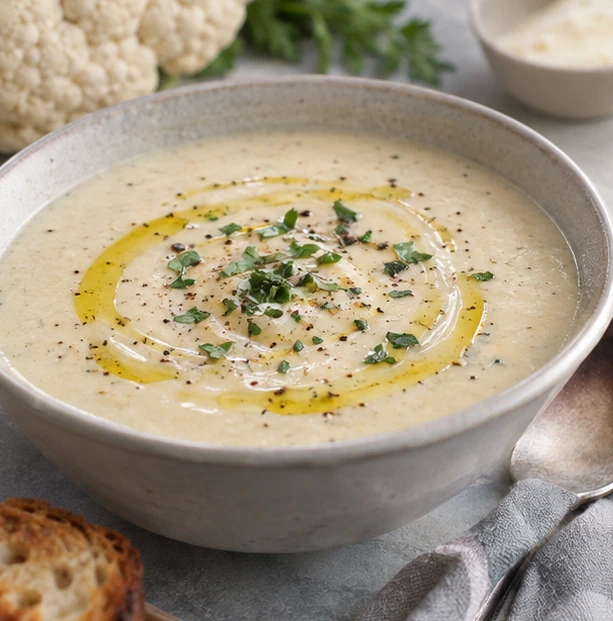
Cauliflower soup and sauce
For: Ingredient buyers at food-processing plants
Form: riced
We review riced for your cauliflower soup and sauce programme. Confirm cooked solids, refining losses and finished-base smoothness in cauliflower soup and sauce. Larger declared inputs require controlled tempering, trimming and cutting, or cooking and blending as appropriate, before they meet the ideal form; assess preparation yield and discard losses. Your team prepares the required cut or refined component before this application.
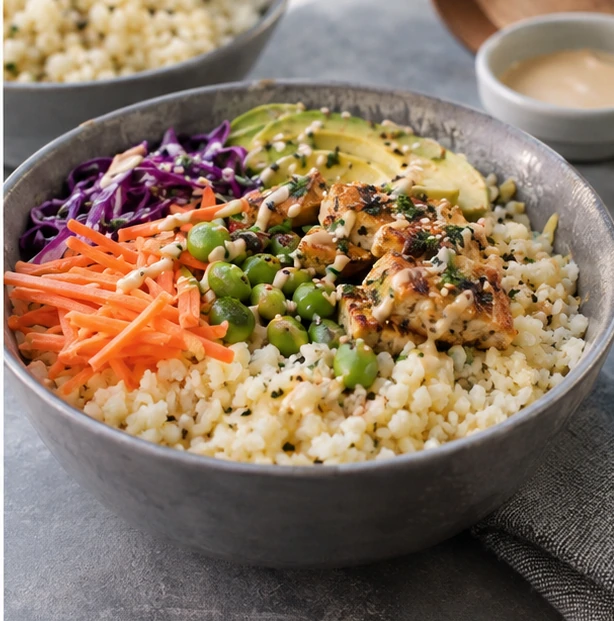
Cauliflower rice bowls
For: Ready-meal and vegetable-blend buyers
Form: riced
We review riced for your cauliflower rice bowls programme. Confirm dosing accuracy, cut distribution and reheating texture in cauliflower rice bowls. Florets or chopped cauliflower require downstream ricing; screen fines and control water release. Received florets are not already riced.
Match the Application with the Purchasing Specification
Application
Selected form
Quality points to confirm
Cauliflower soup and sauce
riced
cooked solids, refining losses and finished-base smoothness in cauliflower soup and sauce
Cauliflower rice bowls
riced
dosing accuracy, cut distribution and reheating texture in cauliflower rice bowls
Send us the product, required form, final application, key quality requirements, packing, quantity and destination market. We will review the supply programme and confirm the order specification with your team.
Start with 4–6 mm or 5 × 5 mm, fines ≤ 5%, strong white appearance and a free-flowing pack. We review bag dimensions, net weight, label language, barcode and cooking statement.
Ready Meals and Meal Kits
Select the cut after testing reheating moisture, sauce compatibility and particle definition. We align the blanching status and COA plan with the finished meal's NRTE or ready-to-heat controls.
Foodservice and Central Kitchens
Use 2.5 kg or 5 kg inner bags where portioning and freezer handling matter. Free-flowing condition and predictable cooking yield are more important than consumer-facing artwork.
Industrial Formulation
Fine rice or 10–20 mm crumble can be matched to fillings, sauces, soups, vegetable blends and formed products. Particle range, fines and water behavior are specified around the actual process.
General certificate and compliance files are reviewed according to the factory, product and destination program.
Certificates, COA and Traceability Documents
We provide the product specification, ingredient statement, allergen statement, batch COA, packing list, commercial invoice and bill of lading. Certificate of origin, health certificate, phytosanitary documentation and other shipment files are prepared where the destination and product classification require them.
Available quality-system and market certificates depend on the approved production site and order program. The certificate wall is general company evidence; it is not represented as a certificate for a particular cauliflower rice batch.
Each finished lot connects to raw material reception, processing date, cutting line, IQF run, packing date, metal-detection checks, carton code, frozen storage and shipment. The COA identifies the same lot and states the actual test results agreed for release.
Packaging, MOQ and Private-Label Planning
Industrial Bulk
1 × 10 kg blue PE liner in a corrugated carton. Optional 20 lb, 40 lb and 20 kg cartons are planned by market and handling requirement.
Foodservice
4 × 2.5 kg, 2 × 5 kg or another practical inner-bag configuration inside an export carton.
Retail / Private Label
500 g, 1 kg, 1 lb or 2 lb bags with approved artwork, barcode, date code, cooking statement and carton marks.
Pallet and Mixed Load
Pallet height, stretch wrap, corner protection and mixed frozen-vegetable container planning are set before booking.
MOQ: 10 metric tons for a standard bulk specification; 15 metric tons for a new printed retail bag; mixed-container programs can be discussed from 3 metric tons per item when the products share compatible production and loading conditions.
Lead time: normally 15–20 working days after the specification, packaging and deposit are complete. New printed film generally requires 25–35 days. We state current stock, production window and shipment schedule in the commercial offer.
Frozen Storage and Container Loading
We store sealed cartons at or below −18°C and protect them from thawing and refreezing. The product should remain hard frozen and free flowing. Temperature fluctuation can increase frost, fused particles and water release even when the carton remains externally intact.
Loading quantity depends on carton size and pallet use. A practical reference is 10–12 metric tons in a 20-foot refrigerated container and 22–24 metric tons in a 40-foot high-cube refrigerated container. The carrier's payload limit and the final carton plan control the booked quantity.
Before loading, we check carton condition, lot codes, quantities, container cleanliness, reefer set point and loading arrangement. FOB, CFR and CIF terms can be quoted from an applicable China port.
General frozen storage evidence supports the ≤ −18°C cold-chain module; it is not presented as a cauliflower-only warehouse.
General export loading evidence shows carton handling and reefer temperature checks.
Receiving Inspection for Repeat Orders
At receipt, record the seal, reefer temperature, product temperature, carton condition, quantity and lot codes before opening representative cartons. Keep samples frozen while checking free flow, loose frost, discoloration, fines and oversize pieces.
For size distribution, sieve or manually separate a defined sample into the contracted bands and report each fraction by weight. Use the same sample mass and method for the approved sample and each repeat lot. This produces a meaningful trend instead of a subjective judgment that the product "looks too fine."
If a result falls outside the specification, retain unopened cartons and a representative frozen sample, photograph the finding and identify the affected batch. Lot-specific evidence allows the result to be compared with production, packing and laboratory records.
Ingredient, Additive, Allergen and Label Status
The standard ingredient statement is "Cauliflower." We do not add rice, starch, salt, sugar, oil, sauce, flavor or preservative to the standard product. If a buyer requests a treated, seasoned or blended version, every additional ingredient and processing aid must appear in the order specification and destination-market label assessment.
Cauliflower itself is not one of the major allergens commonly declared under US, EU, UK, Canadian or Australian/New Zealand priority-allergen lists. We nevertheless provide the production site's allergen questionnaire and cross-contact statement because the final precautionary wording depends on every material handled at the approved facility. We do not place an "allergen-free" claim on the product without the required site assessment and market-specific evidence.
For GMO status, we can provide an ingredient-origin statement or the documentation required by the agreed program. The statement describes the cauliflower and the approved supply chain; it is not used as a substitute for destination-market labeling rules. Organic product is quoted only under a certified organic supply program with a valid scope certificate and transaction documents where applicable.
Retail artwork should state the product name, ingredient, net weight, country of origin, storage condition, lot/date coding, best-before date and an adequate cooking instruction. We review the production data and print position, while the brand owner remains responsible for final legal label approval in the destination market.
What the Batch COA and Release File Contain
A useful COA identifies the shipped production batch instead of repeating a generic data sheet. We place the product name, specification code, production date, lot number, sampling date and analysis date at the top. Each tested parameter then shows the method or reporting unit, specification limit and actual result.
COA Group
Recorded Information
Purpose
Lot identity
Product, cut, specification code, batch, production date and best-before date
Shows whether the lot matches the agreed commercial grade
Process controls
Blanching indicator when contracted, packing weight, metal-detection verification and release temperature
Links product release to the processing and packing records
Microbiology
Actual numerical counts and pathogen detected/not-detected results
Provides batch evidence against the contracted limits
Additional analyses
Pesticide residues, lead, cadmium or other market-specific tests when ordered
Supports buyer QA and destination-market compliance files
Not every parameter needs laboratory testing on every shipment. We separate routine batch-release checks from periodic monitoring and order-specific external analysis. If the buyer requires a test for each lot or each container, it is listed in the testing plan so sampling, laboratory time and document release are included in the production schedule.
We also retain the related specification, inspection sheet, packaging record and traceability data. This allows a repeat order to be compared with the same size definitions, defect basis and methods rather than with a generic marketing sample.
Frequently Asked Questions
1. What is frozen riced cauliflower?
It is cauliflower cut into small, rice-sized particles and individually quick frozen. Our standard item contains 100% cauliflower without rice, sauce or seasoning.
2. Which particle sizes can you supply?
Our main grade is 4–6 mm. We also offer 3–5 mm fine rice, nominal 5 × 5 mm and 10–20 mm coarse crumble under separate size distributions.
3. How is the 4–6 mm grade inspected?
The baseline requires at least 85% by weight between 3 and 8 mm, fines below 2 mm at ≤ 5%, and oversize pieces above 10 mm at ≤ 5%.
4. Is the product blanched?
The standard offer is blanched, cooled, dewatered and IQF frozen. An unblanched program requires a separate process description, microbiological plan and application assessment.
5. Is IQF cauliflower rice ready to eat?
No. The standard product is not ready to eat and must receive an adequate cooking step before consumption. Finished-product instructions follow the buyer's validated process.
6. How do you limit watery performance?
We control blanching, rapid cooling, dewatering, loose frost, fused clusters and frozen-chain conditions. We also recommend a fixed application test that records cooked weight and free liquid.
7. What discoloration and leaf limits apply?
Serious yellow, brown or black discoloration is ≤ 1.0% by weight, and visible green leaf material is ≤ 0.5% under the baseline specification.
8. What microbiological values appear on the COA?
The baseline covers TPC, coliforms, E. coli, yeasts, moulds, S. aureus, Salmonella and Listeria monocytogenes. The Actual Result column contains the corresponding batch result.
9. Which bulk packing is standard?
The standard bulk pack is one 10 kg food-grade PE liner in a corrugated carton. Foodservice inner bags and 20 lb, 40 lb or 20 kg cartons can be planned by order.
10. Can you produce private-label retail bags?
Yes. We review bag size, net weight, artwork, label language, barcode, lot coding, cooking statement, carton marks and destination-market requirements before printing.
11. What are the storage temperature and shelf life?
Store and transport the sealed product at or below −18°C. Shelf life is 24 months from production when the frozen chain remains continuous.
12. Can cauliflower rice share a mixed container?
Yes, when the selected frozen vegetables have compatible production schedules, packing dimensions and storage requirements. A mixed program can be discussed from 3 metric tons per item.
13. What documents can accompany the shipment?
We provide specification, batch COA, invoice, packing list and bill of lading, plus origin, health, phytosanitary and test documents where the destination or contract requires them.
14. What are the MOQ and normal lead time?
MOQ is 10 metric tons for standard bulk and 15 metric tons for a new printed retail program. Standard production normally requires 15–20 working days; new packaging generally requires 25–35 days.
Send a Complete Frozen Cauliflower Rice RFQ
Tell us the particle size, blanching status, fines and oversize limits, discoloration limit, intended application, microbiological standard, pack size, private-label requirement, order quantity, destination port, shipment date and mixed-container plan. We will quote the grade that matches your processing and channel.
We review the selected form, grade, process and packing against the technical schedule below. Published and TDS values are specification references for order review. External benchmarks apply only within their stated scope. Acceptance is governed by the signed SKU specification; the identified lot COA reports actual measured results.
Brassica oleracea var. botrytisPublished reference
Check raw-material identity and variety/source declaration against the ordered programme.
Nominal particle size
4–6 mmPublished reference
Measure a defined frozen sample with caliper or size gauge; report distribution and tolerance.
Practical size band
≥ 85% between 3 and 8 mm by weightPublished reference
Measure a defined frozen sample with caliper or size gauge; report distribution and tolerance.
Color
Natural white to creamy whitePublished reference
Compare with the approved sensory reference using the stated frozen/thawed/prepared condition.
Flavor and odor
Typical cauliflower; no sour, fermented, mouldy or foreign odorPublished reference
Compare with the approved sensory reference using the stated frozen/thawed/prepared condition.
Particle-size distribution
Define the desired cut range and separate undersize fines from oversize pieces.
Sieve or gauge a defined frozen sample; state each size fraction and denominator.
Declared product form
Riced cauliflower
Match approved sample, pack label and order form. Published page identity; approve selected grade before order.
02 / Physicochemical & Residue Controls
Parameter
Specification / reference
Verification & order basis
Pesticide residues - Baseline Limit
Comply with destination-market MRLsPublished reference
Use a validated analytical method for this matrix; report sample basis, unit, preparation and lot result. Programme: Baseline Limit.
Lead, cadmium and other contaminants - Baseline Limit
Comply with destination-market maximum levelsPublished reference
Use a validated analytical method for this matrix; report sample basis, unit, preparation and lot result. Programme: Baseline Limit.
Pesticide residue schedule
Named active ingredients and commodity-specific limits are selected for the destination market. EU source
Link farm spray history, laboratory LOQ and batch result to the destination MRL. EU database is one market reference; apply the actual destination rule.
Lead, cadmium and other contaminants
Apply the limit for the exact commodity and processed form in the destination market. EU source
State analyte, preparation basis, method, LOQ and lot result. Do not transfer a fresh-commodity limit to a processed form without the required assessment.
03 / Microbiological Criteria
Parameter
Specification / reference
Verification & order basis
Total plate count - Baseline Limit
< 100,000 CFU/gPublished reference
Report the named organism, analytical method, sample mass, sampling plan and lot result; use CFU/g for enumeration and a stated mass for detection. Programme: Baseline Limit.
Coliforms - Baseline Limit
< 100 CFU/gPublished reference
Report the named organism, analytical method, sample mass, sampling plan and lot result; use CFU/g for enumeration and a stated mass for detection. Programme: Baseline Limit.
Escherichia coli - Baseline Limit
< 10 CFU/gPublished reference
Report the named organism, analytical method, sample mass, sampling plan and lot result; use CFU/g for enumeration and a stated mass for detection. Programme: Baseline Limit.
Yeasts - Baseline Limit
< 1,000 CFU/gPublished reference
Report the named organism, analytical method, sample mass, sampling plan and lot result; use CFU/g for enumeration and a stated mass for detection. Programme: Baseline Limit.
Moulds - Baseline Limit
< 1,000 CFU/gPublished reference
Report the named organism, analytical method, sample mass, sampling plan and lot result; use CFU/g for enumeration and a stated mass for detection. Programme: Baseline Limit.
Staphylococcus aureus - Baseline Limit
< 100 CFU/gPublished reference
Report the named organism, analytical method, sample mass, sampling plan and lot result; use CFU/g for enumeration and a stated mass for detection. Programme: Baseline Limit.
Salmonella - Baseline Limit
Not detected in 25 gPublished reference
Report the named organism, analytical method, sample mass, sampling plan and lot result; use CFU/g for enumeration and a stated mass for detection. Programme: Baseline Limit.
Listeria monocytogenes - Baseline Limit
Not detected in 25 gPublished reference
Report the named organism, analytical method, sample mass, sampling plan and lot result; use CFU/g for enumeration and a stated mass for detection. Programme: Baseline Limit.
Acceptance schedule
Select the test panel and limits by intended use (ready-to-eat or further processing), product form and destination. EU source
State organism, analytical method, sample mass and n/c plan; report actual lot results. A universal APC, coliform, Salmonella or Listeria limit is not assigned to every frozen product.
04 / Freezing & Cold Chain
Parameter
Specification / reference
Verification & order basis
Separation & loose-ice assessment
Keep inherent moisture, loose ice and permanently frozen clusters as separate inspection categories.
Weigh separated loose ice and welded clusters against initial sample mass; distinguish natural paired pieces or blocks.
Product thermal centre
−18°C or colder after freezing and thermal stabilization; maintain the agreed frozen distribution condition.External referenceCodex
Probe the thickest representative pack and retain storage/transport temperature records. Codex quick-frozen reference; selected product form and route must be frozen.
Frozen condition at dispatch
Hard frozen, correctly sealed and coded, without thaw/refreeze evidence or excessive loose ice. Codex
Check pack integrity, free-flow or block condition as declared, carton condition and loading temperature.
05 / Pack Size & Shelf Life
Parameter
Specification / reference
Verification & order basis
Shelf life
24 months from productionPublished reference
Verify unopened-pack validation, declared storage condition and production/best-before coding.
Declared net contents
Verify each selected pack format against the artwork and applicable quantity-control rule. Codex
Calibrated checkweigher or scale; defined sample and tare.
Shelf-life basis
The labelled period applies only to its validated pack and continuous stated storage condition. Codex
Review stability study or approved shelf-life file and production-date code.
06 / Process Controls
Parameter
Specification / reference
Verification & order basis
Process
Washed, trimmed, cut, blanched, cooled, dewatered and IQF frozenPublished reference
Check the approved product flow, line settings and identified production record; validate numerical critical limits within the site HACCP plan.
Raw-material preparation checks
Check floret head/stalk proportion; for riced material use particle distribution rather than floret diameter.
Verify the selected product flow and the relevant trimming, sorting and pretreatment record.
CCP designation
Use the site-approved HACCP plan to identify true CCPs and their validated critical limits. Codex
Check hazard analysis, monitoring, deviation and corrective-action records. A quality-control step is not automatically a CCP.
07 / Ingredients, Additives & Allergens
Parameter
Specification / reference
Verification & order basis
Ingredient
100% cauliflowerPublished reference
Verify approved formula, supplier declarations and line-specific allergen assessment.
Added glaze / coating declaration
Declare any intentionally added water glaze, syrup, oil or coating and the measurement basis; loose ice is assessed separately.
Verify formula/addition records; agree a deglazing or coating test and net-content basis where applicable.
Additive use
Declare any colour-protection agent, acidulant or other additive by ingredient and maximum permitted use for the target market. NHC standard
Check approved formula, actual addition record and market-specific additive category. GB 2760-2024 applies to China; export rules are checked separately.
Allergen and cross-contact assessment
Declare inherent allergens and assess shared-line cross-contact from the actual facility schedule. FDA
Review line matrix, cleaning validation and buyer label approval. Do not claim a shared-line allergen or allergen-free status without facility evidence.
08 / Defects & Foreign Matter
Parameter
Specification / reference
Verification & order basis
Oversize particles
≤ 5% above 10 mm by weightPublished reference
Measure a defined frozen sample with caliper or size gauge; report distribution and tolerance.
Foreign material
0 detectablePublished reference
Inspect a defined representative sample; record count or mass basis and disposition.
Serious yellow, brown or black discoloration - Baseline Limit
≤ 1.0% by weight combinedPublished reference
Separated from acceptable natural creamy-white variation. Programme: Baseline Limit.
Insect-damaged or decayed tissue - Baseline Limit
≤ 0.5% by weightPublished reference
No live infestation; mouldy pieces rejected. Programme: Baseline Limit.
Fused clusters after normal handling - Baseline Limit
≤ 5.0% by weightPublished reference
Clusters that do not separate with light manual pressure. Programme: Baseline Limit.
Record each defect class separately by count or mass; state sample size, denominator and combined-limit rules.
Hazardous foreign matter
No foreign matter detected in the defined inspection sample; reject and investigate any finding.External referenceCodex
Define visual-inspection sample size and detector challenge in the signed quality schedule. "None detected" is a sampling statement, not an absolute guarantee of zero particles.
09 / Packaging Materials & Label
Parameter
Specification / reference
Verification & order basis
Food-contact pack
Specify inner-contact material and obtain the applicable food-contact compliance declaration. NHC standard
Review film structure, supplier DoC, migration evidence and actual intended conditions. GB 4806 series is China-specific; EU export also checks Regulations 1935/2004 and 10/2011.
Carton and seal integrity
Define carton stacking strength, bag seal and puncture resistance for the confirmed net weight and pallet plan. EU source
Inspect pack drawing, compression/seal test and shipment configuration.
Label verification
Match product name, ingredient/allergen statement, net weight, lot/date, shelf life and storage instruction to the destination artwork. Codex
Approve artwork against the signed specification and destination rules.
10 / Detection & Traceability
Parameter
Specification / reference
Verification & order basis
Metal detection - Baseline Limit
Fe 1.5 mm / Non-Fe 2.0 mm / SUS 2.5 mmPublished reference
Challenge the actual packed product on the selected line with validated test pieces. Programme: Baseline Limit. Published challenge-piece reference; actual line sensitivity requires validation with the selected product and pack.
Foreign-body detector
Validate Fe, non-Fe and stainless-steel challenge pieces for the actual product, aperture, pack and line; record the proven sensitivity. Codex
Challenge at defined start, changeover, interval and end points; retain rejection records. Do not copy generic detector sizes into a plant capability claim.
Lot traceability
Link input source lot, processing run, packaging code, test records, frozen storage and shipment to one finished lot. Codex
Trace one sample lot forward and backward in a recorded mock recall. Recall speed is stated only when the site has a validated target and record.
Order approval: Confirm the selected form and grade, ingredient formula, intended use, destination market, packing, sampling plan and test panel. The signed specification controls acceptance; the identified lot COA reports actual results.