Bag Of Frozen Green Beans
video

Bag Of Frozen Green Beans

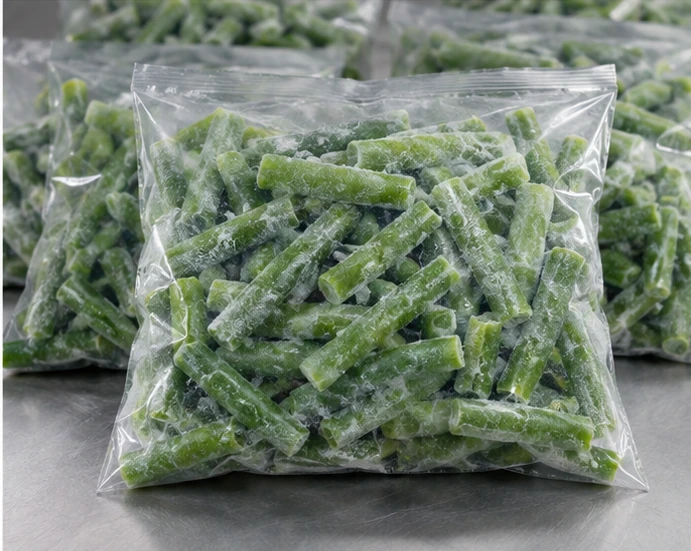
High-quality frozen green beans are processed and frozen quickly after picking to ensure their freshness. Generally speaking, frozen green beans are more uniform in size and bright green in color. In terms of taste, frozen green beans still maintain a certain crispness. Although it may be slightly different from fresh green beans, it can restore a better taste after cooking. If the cooking method is appropriate, such as blanching, stir-frying or stewing for an appropriate time, frozen green beans can provide a delicious experience similar to fresh green beans.

Description

Technical Parameters

IQF Frozen Green Bean


fresh frozen green beans
Cooking Uses


Simple Cooking Methods
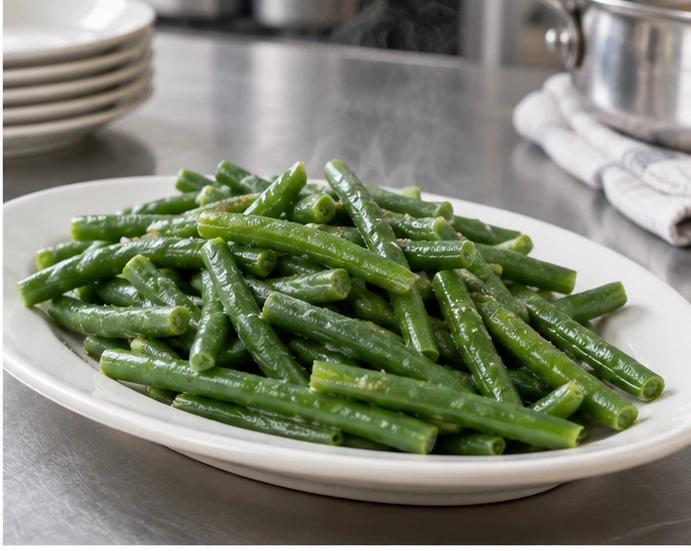
Blanching and Cold Mix: Take the frozen green beans out of the bag and blanch them in boiling water for a few minutes until the green beans become brighter green and cooked. Take them out and rinse them with cold water, drain the water, add olive oil, vinegar, salt, black pepper and other seasonings, and you can also add some minced garlic, lemon juice, etc., stir well to make a simple and refreshing cold mix of green beans.
Stir-frying: Add an appropriate amount of oil to the wok, and stir-fry the frozen green beans after the oil is hot. You can add other ingredients such as onions, carrots, shrimps, etc. according to your personal taste. Add an appropriate amount of salt, light soy sauce and other seasonings, stir-fry until the green beans are cooked and the surface is slightly burnt, and you can make delicious stir-fried green beans or green beans and shrimp dishes.
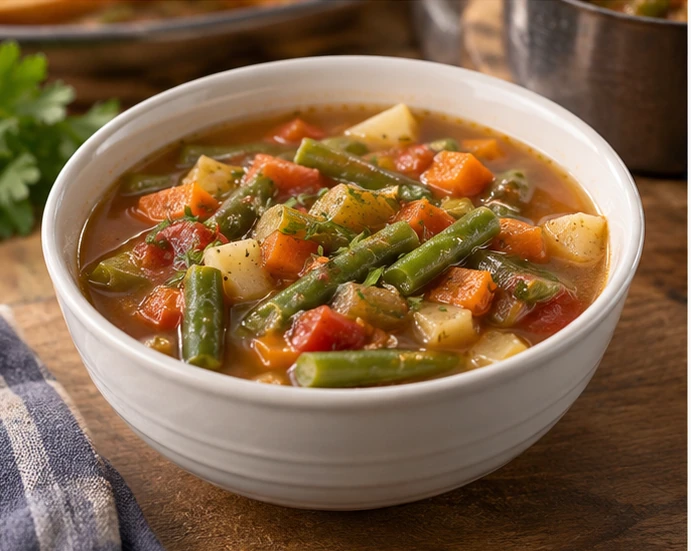
Stew Soups and Stews: When making vegetable soup, broth or stews, put the frozen green beans in the pot and stew them together. For example, when making borscht, green beans can be used as one of the vegetable ingredients and stewed with potatoes, carrots, tomatoes, etc. to absorb the flavor of the soup while adding nutrition and color to the soup.
Creative cooking methods
Making green bean puree: After thawing the frozen green beans, put them in a pot, add appropriate amount of cream, butter, salt and pepper, etc., slowly cook over low heat, and then use a blender to puree the green beans. Green bean puree can be spread on bread as a side dish, or paired with main dishes such as grilled meat and fried fish to increase the richness of the dishes.
Green bean pancakes: After thawing the frozen green beans, use a blender to crush them, add flour, eggs, chopped green onions, salt and other ingredients, and stir into a batter. Pour an appropriate amount of oil into a frying pan, pour the batter into the pan, and spread it into pancakes. This green bean pancake has a unique taste, with both the fresh taste of green beans and the soft texture of pancakes.


 

baked frozen green beans

frozen green bean recipes with bacon

How to tell if green beans are bad?

1. Appearance inspection
Color change
Normal frozen green beans should be bright green. If the color of the green beans becomes dull, yellow, gray, or has brown spots, this may be a sign of deterioration. For example, large yellow spots on the surface of green beans may be due to long storage time, the chlorophyll in the green beans is destroyed, or it may be discolored due to microbial contamination.
Texture change
Observe whether the texture of the green beans is uniform. High-quality frozen green beans are full and well-shaped. If the green beans are found to be shriveled or soft, it may be that the temperature fluctuations during the freezing process caused the ice crystals to destroy the cell structure of the green beans, or that microbial decomposition caused them to deteriorate. In addition, if there are crystals on the surface of the green beans, and these crystals are not normal frost, such as white fluffy or lumpy substances, it is likely a sign of mold growth.
2. Odor identification
Normal odor
Fresh frozen green beans should have a faint green bean fragrance after thawing. When smelling the odor, you can put a small amount of green beans at room temperature to thaw for a while, and then smell it closely.
Abnormal smell
If you smell sour, musty, or other pungent, unnatural smells, this indicates that the green beans have gone bad. For example, if the green beans smell sour, similar to fermented bean curd, it may be because bacteria or mold decompose the nutrients in the green beans and produce acidic substances.
3. Post-thawing state
Juice situation
After normal frozen green beans are thawed, a small amount of transparent juice may seep out. This is because the water in the green bean cells is frozen during the freezing process, and the cell fluid seeps out after thawing. However, if a large amount of turbid and smelly juice appears after thawing, this is likely a sign that the green beans have gone bad.
Taste after cooking
Cook the thawed green beans. Normal green beans should taste crispy or soft after cooking, depending on the cooking method. If the cooked green beans taste soft, sticky, or have a strange taste, the green beans may have gone bad. For example, if the fried green beans taste like batter and have no elasticity, it is not normal.


Stype Frozen.IQF
Shape Special Shape
Size

Wholes:

1)Diam.6-8mm,length:6-12cm

2)Diam.7-9mm,length:6-12cm

3)Diam.8-10mm,length:7-13cm

Cuts:

1)Diam.6-10mm,length:20-30mm,20-40mm,30-50mm,40-60mm

2)Diam.6-12mm,length:20-30mm,20-40mm,30-50mm,40-60mm

Season

May-July.Nov-Dec

Self life 24months
Origin Fujian
Packing 20x500g/ctn,20x300g/ctn,6x2.5lbs/ctn,1x10kg/ctn,

1x30lbs/ctn,1x20lbs/ctn,12x2lbs/ctn

550kgs/totebins(octobin)

Certification HACCP /ISO /KOSHER /ECO CERT /BRC
Successfully Exported Countries USA.Canada.Europe.Israel.Etc

Applications & Quality Requirements

We match Bag Of Frozen Green Beans to your processing or packing line. Product form to confirm: Whole, cut or sliced green beans. Tell us the intended use and target texture so we can review the relevant size, grade, preparation and packing requirements before quotation.

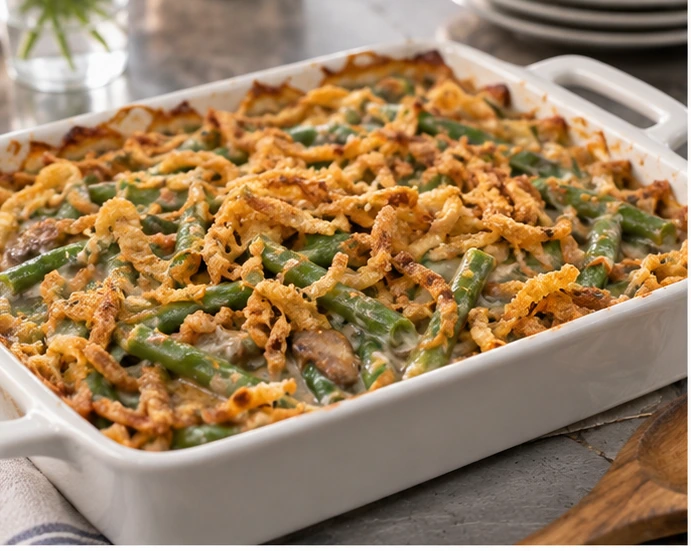
Bag Of Frozen Green Beans applications and quality requirements: Green bean casseroles, Cut Green Bean Foodservice Sides, Vegetable soup blends, Retail Cut Green Bean Packs
Application illustrations. Product form, preparation and suitability follow the confirmed specification. Open the overview to inspect the image.
Green bean casseroles application illustration for Frozen Green Bean

Green bean casseroles

For: Ready-meal and vegetable-blend buyers

Form: slices, chunks, whole

We review slices, chunks, whole for your green bean casseroles programme. Confirm bake water release, slice integrity and finished set. Larger declared inputs require controlled tempering, trimming and cutting, or cooking and blending as appropriate, before they meet the ideal form; assess preparation yield and discard losses. Your team prepares the required cut or refined component before this application.

Cut Green Bean Foodservice Sides application illustration for Frozen Green Bean

Cut Green Bean Foodservice Sides

For: Foodservice distributors and central-kitchen buyers

Form: chunks

We review chunks for your cut green bean foodservice sides programme. Confirm cut length, pod profile and frozen separation. Confirm cut length and pod profile. Your team cuts whole inputs before cooking or further packing; cross-cut pieces are not a claim for an unconfirmed sliced-bean format.

Vegetable soup blends application illustration for Frozen Green Bean

Vegetable soup blends

For: Ingredient buyers at food-processing plants

Form: slices, chunks, whole

We review slices, chunks, whole for your vegetable soup blends programme. Confirm kettle texture, broth solids and flavour after heating in vegetable soup blends. Larger declared inputs require controlled tempering, trimming and cutting, or cooking and blending as appropriate, before they meet the ideal form; assess preparation yield and discard losses. Your team prepares the required cut or refined component before this application.

Retail Cut Green Bean Packs application illustration for Frozen Green Bean

Retail Cut Green Bean Packs

For: Frozen-food importers and private-label packers

Form: chunks

We review chunks for your retail cut green bean packs programme. Confirm cut length, pod profile and frozen separation. Confirm cut length and pod profile. Your team cuts whole inputs before cooking or further packing; cross-cut pieces are not a claim for an unconfirmed sliced-bean format.

Match the Application with the Purchasing Specification

ApplicationSelected formQuality points to confirm
Green bean casserolesslices, chunks, wholebake water release, slice integrity and finished set
Cut Green Bean Foodservice Sideschunkscut length, pod profile and frozen separation
Vegetable soup blendsslices, chunks, wholekettle texture, broth solids and flavour after heating in vegetable soup blends
Retail Cut Green Bean Packschunkscut length, pod profile and frozen separation

Quality, Packing & Export Support

We connect the agreed product specification with packing, lot identity, applicable quality documents and frozen delivery planning. Review our quality control system, traceability support and factory audit and inspection support with your sourcing requirements.

Send us the product, required form, final application, key quality requirements, packing, quantity and destination market. We will review the supply programme and confirm the order specification with your team.

Discuss Your Application & Specification

How We Prepare Green Bean for Frozen Supply

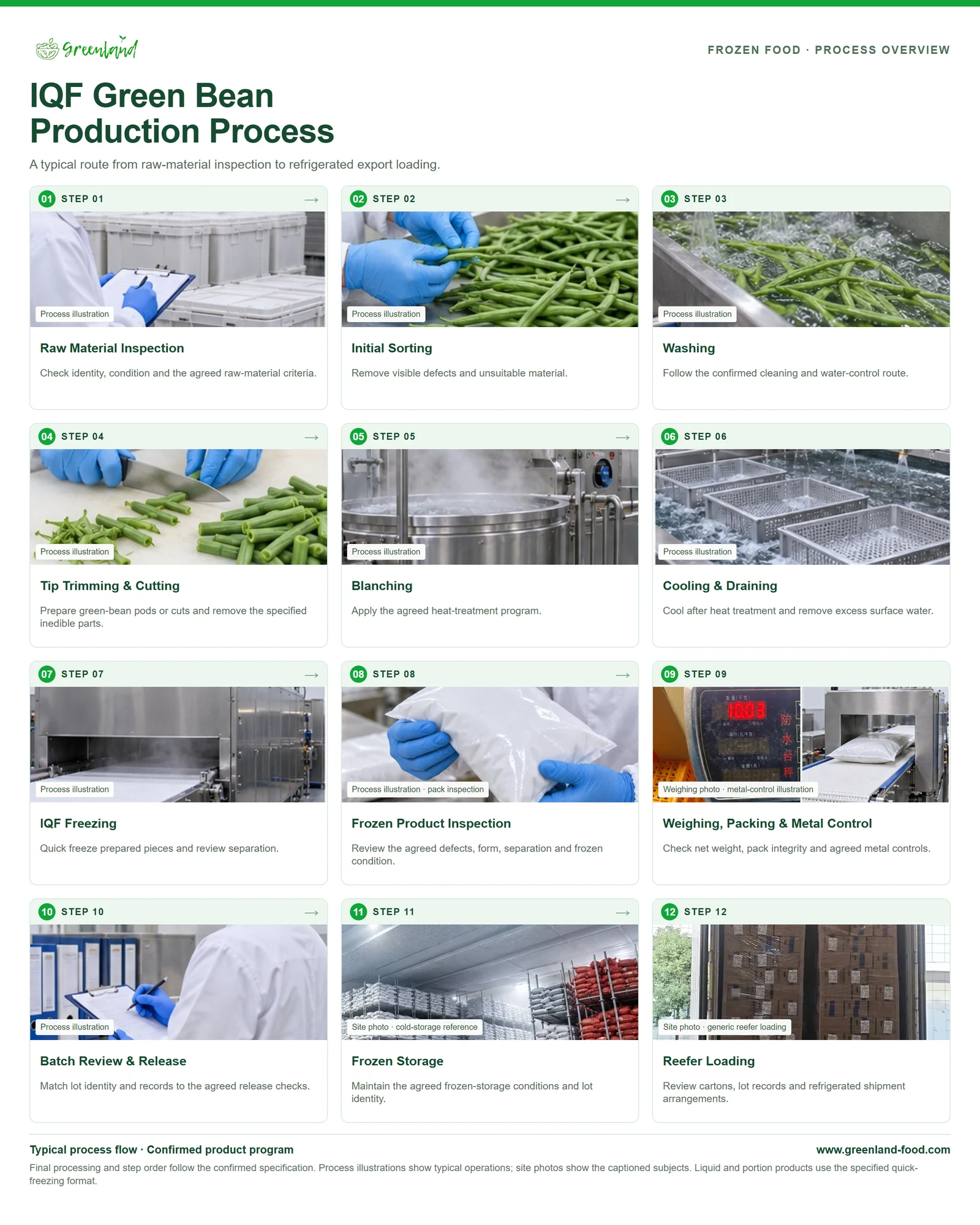
We prepare Bag Of Frozen Green Beans to the agreed product form, pretreatment, grade and packing specification. The diagram shows a typical production process; we confirm preparation and step order for your order.

IQF Green Bean Production Process; twelve typical production and handling stages, with captioned site references and clearly marked process illustrations.
Typical process flow. Final processing and step order follow the confirmed specification. Site photos show the captioned subjects and may illustrate a representative form; process illustrations show typical operations. Storage and loading photos are generic frozen-food references.

Production and handling stages

  1. Raw Material InspectionWe check identity, condition and the agreed raw-material criteria.
  2. Initial SortingWe remove visible defects and unsuitable material.
  3. WashingWe follow the confirmed cleaning and water-control route.
  4. Tip Trimming & CuttingWe prepare green-bean pods or cuts and remove the specified inedible parts.
  5. BlanchingWe apply the agreed heat-treatment program.
  6. Cooling & DrainingWe cool after heat treatment and remove excess surface water.
  7. IQF FreezingWe quick freeze prepared pieces and review separation.
  8. Frozen Product InspectionWe review the agreed defects, form, separation and frozen condition.
  9. Weighing, Packing & Metal ControlWe check net weight, pack integrity and agreed metal controls.
  10. Batch Review & ReleaseWe match lot identity and records to the agreed release checks.
  11. Frozen StorageWe maintain the agreed frozen-storage conditions and lot identity.
  12. Reefer LoadingWe review cartons, lot records and refrigerated shipment arrangements.
Frozen Vegetables
Details of the production process


Temperature control:
The temperature of the entire production workshop needs to be strictly controlled. Different processing areas, such as raw material processing area, processing area, packaging area, etc., should be set at appropriate temperatures according to product requirements and process characteristics. Generally speaking, the temperature of the processing workshop should be maintained at around 10-15℃ to inhibit the growth and reproduction of microorganisms.
In some key processing links, such as quick freezing, temperature control is even more important. The temperature of the quick freezing equipment usually reaches below -30℃, so that the food can quickly pass through the ice crystal formation zone, reduce the damage of ice crystals to the cell structure of the food, and thus maintain the quality and taste of the food. For example, in the production of quick-frozen dumplings, the fast quick freezing speed can ensure that the taste of the dumpling skin and fillings is close to the state of fresh production.
Processing technology specifications:
Strictly follow the standard processing technology. Whether it is food mixing, seasoning, or molding, packaging and other links, there must be detailed operating procedures and quality standards. Taking frozen pizza production as an example, the production of dough requires the control of the ratio of flour, water, yeast and other raw materials, and the fermentation time and temperature must also be strictly controlled; the order and amount of ingredients added also need to be precisely operated to ensure the quality and taste of each pizza is consistent.
Equipment maintenance during the processing process is also critical. Regularly inspect, clean and maintain production equipment such as mixers, forming machines, quick freezers, etc. to ensure the normal operation of the equipment and avoid affecting product quality due to equipment failure. For example, if the mixing paddle of the mixer is severely worn, it may cause uneven mixing of raw materials.


1000

83225d36957fdc545945c88a437c3ee

Details of the packaging process


Packaging material selection:
Choose appropriate packaging materials according to the characteristics of frozen food. Packaging materials should have good barrier properties, such as blocking oxygen, water vapor and odor, to prevent food from oxidation, moisture and odor. For some foods that are easily oxidized, such as frozen meat and seafood, plastic composite packaging materials with high barrier properties are usually selected; for quick-frozen vegetables, packaging materials with good air permeability may be used to prevent vegetables from drying up due to water evaporation during the freezing process.
The packaging materials must also meet food safety standards, be non-toxic and harmless, and maintain good physical properties such as toughness and sealing in low temperature environments. For example, packaging materials cannot become brittle or cracked at low temperatures, otherwise the food will be contaminated or deteriorated.
Packaging operation specifications:
The packaging process must be carried out in a clean and hygienic environment. The air cleanliness of the packaging workshop must meet certain standards, and the staff must strictly abide by the hygienic operating procedures, such as wearing masks and gloves. When packaging, ensure that the food packaging is well sealed to prevent air from entering. For example, vacuum packaging or packaging with inert gases such as nitrogen can effectively extend the shelf life of food.
The label information on the package should be accurate and complete. The label should include the food name, ingredients, net content, production date, shelf life, storage conditions, and consumption methods, so that consumers can choose and consume it correctly.


Green bean FAQ


Q: What is your sample lead time?
around 5 ~ 7 days after offer confirmed.

6 Q: What is your Standard Packaging ?
A: bulk packing is 1x10kgs/ctn,

B: retail packing such as 10x1kg/ctn, 20x500g/ctn, 4x2.5kgs/ctn, 20x1lbs/ctn, all can be

base on customers request.

Authentication

certificate

Plan Your Frozen Food Purchase

We help you match product form, specification, packing and export support. Download our catalog, review our quality and traceability systems, then send us your product, quantity and destination-market requirements.

Tell us the product form, packing, quantity, application and destination market you need.

Send Inquiry

Product Video

Green bean product overview. We confirm the product form, processing method and packing for each order.

Watch on YouTube

Hot Tags: bag of frozen green beans, China bag of frozen green beans manufacturers, suppliers, factory, cowpea bean, asparagus bean, frozen long green beans

Technical specification · reference schedule

IQF Frozen Green Beans

We review the selected form, grade, process and packing against the technical schedule below. Published and TDS values are specification references for order review. External benchmarks apply only within their stated scope. Acceptance is governed by the signed SKU specification; the identified lot COA reports actual measured results.

Form: Whole, cut or sliced green beans Product category: Frozen Green Bean

01 / Physical & Sensory

ParameterSpecification / referenceVerification & order basis
Freezing styleFrozen.IQFPublished referenceConfirm method, representative sample and acceptance basis in the signed specification.
SizeWhole: 1)Diam.6-8 mm,length:6-12 cm 2)Diam.7-9 mm,length:6-12 cm 3)Diam.8-10 mm,length:7-13 cm Cuts: 1)Diam.6-10 mm,length:20-30 mm,20-40 mm,30-50 mm,40-60 mm 2)Diam.6-12 mm,length:20-30 mm,20-40 mm,30-50 mm,40-60 mmPublished referenceMeasure a defined frozen sample with caliper or size gauge; report distribution and tolerance.
OriginFujianPublished referenceReconcile source declaration, intake lot and shipment documents.
Characteristic appearance & textureGreen edible Phaseolus pods with the specified whole or cut presentation.Compare the defined sample with an identified reference grade; use the declared preparation for texture assessment.
Thickness & intact-cut inspectionMeasure thickness separately from fruit/cap/root diameter or piece length; classify broken cuts and end pieces.Use a thickness gauge/caliper and separate mass or count for intact and broken fractions.

02 / Physicochemical & Residue Controls

ParameterSpecification / referenceVerification & order basis
Pesticide residue scheduleNamed active ingredients and commodity-specific limits are selected for the destination market. EU sourceLink farm spray history, laboratory LOQ and batch result to the destination MRL. EU database is one market reference; apply the actual destination rule.
Lead, cadmium and other contaminantsApply the limit for the exact commodity and processed form in the destination market. EU sourceState analyte, preparation basis, method, LOQ and lot result. Do not transfer a fresh-commodity limit to a processed form without the required assessment.

03 / Microbiological Criteria

ParameterSpecification / referenceVerification & order basis
Hygiene-indicator panelSelect aerobic count and relevant Enterobacteriaceae, coliform or E. coli indicators for the declared process and intended use. CodexReport each quantitative result in CFU/g, method/reporting limit, sample plan and lot identity.
Pathogen acceptance programmeDefine Salmonella and Listeria criteria when applicable to the destination, ready-to-eat status and buyer programme. CodexState analytical portion, sample-unit plan, method and detected/not-detected reporting; identify the treatment and release basis.
Acceptance scheduleSelect the test panel and limits by intended use (ready-to-eat or further processing), product form and destination. EU sourceState organism, analytical method, sample mass and n/c plan; report actual lot results. A universal APC, coliform, Salmonella or Listeria limit is not assigned to every frozen product.

04 / Freezing & Cold Chain

ParameterSpecification / referenceVerification & order basis
Separation & loose-ice assessmentKeep inherent moisture, loose ice and permanently frozen clusters as separate inspection categories.Weigh separated loose ice and welded clusters against initial sample mass; distinguish natural paired pieces or blocks.
Product thermal centre−18°C or colder after freezing and thermal stabilization; maintain the agreed frozen distribution condition.External reference CodexProbe the thickest representative pack and retain storage/transport temperature records. Codex quick-frozen reference; selected product form and route must be frozen.
Frozen condition at dispatchHard frozen, correctly sealed and coded, without thaw/refreeze evidence or excessive loose ice. CodexCheck pack integrity, free-flow or block condition as declared, carton condition and loading temperature.

05 / Pack Size & Shelf Life

ParameterSpecification / referenceVerification & order basis
Shelf life24 monthsPublished referenceVerify unopened-pack validation, declared storage condition and production/best-before coding.
Packing20 × 500 g/carton,20 × 300 g/carton,6 × 2.5lbs/carton,1 × 10 kg/carton, 1 × 30lbs/carton,1 × 20lbs/carton,12 × 2lbs/carton 550kgs/totebins(octobin)Published referenceCheck approved pack drawing, calibrated scale and production records.
Declared net contentsVerify each selected pack format against the artwork and applicable quantity-control rule. CodexCalibrated checkweigher or scale; defined sample and tare.
Shelf-life basisThe labelled period applies only to its validated pack and continuous stated storage condition. CodexReview stability study or approved shelf-life file and production-date code.

06 / Process Controls

ParameterSpecification / referenceVerification & order basis
Raw-material preparation checksConfirm species, round/flat pod type and cross-cut versus lengthwise-sliced style.Verify the selected product flow and the relevant trimming, sorting and pretreatment record.
Blanching / enzyme inactivationTime and temperature are product- and cut-specific; confirm residual-enzyme endpoint when relevant. CodexRecord validated line set-points and product sample test; assess colour and texture after treatment. Only classify as a CCP when the site's HACCP plan identifies it as one.
Cooling and dewateringControl prompt cooling and surface-water removal before IQF to avoid clumping and loose ice. CodexReview line time/temperature record, draining check and frozen separation.
CCP designationUse the site-approved HACCP plan to identify true CCPs and their validated critical limits. CodexCheck hazard analysis, monitoring, deviation and corrective-action records. A quality-control step is not automatically a CCP.

07 / Ingredients, Additives & Allergens

ParameterSpecification / referenceVerification & order basis
Added glaze / coating declarationDeclare any intentionally added water glaze, syrup, oil or coating and the measurement basis; loose ice is assessed separately.Verify formula/addition records; agree a deglazing or coating test and net-content basis where applicable.
Ingredient statementList every ingredient and its declared role for the selected SKU; verify any added sugar, oil, coating, seasoning or glazing medium.Approved formula and supplier declarations.
Additive useDeclare any colour-protection agent, acidulant or other additive by ingredient and maximum permitted use for the target market. NHC standardCheck approved formula, actual addition record and market-specific additive category. GB 2760-2024 applies to China; export rules are checked separately.
Allergen and cross-contact assessmentDeclare inherent allergens and assess shared-line cross-contact from the actual facility schedule. FDAReview line matrix, cleaning validation and buyer label approval. Do not claim a shared-line allergen or allergen-free status without facility evidence.

08 / Defects & Foreign Matter

ParameterSpecification / referenceVerification & order basis
Intrinsic defect classificationStem ends, strings, mature seeds, fibrous pods, blemishes and broken pieces.Record each defect class separately by count or mass; state sample size, denominator and combined-limit rules.
Hazardous foreign matterNo foreign matter detected in the defined inspection sample; reject and investigate any finding.External reference CodexDefine visual-inspection sample size and detector challenge in the signed quality schedule. "None detected" is a sampling statement, not an absolute guarantee of zero particles.

09 / Packaging Materials & Label

ParameterSpecification / referenceVerification & order basis
Food-contact packSpecify inner-contact material and obtain the applicable food-contact compliance declaration. NHC standardReview film structure, supplier DoC, migration evidence and actual intended conditions. GB 4806 series is China-specific; EU export also checks Regulations 1935/2004 and 10/2011.
Carton and seal integrityDefine carton stacking strength, bag seal and puncture resistance for the confirmed net weight and pallet plan. EU sourceInspect pack drawing, compression/seal test and shipment configuration.
Label verificationMatch product name, ingredient/allergen statement, net weight, lot/date, shelf life and storage instruction to the destination artwork. CodexApprove artwork against the signed specification and destination rules.

10 / Detection & Traceability

ParameterSpecification / referenceVerification & order basis
Foreign-body detectorValidate Fe, non-Fe and stainless-steel challenge pieces for the actual product, aperture, pack and line; record the proven sensitivity. CodexChallenge at defined start, changeover, interval and end points; retain rejection records. Do not copy generic detector sizes into a plant capability claim.
Lot traceabilityLink input source lot, processing run, packaging code, test records, frozen storage and shipment to one finished lot. CodexTrace one sample lot forward and backward in a recorded mock recall. Recall speed is stated only when the site has a validated target and record.
Order approval: Confirm the selected form and grade, ingredient formula, intended use, destination market, packing, sampling plan and test panel. The signed specification controls acceptance; the identified lot COA reports actual results.

Send Inquiry