


Clarifying Guava Juice: Pectin, Pulp and Cloud Stability
Oct 19, 2026
Leave a message

GUAVA · PROCESS & APPLICATION
Clarifying Guava Juice: Pectin, Pulp and Cloud Stability
Clarifying guava juice means controlling the material that scatters light, forms haze or settles after processing. Removing visible seeds and coarse pulp is only an early separation step. Pectin, fine particles and interactions among juice components can still affect clarity and storage behavior. The first decision is whether the finished product should be transparent or should retain an even, stable cloud; those goals require different acceptance criteria.
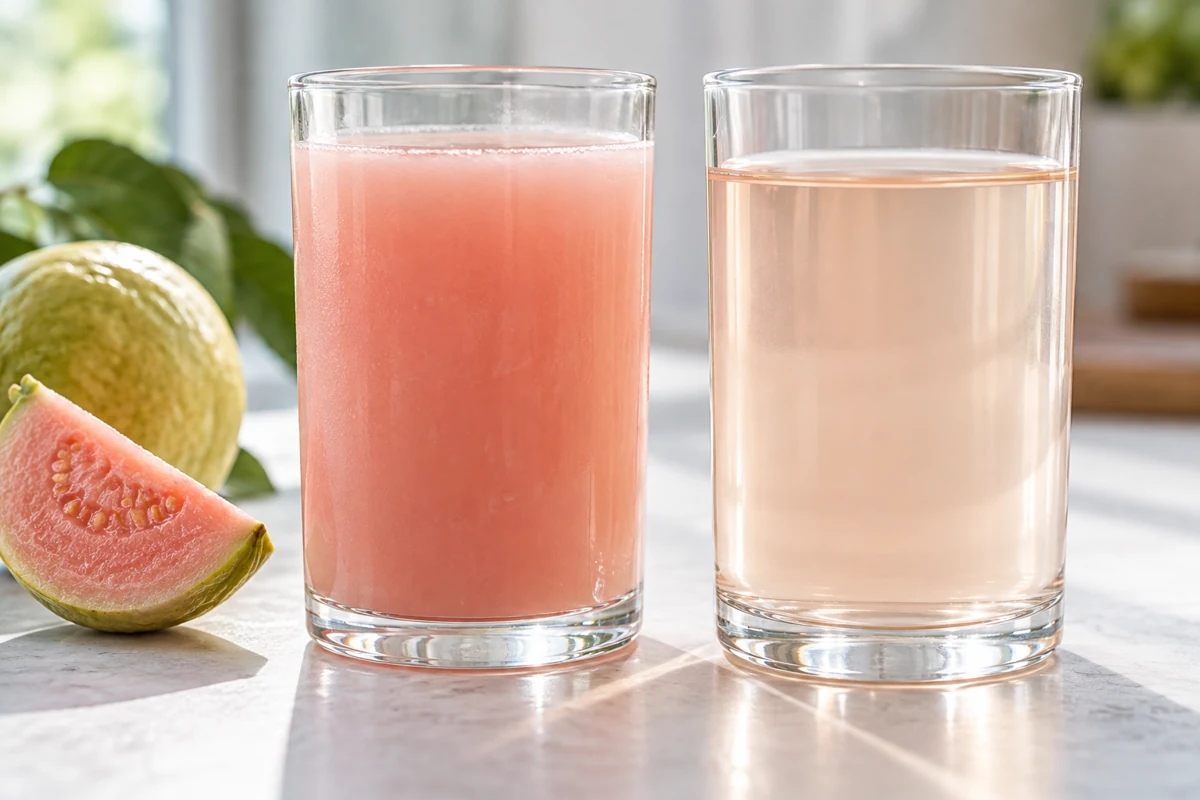
A transparent juice and a cloudy beverage have different appearance targets.
For processors starting with frozen guava pieces, define the feed before comparing clarification treatments. Skin, seed-center tissue, pulping, dilution and previous processing all influence what reaches the separation stage. GreenLand-food's current guava form is skin-on pink-flesh pieces, so a clear-juice programme should be qualified through the buyer's complete preparation. A clear glass immediately after a trial does not establish long-term appearance, retained aroma or acceptable commercial recovery.
Choose the intended clear or cloudy product
A clear beverage and a cloudy nectar can both be deliberate product choices. In the first, suspended material that makes the liquid hazy may be undesirable. In the second, the cloud contributes to the expected appearance and body, while a compact sediment or a clear upper layer may be the concern. Agree which appearance the product should maintain before selecting a treatment or asking the ingredient supplier for a clearer sample.
Use a reference that represents the finished formulation and package. A concentrated guava base viewed in a small cup can look different from the diluted drink in a tall clear bottle. Bottle shape, light path and background affect visual comparison. Record the intended fruit contribution, package and viewing conditions so a later assessment means the same thing. The reference should also identify whether shaking before use is part of the product instruction.
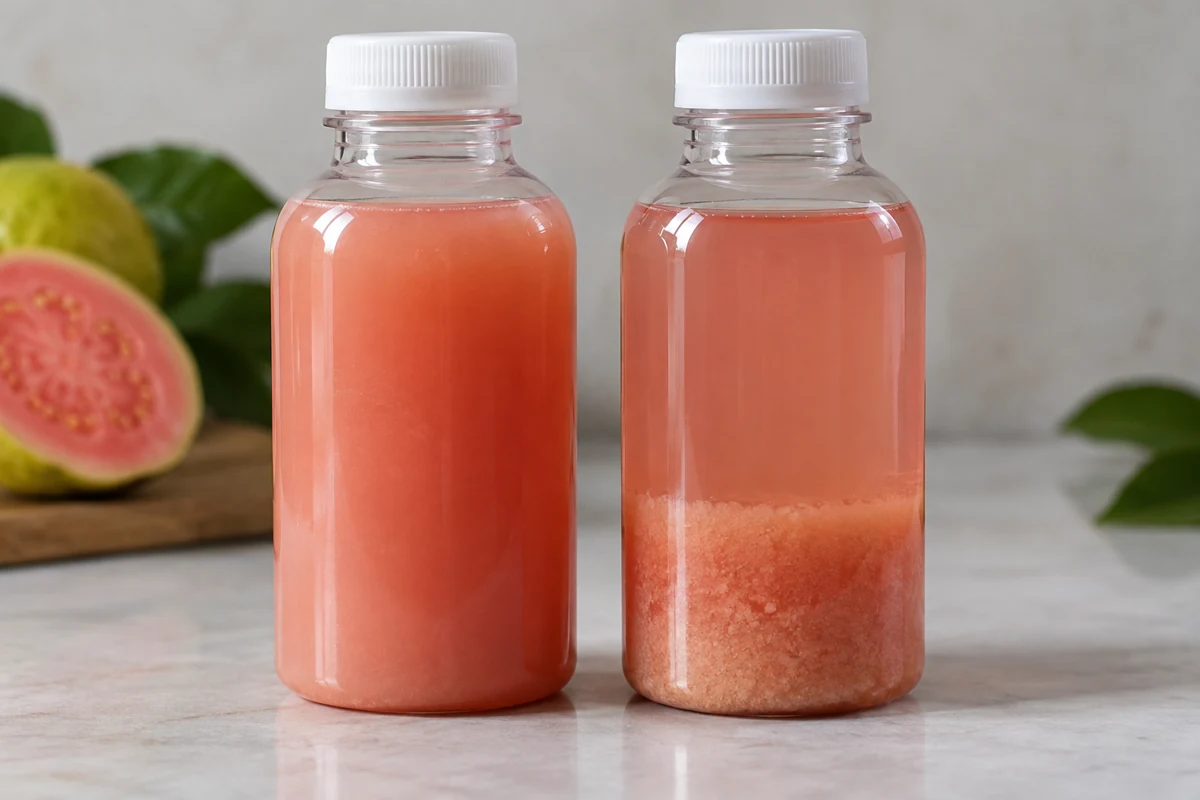
Uniform cloud and settled pulp are different states to describe in the specification.
Retain a filled reference bottle alongside the trial samples when assessing appearance. Compare the upper liquid and lower deposit separately, using the same background and fill height. A deposit can contain several components, so its appearance alone does not identify the cause of separation. Preserve the sample identity and investigate the separated material if its composition affects the corrective decision.
Choose measurements that fit the goal. A turbidity or light-transmission measurement describes the sample under a specified optical method; visible sediment describes a different aspect of the product. A cloudy beverage can be intentionally turbid yet stable, while a low-turbidity sample can develop haze later. Keep the method, dilution, sample temperature and handling with the reading instead of using one number as a general quality score.
For a clear product, define the allowed appearance after the full process and through the intended storage period. For a cloudy product, define acceptable uniformity, serum separation and sediment behavior, including what happens after any label-directed shaking. A sample that redistributes easily can differ commercially from one with a hard deposit. Those properties should be observed under an agreed method rather than described only as stable or unstable.
The commercial question also includes the drinking experience. A clearer liquid may have a lighter body or a different color impression. If the brand expects a pulpy guava character, maximum transparency may be an unsuitable target. Discuss appearance, mouthfeel and flavor together, then set the clarification objective that serves that particular product. This avoids optimizing a laboratory clarity result while moving away from the drink customers expect.
Once the target is explicit, the processor can decide which fraction it wants to retain and which it wants to remove. That decision gives meaning to enzyme trials, separation comparisons and the later storage test. Without it, an apparent improvement in one sample may simply reflect a different product concept.
Define the guava feed entering clarification

Skin-on pink guava pieces: agree the supplied form before evaluating the prepared output.
The supplied fruit and the juice entering a clarifier are different materials. Frozen skin-on pieces must pass through preparation before they become a liquid feed. Record the actual route: controlled tempering or thawing, pulping, removal of larger seeds and peel, any dilution and the relevant processing history. The point at which a sample is taken should be clear in every trial report and ingredient comparison.
The current frozen guava product page shows pink flesh, green peel and firm central seed areas. Those visible characteristics support a raw-form discussion. They do not specify the composition of a clarified juice. We should confirm any alternate peeled or seed-reduced form through its own sample and order agreement, because a different preparation can change the material burden entering the buyer's process.
Keep a mass record through the initial preparation. Weigh the pieces, the removed coarse material and the recovered pulp before adding water. If water enters during blending or transfer, record it separately. Otherwise a larger liquid yield can be mistaken for better fruit recovery. A clarification trial that starts with diluted puree should state that basis, so its recovery cannot be confused with juice obtained per kilogram of incoming frozen fruit.
Mix the feed according to a defined procedure before dividing it into test portions. Settled solids can make the first and last aliquots different, especially when a prepared batch waits between treatments. Record the hold and mixing history, and use the site's established controls to maintain comparable material. Taking a clear upper fraction for one test and a pulp-rich lower fraction for another undermines the treatment comparison before it starts.
Measure the properties that the processor needs to interpret the trial. Soluble solids, pH, titratable acidity, particle information and a defined flow or viscosity measurement can provide context, but their relevance depends on the problem. Identify the analytical method and sample preparation. A refractometer reading does not quantify all insoluble material, and an apparent viscosity value depends on its measurement conditions. Use each result for the property it actually describes.
Cultivar and maturity can also affect the prepared feed. The 2023 study of four guava cultivars found differences among their juice properties and responses to pectinase. It supports treating raw-material identity as part of the trial record. Its figures do not become specifications for GreenLand pink guava pieces, especially when the commercial preparation differs from the research method.
For repeat production, retain enough information to recognize a meaningful feed change. A new lot, different peel removal, altered dilution or revised pulping method may justify another comparison. A clear record makes that decision manageable: the buyer can determine which earlier evidence still applies and which part of the route needs fresh qualification.
Understand what pectin treatment changes
Pectin contributes to the behavior of the fruit's cell-wall material and the resulting juice system. Pectinolytic enzymes can alter that material during processing, changing properties such as viscosity, extraction and the ease of separating some fractions. The effect is tied to the enzyme preparation, feed and treatment conditions. A label reading pectinase does not define one universal response in every guava juice.
For a clear-juice route, the processor may investigate depectinization before a subsequent separation step. For a deliberately cloudy product, reducing or changing the same material can affect the cloud the buyer wants to keep. The FAO guava-processing discussion describes pectic-enzyme treatment in obtaining clear juice. Use that as process background while establishing the actual treatment and output through the processor's qualified development work.
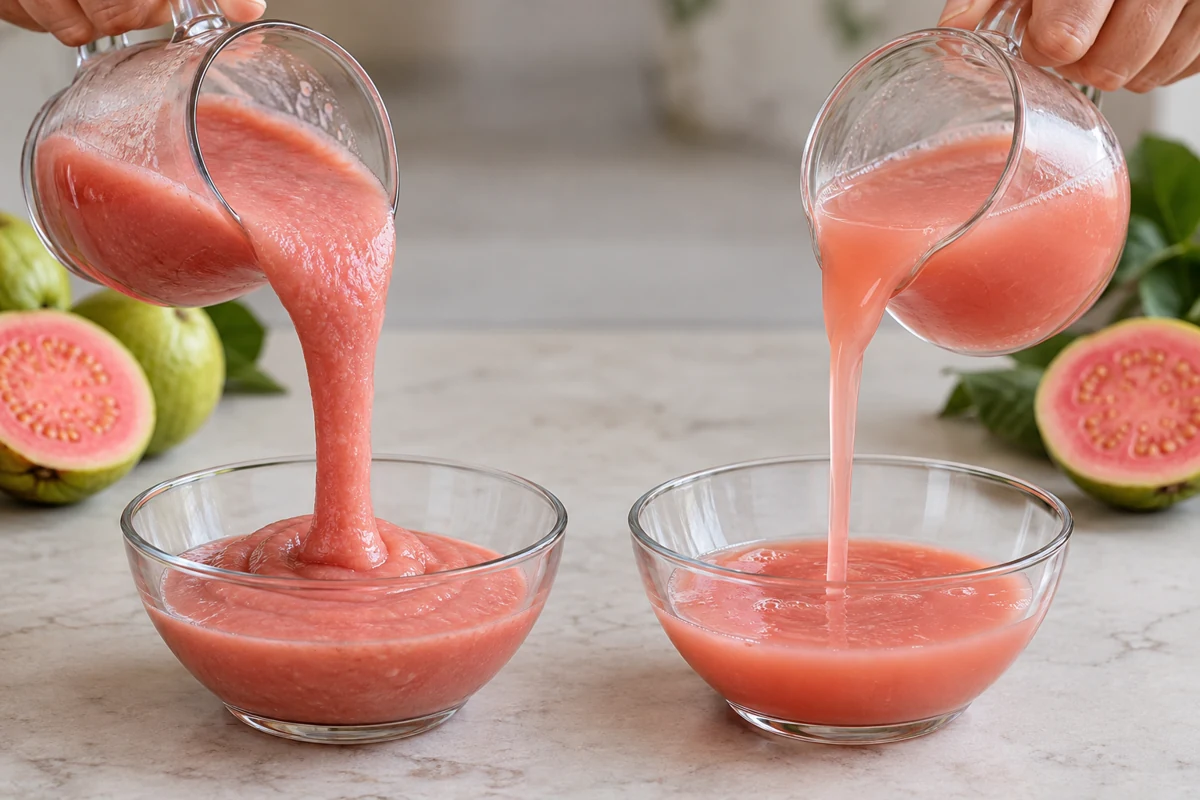
Flow changes should be measured under matched conditions.
An enzyme comparison should identify the product, relevant activity declaration, dose basis, temperature, time and mixing conditions used. Equal masses of two enzyme products do not necessarily represent equal activity. State whether the dose is calculated on incoming fruit, prepared pulp or diluted feed. That detail becomes important when the same instruction moves from a small bench sample to a larger production batch.
Include the end of treatment in the method. The processor needs to decide how enzyme action is controlled or ended within its validated process and what happens before the next measurement. A sample evaluated immediately after treatment may differ from one held longer before separation. This article does not prescribe an enzyme dose, heat schedule or inactivation claim; those depend on the actual preparation and the site's technical controls.
Compare the treated feed with an appropriate untreated or established-process reference. Keep other conditions matched so the result can be attributed with reasonable confidence. If both dilution and enzyme treatment change, report that as a route comparison rather than a clean test of the enzyme alone. Preserve the observations that matter to the final product, including flavor and body, alongside clarity and recovered liquid.
In the four-cultivar study, pectinase treatment improved some extraction and physical measures while the treated juices received lower sensory scores and showed changes in volatile composition. That is a bounded research finding, not a prediction for every commercial treatment. It gives the buyer a practical reason to keep sensory evaluation in the trial instead of approving the route from clarity or yield alone.
Compare flow under a defined method rather than judging only the ribbon from a jug. Record the sample temperature, time after treatment and any mixing before measurement. Keep the actual flow result with the sample identity and treatment record. A thinner-looking sample can help explain handling, but it does not establish stable clarity, a particular pectin concentration or an acceptable finished drink.
Compare screening, centrifugation and membrane filtration
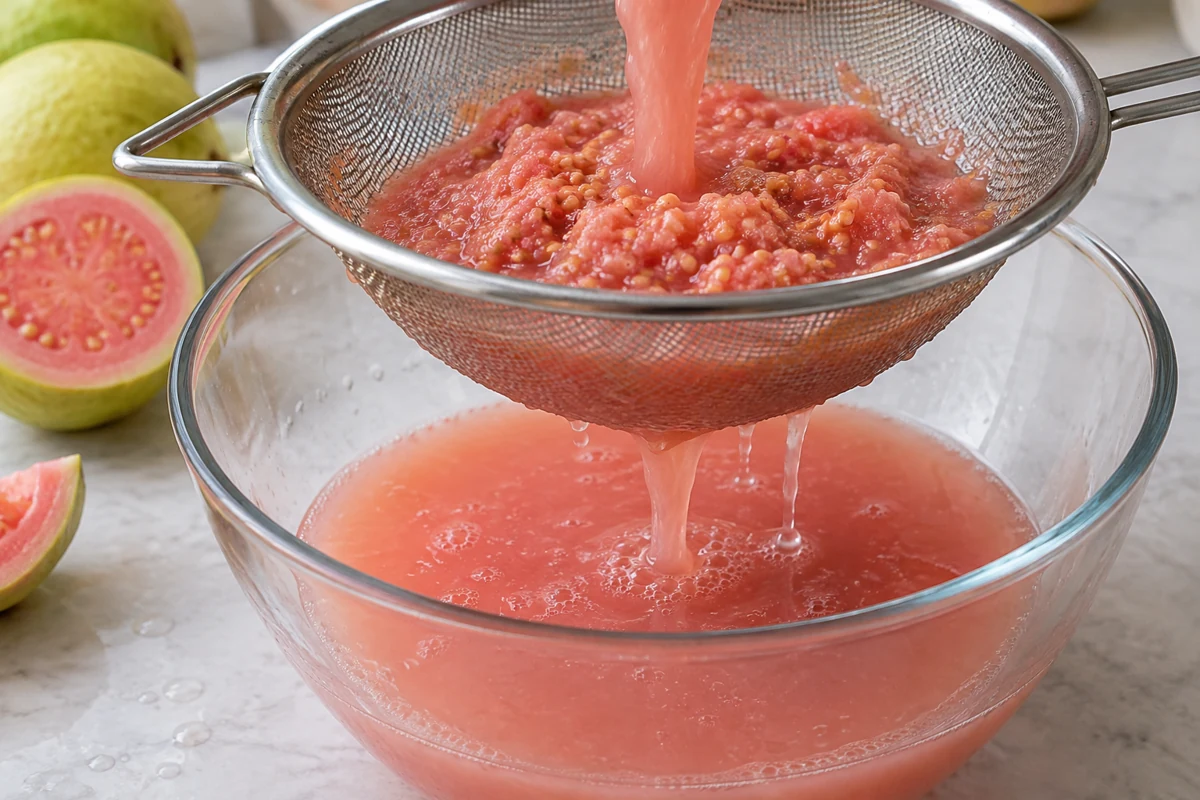
Coarse screening can remove seeds while the passing juice remains cloudy.
Screening removes material according to the openings and operation of the screen. It is useful for larger seeds, peel and coarse pulp, but the passing liquid can remain cloudy. Inspect both fractions: the retained material may contain obvious seeds while the collected liquid remains visibly cloudy. A clean-looking screen residue does not tell the processor how much fine material remains in suspension.
Centrifugation separates fractions according to their behavior under the applied centrifugal conditions. Membrane filtration introduces another set of relationships among the feed, membrane, operating conditions and retained material. These methods should be compared by the outcome required from the same defined feed. A laboratory method and a commercial line can differ in loading, residence, geometry and the way solids accumulate, so their results need a careful connection.
The 2022 white-guava centrifugation study used a specifically prepared feed, including deseeding, dilution and enzyme treatment. It measured laboratory clarification and separately estimated operating characteristics for continuous equipment. That distinction matters: an estimated flow rate in a research model is not a demonstrated capacity for a buyer's line or evidence of equipment installed at GreenLand-food.
When comparing routes, hold the feed definition and accepted output target constant where practical. Record clarity, retained solids, acceptable liquid recovery and the relevant processing rate. A route that makes a clearer sample by sacrificing more usable material may still be worthwhile, but the tradeoff should be visible. A faster route that fails the finished appearance target is not an equivalent result simply because more liquid leaves the equipment.
For membrane work, follow performance through the run. An initial flow measurement can differ substantially from a later or average result as the feed and membrane condition change. State the membrane identity, effective area and operating basis when reporting flux. Keep the processor's qualified operating and cleaning procedures in charge; an ingredient article cannot diagnose a particular fouling mechanism from a single throughput number.
Keep flow measurements comparable when characterizing the feed. Our guide to Bostwick and Brookfield measurements explains why unlike tests should not be converted directly. For guava clarification, choose the method that answers the handling question, record its conditions and use the same preparation in each comparison. A change in one flow reading does not by itself identify a membrane-fouling mechanism.
Include the retained fraction in practical planning. The amount and character of pulp or other separated material affect handling, cleaning and the economic comparison. If a trial relies on a filter aid or another processing input, confirm its permitted use, removal or residual requirements and documentation for the destination through the responsible technical team. Selection should follow the complete process and product requirement, not a promise of clarity in isolation.
Follow cloud and sediment through storage
A sample's appearance immediately after separation is only one observation. A clear product can develop haze later, and a cloudy drink can lose uniformity as material settles or interacts. The storage assessment should follow the finished formulation after the actual processing and packaging route. Testing the intermediate feed alone leaves the buyer's final appearance question unanswered.
Define the observation schedule around the intended commercial use. Record package, fill, headspace where relevant, storage conditions and the stage at which each sample is assessed. Use separate unopened units when the method requires them, so repeated sampling does not unintentionally change the product being observed. The schedule should support the claimed product life through the site's validation programme; a short development comparison is not a shelf-life claim.
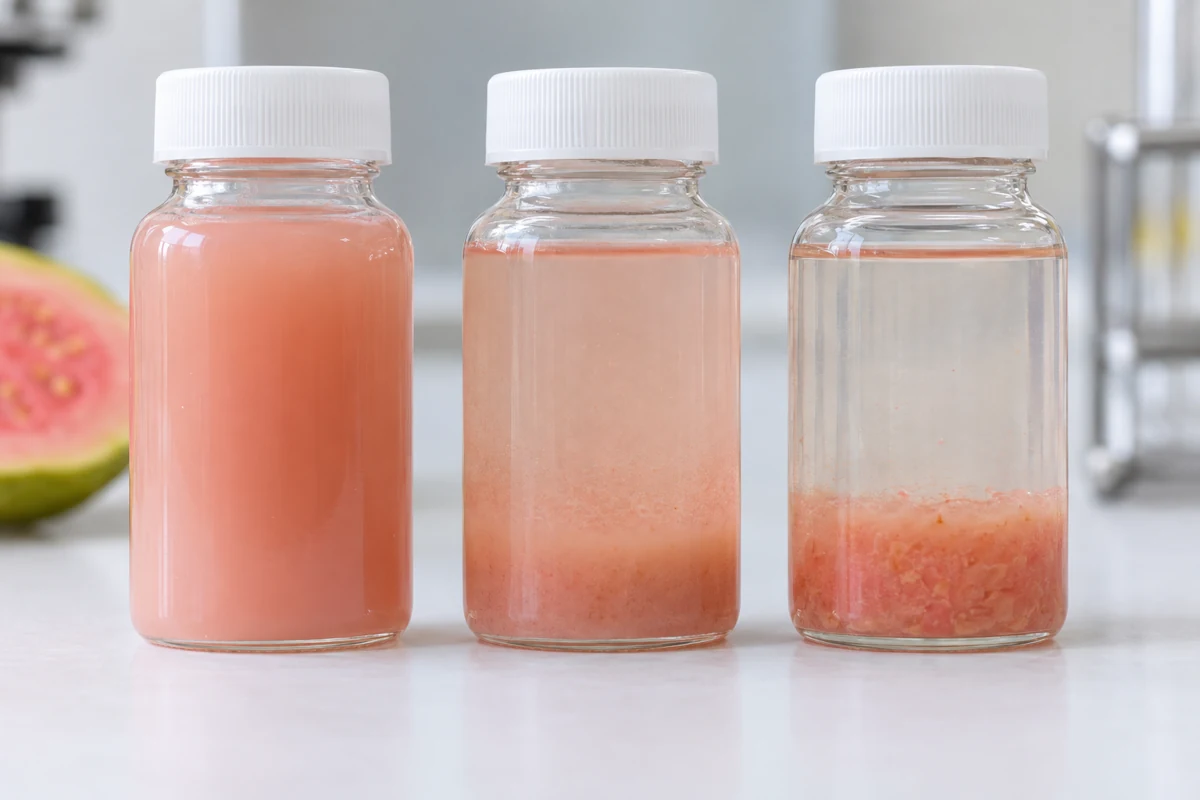
Record the upper liquid, suspended pulp and settled fraction separately.
Record at least the visible features that matter to the product brief. These can include the height or amount of sediment under a defined method, a clear upper band, suspended flocs, overall cloud and the response to label-directed shaking. Photographs are more useful when bottle shape, background, lighting and camera distance stay consistent. Keep the raw observations as well as any summary rating.
Optical measurements can strengthen the record when their method is suitable. State whether the sample was mixed, rested, diluted or measured as received. A turbidity value from a freshly mixed bottle cannot be compared casually with one from the clear upper layer of a settled bottle. The sampling location is part of the result. If the team needs to characterize both phases, report them explicitly as different fractions.
Research on guava cloud stabilization at National Taiwan University considered thickening and particle interactions in a particular formulation. It illustrates that cloud stability involves more than whether coarse pulp was screened out. It does not justify adding that study's material to a commercial recipe without checking suitability, regulatory status and performance in the actual drink.
Thermal or other processing history also belongs with the observation. The original guava study comparing heat and high pressure reported different effects on pectic substances, viscosity and cloud under its tested conditions. The useful implication is to evaluate the process the product will really undergo. A favorable result before that process cannot automatically be carried forward to the packaged beverage.
Retain the exact time and conditions for every observed bottle. Keep individual observations when some bottles remain uniform while others separate; averaging their appearance can hide variability that matters in a commercial pack. If a change occurs, investigate its cause before choosing a remedy; simply repeating clarification may remove material while leaving the underlying stability question unresolved.
Keep aroma and useful yield in the comparison
Clarity is valuable only when the resulting drink meets its full brief. A processor should evaluate guava aroma, flavor balance, color and body alongside physical separation. Material removed during clarification can carry components that affect the sensory result, while the processing route itself can change the sample. The finished beverage comparison should therefore use the same intended dilution and evaluation conditions.
Prepare coded samples where practical and agree the sensory questions in advance. Ask whether the guava character remains recognizable, whether the acidity and sweetness balance suits the product, and whether any new flavor or texture is objectionable. Use the site's safe sensory procedure and appropriately processed material. A technical team can record clear descriptive observations without implying that a small informal panel proves consumer preference.
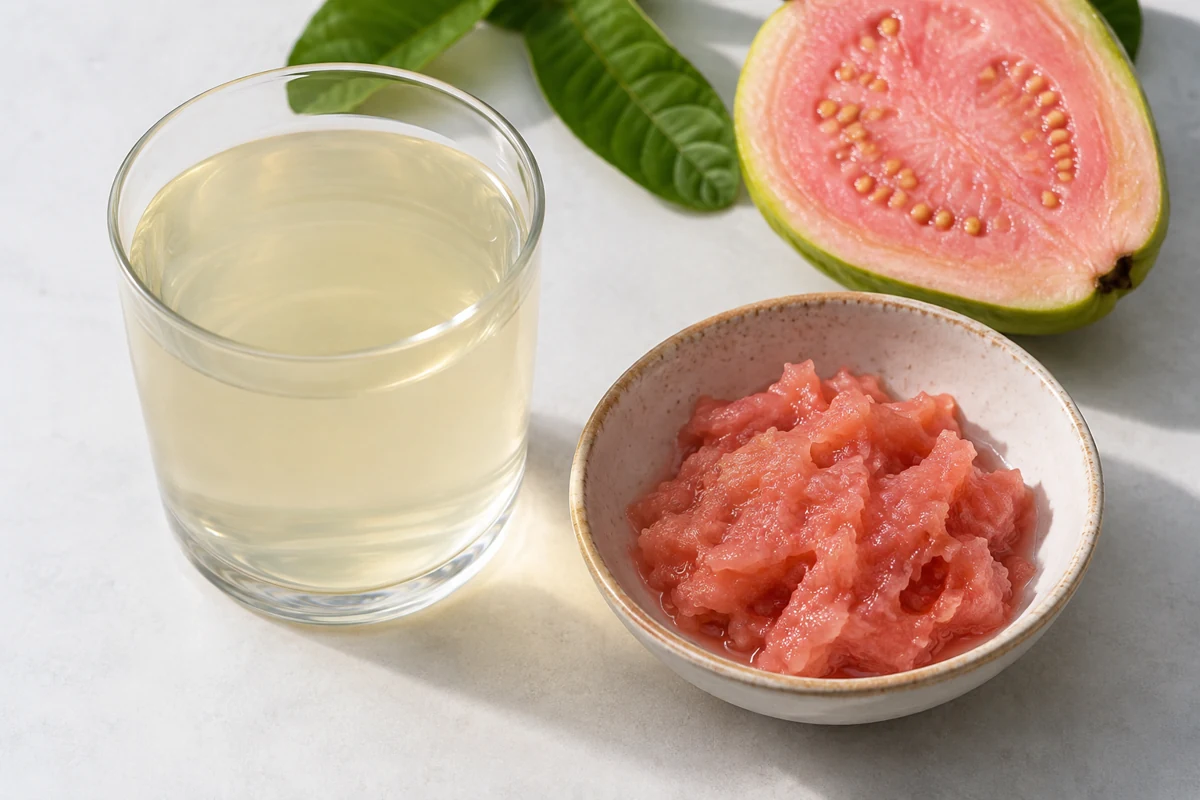
Include both recovered juice and retained pulp in the process balance.
Keep an accepted reference through the comparison. If the new route produces a paler, lighter-bodied liquid, assess whether that change fits the brand concept. Do not compensate by changing several ingredients before documenting the original result. A later reformulation can be useful, but it becomes a second development question with its own cost and acceptance basis. This sequence makes the effect of clarification easier to understand.
Calculate recovery at named stages. The ratio of clarified liquid to prepared feed is different from the ratio of clarified liquid to incoming frozen pieces. Both can be useful if their bases are stated. Record added water, sampled material, retained solids and transfer losses. A result expressed only as ninety percent yield leaves too much unanswered unless the reader knows which material formed the denominator and which output was counted as acceptable.
The recovered liquid is only one fraction of the original preparation. Weigh the retained wet pulp and account for sampled material and liquid left in the equipment. Determine the actual disposition and cost of each stream under the site's procedures. Any proposed secondary use needs its own suitability and safety review.
Compare economic results per unit of approved finished output. Incoming fruit price, preparation recovery, clarification recovery, processing time and required rework can all influence that result. A low-cost piece grade can be attractive when the buyer's line handles it well; a more prepared input can be attractive when it reduces a demonstrated burden. The trial should establish those differences instead of assuming that one form is always cheaper overall.
Finally, keep the aroma and stability observations connected over time. A drink that retains its appearance but loses the intended sensory character may still fail the brief. Conversely, a flavorful cloudy product may be entirely suitable when stable cloud is the chosen goal. The accepted route should satisfy the product's own priorities, supported by the measured and observed results that matter to its buyers.
Approve the ingredient with the complete process
Qualification should begin with a representative guava lot and end with the intended beverage after its defined process. The supply specification describes the fruit input; the processor's trial establishes how that input performs in the preparation and clarification route. Keeping those responsibilities clear allows a meaningful repeat-order standard without implying that the supplier guarantees a finished drink produced under unknown conditions.
For the current skin-on pink pieces, agree the visual reference, relevant piece distribution, peel and seed-center limits, defects and sampling plan. If the buyer requires another preparation, confirm it with a separate sample and quotation. A representative selection should include the physical variation present in the offered pieces. The incoming inspection describes that form, while the functional trial provides evidence about the resulting liquid.
Write a compact process record that identifies the stages which affect comparison. Include preparation, dilution, coarse separation, any enzyme treatment, the final separation method and the downstream processing and packaging route. Record actual settings and methods through the responsible technical team. If one of those stages changes materially, review which part of the earlier qualification must be repeated.

Skin-on pink guava pieces: agree the supplied form before evaluating the prepared output.
The acceptance record should distinguish immediate clarity, storage appearance, sensory quality, usable recovery and relevant throughput. Set limits only from the approved product and its evidence. A research result for white-flesh guava, a different cultivar or a laboratory-prepared feed can inform the questions, but it does not supply a ready-made limit for a shipment of pink frozen pieces.
Agree the required documents by lot and destination. The product description, specification, packing list and requested analytical reports should refer to the same delivered material. Name any analytes, methods and sample preparation needed for comparison. Confirm the ingredient declaration and any processing inputs for the actual SKU. Frozen condition and a successful clarity trial do not establish ready-to-drink status or replace the buyer's validated food-safety process.
Packing and shipment planning should support the way the processor handles the fruit. Confirm pack size, liner, carton arrangement, net weight, lot marks and the requested delivery schedule. Ask how the development sample relates to the commercial lot and what review is needed if supply changes. Minimum quantity and lead time belong to the confirmed form, packing and shipment plan rather than a generic product promise.
We can use the beverage brief to focus frozen guava sourcing on the characteristics the buyer needs to control. The most useful enquiry states the intended clear or cloudy result, preparation route, required sample amount and evidence needed for approval. That gives the technical and purchasing teams a shared basis for comparing the offered fruit with the finished product they intend to make.
Discuss frozen guava with GreenLand-food
Send us your intended application, required fruit form, packing, quantity, destination and documents. Include the preparation and acceptance method used in your sample trial.
For factory-direct wholesale sourcing, confirm the supplier and manufacturer named in the order, the offered specification and the representative sample before volume approval.