


Blackcurrant Syrup from Frozen Fruit: Pectin, Filtration and Pourability
Sep 27, 2026
Leave a message

Define the syrup's finished use
Write a one-sentence job for the syrup before weighing sugar. A beverage base may be diluted into still water, sparkling water, cocktails or a dairy drink. It needs predictable dosing and enough blackcurrant character after dilution. A dessert topping can be thicker and may deliberately retain fruit particles. Both can be called blackcurrant syrup, but the acceptable seed load, clarity, viscosity and serving temperature differ. A fixed ratio from a household recipe cannot settle these choices for a buyer.
Set a use-level target. How many grams of syrup go into a finished glass or over a dessert portion? How long will a dispenser, pump or squeeze bottle hold the product before use? At what temperature must it pour? Does the drink need to remain visually clear, or is a natural cloud acceptable? Is sediment allowed if the user shakes the bottle? These answers determine which extraction and finishing route the development team should test. A rich, pulpy sample can taste excellent on ice cream and clog a fine beverage dosing nozzle.
Blackcurrant has pronounced acid, color and aroma, so evaluate the endpoint after use, not only as undiluted syrup. A neat sample may seem too sharp yet give an attractive drink when diluted. A topping may need enough body to remain on a spoon or plate, where dilution would be the wrong test. The GreenLand sensory guide describes fruit character and broad forms. This article follows the processing variables that decide whether a frozen-fruit extraction becomes the correct syrup for one application.

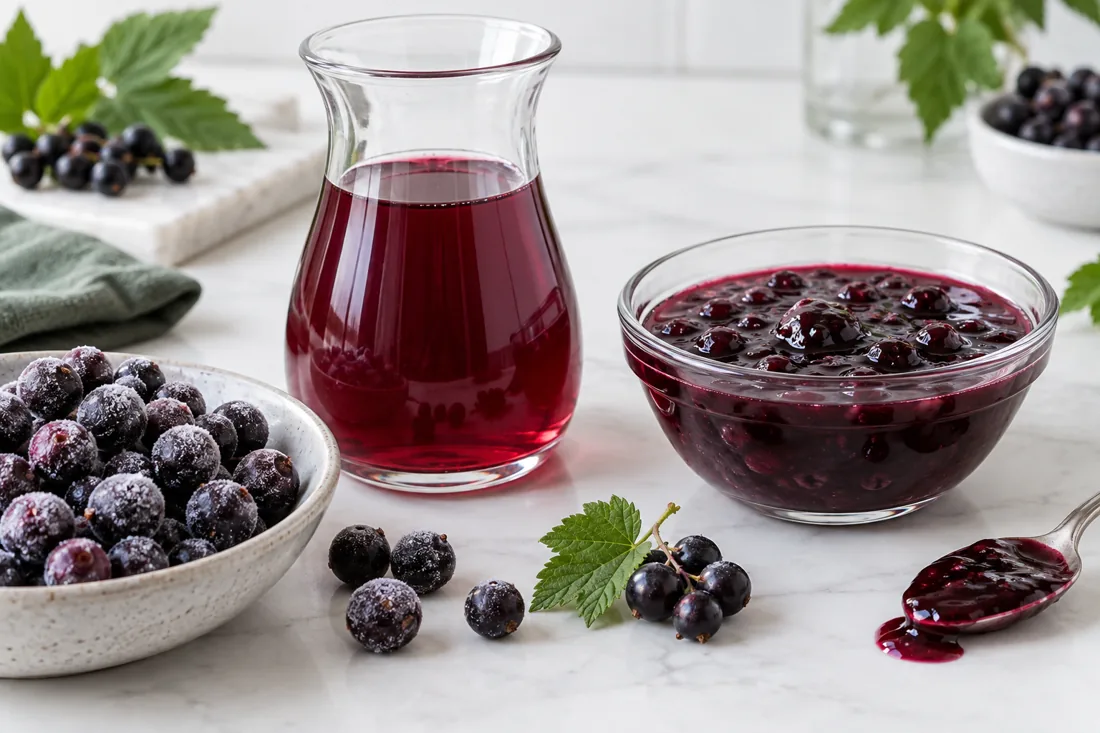
Frosted IQF blackcurrants shown on a GreenLand product page.
Write the preliminary acceptance criteria in observable terms: clear or pulpy appearance, no unacceptable seeds or skins, pourable at the serving temperature, distinctive berry aroma after dilution, and stable enough for the planned handling study. Keep safety and shelf life as separate validation outcomes. A syrup may pour beautifully and still need a different thermal process or package before sale. A thick texture alone says nothing reliable about microbiological safety.
The fruit purchase should remain an ingredient specification. The frozen blackcurrant category lists whole IQF berries, and the processing product page gives the relevant supply context. Neither page is evidence that GreenLand offers a finished blackcurrant syrup. State the ingredient form clearly in the RFQ so the buyer and formulator begin from the same material.
Extract color and aroma from frozen fruit
Frozen blackcurrants should be inspected and weighed as a defined lot before the extraction trial. Record berry size, broken fruit, clumps, visible stem or leaf material and pack condition. Thawing can release juice, so include the thaw liquid in the mass balance unless the process intentionally removes it. A comparison between direct heating and controlled thawing is useful only if both routes begin with the same fruit-equivalent mass and their liquids are accounted for.
Use a measured small batch to compare extraction routes. One route can thaw under controlled conditions, crush and then heat. Another can apply controlled heat to frozen fruit while stirring and breaking it down. Record time to reach the selected process temperature, mixing intensity, mass before and after heating, color and aroma. The purpose is to find a workable route for the specific equipment, not to claim that one universal household simmer time preserves every aroma compound. Strong heat or extended hold can change fruit notes and color, so evaluate the actual sensory difference.
Blackcurrant skins contribute dark color while seeds and skins add solids that later burden the filter. Crushing more aggressively may release more color and flavor but can send more fine particles into the liquid. A gentle extraction can be easier to filter yet leave value in the pomace. Weigh pressed liquid and retained solids. Photograph both and taste a diluted sample. That combination shows whether a higher apparent juice yield actually improves the intended syrup.
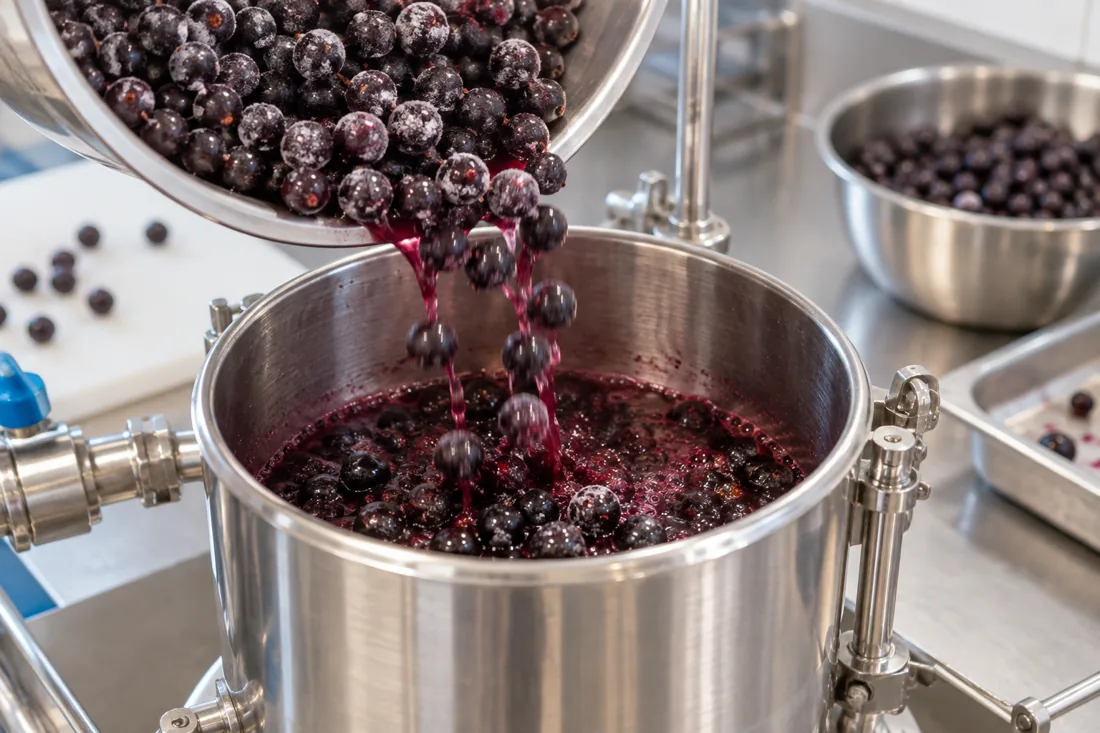
Illustrative blackcurrants releasing color into a pilot extraction vessel.
Industrial research on blackcurrant juice has studied thawing, mash heating, enzyme treatment, pressing and clarification. Those studies explain possible process mechanisms, but their equipment and final juice targets are not identical to a syrup line. Treat published temperatures and enzyme doses as study conditions, not as instructions to copy. The syrup producer must validate its own equipment, permitted ingredients and final process.
Keep oxygen exposure and waiting time consistent during the pilot. A batch left uncovered while another is filtered immediately is not a fair comparison of extraction routes. Record color against a reference under controlled light and taste both samples at the same dilution. If one route loses a fresh berry note, process timing may matter as much as yield. The endpoint remains a syrup that functions in the intended drink or dessert, not the largest possible extraction number.
Measure pectin-related filtration load
Blackcurrant extraction often creates a viscous, solids-rich mash. Published blackcurrant juice work reports that pectin can contribute to high viscosity and lower extraction yield under particular test conditions. This supports measuring the filtration problem; it does not prove that every frozen blackcurrant lot will gel after sugar is added. Pectin behavior depends on fruit, soluble solids, acid, temperature, concentration and process history. The finished syrup must be observed, including after cooling and storage.
Run at least a coarse and a finer screening route on equivalent extract portions. Keep input mass and temperature recorded. Measure the liquid passing the screen, retained skins and seeds, filtration time and any screen blockage. Check whether the screened liquid pours through the intended transfer line. A fine screen can improve smoothness and reduce visible sediment, but it may reduce yield or require frequent cleaning. A coarse screen can retain more fruit character while leaving particles that a dispenser or drink package cannot tolerate.
Separate a filterability issue from a sensory preference. If the pulpy topping is the target, removing every particle can be counterproductive. If a clear drink base is needed, skin fragments and haze may be unacceptable. Compare the outputs at the same blackcurrant-equivalent dose. The clear base may need a stronger addition rate to deliver aroma after dilution; the pulpy route may have a higher apparent yield but a different pump requirement. Record these tradeoffs before assigning a monetary value to the retained solids.
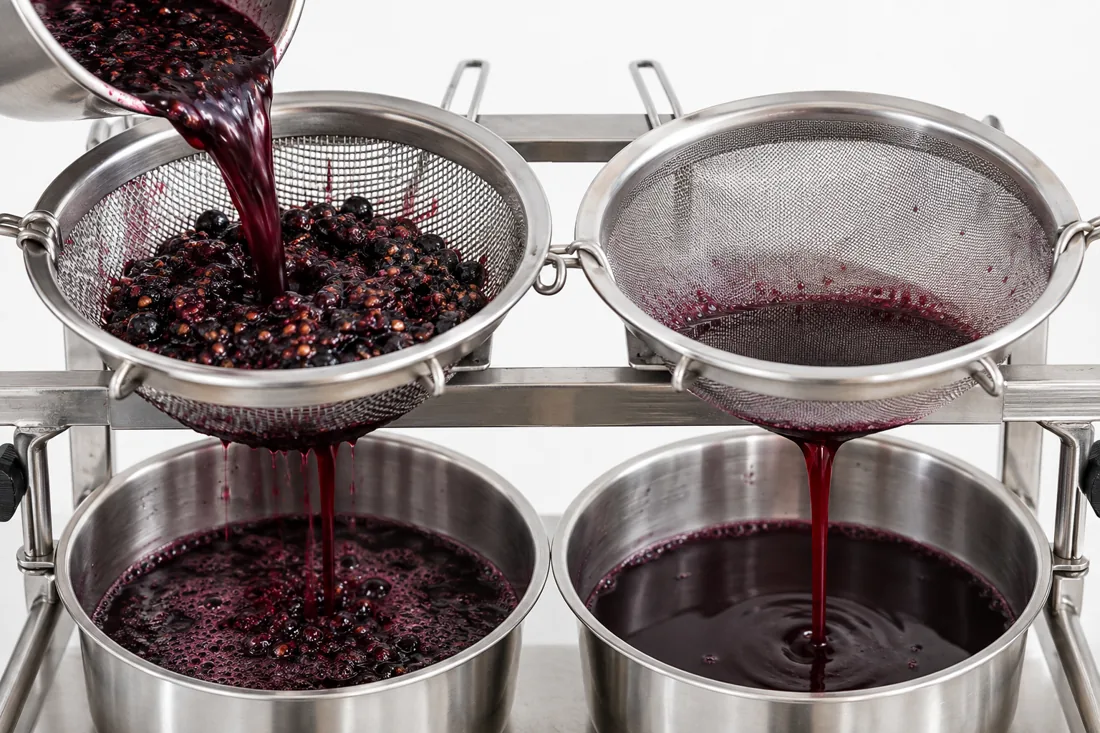
Illustrative coarse and fine screening of blackcurrant extract.
Pectinolytic enzymes are one possible process tool. Research on blackcurrant juice has found changes in viscosity, extraction and composition under defined enzyme treatments. The producer should evaluate an enzyme only after choosing a target and checking the preparation's suitability, process conditions, inactivation or removal needs, labeling and destination rules. An enzyme trial needs a control batch and a sensory check. It is not a default step for every syrup, and it cannot substitute for shelf-life validation.
If the extract seems to thicken during cooling, repeat flow measurements at the intended filling and serving temperatures. A warm liquid passing a screen easily may behave very differently after it stands overnight. Note any gel-like structure, sediment or phase separation in a timed sample. Avoid describing a pectin "risk" as a certain failure. The practical question is whether this lot and formula meet the defined flow and appearance limits over the required handling period.
Choose a clear base or pulpy topping
Prepare two routes from the same fruit lot. The beverage route aims for controlled dilution, smooth dosing and acceptable appearance in a glass. It may use finer finishing and a lower retained-solids level. The dessert route may keep more blackcurrant pulp, giving a thicker texture and visible fruit character. Use the same initial fruit weight and record any difference in water addition, sugar and process time. This creates a fair trial instead of comparing two unrelated recipes.
For the clear route, evaluate what "clear" really means in the finished use. A dark blackcurrant syrup can appear clear in a small sample but show haze or fine sediment in a full bottle. Dilute it into the target beverage, examine it immediately and after the expected hold, and test dispenser performance. If it will be mixed with sparkling water, observe foaming and particulate behavior in that exact use. Do not presume that a filter-size choice alone solves every stability issue.
For the pulpy route, set an acceptable particle range. Large skins or seeds can feel harsh on a dessert even when the syrup is intentionally thick. Measure spoon or bottle flow and whether the topping spreads or remains where placed. A sauce intended for a chilled dessert should be tested chilled; a warm pour test does not define cold service. Consider whether the product will be pumped into portion packs, served from a squeeze bottle or spooned in a kitchen.
Evaluate both routes after the same storage interval, with a process appropriate to the eventual product. A pulpy sample may settle and need mixing; a clear sample may develop haze. Record sensory quality after dilution or plating. If a route needs frequent agitation, include that operational condition in its specification. A route that technically works in a stirred beaker may be unsuitable for a static retail bottle.
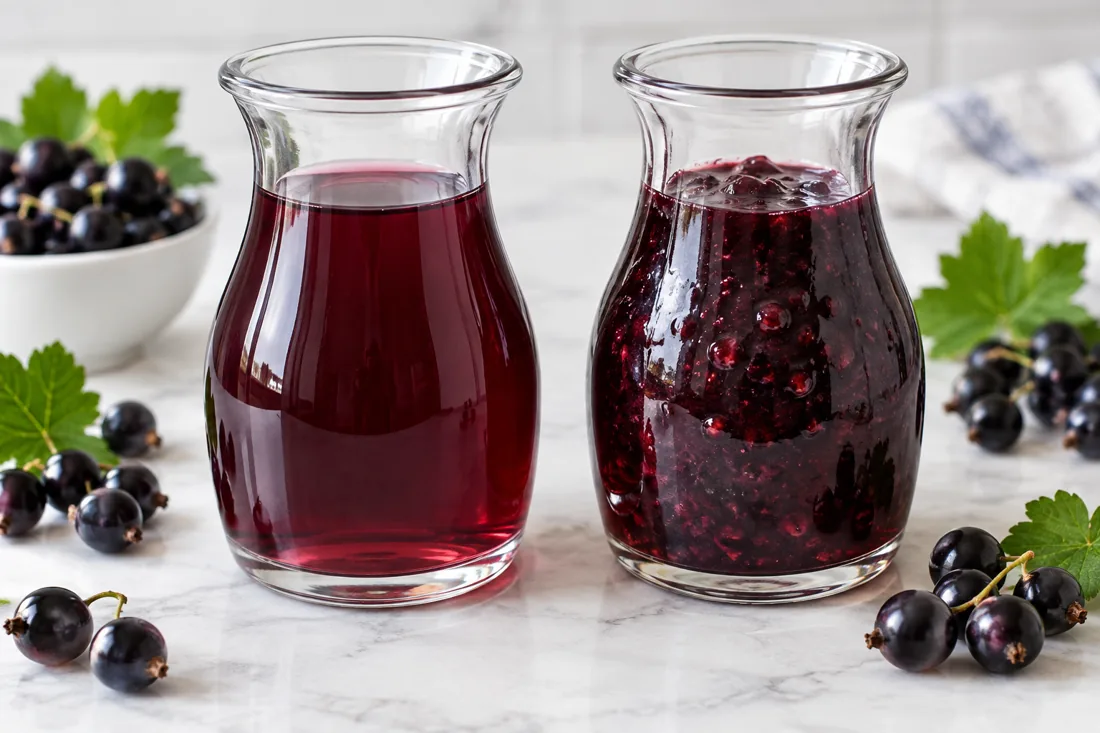
Illustrative clear blackcurrant beverage base beside a pulpy dessert topping.
The two-route comparison should lead to one or two specific development decisions: retain more pulp, change the screen, change the extraction temperature, change the fruit dose or revise the package. Do not solve every mismatch by adding sugar. Sweetness can balance tartness, but it also changes soluble solids and can shift viscosity. The next section measures those variables in the context of use.
| Syrup endpoint | Retained solids | Finishing question | Approval test |
|---|---|---|---|
| Clear beverage base | Low visible skin and seed load | Filter time, yield and haze after dilution | Dosing, diluted aroma and bottle appearance |
| Pulpy dessert topping | Deliberate fine fruit pulp | Seed feel and cold flow | Spoon or squeeze service on the intended dessert |
Set sweetness, acid and flow at use temperature
Blackcurrant's sharp acidity is central to its flavor. Measure soluble solids, pH and titratable acidity of the extract, then taste the syrup at the intended drink dilution or dessert dose. Brix alone cannot represent sweetness perception when acid is strong, and pH alone cannot represent the perceived tartness. Record both chemistry and sensory response. A reference sample from the approved lot helps the team compare later batches.
Test several reasonable sugar additions within the product concept, keeping blackcurrant-equivalent content constant. If the target is a lower-sugar beverage base, the formulation may need to accept more tartness or a different serving dose. If the target is a dessert topping, higher solids may contribute body as well as sweetness. In either case, measure flow at the actual use temperature. A room-temperature bench sample can mislead if the syrup will be chilled or warmed in service.
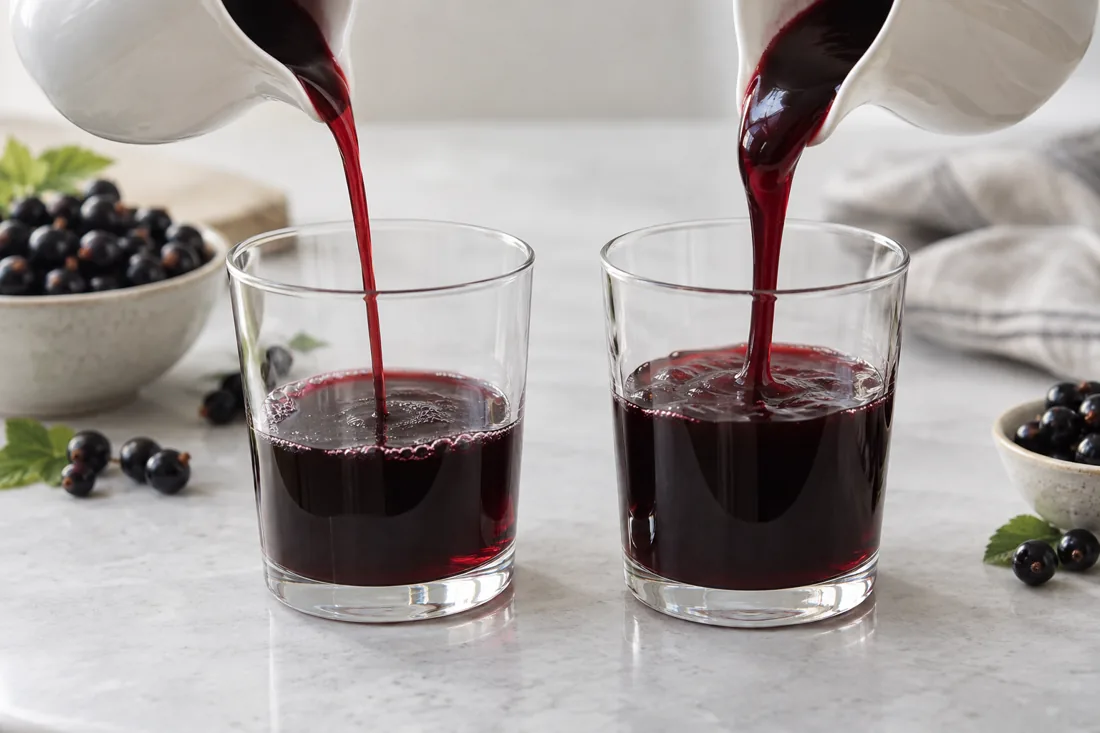
Illustrative comparison of two blackcurrant syrup flow rates.
Use a repeatable pour or viscosity method suited to the equipment. Record temperature, container opening, sample age and time after mixing. If a formal rheometer is available, specify the measurement condition; if not, a controlled timed flow through the intended dispenser can still answer a practical question. Do not compare an agitated sample with an undisturbed one and attribute the difference to fruit. The syrup should be assessed after filling, after standing and after any permitted shaking.
Color and aroma are affected by extraction and heat, so taste the final processed sample rather than only a sweetened raw extract. A strong cooked note may be acceptable in a dessert sauce and too heavy in a drink. A highly filtered route may be bright and easy to dose but less rounded in flavor. Write the preferred sensory profile in concrete terms, such as characteristic blackcurrant aroma after the specified dilution, acceptable astringency and no fermented or scorched note.
High sugar does not by itself establish shelf stability. Water activity, acidity, microbial risks, heat treatment and packaging must be considered under the applicable safety plan. A home cordial stored in a refrigerator for a short period is a different product from an ambient industrial syrup. Keep the flavor/flow approval separate from the safety approval so a good tasting pilot is not mistaken for a saleable packaged food.
Validate process safety and shelf life
Frozen fruit is an ingredient that requires hygienic handling and a validated downstream process. Freezing can preserve quality but is not a universal pathogen elimination step. During thawing or controlled heating, prevent excessive time in conditions that permit microbial growth. The process authority or food-safety team should define the relevant hazards, thermal or other controls, filling conditions and verification plan for the intended market.
Product form changes the validation need. A clear filtered syrup and a pulpy syrup can differ in heat transfer, particulate load and filling behavior. If a process was validated for one route, do not assume that the other has the same critical conditions. The package material, closure, fill temperature, headspace and distribution temperature also affect the program. Build the shelf-life study around the actual commercial configuration rather than a jar from the bench trial.
Specify testing at production start and after the intended distribution period. Measure microbiological criteria required by the market and product type, package integrity, flow, sediment, color and sensory acceptability. A bottle that remains safe but becomes too thick to pour has failed its commercial purpose. A sample that still pours but has unacceptable microbial or package results cannot be released. These are separate acceptance gates.
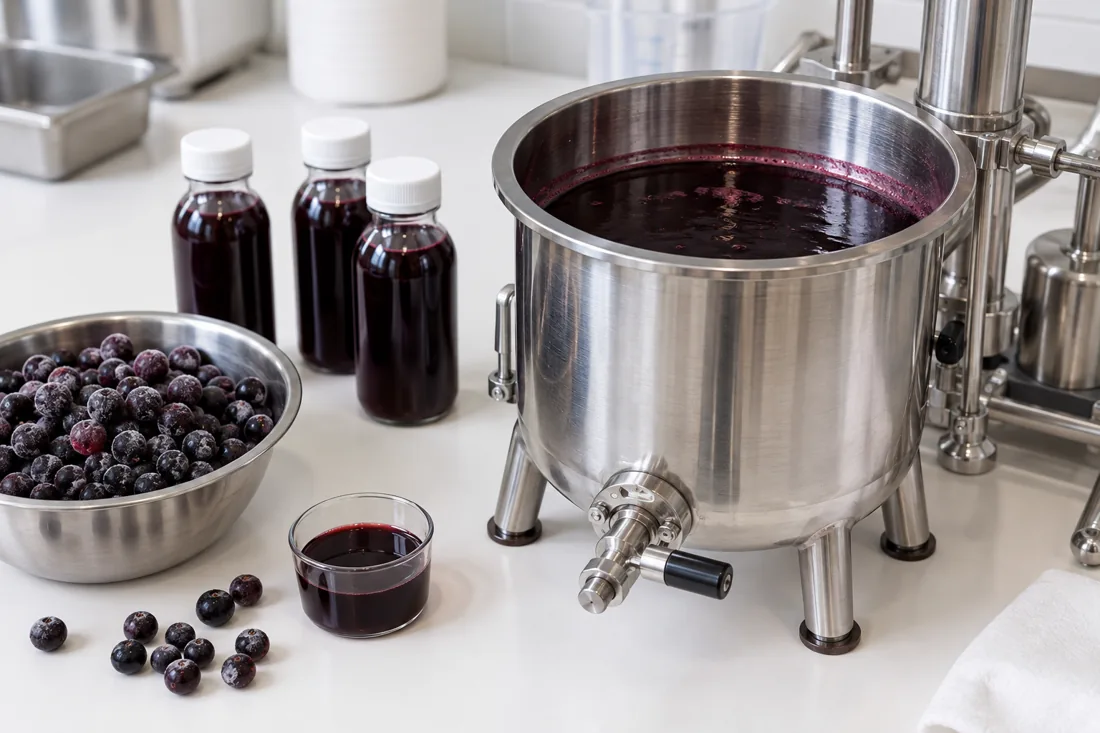
Illustrative pilot vessel and sample bottles for blackcurrant syrup testing.
If enzyme treatment is considered, include it in the validated process sequence and check whether it has any effect on downstream heating, labeling or testing. If sugar is added before straining in one route and after straining in another, document the sequence. Recipes use both approaches. What matters is a controlled process with measured output, not a rule that one sequence is universally correct.
The supplier's role is to deliver frozen blackcurrants against the agreed ingredient specification, with lot identity, packing and relevant documentation. The syrup manufacturer's role begins when the fruit is opened for processing. Keep those responsibilities explicit in the quality agreement. We can discuss the fruit lot and frozen shipment; we cannot certify a finished syrup shelf life from berry Brix or a recipe ratio.
Approve fruit input and a repeatable pilot
Use a written two-route pilot worksheet. Start with one identified frozen blackcurrant lot and record origin, berry size, broken fruit, Brix and acidity if measured, pack integrity, storage and thaw behavior. Weigh the fruit and all additions. Record extract mass, retained skins and seeds, screening time, final syrup output, Brix, pH, titratable acidity, flow at defined temperature, sediment and sensory results. These are proposed measurements, not completed GreenLand factory results.

Bulk whole blackcurrants with size gauge shown on a GreenLand product page.
Keep the clear beverage base and pulpy dessert topping in separate rows. Calculate cost per usable kilogram of finished syrup and, for the beverage route, cost per finished liter at the approved dilution. Include fruit loss, sugar, packaging, labor, filtering time and any enzyme or process input. A high fruit yield may not be the best economic choice if the route is slow to filter or produces a syrup that cannot be dispensed consistently.
Approve representative samples under the intended use. Dilute the beverage syrup into the real drink base and taste it after the planned hold. Pour the topping over the actual dessert at serving temperature. Observe the package and dispenser. Repeating the same tests on a second fruit lot reveals whether the specification captures the variables that matter. A single attractive pilot is a beginning, not proof of long-run consistency.
In the frozen-fruit RFQ, tell us the application, required berry form, Brix or acidity expectations, size, stem and foreign-material tolerance, packing, quantity, destination, private-label needs if any, and requested documents. Ask for a sample that can support the planned extraction trial. We can help align factory-direct wholesale blackcurrant supply with that input specification and provide order-specific records. The syrup producer then decides the extraction, finishing and validated finished-product process.
The best syrup route is the one that gives the planned pour, fruit character and usable yield under the actual process and service conditions. Keep the approved worksheet and reference sample with the ingredient specification. When the next frozen fruit lot arrives, test the variables that predict the syrup endpoint rather than assuming that any dark berry or any high-Brix extract will behave the same way.
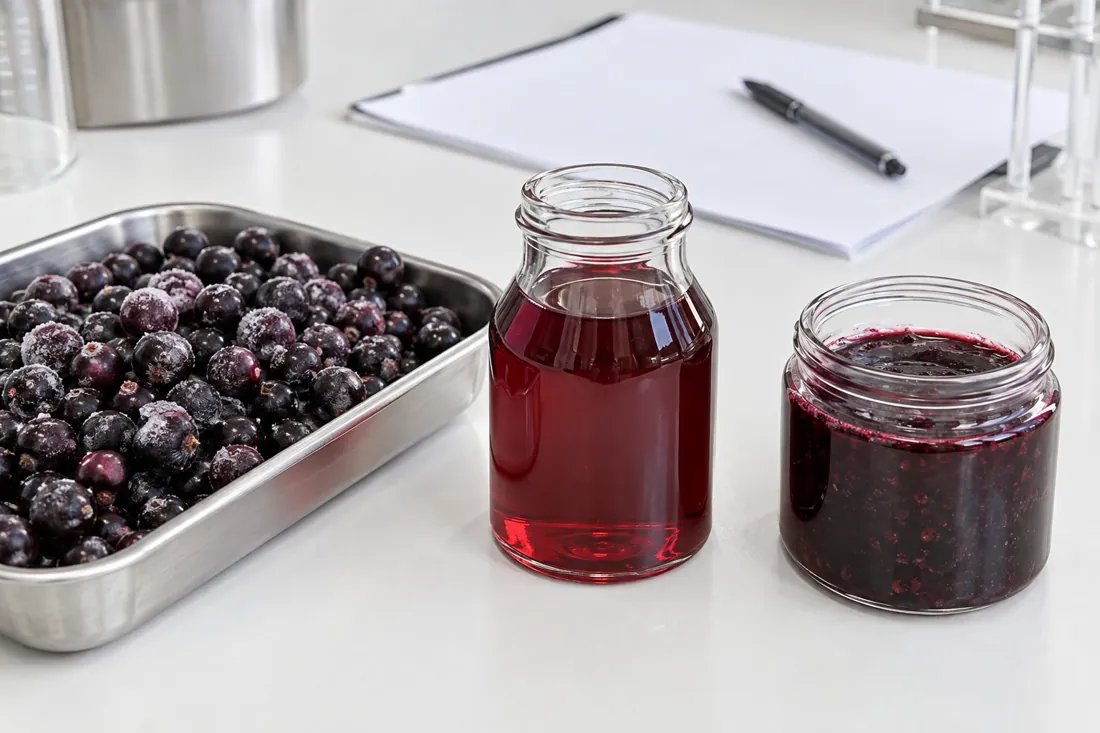
Illustrative blackcurrant lot beside clear and pulpy syrup pilot samples.
The pilot should also account for line cleaning and changeover. A pulpy route can leave seeds and skins in screens, hoses and filling valves; a clear route may need extra filtering time. Record the time and material needed to restore the equipment for the next product. These operational costs belong in the route decision alongside fruit yield. If the process produces a retained pulp stream, decide whether it has a validated use or must be treated as loss. Do not count it as saleable output merely because it still contains color and flavor.
Use an incoming fruit sample to test the variables that caused the most sensitivity in the pilot. If filter time changed sharply with berry breakage, include breakage in the ingredient specification and receiving review. If acidity determined the drink dose, measure acid as well as Brix. If a thick topping was preferred for its visible pulp, retain a clear photo standard of acceptable particles. These controls should reflect measured trial results, not arbitrary generic thresholds. A lot can meet a broad "IQF blackcurrant" description and still behave differently in a narrow syrup process.
Blackcurrant color is another reason to keep process history. Compare the syrup against an approved sample after the same heat treatment and at the same dilution or plated dose. A darker neat syrup is not automatically stronger in the final drink; concentration, haze and vessel depth can alter appearance. Take photographs with matched lighting, then ask a trained panel to judge aroma and taste. If the desired product is shelf stable, run these checks through the validated storage period. The finished-product safety and quality data together decide release.
Source Frozen Blackcurrant with GreenLand-food
GreenLand-food is a professional frozen blackcurrant supplier and manufacturer in China, providing factory-direct wholesale supply for importers, food manufacturers, distributors and private-label programs.
Send the product form, specification, packing, quantity, application, destination, private-label needs and requested documents. We will confirm the current offer and representative sample route.